
Life, 1887-05-26 · page 2 of 18
Life — May 26, 1887 — page 2: what you’re looking at
What you’re looking at
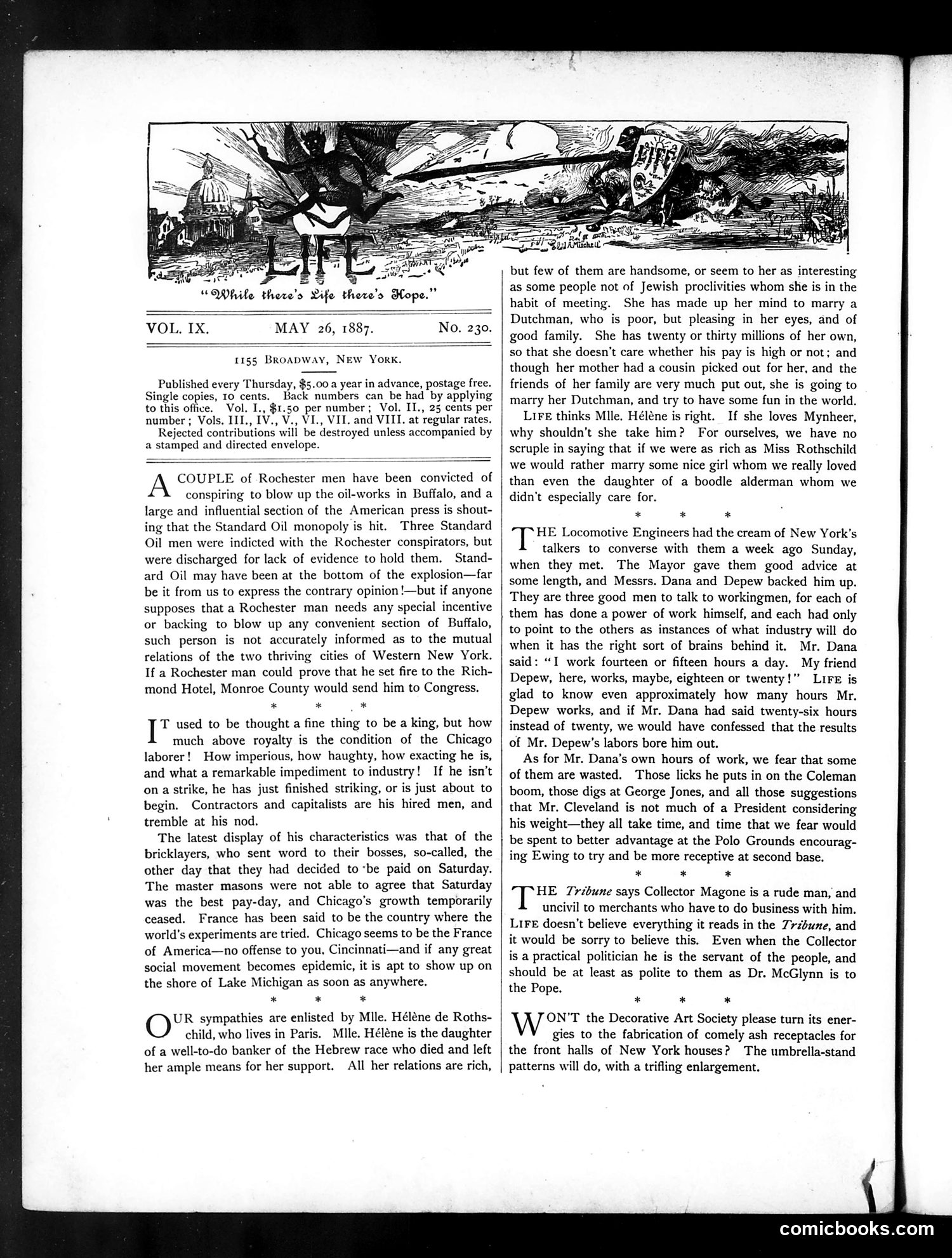
The masthead cartoon depicts a gnarled tree beside a full moon with the caption "While there's Life there's Hope." This appears to be Life magazine's standard decorative header rather than political commentary. The page contains several brief satirical editorial comments on current events. One section mocks Rochester men involved in an oil monopoly conspiracy; another critiques Chicago laborers' entitlement during strikes. There's commentary on the Locomotive Engineers union discussing working hours with New York's Mayor. Most notably, Life satirizes the *Tribune's* Collector Mayence as rude to merchants, suggesting he should emulate Pope Leo XIII's civility toward the public. The content reflects 1880s urban labor disputes, monopoly concerns, and local New York politics rather than a cohesive narrative cartoon.
📄 Transcribed text from this page (OCR, searchable)
Machine-transcribed from the original scan — historical spelling and the odd misread are preserved.
“OMhile there's Life there's Hope.” VOL. IX. MAY 26, 1887. Published every Thursday, $5.00 a year in advance, postage free. Single copies, 10 cents. Back numbers can be had by applying to this office. Vol, I., $1 number ; Vols. III., IV., V., VI., VII. and VIII. at regular rates. Rejected contributions will be destroyed unless accompanied by a stamped and directed envelope. COUPLE of Rochester men have been convicted of conspiring to blow up the oil-works in Buffalo, and a large and influential section of the American press is shout- ing that the Standard Oil monopoly is hit. Three Standard Oil men were indicted with the Rochester conspirators, but were discharged for lack of evidence to hold them. Stand- ard Oil may have been at the bottom of the explosion—far be it from us to express the contrary opinion !—but if anyone supposes that a Rochester man needs any special incentive or backing to blow up any convenient section of Buffalo, such person is not accurately informed as to the mutual relations of the two thriving cities of Western New York. If a Rochester man could prove that he set fire to the Rich- mond Hotel, Monroe County would send him to Congress. * * * ii used to be thought a fine thing to be a king, but how much above royalty is the condition of the Chicago laborer! How imperious, how haughty, how exacting he is, and what a remarkable impediment to industry! If he isn’t ona strike, he has just finished striking, or is just about to begin. Contractors and capitalists are his hired men, and tremble at his nod. The latest display of his characteristics was that of the bricklayers, who sent word to their bosses, so-called, the other day that they had decided to be paid on Saturday. The master masons were not able to agree that Saturday was the best pay-day, and Chicago’s growth temporarily ceased. France has been said to be the country where the world's experiments are tried. Chicago seems to be the France of America—no offense to you, Cincinnati—and if any great social movement becomes epidemic, it is apt to show up on the shore of Lake Michigan as soon as anywhere. * * * UR sympathies are enlisted by Mlle. Héléne de Roths- child, who lives in Paris. Mlle. Héléne is the daughter of a well-to-do banker of the Hebrew race who died and left her ample means for her support. All her relations are rich, ‘© per number; Vol. II., 25 cents per | but few of them are handsome, or seem to her as interesting as some people not of Jewish proclivities whom she is in the habit of meeting. She has made up her mind to marry a Dutchman, who is poor, but pleasing in her eyes, and of good family. She has twenty or thirty millions of her own, so that she doesn’t care whether his pay is high or not; and though her mother had a cousin picked out for her, and the friends of her family are very much put out, she is going to marry her Dutchman, and try to have some fun in the world. LIFE thinks Mlle. Héléne is right. If she loves Mynheer, why shouldn’t she take him? For ourselves, we have no scruple in saying that if we were as rich as Miss Rothschild we would rather marry some nice girl whom we really loved than even the daughter of a boodle alderman whom we didn't especially care for. * * * HE Locomotive Engineers had the cream of New York’s talkers to converse with them a week ago Sunday, when they met. The Mayor gave them good advice at some length, and Messrs. Dana and Depew backed him up. They are three good men to talk to workingmen, for each of them has done a power of work himself, and each had only to point to the others as instances of what industry will do when it has the right sort of brains behind it. Mr. Dana said: “I work fourteen or fifteen hours a day. My friend Depew, here, works, maybe, eighteen or twenty!” LIFE is glad to know even approximately how many hours Mr. Depew works, and if Mr. Dana had said twenty-six hours instead of twenty, we would have confessed that the results of Mr. Depew’s labors bore him out. As for Mr. Dana’s own hours of work, we fear that some of them are wasted. Those licks he puts in on the Coleman boom, those digs at George Jones, and all those suggestions that Mr. Cleveland is not much of a President considering his weight—they all take time, and time that we fear would be spent to better advantage at the Polo Grounds encourag- ing Ewing to try and be more receptive at second base. * * * HE Tribune says Collector Magone is a rude man, and uncivil to merchants who have to do business with him. LIFE doesn't believe everything it reads in the 7yzbune, and it would be sorry to believe this. Even when the Collector is a practical politician he is the servant of the people, and should be at least as polite to them as Dr. McGlynn is to the Pope. * * * ON’T the Decorative Art Society please turn its ener- gies to the fabrication of comely ash receptacles for the front halls of New York houses? The umbrella-stand patterns will do, with a trifling enlargement. comicbooks.com