
A complete issue · 16 pages · 1887
Life — May 5, 1887
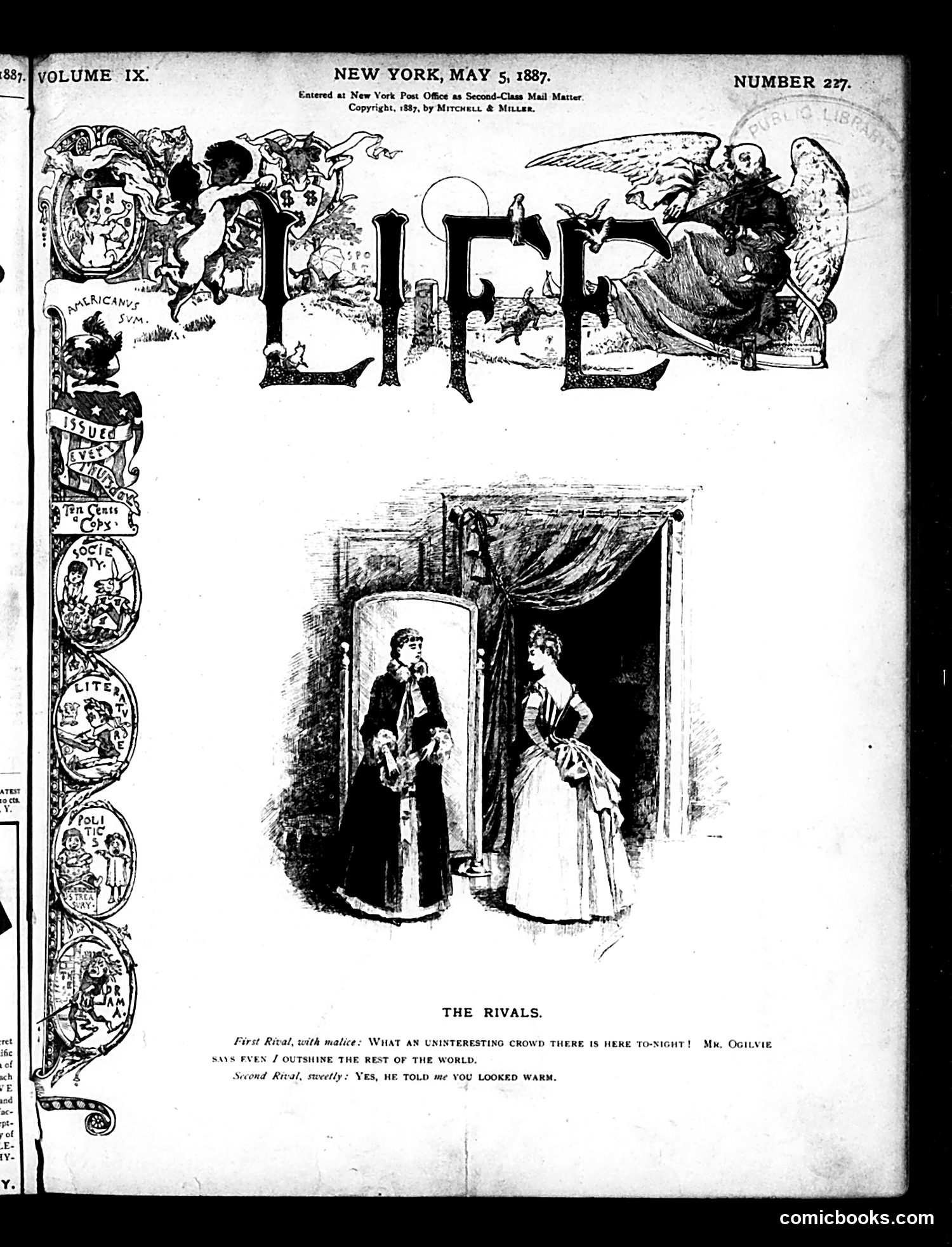
This satirical cartoon depicts two well-dressed figures meeting at a doorway, labeled "The Rivals." The dialogue reveals the joke's social commentary: **First Rival** boasts about an "uninteresting crowd" at home, claiming Mr. Ogilvie "saw even I outshing the rest of the world." **Second Rival** responds that Ogilvie "told me you looked warm." The humor targets vanity and competitive social posturing among the upper classes. Each man believes he's made the superior impression on Ogilvie, but the second rival's comment—that he merely "looked warm"—deflates the first's grandiose claim, suggesting his self-importance is baseless. The cartoon mocks how wealthy rivals interpret social interactions through inflated egos.
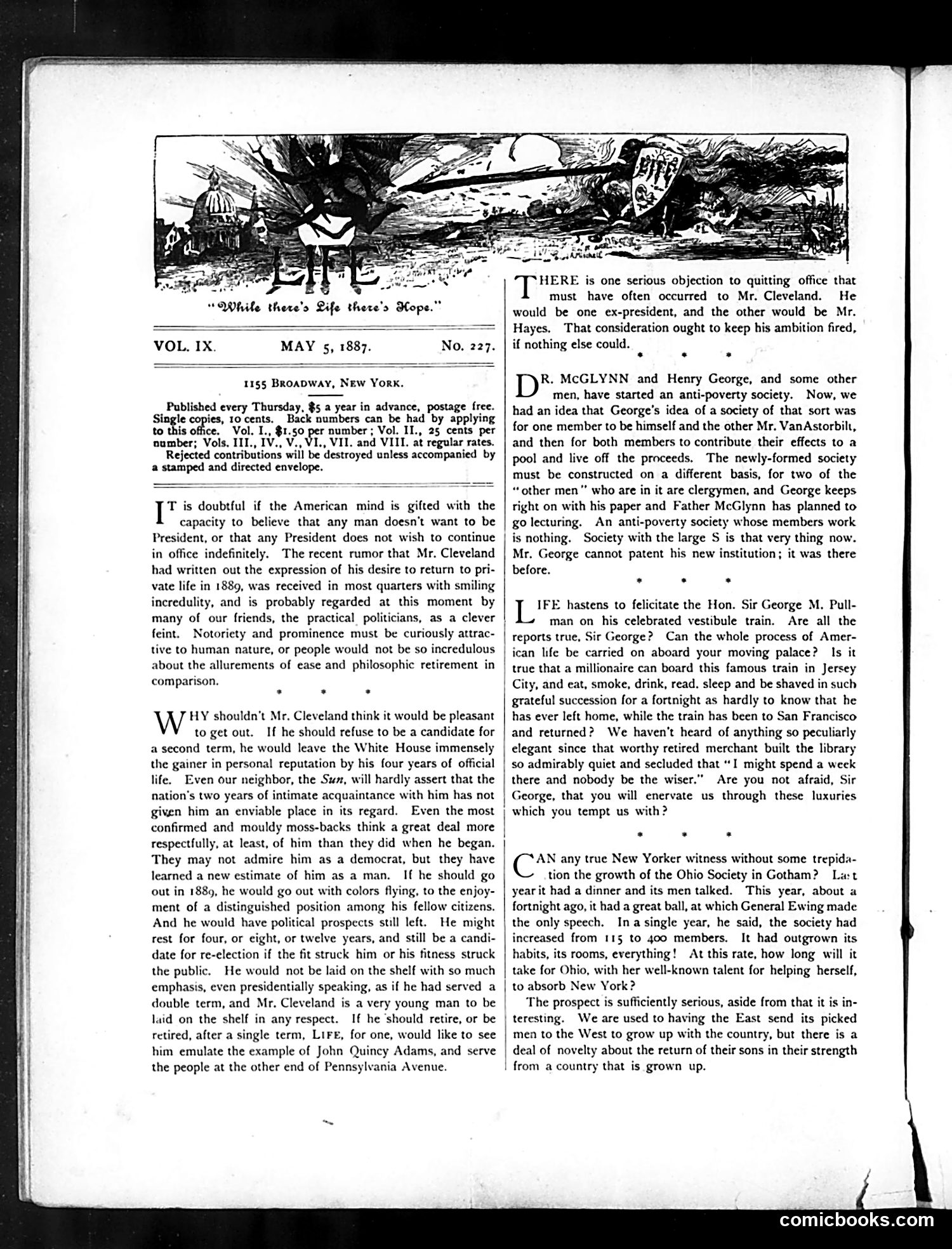
The masthead cartoon depicts a figure departing ("While there's Life there's Hope"), likely referencing President Grover Cleveland's rumored desire to leave office after his first term. The editorial discusses whether Cleveland should seek re-election. The writer argues Cleveland deserves respect for his four years of service and suggests retirement would be more dignified than continuing in office. Notably, the text mentions an "ex-president" and "Mr. Hayes" as alternatives, indicating contemporary debate about potential successors. The piece also satirizes an anti-poverty society proposal by Henry George and Dr. McGlynn, criticizing their impractical schemes to redistribute wealth. Finally, it comments on westward expansion and Ohio's growing prominence, noting the novelty of strength flowing from the West rather than East.
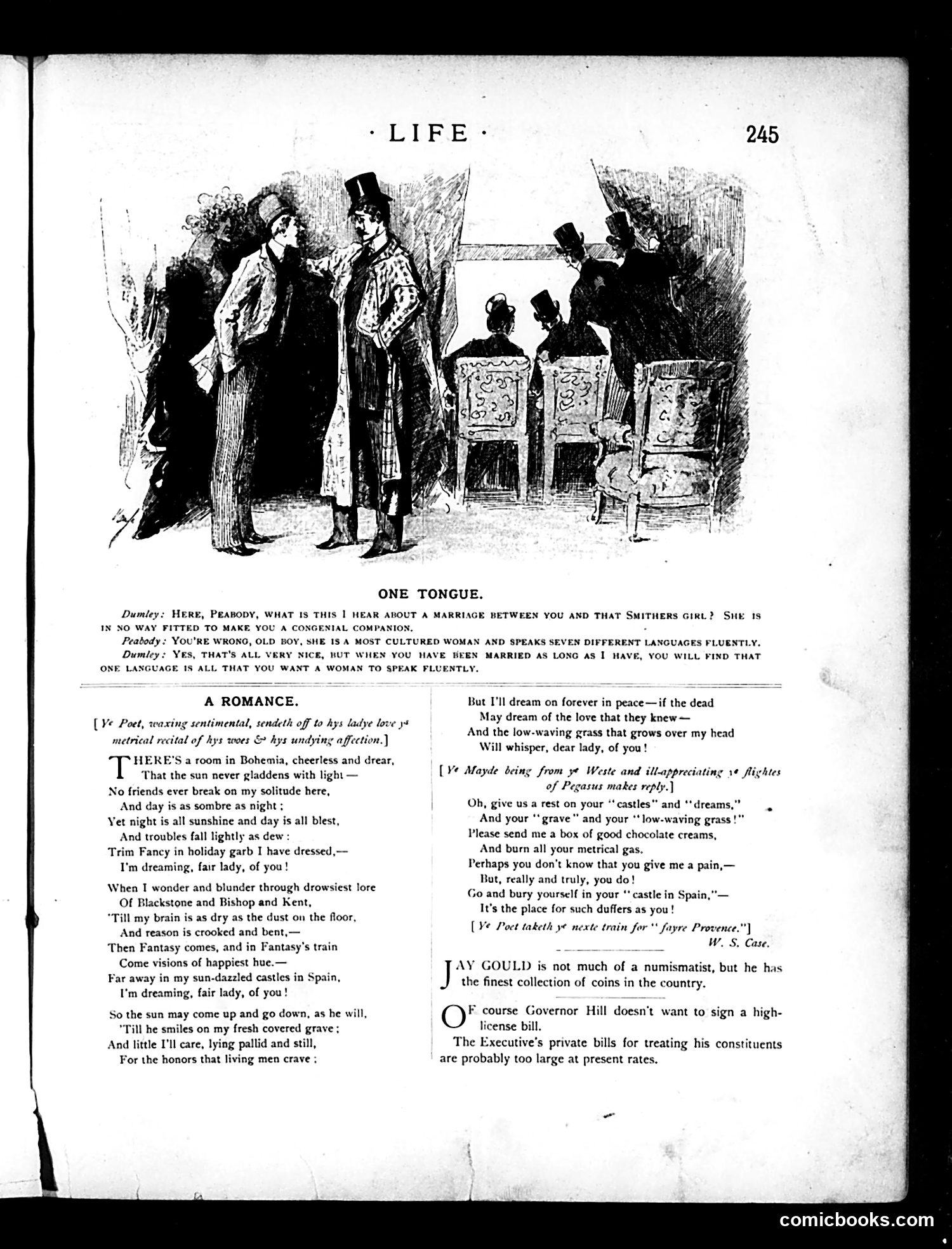
This cartoon satirizes marriage across language barriers. The dialogue shows a man (Ormsley) being warned by a friend (Here Peabody) about marrying a "Smithers girl" who speaks multiple languages fluently. The joke's punchline: after marriage, a woman will revert to speaking only one language—her native tongue, implying nagging or quarreling in a single language becomes incessant. The cartoon reflects Victorian-era anxieties about foreign wives and gender roles. The "romance" poems below provide sentimental contrast to the cynical humor above, suggesting the gap between courtship ideals and married reality. The page also contains brief satirical notes about a numismatist and Governor Hill's reluctance to sign legislation—typical period political commentary.
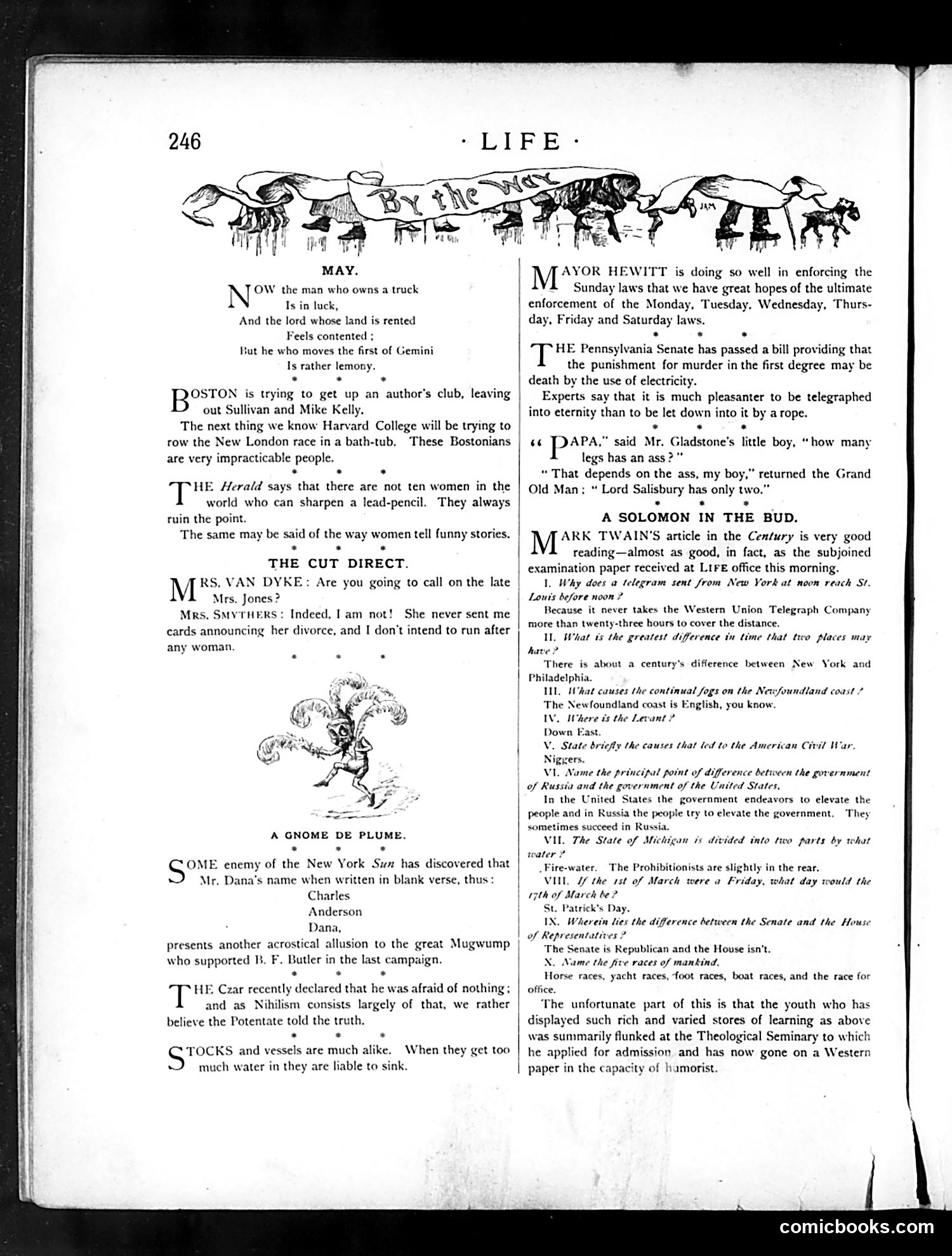
This page contains several short satirical pieces typical of Life's humor section: **"May"** opens with a poem about truck ownership and land rental, using a classical reference to Gemini. **"The Cut Direct"** is a brief dialogue joke about Mrs. Van Dyke avoiding Mrs. Jones, with Mrs. Smythers claiming she never received divorce announcement cards—a satire on social etiquette and divorce gossip. **"A Gnome de Plume"** mocks the New York Sun for printing a poem by someone named Charles Anderson Dana. The joke appears to reference the newspaper's tendency toward self-promotion or editorial confusion. **"A Solomon in the Bud"** presents examination questions presumably from Life's office, testing basic American geography and civics knowledge—poking fun at gaps in education. The overall tone is light domestic and social satire typical of early-20th-century American humor magazines.
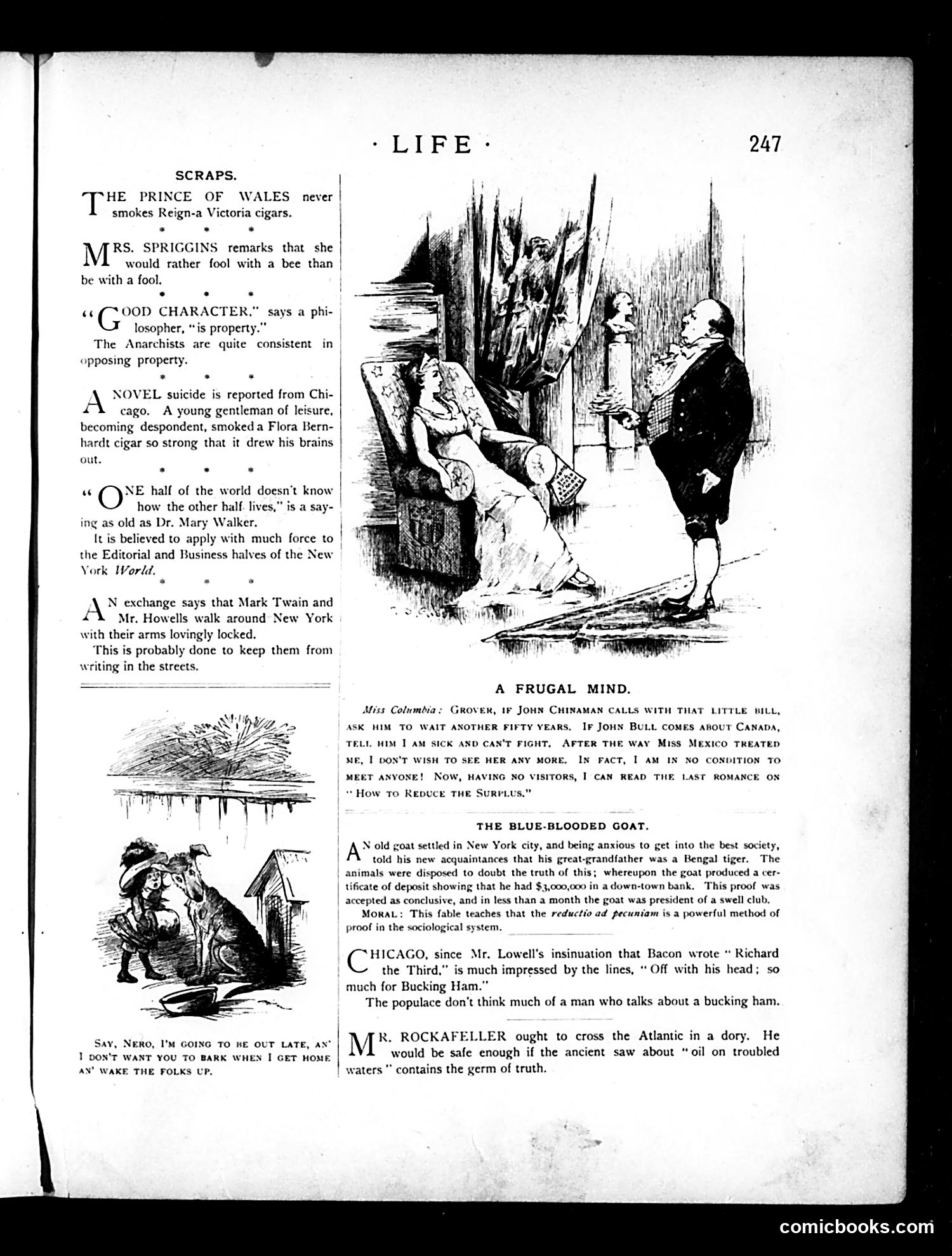
The main cartoon, titled "A Frugal Mind," depicts a woman in a large hat seated outdoors while a man stands nearby. The accompanying caption references Miss Colombia, John Chinaman, John Bull, and Miss Mexico, suggesting this is political satire about international relations or colonial attitudes of the era. The smaller cartoon below shows a figure (labeled "Nero") apparently departing, with another figure warning him not to bark when he returns home—likely satirizing someone's cowardly behavior or hypocrisy. The "scraps" section contains brief social commentary about topics like Mark Twain, anarchism, and New York society—typical of Life magazine's lighthearted cultural criticism. Without clearer historical context or dates, the specific political figures or events remain uncertain.
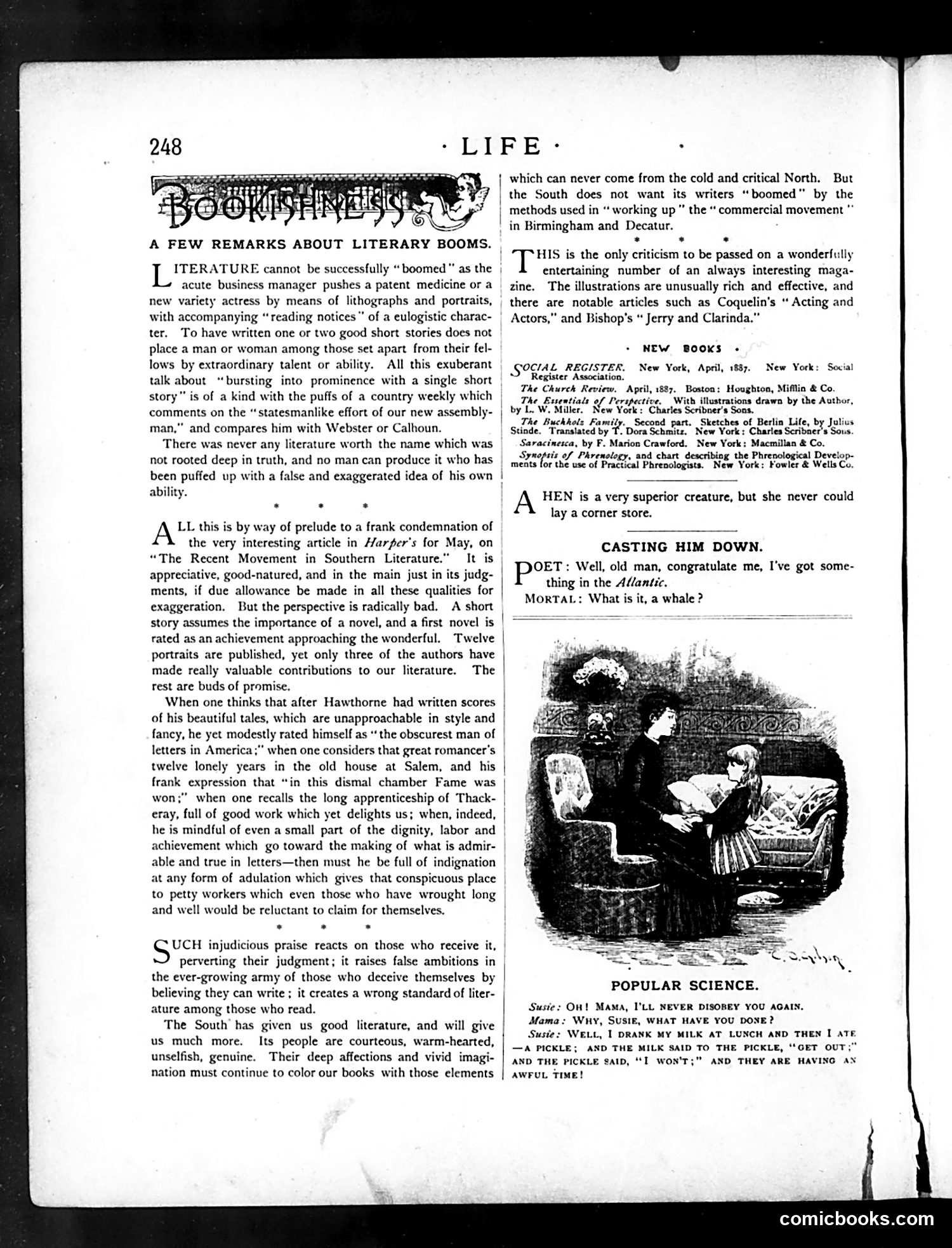
This page contains two distinct sections: **"Bookishness" Editorial Section:** A lengthy critique of the "booming" of Southern literature. The author argues against artificially inflating mediocre literary works through marketing hype, comparing it to false business promotion. The piece criticizes how undeserving authors receive excessive praise while truly talented writers remain overlooked—a complaint about literary standards being corrupted by commercial interests rather than merit. **"Casting Him Down" Cartoon:** A simple two-panel joke featuring a Poet boasting to a Mortal about something in "the *Atlantic*" (likely a prestigious magazine). The Mortal's response—"What is it, a whale?"—is a dismissive pun, suggesting the Poet's work is bloated or oversized, mocking pretentious literary ambitions.
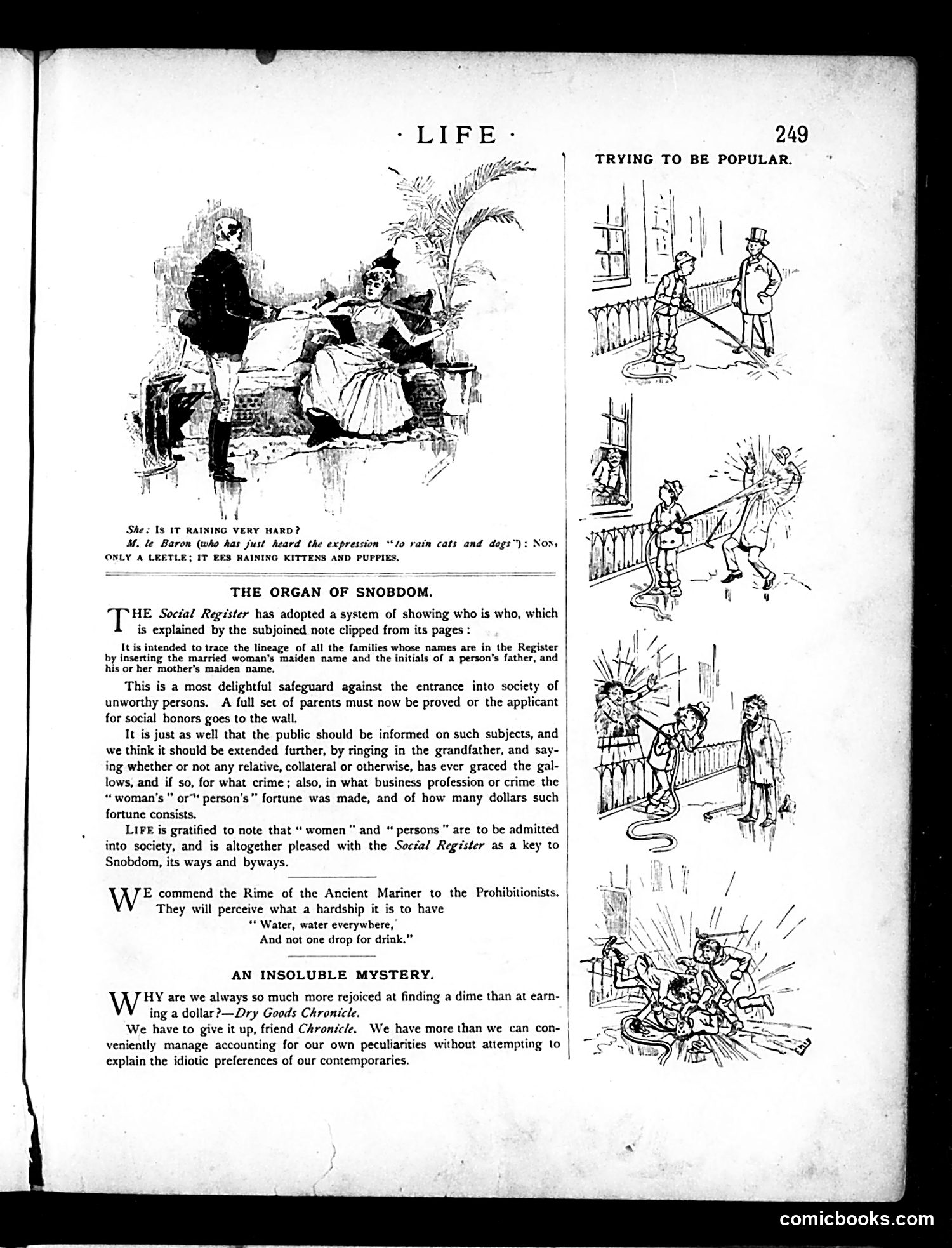
This page contains two distinct sections: **Left side:** A cartoon titled "She is in QUITE VERY HARD" showing what appears to be a social scene with well-dressed figures, likely satirizing pretentious social behavior or romantic entanglement. **Right side:** A series of four comic panels titled "TRYING TO BE POPULAR" depicting children on what appears to be a balcony or railing attempting various stunts—jumping, acrobatics, and risky behavior—to impress each other. The satire mocks how children desperately seek peer acceptance through increasingly dangerous or ridiculous antics. The humor lies in the universal human drive for social approval manifesting as absurd physical comedy, particularly poignant when depicting youth. The accompanying articles discuss social registers and snobbery, reinforcing themes about social status-seeking and acceptance.
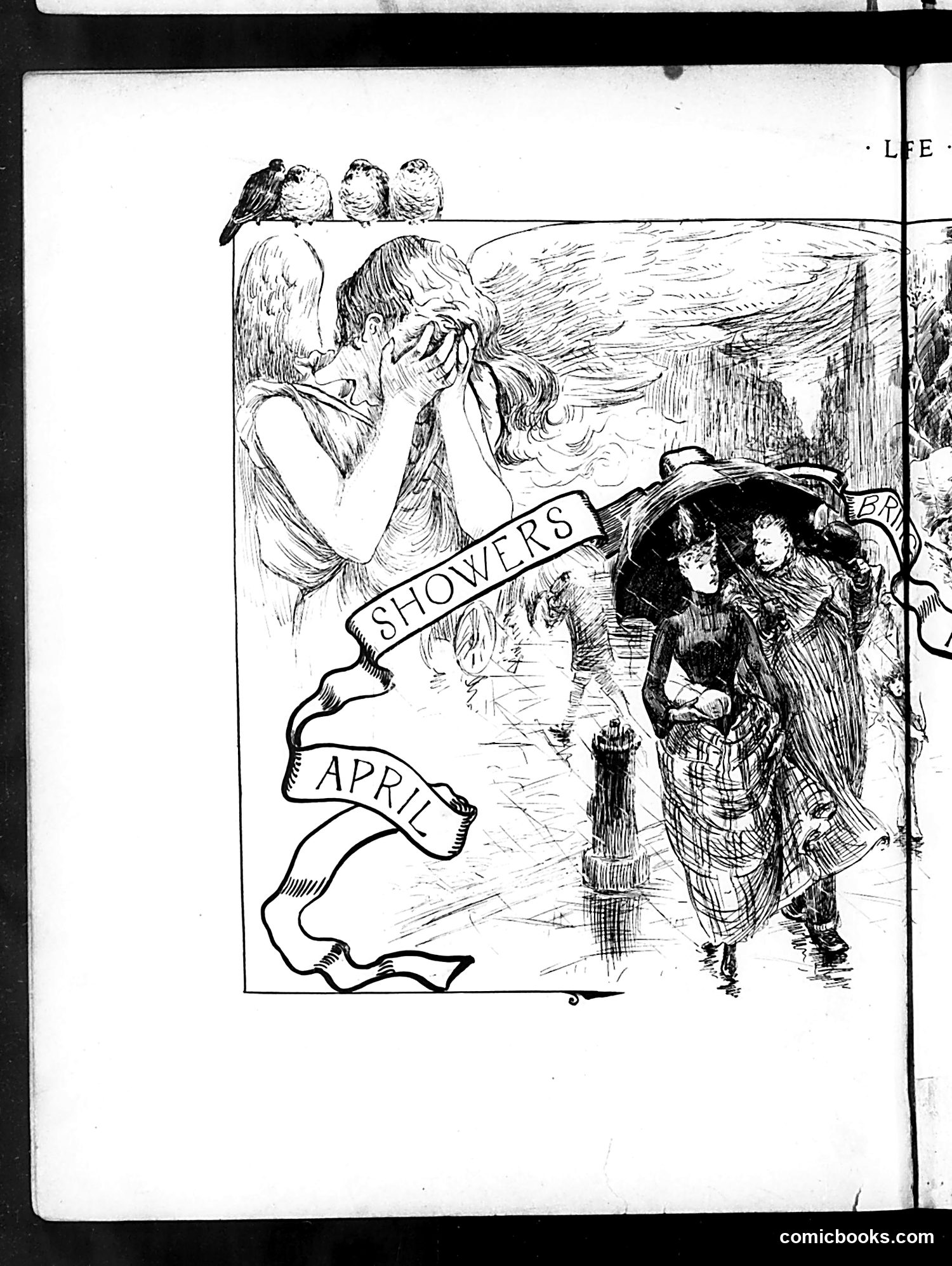
This appears to be a Life magazine illustration for April showers. The image shows two figures with an umbrella encountering rain on a street, while above them a woman holds four small birds on her arm. The banner text reads "SHOWERS" and "APRIL." The satire likely plays on the phrase "April showers bring May flowers"—a common saying about spring weather. The juxtaposition suggests the contrast between the poetic, pleasant association of April showers (represented by the woman with birds, symbolizing springtime and nature) and the actual miserable reality of rain (the drenched pedestrians seeking shelter). The humor derives from this gap between romantic expectation and wet, uncomfortable reality during spring's unpredictable weather.
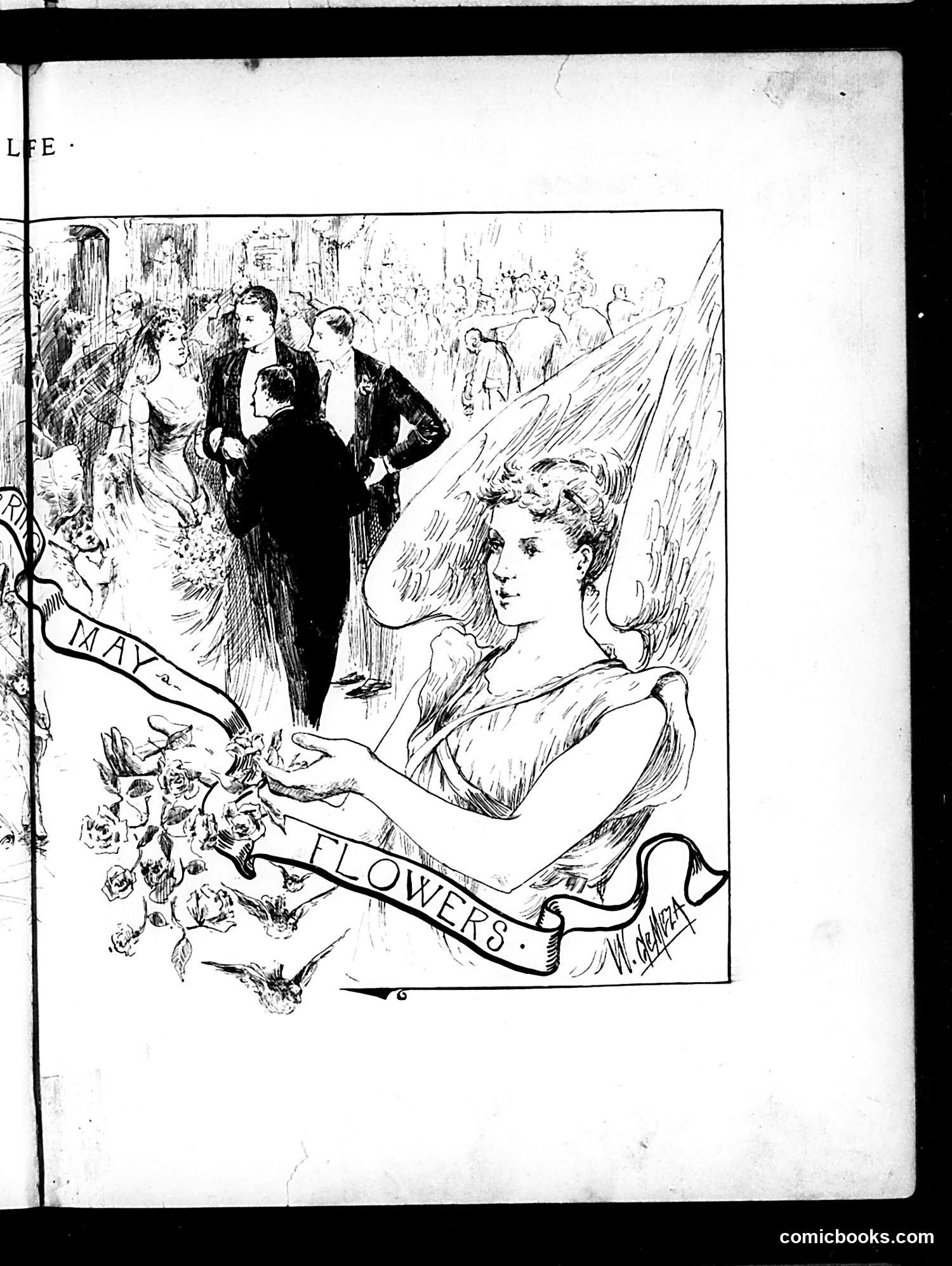
This appears to be an illustration titled "May Flowers" from Life magazine. The image depicts a social scene with a woman in the foreground holding flowers, while fashionably dressed figures gather in the background at what seems to be an elegant indoor venue or social gathering. The satire likely comments on May Day traditions and courtship rituals of the period. The prominent display of the woman with flowers suggests commentary on romantic gestures and social conventions. The crowd of well-dressed attendees in the background indicates this depicts upper-class social life. Without additional context about the specific publication date or accompanying text, the exact satirical target remains unclear, though it appears to mock Victorian or Edwardian era social pretensions and romantic customs through its stylized illustration.
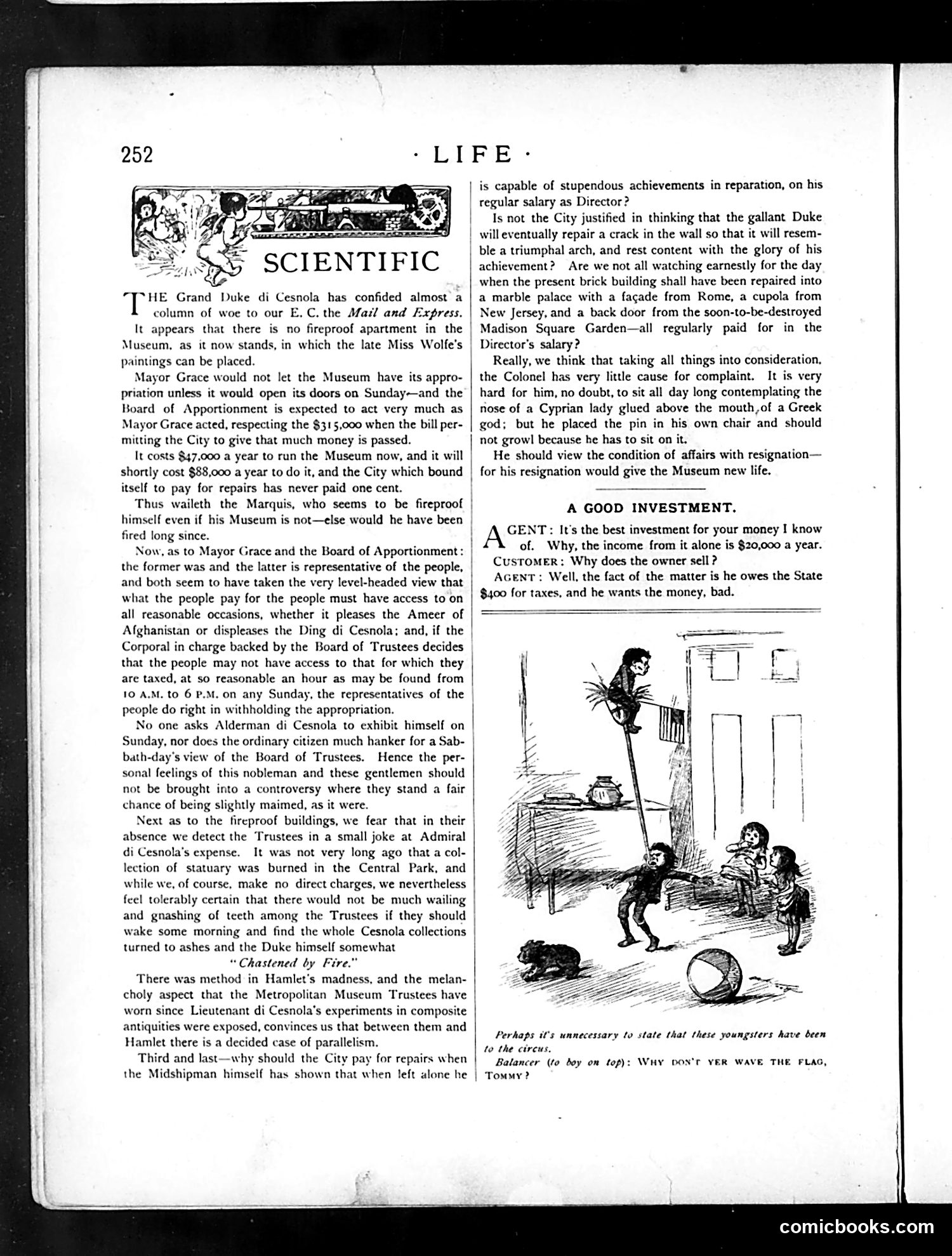
This single-panel cartoon depicts a real-estate transaction between an Agent and Customer. The Agent pitches a property yielding "$20,000 a year" income, but the Customer hesitates—the owner wants to sell because "the matter is he owes the State $100 for taxes, and he wants the money, bad." The satire targets tax evasion and financial desperation during what appears to be an economically strained period. The joke is that despite the property's attractive income, the owner is so desperate to pay his tax debt that he's liquidating an asset. The cartoon critiques both the property owner's financial mismanagement and suggests broader commentary on state taxation or economic hardship affecting property holders.
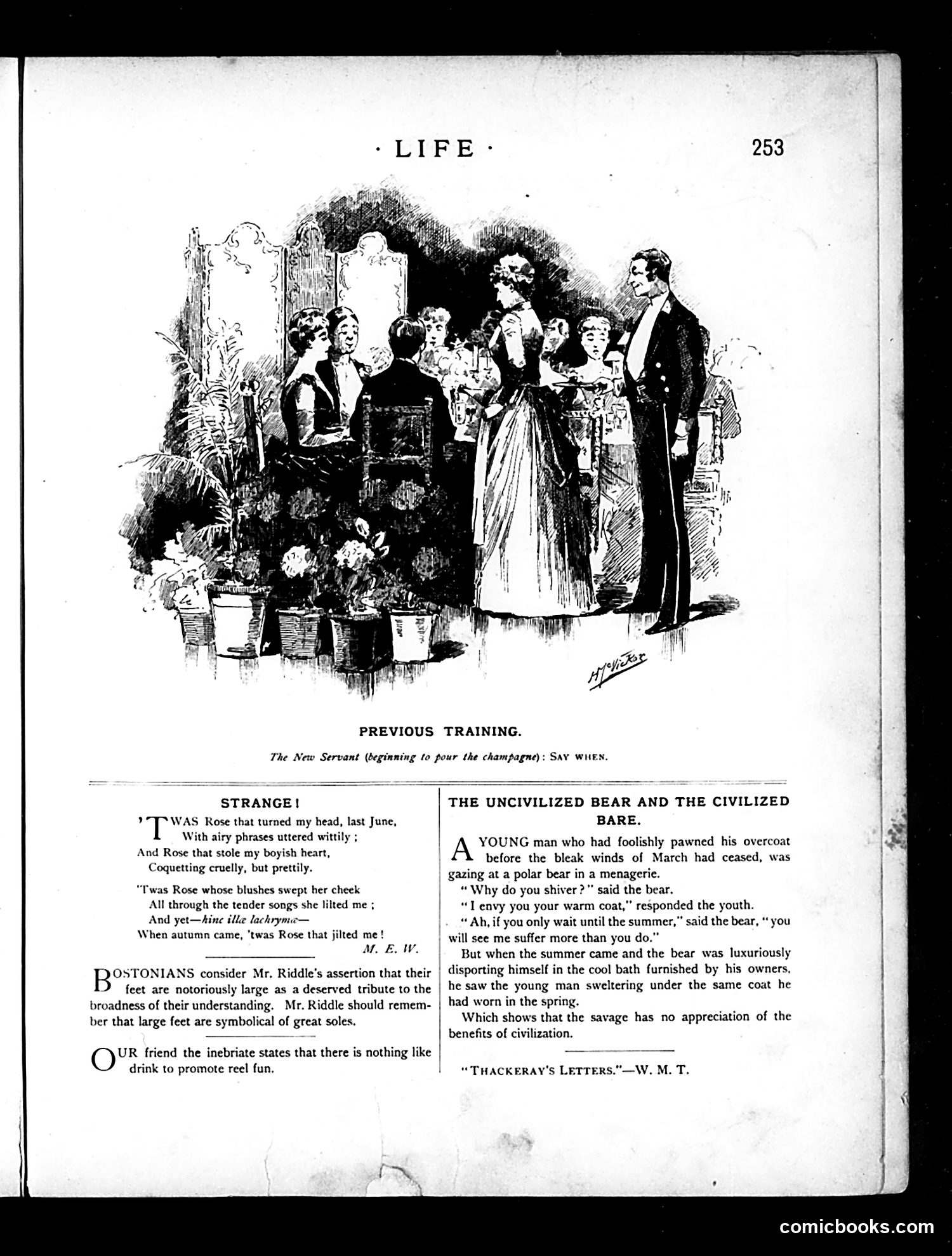
This page contains three separate humorous pieces typical of early 20th-century satirical magazines: 1. **Top illustration**: "Previous Training" depicts a new servant being instructed to serve champagne by saying "when" to stop pouring—a basic etiquette lesson, likely mocking nouveau riche or untrained domestic help. 2. **"Strange!"**: A sentimental poem about romantic rejection, playing on the melodramatic tone of period literature. 3. **Boston feet joke**: A pun mocking Bostonians' supposedly large feet, with wordplay on "soles" (feet vs. character/morality). 4. **Drunk humor**: A short quip suggesting alcohol promotes "reel fun" (likely a dance pun). 5. **"The Uncivilized Bear and the Civilized Bare"**: A fable contrasting a bear comfortable in summer with a shirtless young man suffering in his retained coat year-round. The moral sarcastically suggests "civilization" causes unnecessary suffering—a critique of social convention and class-bound behavior. The page exemplifies Life's mix of social satire, wordplay, and gentle mockery of contemporary manners and pretension.
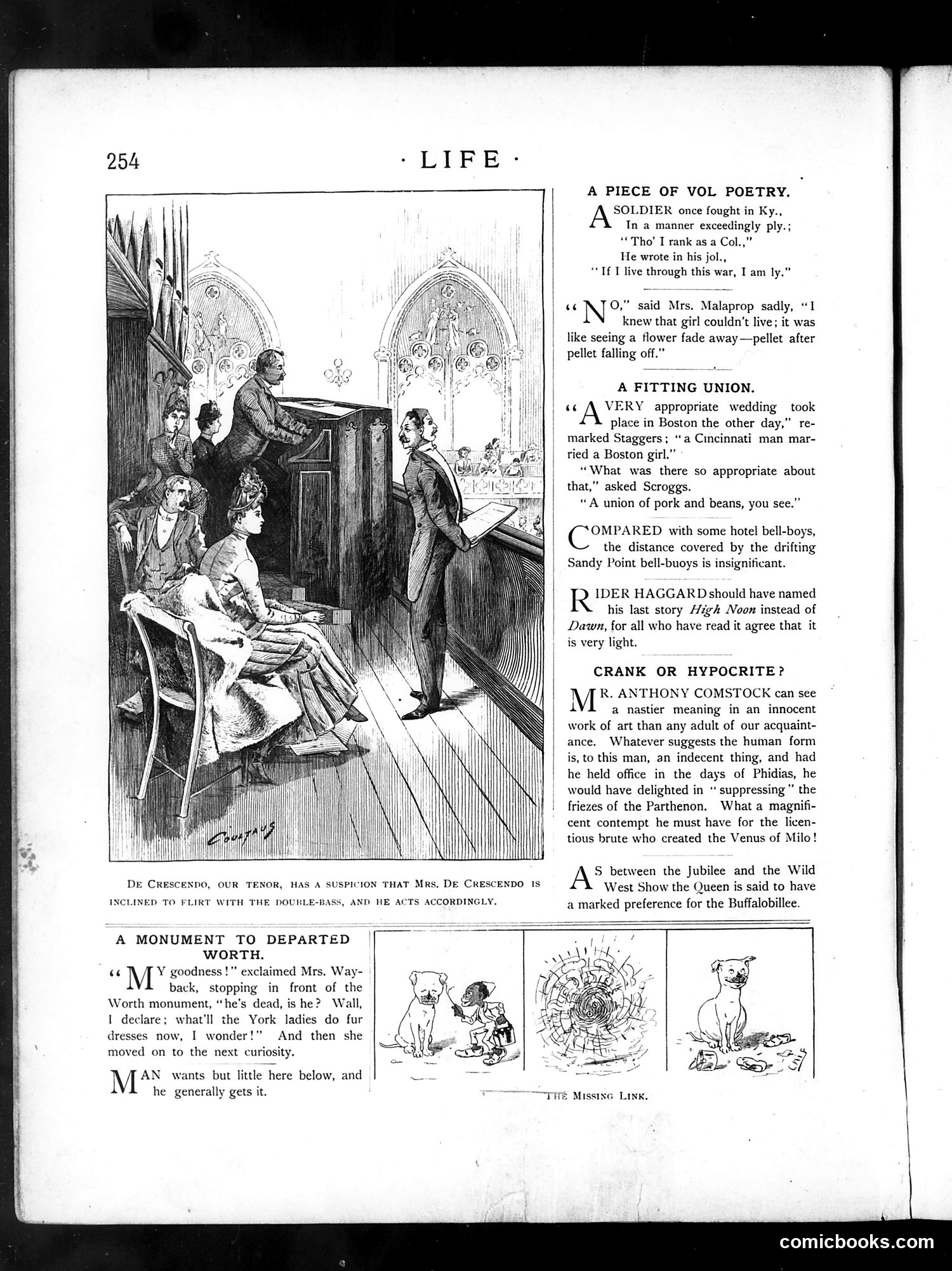
This page contains multiple brief humorous pieces typical of Life's satirical format: **Main cartoon**: Shows a church wedding scene where "De Crescendo," a tenor, suspects his wife of flirting with the double-bass player, acting jealously accordingly—a musical pun on marital discord. **Recurring jokes**: - A malaprop-style piece mocking affected speech (Mrs. Malaprop, a character type from Sheridan's *The Rivals*) - Regional stereotyping: a Cincinnati-Boston marriage joked as a union of "pork and beans" (regional food associations) - Criticism of Anthony Comstock, the famous anti-obscenity crusader, portrayed as seeing indecency everywhere, even in classical art like the Parthenon friezes and Venus de Milo—suggesting his prudishness is absurd **Bottom panels** ("The Missing Link"): Three wordless cartoon panels showing dogs, likely visual gags about human-animal behavior. The page satirizes contemporary figures (Comstock), regional stereotypes, and literary pretension through brief, punchy jokes—Life's characteristic format.
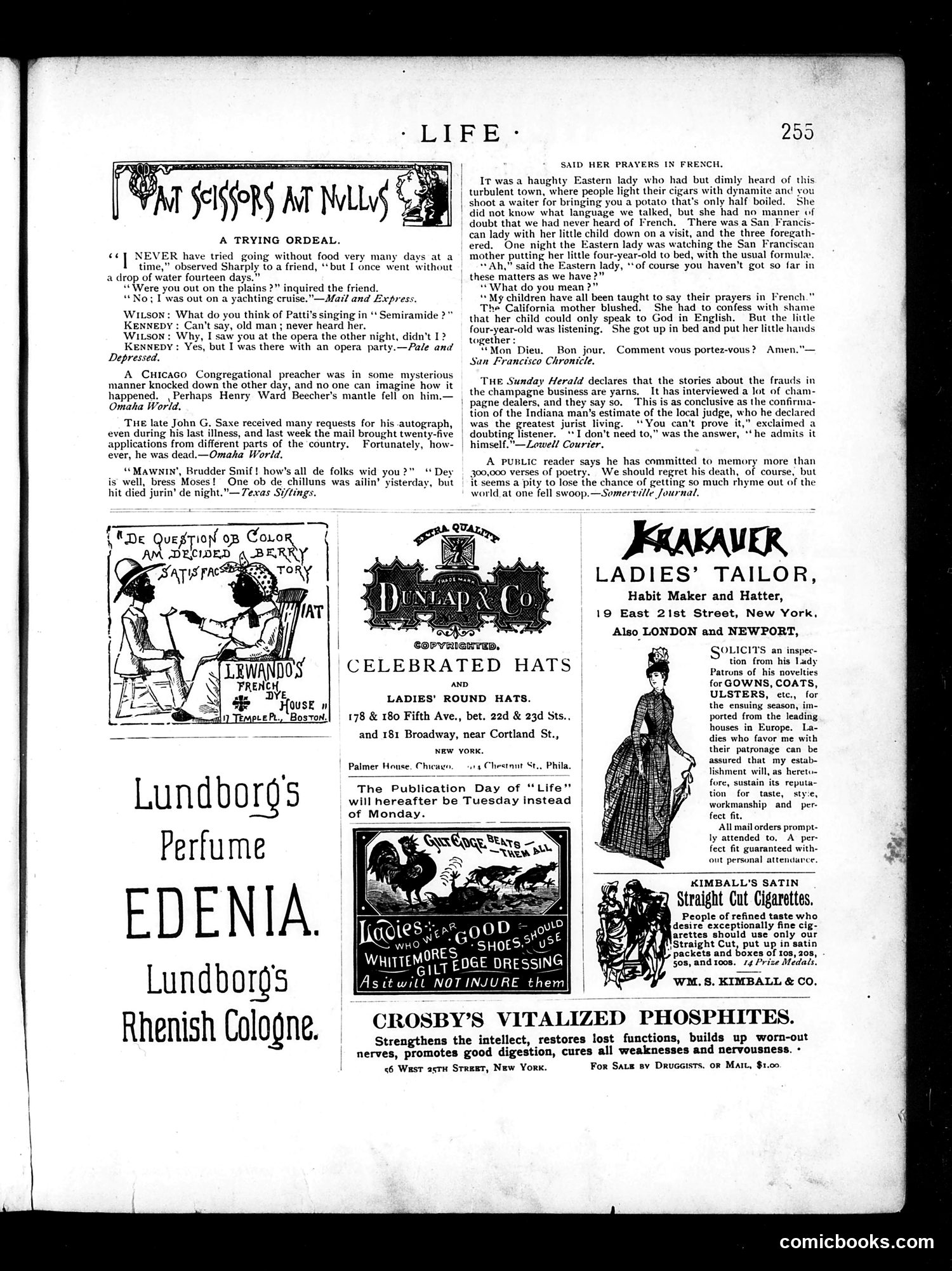
This page is primarily **advertising and humor anecdotes** rather than political commentary. The cartoons and text are light satirical sketches: **"A Trying Ordeal"** presents a series of brief jokes mocking social pretension and absurdity—a man boasting about surviving without water on a yacht cruise, opera-goers claiming not to hear performers, and wordplay about a preacher's misfortune. **"Said Her Prayers in French"** satirizes East Coast snobbery. A haughty Eastern lady assumes superiority by having her children pray in French, only to be humbled when a San Francisco woman's four-year-old child innocently responds with the only French she knows ("Good morning, how are you?"), mocking the pretentiousness of linguistic elitism. The remaining content is commercial advertising for perfumes, hats, tailoring services, and patent medicines—typical of period magazines. No specific political figures or events are referenced; the humor targets universal human foibles: vanity, class pretension, and affected sophistication.
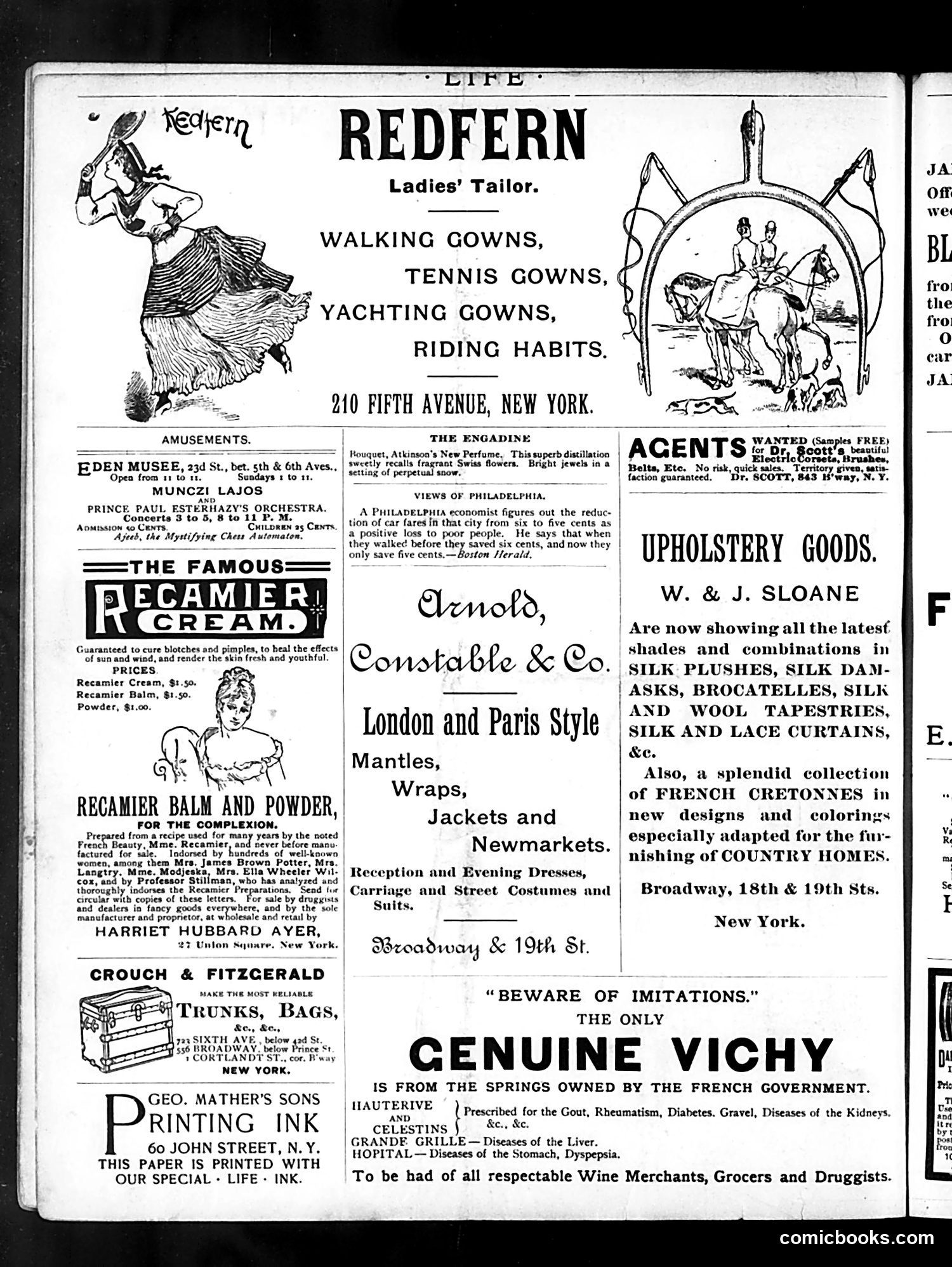
This is primarily an **advertising page**, not a satirical cartoon. The page contains commercial advertisements for late 19th-century luxury goods and services targeting affluent readers. **Notable ads include:** - **Redfern** (top): A high-end women's tailor advertising fashionable clothing (walking gowns, tennis wear, yachting gowns, riding habits) - **Recamier Cream/Balm**: Beauty products endorsed by famous actresses like Lillie Langtry and Modjeska - **Arnold, Constable & Co.**: Upscale clothing retailer for London and Paris-style fashions - **W. & J. Sloane**: Luxury upholstery and home furnishings - **Vichy Water**: French mineral water marketed for medicinal purposes (gout, rheumatism, etc.) There is **one brief satirical item**: A short quip about Philadelphia's streetcar fare reduction, suggesting poor people actually lose money because they now walk less and save fewer cents. The page reflects Gilded Age consumer culture and the aspirational lifestyle marketed to wealthy New Yorkers.
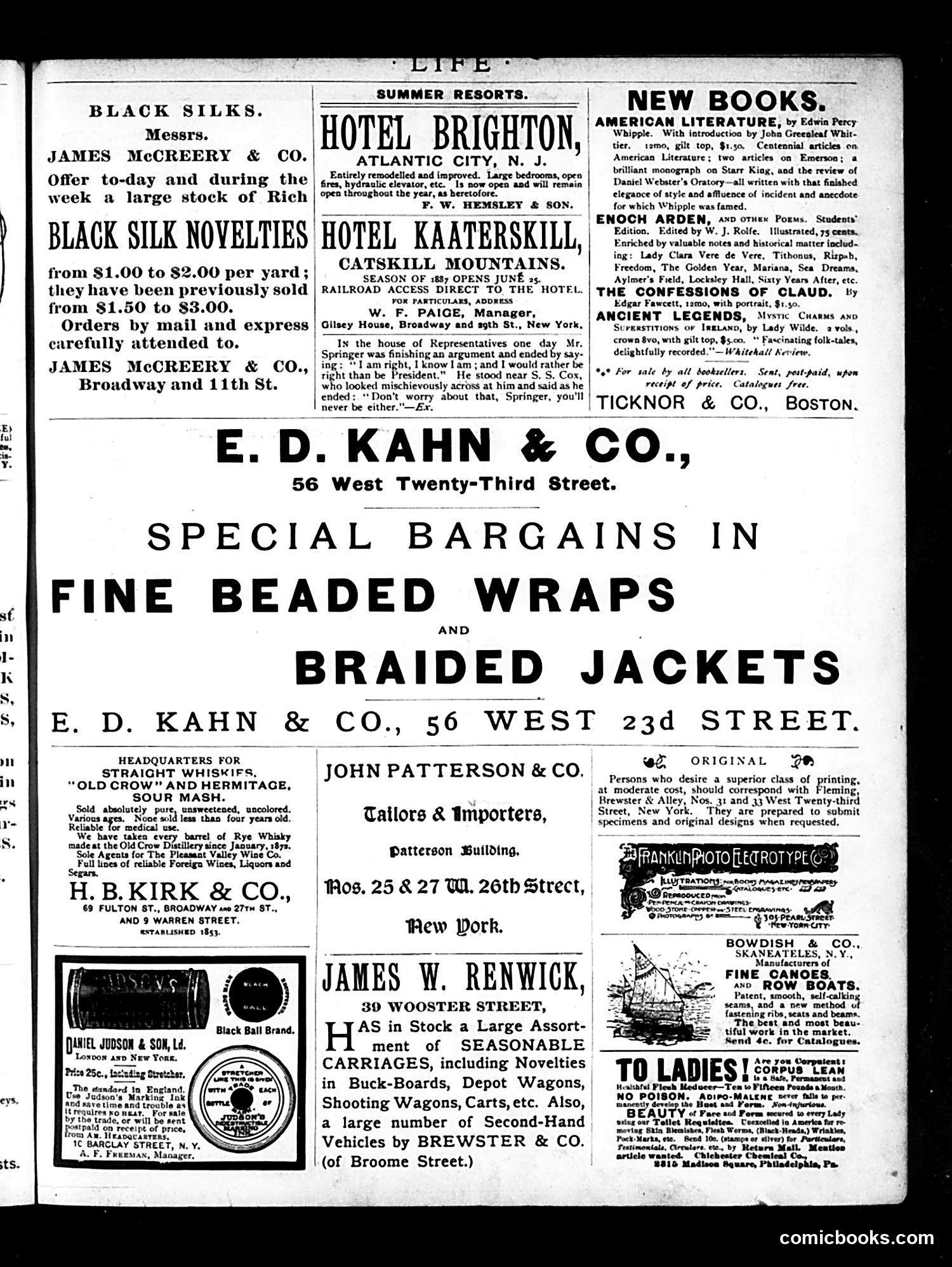
This is primarily an advertising page from Life magazine, with minimal editorial content. The only notable cartoon-related item is a brief anecdote about **Representative Springer** and **S.S. Cox** (a Congressman known for wit), set in the House of Representatives. Springer boasts he'd "rather be right than be President," and Cox quips back that he needn't worry—he'll never be either. This is a mild political joke mocking Springer's self-importance and his lack of presidential prospects, playing on the common expression about principle versus ambition. The humor relies on Cox's reputation as a sharp-tongued politician. The rest of the page comprises advertisements for black silk, hotels, books, clothing, carriages, and liquor—typical of Life's commercial content from this era.
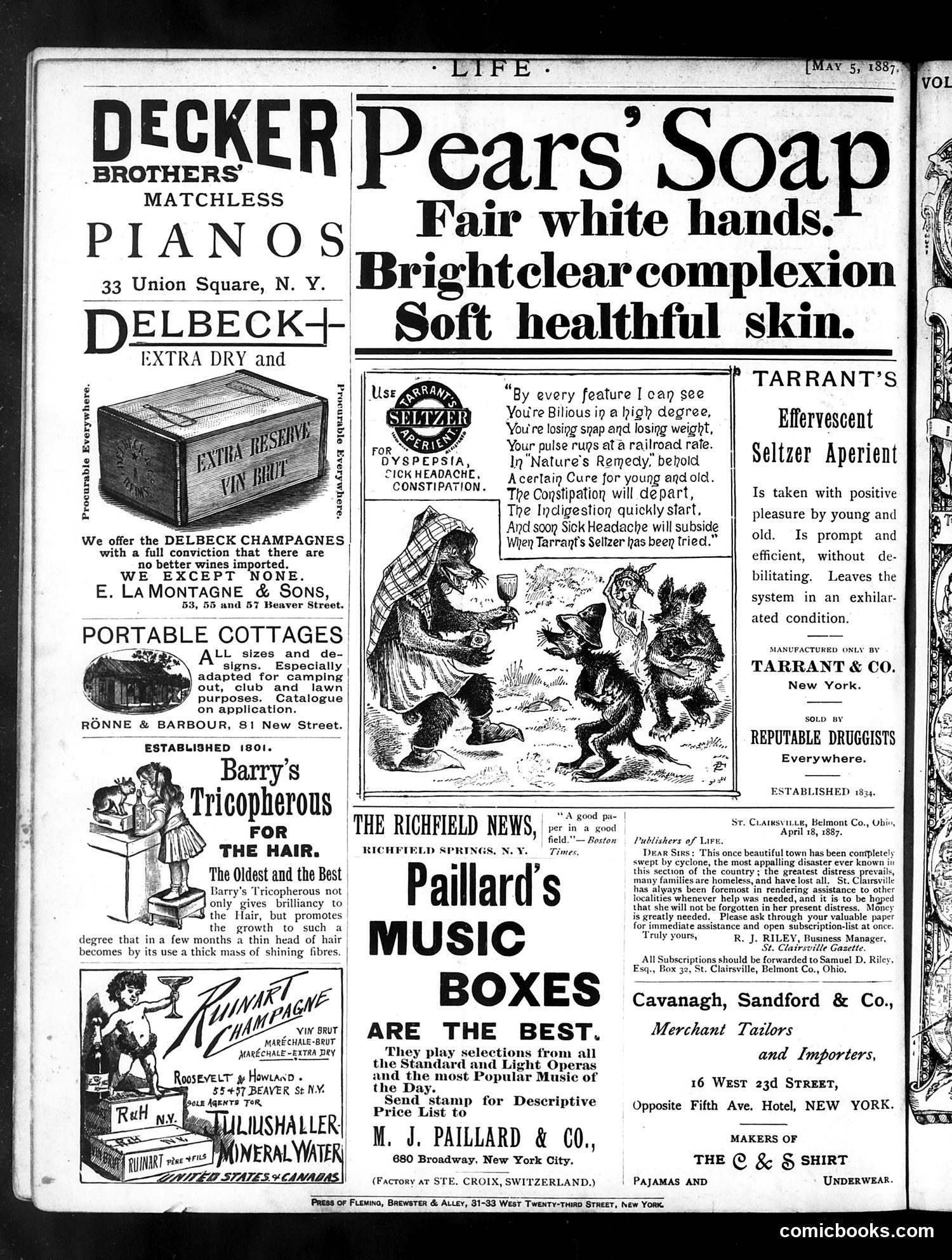
This is primarily an **advertising page** with one satirical cartoon. The central illustration depicts a sickly, gaunt figure being examined by a doctor or healer, captioned with verse about bilious complaints, weight loss, and constipation—promoting "Nature's Remedy" and Tarrant's Seltzer Aperient. **The satire**: The exaggerated physical deterioration shown represents the common Victorian-era concern about digestive ailments and "biliousness" (believed caused by liver dysfunction). The cartoon mocks both hypochondria and the era's obsession with patent medicines and tonics as cure-alls. **Context**: Late 19th-century Americans were heavily marketed dubious remedies for vague complaints. The dramatic visual of a wasting man serves as fear-mongering advertising—suggesting catastrophic health decline without the product. The remaining content is straightforward period advertising for pianos, champagne, hair tonic, music boxes, and clothing—typical of Life's revenue model.