
Life, 1887-05-05 · page 6 of 16
Life — May 5, 1887 — page 6: what you’re looking at
What you’re looking at
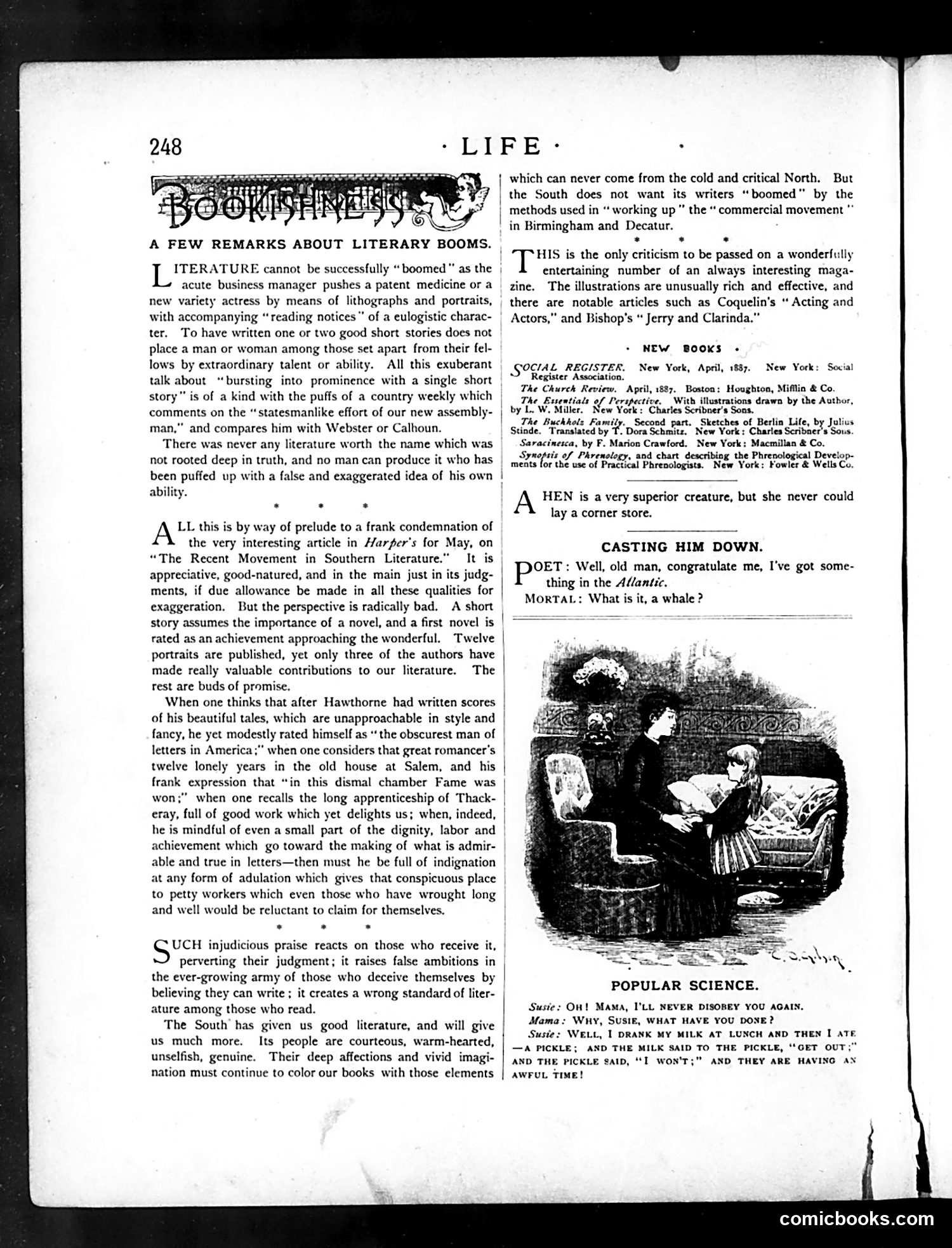
This page contains two distinct sections: **"Bookishness" Editorial Section:** A lengthy critique of the "booming" of Southern literature. The author argues against artificially inflating mediocre literary works through marketing hype, comparing it to false business promotion. The piece criticizes how undeserving authors receive excessive praise while truly talented writers remain overlooked—a complaint about literary standards being corrupted by commercial interests rather than merit. **"Casting Him Down" Cartoon:** A simple two-panel joke featuring a Poet boasting to a Mortal about something in "the *Atlantic*" (likely a prestigious magazine). The Mortal's response—"What is it, a whale?"—is a dismissive pun, suggesting the Poet's work is bloated or oversized, mocking pretentious literary ambitions.
📄 Transcribed text from this page (OCR, searchable)
Machine-transcribed from the original scan — historical spelling and the odd misread are preserved.
‘LIFE: A FEW REMARKS ABOUT LITERARY BOOMS. | ITERATURE cannot be successfully “ boomed" as the | acute business manager pushes a patent medicine or a new variety actress by means of lithographs and portraits, with accompanying “reading notices” of a eulogistic charac- ter. To have written one or two good short stories does not place a man or woman among those set apart from their fel- lows by extraordinary talent or ability. All this exuberant talk about “bursting into prominence with a single short story” is of a kind with the puffs of a country weekly which comments on the “statesmanlike effort of our new assembly- man,” and compares him with Webster or Calhoun. There was never any literature worth the name which was not rooted deep in truth, and no man can produce it who has been puffed up with a false and exaggerated idea of his own | ability. . . * LL this is by way of prelude to a frank condemnation of the very interesting article in Harper's for May, on “The Recent Movement in Southern Literature.” It is appreciative, good-natured, and in the main just in its judg- ments, if due allowance be made in all these qualities for exaggeration. But the perspective is radically bad. A short story assumes the importance of a novel, and a first novel is | rated as an achievement approaching the wonderful. Twelve portraits are published, yet only three of the authors have made really valuable contributions to our literature. rest are buds of promise, When one thinks that after Hawthorne had written scores of his beautiful tales, which are unapproachable in style and fancy, he yet modestly rated himself as “the obscurest man of letters in America;" when one considers that great romancer's twelve lonely years in the old house at Salem, and his frank expression that “in this dismal chamber Fame was won ;” when one recalls the long apprenticeship of Thack- | eray, full of good work which yet delights us; when, indeed, he is mindful of even a small part of the dignity, labor and achievement which go toward the making of what is admir- able and true in letters—then must he be full of indignation at any form of adulation which gives that conspicuous place to petty workers which even those who have wrought long and well would be reluctant to claim for themselves. UCH injudicious praise reacts on those who receive it, perverting their judgment; it raises false ambitions in the ever-growing army of those who deceive themselves by believing they can write ; it creates a wrong standard of liter- ature among those who read. The South’ has given us good literature, and will give us much more. Its people are courteous, warm-hearted, unselfish, genuine. Their deep affections and vivid imagi- The | which can never come from the cold and critical North. But the South does not want its writers “boomed” by the | methods used in “ working up” the “ commercial movement " in Birmingham and Decatur. . . . HIS is the only criticism to be passed on a wonderfully entertaining number of an always interesting maga- zine. The illustrations are unusually rich and effective, and there are notable articles such as Coquelin’s “ Acting and Actors,” and Bishop's “ Jerry and Clarinda.” + NEW BOOKS - OCIAL REGISTER. New York, April, 1887. New York: Social Register Association. The Church Review. April, 1887. The Essentials of Perspective. by L. W. Miller. The Buchhols Family. Second part. Sketches of Berlin Life, by J Stinde. Translated by T. Dora Schmitz. New York: Charles Scribaer's Sous Saracinesca, by F. Marion Crawford. New York: Macmillan & Co. Synopsis of Phrenology, and chart describing the Phrenological Develop ments for the use of Practical Phrenologists. New York: Fowler & Wells Co. Bostoa: Houghton, Mifflin & Co. With illustrations drawn by the Author, New York: Charles Scribner's Sons. HEN is a very superior creature, but she never could lay a corner store. CASTING HIM DOWN. OET : Well, old man, congratulate me, I've got some- thing in the AMantic MorTAL: What is it, a whale ? POPULAR SCIENCE. Susie: OH! Mama, I'LL NEVER DISOBEY YOU AGAIN. Mama: WHY, SUSIE, WHAT HAVE YOU DONE? Susie: WELL, 1 DRANK MY MILK AT LUNCH AND THEN I ATE —A PICKLE; AND THE MILK SAID TO THE PICKLE, ‘GET OUT; AND THE PICKLE eatp, “I won'T;" AND THEY ARE HAVING AN nation must continue to color our books with those elements | awrut Time! comicbooks.com