
A complete issue · 16 pages · 1887
Life — April 14, 1887
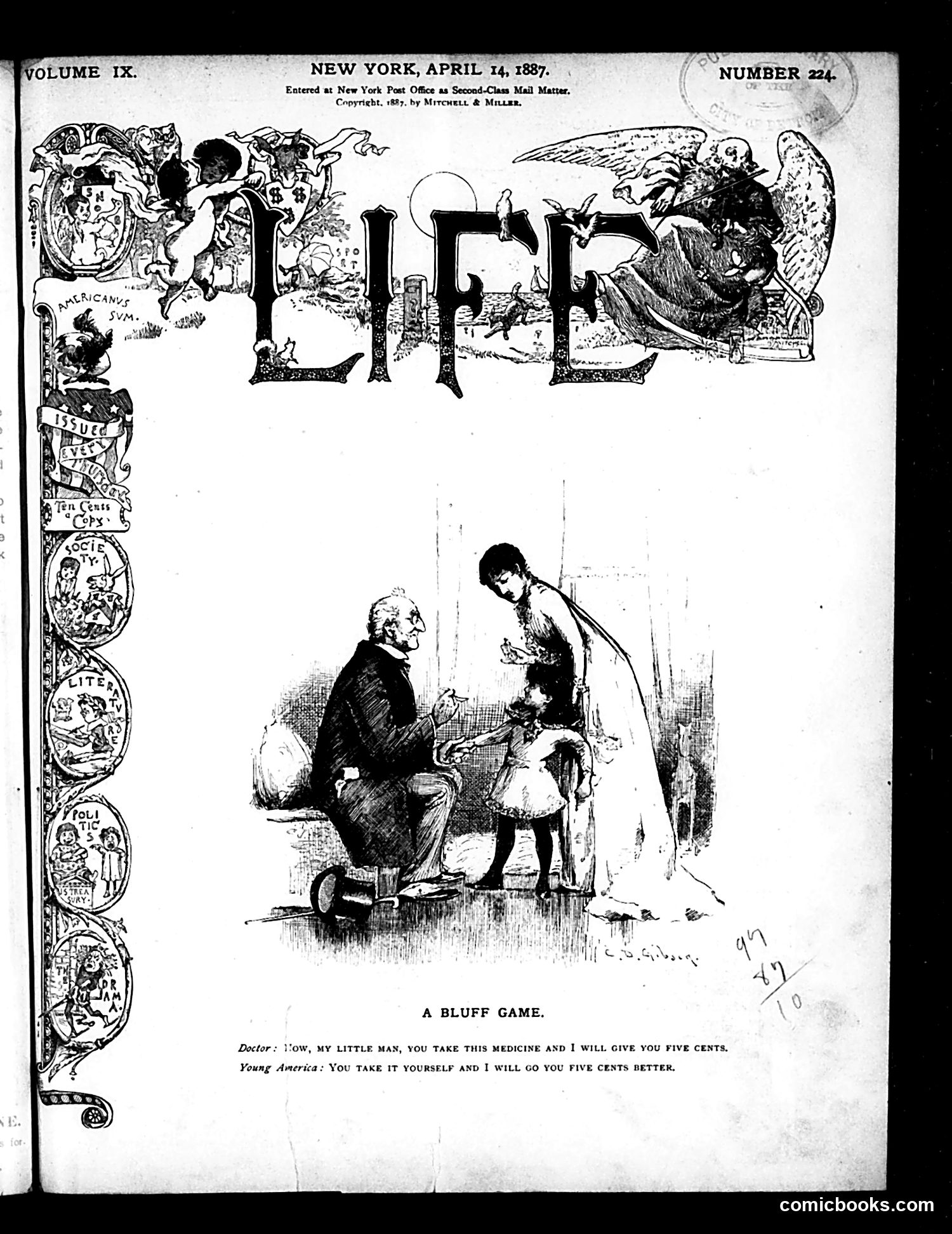
This cartoon satirizes a negotiation between a doctor and a young patient (representing "Young America"). The doctor offers the child medicine in exchange for five cents. The child counters by proposing to take the medicine himself and pay the doctor only five cents "better"—essentially calling the doctor's bluff by suggesting he'll get the same result cheaper. The satire likely critiques either medical practitioners overcharging patients, or more broadly, American business practices of the era where shrewd negotiation was becoming standard. "Young America" represents the nation's emerging commercial shrewdness, outmaneuvering an established authority figure through clever bargaining. The title "A Bluff Game" emphasizes this was about strategic deception in commerce.
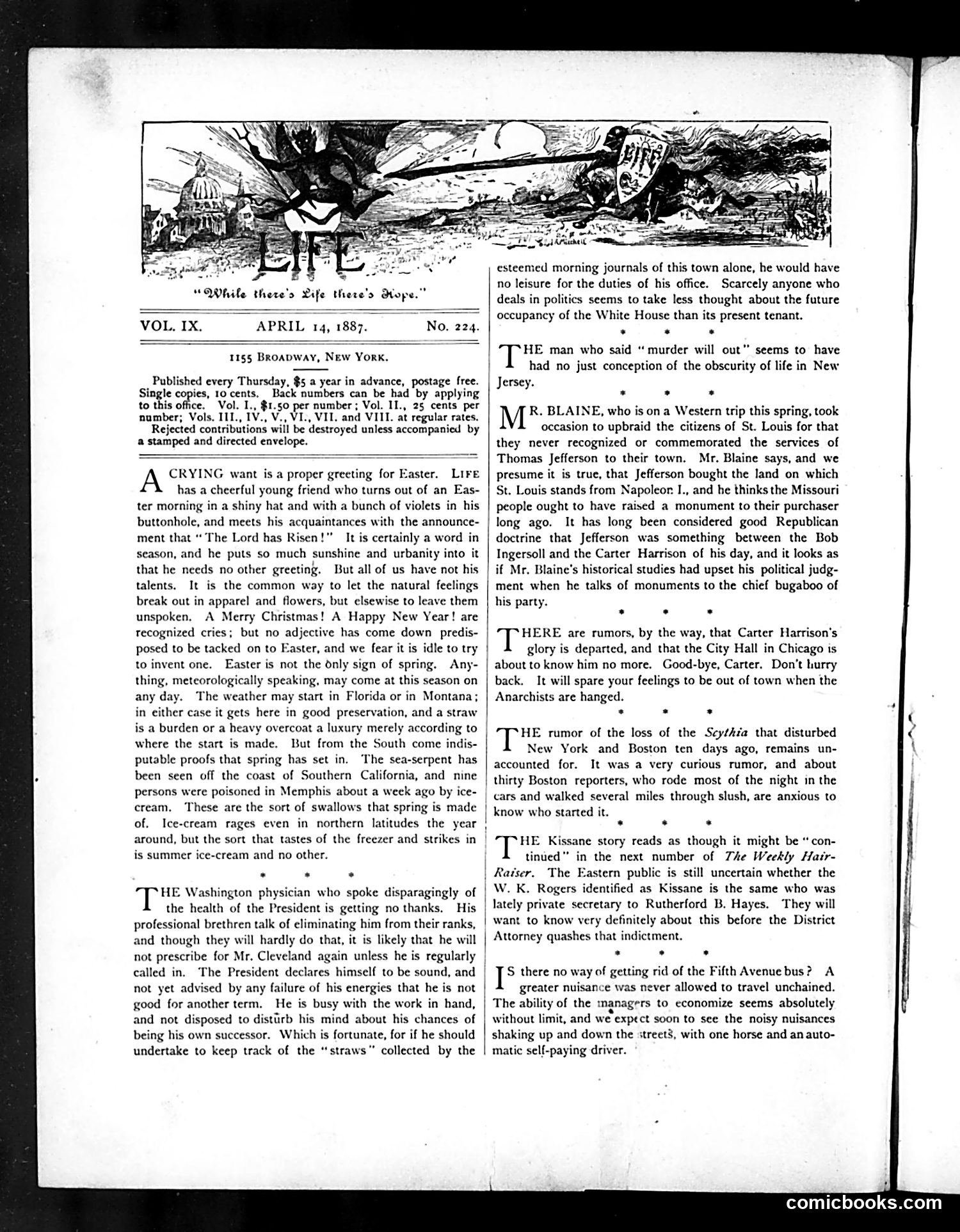
The masthead cartoon depicts a pastoral landscape with the caption "While there's Life there's Hope," establishing the magazine's cheerful satirical tone. The text discusses contemporary political and social matters, including criticism of President Cleveland's health and his fitness for office. One passage mocks a Washington physician who spoke publicly about eliminating Cleveland from political consideration. The page also references disputes about transportation (the Fifth Avenue bus), rumors about the steamship *Scythia*, and mentions of Mr. Blaine's historical claims about Thomas Jefferson and St. Louis. The content is primarily political commentary and gossip rather than visual satire—typical of *Life*'s format as a weekly magazine mixing illustrated cartoons with satirical editorial commentary on current events and public figures.
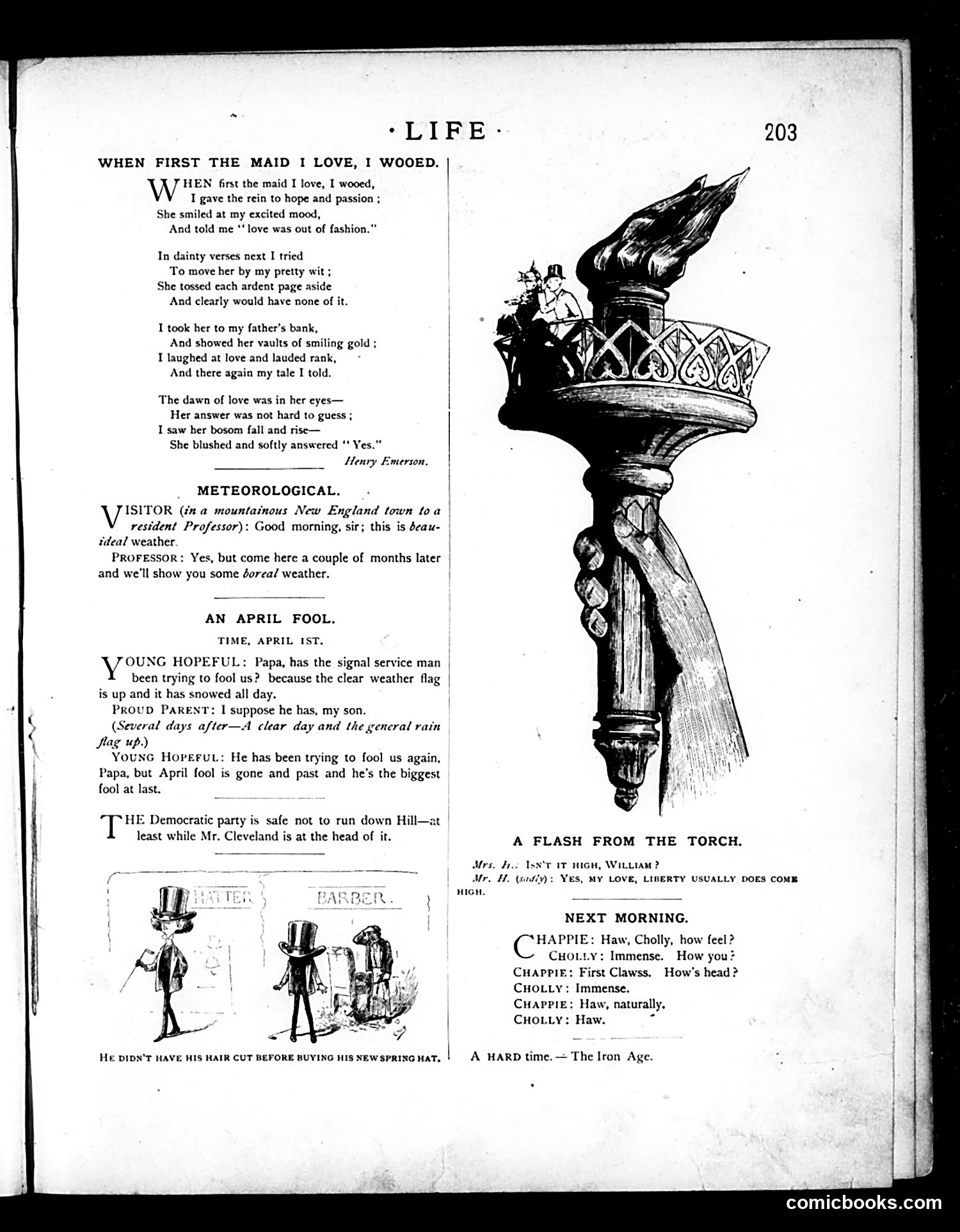
This page contains several distinct pieces: 1. **"When First the Maid I Love, I Wooed"** — A romantic poem by Henry Emerson about courtship, with no apparent political satire. 2. **"Meteorological"** — A brief dialogue joke about a New England professor predicting "boreal weather" months later. 3. **"An April Fool"** — A comic sketch where a "Young Hopeful" mistakes his father's weather flag signal for foolery, only to discover April rain arrived as predicted. The humor depends on misreading signs and failed expectations. 4. **Political line** — One sentence references Cleveland and the Democratic party, but lacks context. 5. **"A Flash from the Torch"** and **"Next Morning"** — Dialogue snippets, possibly continuations of illustrated scenes (unclear without full context). 6. **Bottom cartoon** — Shows figures about a new spring hat purchase. The page mixes light humor, weather jokes, and brief political commentary typical of 1880s-90s satirical magazines.
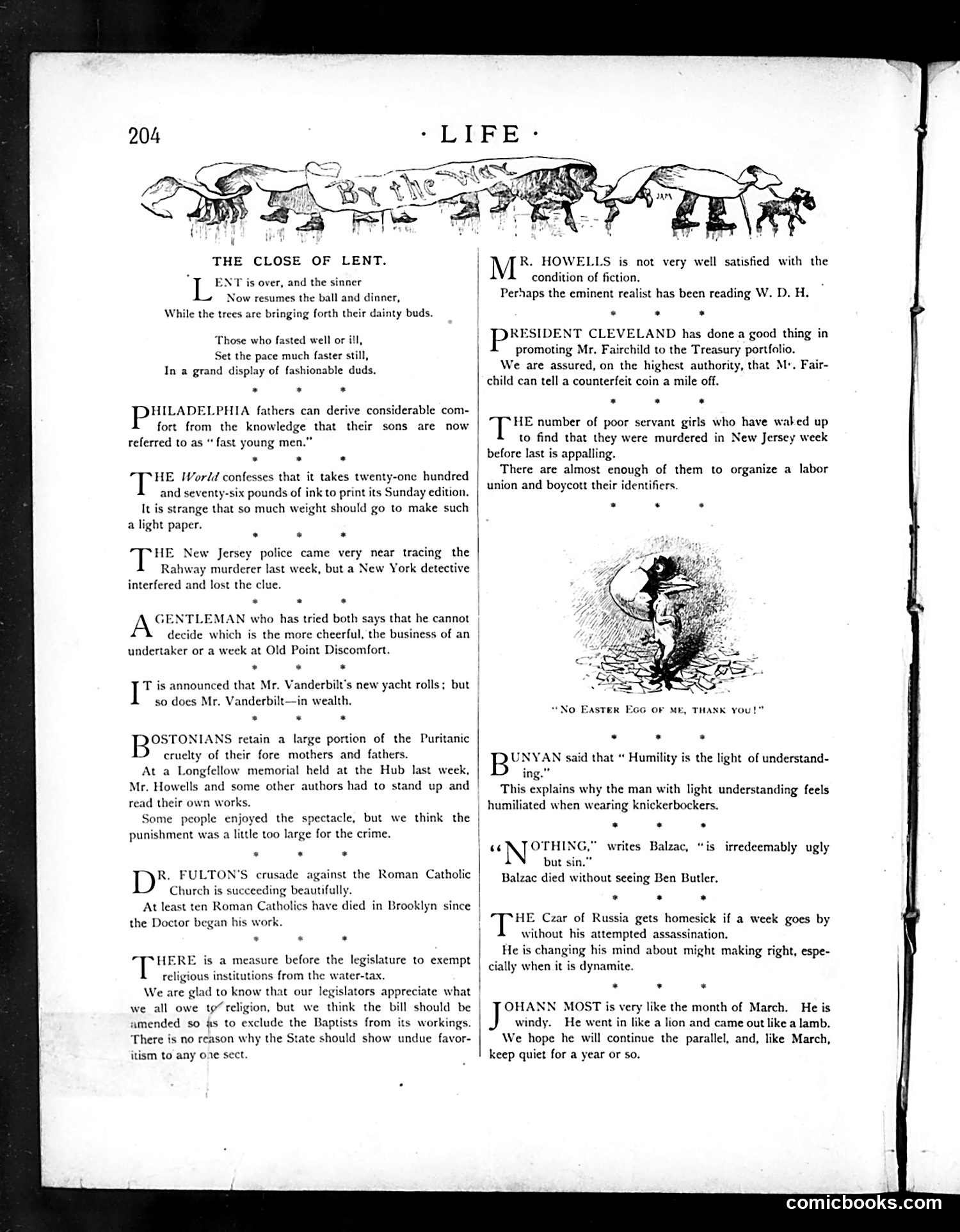
This page contains satirical commentary and a cartoon rather than political caricature. The top decorative border shows animals in various poses, setting a humorous tone. The main cartoon, captioned "No Easter Egg of Me, Thank You!" depicts a bird (likely a chicken or similar fowl) rejecting an egg—a visual pun on Easter traditions and perhaps commentary on reproductive anxieties or commercialization of holidays. The accompanying text consists of brief satirical observations on contemporary issues: Dr. Fulton's anti-Catholic activism, legislative exemptions for religious institutions, Johann Most's erratic political behavior, Russian assassination attempts, and servant girls organizing labor in New Jersey. These items exemplify Life's style of short, witty social commentary on current events and personalities.
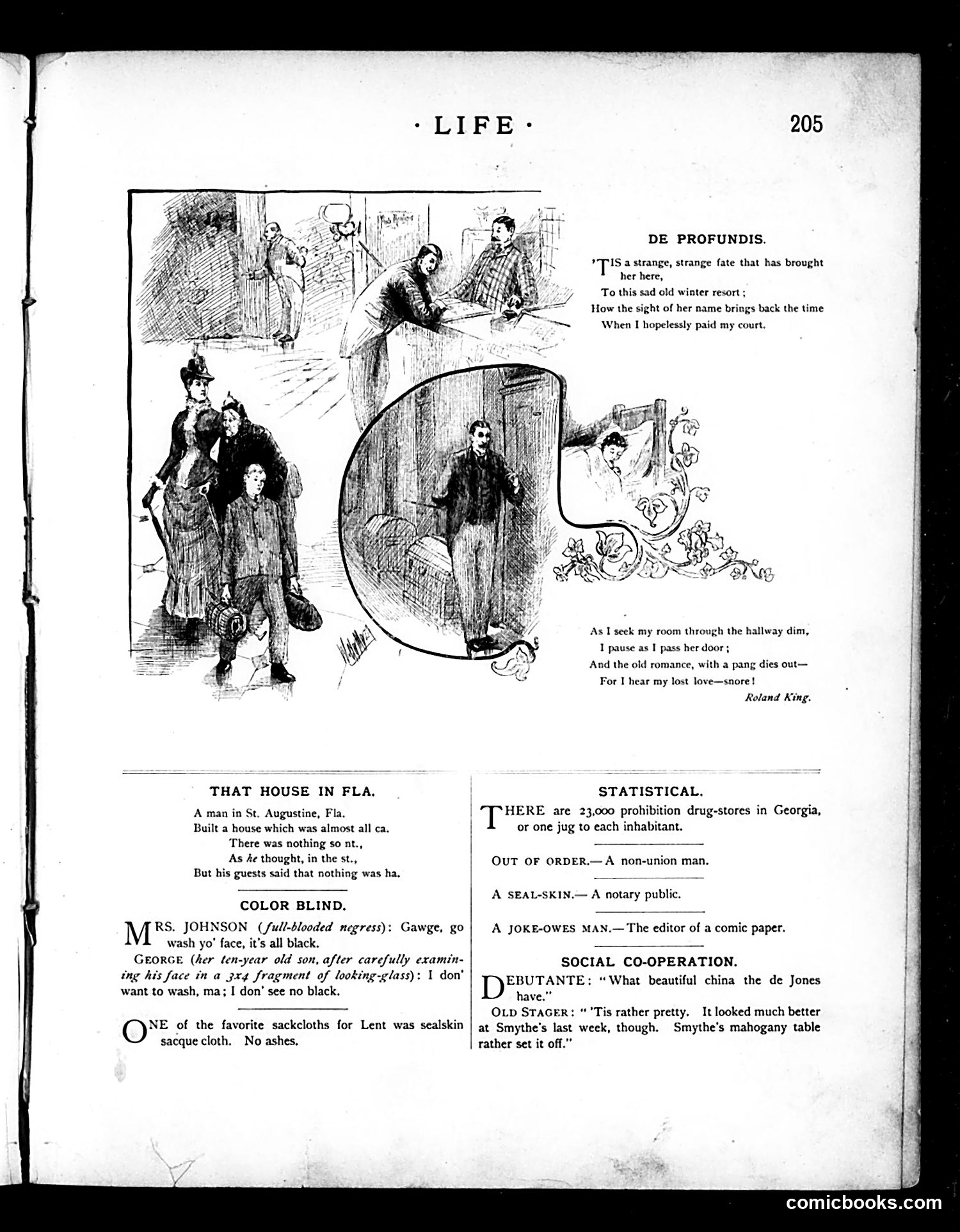
The main cartoon titled "De Profundis" depicts a man in a room, with a woman visible through a doorway. The accompanying poem suggests a romantic or domestic conflict—the narrator regrets a lost love and hears snoring, implying his romantic partner has moved on or rejected him. Below are several brief satirical items: - "That House in Fla." mocks a man who built a house "which was almost all call" but whose guests find it has nothing—wordplay on the emptiness of the structure. - "Color Blind" jokes about Mrs. Johnson (described as "full-blooded negress") and George discussing whether black items are actually black—crude racial humor typical of the era. - "Statistical" and other sections contain period-specific one-liner jokes about unions, notaries, and newspapers.
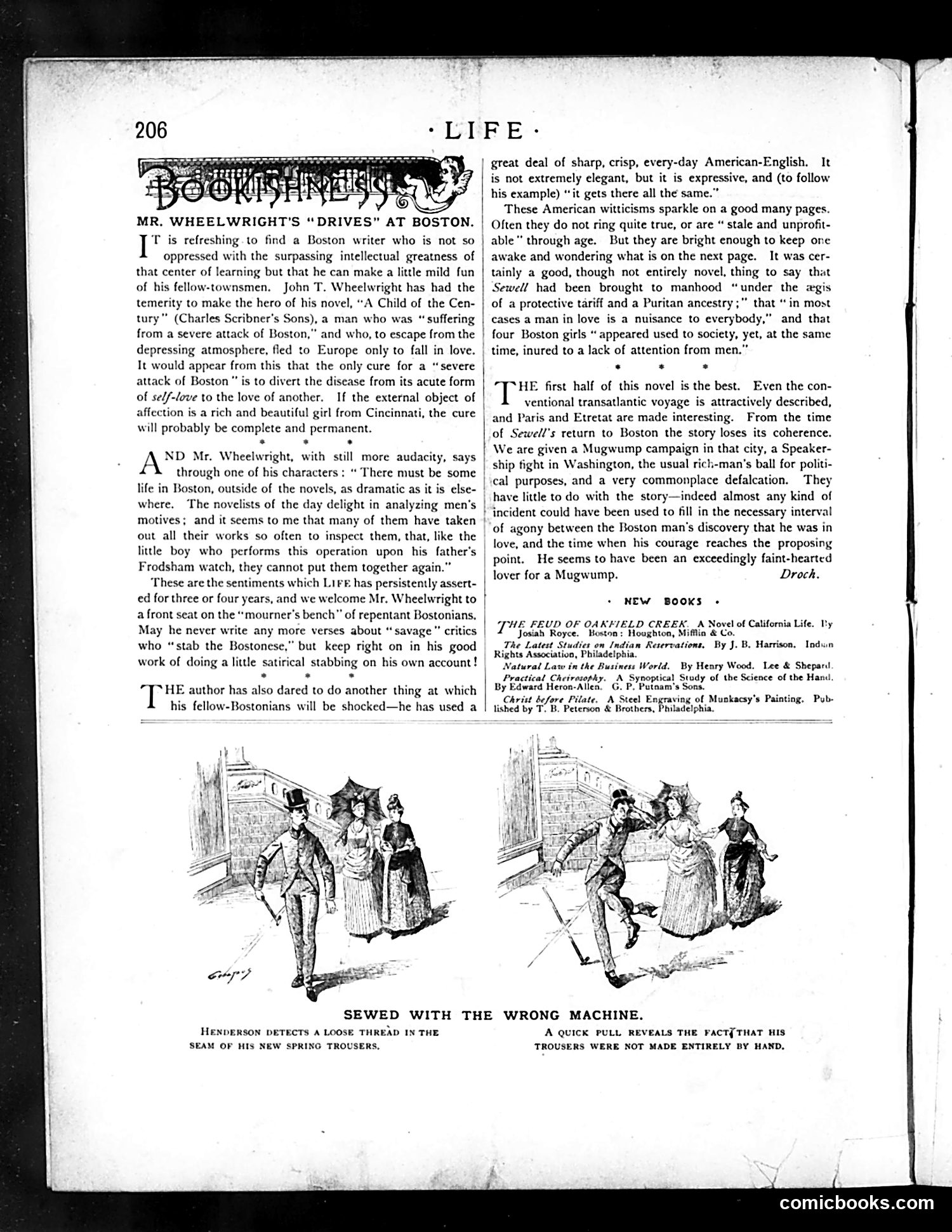
This page contains a book review section titled "Book Shelf" discussing Mr. Wheelwright's novel "Drives" set in Boston. Below the review are two accompanying illustrations captioned "SEWED WITH THE WRONG MACHINE." The cartoons humorously depict a character named Henderson who discovers his new spring trousers have a loose thread. The left image shows Henderson detecting the problem, while the right reveals the embarrassing truth: his trousers were sewn by machine rather than entirely by hand—a social gaffe suggesting inferior tailoring or quality. The satire mocks Victorian-era expectations about gentlemen's fashion and craftsmanship, where handmade garments signified respectability and wealth. The cartoon's humor relies on the contrast between Henderson's seemingly respectable appearance and the discovery of this mechanical shortcut, exposing pretense about social status through clothing.
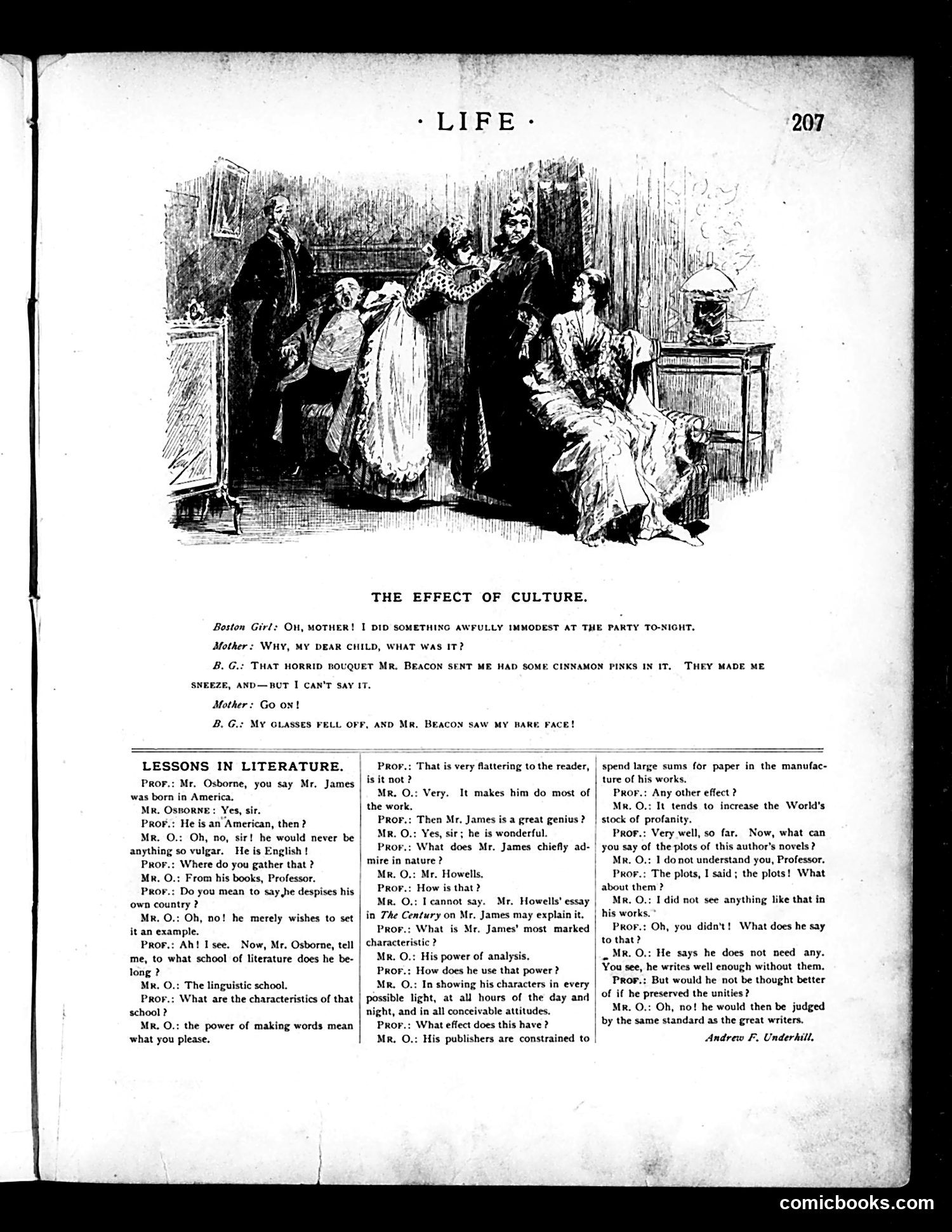
This cartoon satirizes pretentiousness and social climbing among Boston's wealthy elite. A young "Boston Girl" confesses to her mother that she caused an embarrassing incident at a formal party: she sneezed after smelling cinnamon in Mr. Beacon's bouquet, causing her glasses to fall off and expose her bare face to Mr. Beacon's view. The humor lies in the collision between "culture" (refined society, formal etiquette) and bodily reality. The girl's concern about propriety—her mortification at being seen without glasses—undercuts the pretense that Boston society maintains. The satire mocks how seriously the upper class takes appearances and decorum, suggesting their "culture" is fragile and easily disrupted by natural, undignified human moments.
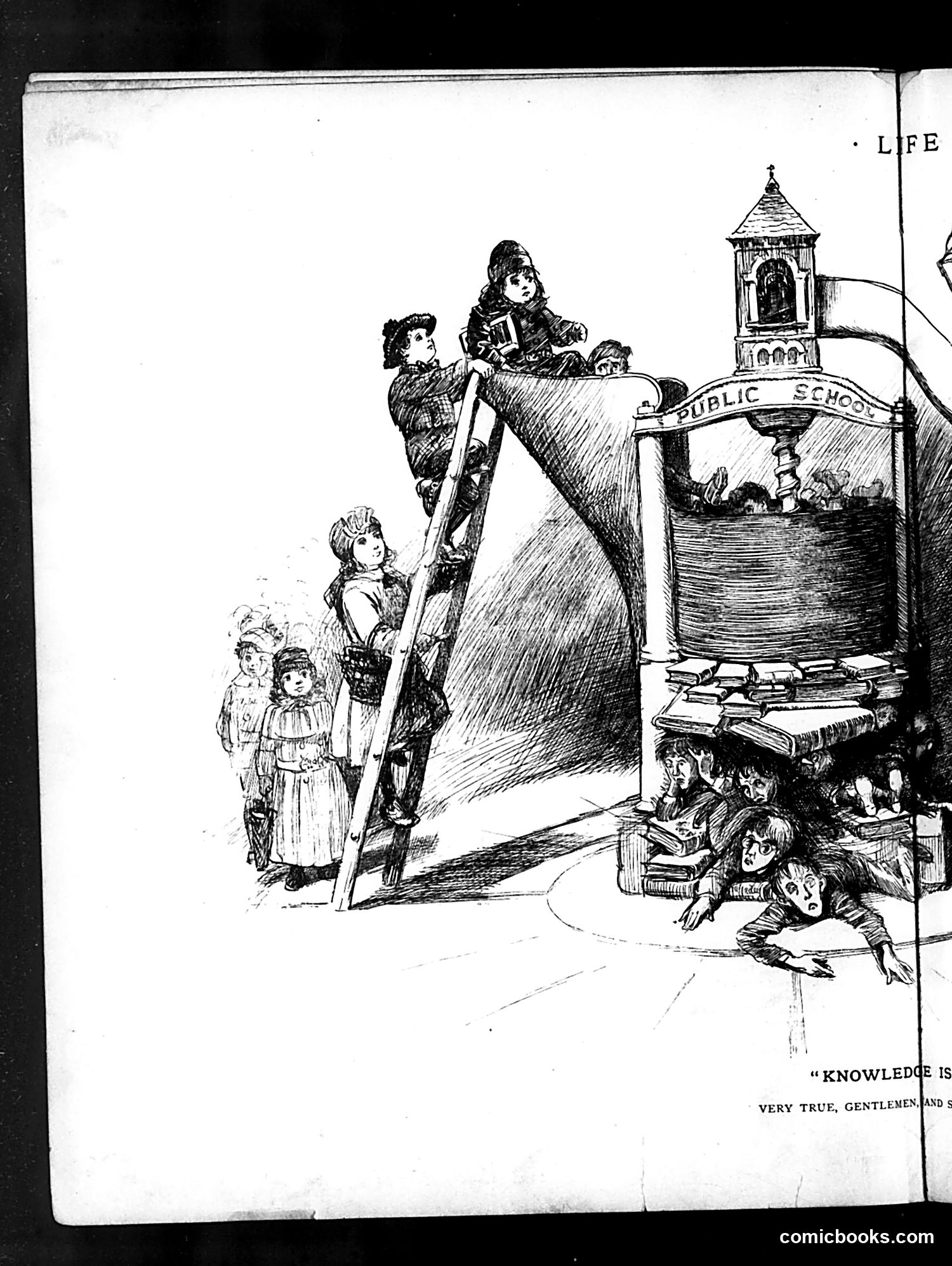
This illustration satirizes educational inequality in America. A wealthy, well-dressed woman (likely representing Education or Privilege) stands atop a precarious ladder, distributing knowledge to children climbing below her. The Public School building looms in the background. The satire critiques how education was accessed unequally: wealthy children could reach higher education through their advantages, while poor children (shown struggling at the ladder's base) faced obstacles. The unstable ladder symbolizes the fragile, unequal system itself. The caption—cut off but beginning "Knowledge is very true, gentlemen, and so..."—appears ironic, suggesting that while knowledge claims to be universally valuable, the illustration demonstrates it remains accessible only to those already privileged enough to climb.
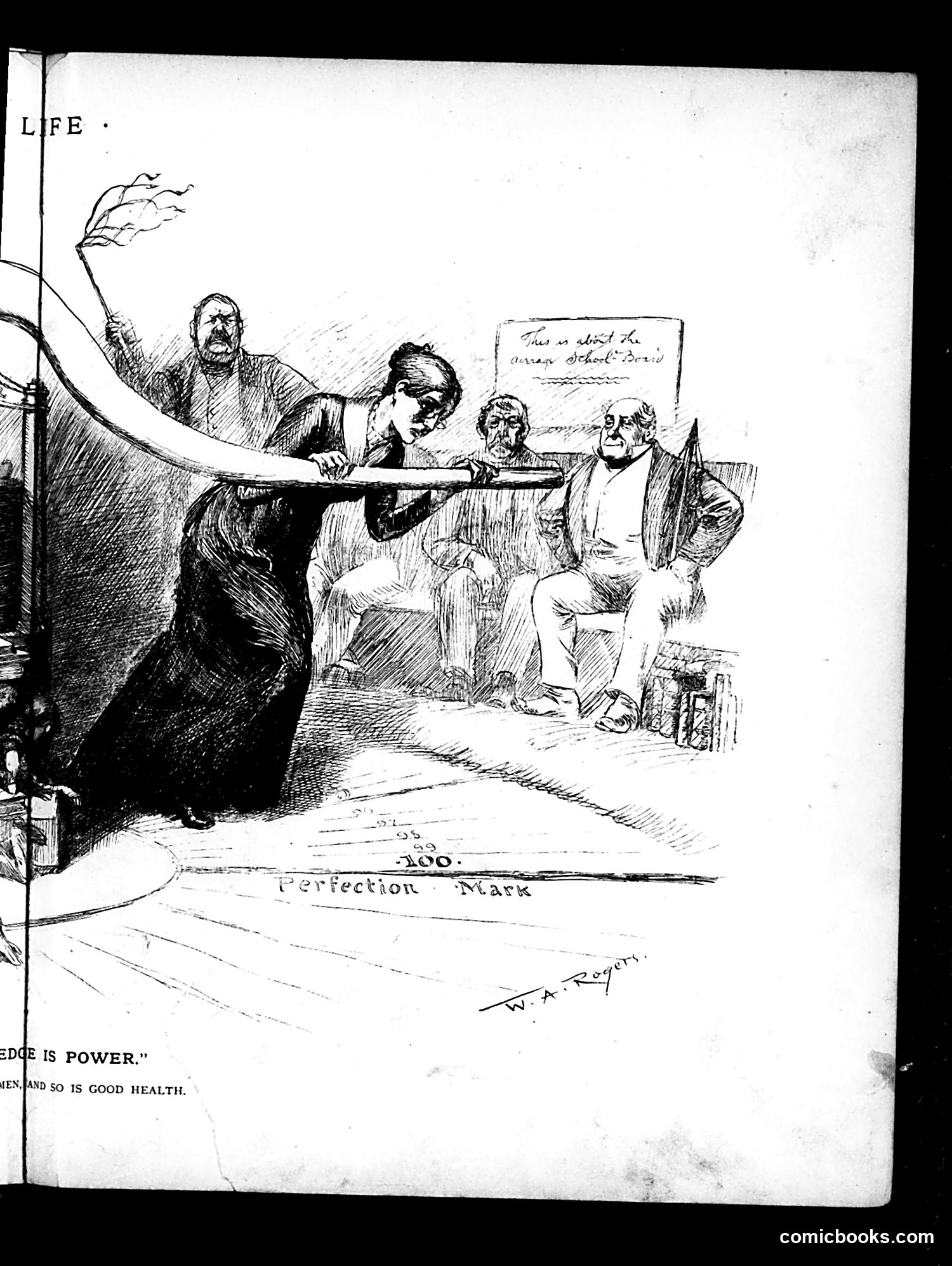
This W.A. Rogers cartoon satirizes what appears to be a quality-control or standards-setting meeting. A figure on the left holds up a measuring instrument or ruler, presenting it to four seated men who examine his work. One man holds a sign reading "This is about the nearest approach" (text unclear). The caption "Perfection Mark" suggests ironic commentary on claims of achieving perfection or meeting an impossible standard. The cartoon likely critiques either industrial/manufacturing standards, political policy-making, or professional standards-setting of the era, mocking the gap between aspirations and reality. The specific figures and context remain unclear without additional historical documentation about Life magazine's contemporary issues.
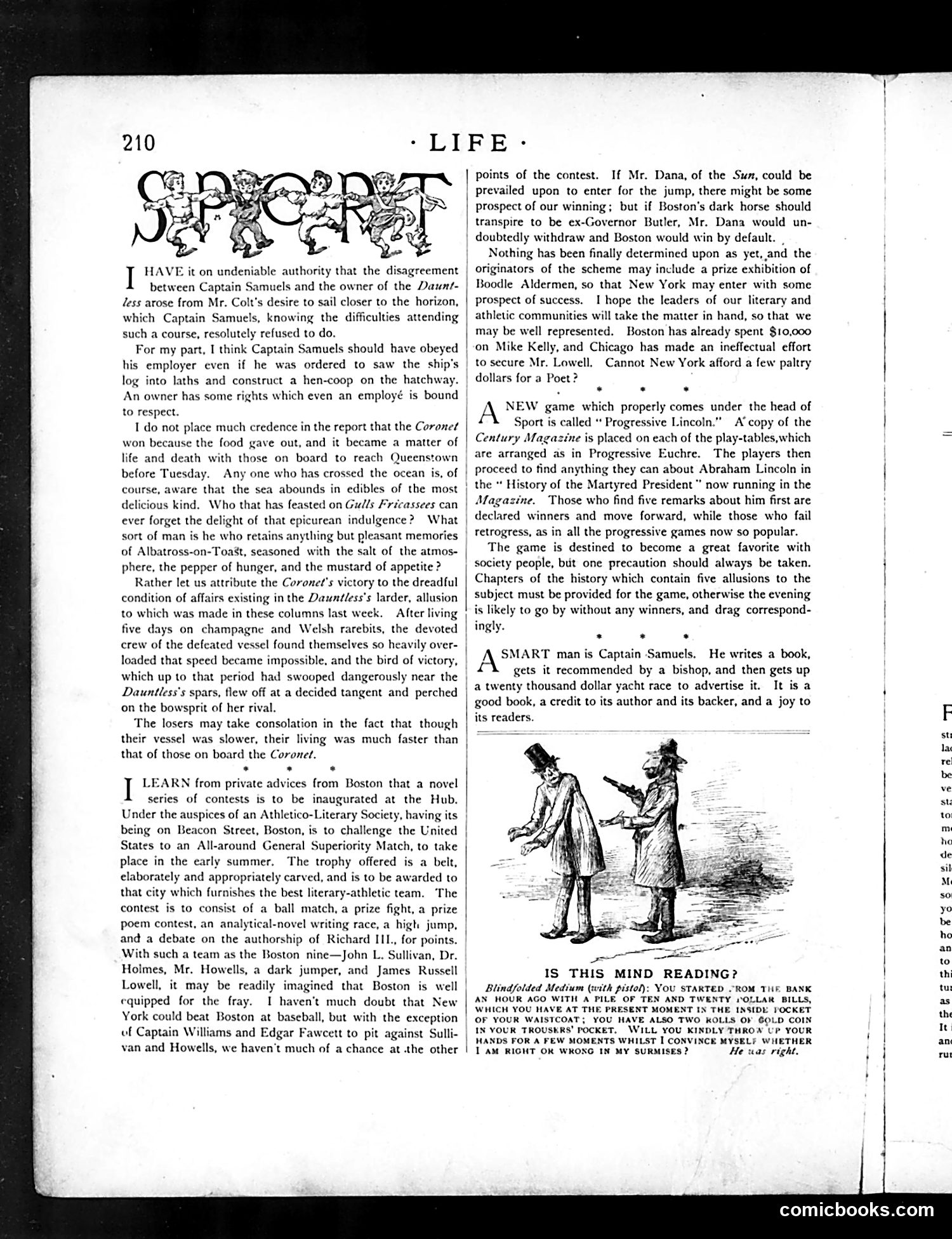
This cartoon depicts a "Blindfolded Medium (with pistol)" performing a trick for a skeptical observer. The medium claims to read minds by identifying objects (bank notes, dollar bills, a waistcoat, gold coins, trousers) that the observer is thinking about—all while blindfolded and holding a pistol. The satire targets spiritualism and fraudulent mediums who were popular entertainment in this era. The absurdity of the setup—particularly the pistol and the mundane objects—mocks both the mediums' claimed supernatural powers and the gullibility of believers who paid to witness such "performances." The joke suggests the medium is using obvious guessing or confederates rather than genuine psychic ability.
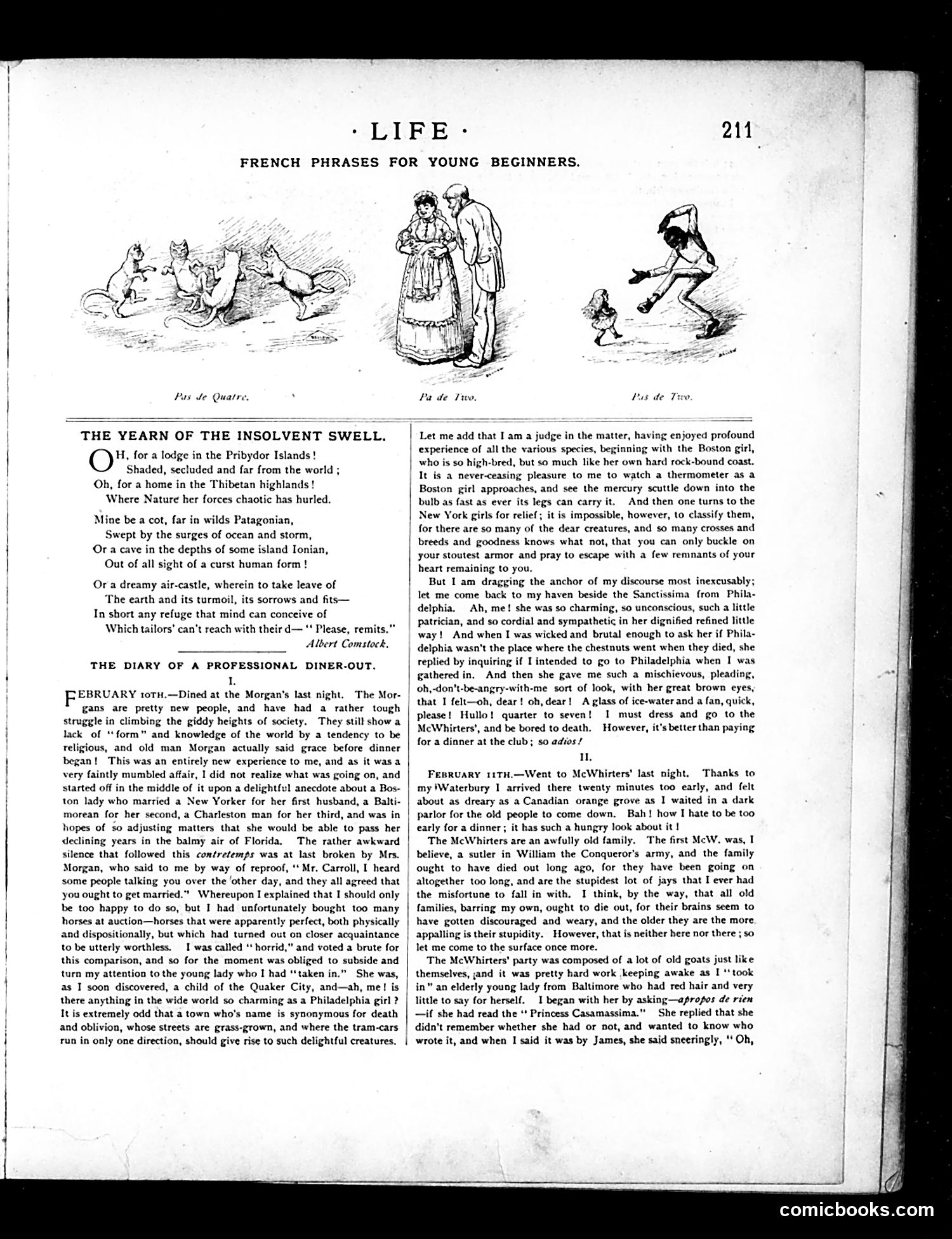
This page from Life magazine contains three distinct satirical pieces: **"French Phrases for Young Beginners"** (top): Three small illustrations labeled with French dance terms ("Pas de Quatre," "Pas de Deux," "Pas de Trois") humorously depict children engaged in crude, ungraceful physical activities rather than refined dancing—satirizing pretentious attempts to teach "culture" to the young. **"The Yearn of the Insolvent Swell"** (poem): Mocks a financially desperate wealthy person ("swell") fantasizing about exotic escapes to avoid debt collectors ("tailors' can't reach"). The satire targets frivolous aristocrats who spend beyond means. **"The Diary of a Professional Diner-Out"** (prose): Ridicules a social climber who freeloads at wealthy hosts' dinner parties while being oblivious, rude, and self-absorbed. He offends his hosts (interrupting prayer, making inappropriate remarks), yet remains smugly confident. The satire critiques both shallow society figures and parasitic hangers-on seeking free meals. All three pieces mock pretension and financial irresponsibility among the wealthy and social-climbing classes.
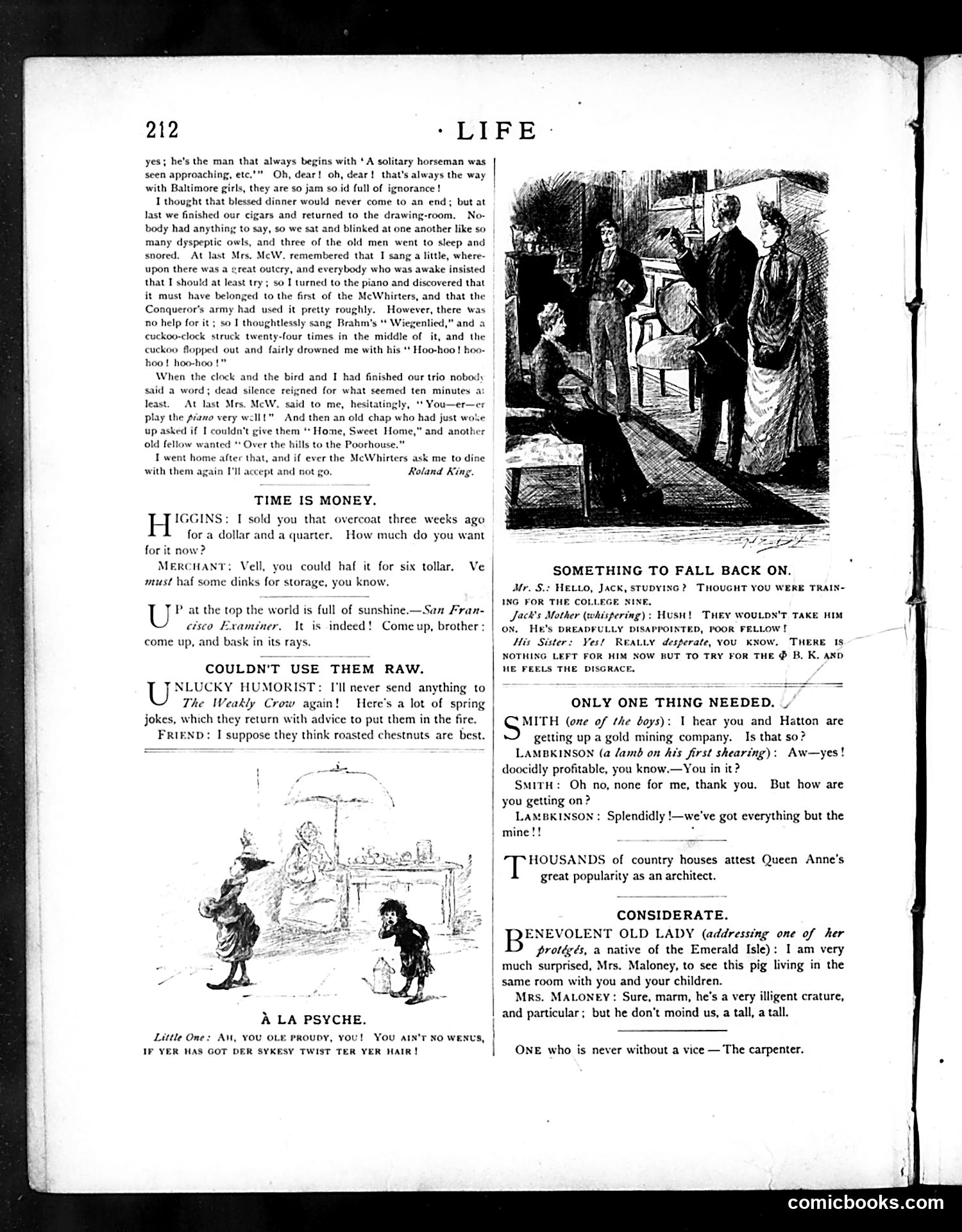
This page from the satirical magazine *Life* contains several short humorous dialogues and one cartoon mocking social pretension and human folly: **"Time is Money"**: A merchant exploits a customer by charging inflated storage fees for an overcoat, demonstrating petty greed. **"Couldn't Use Them Raw"**: A editor rejects amateur jokes as unsuitable, suggesting they'd only be useful if roasted—mocking failed humorists. **"À la Psyche"**: A crude cartoon shows a street child mocking a vain woman's pretensions to beauty, with dialect humor typical of period comedy. **"Something to Fall Back On"**: A young man, rejected from college athletics, must resort to studying—portrayed as humiliating desperation for the middle class. **"Only One Thing Needed"**: Satirizes naive entrepreneurs: a "lamb" (inexperienced investor) enthusiastically joins a gold mining venture—despite having no actual mine. **"Considerate"**: An Irishwoman casually mentions her pig shares the family's living quarters; working-class poverty is treated as quaint rather than serious. The humor reflects period class attitudes and ethnic stereotyping.
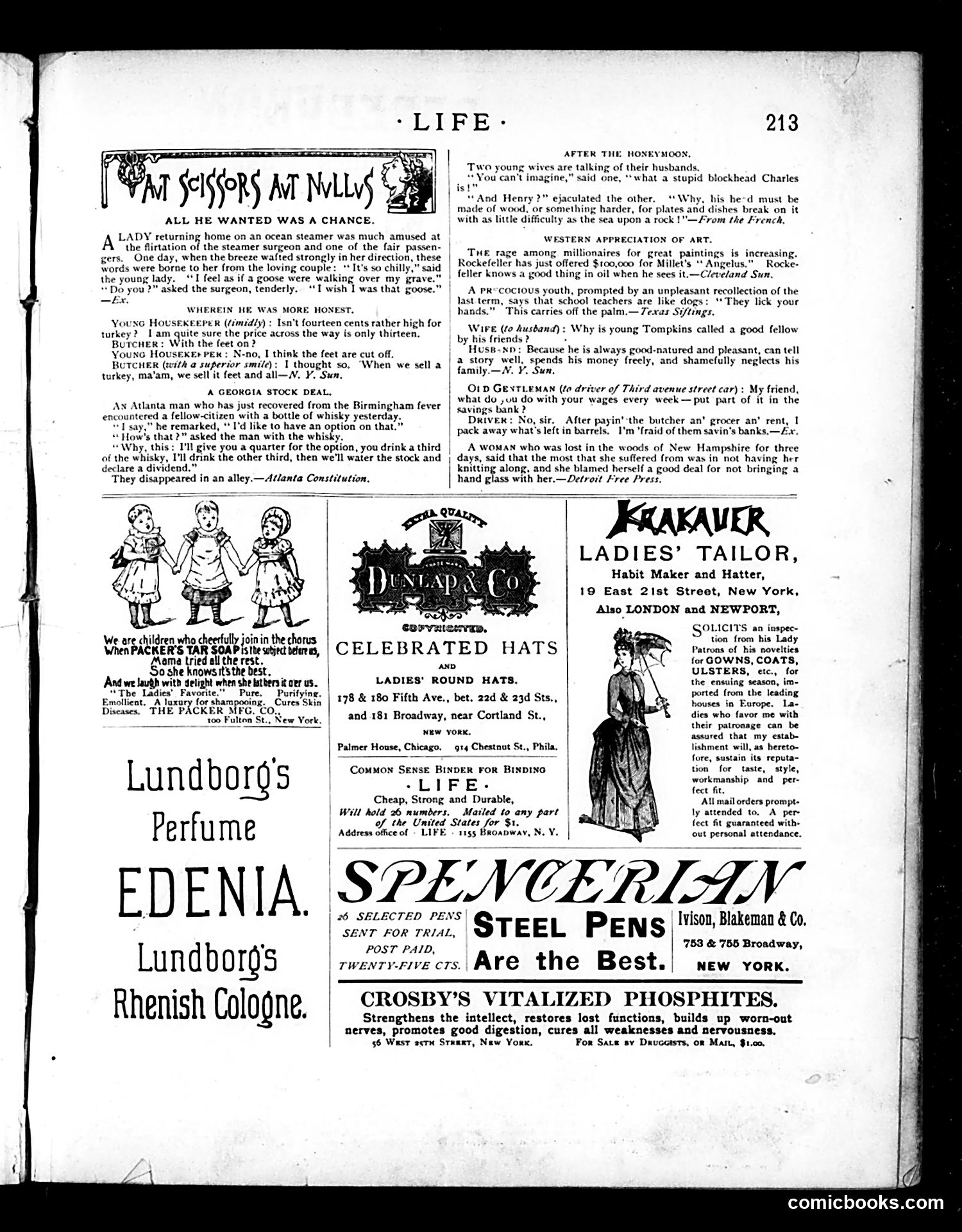
This page contains several brief satirical anecdotes typical of *Life* magazine's humor style: **"All He Wanted Was a Chance"**: A shipboard flirtation joke where a surgeon attempts to seduce a female passenger using mild flattery about wishing to be a "goose" walking over her grave—Victorian-era romance humor. **"Wherein He Was More Honest"**: A butcher joke exploiting class differences. A housekeeper complains about turkey prices; the butcher explains his costs higher because he sells whole turkeys with feet, implying competitors cut corners or deceive customers. **"A Georgia Stock Deal"**: Satirizes financial speculation and stock manipulation. Two Georgians scheme to profit from whisky by diluting it ("watering the stock") then falsely declaring dividends—a metaphor for fraudulent investment practices. **"After the Honeymoon"** and other anecdotes mock marriage, male stupidity, and domestic disappointment—common *Life* themes. The page is primarily **advertising** (perfumes, pens, tailoring services), with humor filling remaining space. No identifiable political figures appear; instead, these are generic social satires reflecting early 20th-century American attitudes.
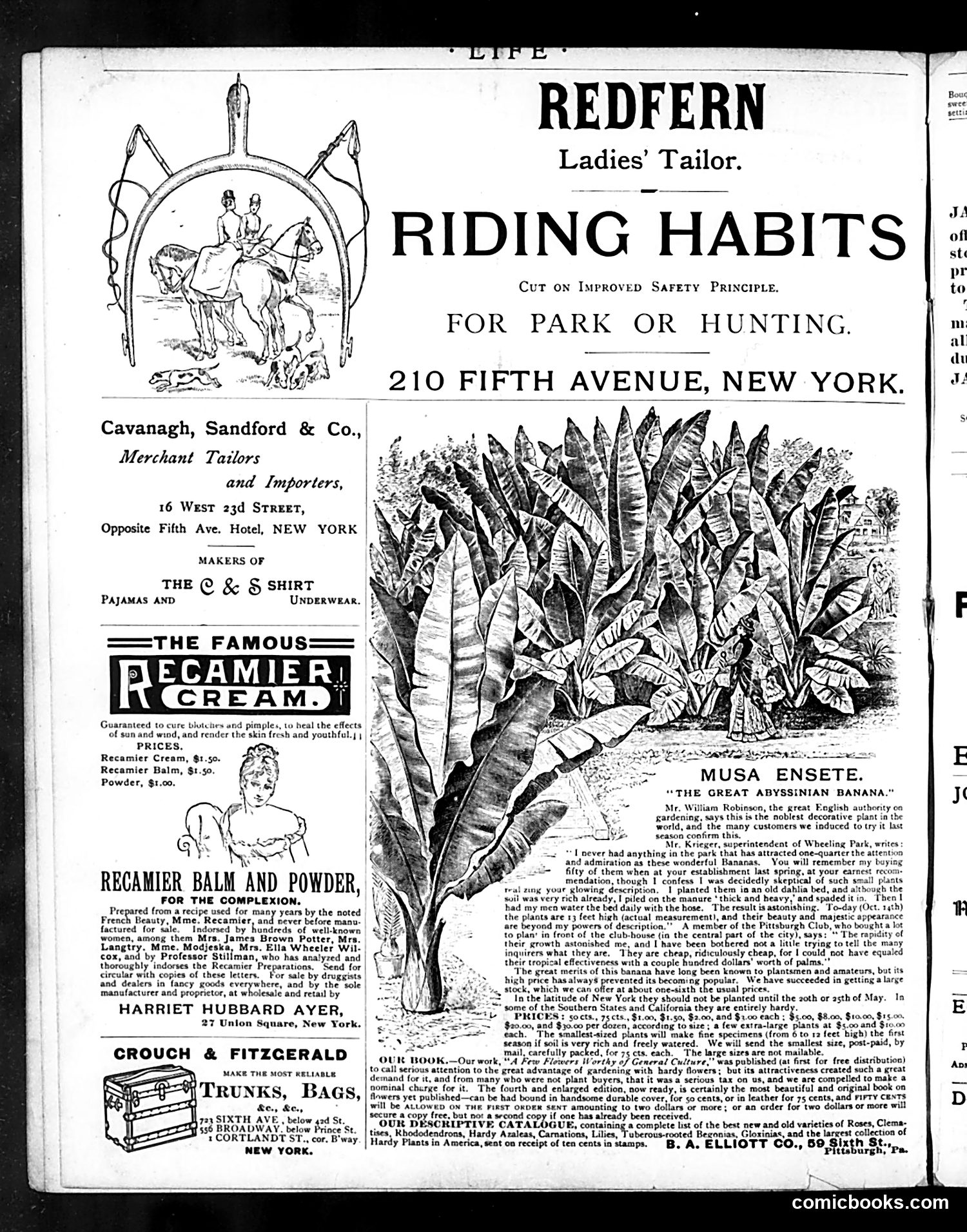
This is primarily an **advertising page** from Life magazine, not a political cartoon. It contains multiple period advertisements (circa 1890s) with minimal satirical content. The main elements are: **Advertisements featured:** - Redfern: A ladies' tailor advertising "riding habits" designed with "improved safety principle" for park or hunting—reflecting the era's concern with women's fashion in sports - Recamier Cream/Balm: Cosmetics endorsed by celebrity women of the time (Mrs. Langtry, Mme. Modjeska) - Crouch & Fitzgerald: Luggage manufacturer - Musa Ensete: A banana plant seller marketing the "Great Abyssinian Banana" as a decorative plant, with testimonials about its rapid growth **Historical context:** These ads reflect Gilded Age consumer culture and the emerging market for specialty goods. The riding habit ad notably emphasizes "safety"—indicating growing female participation in sports and contemporary debates about appropriate women's clothing. No political satire or caricature is evident on this page.
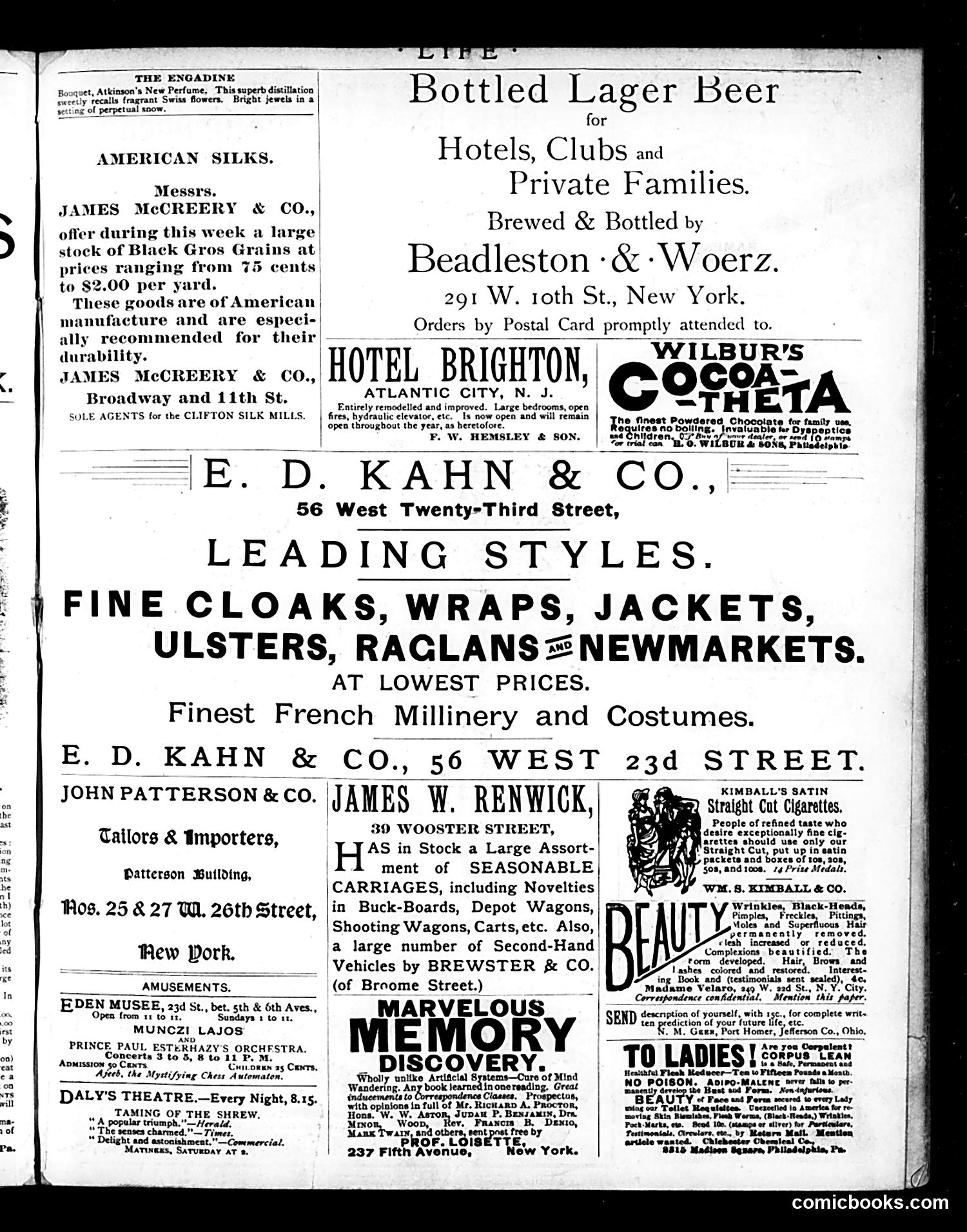
This is primarily a **commercial advertisement page** from *Life* magazine, not a satirical cartoon page. It contains classified ads and business notices for late-19th-century New York establishments—clothing retailers (E.D. Kahn & Co., James McCreery), hotels, carriages, theaters, and patent medicines. The only potentially satirical element is **"Marvelous Memory Discovery"** (center), a dubious self-help course promising to cure forgetfulness and improve mental powers—typical of the era's often-fraudulent mail-order schemes that *Life* would normally mock. However, presented here as a straightforward ad, its satirical intent (if any) remains unclear from this page alone. The rest consists of legitimate period advertising: silk goods, carriages, theater shows, and cosmetic products typical of 1880s-90s consumer culture. No identifiable political figures or events appear.
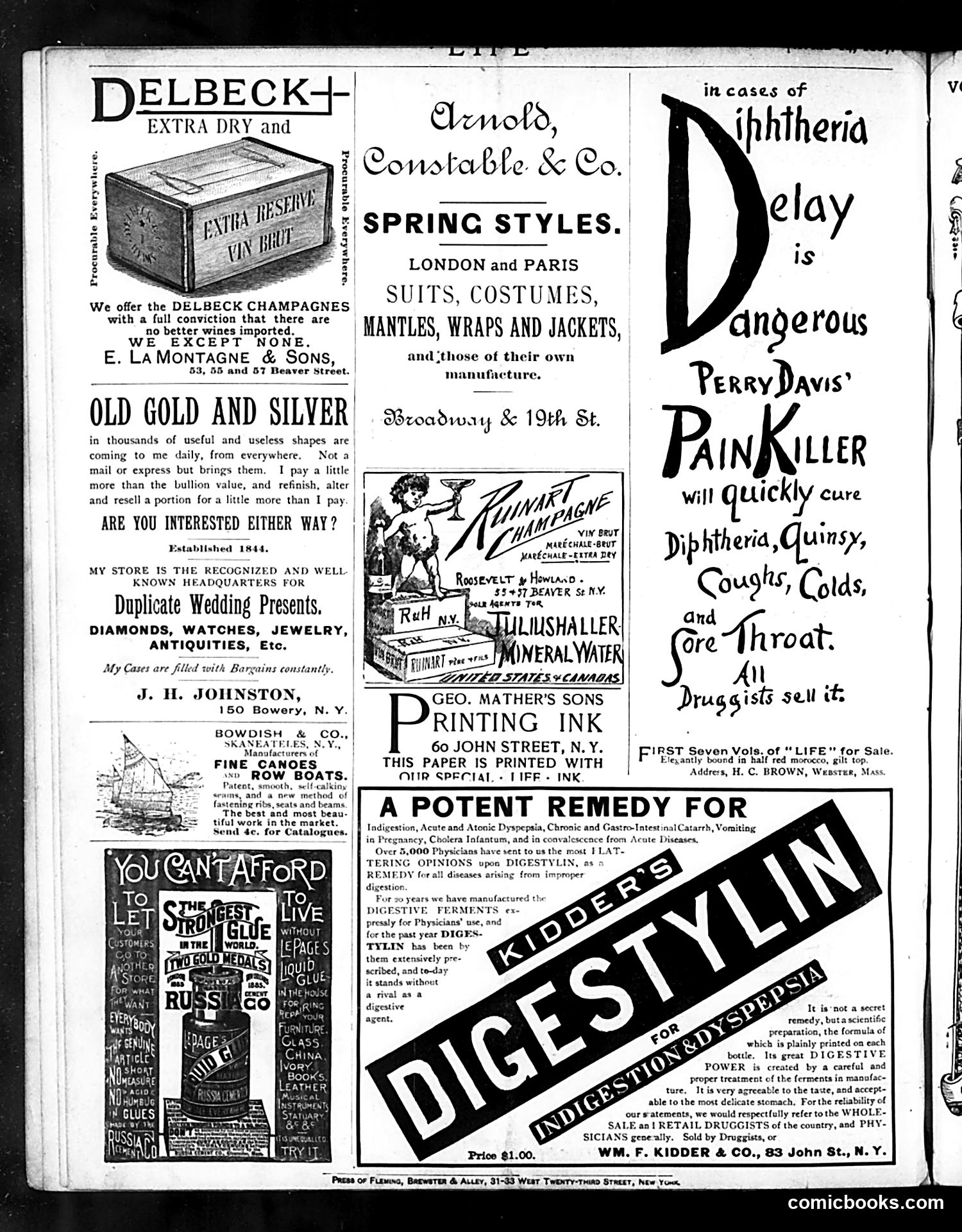
This page is **entirely advertisements**—no editorial cartoons or satirical content. It's a collection of late 19th-century commercial pitches typical of *Life* magazine's revenue model. Notable ads include: - **Champagne and jewelry dealers** (Delbeck, J.H. Johnston) - **Perry Davis' Painkiller**: A patent medicine claiming to cure diphtheria, quinsy, coughs, and colds—representative of the era's unregulated medical claims before FDA oversight - **Digestylin**: Another patent remedy for indigestion, citing endorsements from "5,000 Physicians" to appear credible - **Printing ink and fine canoes** The humor for modern readers lies in the **brazen medical claims** on unproven remedies sold directly to consumers. These ads illustrate why the Pure Food and Drug Act (1906) became necessary—such products were marketed without evidence, often containing dangerous ingredients. The page reflects an era before advertising regulation, when magazines profited heavily from patent medicine promotions.