
Life, 1887-04-14 · page 7 of 16
Life — April 14, 1887 — page 7: what you’re looking at
What you’re looking at
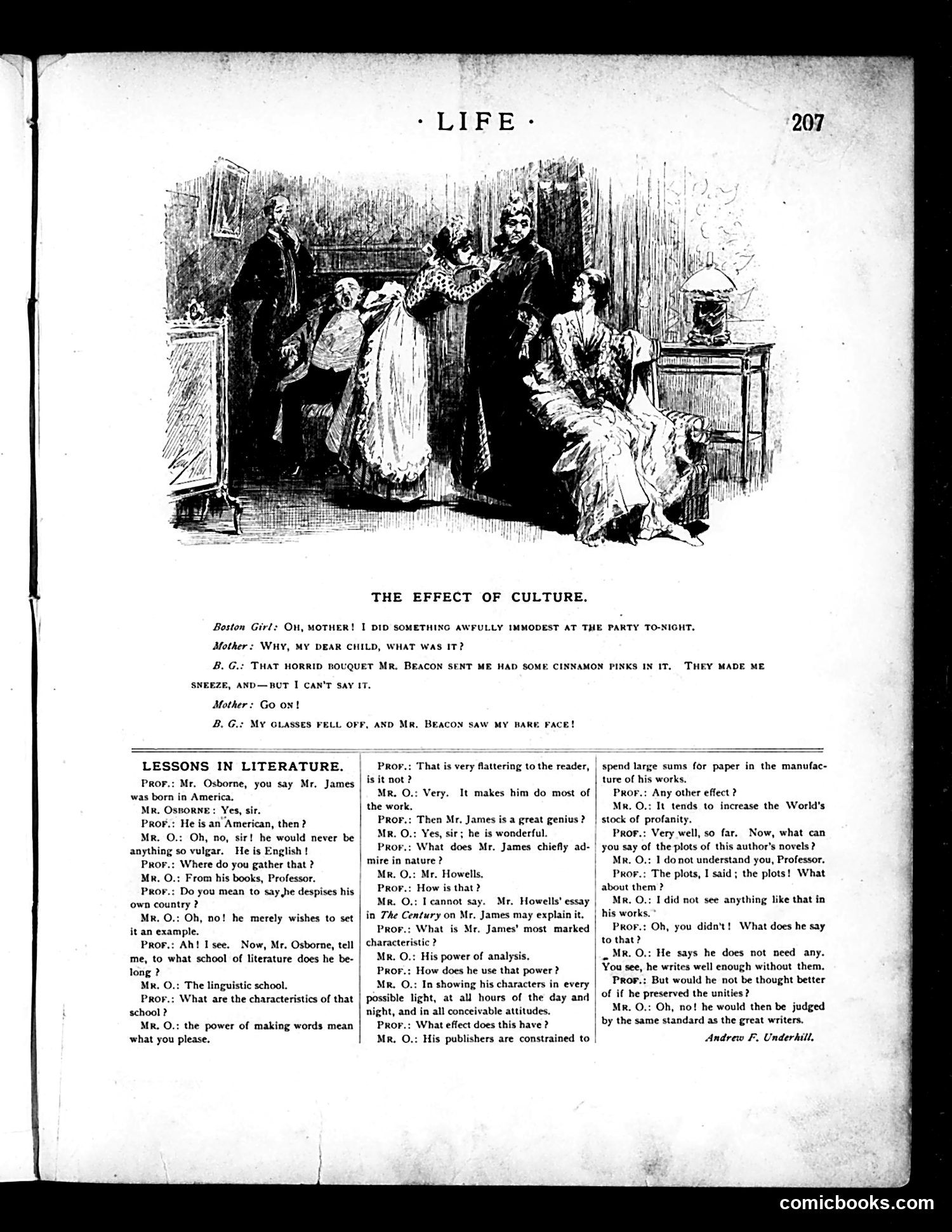
This cartoon satirizes pretentiousness and social climbing among Boston's wealthy elite. A young "Boston Girl" confesses to her mother that she caused an embarrassing incident at a formal party: she sneezed after smelling cinnamon in Mr. Beacon's bouquet, causing her glasses to fall off and expose her bare face to Mr. Beacon's view. The humor lies in the collision between "culture" (refined society, formal etiquette) and bodily reality. The girl's concern about propriety—her mortification at being seen without glasses—undercuts the pretense that Boston society maintains. The satire mocks how seriously the upper class takes appearances and decorum, suggesting their "culture" is fragile and easily disrupted by natural, undignified human moments.
📄 Transcribed text from this page (OCR, searchable)
Machine-transcribed from the original scan — historical spelling and the odd misread are preserved.
THE EFFECT OF CULTURE. Boston Girt: Ou, MOTHER! I DID SOMETHING AWFULLY IMMODEST AT THE PARTY TO-NIGHT. Afother : WHY, MY DEAR CHILD, WHAT WAS IT? &.G.: THAT HORRID BOUQUET MR. BEACON SENT ME HAD SOME CINNAMON PINKS IN IT. THEY MADE ME SNEEZE, AND—BUT I CAN'T SAY IT. Mother: Go ont zB LESSONS IN LITERATURE. Pror.: Mr. Osborne, you say Mr. James was born in America. Mr. Osborne: Yes, sir. ProF.: He is an American, then? Mr. O.: Oh, no, sir! he would never be anything so vulgar. He is English ! Pror.: Where do you gather that ? Mr. O.: From his books, Professor. Pror.: Do you mean to say he despises his own country ? Mr. O.: Oh, no! he merely wishes to set it an example. Pror.: Ah! I see. Now, Mr. Osborne, tell me, to what school of literature does he be- long ? Mr. O.: The linguistic school. Pro’ school ? Mr. O.: the power of making words mean ¢ MY GLASSES FELL OFF, AND MR. BEACON SAW MY RARE FACE! Pro! is it not ? Mr. O.: Very. the work. ProF.: Then Mr, James is a great genius ? MR. O.: Yes, sir; he is wonderful. Pror.; What does Mr. James chiefly ad- mire in nature? Mr. O.: Mr. Howells, Pror.: How is that? Mr. .: Icannot say. Mr. Howells’ essay in The Century on Mr. James may explain it. Pror.; What is Mr. James’ most: marked characteristic ? Mr. O.: His power of analysis, Pror.: How does he use that power ? Mr. .: In showing his characters in every That is very flattering to the reader, It makes him do most of : What are the characteristics of that | possible light, at all hours of the day and | night, and in all conceivable attitudes. What effect does this have ? spend large sums for paper in the manufac- ture of his works. Pror.: Any other effect ? Mr. O.: It tends to increase the World's | stock of profanity. Pror.: Very well, so far. Now, what can you say of the plots of this author's novels? Mr. O.: 1 donot understand you, Professor. Pror.: The plots, I said; the plots! What about them ? | Mr. O.: Idid not see anything like that in | his works. * ProF.: Oh, you didn't! What does he say to that? . Mr. O.: He says he does not need any. You see, he writes well enough without them. Pror.: But would he not be thought better of if he preserved the unities? Mr. O.: Oh, no! he would then be judged by the same standard as the great writers. Andrew F, Underhill, what you please, MR. O.: His publishers are constrained to | comicbooks.com