
A complete issue · 20 pages · 1887
Life — April 7, 1887
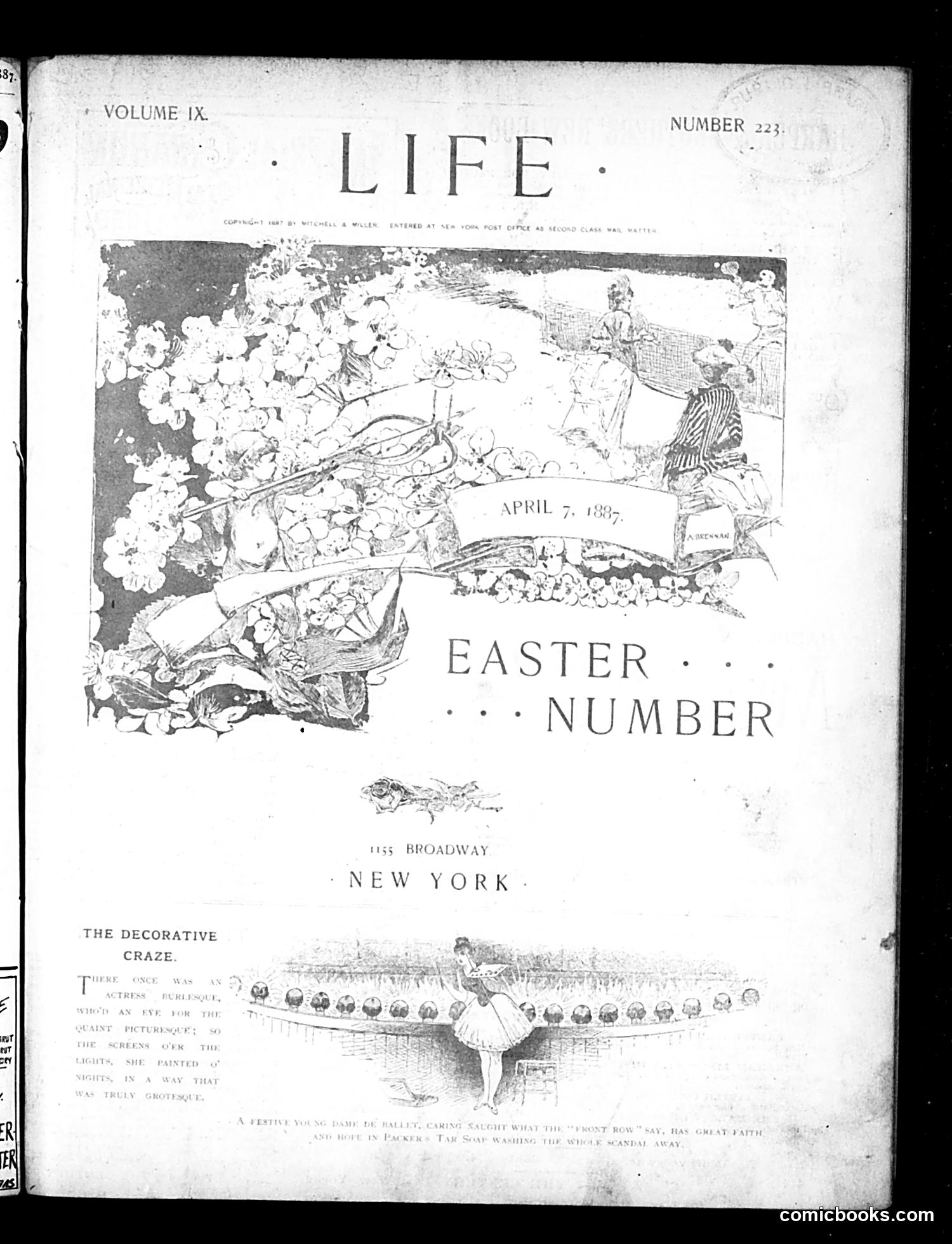
This is the cover of Life's Easter special issue. The central illustration depicts a young woman in classical dress catching Easter eggs in her skirt, surrounded by decorative floral borders (lilies and other spring flowers). Below, there's a section titled "The Decorative Craze" showing a ballet dancer performing. The satirical commentary appears directed at aesthetic trends of the 1880s—specifically the decorative and artistic movements that emphasized ornamental beauty over practical function. The juxtaposition of classical/artistic imagery with Easter imagery suggests Life is gently mocking the era's obsession with refined, decorative aesthetics even in holiday observances. The specific caricatures and social figures are unclear from this cover alone, but the overall tone is light Easter-themed satire typical of the period's approach to seasonal issues.
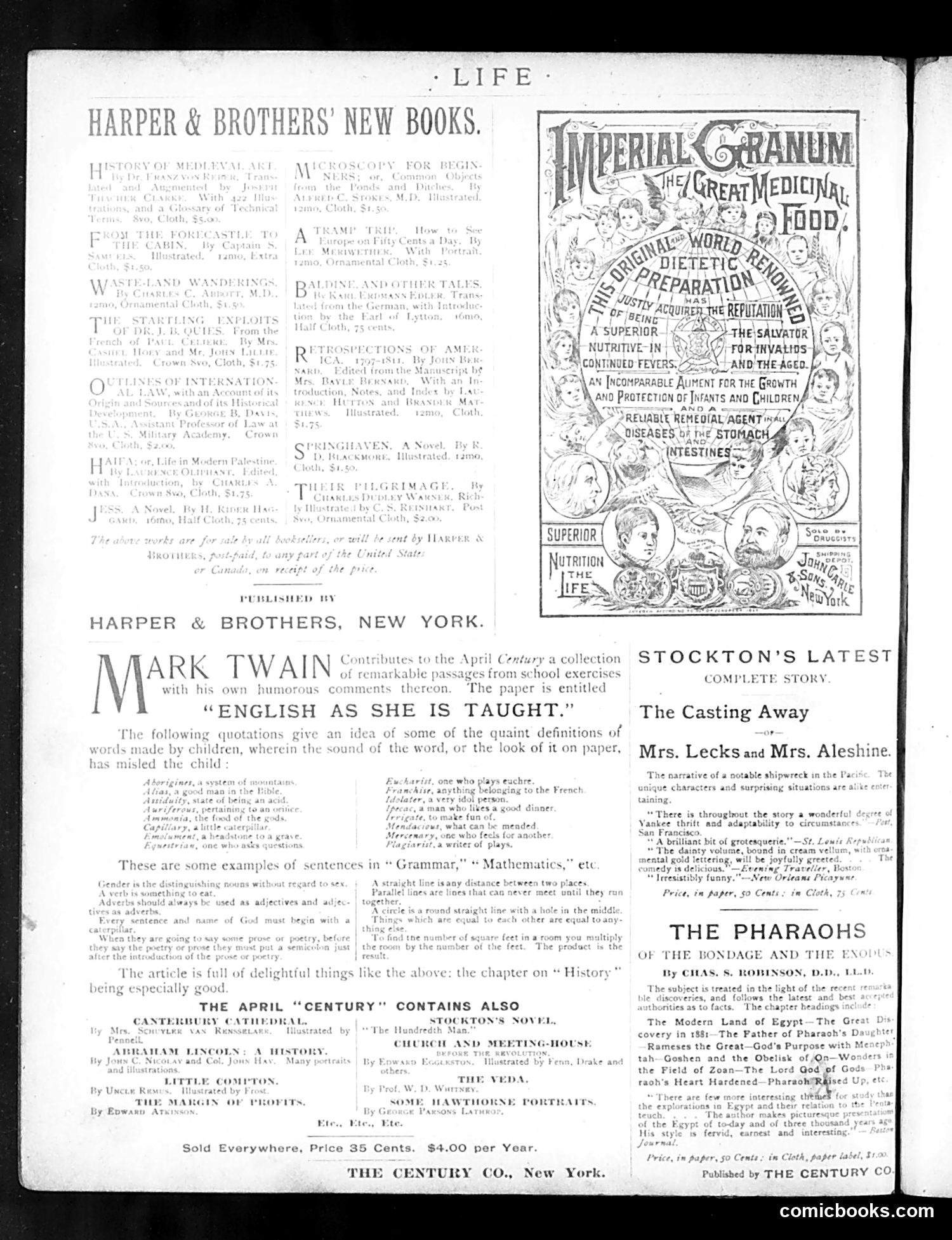
This page is primarily **advertising and literary content** rather than political satire. The left side features Harper & Brothers' book advertisements and a Mark Twain contribution to Century magazine about humorous English definitions by schoolchildren—lighthearted but not satirical. The right side displays a large advertisement for "Imperial Granum," a patent medicine marketed as a nutritious food and cure-all for infants, children, stomach ailments, and fevers. The elaborate decorative border features cherubic faces and testimonial language typical of late-19th-century medical product marketing. Below this is advertisement for Stockton's story "The Casting Away" and Century Co.'s book about Egyptian pharaohs. **No political cartoon or satire appears on this page.** It's a standard magazine page mixing literary content with period patent-medicine and book advertising.
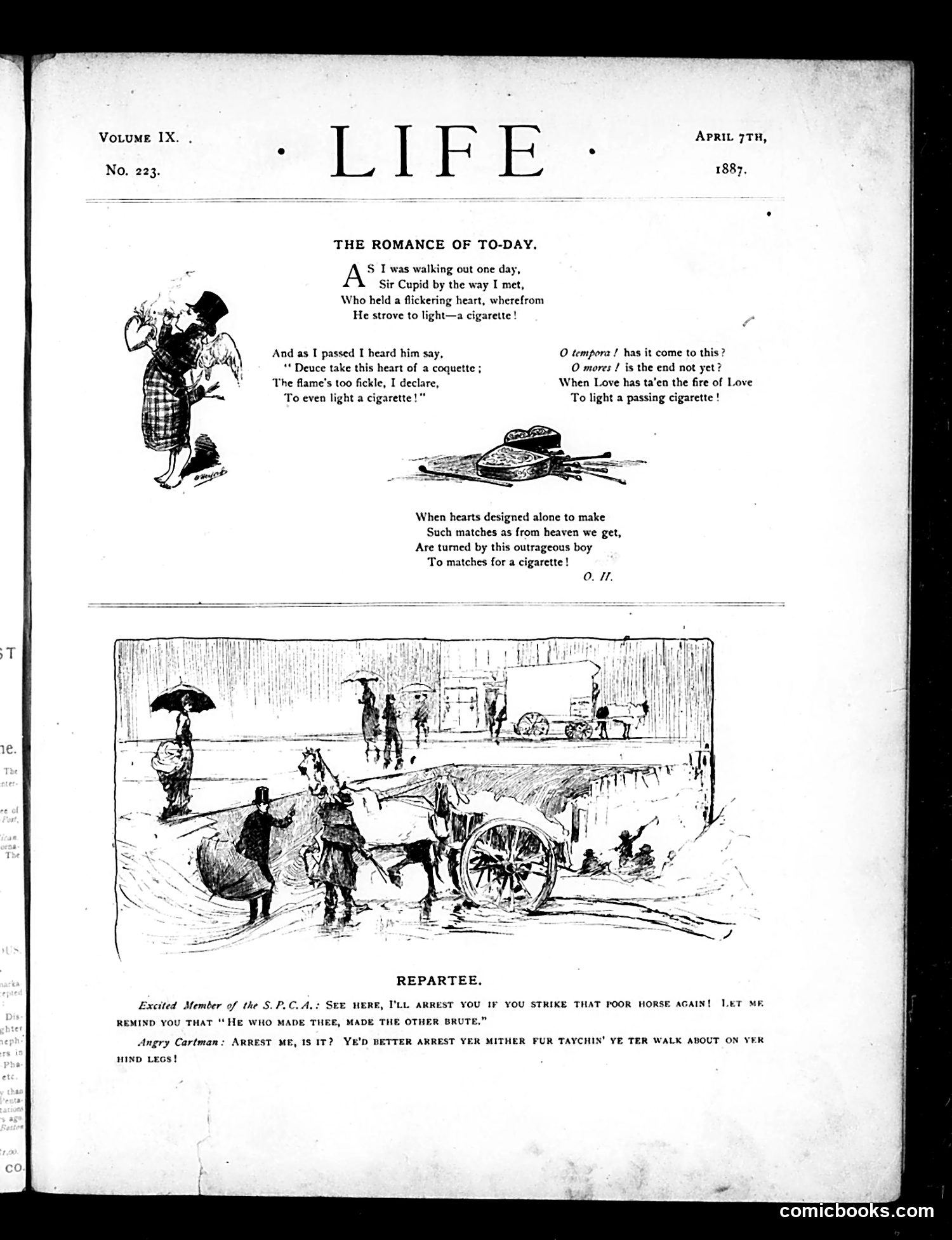
**Top poem**: This satirizes modern romance's decline. Cupid encounters a man using a cigarette to light his heart—reversing traditional romance. The verses lament that love's passion has been replaced by mundane cigarette-lighting. It's Victorian-era social commentary mocking how industrial/consumer culture has trivialized romantic love and masculine passion. **Bottom cartoon ("Repartee")**: Shows a street scene where an S.P.C.A. (Society for the Prevention of Cruelty to Animals) member confronts someone about striking a horse. The angry cartman responds with working-class dialect, sarcastically suggesting the member arrest his mother instead—implying the activist is naive about actual street life. It's satire of animal-welfare reformers perceived as out-of-touch busybodies.
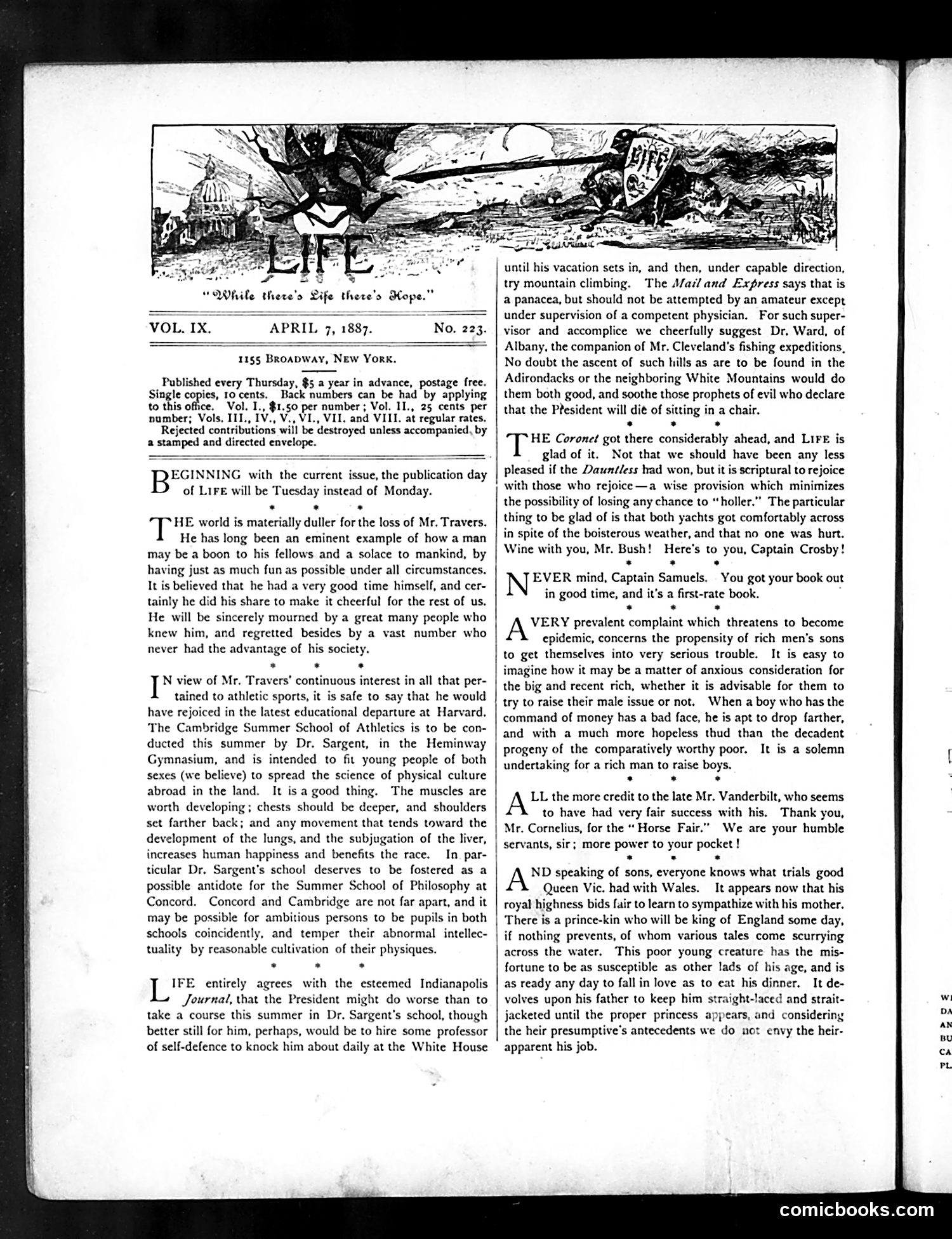
This page is primarily **editorial commentary**, not political cartoons. The main content discusses: 1. **Mr. Travers' death** - mourning an apparently prominent figure known for supporting athletics and public welfare 2. **Harvard's new athletics school** - praise for Dr. Sargent's Cambridge Summer School of Athletics, seen as valuable for physical development 3. **President Cleveland and mountain climbing** - suggesting the President take up mountaineering during vacation for health benefits 4. **Rich men raising sons** - satirizing wealthy families' difficulties producing competent heirs, mentioning the late Mr. Vanderbilt as a counter-example 5. **Queen Victoria's son** - gossip about a royal prince's romantic vulnerability and family management The page reflects 1880s concerns: physical fitness, hereditary wealth, and American attitudes toward European royalty.
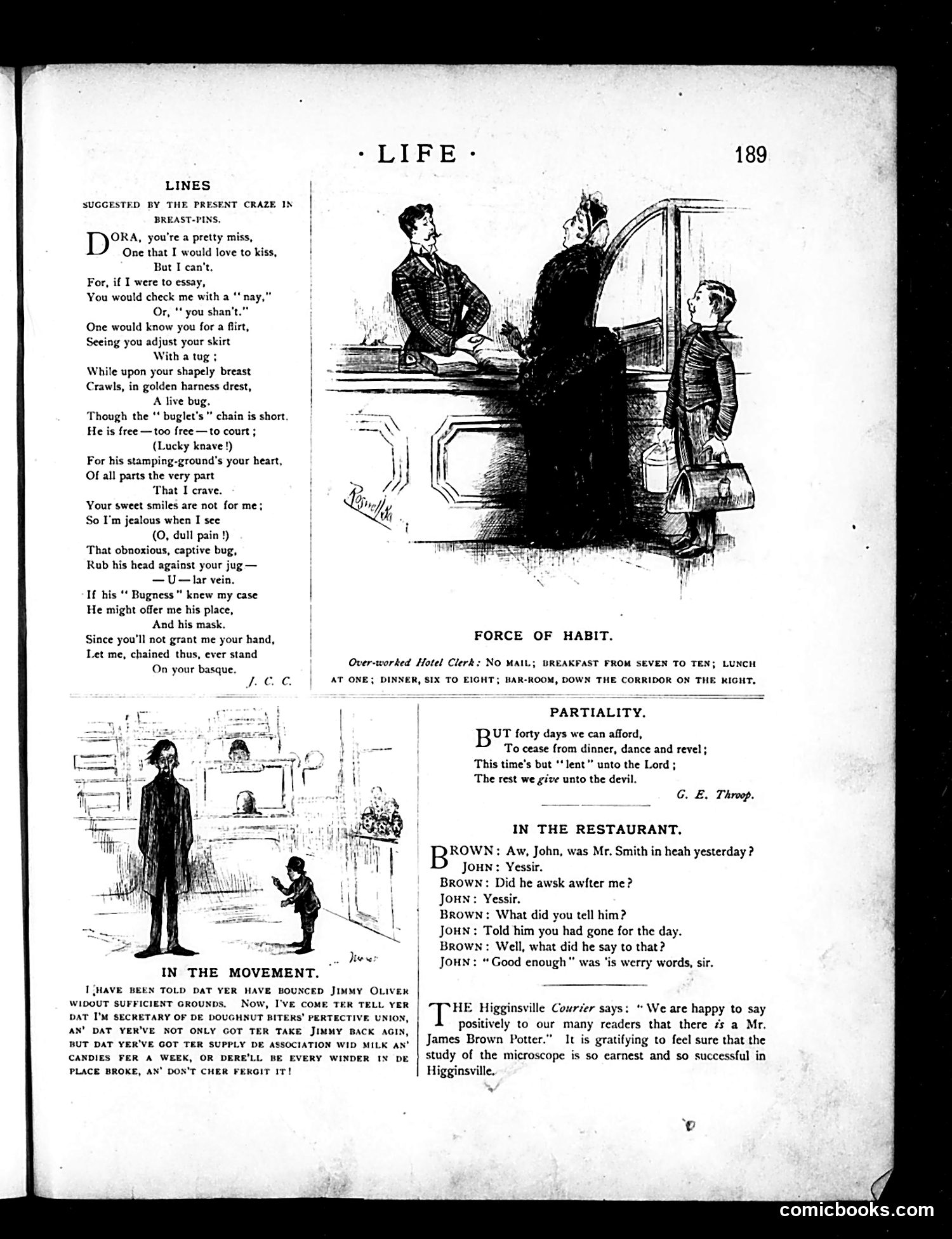
This page contains three distinct satirical pieces: **"Force of Habit"** (top cartoon): An overworked hotel clerk, exhausted from rigid daily routines (breakfast 7-10am, lunch 1pm, dinner 6-8pm), appears to be addressing patrons. The satire mocks the dehumanizing monotony of service industry work and institutional scheduling. **"In the Movement"** (left cartoon): Shows a tall man and small boy. The accompanying text references "Jimmy Oliver" and a "doughnut biters' perfective union," satirizing labor union organizing and strikes—likely commentary on early 20th-century labor disputes and their sometimes absurd or trivial nature. **"In the Restaurant"** (dialogue piece): A humorous exchange between "Brown" and "John" about Mr. Smith's absence, using mundane workplace gossip to mock office communication and pretense. The page represents *Life* magazine's characteristic blend of visual and textual satire targeting everyday American social dynamics.
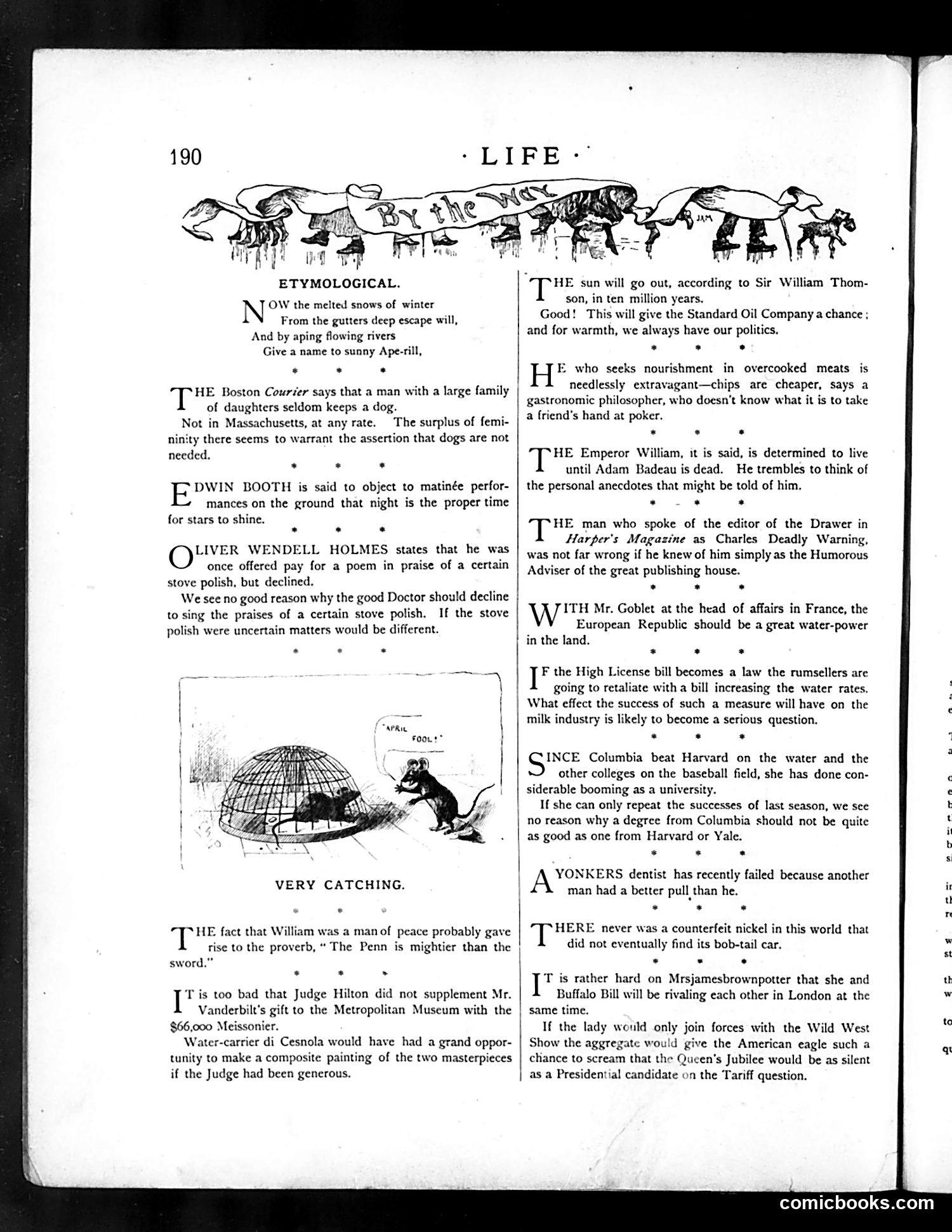
The cartoon depicts a figure labeled "FOOL" inside an umbrella-like dome, with another figure outside attempting to pull or trap them. The accompanying text explains: "The fact that William was a man of peace probably gave rise to the proverb, 'The Penn is mightier than the sword.'" This is a pun on William Penn, the Quaker founder of Pennsylvania known for pacifism. The dome likely represents a protective enclosure or naive idealism. The cartoon satirizes the idea that peaceful principles, while admirable, may leave one vulnerable or foolish in practical matters. The "fool" label suggests the cartoonist mocks those who prioritize peace over pragmatism—a common satirical theme in early 20th-century American commentary.
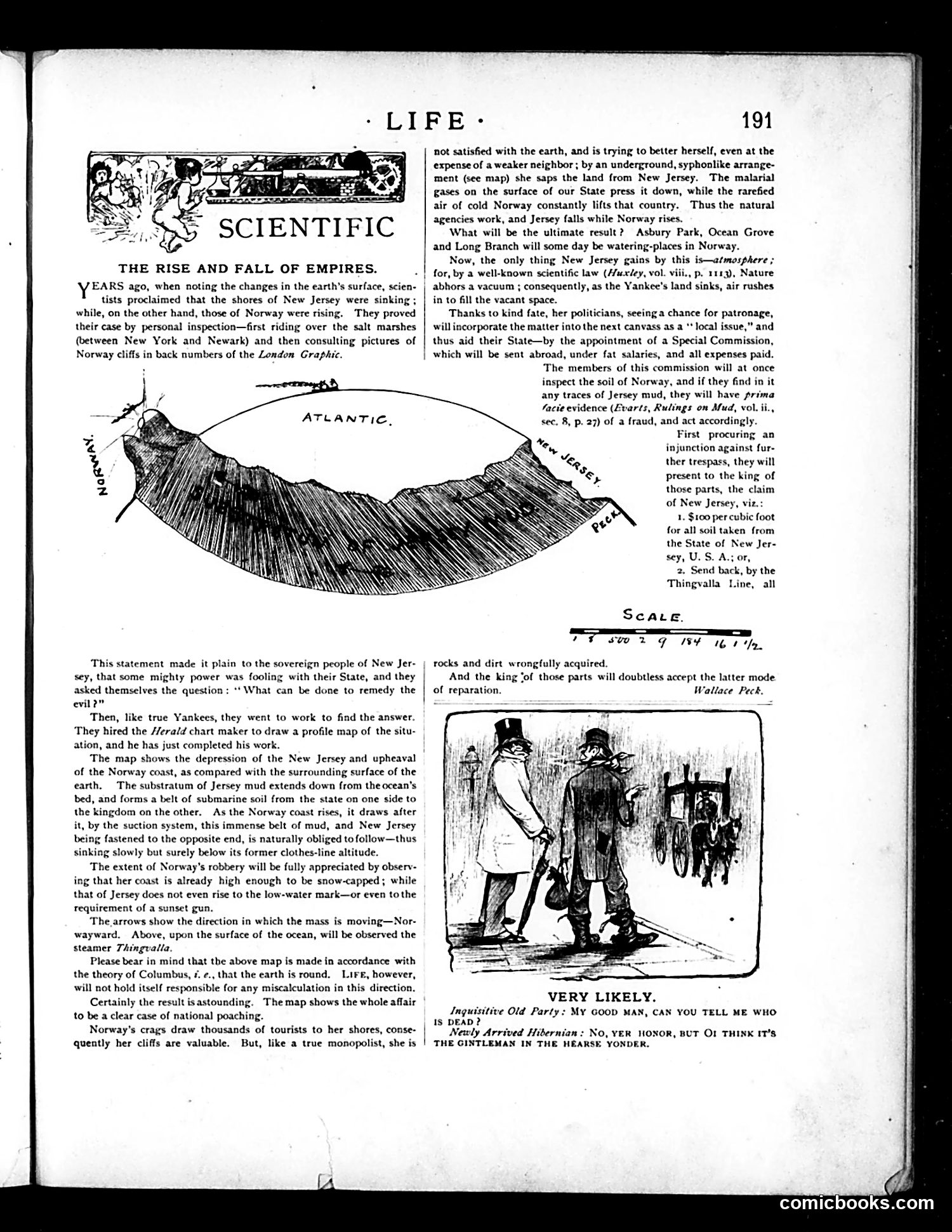
The bottom cartoon depicts two figures in Victorian dress: an "Inquisitive Old Party" (left) asking a gentleman (right) who is dead, whether he can identify the corpse of "a certain Hibernian" (Irish person). The gentleman replies it's "the gentleman in the hearse yonder." The satire appears to target anti-Irish sentiment and possibly mock those who would deny knowing Irish victims or perpetrators of violence. The joke's dark humor hinges on the absurdity of asking someone to identify a corpse they're standing near—suggesting either willful ignorance or complicity in pretending not to recognize the victim. The cartoon likely references broader 19th-century Anglo-Irish tensions, though the specific historical incident remains unclear without additional context.
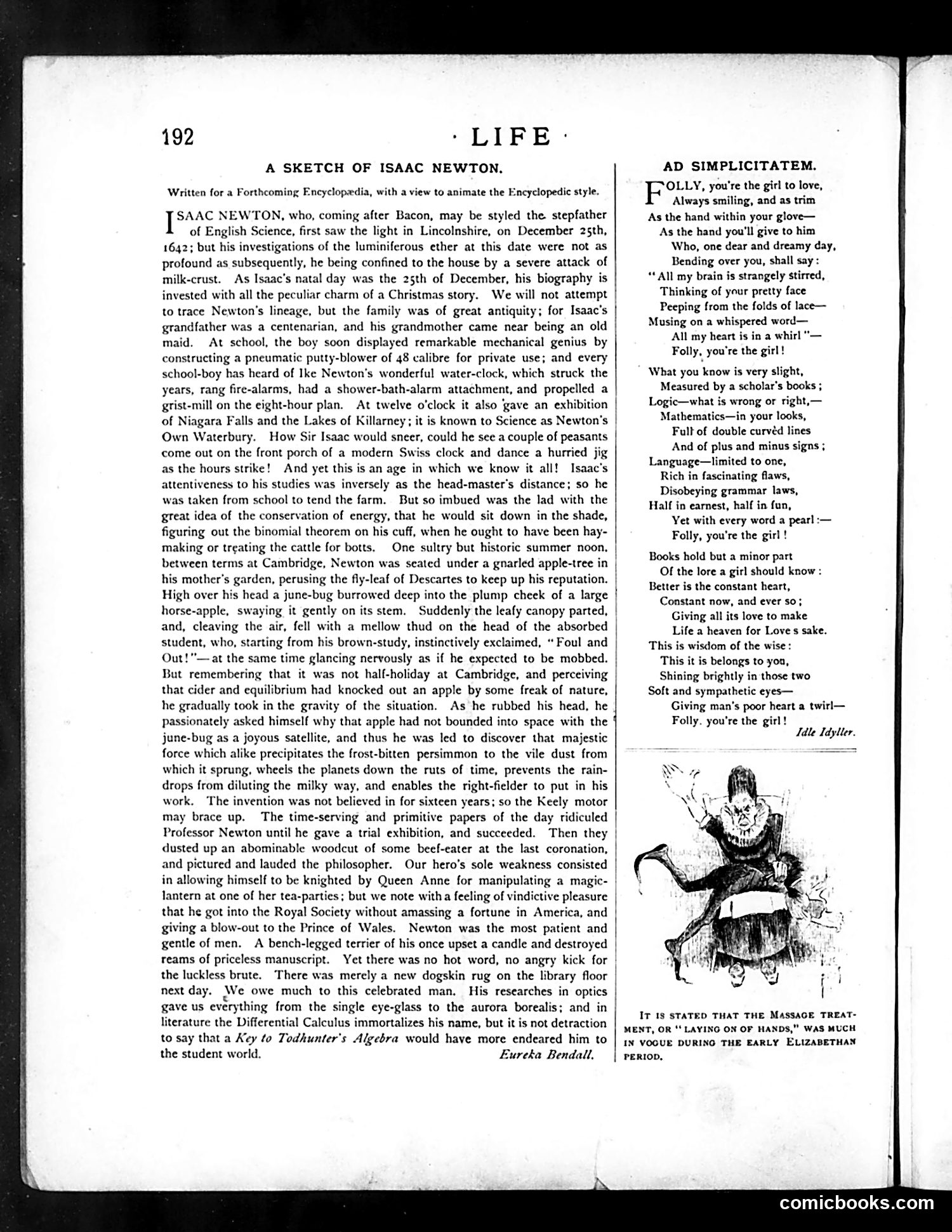
This page from *Life* magazine contains a biographical sketch of Isaac Newton (left column) and an unrelated poem titled "Ad Simplicitatem" (right column) about courting a girl named Polly. The small illustration at bottom right appears to depict a figure in period dress, likely related to the Newton article's mention of "massage treatment, or 'laying on of hands,'" which was in vogue during the early Elizabethan period—though Newton lived later (1642-1727). The illustration's exact relevance to the Newton text is unclear from the image alone. The Newton sketch humorously describes his mechanical genius, his famous apple-tree incident at Cambridge, and notes his knighthood by Queen Anne, treating his life with affectionate satire rather than reverence.
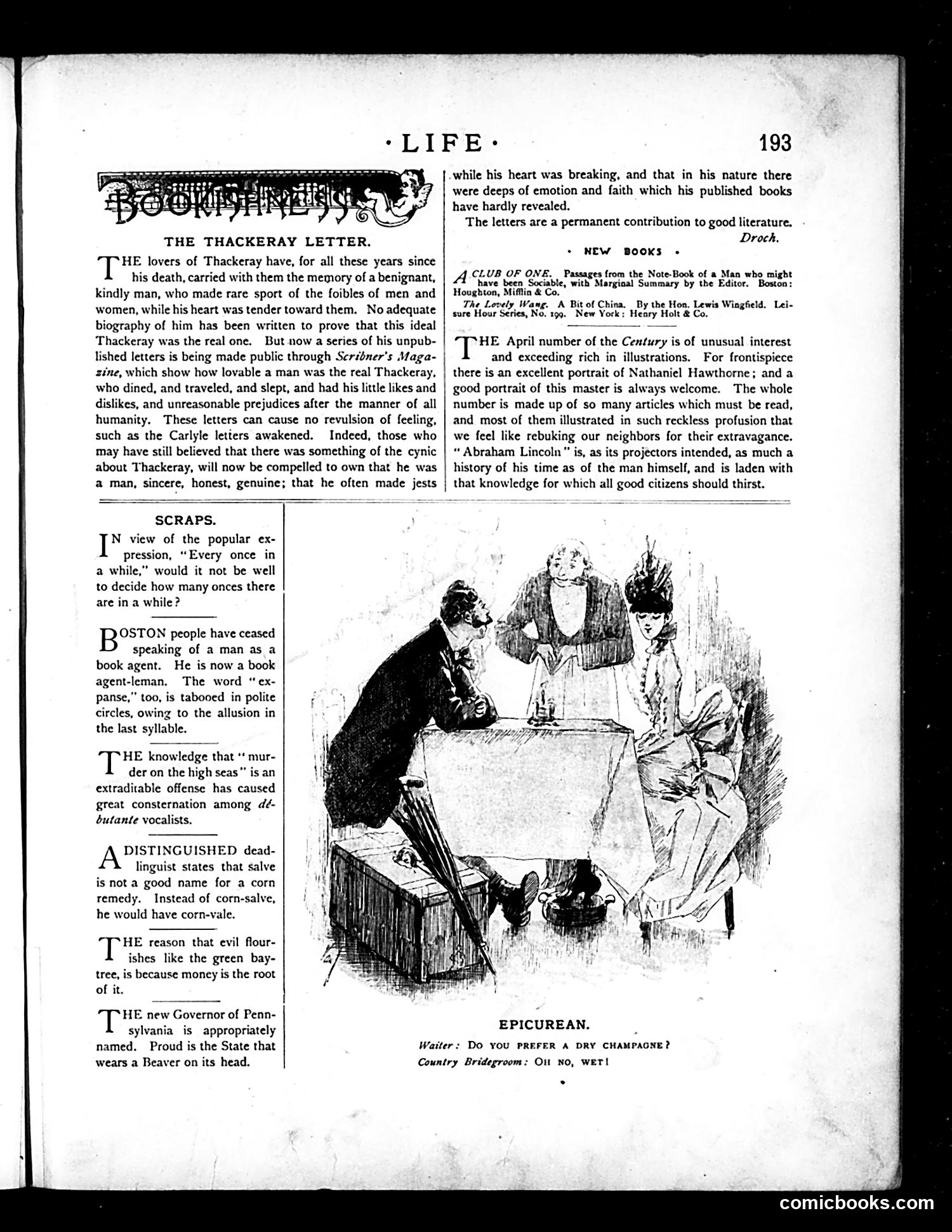
This page contains literary commentary and brief humorous observations rather than political cartoons. The main illustrated item is titled "EPICUREAN," showing a sketch of three figures at a dining table. A waiter asks a country bridegroom whether he prefers dry champagne; the bridegroom replies "Oh no, wet!" The joke relies on the bridegroom's apparent misunderstanding or deliberate obtuseness—confusing "dry" (a champagne classification) with literal dryness, suggesting he wants wet champagne instead. This plays on the stereotype of rural or unsophisticated persons unfamiliar with refined dining conventions and wine terminology, a common theme in early 20th-century American humor. The surrounding text discusses Thackeray's letters and contemporary book reviews.
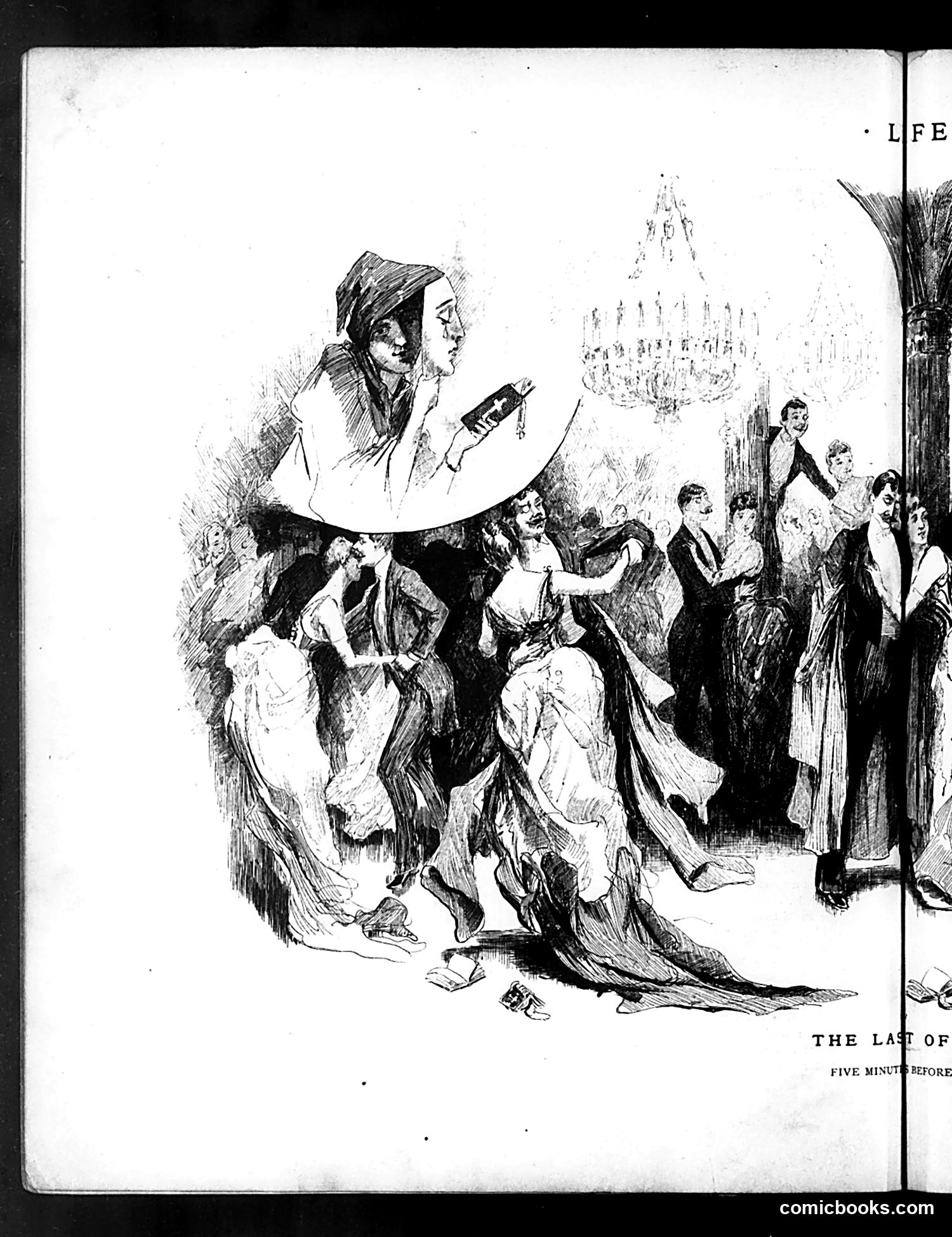
This illustration from *Life* magazine depicts a satirical scene of a fancy social gathering or ball. The caption reads "THE LAST OF [text cut off] FIVE MINUTE BEFORE," suggesting a moment just before some event concludes or a crisis occurs. The sketch shows elegantly dressed society figures in formal attire gathered in what appears to be a grand ballroom with a chandelier. Two women in the foreground wear flowing gowns. A figure with exaggerated facial features leans in from above—likely a caricatured celebrity or social figure—holding what appears to be a bottle, apparently disrupting the refined proceedings. The satire appears to target either high society pretension or the intrusion of scandal/undesirable behavior into exclusive social spaces. Without the complete caption, the specific event or figure being mocked cannot be definitively identified.
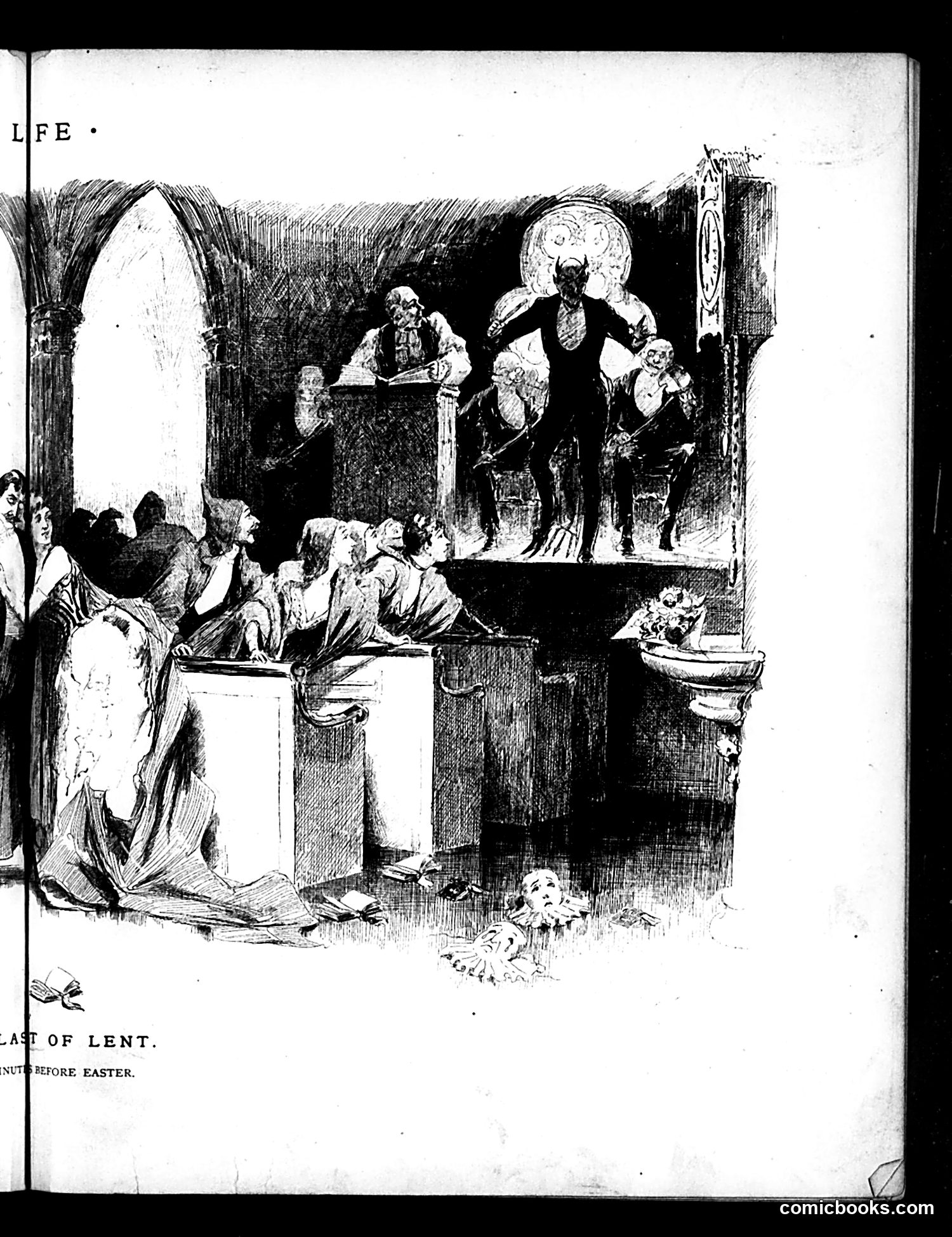
This satirical illustration depicts a religious ceremony, likely a Catholic confession or penance scene during Lent (the 40-day period before Easter). The central figure appears to be a priest or religious authority at an elevated pulpit or confessional, addressing congregants below who are in poses of supplication or penitence. The cartoon's satire likely mocks the formality and ritualism of religious observance—suggesting that worshippers mechanically perform penance "before Easter" rather than engaging in genuine spiritual reflection. The phrase "nuts before Easter" (partial text visible) may reference indulgences or last-minute religious compliance. The sketch's dark, dramatic shading emphasizes the solemnity being satirized, critiquing either religious hypocrisy or the superficiality of seasonal piety among worshippers.
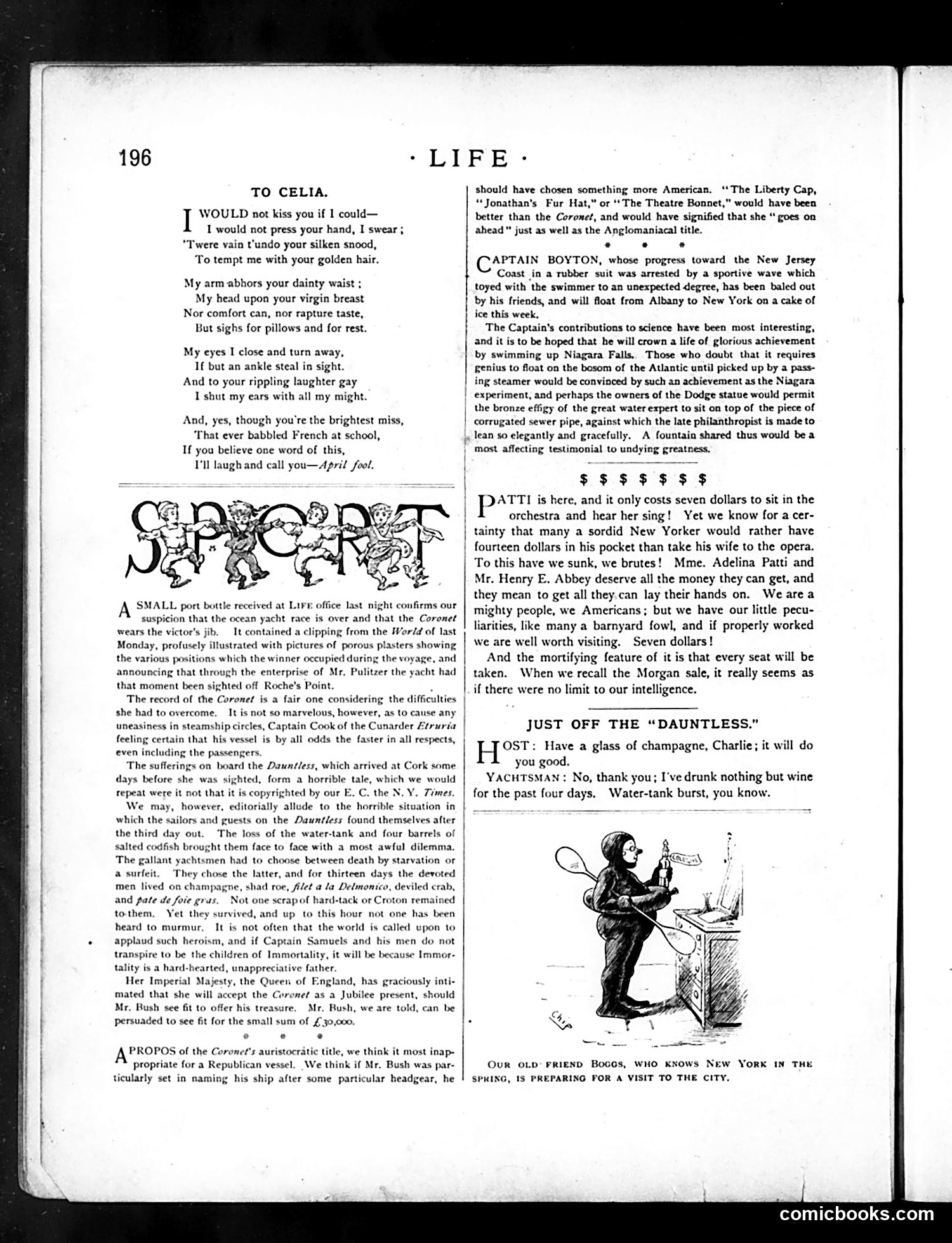
This page contains satirical commentary on contemporary events and a romantic poem. **"To Celia"** is an April Fool's joke—a poem of elaborate romantic denial (refusing to kiss, touch, or admire a woman) that culminates in the reveal that the speaker is lying, calling the female reader a fool for believing him. **Main satirical content** mocks the recently-completed yacht race between the *Coronet* and *Dauntless*. Life jokes that the *Coronet* won, and sarcastically praises the *Dauntless* crew for surviving thirteen days eating luxury foods (champagne, filet mignon, pâté) after losing their water tank and salt cod—framing deprivation as humorous excess. **Political jab**: Life criticizes naming an American yacht the *Coronet* (a British royal term), suggesting Republican vessels should bear American names like "The Liberty Cap" instead of "Anglomaniacal" titles. **Captain Boyton reference**: A brief note about a swimmer's mishap approaching New Jersey. The humor assumes reader familiarity with these yacht-racing headlines.
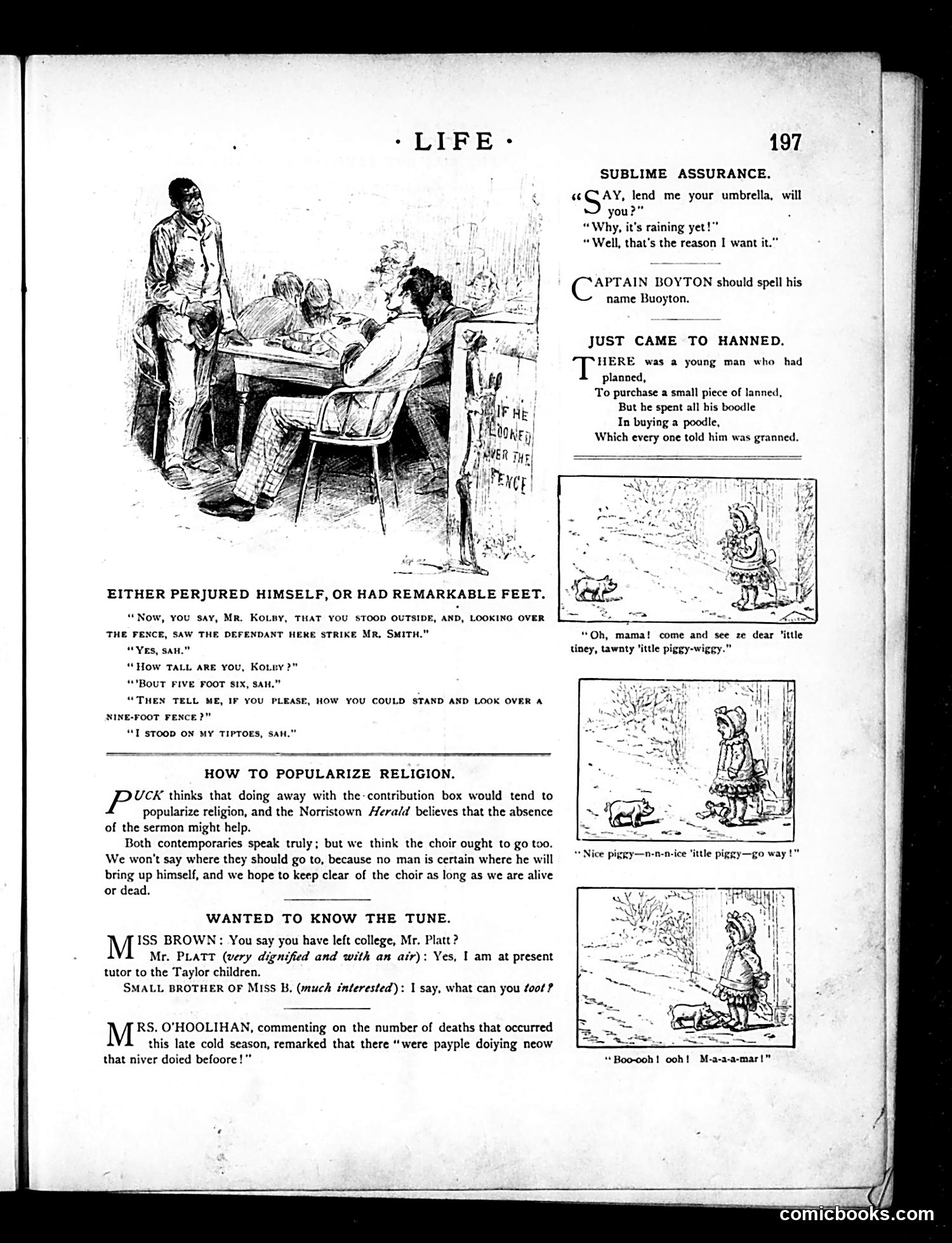
This page collects brief comic sketches typical of *Life* magazine's satirical format: **"Sublime Assurance"** mocks illogical reasoning—borrowing an umbrella during rain because it's raining is absurd. **"Captain Boyton"** appears to reference a public figure (likely Paul Boyton, a famous swimmer/performer of the era) with a pun on spelling his name. **"Just Came to Hanned"** is a light verse joke about a young man who squanders his land-purchase money on a fashionable poodle—satirizing frivolous spending and status-seeking through pets. **"Either Perjured Himself"** ridicules a courtroom witness who claims to have seen over a nine-foot fence while standing outside it—exposing obvious perjury through simple mathematics. **"How to Popularize Religion"** sarcastically suggests removing contribution boxes and sermons to boost church attendance, ending with a dig at choir quality. **Right-side illustrations** show a woman coaxing a pig with affected speech, mocking affectation toward animals. The tone throughout is genteel mockery of everyday human foolishness and pretension.
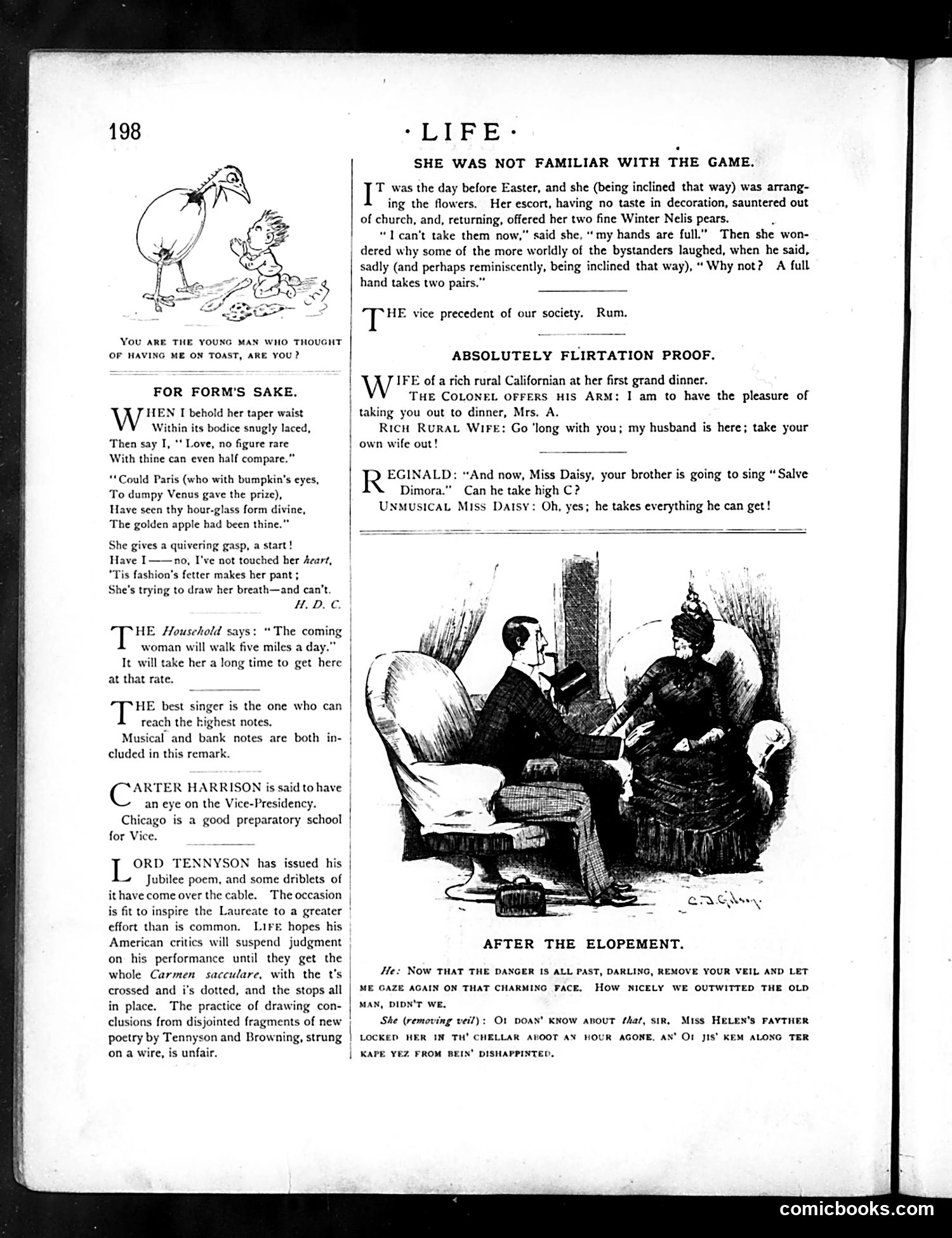
This page from *Life* magazine contains multiple satirical vignettes mocking Victorian courtship rituals and social pretense: **"For Form's Sake"**: A poem ridiculing overwrought romantic flattery. A suitor recites extravagant compliments to a woman in a tightly-laced corset, who gasps and pants—not from emotion but from physical constriction. The satire targets both men's insincere flowery language and women's dangerous fashion. **"Absolutely Flirtation Proof"**: A rural California woman rebuffs a colonel's dinner invitation, refusing to leave her husband's side—a joke about frontier practicality versus city social conventions. **"After the Elopement"**: The final cartoon depicts an elopement's dark twist: the groom discovers his bride is actually a servant girl who locked the real bride in the cellar. It's a bawdy punchline mocking both class pretensions and the chaos of secret marriages. The page also includes brief satirical items on Tennyson's poetry, women's exercise habits, and politics, reflecting *Life*'s role as a humor magazine for educated readers.
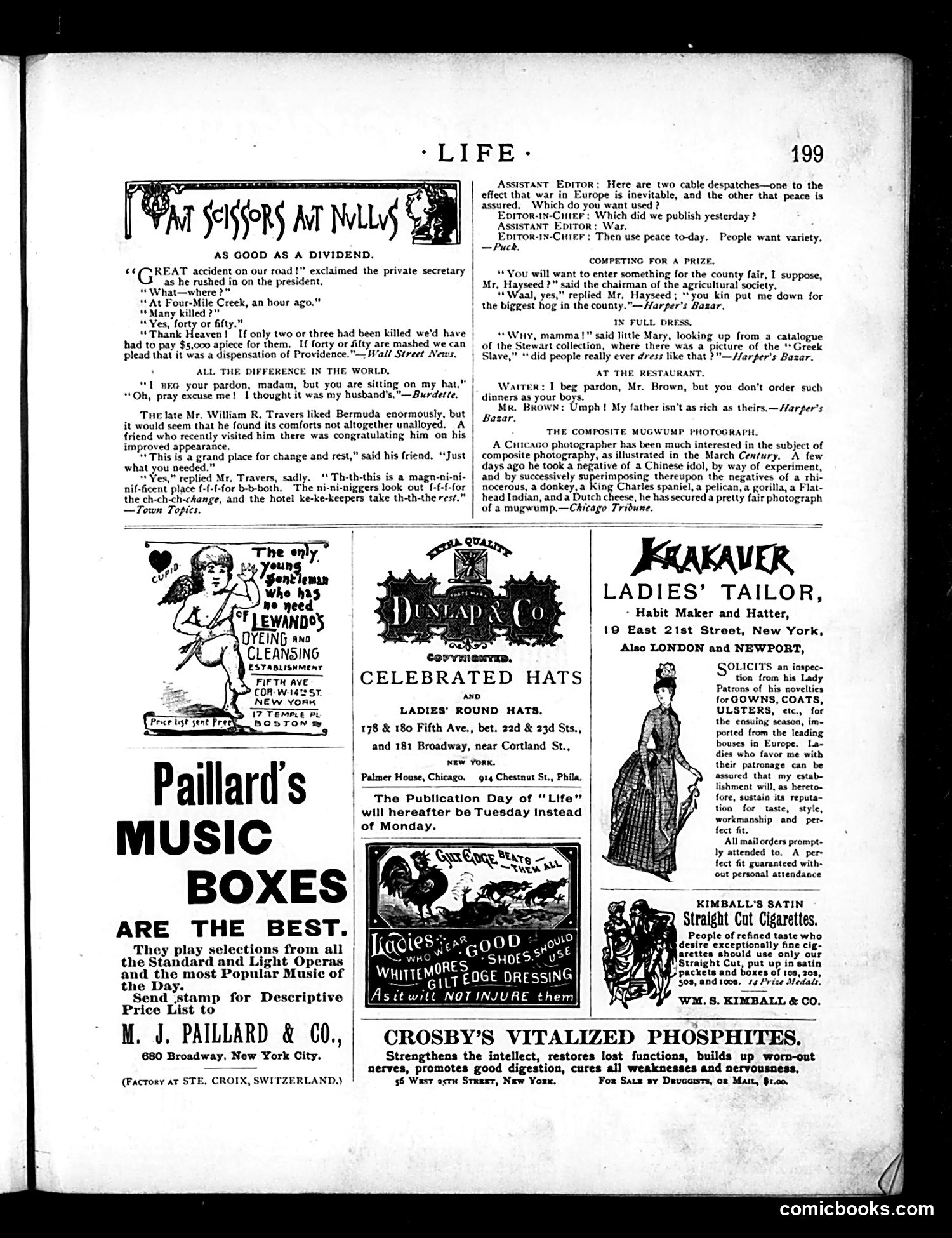
This page is primarily **advertisements and humor filler** from *Life* magazine, with three notable satirical pieces: 1. **"As Good as a Dividend"**: A dark joke about a railroad president learning of a fatal accident. The humor relies on morbid late-19th-century industrial logic—killing 40–50 people is financially advantageous to the company because they can claim an act of God, whereas killing just 2–3 would require paying $5,000 per death. This satirizes corporate indifference to worker safety and legal loopholes. 2. **"The Composite Mugwump Photograph"**: Political satire identifying a "mugwump" (Republicans who broke party loyalty) as laughably grotesque—a composite face combining a Chinese idol, rhinoceros, donkey, pelican, gorilla, Native American, and cheese. The insult ridicules mugwumps as incoherent, contemptible hybrids. 3. **Competing for a Prize**: Gentle rural satire where a farmer plans entering his "biggest hog" in a county fair—suggesting he himself is the real hog. The rest is period advertising and social humor from *Harper's Bazar*.
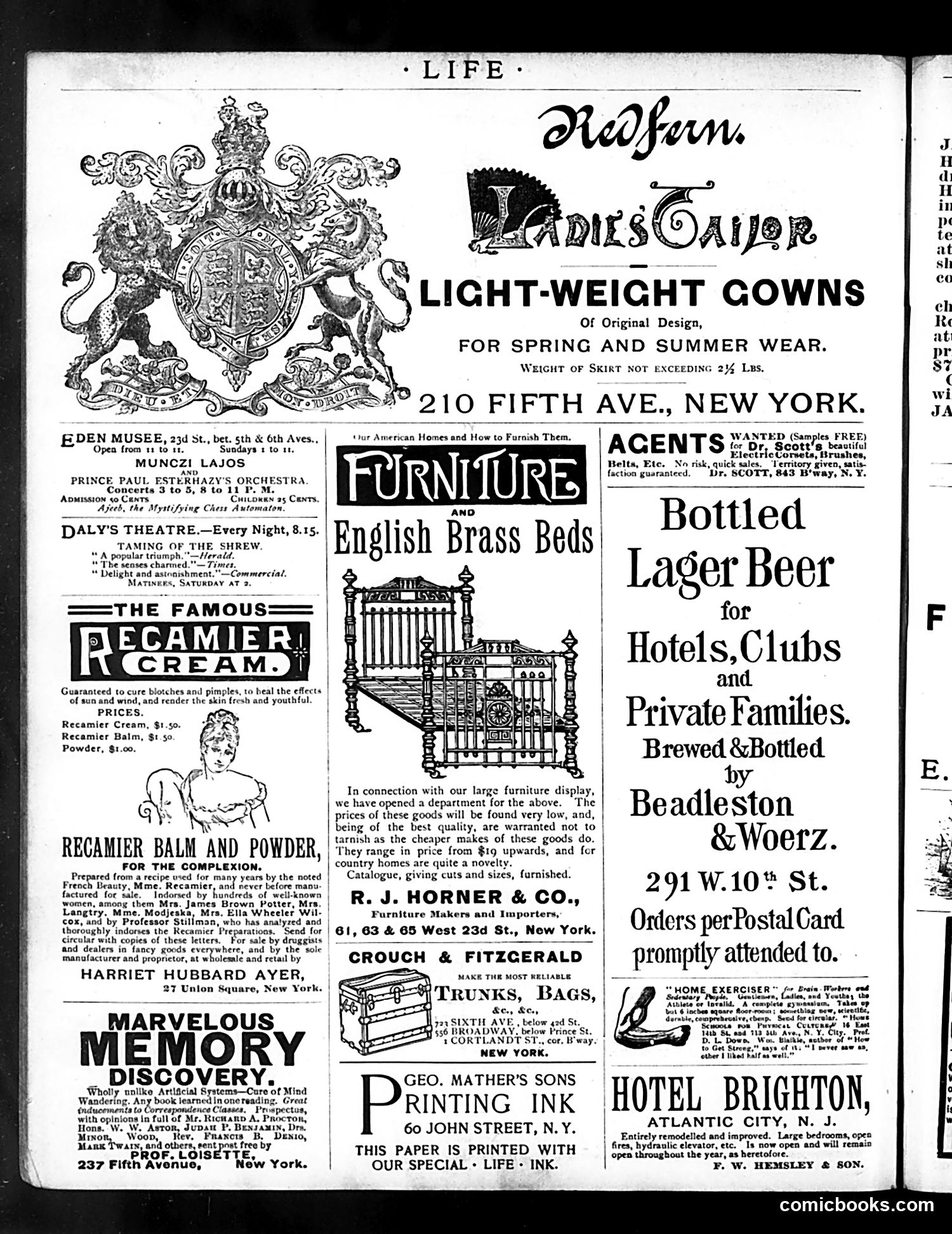
This is **primarily an advertisements page**, not a satirical cartoon. It features various commercial notices typical of late 19th-century American periodicals. Notable ads include beauty products (Recamier cosmetics, endorsed by wealthy socialites like Mrs. Langtry), furniture and brass beds, luggage, printing ink, and bottled lager beer. Theater notices promote performances at Eden Musee and Daly's Theatre. The only potentially satirical element is subtle: the "Marvelous Discovery" ad claims to teach any book "in one reading" through mind-training—an obvious charlatan pitch mocking pseudoscientific self-improvement schemes popular in the era. The page demonstrates how Life financed satirical content through advertisements targeting wealthy urban readers interested in luxury goods, cosmetics, and entertainment—the same audience the magazine's humor addressed.
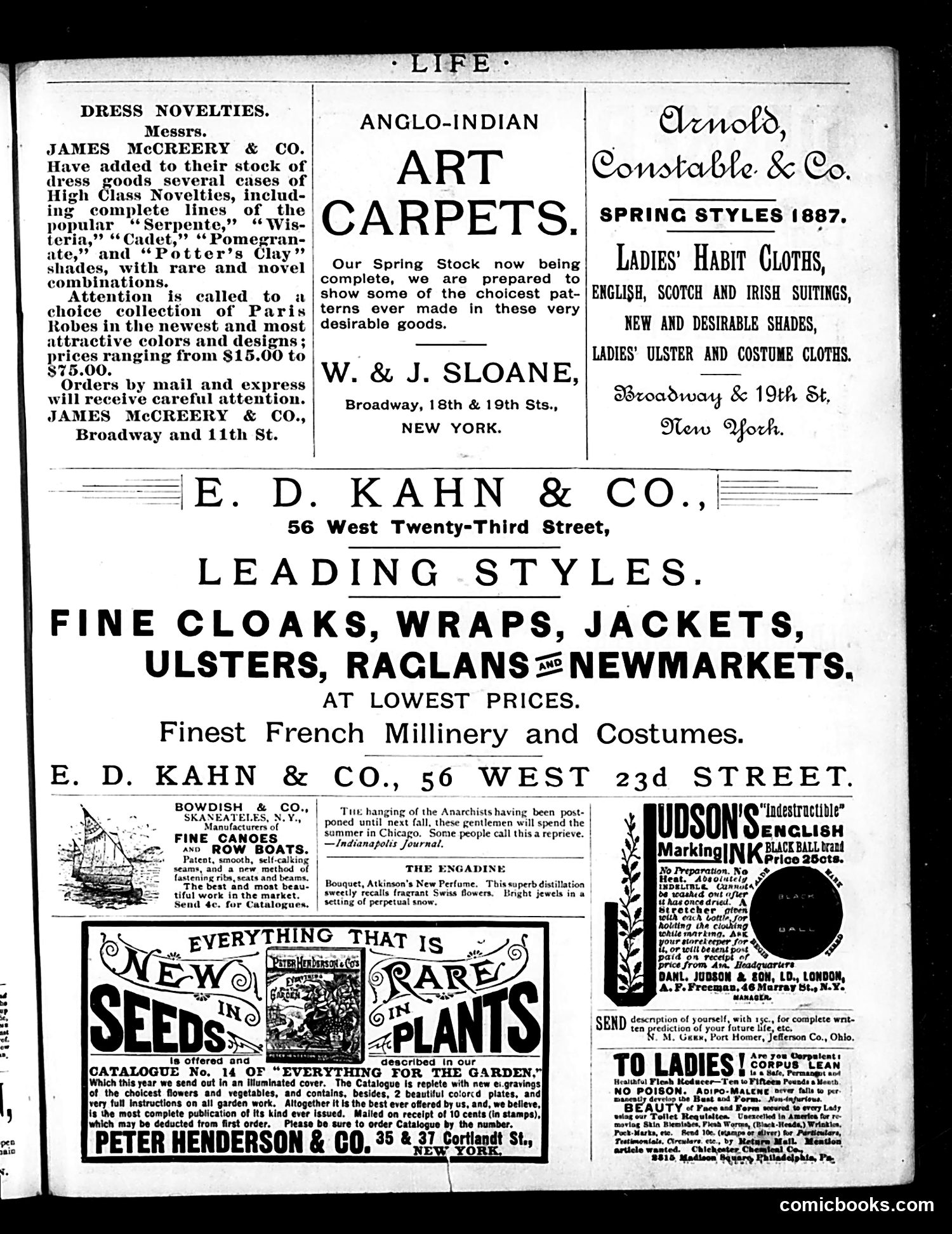
This page is primarily **advertising**, not satirical content. It showcases late 19th-century commercial establishments selling women's clothing, home furnishings, and novelty goods—typical of Life's revenue model. However, there is **one satirical reference**: A brief text snippet about "the hanging of the Anarchists" being postponed until fall, allowing them to "spend the summer in Chicago," which the Indianapolis Journal sarcastically calls "a reprieve." This likely references the 1887 Haymarket affair aftermath, when convicted anarchists faced execution. The joke is dark: rather than seeing imprisonment as punishment, it's framed as an unexpected vacation opportunity. The rest of the page consists of genuine period advertisements for James McCreery & Co. (dress goods), E.D. Kahn & Co. (women's cloaks), Peter Henderson & Co. (seeds), and various beauty/health products—reflecting consumer culture and marketing practices of the 1880s.
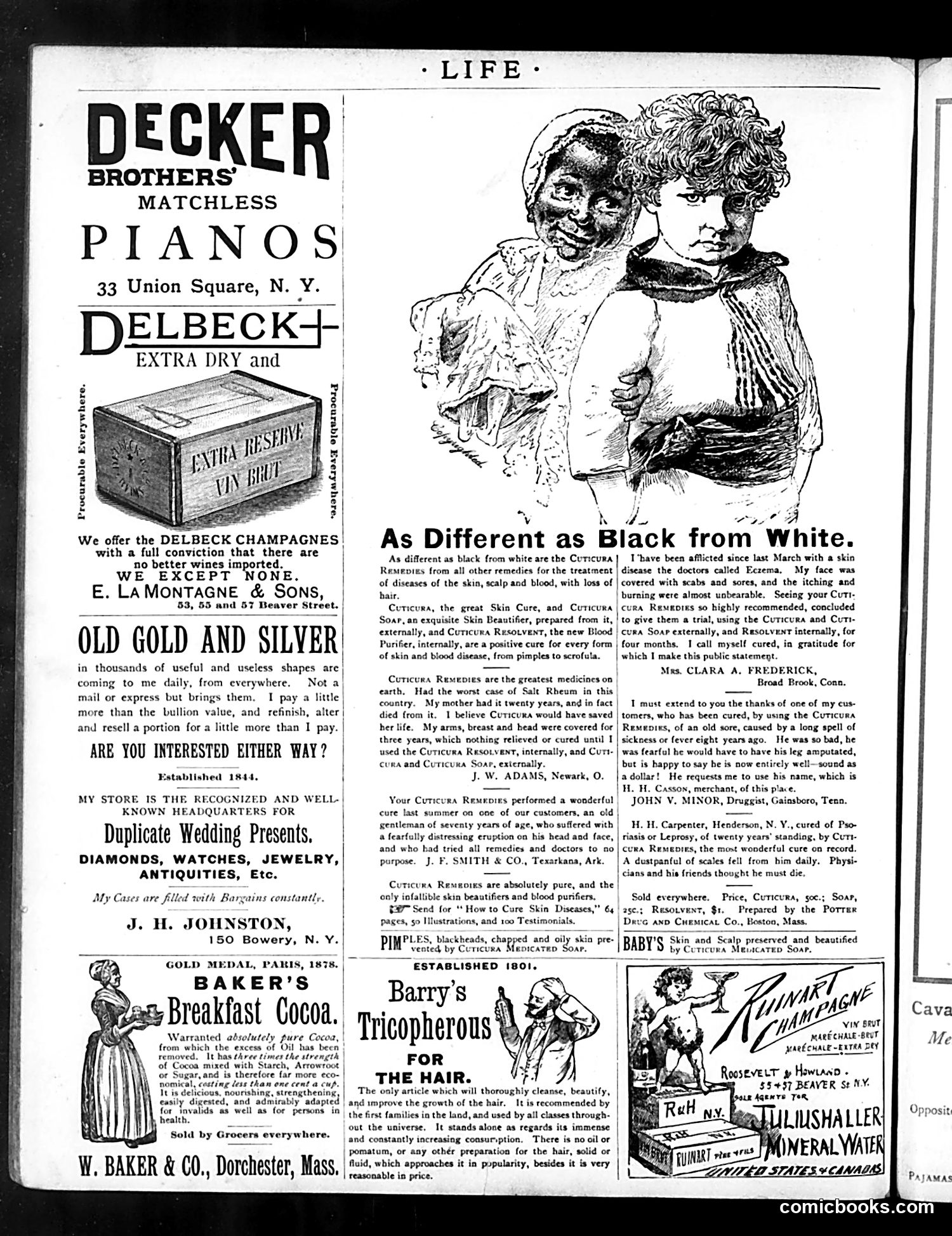
This page is primarily **advertisements with no political cartoons**. The main visual element is an illustration accompanying a Cuticura Remedies advertisement titled "As Different as Black from White." The illustration depicts two children—one Black, one white—posed together. The title uses this racial contrast as a metaphor for how different Cuticura products are from competitors' remedies for skin diseases. **Context for modern readers:** The advertisement exploits racial imagery common in 19th-century marketing, using the visible difference between the children to create a visual hook for selling patent medicines. The phrase itself wasn't meant as social commentary but as crude marketing rhetoric. The page otherwise contains typical period advertisements: Decker Brothers pianos, champagne, cocoa, jewelry services, and various patent medicines—standard commercial content from Life magazine's revenue model.
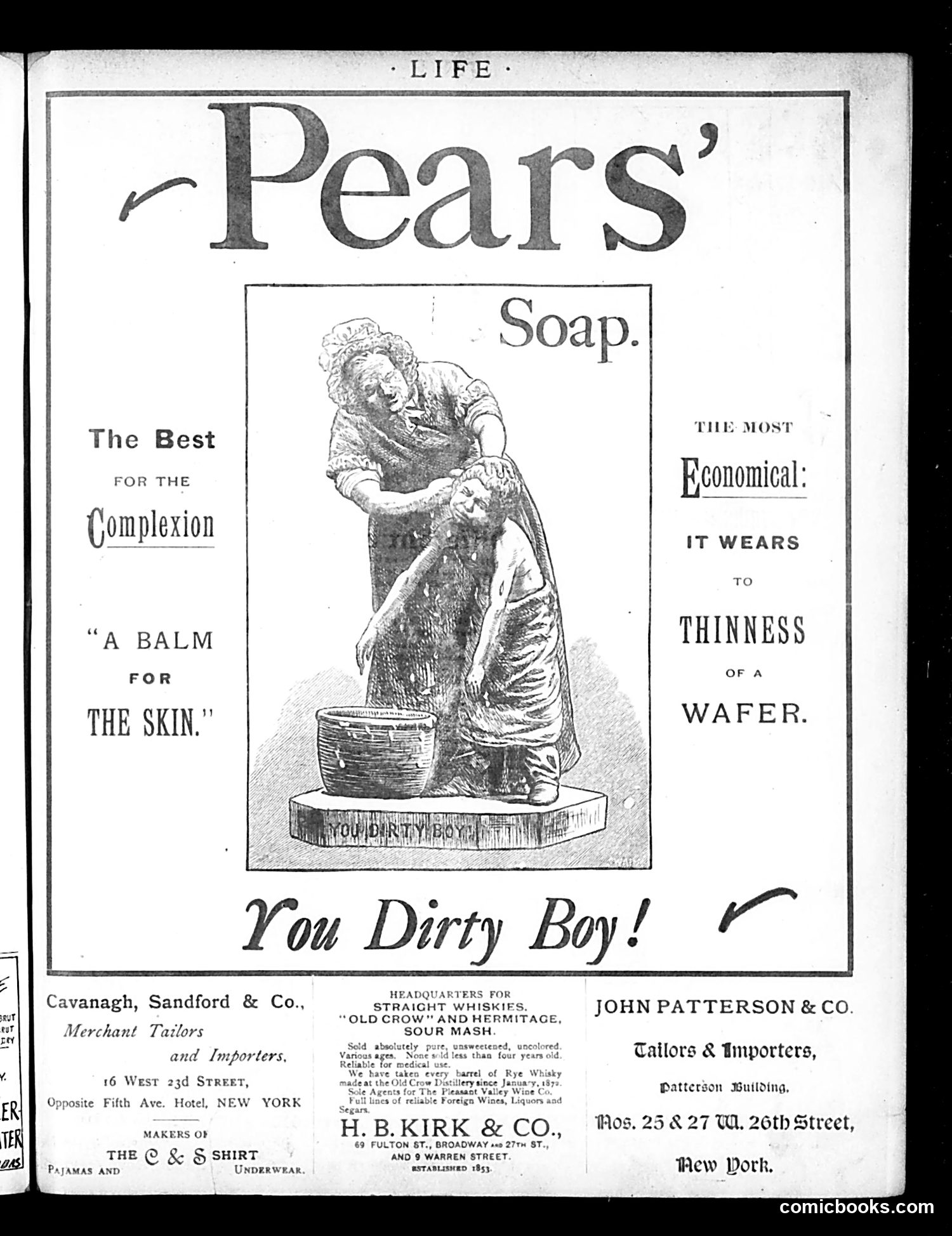
This is primarily a **product advertisement** for Pears' Soap, not political satire. The central image shows a washerwoman scrubbing a dirty boy, with the headline "You Dirty Boy!" The advertisement's humor relies on class-based stereotypes common to the Victorian era: the poorly-dressed child and working-class woman represent the target market—families who need affordable soap. The marketing message is straightforward: Pears' Soap is economical ("wears to thinness of a wafer"), effective for skin care, and best for complexion. The surrounding text features competing advertisements from New York merchants (tailors, shirt makers, and whiskey distributors), typical of magazine layout from this period. There is **no political cartoon or satirical commentary** here—this is commercial advertising using gentle humor to market household soap to middle and working-class consumers.
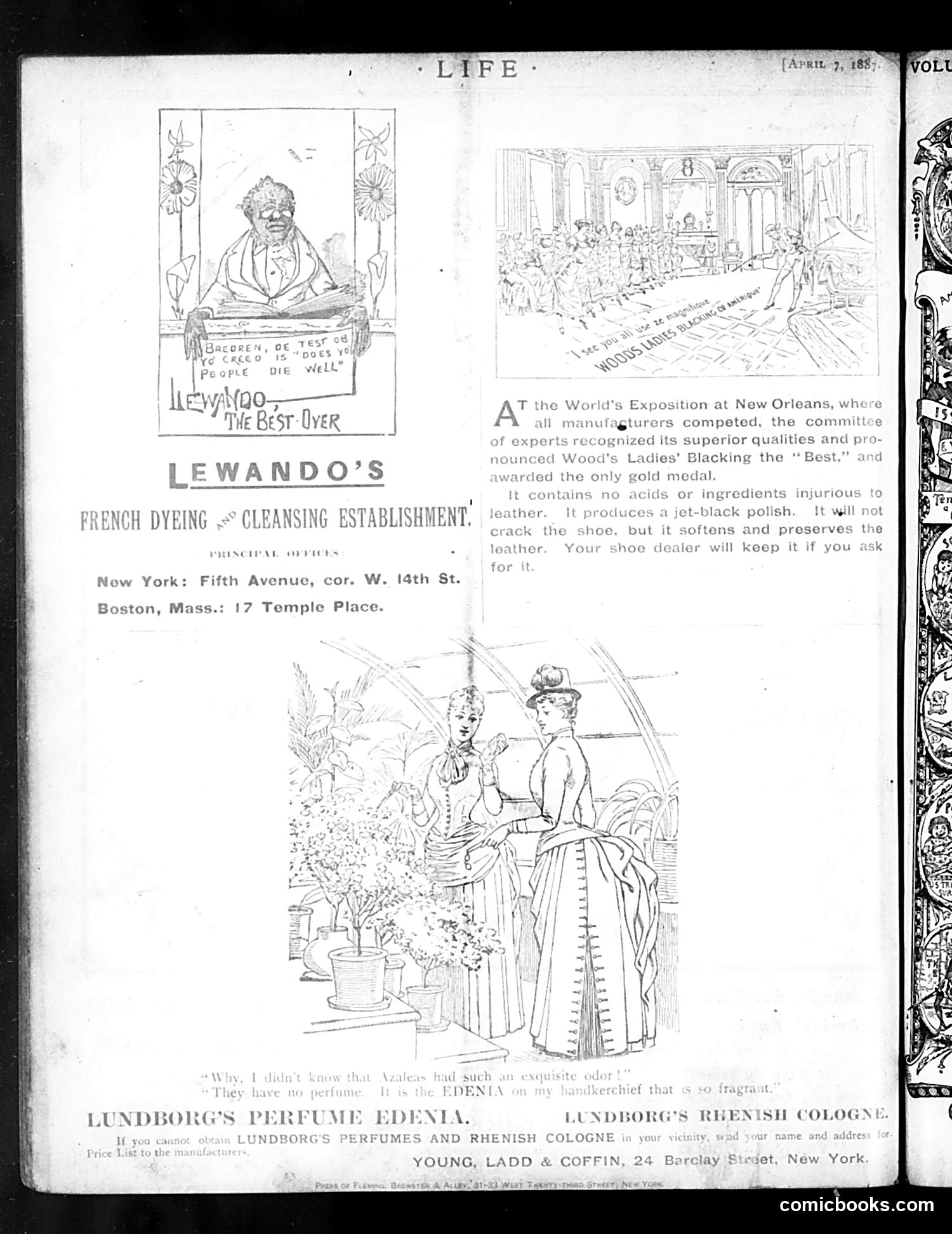
This page is primarily **advertising**, not political satire. It contains three product advertisements: 1. **Lewando's French Dyeing & Cleansing Establishment** — features a caricatured bust labeled "Lewando: The Best Dyer," promoting shoe polish that won a gold medal at the World's Exposition in New Orleans. 2. **Lundborg's Perfume Edenia** — shows two fashionable women discussing the fragrance's quality, with dialogue about azaleas and perfume on a handkerchief. 3. **Lundborg's Rhenish Cologne** — advertised below. The only satirical element appears minor: Lewando's bust caricature uses exaggerated features typical of 1880s commercial imagery. The "World's Exposition" reference is factual advertising, not satire. Overall, this is a commercial page designed to showcase luxury goods to Life's middle-class readership.