
A complete issue · 16 pages · 1887
Life — March 31, 1887
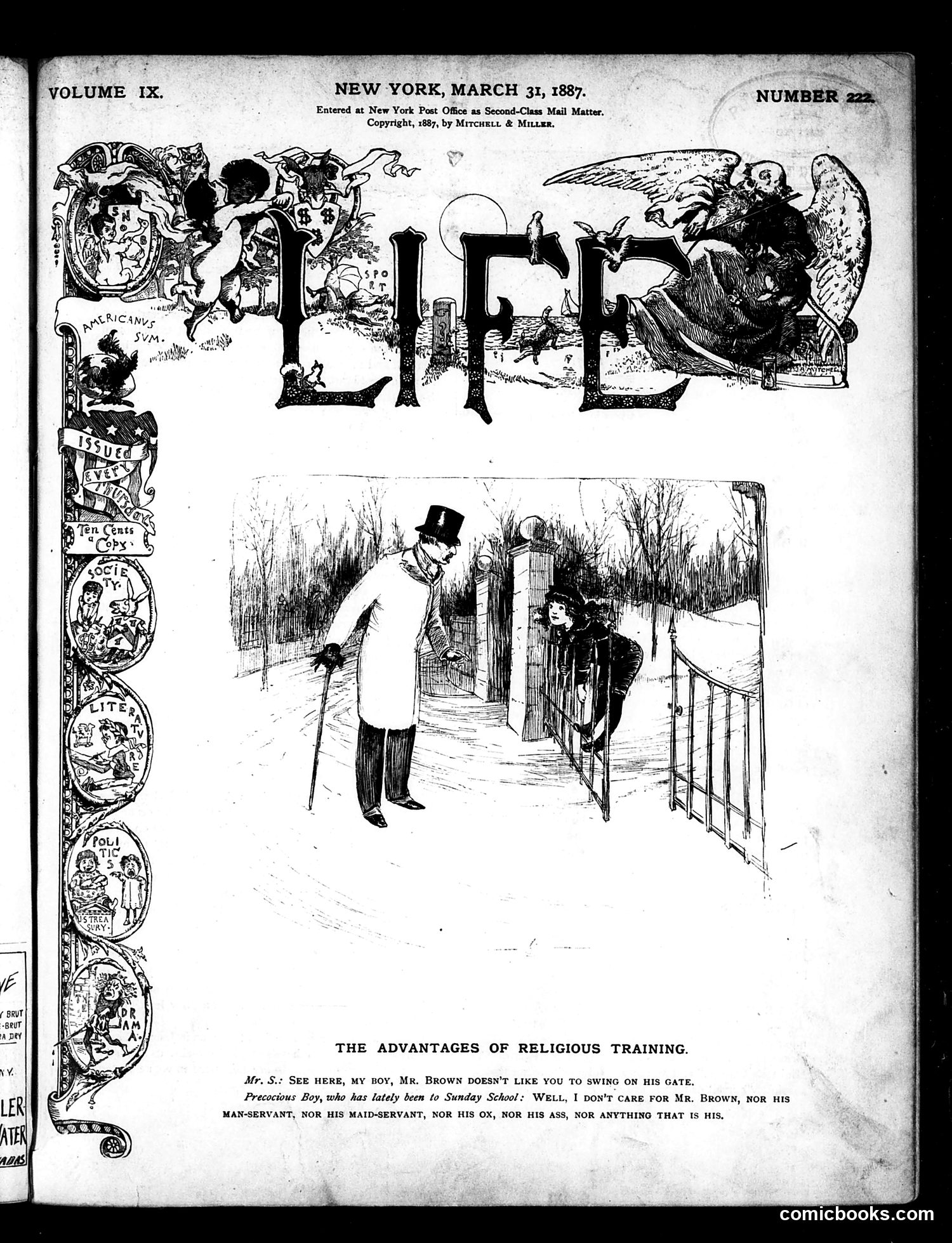
This 1887 *Life* cartoon satirizes religious hypocrisy. A well-dressed gentleman (Mr. S.) confronts a poorly-dressed boy swinging on Mr. Brown's gate. The caption presents the boy's justification: he dismisses Mr. Brown's property rights and his servants' concerns, claiming religious training gives him moral authority to disregard others' possessions and authority. The satire targets wealthy individuals who claim religious virtue while behaving selfishly—ignoring their social obligations to respect others' property and station. The elegantly-dressed man represents the educated class invoking religious training as cover for arrogant entitlement. The cartoon mocks the disconnect between professed Christian values (respecting others' property) and actual privileged behavior.
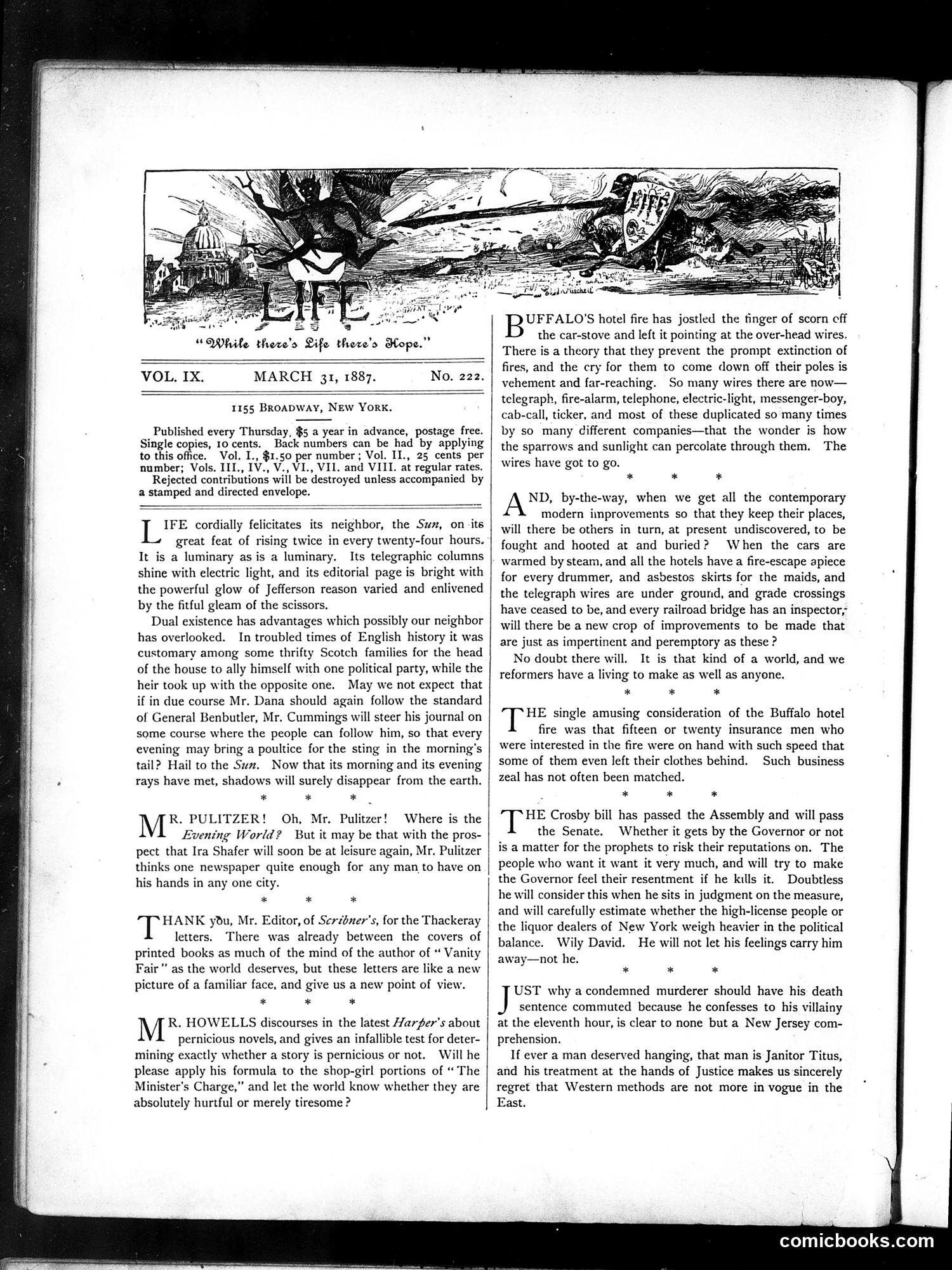
The masthead cartoon shows a bare tree with a noose, labeled "LIFE," and text reading "While there's Life there's Hope." This is dark gallows humor—a visual pun on Life magazine's title. The page contains editorial commentary rather than detailed political cartoons. It references: - **Buffalo hotel fire**: Satirizing overhead wires from competing utility companies (telegraph, telephone, electric) as fire hazards - **Mr. Pulitzer**: A jab at newspaper competition, likely referring to Joseph Pulitzer's *Evening World* - **The Crosby bill**: Legislation apparently concerning liquor licensing, with commentary on whether Governor David B. Hill will veto it The tone is typical 1887 satirical journalism—witty, gossipy editorial commentary mixed with social criticism about urban infrastructure dangers and political intrigue.
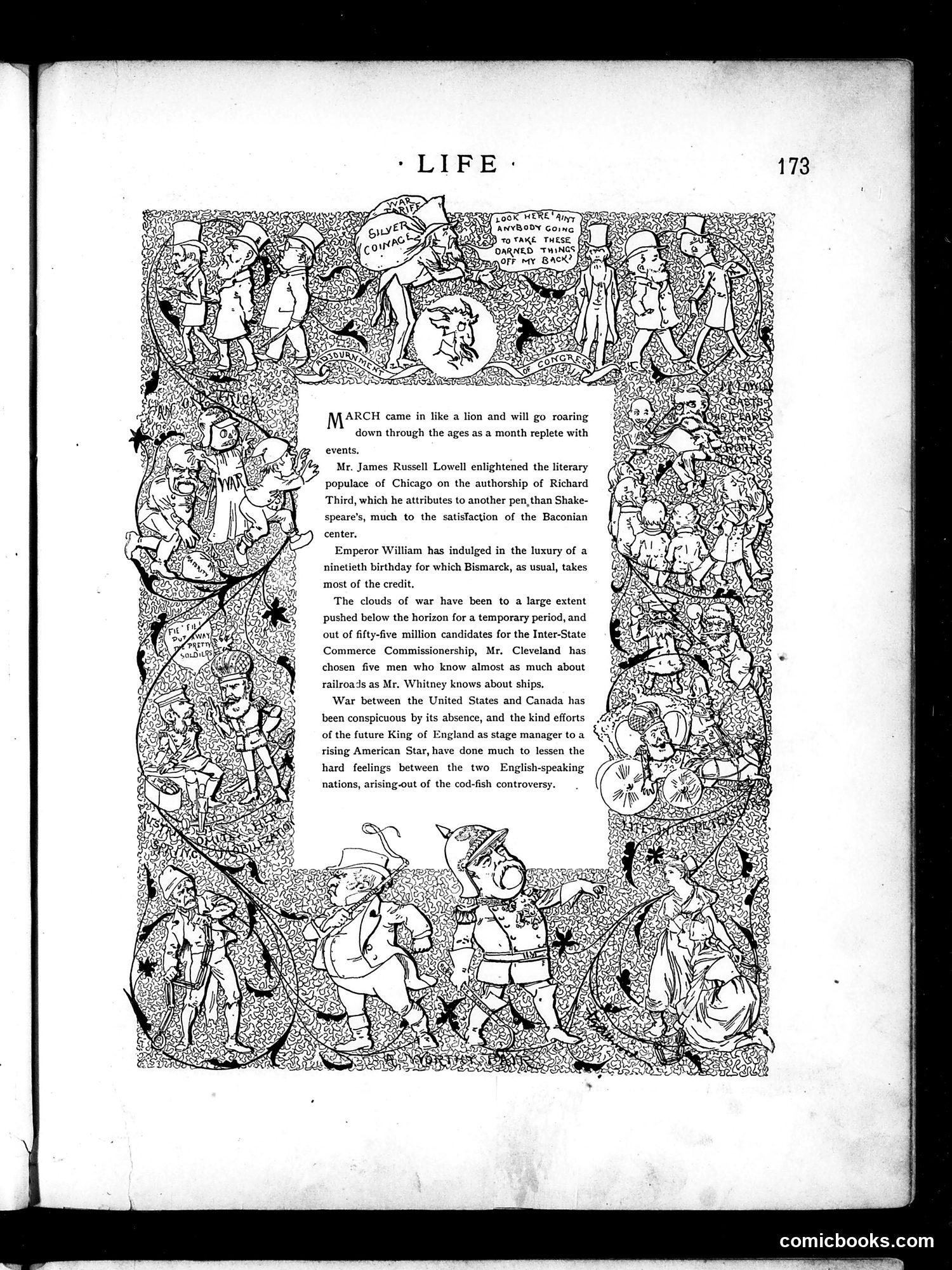
This page contains satirical commentary on contemporary events. The text references: 1. **James Russell Lowell's authorship debate** — discussing whether Richard Third was written by Shakespeare or another author, with mention of the "Baconian center" (those who believed Francis Bacon wrote Shakespeare's works). 2. **Emperor William's birthday** — attributed to Bismarck's credit. 3. **Interstate Commerce Commission** — Cleveland's appointment of five railroad experts, compared to Whitney's shipping knowledge. 4. **US-Canada relations** — noting the absence of war and efforts by England's "future King" to manage a rising American star, improving relations strained by the "cod-fish controversy." The decorative border contains whimsical illustrations of figures and various scenes, typical of Life's satirical visual style. The cartoons appear to be humorous commentary on these political and cultural topics of the era.
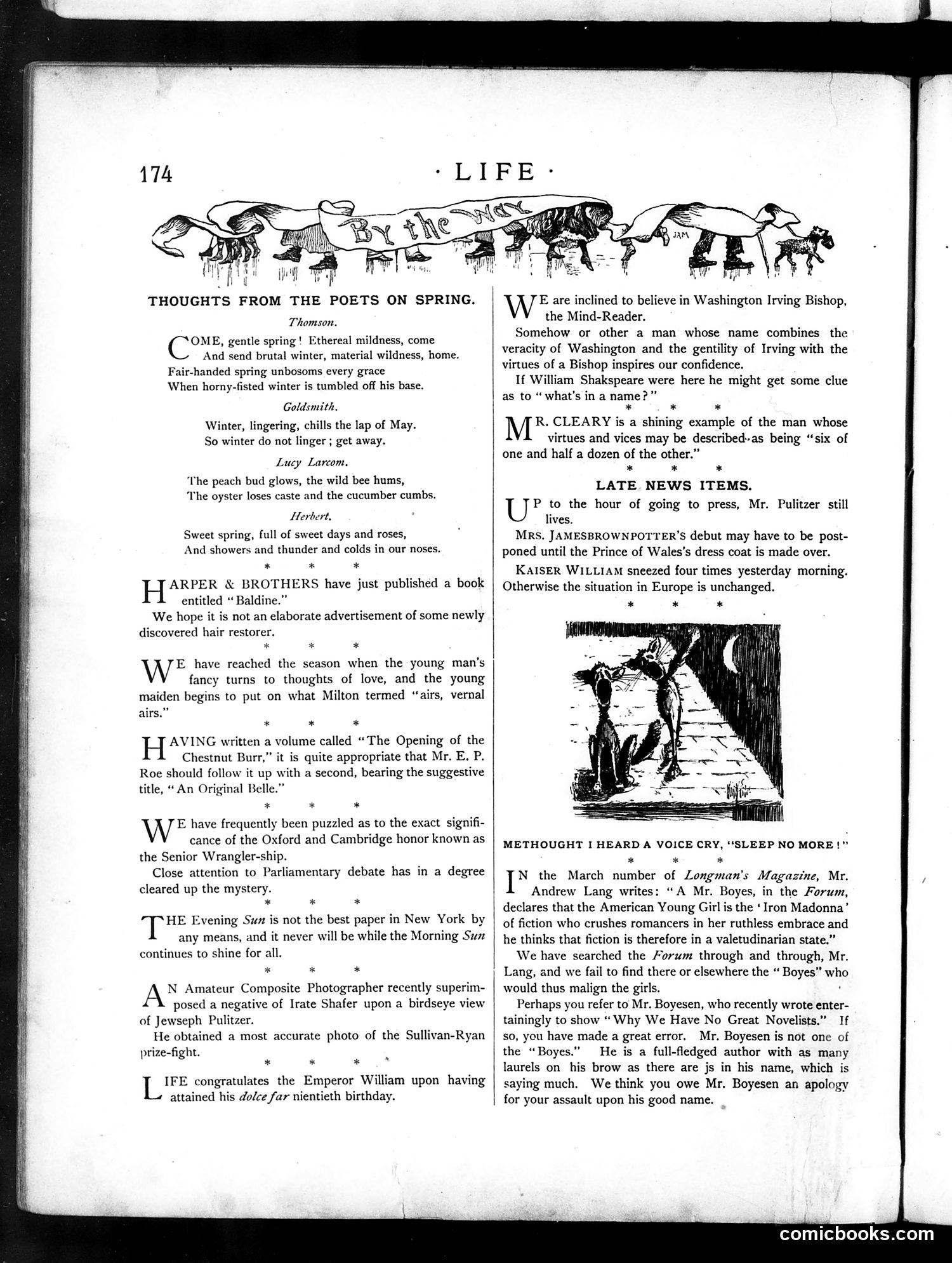
This page contains literary commentary and news items rather than political cartoons. The "Late News Items" section includes brief satirical observations typical of Life's humor: - A quip about Mr. Pulitzer still living - A note about Mrs. James Brown Potter's delayed debut - Commentary on Kaiser William sneezing (a light topical reference to German affairs) The main illustration shows a figure by water with the caption "Methought I heard a voice cry, 'Sleep no more!'" — a Shakespeare reference (from *Macbeth*), used humorously rather than politically. The page's content is primarily literary and social satire: discussions of spring poetry, critiques of recent publications like "Baldine" and "The Opening of the Chestnut Burr," and debate over American novelists. The humor targets cultural pretensions and literary merit rather than political figures.
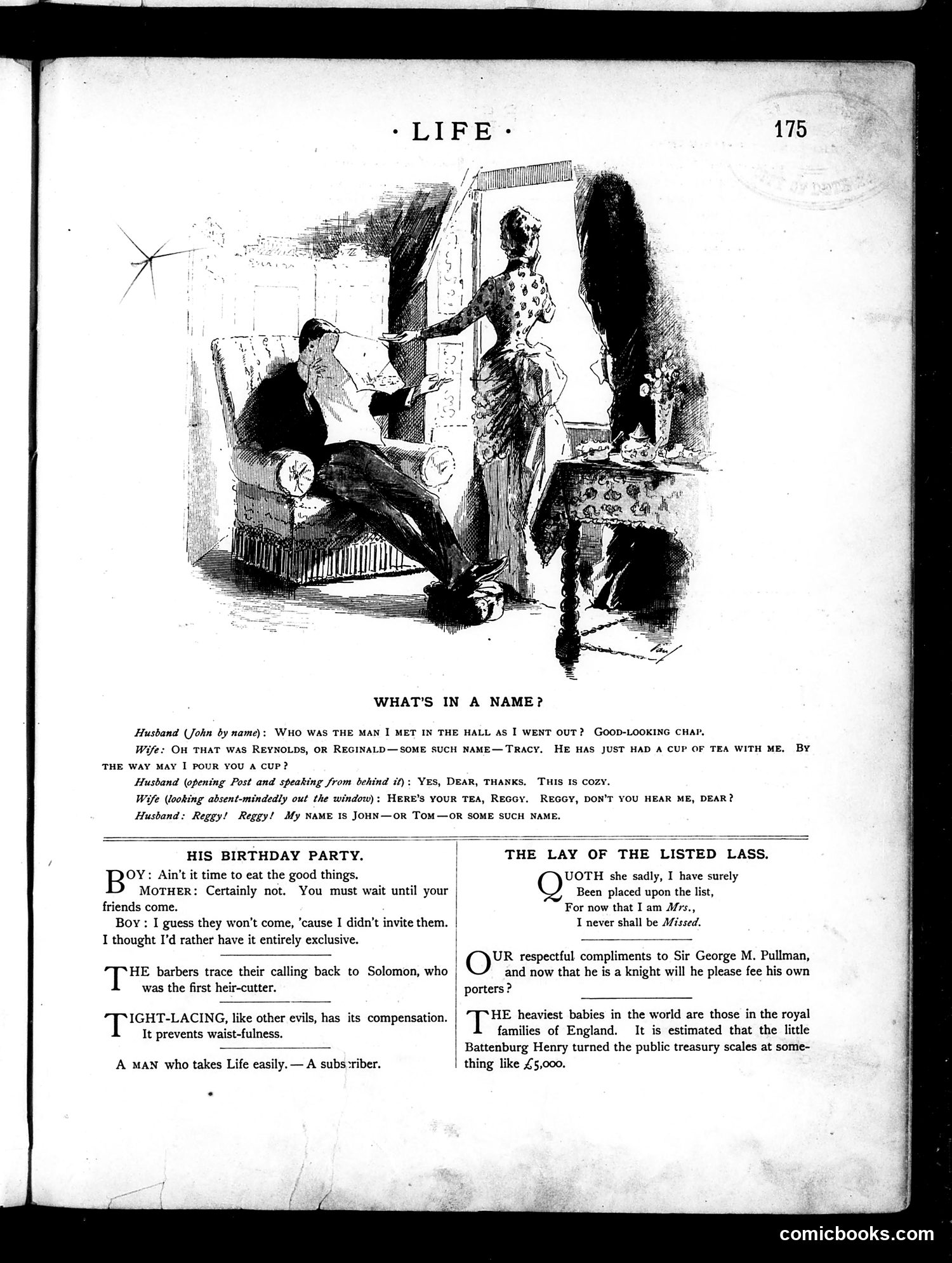
The top cartoon satirizes marital communication and naming conventions. A husband lounging in a chair asks his wife about a man she encountered, requesting his name. The wife struggles to recall whether the visitor was "Reynolds, or Reginald—some such name—Tracy." She notes he's just had tea with her. The husband responds that his name is "John—or Tom—or some such name," mocking her vagueness by mirroring her forgetfulness. This appears to be Victorian-era satire about wives' supposedly poor memory for acquaintances' names, or possibly about careless social introductions and the absurdity of not knowing guests' identities. The joke relies on gender stereotypes common to period humor. The page also contains unrelated brief items ("His Birthday Party," "The Lay of the Listed Lass") typical of Life's miscellaneous satirical content.
This page from *Life* magazine (page 176) is primarily **literary content**, not political satire. It features: 1. **"Photography"** — a poem by Frank Dempster Sherman praising a woman named Loveliness, referencing her connection to Massachusetts and "Seniors seven." 2. **Book review section** discussing Sherman's verses, praising their graceful rhythm and metrical skill while gently mocking the "deep poetic sentiment" as suitable for summer flirtation rather than serious literature. 3. **"New Books"** section listing recent publications. 4. **Two humor items** at bottom: "Awkward" (a brief joke about harnesses) and "Our Cook's Ammunition" (a pun about baking powder). The page contains **no political cartoons**—it's a mix of poetry, literary criticism, and light humor typical of *Life*'s entertainment content from this era.
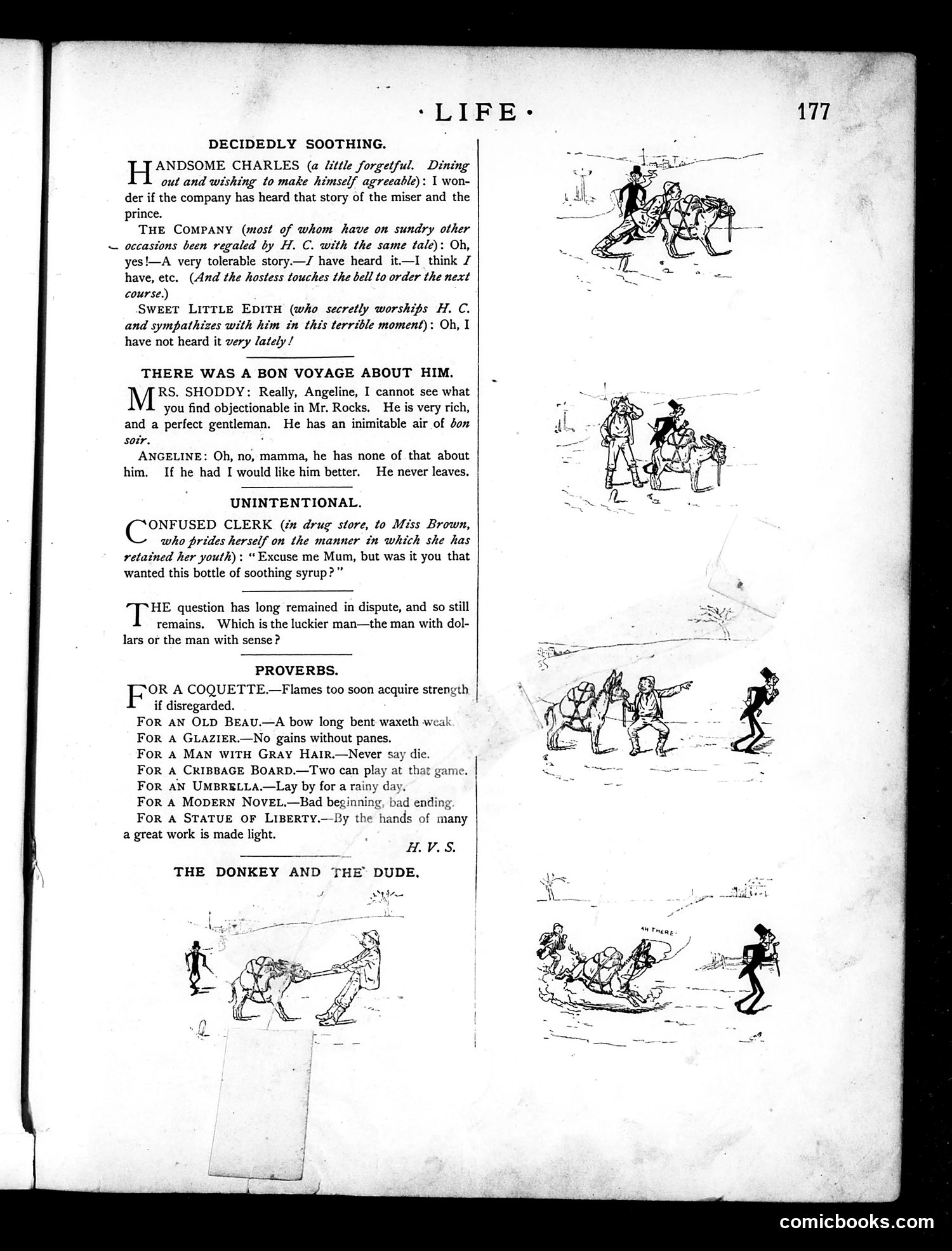
This page contains satirical social commentary and humorous sketches rather than political cartoons. The main sections include: **"Decidedly Soothing"**: A dinner party scene where Handsome Charles tells a story about a miser and prince; the company reacts with varying enthusiasm. **"There Was a Bon Voyage About Him"**: Mrs. Shoddy defends Mr. Rocks as a gentleman, while Angeline critiques his lack of charm and constant presence. **"The Donkey and the Dude"**: A visual joke showing a confrontation between a donkey and a man in formal attire (a "dude"), illustrated through sequential sketches. **"Proverbs"**: Witty observations about luck, poverty, and life. The sketches use exaggerated physical humor typical of early-20th-century magazine illustration. The satire targets social pretension and domestic absurdities rather than specific political figures or events.
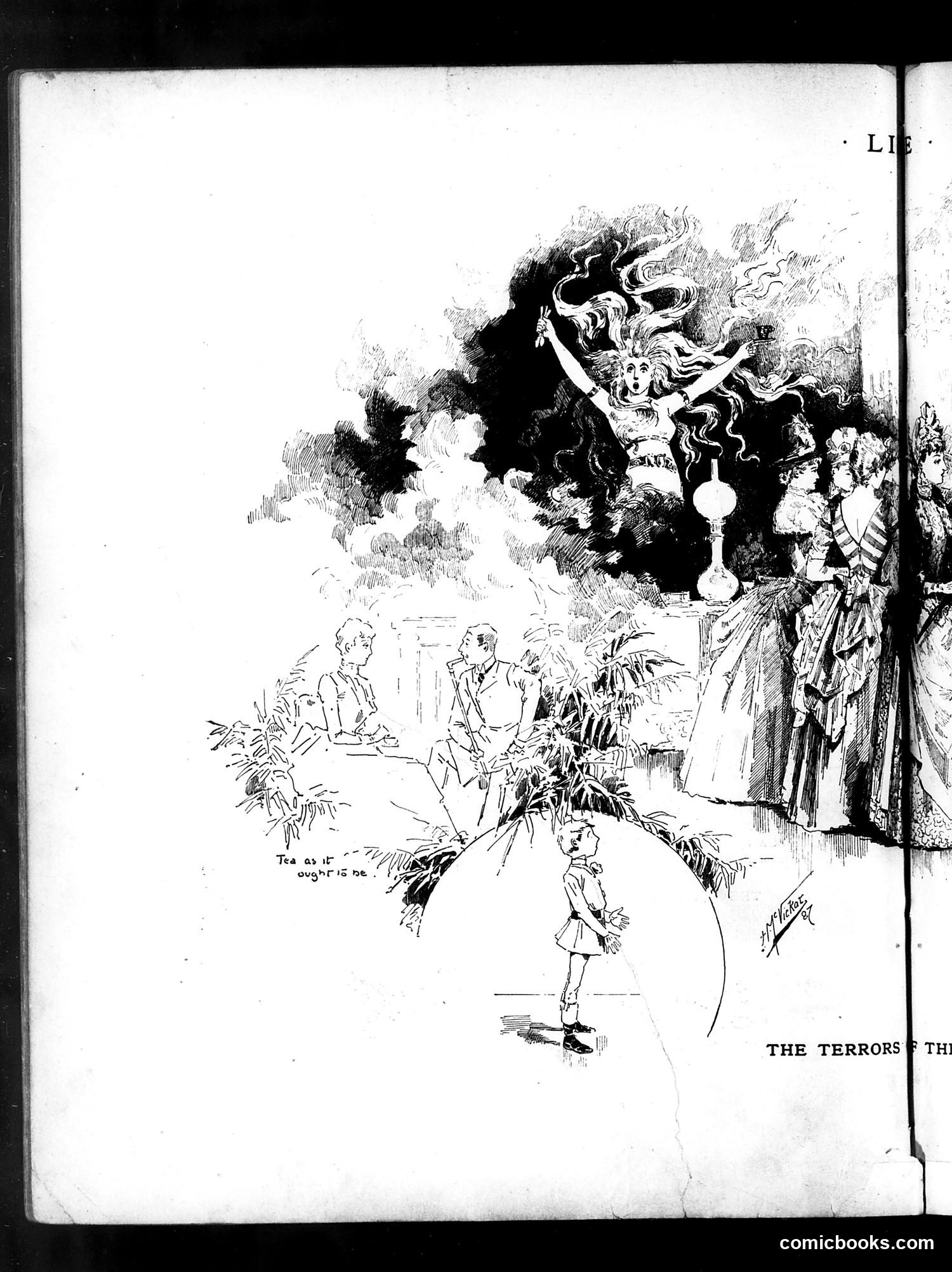
This appears to be a satirical illustration showing a child's nighttime fears brought to life. In the center stands a small boy holding what looks like a stick or sword, confronting an elaborate phantasmagorical scene above him. The upper portion depicts various theatrical or supernatural figures—demons, witches, or fantastical creatures emerging from darkness and smoke. The left side shows adults (possibly parents) seemingly indifferent or unconcerned with the child's terror. The caption "Tea as it ought to be" suggests this may be commentary on how certain foods or stimuli cause children's nightmares or anxieties. The overall satire likely mocks either parental negligence regarding children's bedtime habits, or contemporary beliefs about what caused childhood fears and night terrors.
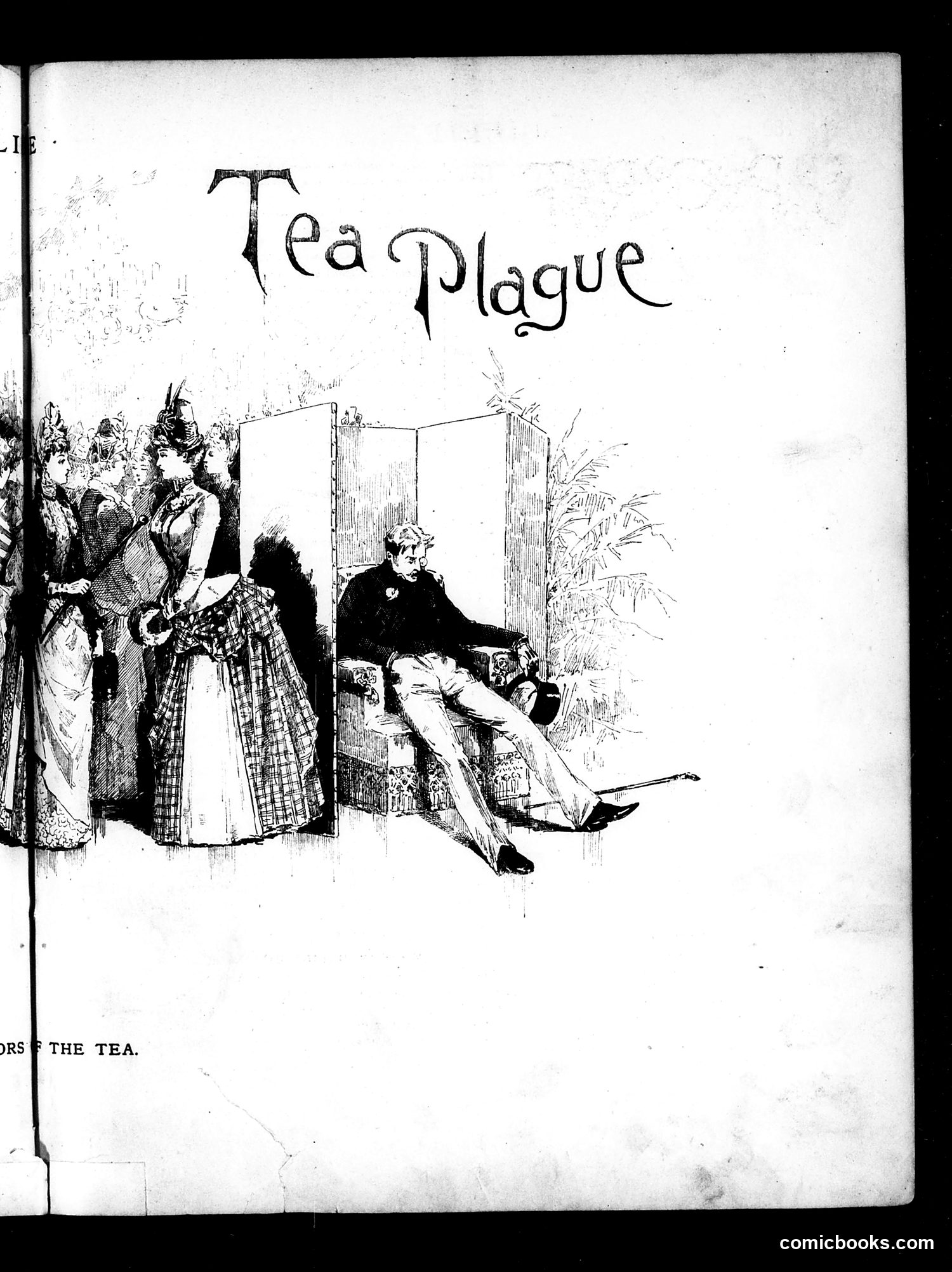
This is a title page for a section called "Tea Plague." The illustration depicts a social scene, likely satirizing Victorian or Edwardian-era tea culture. A man reclines lounging in a chair while several fashionably-dressed women attend to him—appearing to serve or entertain. The screen behind them suggests an interior domestic setting. The satire likely mocks the social rituals and excessive formality surrounding afternoon tea gatherings among the upper classes, or possibly critiques the idle leisure of wealthy men who are waited upon by women. Without additional context from the magazine's date and surrounding articles, the specific "plague" being satirized—whether it's social affectation, gender dynamics, or class pretension—remains somewhat unclear, though the exaggerated postures suggest mockery of affected behavior.
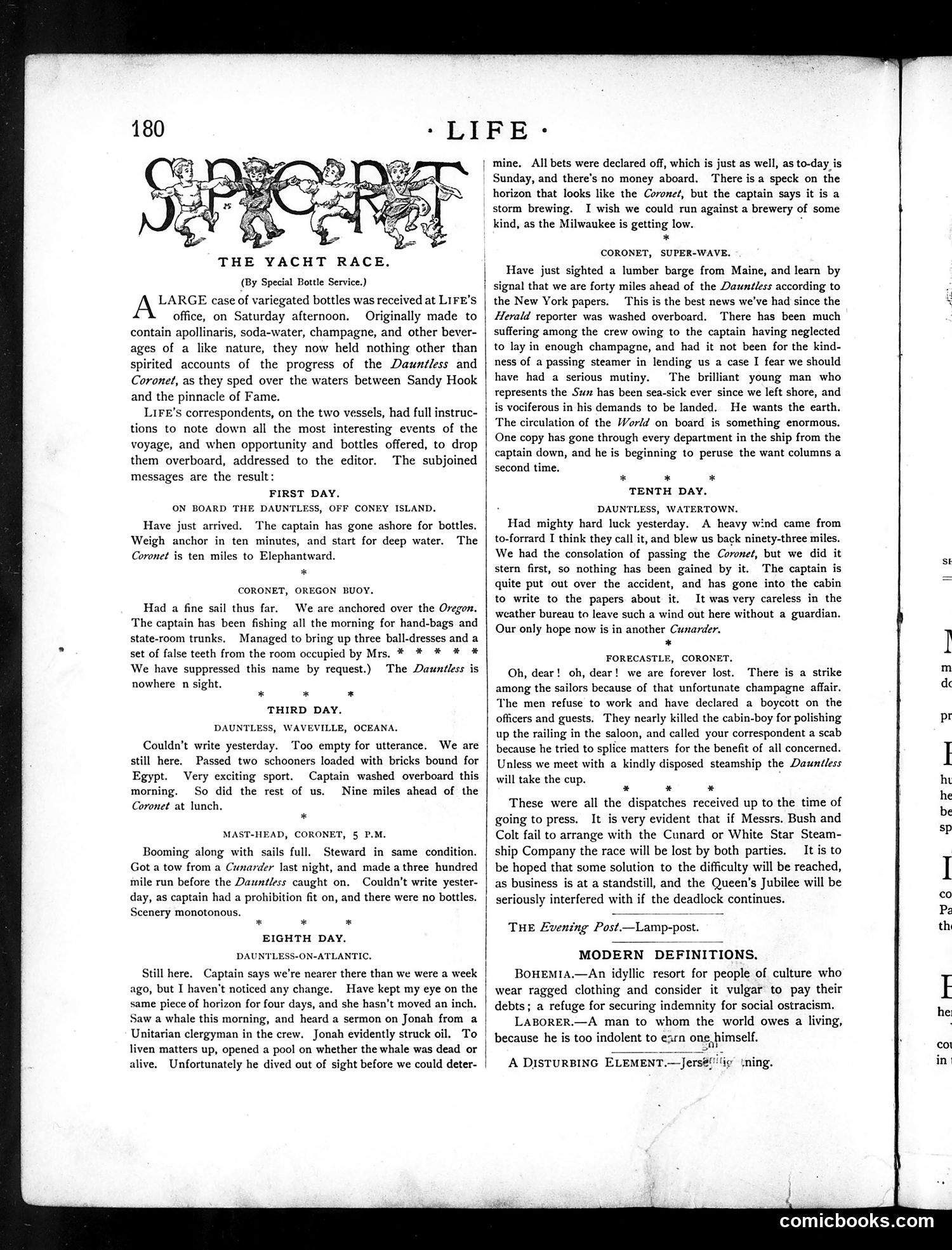
This page covers a transatlantic yacht race between two vessels: the *Dauntless* and the *Coronet*. The "Sport" section presents dispatches from correspondents aboard both ships, documenting their competition day-by-day as they race across the Atlantic. The narrative includes dramatic incidents: a lumber barge sighting, severe weather ("super-wave"), a strike among sailors over champagne rationing, and crew conflicts. The tone is satirical—the reporters humorously exaggerate the trivial hardships and social tensions aboard the luxurious yachts (notably the complaint about insufficient champagne). The page concludes with humorous "Modern Definitions," including satirical takes on bohemians and laborers—typical Life magazine social commentary of the period.
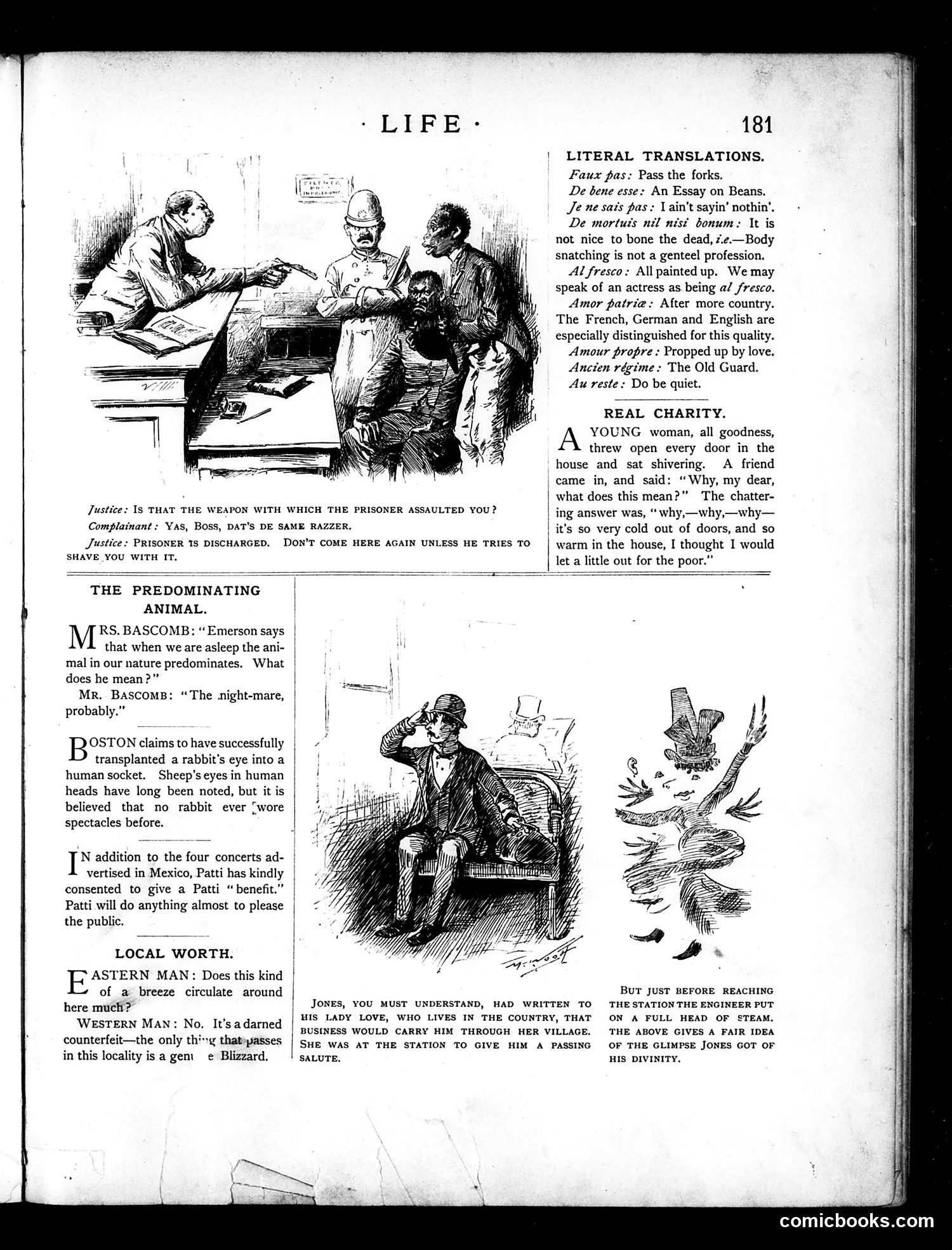
This page contains multiple satirical pieces typical of 19th-century American humor magazines: **Top cartoon:** A courtroom scene mocking racial justice. A Black defendant is accused of assault with a razor; the judge dismisses the case, joking the prisoner should only be discharged if he tries to "shave" the complainant. The satire targets judicial indifference to violence against Black people and racist stereotypes portraying Black men as razor-wielders. **"Real Charity":** Satirizes performative benevolence—a wealthy woman opens doors to the poor not from genuine compassion but to let warmth escape her house for them, viewing charity as mere window-dressing. **Other bits:** Include puns on French phrases, jokes about scientific transplantation, and a romantic vignette mocking a missed romantic encounter. The humor relies on wordplay, absurdist logic, and social observation typical of late 19th-century American satire.
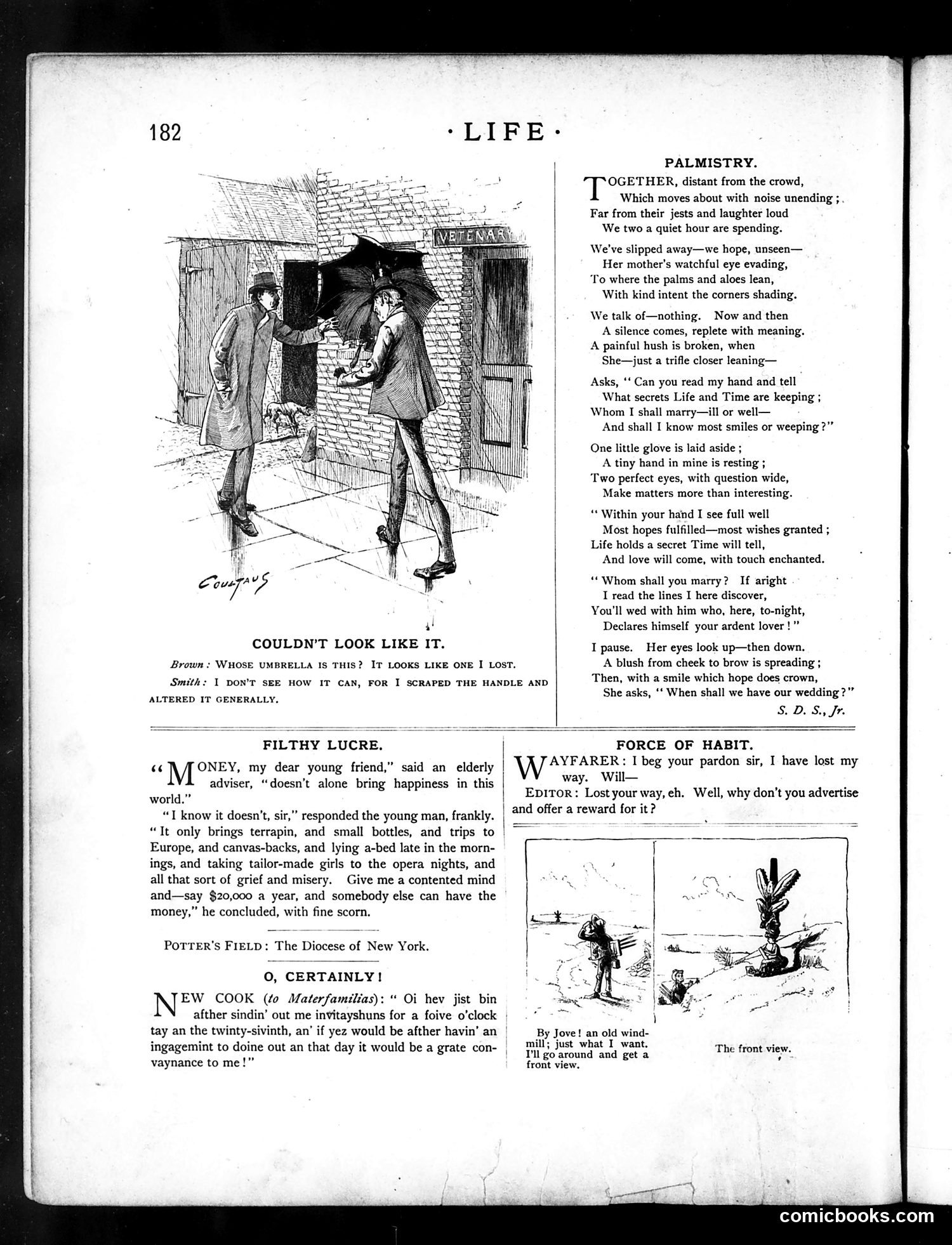
This page contains several humorous short pieces typical of Life's satirical content: **"Couldn't Look Like It"** (top): A joke about umbrella theft. Smith claims Brown's lost umbrella couldn't be his because he deliberately altered it—scraping and changing the handle. The humor lies in Smith inadvertently confessing to the theft while denying it. **"Palmistry"** (right): A romantic poem about a young couple secretly meeting near plants. The boy reads the girl's palm, flirtatiously "predicting" she'll marry him—a playful seduction disguised as fortune-telling. The girl blushes and accepts, asking when they'll marry. **"Filthy Lucre"**: A cynical dialogue where an elder advises that money doesn't bring happiness, but the young man agrees while listing luxuries money *does* buy (travel, fine dining, opera dates), revealing money's actual appeal. **"O, Certainly!"**: An Irish-accented cook's invitation mishap—unclear context without more page content. **"Force of Habit"**: A lost wayfarer asks directions but the Editor assumes he wants to *advertise* his lostness, reflecting contemporary newspaper culture.
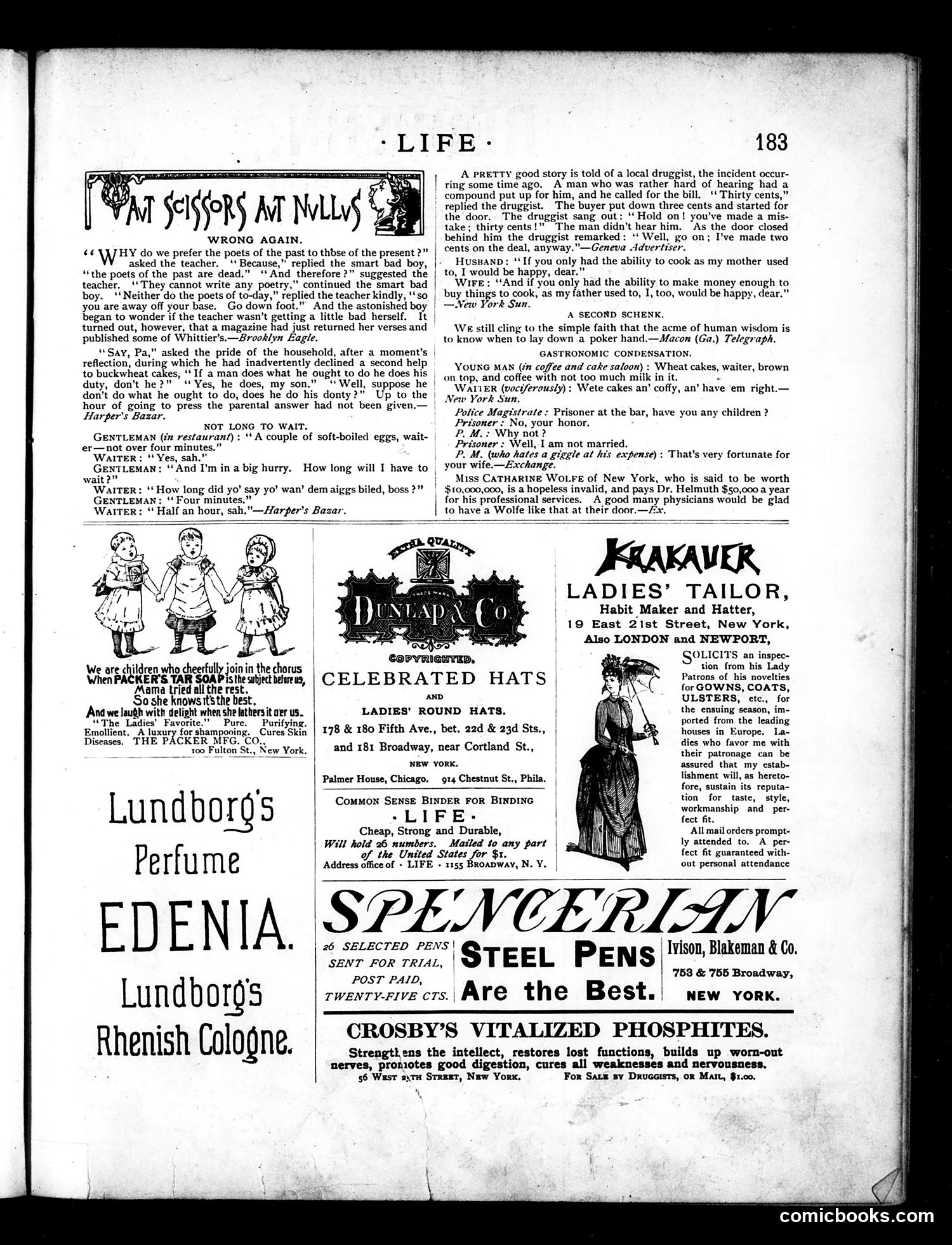
This page contains several humorous short anecdotes satirizing everyday social situations and human nature, rather than political cartoons. The jokes target: **Educational pretension**: A smart boy's logic embarrasses a teacher who claims modern poets can't write—ironic since *her* verses were rejected while dead poets (Whittier) are published. **Marital discord**: Spouses blame each other's family shortcomings (cooking ability vs. earning power), deflecting responsibility. **Class/Service dynamics**: A deaf customer underpays a druggist, who philosophically accepts the loss. Separately, a rushed customer discovers the waiter's "four minutes" actually means "half an hour"—mocking service workers' indifference. **Absurd logic**: A child's philosophical question about duty confuses his father. **Police court humor**: A magistrate's irritation when a prisoner's innocent answer (unmarried = no children) gets laughs at the magistrate's expense. The page also contains period advertisements for perfume, ladies' tailoring, and steel pens—typical of Life's format mixing satire with commercial content.
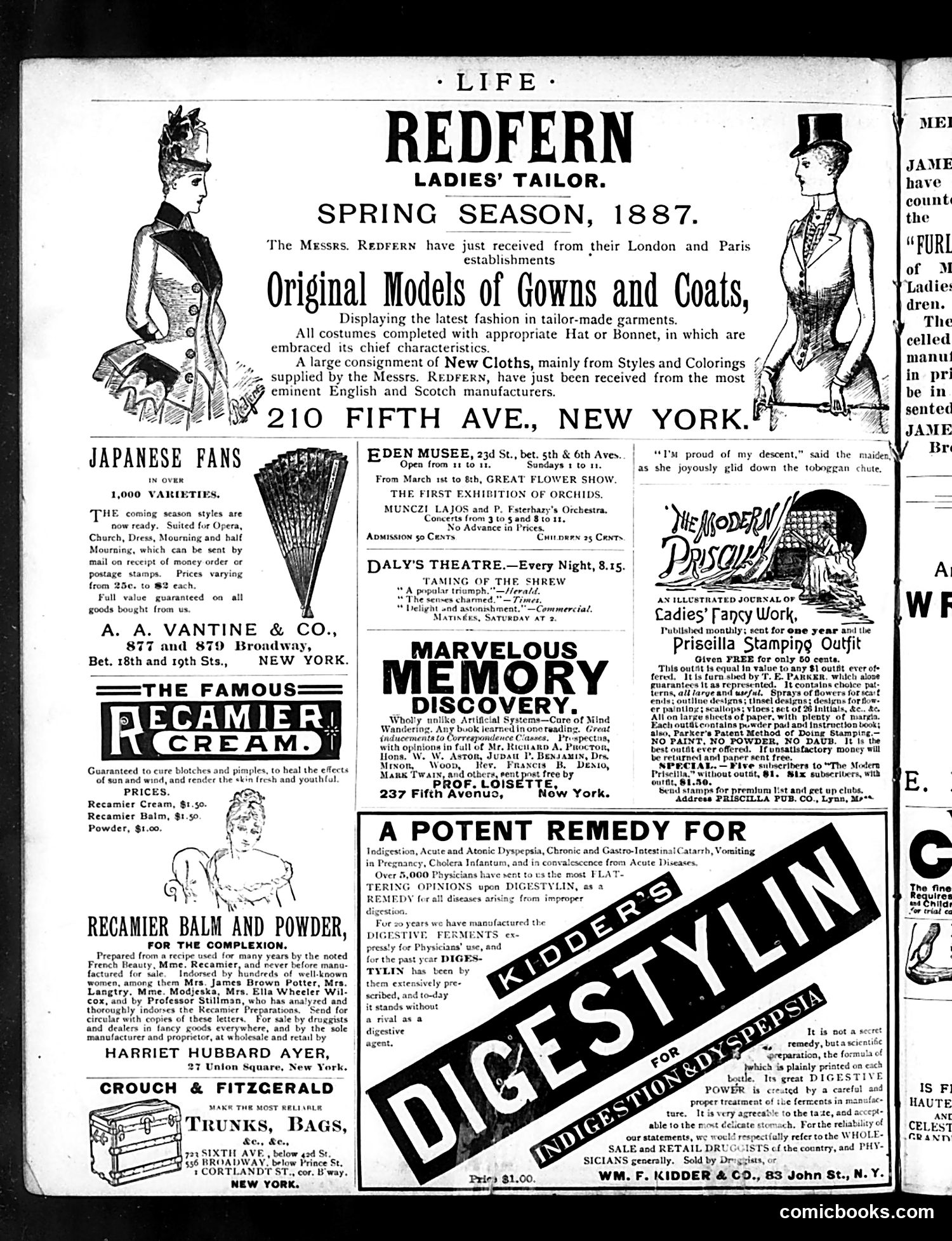
This page is primarily **advertising and announcements**, not political satire. It contains: **Main content:** Fashion advertisements, particularly Redfern Ladies' Tailor (center top) promoting spring 1887 gowns and coats in the latest London and Paris styles. This reflects the era's fashion obsession and European cultural dominance. **Other advertisements include:** Japanese fans (exotic goods), Recamier cosmetics (beauty products emphasizing complexion care), theater listings (Daly's Theatre), and various patent medicines and remedies—typical of 1880s magazines. **Notable:** The large diagonal advertisement for "Kidder's Digestion" (a patent medicine) and "The Modern Priscilla" stamping outfit reflect consumer culture priorities. **No significant political cartoons or satire** appear on this page. The small anecdote about a maiden on a toboggan is merely light humor accompanying an advertisement.
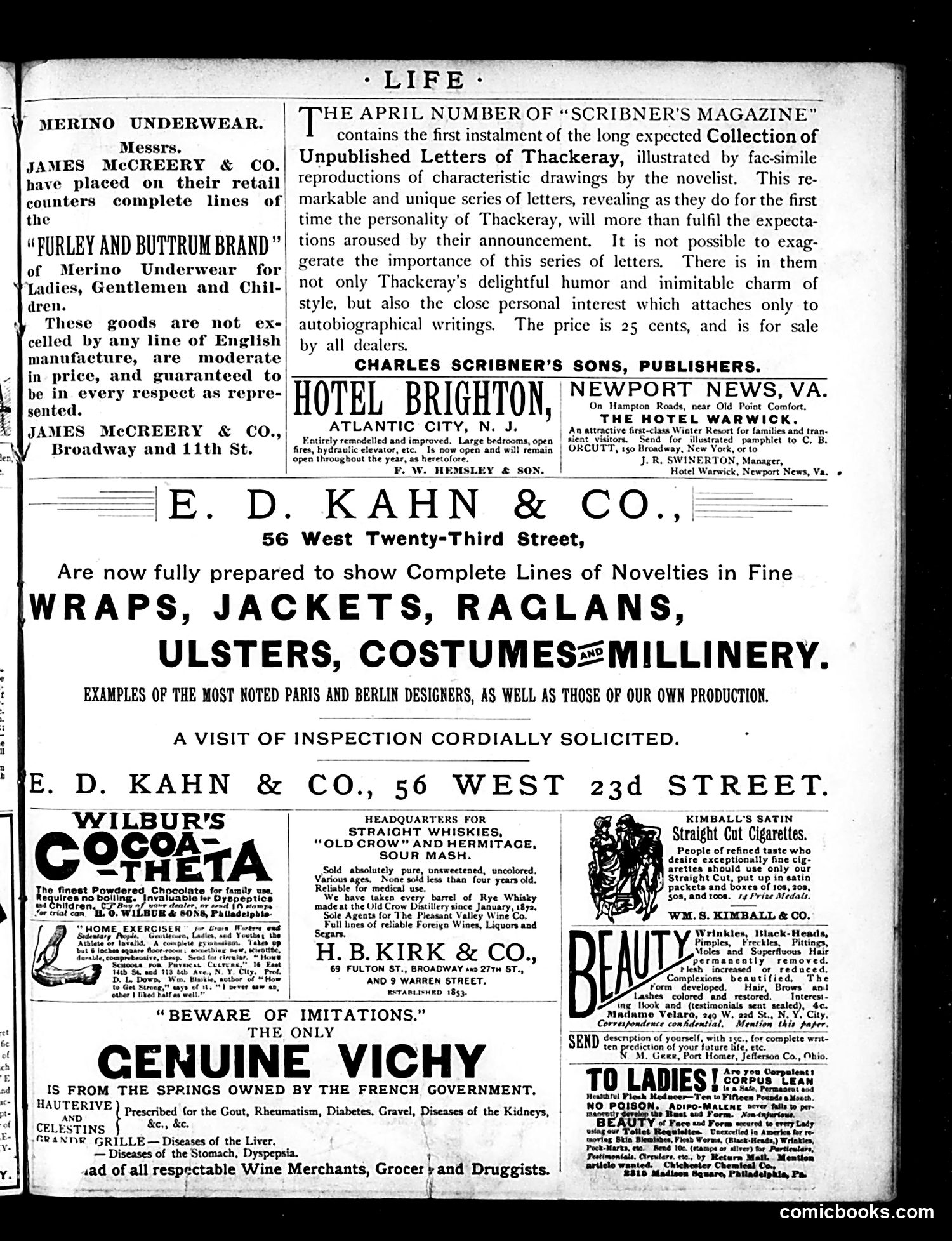
This page is **primarily advertising**, not satire or political cartoons. It's a compilation of late-19th-century commercial advertisements and notices. **Notable content includes:** - **Scribner's Magazine** promotion announcing Thackeray's unpublished letters—appealing to literary audiences - **Fashion/clothing ads** (E.D. Kahn & Co., James McCreery) showcasing Paris and Berlin designers - **Luxury goods**: Wilbur's cocoa, H.B. Kirk whiskeys, Kimball's cigarettes—targeting affluent consumers - **Vichy water advertisement** warning against imitations, emphasizing it's "from springs owned by the French government"—a status symbol for health-conscious elites - **Beauty treatments** (Madame Velaro) offering skin improvement and hair restoration **The page reflects Gilded Age consumer culture**: emphasis on European sophistication, medical remedies marketed to wealthy audiences, and brand authentication against counterfeits. There's no discernible satirical content—this is straightforward period advertising.
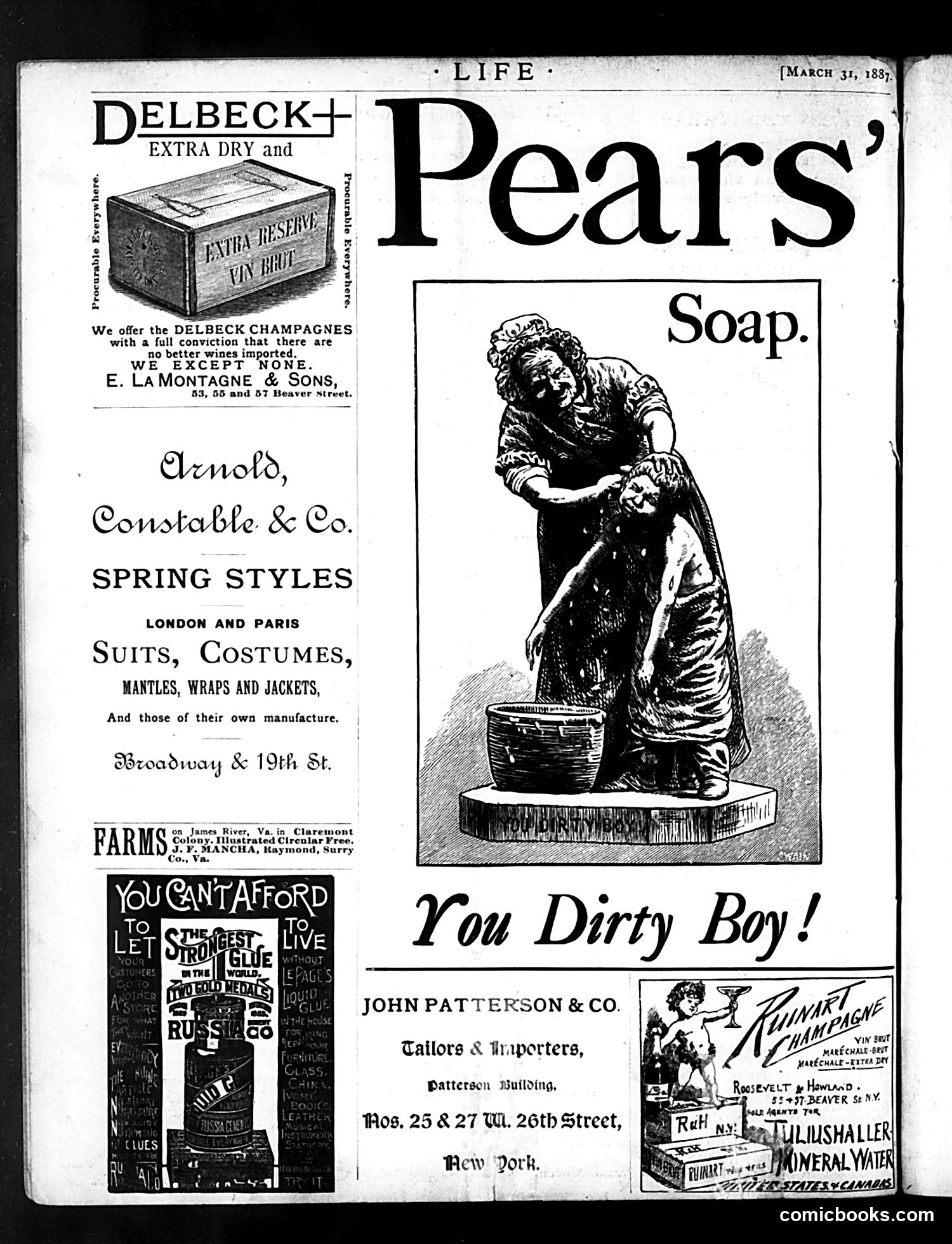
This is primarily an **advertising page** from Life magazine (March 31, 1887). The dominant image is a Pears' Soap advertisement featuring a young boy in tattered clothes kneeling beside a washing basin. The caption reads "You Dirty Boy!"—a humorous appeal to cleanliness. The cartoon's satire is genteel and mild by modern standards: it depicts poverty or neglect through the child's ragged appearance, then uses shame/humor to sell soap as a solution to uncleanliness. The image plays on Victorian anxieties about hygiene and social respectability. The remainder of the page consists of period advertisements for champagne, women's fashions, tailoring services, and other luxury goods—typical of Life's advertising content. **No political figures or events are referenced.** This is commercial satire targeting consumer behavior, not social commentary.