
Life, 1887-03-31 · page 6 of 16
Life — March 31, 1887 — page 6: what you’re looking at
What you’re looking at
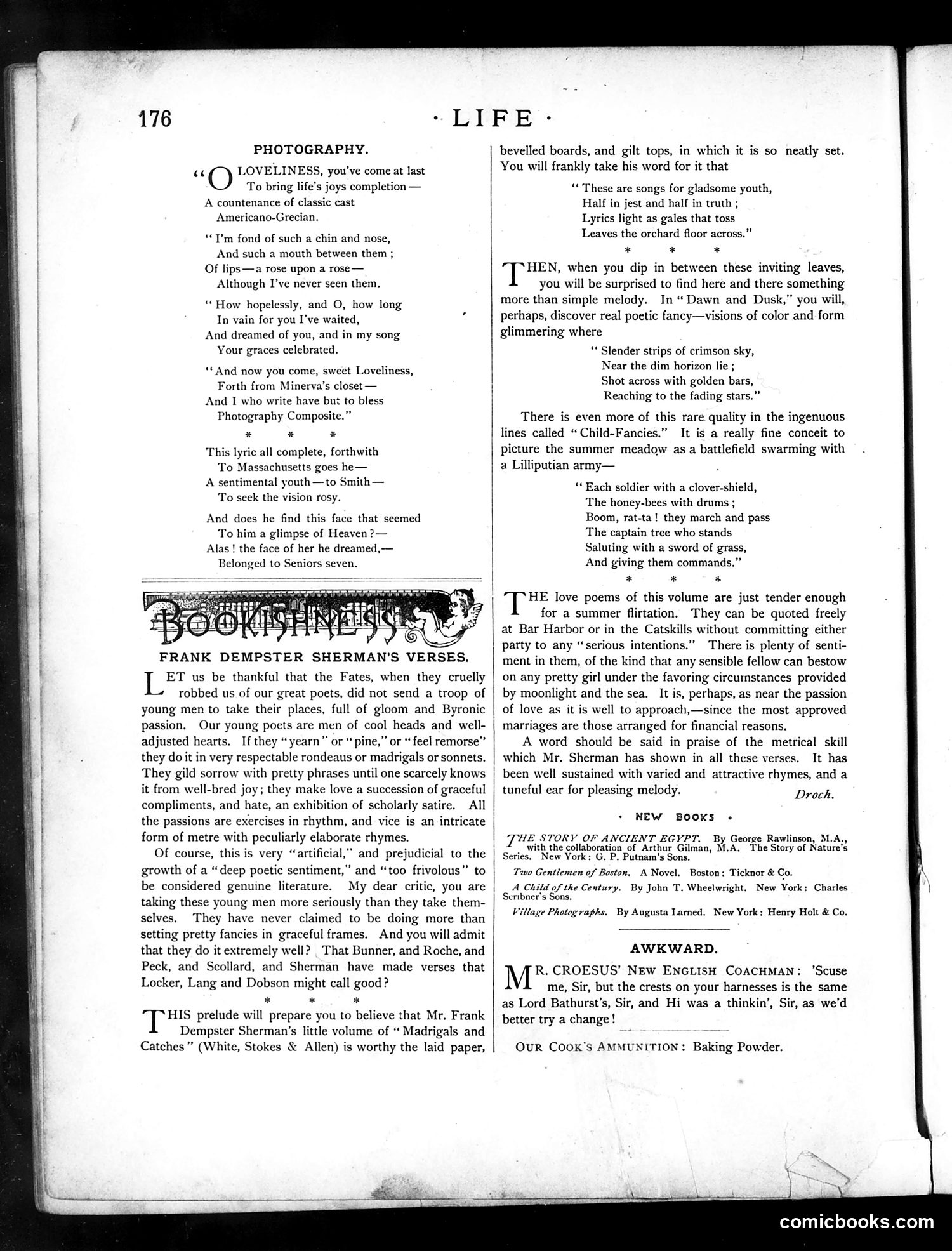
This page from *Life* magazine (page 176) is primarily **literary content**, not political satire. It features: 1. **"Photography"** — a poem by Frank Dempster Sherman praising a woman named Loveliness, referencing her connection to Massachusetts and "Seniors seven." 2. **Book review section** discussing Sherman's verses, praising their graceful rhythm and metrical skill while gently mocking the "deep poetic sentiment" as suitable for summer flirtation rather than serious literature. 3. **"New Books"** section listing recent publications. 4. **Two humor items** at bottom: "Awkward" (a brief joke about harnesses) and "Our Cook's Ammunition" (a pun about baking powder). The page contains **no political cartoons**—it's a mix of poetry, literary criticism, and light humor typical of *Life*'s entertainment content from this era.
📄 Transcribed text from this page (OCR, searchable)
Machine-transcribed from the original scan — historical spelling and the odd misread are preserved.
> DFE PHOTOGRAPHY. oc O LOVELINESS, you've come at last To bring life's joys completion — A countenance of classic cast Americano-Grecian. “I'm fond of such a chin and nose, And such a mouth between them ; Of lips—a rose upon a rose— Although I’ve never seen them. “How hopelessly, and O, how long In vain for you I've waited, And dreamed of you, and in my song Your graces celebrated. “And now you come, sweet Loveliness, Forth from Minerva’s closet — And I who write have but to bless Photography Composite.” * * * This lyric all complete, forthwith To Massachusetts goes he— A sentimental youth—to Smith — To seek the vision rosy. And does he find this face that seemed To him a glimpse of Heaven ?— Alas ! the face of her he dreamed,— Belonged to Seniors seven. FRANK DEMPSTER SHERMAN’S VERSES. ET us be thankful that the Fates, when they cruelly robbed us of our great poets, did not send a troop of young men to take their places, full of gloom and Byronic passion. Our young poets are men of cool heads and well- adjusted hearts. If they “yearn” or “pine,” or “feel remorse” they doit in very respectable rondeaus or madrigals or sonnets. They gild sorrow with pretty phrases until one scarcely knows it from well-bred joy; they make love a succession of graceful compliments, and hate, an exhibition of scholarly satire. All the passions are exercises in rhythm, and vice is an intricate form of metre with peculiarly elaborate rhymes. OF course, this is very “artificial,” and prejudicial to the | growth of a “deep poetic sentiment,” and “too frivolous” to be considered genuine literature. My dear critic, you are taking these young men more seriously than they take them- selves. They have never claimed to be doing more than setting pretty fancies in graceful frames. And you will admit that they do it extremely well? _That Bunner, and Roche, and Peck, and Scollard, and Sherman have made verses that Locker, Lang and Dobson might call good ? * * * HIS prelude will prepare you to believe that Mr. Frank Dempster Sherman's little volume of “ Madrigals and Catches” (White, Stokes & Allen) is worthy the laid paper, bevelled boards, and gilt tops, in which it is so neatly set. You will frankly take his word for it that “These are songs for gladsome youth, Half in jest and half in truth ; Lyrics light as gales that toss Leaves the orchard floor across.” * * * HEN, when you dip in between these inviting leaves, you will be surprised to find here and there something more than simple melody. In “ Dawn and Dusk,” you will, perhaps, discover real poetic fancy—visions of color and form glimmering where “« Slender strips of crimson sky, Near the dim horizon lie ; Shot across with golden bars, Reaching to the fading stars.” There is even more of this rare quality in the ingenuous lines called “Child-Fancies.” It is a really fine conceit to picture the summer meadow as a battlefield swarming with a Lilliputian army— “*Each soldier with a clover-shield, The honey-bees with drums ; Boom, rat-ta! they march and pass The captain tree who stands Saluting with a sword of grass, And giving them commands.” * * 4 HE love poems of this volume are just tender enough for a summer flirtation. They can be quoted freely at Bar Harbor or in the Catskills without committing either party to any “serious intentions.” There is plenty of senti- ment in them, of the kind that any sensible fellow can bestow on any pretty girl under the favoring circuinstances provided by moonlight and the sea. It is, perhaps, as near the passion of love as it is well to approach,—since the most approved marriages are those arranged for financial reasons. A word should be said in praise of the metrical skill which Mr. Sherman has shown in all these verses. It has been well sustained with varied and attractive rhymes, and a tuneful ear for pleasing melody. Droch. + NEW BOOKS «+ TUE STORY OF ANCIENT EGYPT. By George Rawlinson, M.A,, __ with the collaboration of Arthur Gilman, M.A. The Story of Nature's Series. New York: G. P. Putnam's Sons. Two Gentlemen of Boston. A Novel. Boston: Ticknor & Co. A Child of the Century. By John T. Wheelwright. New York: Charles Scribner's Sons. Village Photographs. By Augusta Larned, New York: Henry Holt & Co. AWKWARD. R. CROESUS’ NEw ENGLISH COACHMAN: 'Scuse me, Sir, but the crests on your harnesses is the same as Lord Bathurst’s, Sir, and Hi was a thinkin’, Sir, as we'd better try a change! Our Cook's AMMUNITION: Baking Powder. comicbooks.com