
A complete issue · 16 pages · 1887
Life — February 24, 1887
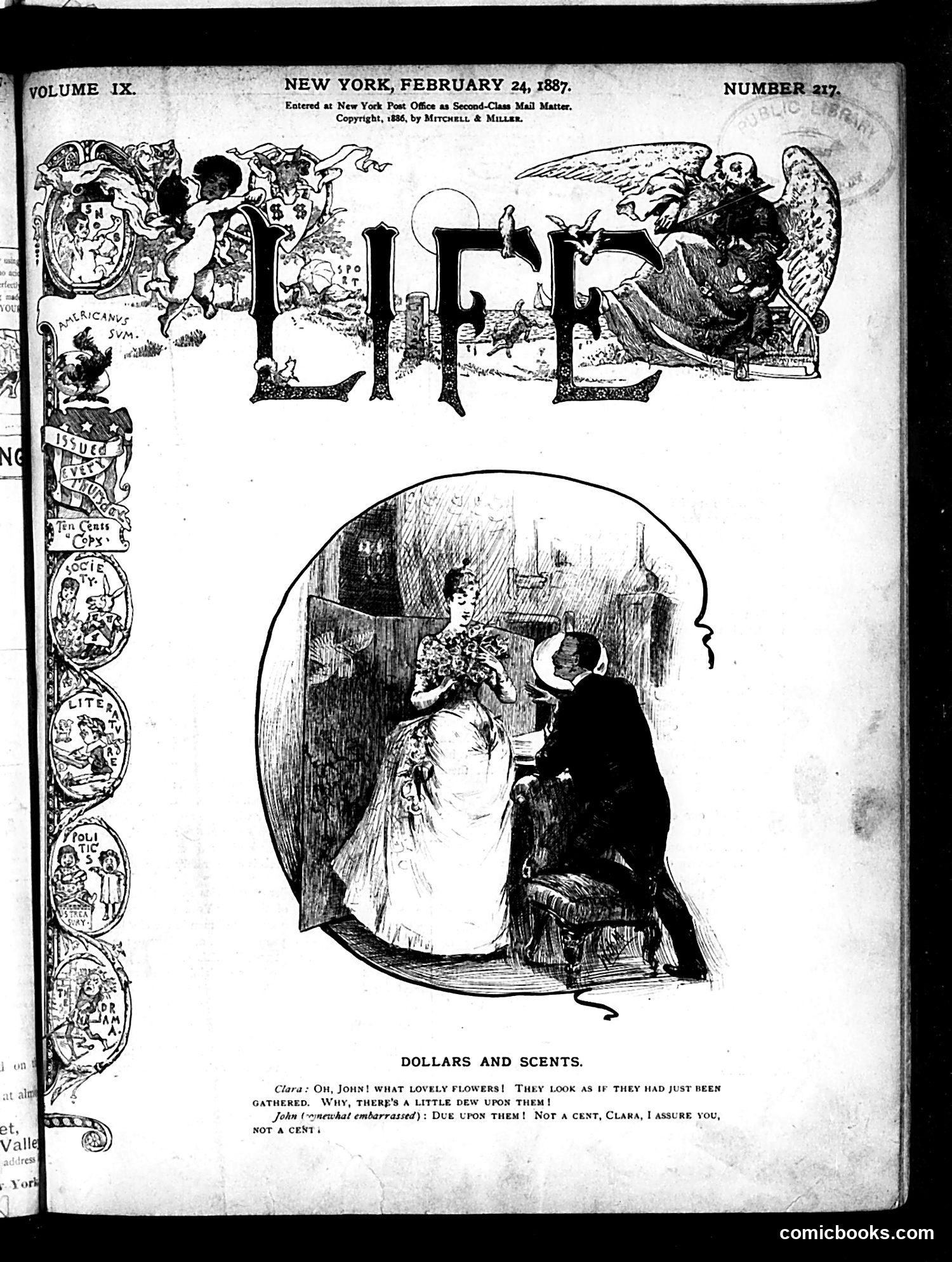
This satirical cartoon depicts a social encounter between two figures. The text reveals the joke: Clara remarks that John's lover "look[s] lovely" with "just been gathered" flowers, and notices "a little dew upon them." John defensively insists the dew is genuine—"Not a cent, Clara, I assure you, not a cent!" The satire plays on a double meaning: "scents" (perfumes) versus "cents" (money). The cartoon mocks John's anxiety about appearing cheap or fraudulent. He's worried Clara suspects he bought artificial flowers or used cheap perfume instead of genuine dew, suggesting social anxieties about displaying adequate wealth and taste to impress women in Victorian courtship rituals.
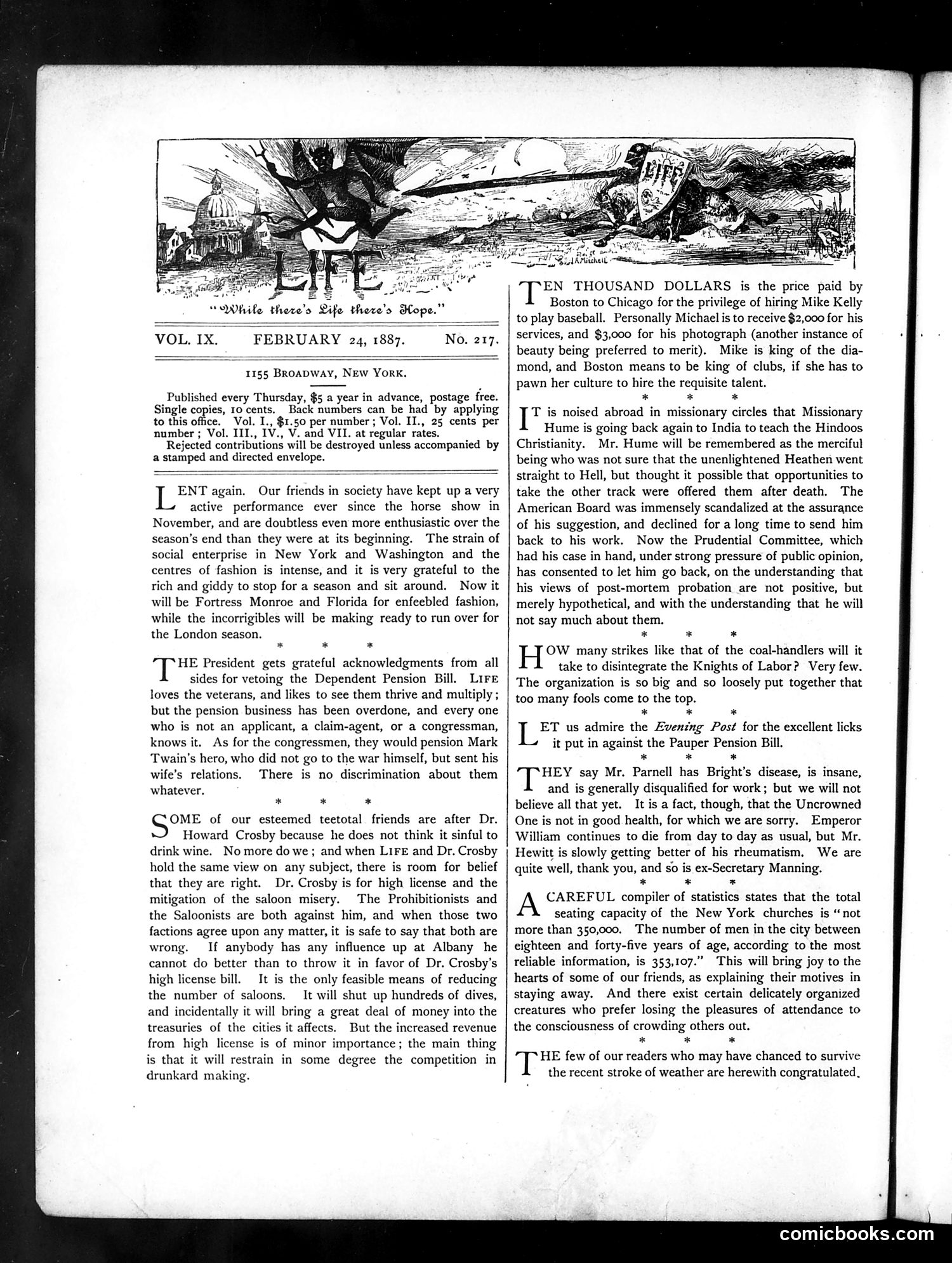
The header cartoon, titled "While there's Life there's Hope," depicts a skeletal Death figure wielding a scythe over a cityscape dominated by a Capitol building and church dome. This appears to be satirizing mortality and human vulnerability—fitting for a magazine called *Life* using dark humor about death's inevitability. The text discusses social and political issues of the era: a $10,000 baseball salary, missionary work in India, pension reform debates, prohibition versus licensing of alcohol, church seating capacity statistics, and recent weather-related deaths. The satire targets various institutions and public figures debating social reform, with *Life* taking moderate or skeptical positions on heated contemporary debates.
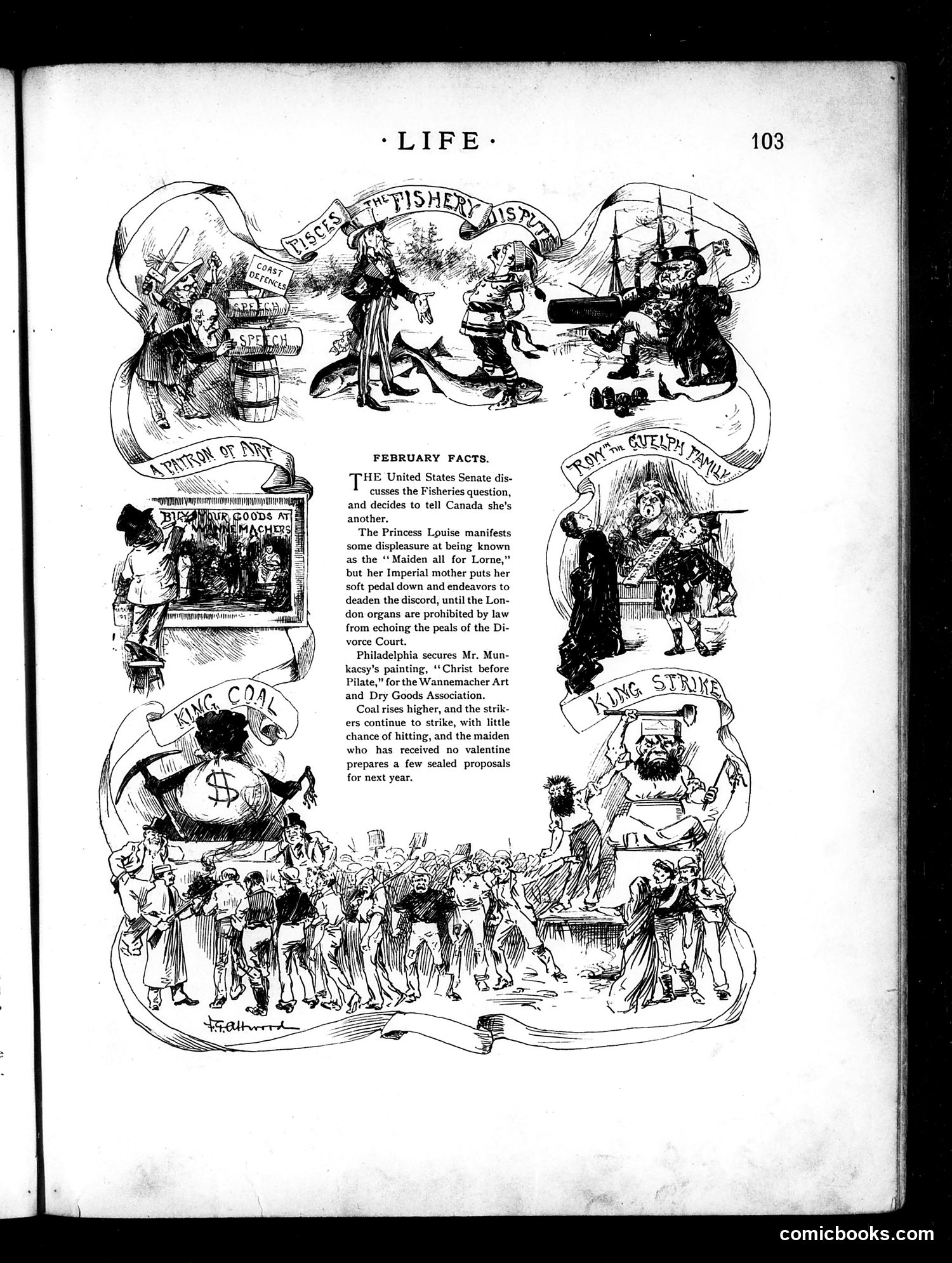
This page presents interconnected satirical vignettes commenting on early 1900s American politics and society: **Top banner ("The Fishery Question")**: References U.S.-Canada fisheries disputes being debated in the Senate. **Side panels** address contemporary issues: Princess Louise's scandal ("Maiden all for Lorne"), Philadelphia art acquisition, and labor unrest ("King Coal," "King Strike"). **Central text** discusses coal strikes continuing with little resolution, and mentions "the maiden who has received no valentine" preparing sealed proposals for the next year—likely satirizing stalled negotiations or political deadlock. The ornamental border framing these vignettes, crowded with caricatured figures and symbolic imagery, was typical of Life's dense visual commentary style. The overall message critiques political paralysis and social turmoil during this period.
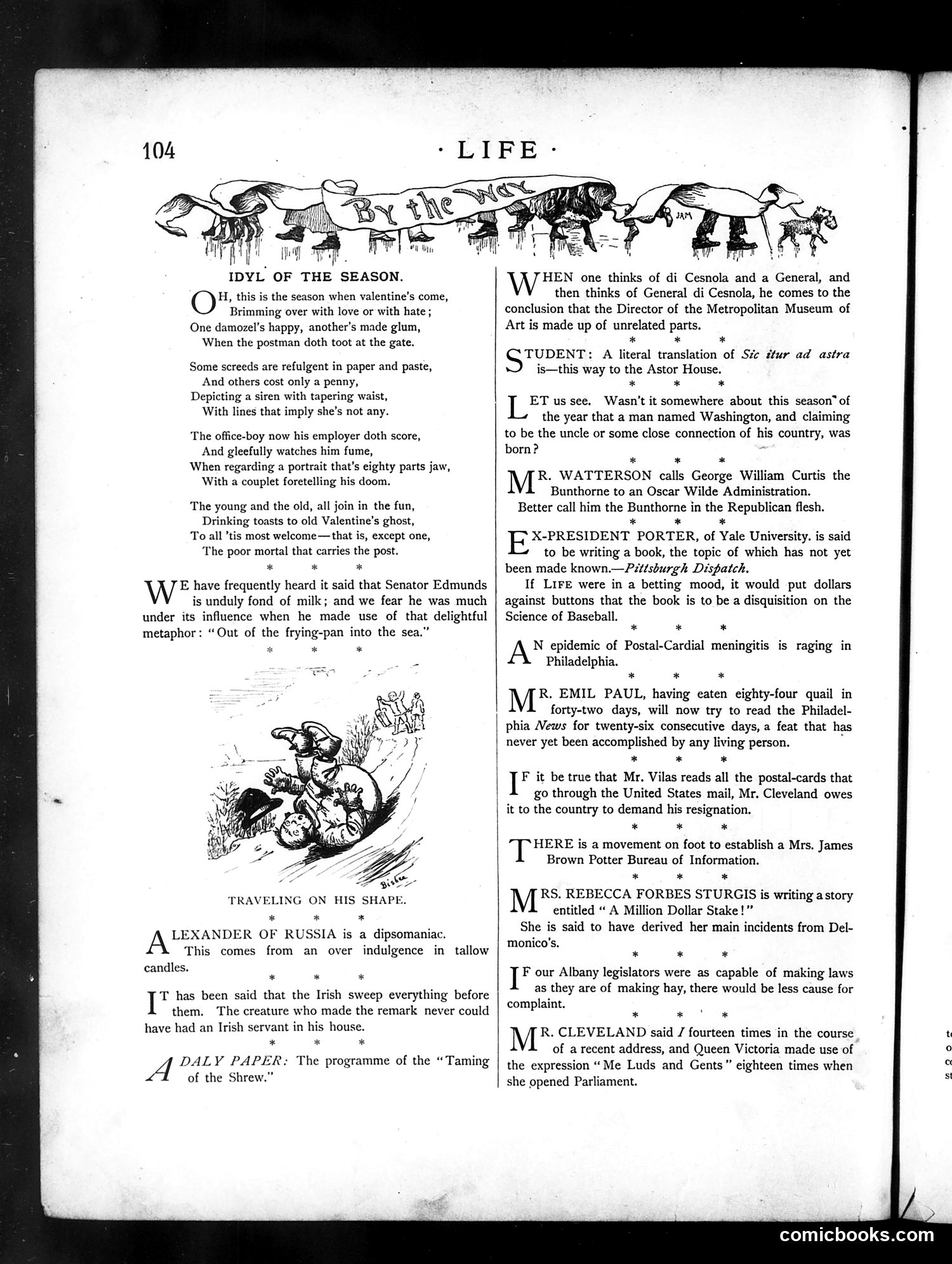
This page contains brief satirical news items and commentary typical of Life magazine's "By the Way" section. The left side features a poem, "Idyl of the Season," mocking holiday workplace behavior—office workers drinking and socializing despite their employer's disapproval. Below is a cartoon titled "Traveling on His Shape" depicting someone sliding downhill, likely satirizing a public figure's loss of dignity or political downfall. The right column consists of short jabs at contemporary figures and events: Senator Edmunds's fondness for milk as an influence metaphor, references to ex-President Porter, postal meningitis in Philadelphia, and Mr. Vilas reading postcards. These items mock politicians, academics, and newsworthy personalities of the period through brief, pointed humor without deep explanation—assuming readers recognized the names and scandals referenced.
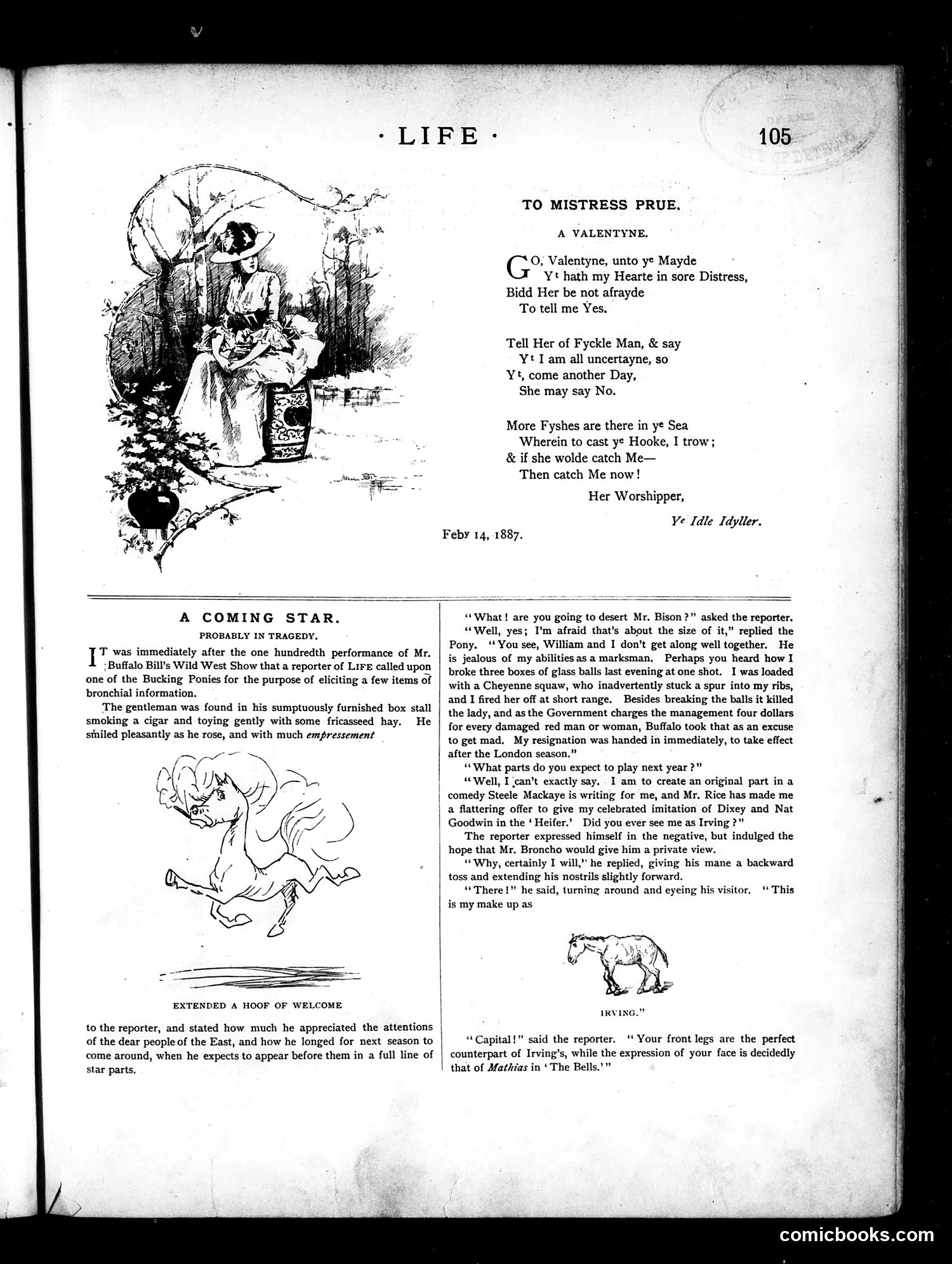
The page contains two distinct items: **"To Mistress Prue: A Valentine"** (top) is a humorous Valentine's Day poem mocking romantic uncertainty, using fishing metaphors to express the suitor's anxiety about rejection. **"A Coming Star"** (bottom) is a satirical article about Buffalo Bill's Wild West show's recent performance. The piece humorously portrays Buffalo Bill (William F. Cody) as vain and temperamental. The accompanying caricature and anecdotes mock his ego—particularly a story where he compares himself favorably to famous actors like Irving and Bison, and his complaint about damaged property during performances. The satire suggests Buffalo Bill's inflated sense of his own theatrical importance compared to legitimate stage actors.
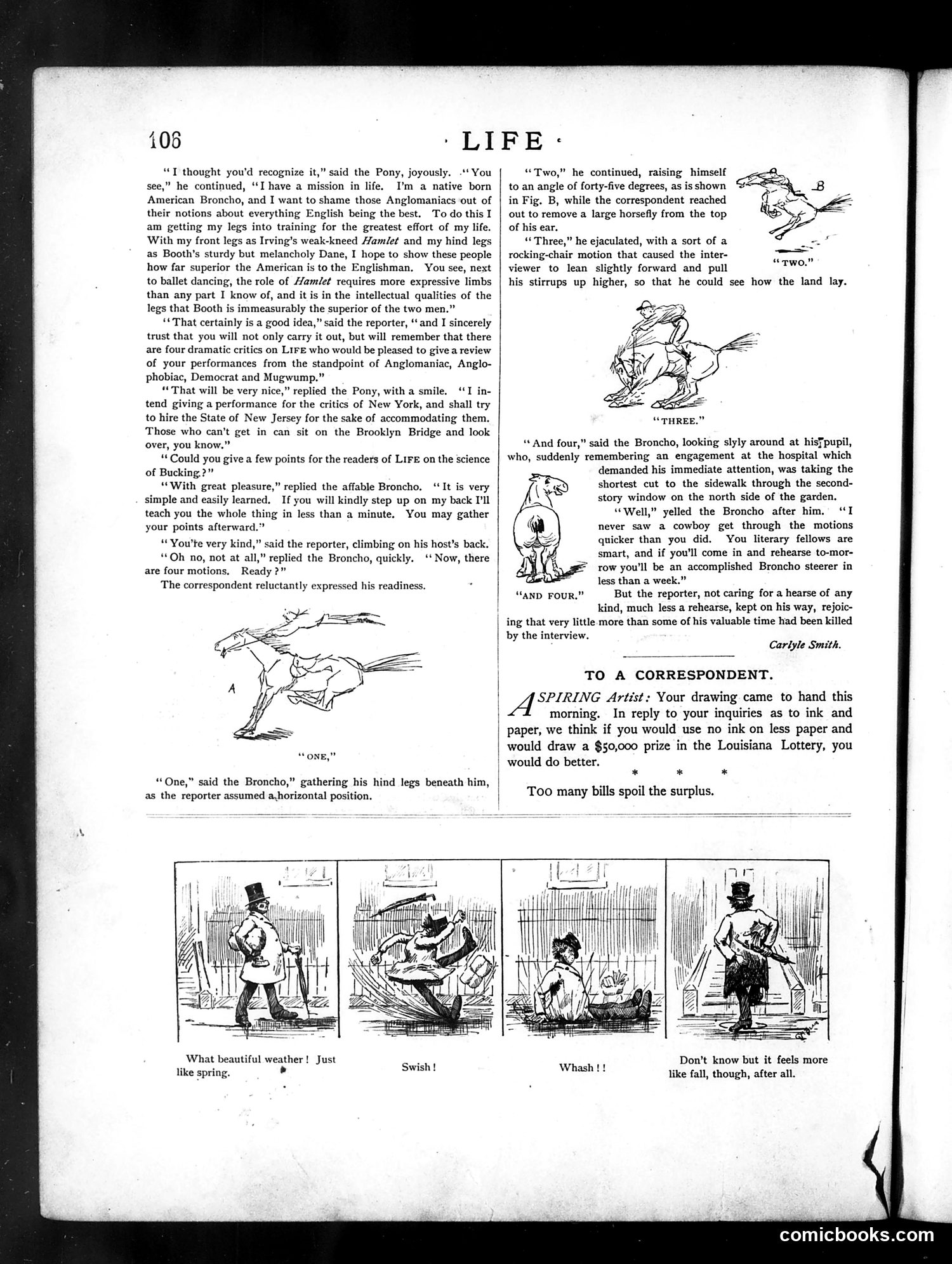
This page contains a humorous article about a Pony's training for ballet, illustrated with sketches of a horse attempting various positions ("One," "Two," "Three," "Four"). The reporter interviews the Pony's trainer, an "Anglomaniac" who claims the horse will become superior to English ballet dancers through rigorous leg training. The satire mocks both Anglophilia (excessive admiration of English culture) and pretentious claims about training. The joke hinges on the absurdity of training a horse for ballet—an inherently ridiculous premise used to poke fun at overly earnest cultural pretensions. Below is an unrelated four-panel comic about spring weather and physical mishaps, ending with the punchline that falling feels more like autumn than spring.
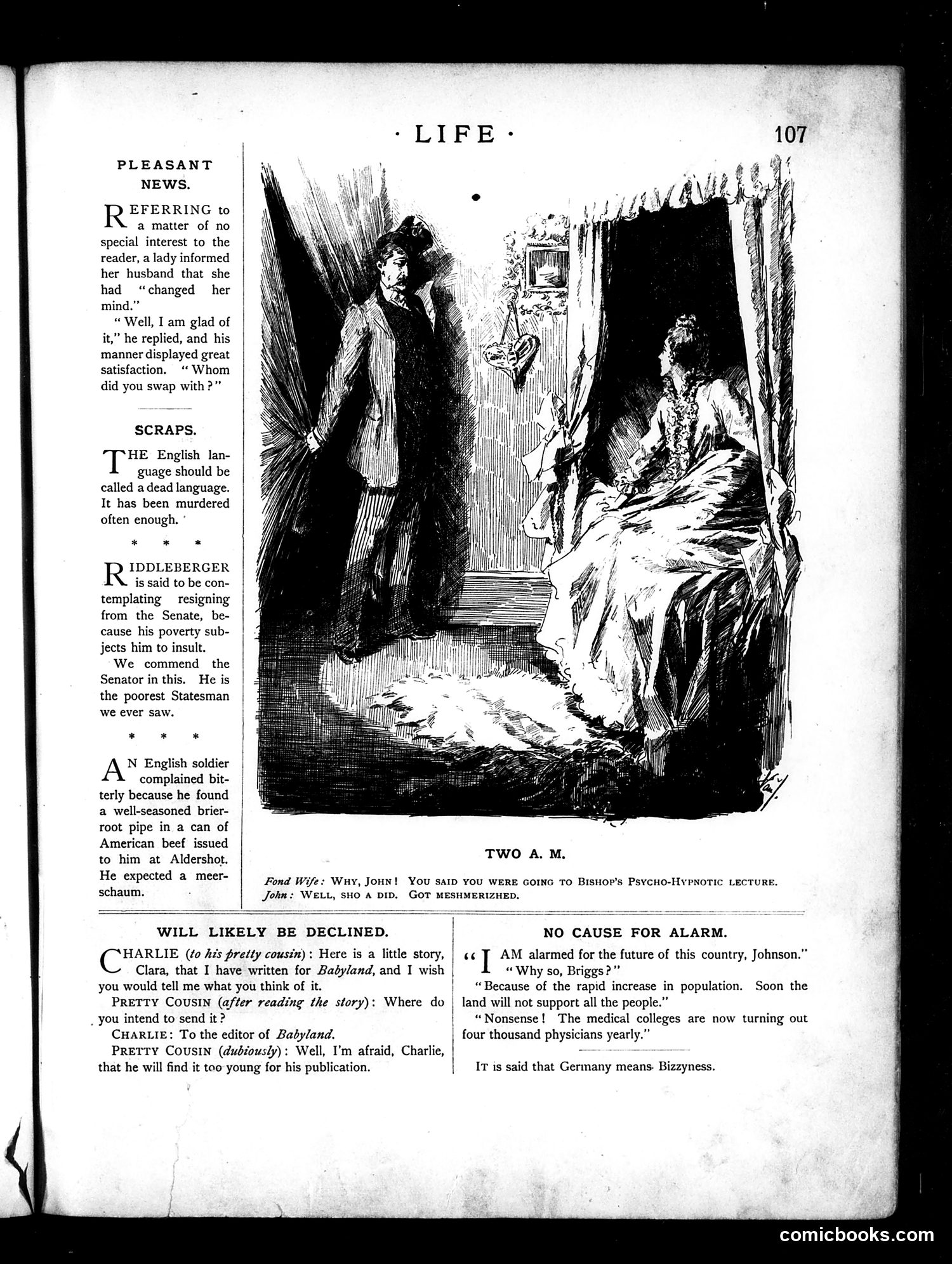
The main cartoon titled "TWO A.M." depicts a domestic scene where a husband returns home late, and his wife confronts him about breaking a promise to attend a "Bishop's Psycho-Hypnotic Lecture." The husband claims he was "mesmerized," offering a humorous excuse. The joke satirizes the contemporary fascination with mesmerism/hypnotism as a pseudo-scientific fad, while also mocking marital excuses and late-night behavior. The wife's skepticism suggests audiences recognized such claims as dubious. Below are brief satirical "scraps"—short quips mocking topics including English language decline, a senator's poor behavior, and military complaints about American beef quality. These reflect early 1900s social commentary on politics, language evolution, and military-civilian relations.
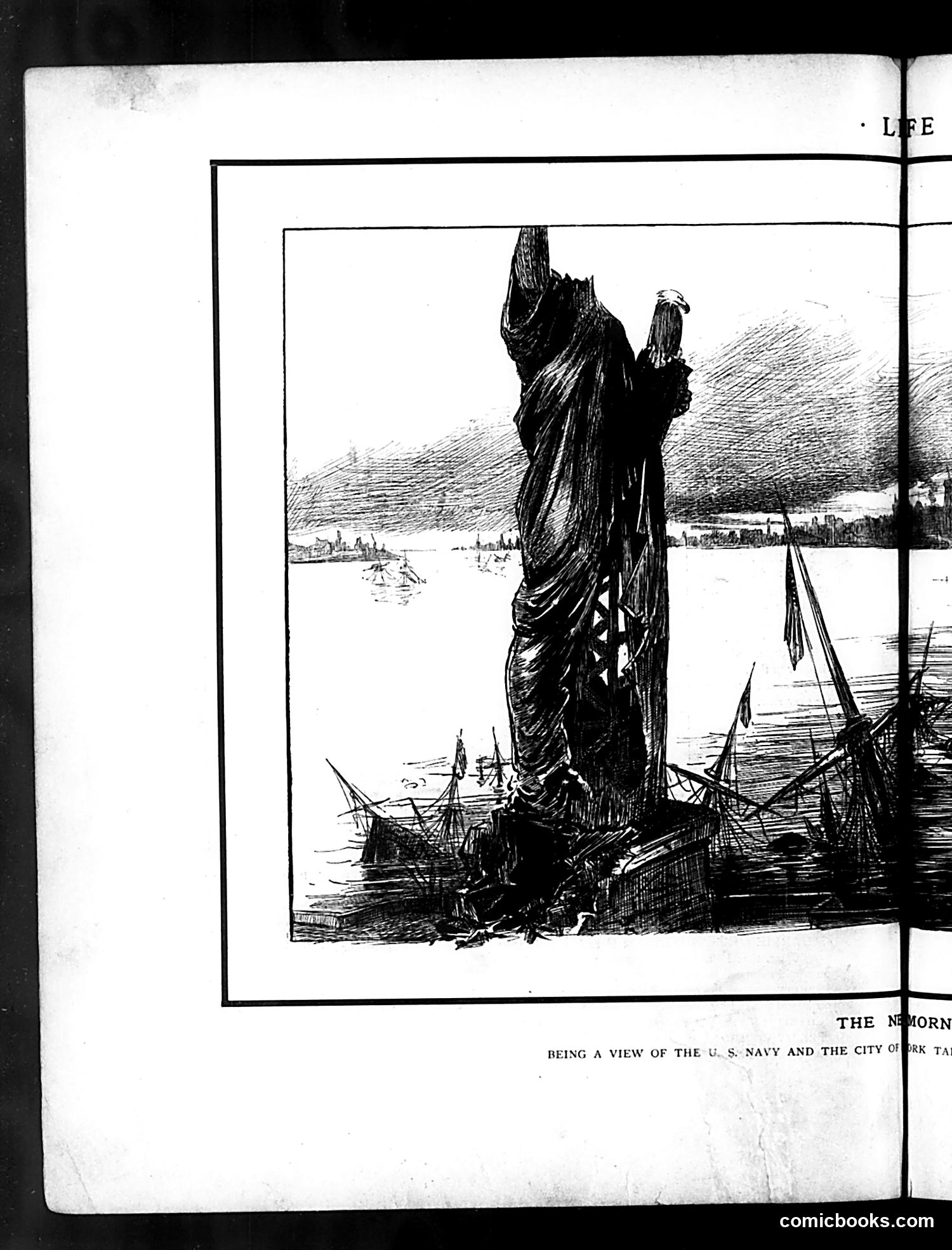
This appears to be an editorial illustration from *Life* magazine showing a monumental statue or figure (likely representing Lady Liberty or American naval power) overlooking a harbor scene with sailing vessels and ships below. The caption indicates this depicts "a view of the U.S. Navy and the City of New York" (text partially cut off). The dramatic scale—with the colossal robed figure towering over docked vessels and the cityscape—suggests commentary on American naval supremacy or New York's importance as a maritime hub. The artistic style uses heavy contrast and detailed cross-hatching typical of early-to-mid 20th century satirical illustration. Without the complete caption and publication date, the specific political context remains unclear, though it likely celebrates American naval power or comments on naval affairs of its era.
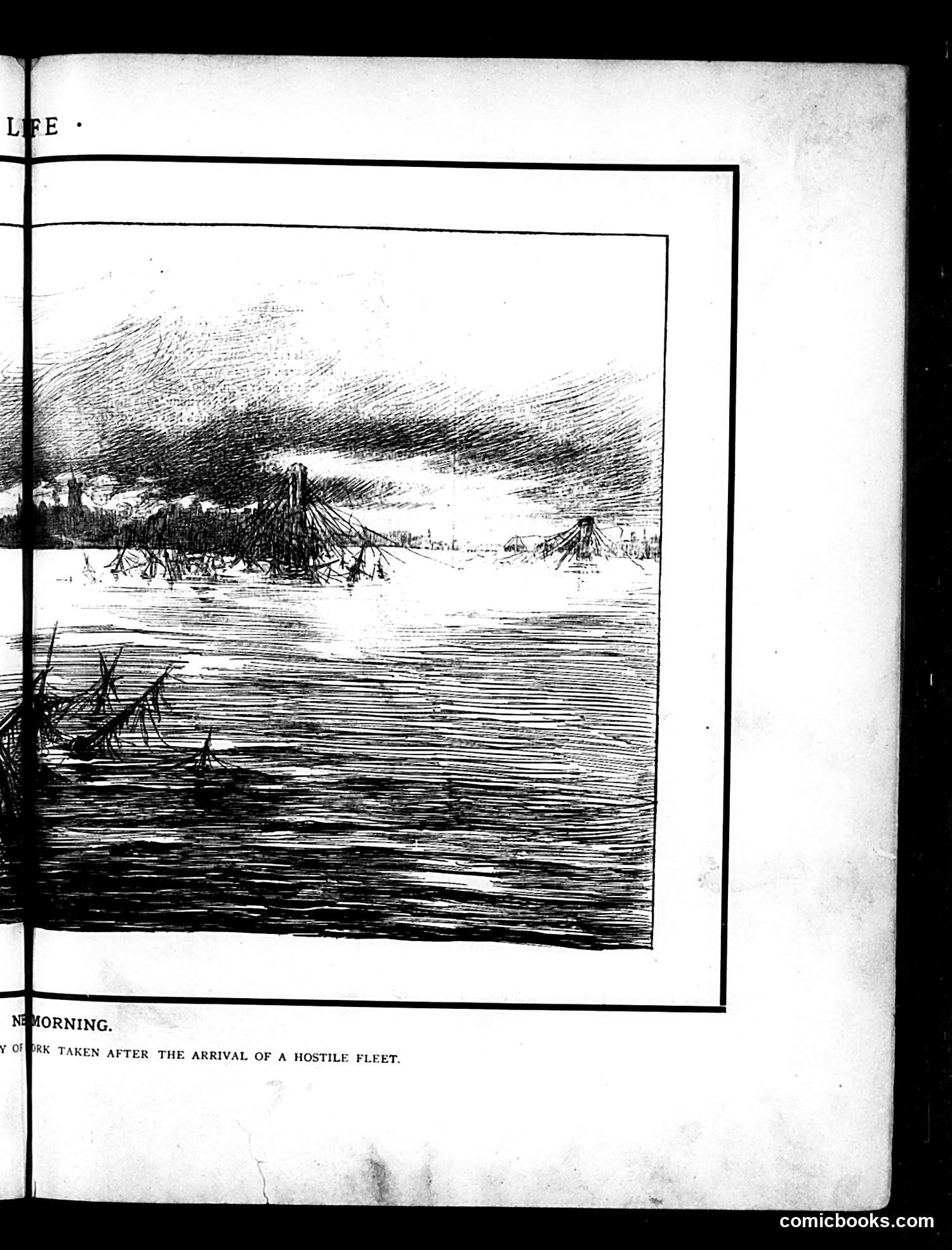
This engraving depicts a harbor scene following a military attack by an enemy naval force. The sketch shows damaged or burning structures along the shoreline, with ships in the water and smoke rising from the buildings in the background. The composition emphasizes the destruction and chaos resulting from the hostile incursion. The satirical point appears to be commentary on coastal vulnerability to naval attack, likely referencing a specific historical incident of Anglo-American tension or foreign military threat. The title's dark humor—treating catastrophic warfare as a casual "morning after" scenario—suggests *Life* magazine's characteristic irreverent approach to serious geopolitical events, mocking both the threat itself and public complacency about national defense.
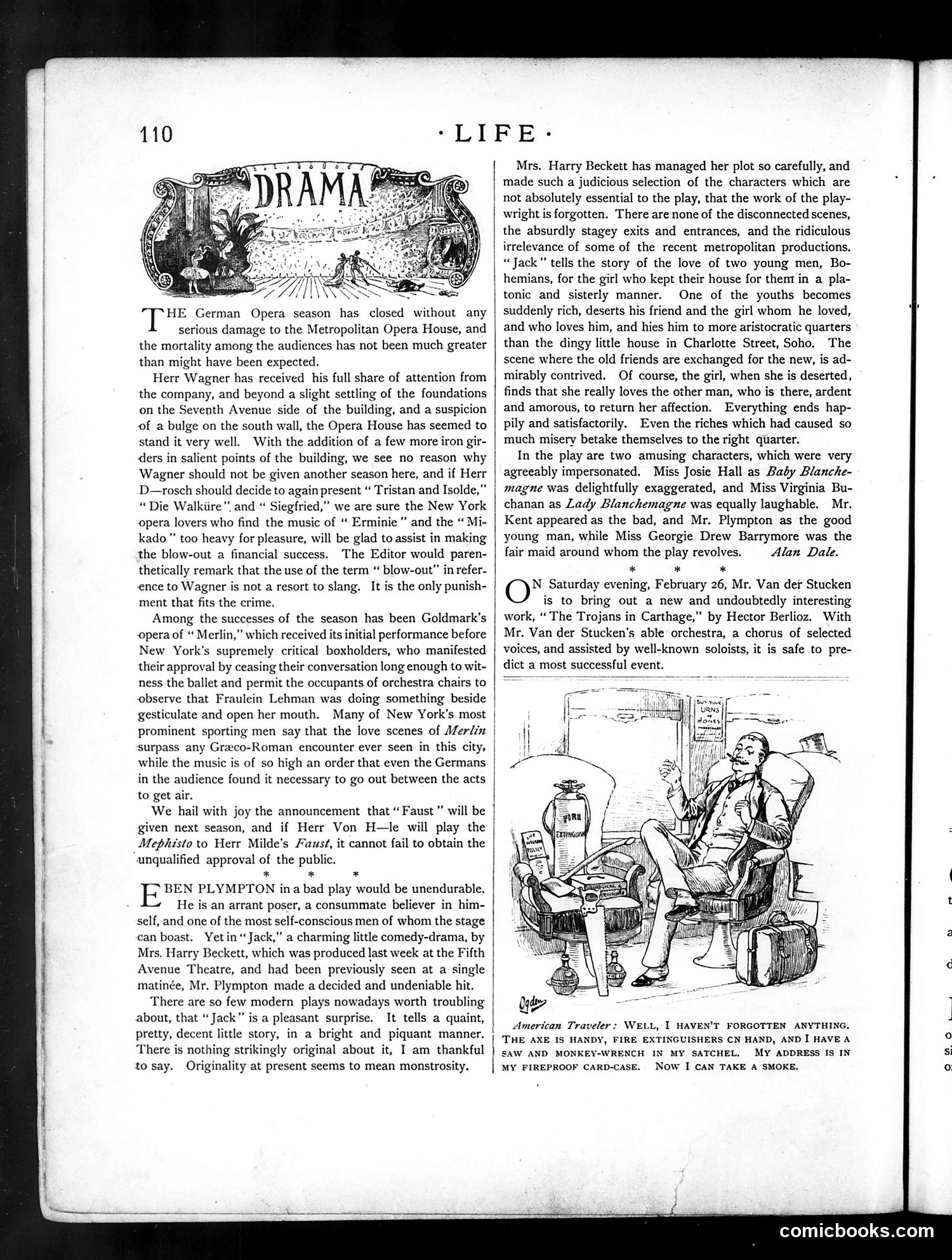
This page is primarily a **drama review section**, not political satire. The main content discusses theatrical productions: German opera season closures, a play called "Jack" (about Bohemian lovers), and upcoming performances including "The Trojans in Carthage" by Hector Berlioz. The **cartoon** (bottom half) shows an "American Traveler" character boasting to a companion about his possessions—an axe, fire extinguishers, a saw, monkey-wrench, satchel, and fireproof card-case. The joke appears to be satirizing the overly cautious, heavily-prepared American tourist abroad, humorously suggesting he's prepared for virtually any emergency ("now I can take a smoke"). The satire targets **American travel culture and paranoia** rather than politics.
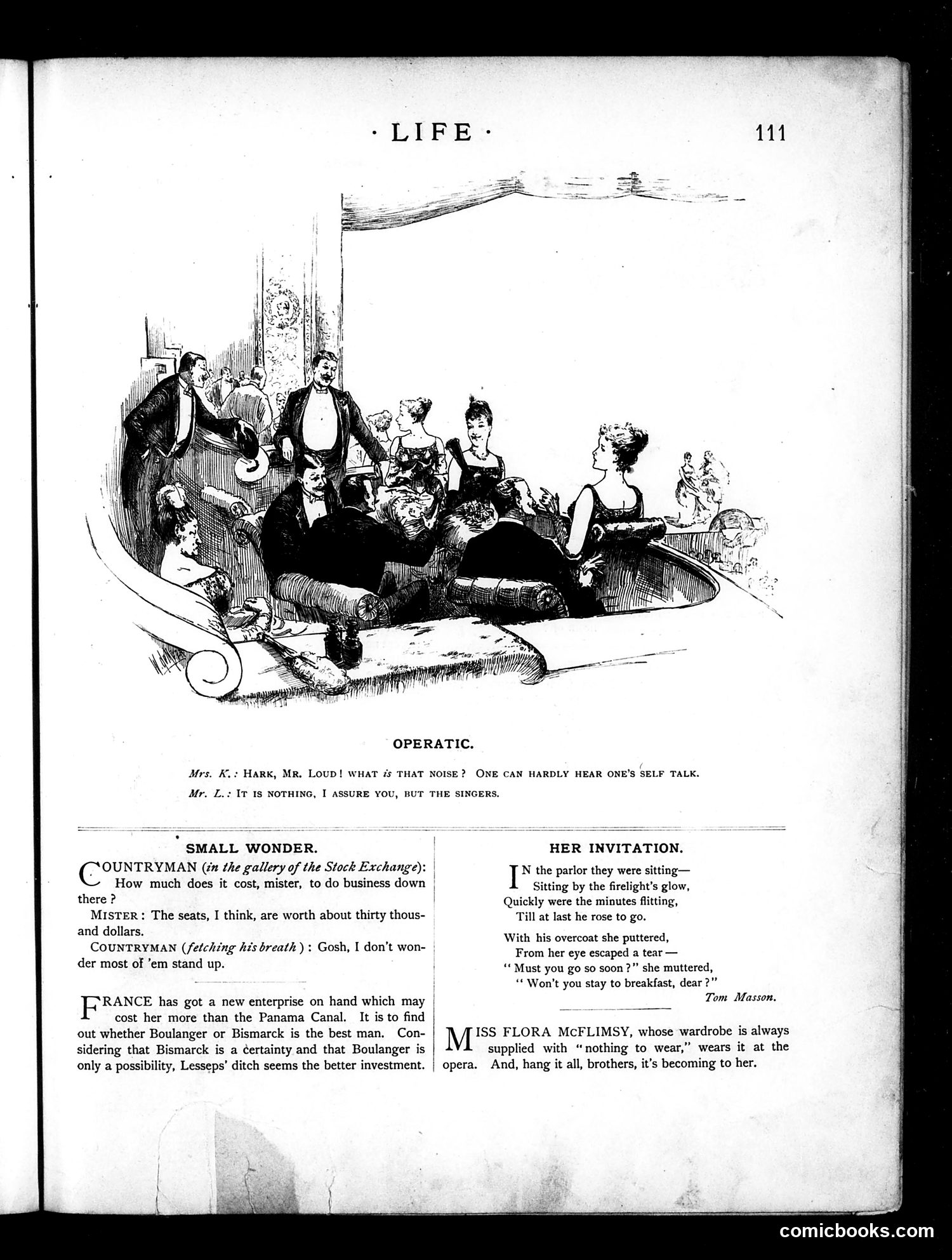
This page contains multiple satirical pieces from Life's humorous section: **"Operatic"**: A joke about opera singers being so loud that patrons can't converse—the irony being that attending opera defeats its social purpose. **"Small Wonder"**: Stock Exchange satire. A countryman is shocked that seats cost $30,000, prompting the joke that traders prefer standing—implying the financial district is so crowded/chaotic that even expensive seating won't help. **France/Boulanger reference**: Political commentary on France choosing between General Boulanger and Bismarck as leaders, sarcastically suggesting France's indecision rivals the Panama Canal as a costly enterprise. (Boulanger was a controversial French general; Lesseps built the Canal.) **"Her Invitation"**: A sentimental poem about a woman reluctant to see her visitor leave, asking him to stay for breakfast. **Flora McFlimsy**: A humorous jab at high society—referencing the famous satirical character known for having "nothing to wear," the piece jokes that she's become fashionable by wearing literally nothing to the opera.
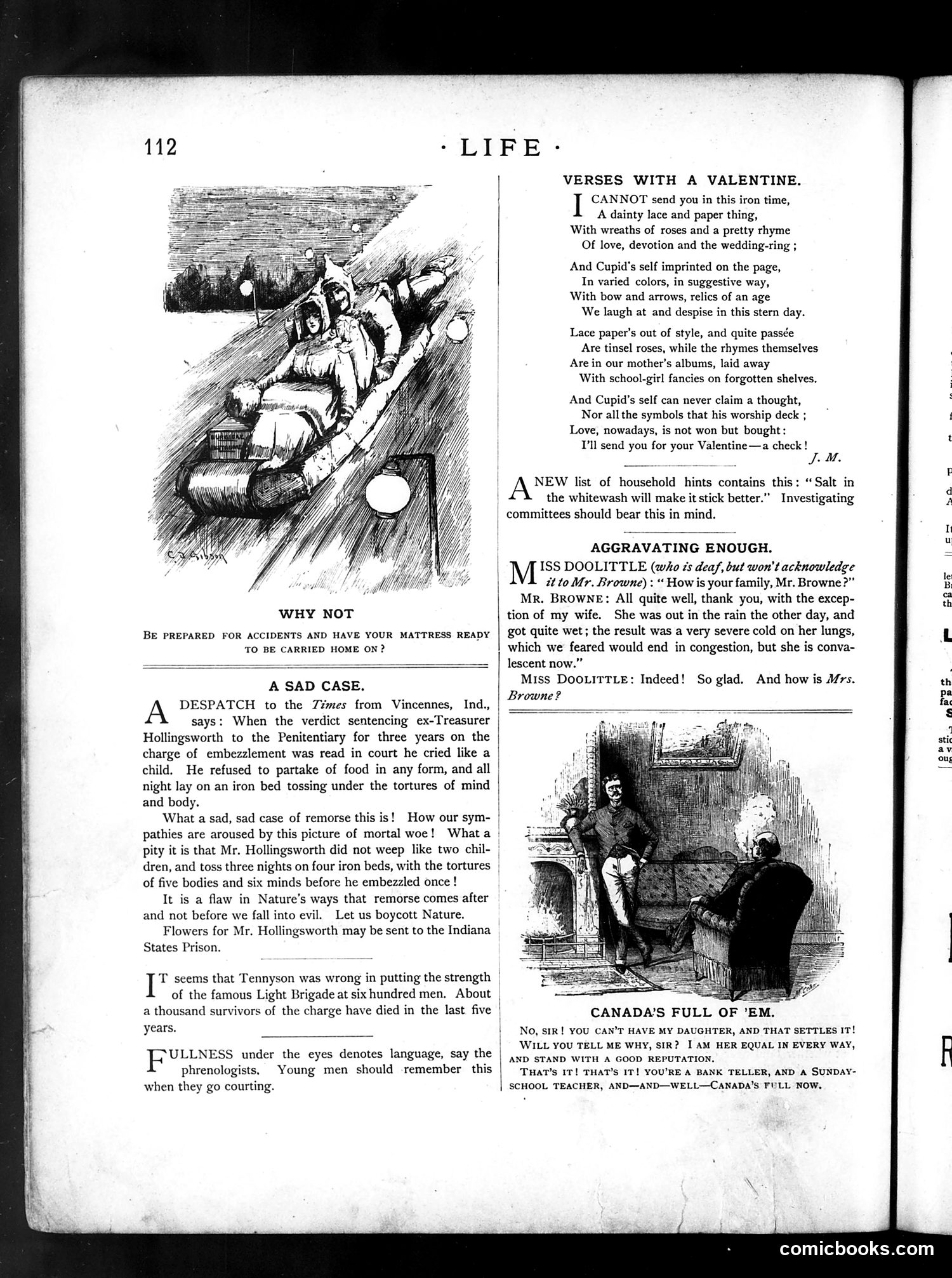
This page contains several distinct satirical pieces typical of Life's humor: **"A Sad Case"** mocks ex-Treasurer Hollingsworth's remorse after embezzlement conviction. The satire argues that his belated tears and suffering are hypocritical—he should have experienced such torment *before* committing the crime, not after. Life sarcastically suggests boycotting "Nature" for this moral flaw, then darkly offers to send flowers to his prison cell. **"Verses with a Valentine"** satirizes modern romance's commercialization, contrasting old-fashioned valentines (roses, poetry, Cupid imagery) with contemporary reality: "Love, nowadays, is not won but bought: I'll send you for your Valentine—a check!" **The deaf woman cartoon** plays on Miss Doolittle's pretense of hearing while asking questions, then mishearing the answer about Mrs. Browne's illness. **The final dialogue** depicts a suitor rejected because he's merely a bank teller and Sunday-school teacher—"Canada's full now" suggests satirizing either Canadian immigration debates or comedically implying he should emigrate.
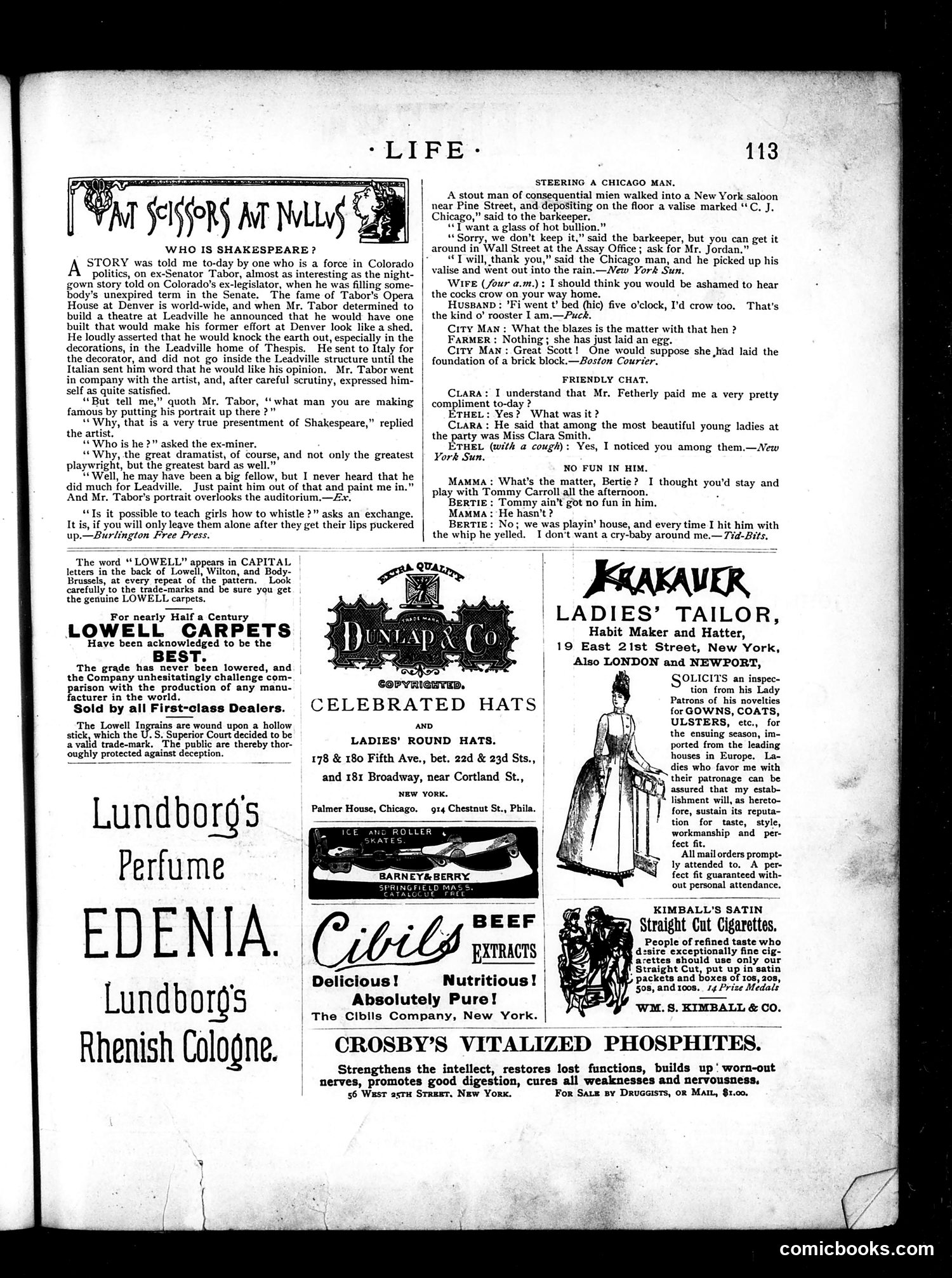
This page's main satirical content is the story about **Horace Tabor**, a Colorado mining magnate and ex-Senator famous for building the ornate Tabor Opera House in Denver. The joke targets his cultural ignorance and vanity. When Tabor commissioned an expensive Italian decorator for his Leadville theater, he discovered a portrait of Shakespeare in the auditorium. Upon learning Shakespeare was a famous playwright, Tabor allegedly demanded the decorator paint him (Tabor) over Shakespeare instead—reasoning that Shakespeare "did much for Leadville" while he himself had. The satire mocks wealthy industrialists who equated personal wealth with cultural importance and lacked appreciation for classical arts. It also satirizes the nouveau riche tendency to replace historical significance with self-aggrandizing decoration. The anecdote exemplifies a common 19th-century American theme: uncultured but powerful businessmen reshaping institutions according to ego rather than artistic merit. The remainder of the page contains period advertisements and brief humorous anecdotes.
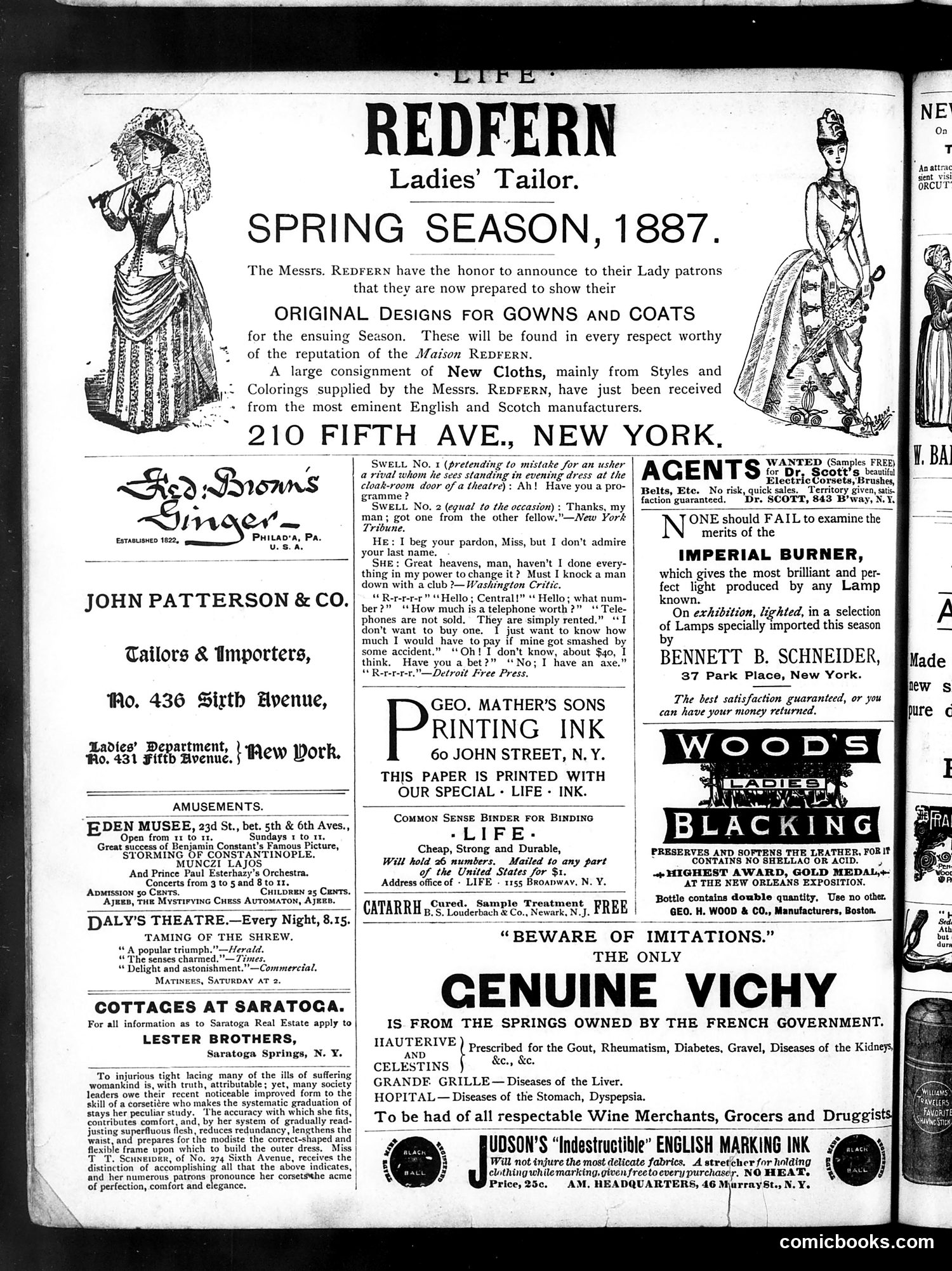
This page is primarily **advertising and announcements**, not political satire. It represents a typical late-19th-century magazine layout mixing commercial content with light humor. The page features: **Main advertisements**: High-end fashion (Redfern ladies' tailor, John Patterson tailors), theatrical shows (Daly's Theatre, Eden Musee), and consumer products (printing ink, corsets, lamps). **Humor section**: Several brief, genteel jokes typical of the era—mostly about social awkwardness and new technology. Notable: a telephone joke mocking confusion over rental versus purchase, and swells (wealthy dandies) making witty remarks at theaters. **Social context**: The ads reveal 1887 priorities—fashionable clothing, theater entertainment, and emerging consumer goods. The corset advertisement pathologizes women's bodies, promoting custom fitting to reshape flesh. The page reflects Gilded Age consumer culture and genteel magazine humor rather than political commentary.
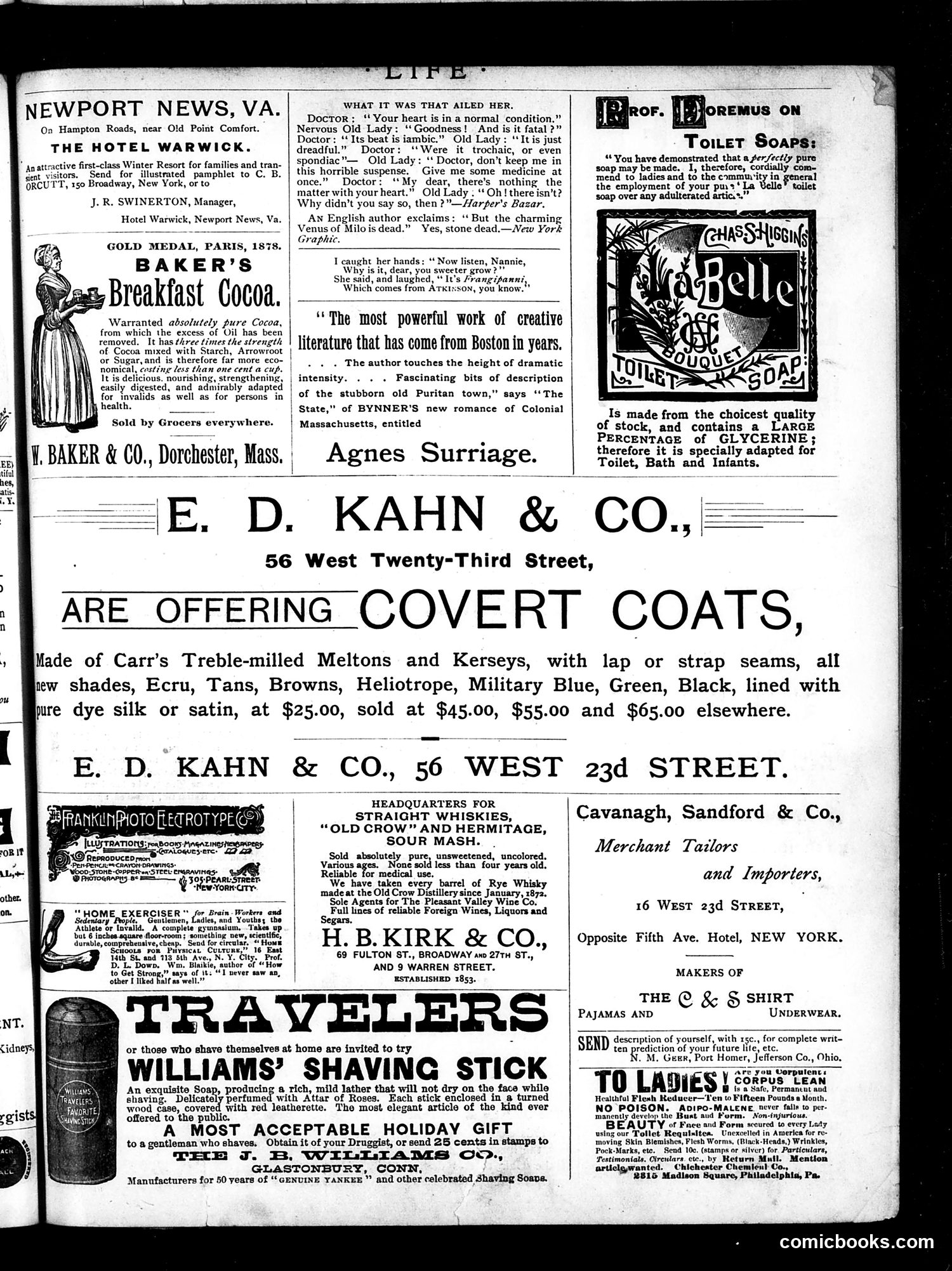
This is primarily an **advertising page** with minimal editorial content. The few non-commercial items are brief jokes: **"What It Was That Ailed Her"** is a gentle medical humor piece where a nervous elderly woman misunderstands her doctor's use of prosody terms ("iambic," "trochaic") to describe her heartbeat, becoming increasingly alarmed by the technical language despite being told nothing is wrong. The joke targets both medical jargon and anxious elderly women. **The opening anecdote** references the Venus of Milo statue being "dead"—a whimsical literary joke about the famous armless sculpture. **"Agnes Surriage"** appears to be promotional text for a novel set in Colonial Massachusetts. The remainder comprises typical late-19th-century advertisements for covert coats, cocoa, shaving products, whiskey, and patent medicines—standard commercial content for *Life* magazine, which financed its satirical editorial through extensive advertising.
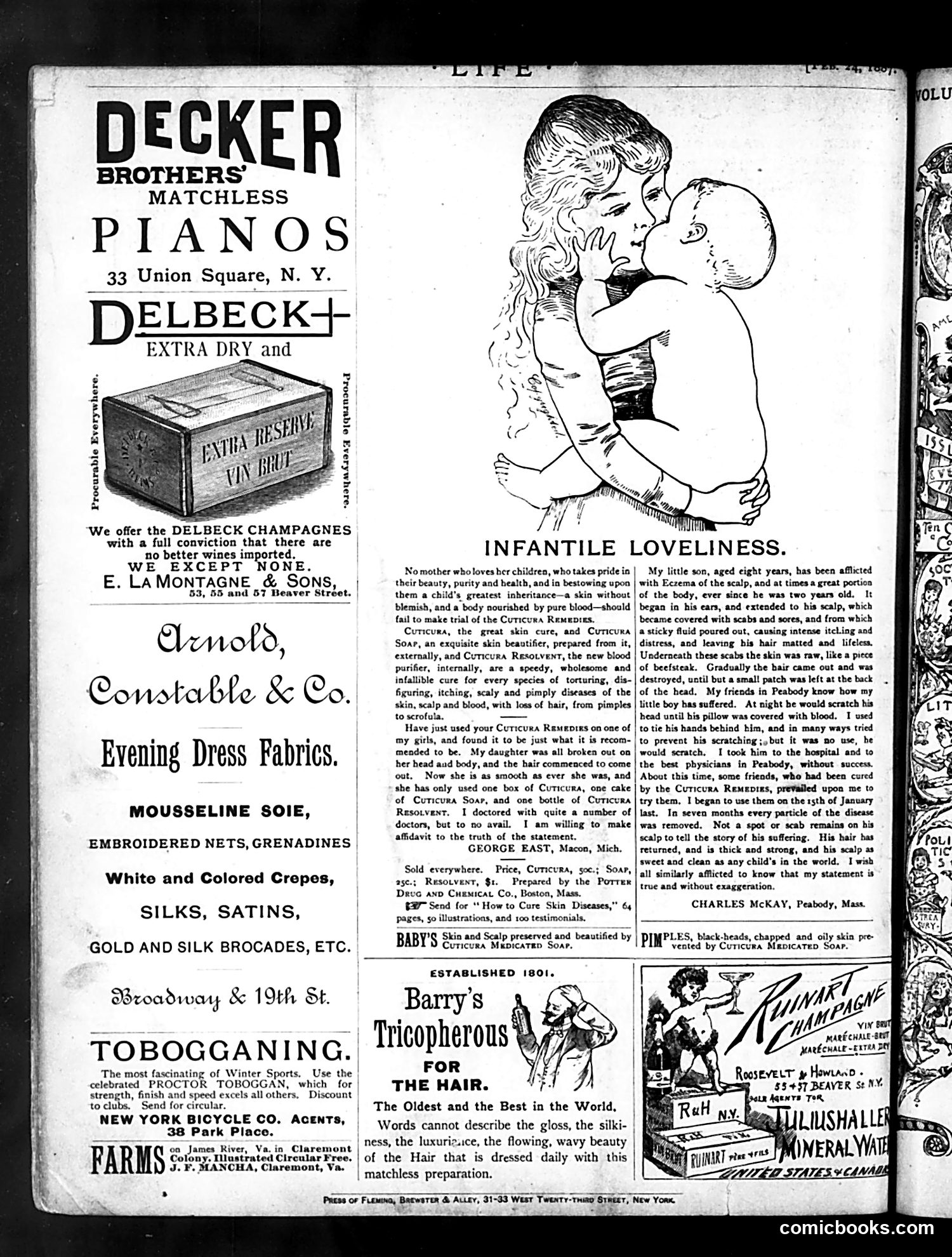
This page is primarily **advertising**, not political satire. It features Victorian-era product endorsements typical of early Life magazine. The main illustrated content shows "Infantile Loveliness"—a woman with curled hair holding a baby—accompanying testimonials for **Cuticura Remedies**, a patent medicine for skin diseases. Two detailed case studies describe mothers praising the product for curing children's eczema and scalp conditions. These testimonials were common marketing tactics of the period, lending pseudo-medical authority through personal endorsements. Other advertisements promote luxury goods: Decker pianos, Delbeck champagne, evening dress fabrics from Arnold Constable & Co., and Proctor toboggans. The Barry's Tricopherous hair treatment advertisement appears at the bottom. **No political satire is present.** This represents straightforward commercial advertising from approximately 1901, reflecting consumer culture and the era's acceptance of unregulated patent medicine claims.