
Life, 1887-02-24 · page 10 of 16
Life — February 24, 1887 — page 10: what you’re looking at
What you’re looking at
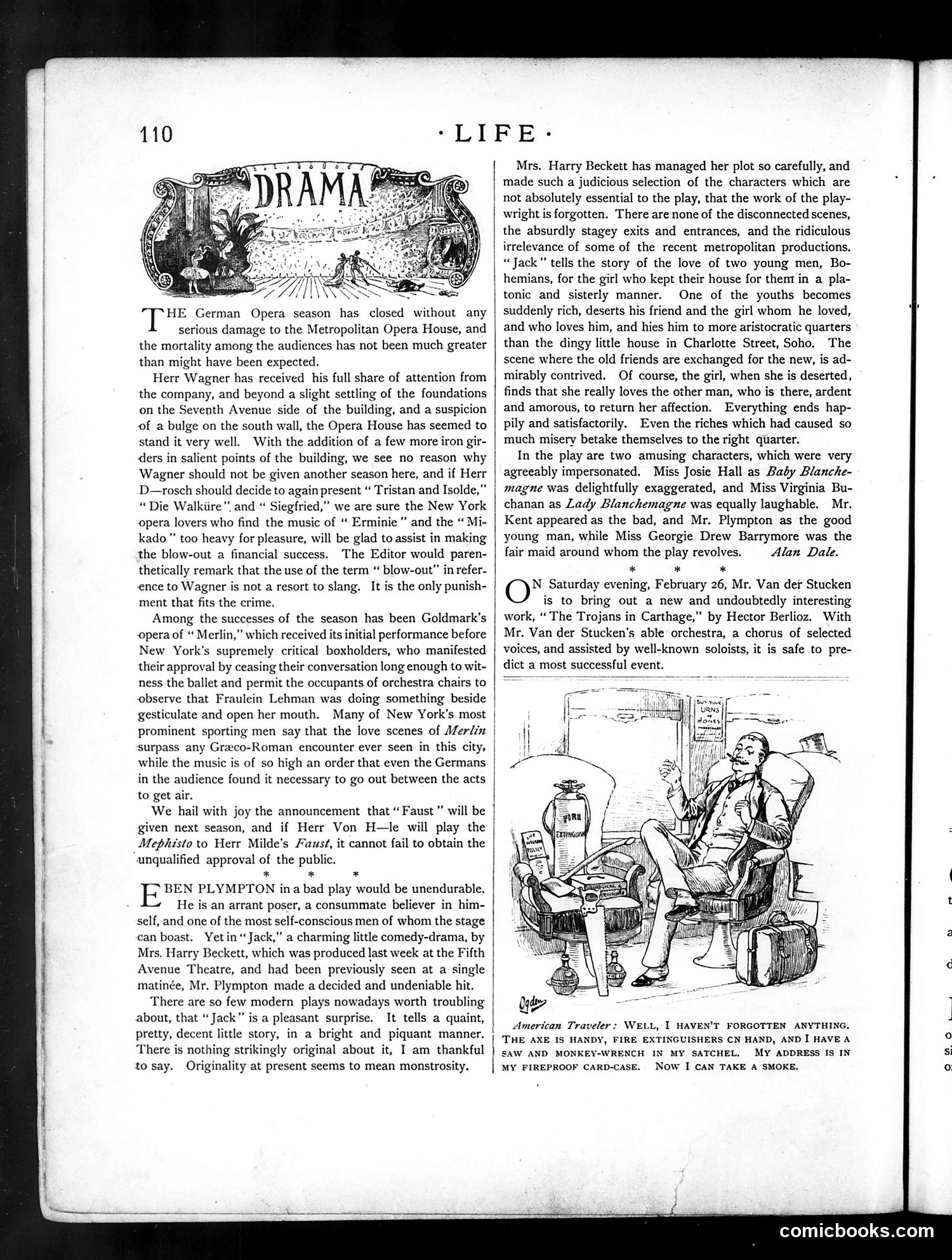
This page is primarily a **drama review section**, not political satire. The main content discusses theatrical productions: German opera season closures, a play called "Jack" (about Bohemian lovers), and upcoming performances including "The Trojans in Carthage" by Hector Berlioz. The **cartoon** (bottom half) shows an "American Traveler" character boasting to a companion about his possessions—an axe, fire extinguishers, a saw, monkey-wrench, satchel, and fireproof card-case. The joke appears to be satirizing the overly cautious, heavily-prepared American tourist abroad, humorously suggesting he's prepared for virtually any emergency ("now I can take a smoke"). The satire targets **American travel culture and paranoia** rather than politics.
📄 Transcribed text from this page (OCR, searchable)
Machine-transcribed from the original scan — historical spelling and the odd misread are preserved.
~ LI HE German Opera season has closed without any | serious damage to the Metropolitan Opera House, and the mortality among the audiences has not been much greater than might have been expected. Herr Wagner has received his full share of attention from the company, and beyond a slight settling of the foundations on the Seventh Avenue side of the building, and a suspicion of a bulge on the south wall, the Opera House has seemed to stand it very well. With the addition of a few more iron gir- ders in salient points of the building, we see no reason why Wagner should not be given another season here, and if Herr D—rosch should decide to again present “ Tristan and Isolde,” “Die Walkiire” and “ Siegfried,” we are sure the New York opera lovers who find the music of “ Erminie ” and the “ Mi- kado” too heavy for pleasure, will be glad to assist in making the blow-out a financial success. The Editor would paren- thetically remark that the use of the term “ blow-out” in refer- ence to Wagner is not a resort to slang. It is the only punish- ment that fits the crime. Among the successes of the season has been Goldmark’s opera of “ Merlin,” which received its initial performance before New York's supremely critical boxholders, who manifested their approval by ceasing their conversation long enough to wit- ness the ballet and permit the occupants of orchestra chairs to observe that Fraulein Lehman was doing something beside gesticulate and open her mouth. Many of New York’s most prominent sporting men say that the love scenes of Merlin | surpass any Graco-Roman encounter ever seen in this city, | while the music is of so high an order that even the Germans | in the audience found it necessary to go out between the acts to get air. We hail with joy the announcement that “Faust ” will be given next season, and if Herr Von H—le will play the Mephisto to Herr Milde’s Faust, it cannot fail to obtain the unqualified approval of the public. * * * BEN PLYMPTON ina bad play would be unendurable. He is an arrant poser, a consummate believer in him- self, and one of the most self-conscious men of whom the stage can boast. Yet in‘ Jack,” a charming little comedy-drama, by Mrs. Harry Beckett, which was produced last week at the Fifth Avenue Theatre, and had been previously seen at a single matinée, Mr. Plympton made a decided and undeniable hit. There are so few modern plays nowadays worth troubling | about, that “Jack” is a pleasant surprise. It tells a quaint, pretty, decent little story, in a bright and piquant manner. There is nothing strikingly original about it, I am thankful to say. Originality at present seems to mean monstrosity. FE- Mrs. Harry Beckett has managed her plot so carefully, and made such a judicious selection of the characters which are not absolutely essential to the play, that the work of the play- wright is forgotten. There are none of the disconnected scenes, the absurdly stagey exits and entrances, and the ridiculous | irrelevance of some of the recent metropolitan productions. “Jack” tells the story of the love of two young men, Bo- hemians, for the girl who kept their house for thent in a pla- tonic and sisterly manner. One of the youths becomes suddenly rich, deserts his friend and the girl whom he loved, and who loves him, and hies him to more aristocratic quarters than the dingy little house in Charlotte Street, Soho. The scene where the old friends are exchanged for the new, is ad- mirably contrived. Of course, the girl, when she is deserted, finds that she really loves the other man, who is there, ardent and amorous, to return her affection. Everything ends hap- pily and satisfactorily. Even the riches which had caused so | much misery betake themselves to the right quarter. In the play are two amusing characters, which were very agreeably impersonated. Miss Josie Hall as Baby Blanche- magne was delightfully exaggerated, and Miss Virginia Bu- chanan as Lady Blanchemagne was equally laughable. Mr. Kent appeared as the bad, and Mr. Plympton as the good young man, while Miss Georgie Drew Barrymore was the fair maid around whom the play revolves. Alan Dale. * * * N Saturday evening, February 26, Mr. Van der Stucken | is to bring out a new and undoubtedly interesting | work, “The Trojans in Carthage,” by Hector Berlioz, With Mr. Van der Stucken’s able orchestra, a chorus of selected voices, and assisted by well-known soloists, it is safe to pre- dict a most successful event. American Traveler: WELL, | HAVEN'T FORGOTTEN ANYTHING. THE AXE IS HANDY, FIRE EXTINGUISHERS CN HAND, ANDI HAVE A SAW AND MONKEY-WRENCH IN MY SATCHEL. MY ADDRESS IS IN MY FIREPROOF CARD-CaSE. NoW I CAN TAKE A SMOKE. comicbooks.com