
A complete issue · 20 pages · 1887
Life — February 17, 1887
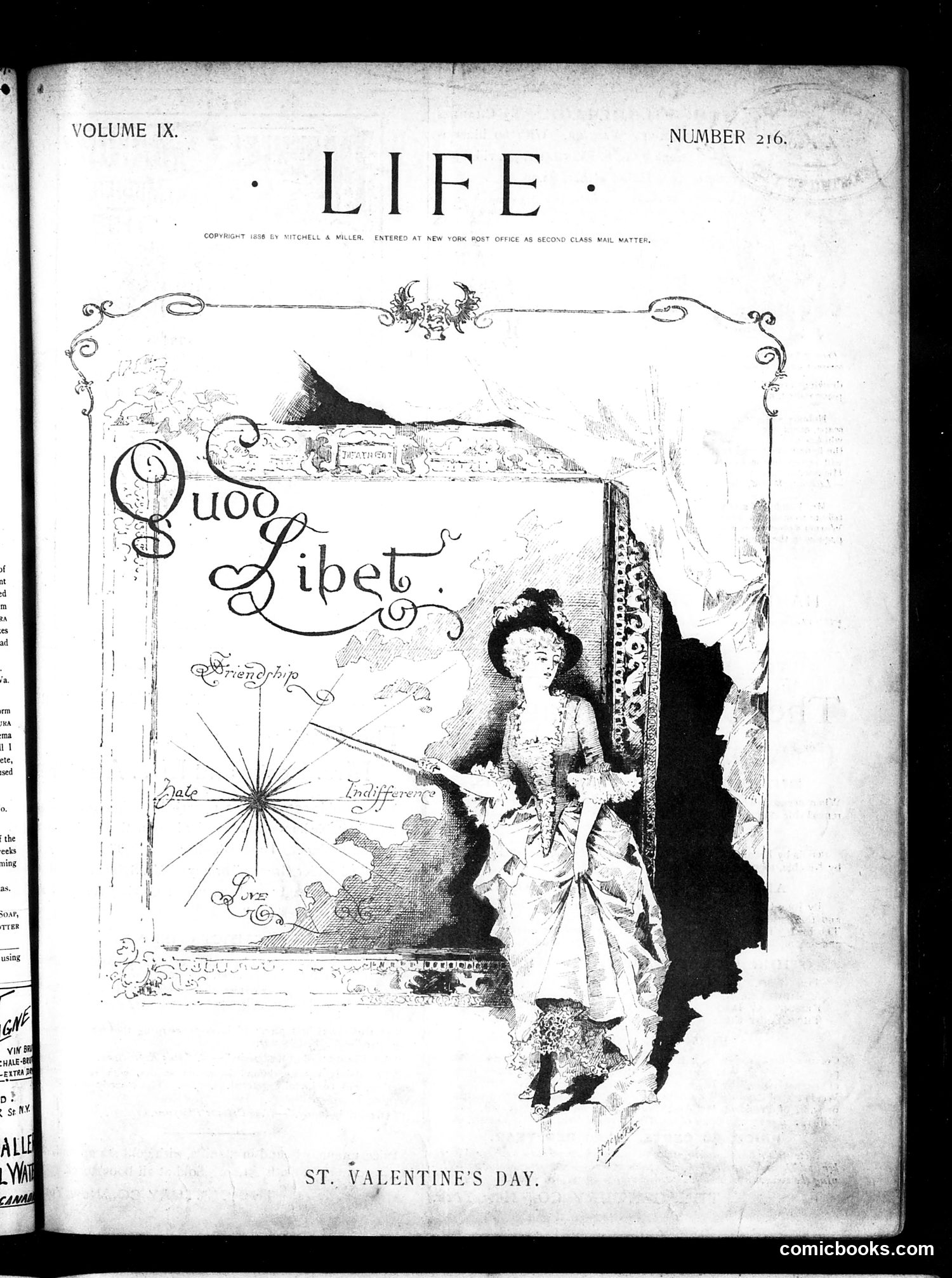
This Life magazine cover uses the Latin phrase "Quod Libet" (meaning "whatever pleases") as its title for a St. Valentine's Day-themed illustration. The image depicts an elegantly dressed woman in late 19th-century attire holding what appears to be a decorative fan or mirror, positioned near an ornate screen or doorway. The satirical diagram within the illustration maps emotional concepts—labeled "Friendship," "Love," "Dale" (unclear), and "Indifference"—radiating outward like a compass. The joke appears to satirize the complex, contradictory nature of romantic feelings and Valentine's Day sentiments: women's (or people's) romantic emotions are presented as multidirectional and deliberately unclear, mocking the holiday's oversimplified expectations about love and courtship.
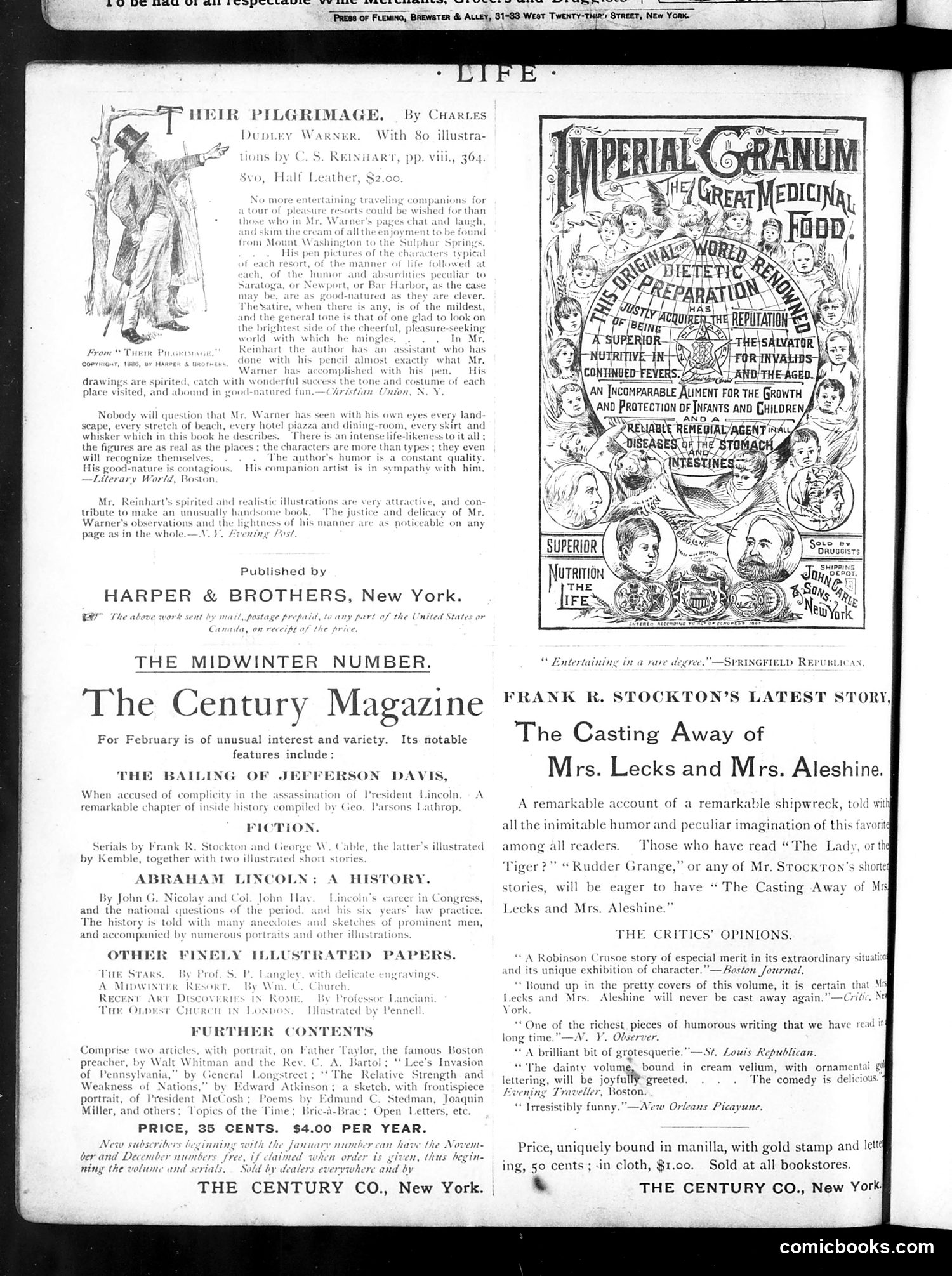
This page is primarily advertising rather than political satire. The large illustrated advertisement for "Imperial Granum" occupies the right side, promoting it as "The Great Medicinal Food" and "The World's Renowned Preparation." The ad uses multiple illustrated faces (appearing to be children and adults) surrounding text claiming the product is superior for nutrition, growth of infants and children, treatment of fevers, and various stomach/intestinal ailments. The advertisement style is typical of 19th-century patent medicine marketing—making broad therapeutic claims with decorative illustrations to suggest effectiveness and respectability. The left side contains book reviews, including discussion of Charles Dudley Warner's travel book "Their Pilgrimage," but contains no political cartoons or satire relevant to modern historical context.
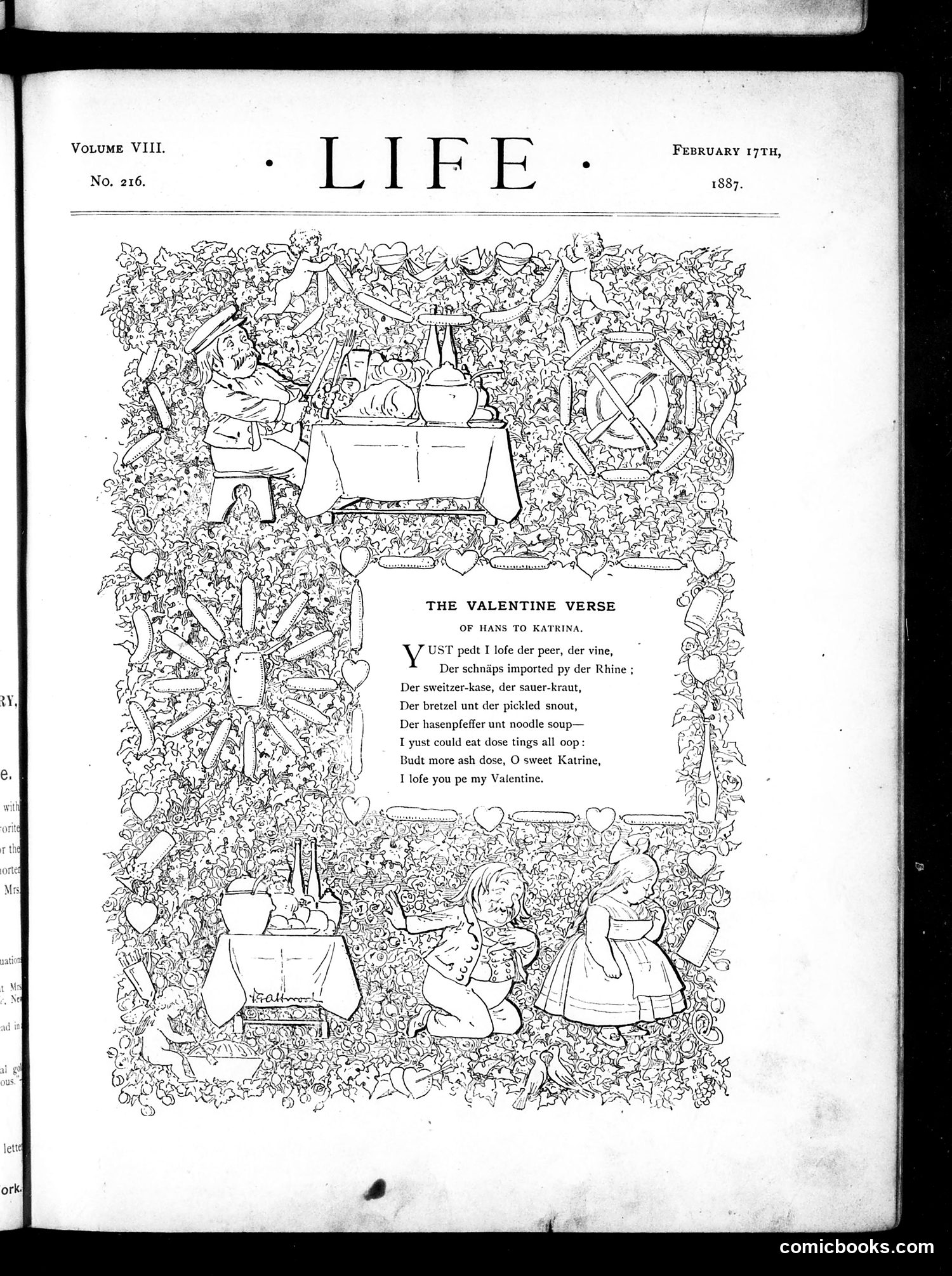
This is a humorous Valentine's Day piece from February 17, 1887. The decorative border features hearts, flowers, and romantic imagery typical of Valentine's Day illustrations. The "verse" is a comedic love poem written in German dialect English, presenting a suitor (Hans) declaring his affection for Katrina through a catalog of food preferences rather than romantic sentiment. He expresses love for her while listing German foods—Rhine wine, cheese, sauerkraut, pickled snout, noodle soup—concluding with the sentiment that he loves her "as my Valentine." The humor lies in the contrast between genuine romantic expression and this crude, food-focused declaration, likely satirizing working-class German-American courtship customs or parodying sentimental Valentine conventions by substituting culinary tastes for emotional depth.
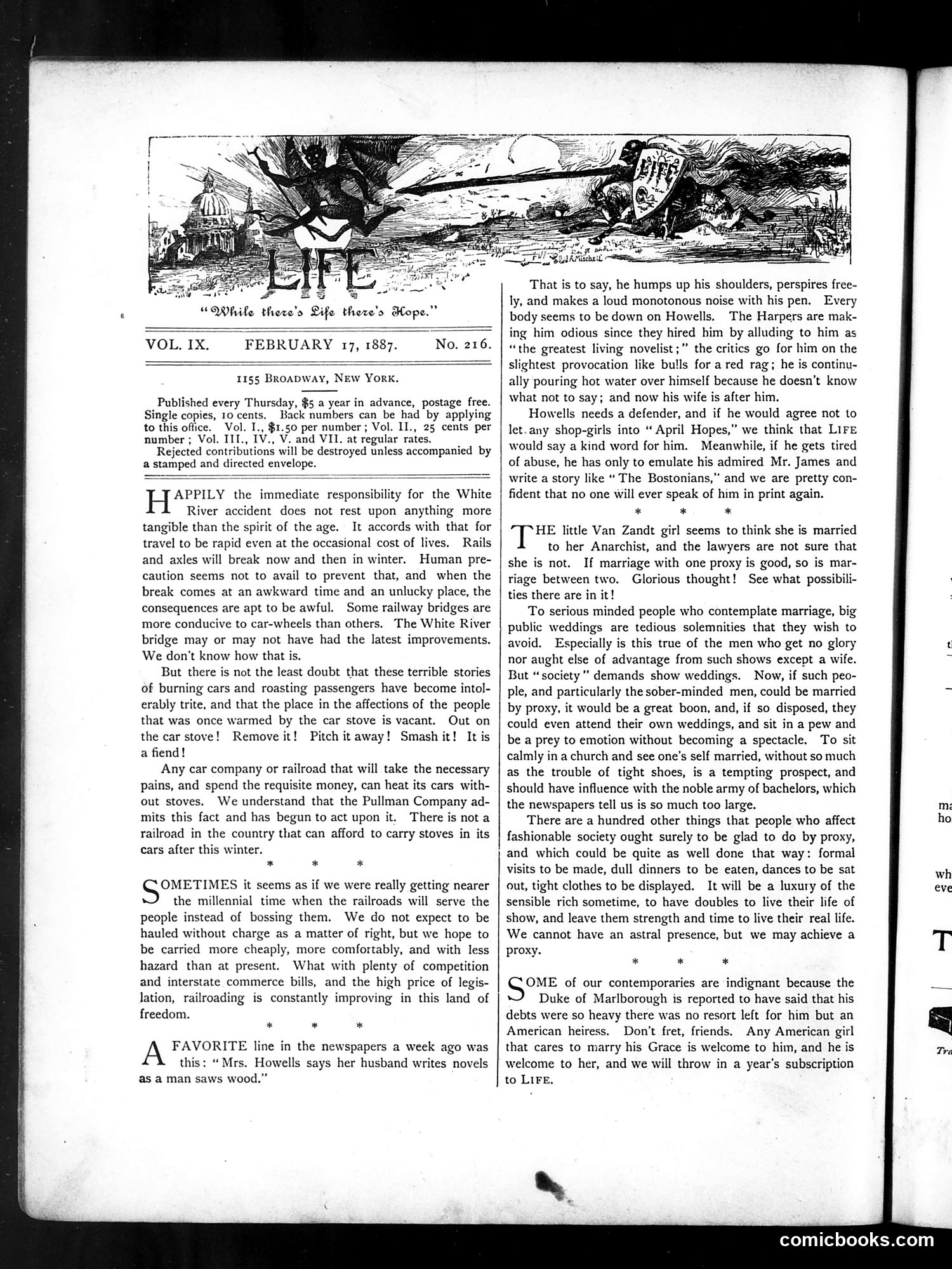
The masthead cartoon depicts a skeletal Death figure wielding a scythe over a landscape, with the caption "While there's Life there's Hope." This appears to illustrate the magazine's name ironically—suggesting mortality despite hope. The text discusses the White River railroad accident, advocating for heated railway cars as a safety measure. It critiques both the railroad industry's negligence and society's acceptance of preventable deaths from cold winters. The remaining editorials address: Mrs. Howells (wife of novelist William Dean Howells) and literary criticism; marriage by proxy; and the Duke of Marlborough's marriage to an American heiress for financial reasons—a common satirical target of the era, reflecting American anxiety about wealthy daughters marrying impoverished foreign nobility.
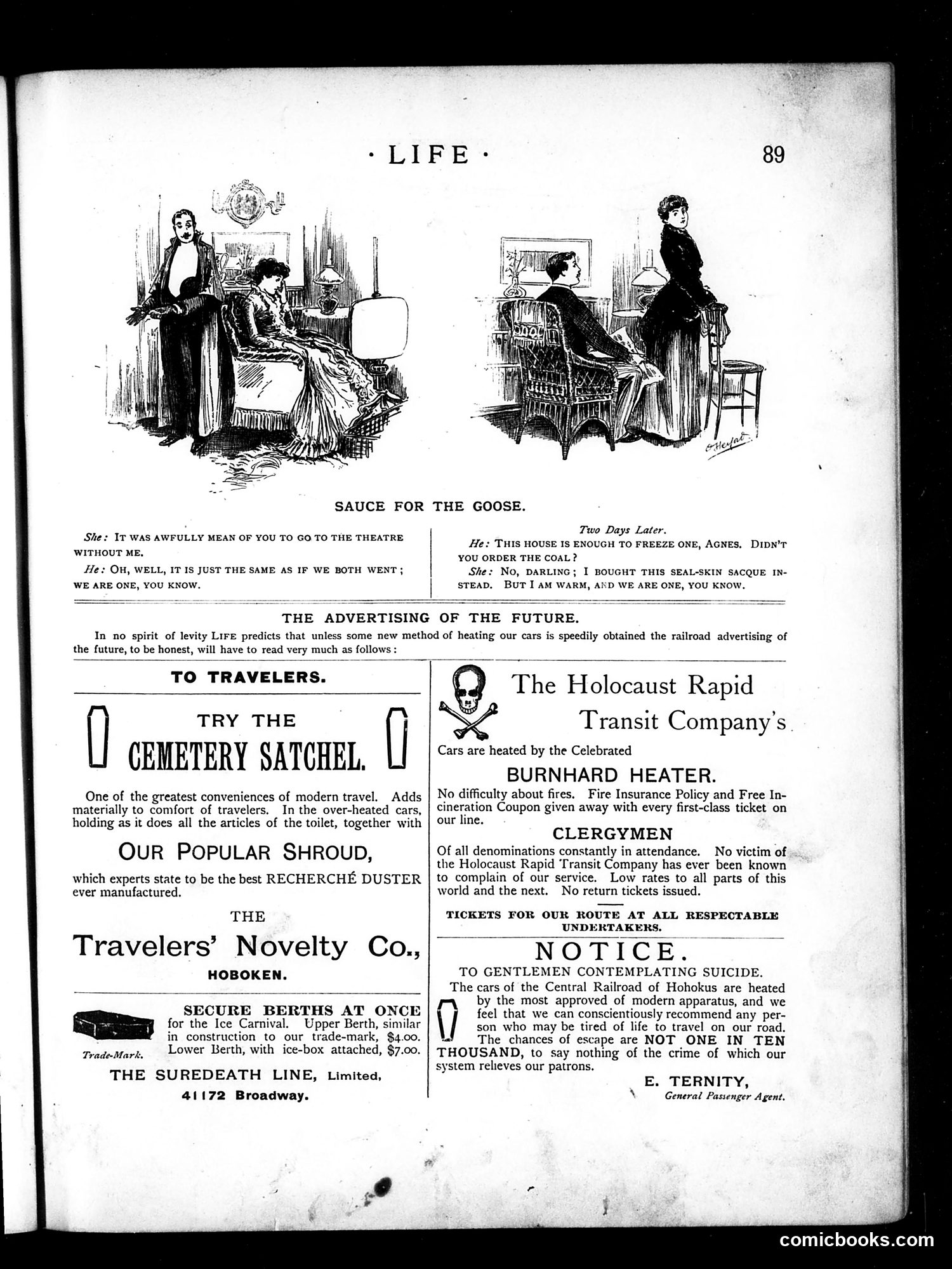
**Main Content:** Two cartoon panels titled "Sauce for the Goose" depict domestic scenes where a husband and wife exchange cutting remarks about theater attendance and household spending. The humor relies on marital role-reversal and tit-for-tat arguments—she criticizes his theater trip, he retorts about her expensive seal-skin purchase. **"The Advertising of the Future" Section:** Below are satirical fake advertisements mocking emerging transportation and services. The "Holocaust Rapid Transit Company" with its skull-and-crossbones logo, "Suredeath Line," and "Cemetery Satchel" products suggest dark humor about railroad safety hazards and travel dangers of the era. These ads parody genuine advertisements while highlighting public anxiety about modern industrial transportation—a genuine contemporary concern during the early automobile and train expansion period.
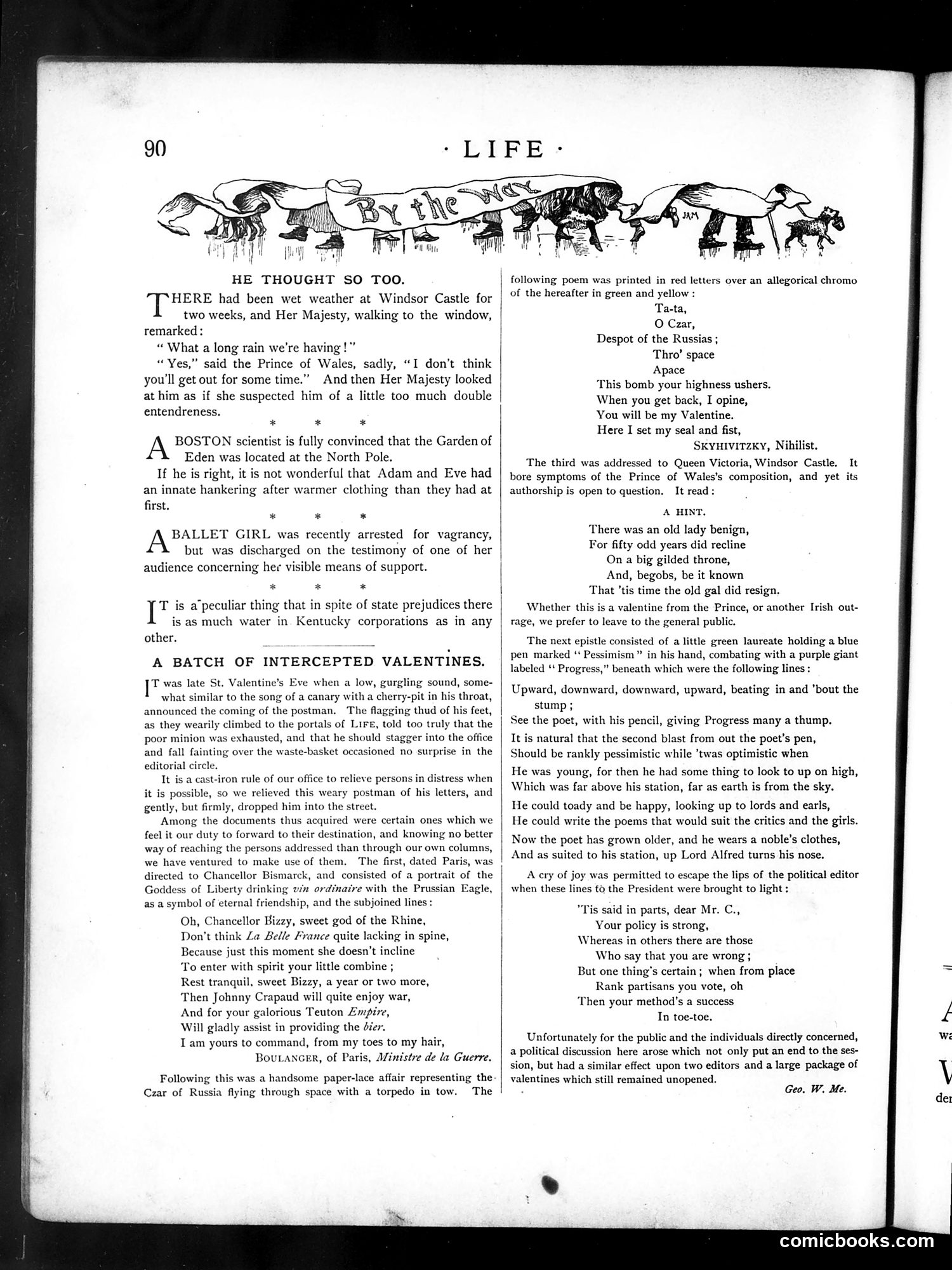
This page contains several brief satirical pieces rather than a single cartoon. The main humor targets: **"HE THOUGHT SO TOO"**: A joke about the Prince of Wales and Queen Victoria at Windsor Castle during rainy weather, playing on assumptions about the Prince's intelligence or character. **"A BOSTON SCIENTIST"**: Satire of pseudoscientific claims that Eden was at the North Pole. **"A BATCH OF INTERCEPTED VALENTINES"**: The centerpiece—humorous fake love letters allegedly sent to Queen Victoria, including one from the Czar of Russia "flying through space with a torpedo in tow." These mock romantic declarations parody both sentimental Victorian valentines and international political relations through absurdist humor. The overall tone is light political and social satire typical of Life's humor during the Victorian era.
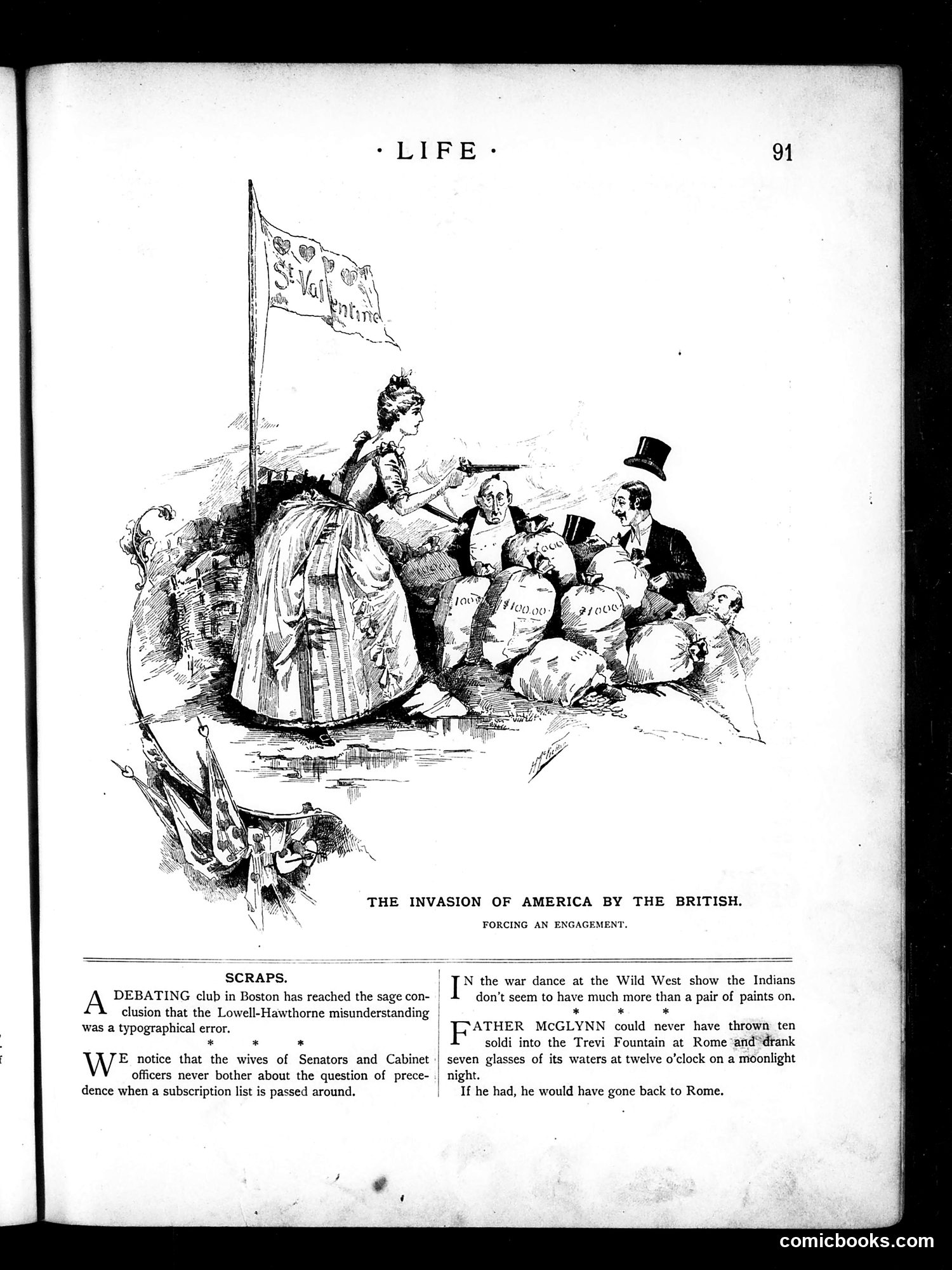
This satirical cartoon depicts **Britannia** (the female figure with crown and flag, representing Britain) distributing bags of money to American political figures—likely Senators and Cabinet members—suggesting Britain is "invading" America through financial influence rather than military force. The men in top hats appear to be competing for these funds, satirizing political corruption and the perception that American politicians are susceptible to British bribery. The "scraps" section below contains three unrelated satirical quips mocking Boston debating clubs, Senate wives' behavior regarding subscription lists, and Father McGlynn's alleged drinking habits in Rome—typical of Life magazine's random social commentary style.
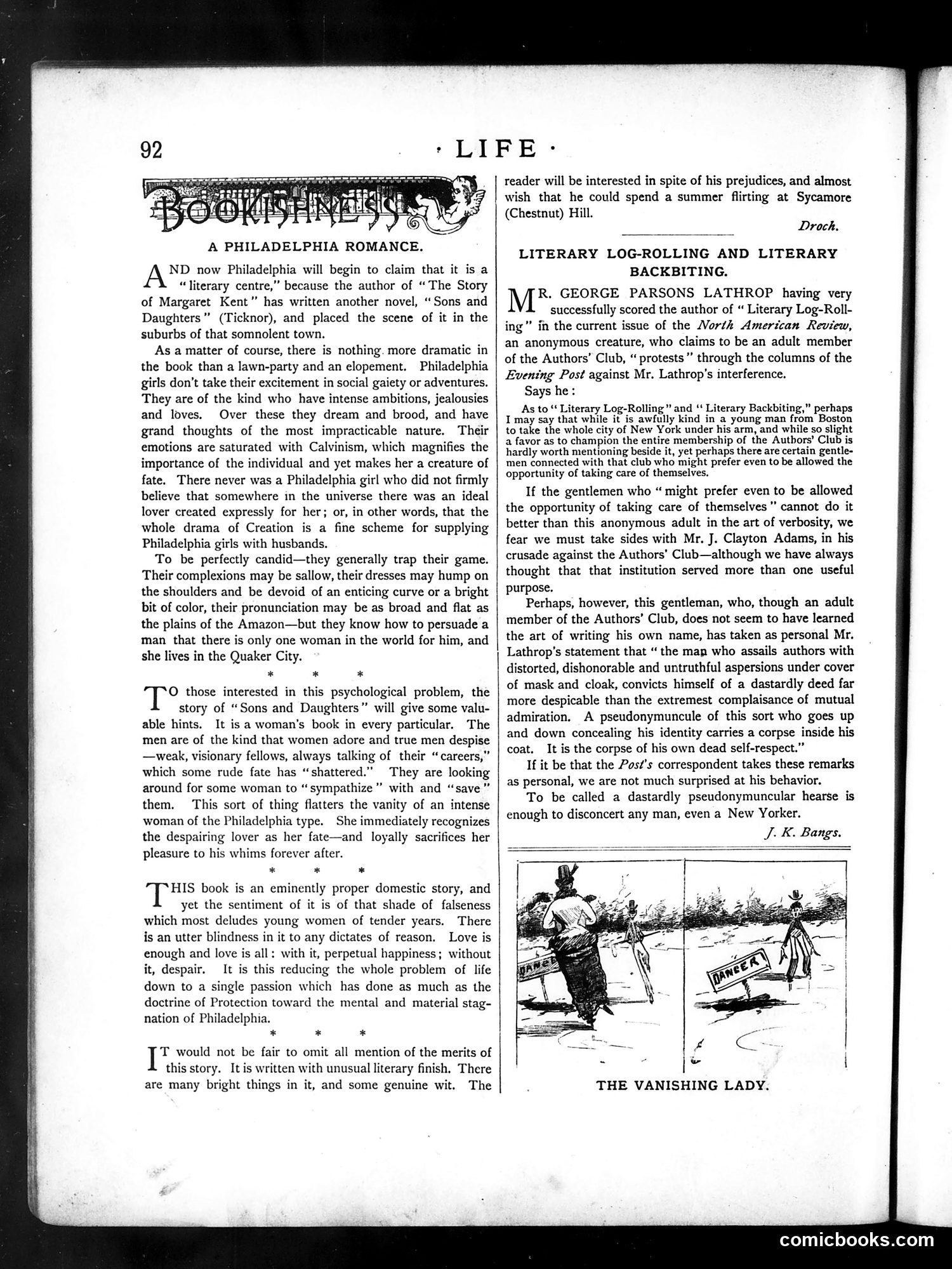
This page contains book reviews rather than political cartoons. The main content discusses "The Story of Margaret Kent" by Nicknor and "Sons and Daughters" by Ticknor, both Philadelphia-set novels about romance and domestic life. Below the reviews is a section titled "Literary Log-Rolling and Literary Backbiting" critiquing George Parsons Lathrop's recent work in *American Mercury*. An anonymous Authors' Club member defends the club against Lathrop's attacks, while satirizing his pretensions. At the bottom is a cartoon titled "The Vanishing Lady" showing what appears to be a magician's disappearing act illusion, though the specific satirical reference is unclear from the image alone. The cartoon likely comments on contemporary entertainment or social themes, but context is insufficient for definitive interpretation.
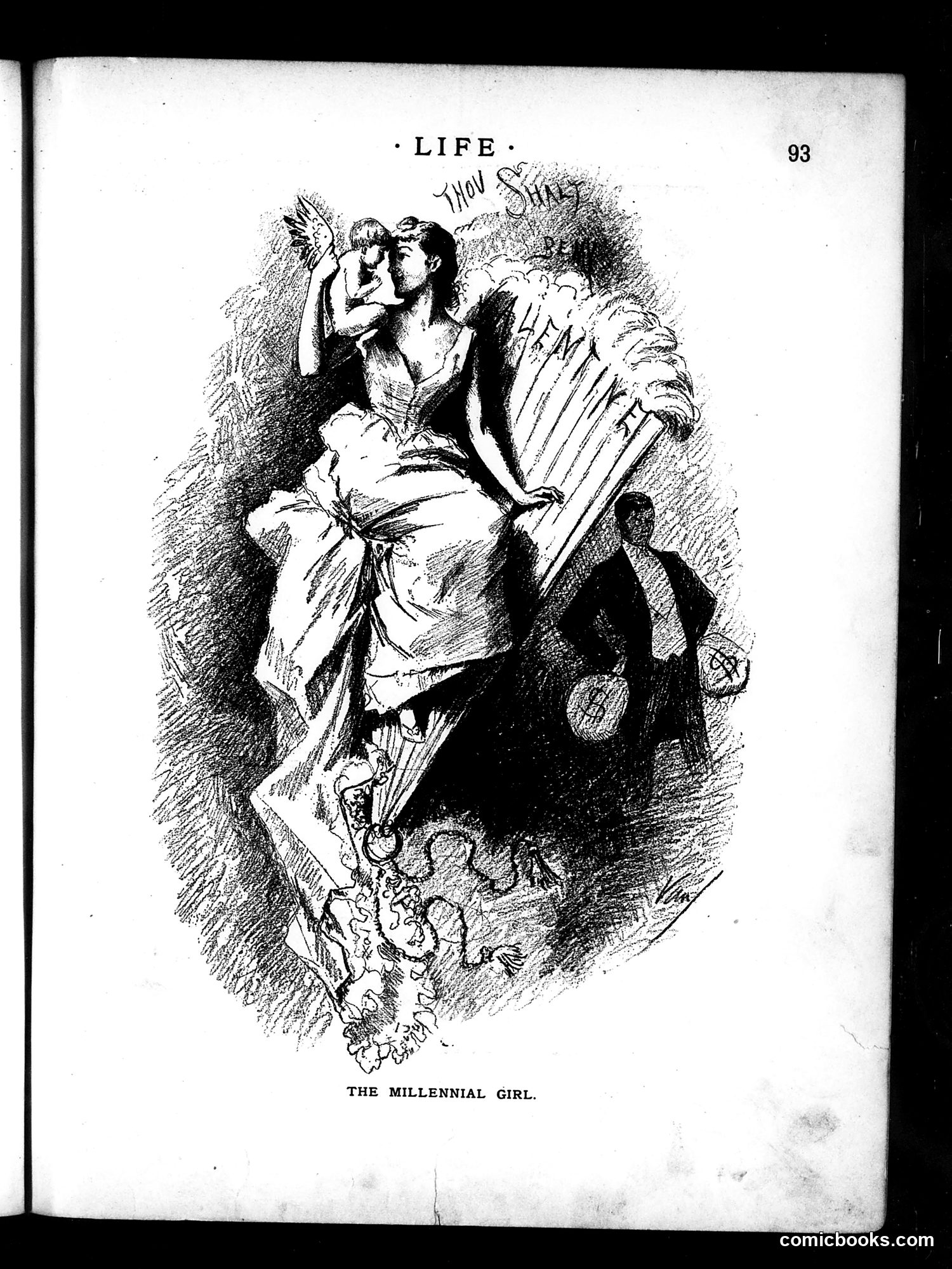
This satirical illustration depicts a young woman labeled "The Millennial Girl"—though the term here refers to the turn of the 20th century (the 1900s), not the modern generation. The sketch shows a fashionable woman in elaborate Edwardian dress, reclining or posed dramatically. The exaggerated style and flowing garments appear to mock contemporary ideals of femininity and sophistication among upper-class young women of that era. The satire likely targets the perceived affectations, materialism, or social pretensions of wealthy young women at the century's turn. The dramatic pose and detailed rendering suggest gentle mockery of both their fashion choices and their self-presentation in high society. Without additional context, the specific critique remains somewhat unclear, but the tone is clearly comedic rather than mean-spirited.
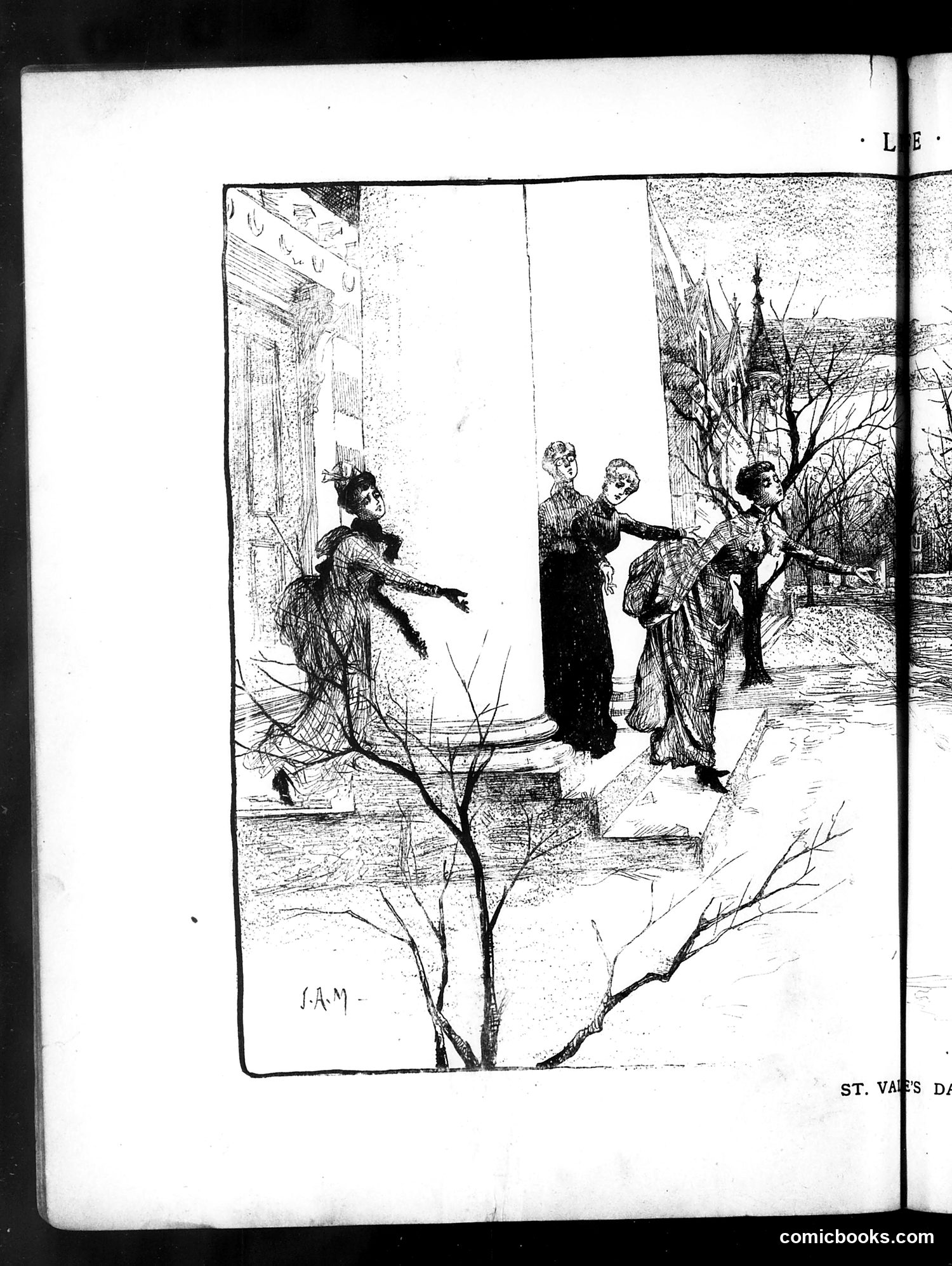
This pen-and-ink illustration depicts a winter scene in what appears to be a courtyard or alley (the caption reads "ST. VALES DA[...]"). The cartoon shows five figures: a woman on the left in an exaggerated pose appears to be slipping or falling on ice, while three other figures in dark coats observe or react to her mishap. A bare tree is prominent in the foreground. The satire likely concerns winter hazards and social responses to accidents—possibly commentary on urban safety, indifference to others' misfortune, or the absurdity of winter conditions. The woman's dramatic pose suggests physical comedy typical of Life magazine's satirical humor. Without the complete caption or publication date visible, the specific social or political target remains unclear, though the artistic style suggests early-to-mid 20th century.
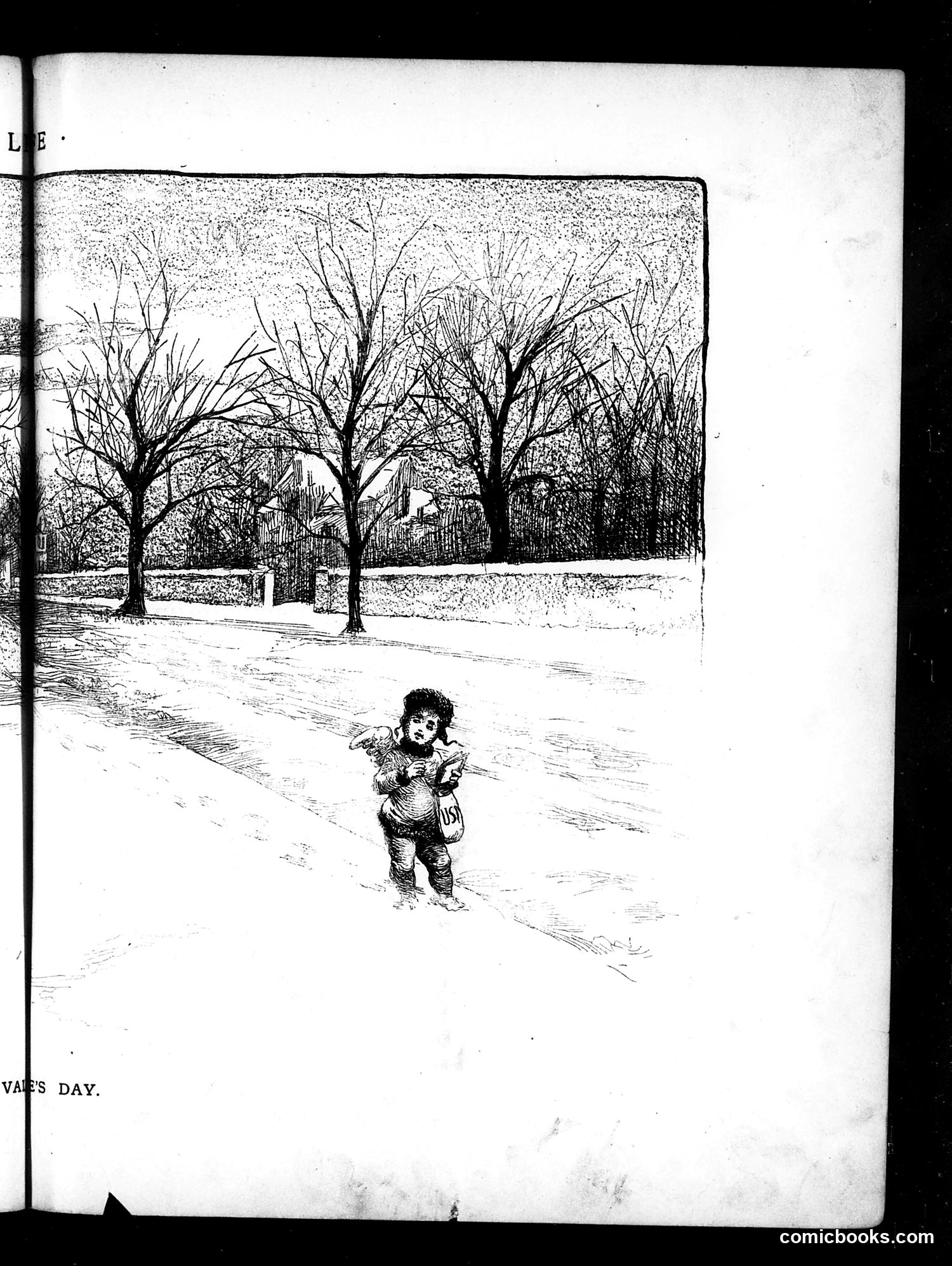
This appears to be an illustration titled "Valentine's Day" (visible at bottom left). The image shows a solitary toddler in winter clothing standing in a snowy landscape with bare trees and a distant house. The child appears isolated and small against the vast, empty scenery. The satire likely comments on loneliness or abandonment around Valentine's Day—traditionally a celebration of love and connection. By depicting a small child alone in a barren winter landscape on this romantic holiday, the artist creates ironic contrast, perhaps critiquing the commercialization of Valentine's Day or highlighting those excluded from its sentimentality. The composition emphasizes isolation and vulnerability, making a pointed social observation about love's exclusions.
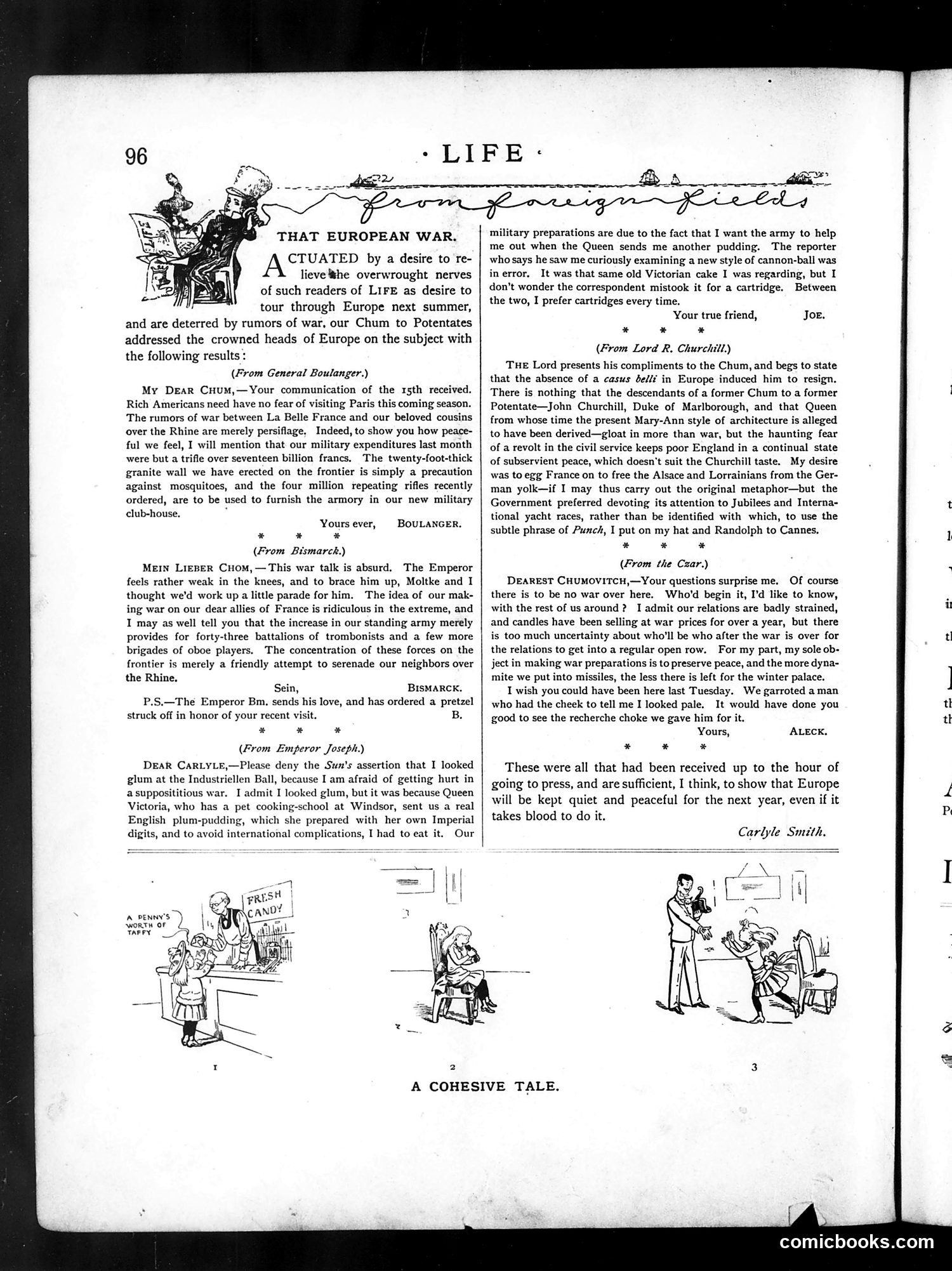
This page satirizes European leaders' disingenuous denials of war preparations in the 1880s-90s. Through fictional letters to Life's editor ("the Chum"), political figures claim peaceful intentions while describing massive military buildups—the satire lies in their transparent contradictions. **Key figures and jokes:** - **Boulanger** (French general): Claims no war threat while mentioning "seventeen billion francs" in military spending and a "twenty-foot-thick granite wall" - **Bismarck**: Denies attacking France while describing troop concentrations as merely a "serenade" - **Emperor Joseph** (Austria): Blames his gloomy expression on Queen Victoria's cooking, not war fears - **Lord Randolph Churchill**: Laments England won't help France fight Germany The humor targets the absurd pretense of European powers—all visibly arming themselves while publicly insisting peace is assured. The cartoon at bottom ("A Cohesive Tale") likely reinforces this theme visually.
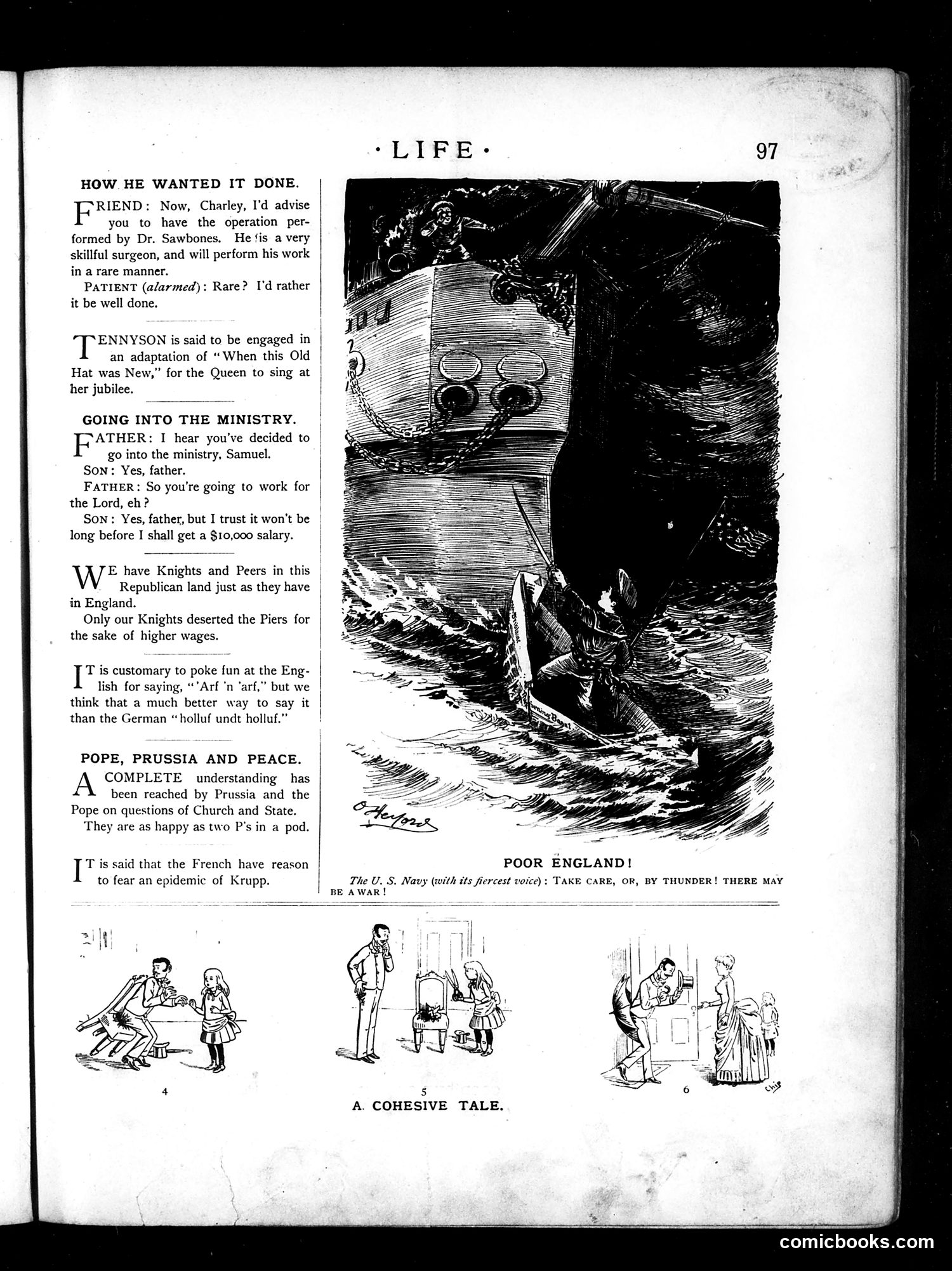
This page contains several short humor pieces and a political cartoon. **"Poor England!" (main cartoon):** The large illustration depicts the U.S. Navy as a threatening warship menacing a small British vessel. The caption suggests America is warning Britain about potential naval conflict. This likely references 1890s tensions between American and British naval power—a period of Anglo-American rivalry over colonial interests and naval supremacy. **Short jokes include:** - A pun on "rare" surgery (rare vs. well-done) - A jab at American materialism: a young man entering the ministry only for the $10,000 salary - Wordplay about "Knights" deserting "Piers" (Knights and Pierces/Piers)—a pun on American social pretension mimicking British aristocracy **"A Cohesive Tale":** Three small sequential cartoons illustrating a domestic narrative (plot unclear from image alone). The overall tone mocks American social climbing, materialism, religious hypocrisy, and reflects period anxieties about naval power competition with Britain.
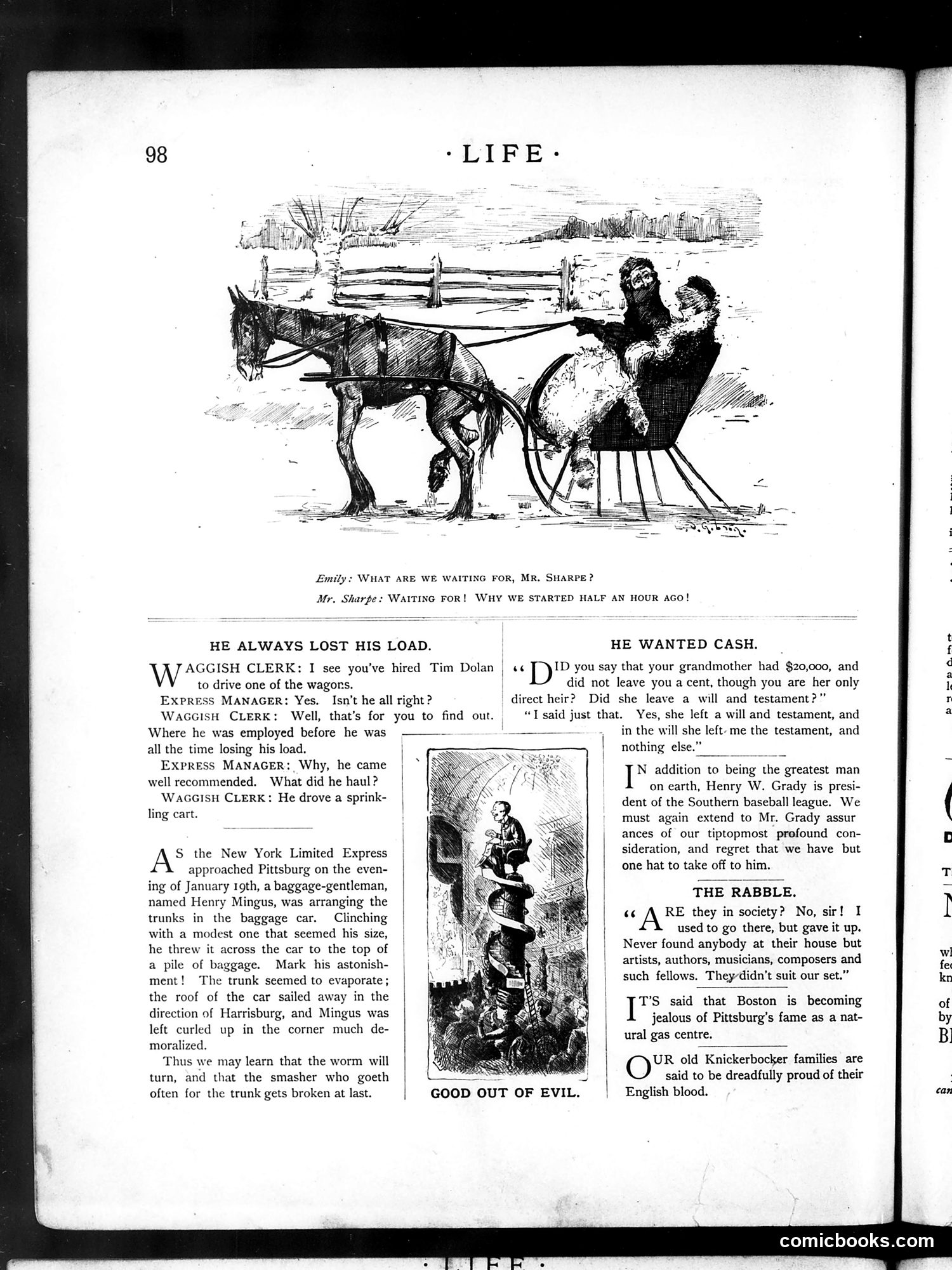
This page contains several unrelated satirical items typical of Life's format: **Top cartoon**: Shows a man and woman in a cart pulled by a horse, with the woman asking why they're waiting. The man replies they started half an hour ago—likely satirizing unreliable transportation or slowness. **"He Always Lost His Load"**: A joke about hiring Tim Dolan as a wagon driver. The punchline: he previously drove a sprinkling cart, so "losing his load" (water) was expected—a simple play on words about incompetence. **"Good Out of Evil"**: A story about baggage handler Henry Mingus throwing a trunk that mysteriously launches through the train car roof. The moral: "the smasher who goeth often for the trunk gets broken at last"—apparently about consequences of rough handling. **Remaining items**: Brief satirical notes mocking social pretension (the "rabble" who associate with artists rather than "society," Boston's jealousy of Pittsburgh's industrial prominence, and old New York families' pride in English ancestry). The page reflects Life's characteristic mix of puns, ironic social commentary, and gentle mockery of American life.
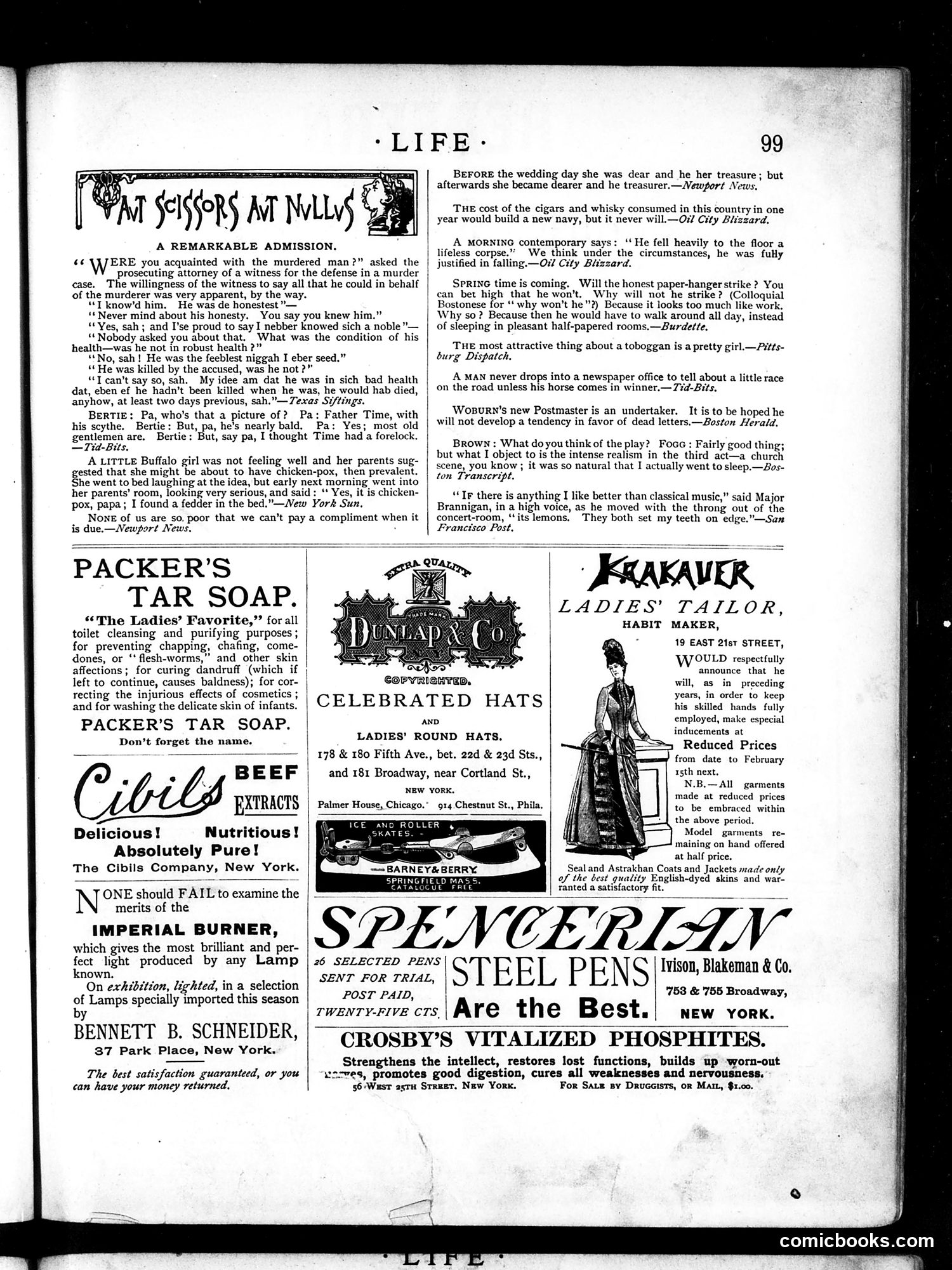
This page contains brief satirical quips typical of Life's humor format, plus period advertisements. **Notable satire:** The opening piece mocks courtroom testimony, featuring a witness (depicted using dialect suggesting a Black Southern speaker) defending a murder suspect by contradicting himself—first praising the victim's honesty, then claiming he was so sickly he'd have died anyway. The satire targets both unreliable witnesses and the absurdity of biased testimony. Other jokes target contemporary issues: the cost of liquor and cigars (suggesting wasted national resources), dishonest paperhangers (common trade complaints), and newspaper sensationalism (mocking flowery descriptions of death). **Advertisements** include Packer's Tar Soap, Cibils Beef Extracts, and an Imperial Burner lamp—typical consumer goods of the era. The overall tone reflects turn-of-the-century American humor: workplace gripes, gender relations jokes, and social observation rather than partisan political satire.
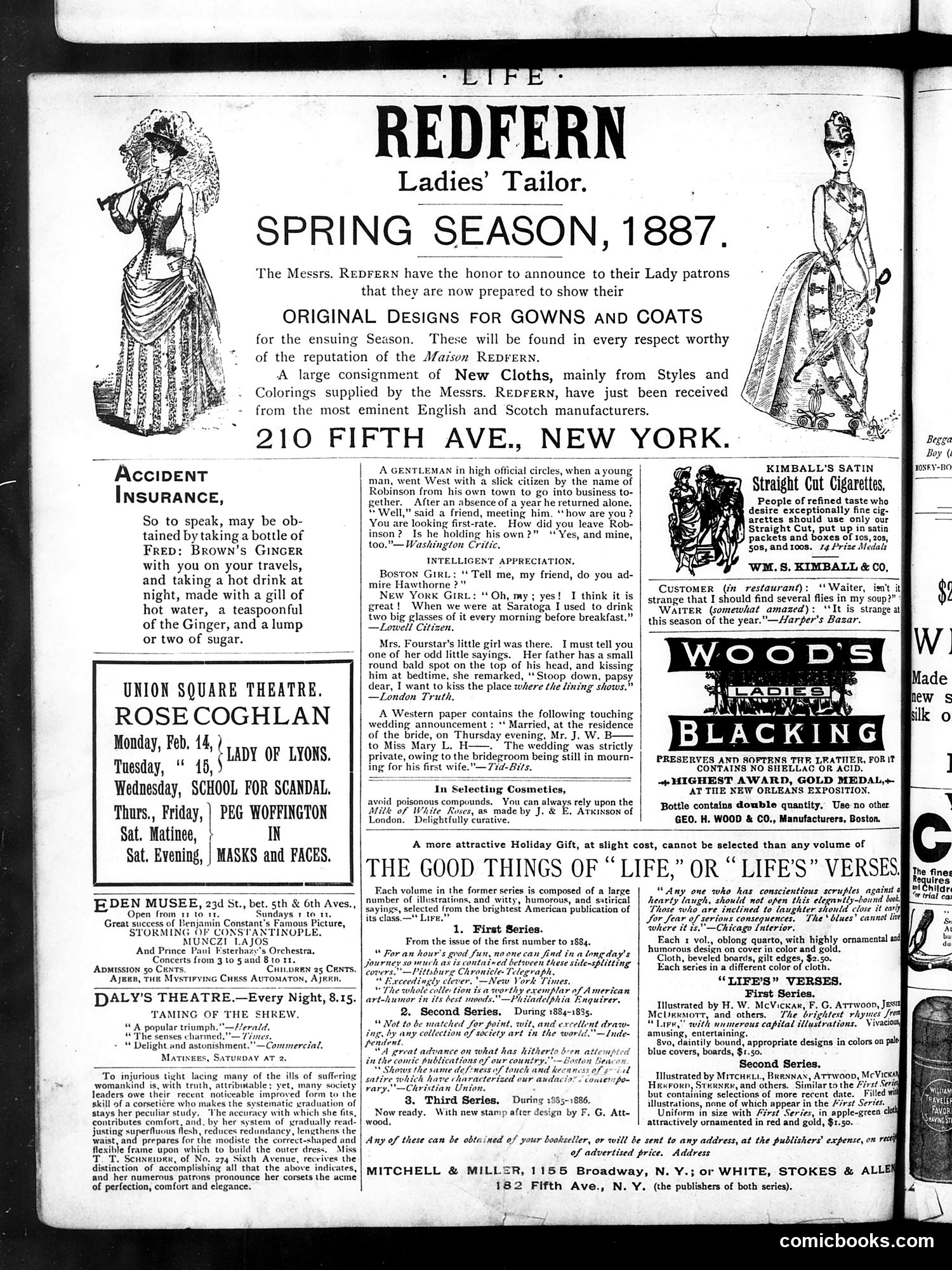
This page is primarily **commercial advertising**, not political satire. It features fashion and consumer product ads typical of the era. The main content advertises **Redfern**, a prestigious ladies' tailor at 210 Fifth Avenue, New York, announcing spring 1887 gown and coat designs. Two illustrated fashion figures flank the announcement, showing the elaborate bustle silhouettes of 1880s women's fashion. The page also includes theater listings (Union Square Theatre, Eden Musee, Daly's Theatre) and various product advertisements: Fred Brown's Ginger for travelers, Kimball's Satin Straight Cut Cigarettes, Wood's Blacking shoe polish, and cosmetics. Scattered throughout are brief humorous anecdotes and social commentary—a joke about a businessman who absorbed his partner's assets, observations about tight-lacing corsets, and witty remarks about travel and courtship—typical of Life's satirical tone. These are conversational filler rather than pointed political commentary.
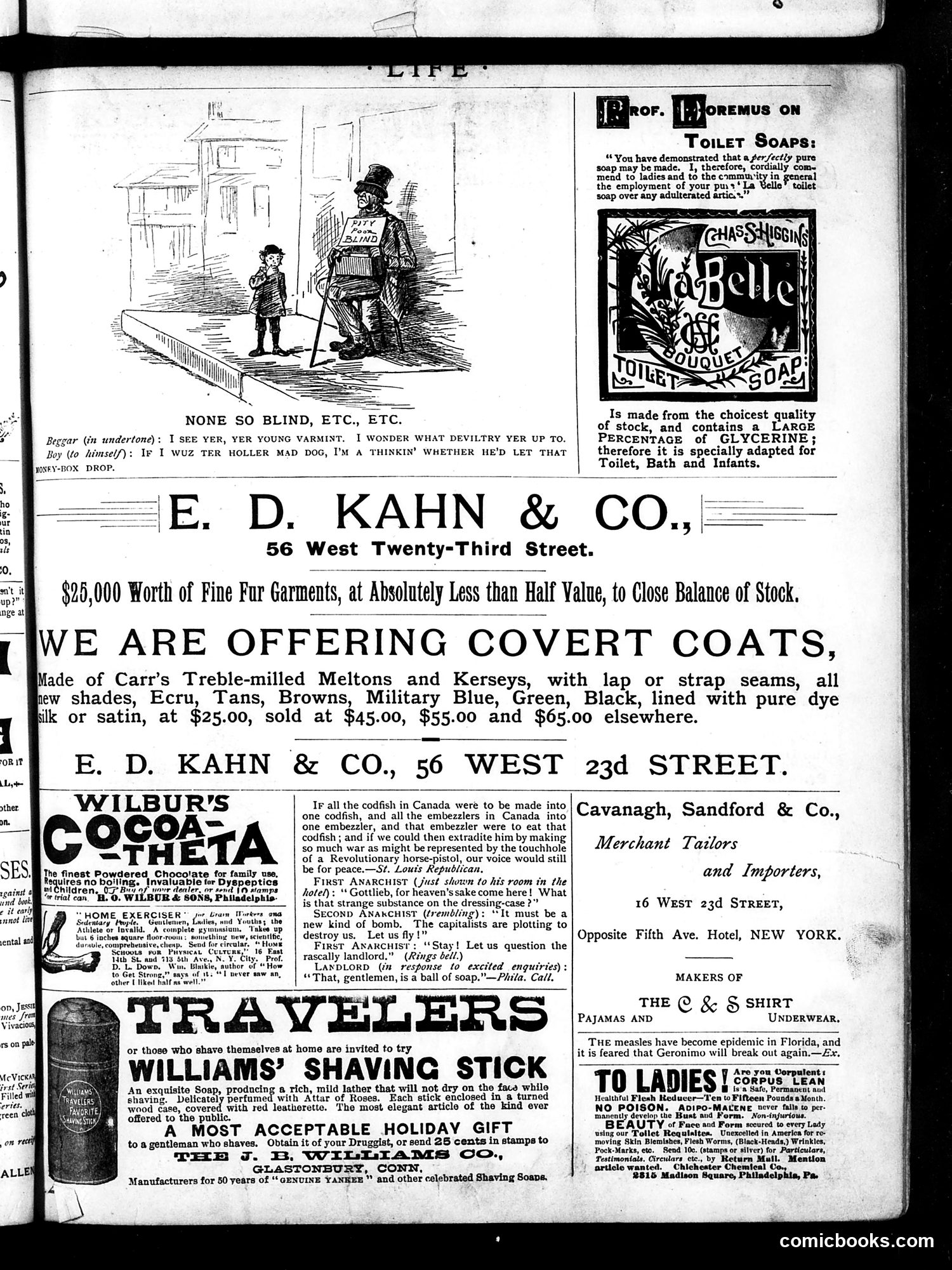
This cartoon satirizes willful ignorance or deliberate blindness to obvious wrongdoing. A beggar observes a young boy scheming about creating a false alarm ("holler mad dog"), yet the beggar pretends not to notice the boy's mischievous intent—hence "none so blind" as those who choose not to see. The title's repetition suggests a commentary on how people, institutions, or authorities often ignore blatant misconduct when it suits them. The beggar's aside to himself reveals he *does* see what's happening, making the joke about hypocrisy and willful complicity rather than actual blindness. The page is primarily **advertising** (fur coats, soap, chocolate, shaving products, tailoring services), with this single political cartoon as the only satirical content—typical of *Life* magazine's mixed format during this era.
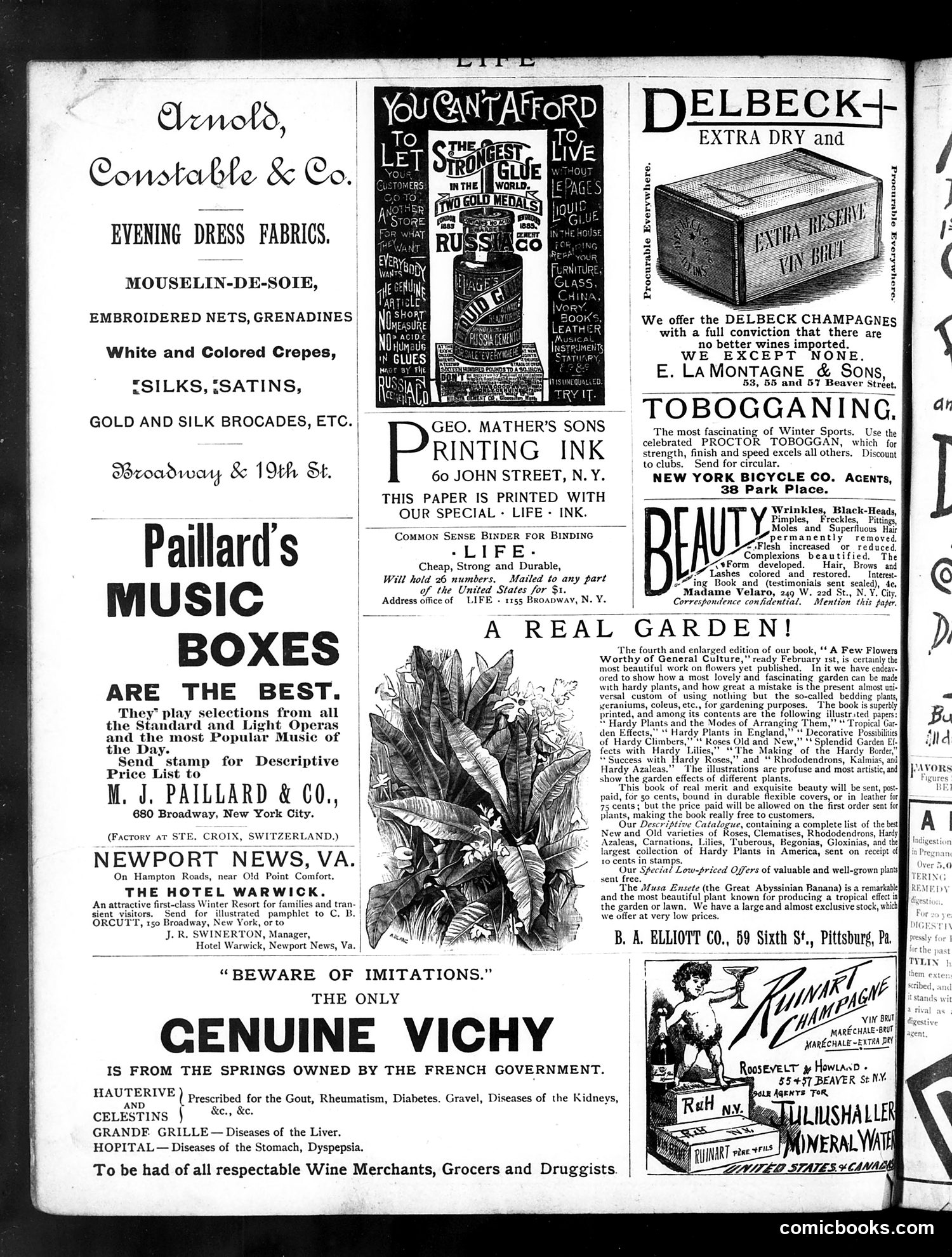
This page is primarily **advertising**, not satire or political cartoon. It contains commercial notices for late 19th-century luxury goods and services typical of Life magazine's affluent readership. Notable ads include: - **Paillard's Music Boxes** — mechanical devices playing opera selections - **Delbeck Champagne** — positioned as superior imported wine - **Vichy Water** — French mineral water marketed for gout, rheumatism, and kidney disease - **Tobogganing equipment** — winter sports gear - **B.A. Elliott's gardening book** — horticultural instruction with botanical illustrations - **Beauty treatments by Madame Velaro** — cosmetic services removing wrinkles and blemishes The only cartoon visible is a small **Kinmarck Champagne advertisement** (lower right) showing a woman, though details are unclear. The page reflects Gilded Age consumer culture targeting wealthy urbanites interested in European imports, winter recreation, and personal grooming.
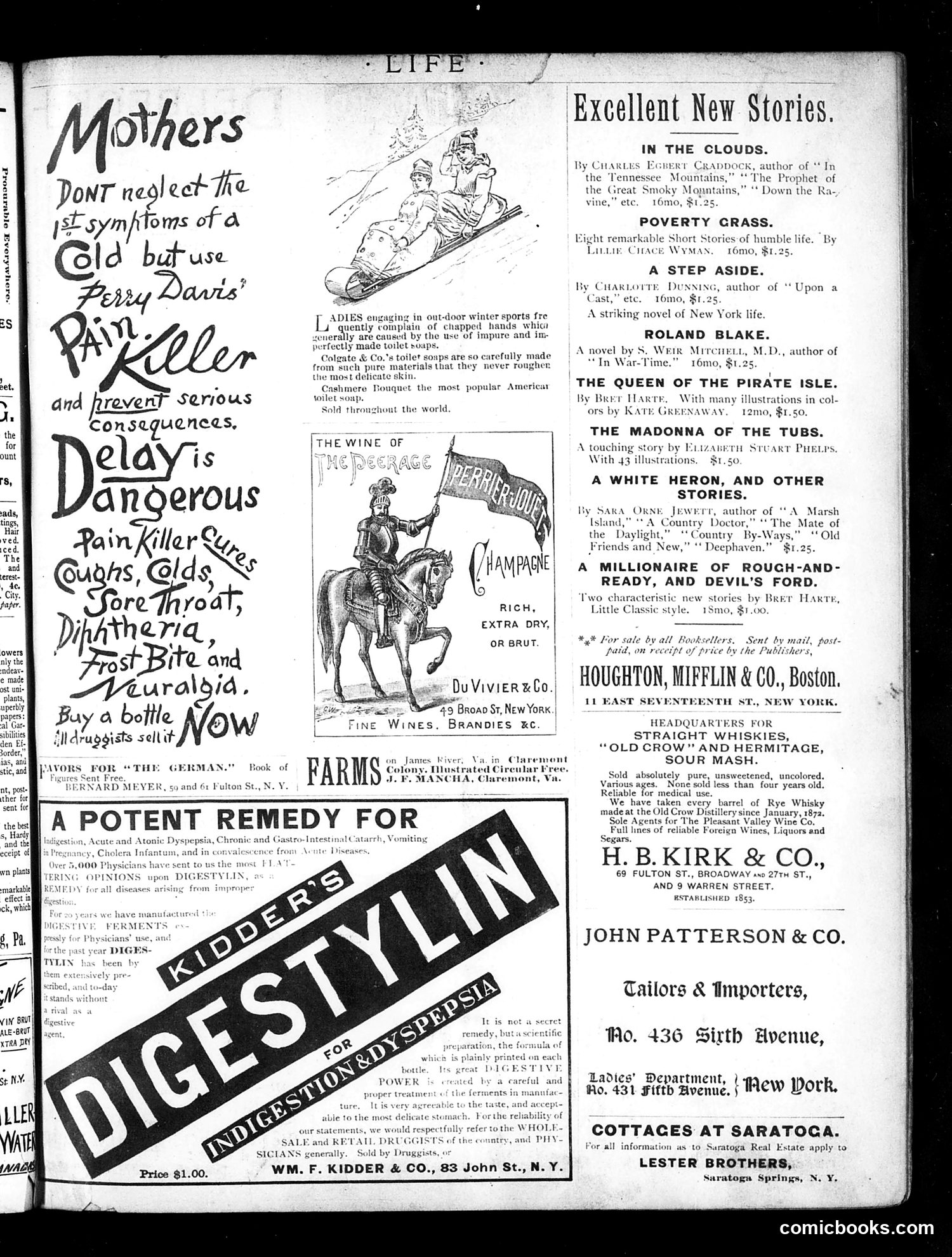
This page is primarily **advertising and book announcements**, not political satire or cartoons requiring historical context. The main visual elements are commercial ads: a Perry Davis Pain Killer advertisement (left side, large text warning mothers about cold symptoms), a Champagne wine advertisement featuring a figure on horseback, and a Kidder's Digestlin remedy ad (center). These are typical late-19th-century patent medicine and luxury goods advertisements. The right column lists "Excellent New Stories"—book announcements for works by authors like Bret Harte and Charlotte Dunning, published by Houghton Mifflin & Co. Additional ads promote H.B. Kirk & Co. whiskeys, John Patterson & Co. tailors, and Saratoga real estate. **No political cartoon or satirical content is present.** This appears to be a commercial/editorial page from Life magazine, typical of publications that mixed content with advertising revenue.
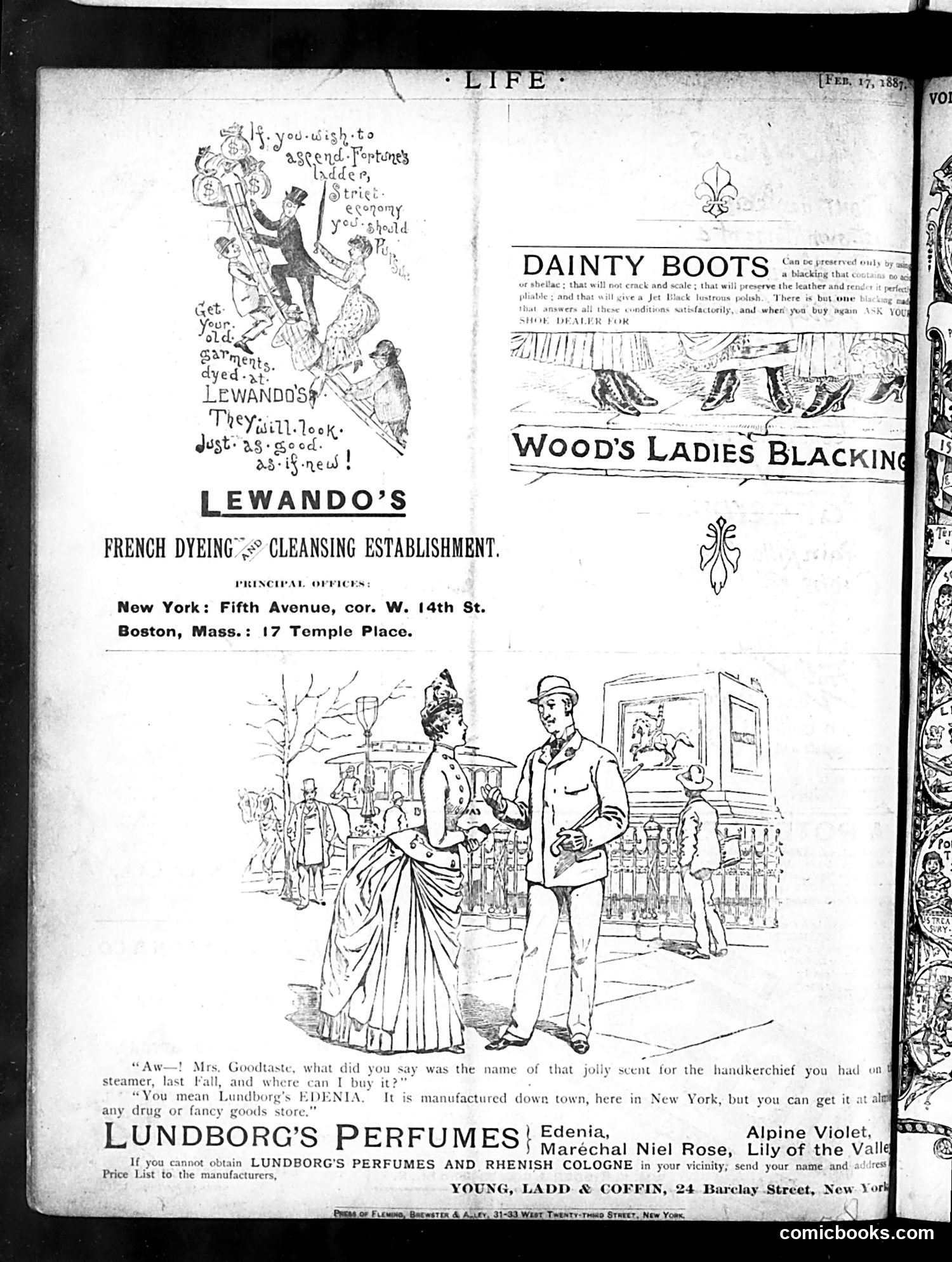
This is primarily **a advertising page**, not political satire. It contains three product advertisements from the 1880s: 1. **Lewando's French Dyeing & Cleansing Establishment** (top left): A humorous illustrated ad showing a man climbing a "ladder" of social aspirations—ascending from poverty toward wealth and respectability. The joke: dry cleaning helps you ascend socially. 2. **Dainty Boots and Wood's Ladies Blacking** (top right): Shoe polish advertisements featuring illustrated women's boots. 3. **Lundborg's Perfumes** (bottom): The main ad shows a fashionable couple at what appears to be a park or social venue. The accompanying dialogue depicts a genteel conversation where one woman asks another about a perfume she noticed—a common advertising format of the era, using social endorsement to sell luxury goods. The overall page reflects **late-19th-century consumer culture**, emphasizing how commercial products promised social advancement and refined taste to aspirational middle-class readers.