
Life, 1887-02-17 · page 14 of 20
Life — February 17, 1887 — page 14: what you’re looking at
What you’re looking at
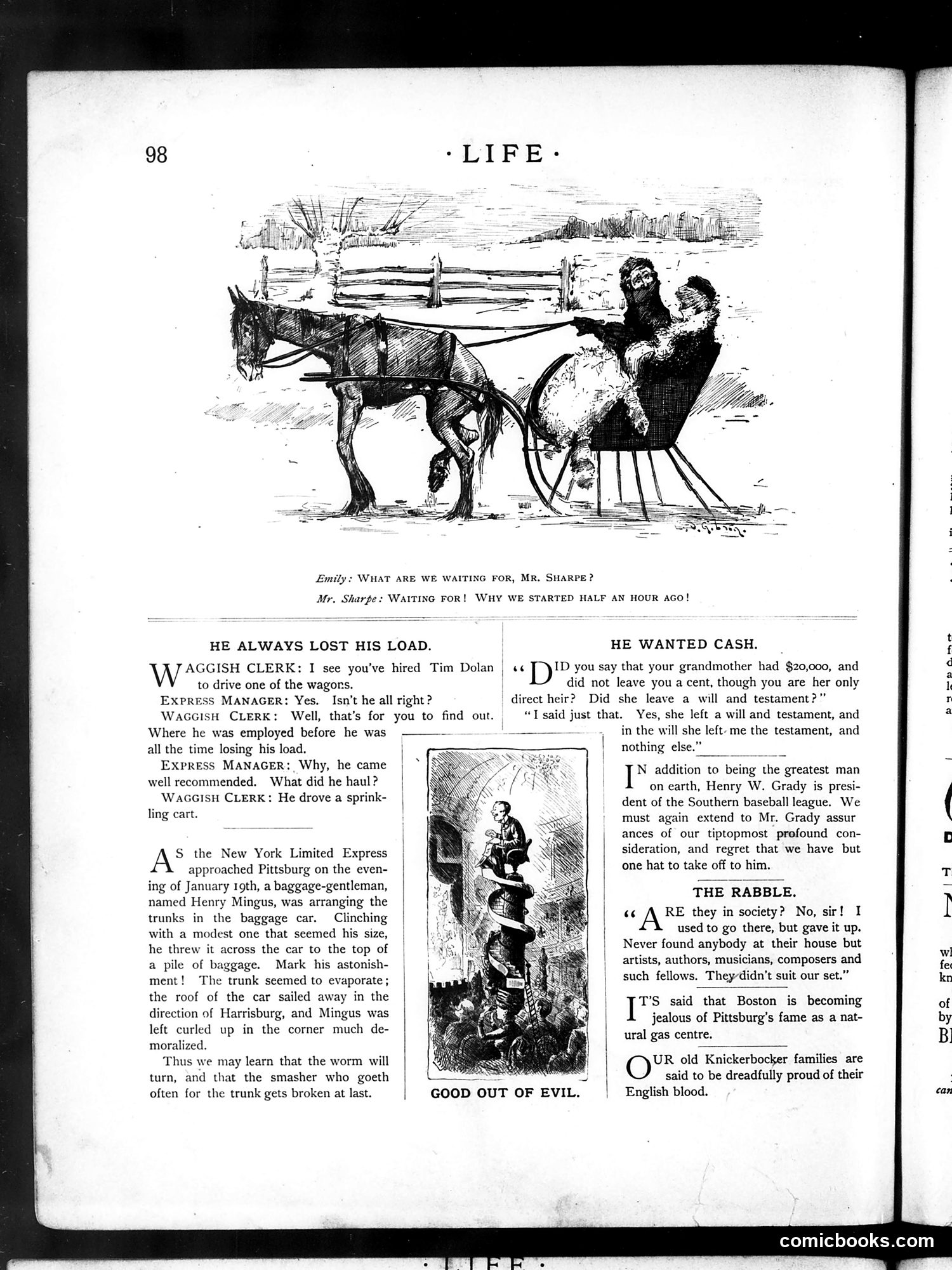
This page contains several unrelated satirical items typical of Life's format: **Top cartoon**: Shows a man and woman in a cart pulled by a horse, with the woman asking why they're waiting. The man replies they started half an hour ago—likely satirizing unreliable transportation or slowness. **"He Always Lost His Load"**: A joke about hiring Tim Dolan as a wagon driver. The punchline: he previously drove a sprinkling cart, so "losing his load" (water) was expected—a simple play on words about incompetence. **"Good Out of Evil"**: A story about baggage handler Henry Mingus throwing a trunk that mysteriously launches through the train car roof. The moral: "the smasher who goeth often for the trunk gets broken at last"—apparently about consequences of rough handling. **Remaining items**: Brief satirical notes mocking social pretension (the "rabble" who associate with artists rather than "society," Boston's jealousy of Pittsburgh's industrial prominence, and old New York families' pride in English ancestry). The page reflects Life's characteristic mix of puns, ironic social commentary, and gentle mockery of American life.
📄 Transcribed text from this page (OCR, searchable)
Machine-transcribed from the original scan — historical spelling and the odd misread are preserved.
Emily; WHAT ARE WE WAITING FoR, MR. SHARPE? Mr, Sharpe: WattTinG FOR! WHY WE STARTED HALF AN HOUR AGO! HE ALWAYS LOST HIS LOAD. AGGISH CLERK: I see you've hired Tim Dolan | to drive one of the wagors. ESS MANAGER: Yes. Isn't he all right ? SH CLERK: Well, that’s for you to find out. Where he was employed before he was - all the time losing his load. EXPRESS MANAGER: Why, he came well recommended. What did he haul? WaGGISH CLERK: He drove a sprink- ling cart. AS the New York Limited Express approached Pittsburg on the even- ing of January rgth, a baggage-gentleman, named Henry Mingus, was arranging the trunks in the baggage car. Clinching with a modest one that seemed his size, he threw it across the car to the top of a pile of baggage. Mark his astonish- ment! The trunk seemed to evaporate; the roof of the car sailed away in the direction of Harrisburg, and Mingus was left curled up in the corner much de- moralized. Thus we may learn that the worm will turn, and that the smasher who goeth often for the trunk gets broken at last. HE WANTED CASH. “ ID you say that your grandmother had $20,000, and did not leave you a cent, though you are her only direct heir? Did she leave a will and testament?” “T said just that. Yes, she left a will and testament, and in the will she left-me the testament, and | nothing else.” N addition to being the greatest man on earth, Henry W. Grady is presi- dent of the Southern baseball league. We must again extend to Mr. Grady assur ances of our tiptopmost profound con- sideration, and regret that we have but one hat to take off to him. THE RABBLE. “cc RE they in society? No, sir! I used to go there, but gave it up. Never found anybody at their house but artists, authors, musicians, composers and such fellows. They-didn’t suit our set.” T’S said that Boston is becoming jealous of Pittsburg’s fame as a nat- ural gas centre. UR old Knickerbocker families are said to be dreadfully proud of their English blood. comicbooks.com