
Life, 1887-02-17 · page 8 of 20
Life — February 17, 1887 — page 8: what you’re looking at
What you’re looking at
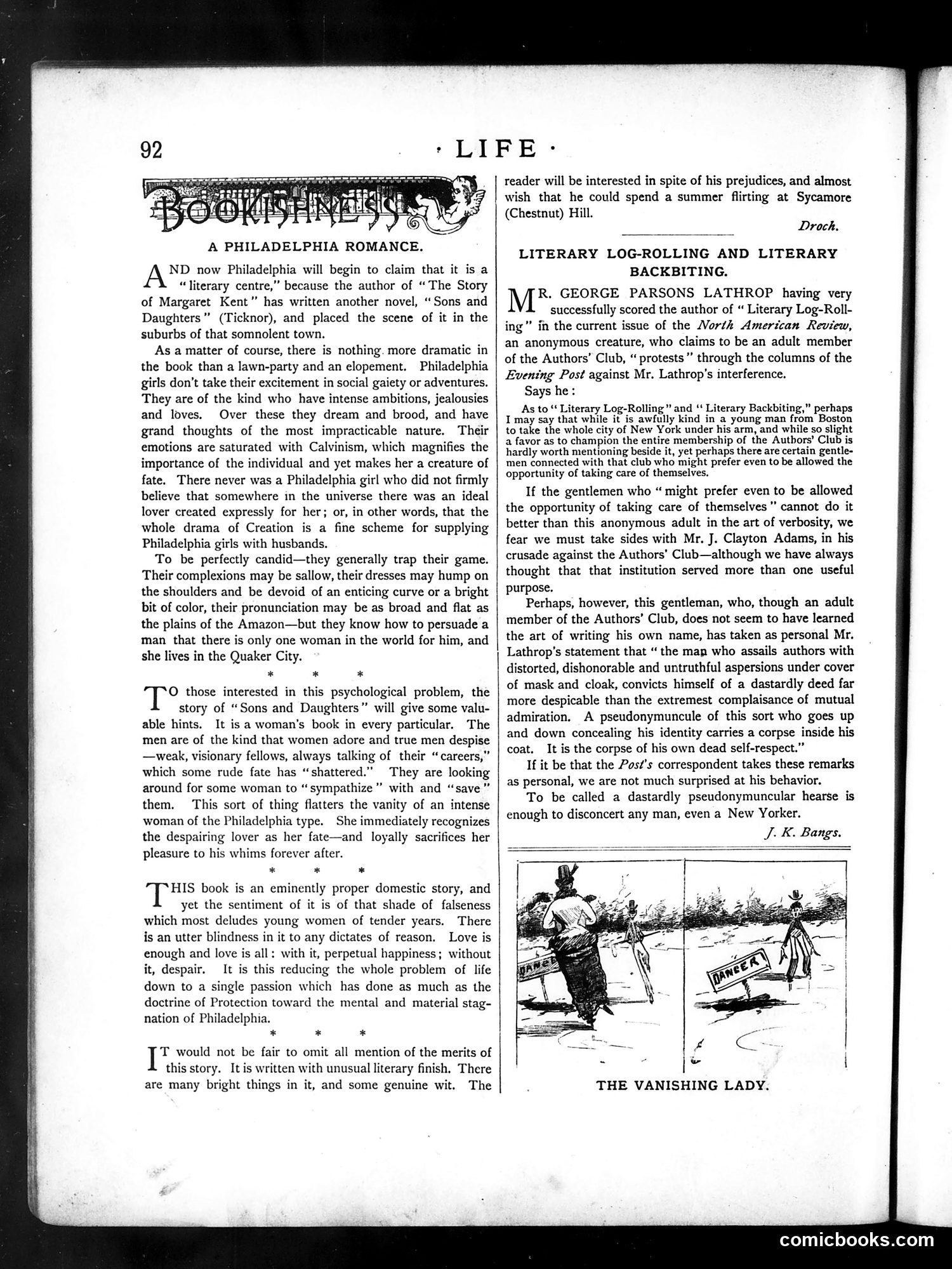
This page contains book reviews rather than political cartoons. The main content discusses "The Story of Margaret Kent" by Nicknor and "Sons and Daughters" by Ticknor, both Philadelphia-set novels about romance and domestic life. Below the reviews is a section titled "Literary Log-Rolling and Literary Backbiting" critiquing George Parsons Lathrop's recent work in *American Mercury*. An anonymous Authors' Club member defends the club against Lathrop's attacks, while satirizing his pretensions. At the bottom is a cartoon titled "The Vanishing Lady" showing what appears to be a magician's disappearing act illusion, though the specific satirical reference is unclear from the image alone. The cartoon likely comments on contemporary entertainment or social themes, but context is insufficient for definitive interpretation.
📄 Transcribed text from this page (OCR, searchable)
Machine-transcribed from the original scan — historical spelling and the odd misread are preserved.
‘LIFE: A PHILADELPHIA ROMANCE. ND now Philadelphia will begin to claim that it is a “literary centre,” because the author of “ The Story of Margaret Kent” has written another novel, “Sons and Daughters” (Ticknor), and placed the scene of it in the suburbs of that somnolent town. As a matter of course, there is nothing. more dramatic in the book than a lawn-party and an elopement. Philadelphia girls don’t take their excitement in social gaiety or adventures. They are of the kind who have intense ambitions, jealousies and loves. Over these they dream and brood, and have grand thoughts of the most impracticable nature. Their emotions are saturated with Calvinism, which magnifies the importance of the individual and yet makes her a creature of fate. There never was a Philadelphia girl who did not firmly believe that somewhere in the universe there was an ideal lover created expressly for her; or, in other words, that the whole drama of Creation is a fine scheme for supplying Philadelphia girls with husbands. To be perfectly candid—they generally trap their game. Their complexions may be sallow, their dresses may hump on the shoulders and be devoid of an enticing curve or a bright bit of color, their pronunciation may be as broad and flat as the plains of the Amazon—but they know how to persuade a man that there is only one woman in the world for him, and she lives in the Quaker City. * * * O those interested in this psychological problem, the story of “Sons and Daughters” will give some valu- able hints. It isa woman's book in every particular. The men are of the kind that women adore and true men despise —weak, visionary fellows, always talking of their “careers,” which some rude fate has “shattered.” They are looking around for some woman to “sympathize” with and “save” them. This sort of thing flatters the vanity of an intense woman of the Philadelphia type. She immediately recognizes the despairing lover as her fate—and loyally sacrifices her pleasure to his whims forever after. * * * HIS book is an eminently proper domestic story, and yet the sentiment of it is of that shade of falseness which most deludes young women of tender years. There is an utter blindness in it to any dictates of reason. Love is enough and love is all: with it, perpetual happiness; without it, despair. It is this reducing the whole problem of life down to a single passion which has done as much as the doctrine of Protection toward the mental and material stag- nation of Philadelphia. * * * T would not be fair to omit all mention of the merits of this story. It is written with unusual literary finish, There are many bright things in it, and some genuine wit. The reader will be interested in spite of his prejudices, and almost wish that he could spend a summer flirting at Sycamore (Chestnut) Hill. Droch. LITERARY LOG-ROLLING AND LITERARY BACKBITING. R. GEORGE PARSONS LATHROP having very successfully scored the author of “ Literary Log-Roll- ing” in the current issue of the Worth American Review, an anonymous creature, who claims to be an adult member of the Authors’ Club, “ protests” through the columns of the Evening Post against Mr. Lathrop’s interference. Says he: As to “ Literary Log-Rolling” and ‘ Literary Backbiting,” perhaps I may say that while it is awfully kind in a young man from Boston to take the whole city of New York under his arm, and while so slight a favor as to champion the entire membership of the Authors’ Club is hardly worth mentioning beside it, yet perhaps there are certain gentle- men connected with that club who might prefer even to be allowed the opportunity of taking care of themselves. If the gentlemen who “ might prefer even to be allowed the opportunity of taking care of themselves” cannot do it better than this anonymous adult in the art of verbosity, we fear we must take sides with Mr. J. Clayton Adams, in his crusade against the Authors’ Club—although we have always thought that that institution served more than one useful purpose. Perhaps, however, this gentleman, who, though an adult member of the Authors’ Club, does not seem to have learned the art of writing his own name, has taken as personal Mr. Lathrop’s statement that “the map who assails authors with distorted, dishonorable and untruthful aspersions under cover of mask and cloak, convicts himself of a dastardly deed far more despicable than the extremest complaisance of mutual admiration. A pseudonymuncule of this sort who goes up and down concealing his identity carries a corpse inside his coat. It is the corpse of his own dead self-respect.” If it be that the Post's correspondent takes these remarks as personal, we are not much surprised at his behavior. To be called a dastardly pseudonymuncular hearse is enough to disconcert any man, even a New Yorker. THE VANISHING LADY. comicbooks.com