
A complete issue · 16 pages · 1887
Life — January 27, 1887
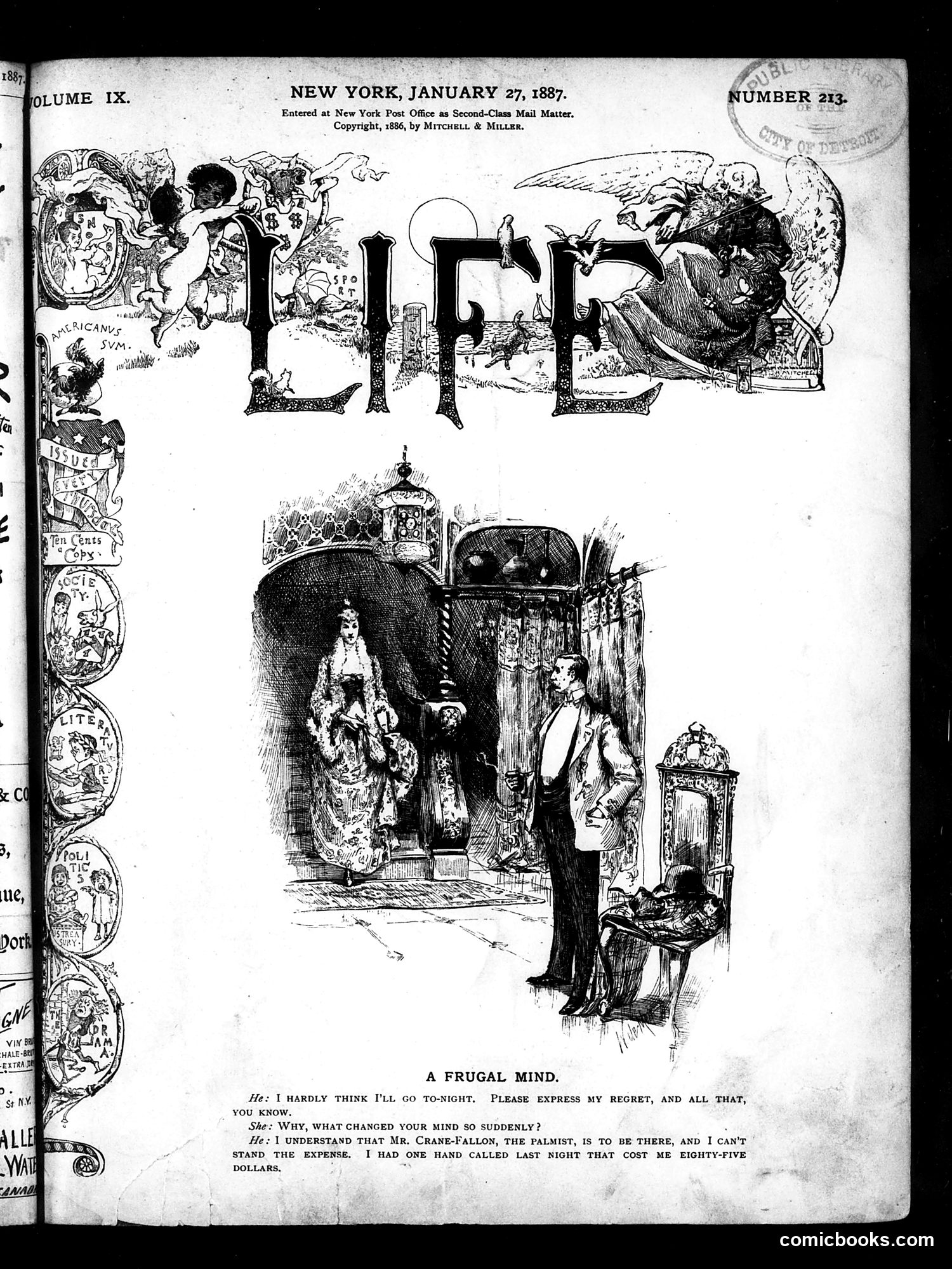
This cartoon satirizes penny-pinching hypocrisy. A well-dressed man tells his companion he won't attend an evening event because he regrets expenses and "can't stand the expense." He then mentions he had "one hand called last night that cost me eighty-five dollars"—revealing he gambled away far more money than the evening outing would cost. The joke mocks the contradiction between claimed financial restraint and actual wasteful spending. The elegant setting (appears to be an opera house or theater entrance) and the man's fine clothing emphasize the absurdity: someone wealthy enough to gamble $85 complains about modest social expenses. It's social commentary on self-deception and selective frugality among the affluent.
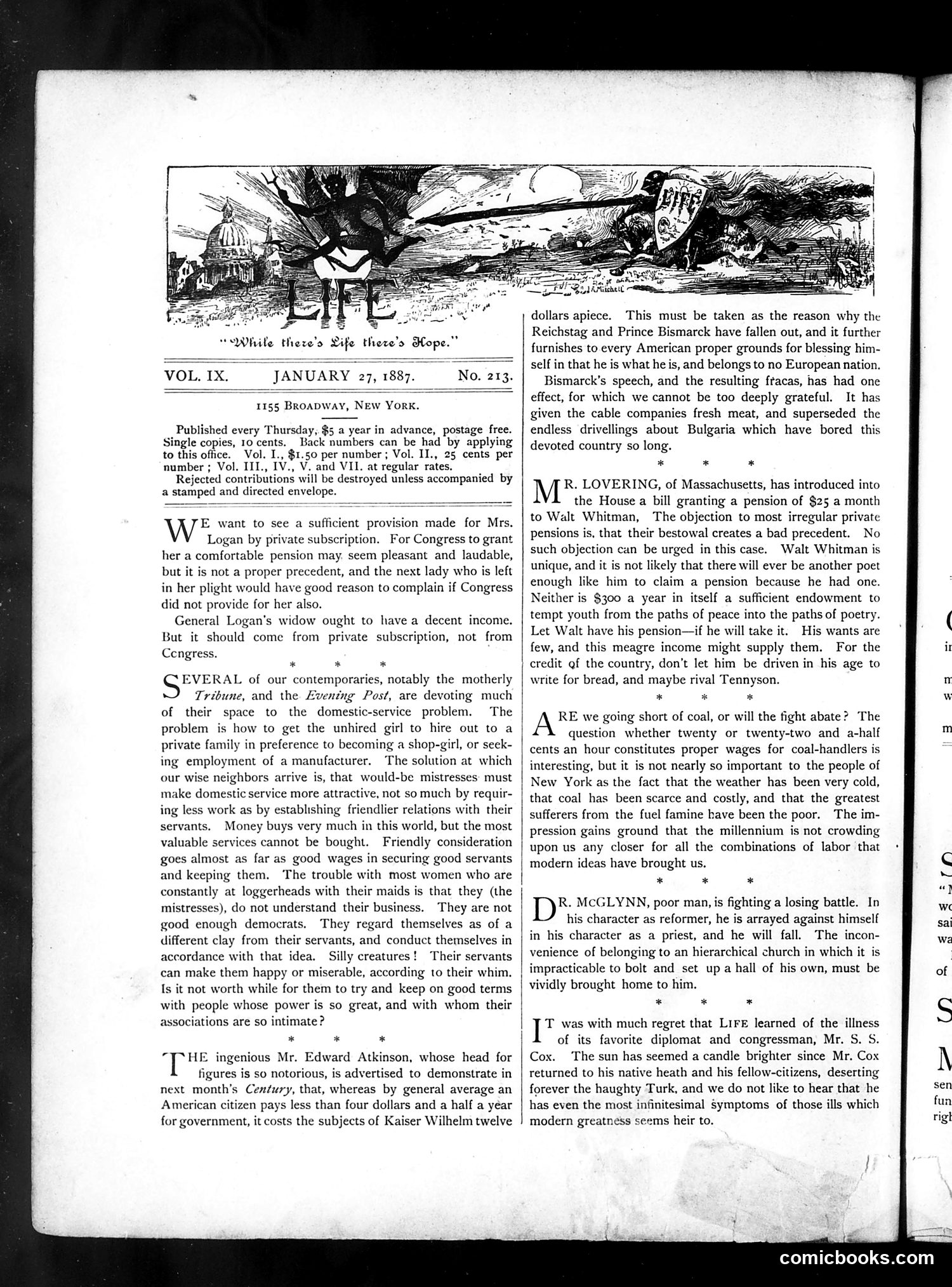
The cartoon's caption reads "While there's Life there's Hope." The sketch depicts a figure in formal dress appearing to fall or stumble, with exaggerated motion lines suggesting chaos or instability. A structure resembling a dome (possibly the Capitol) appears in the background. The page's text focuses on domestic policy debates: pensions for Mrs. Logan (widow of General Logan), household employment issues, coal pricing, and criticism of reformer Dr. McGlynn's conflict with the Catholic Church hierarchy. There's also commentary on Mr. Edward Atkinson's comparative analysis of American versus German citizen taxation. The cartoon likely satirizes political instability or the precarious state of current governance, though the specific reference remains unclear without additional context about 1887 events.
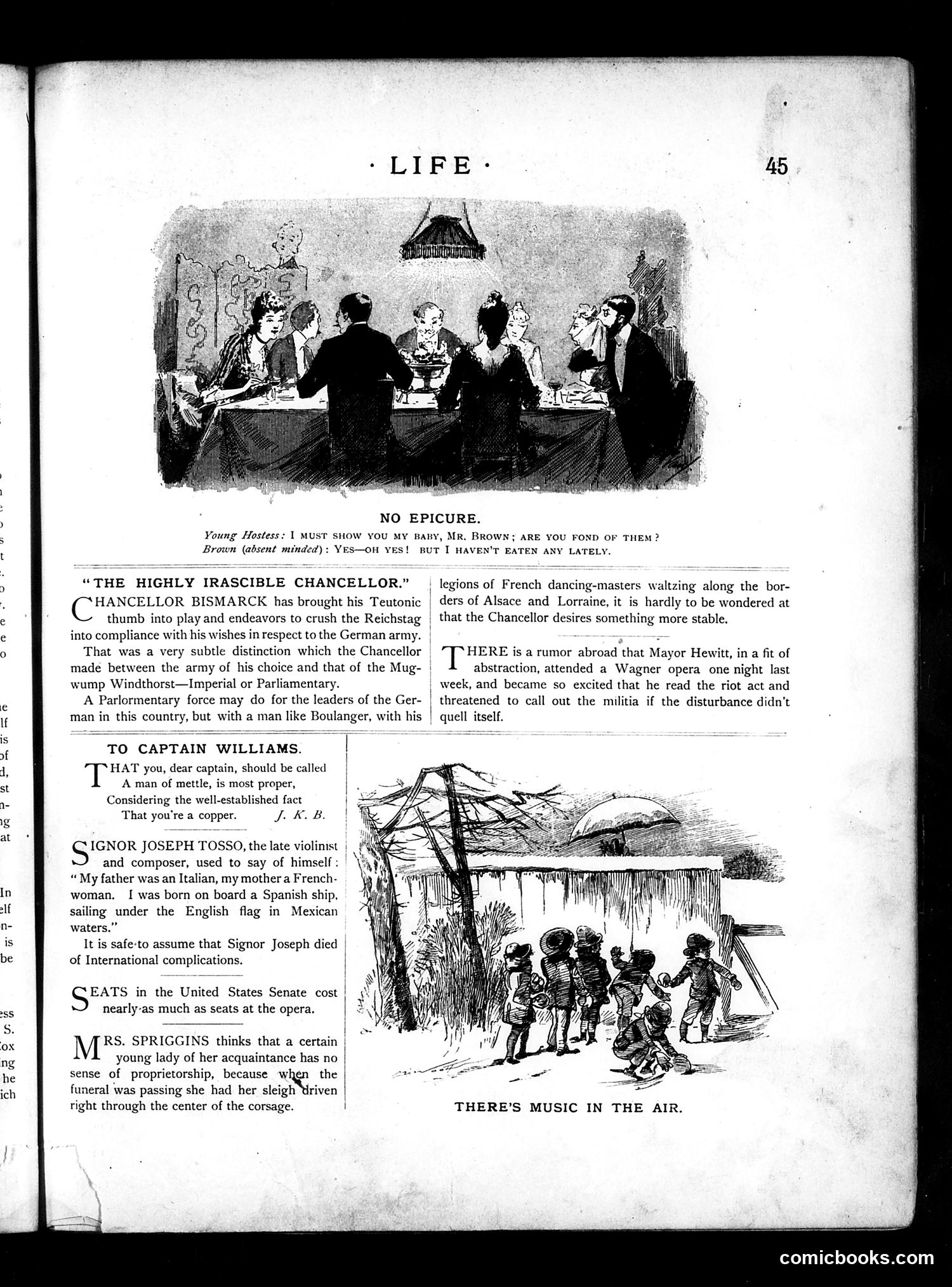
**Top Cartoon ("No Epicure"):** A social satire showing young hostesses at a dinner party. One asks Mr. Brown if he's fond of babies, and he responds he hasn't "even tasted any lately." The joke plays on the ambiguity of "fond of"—suggesting he might eat babies—implying that Mr. Brown is a crude, uncultured dinner guest who misinterprets polite conversation. **Political Section:** References Chancellor Bismarck's aggressive Prussian military policies and his attempts to suppress the German Reichstag. The text criticizes his iron-fisted approach, calling it "a subtle distinction" between legitimate political maneuvering and outright authoritarianism. **Brief Humorous Items:** Include jokes about military spending, an Italian musician's background, Senate dining costs, and a woman's questionable judgment driving a hearse through a funeral procession.
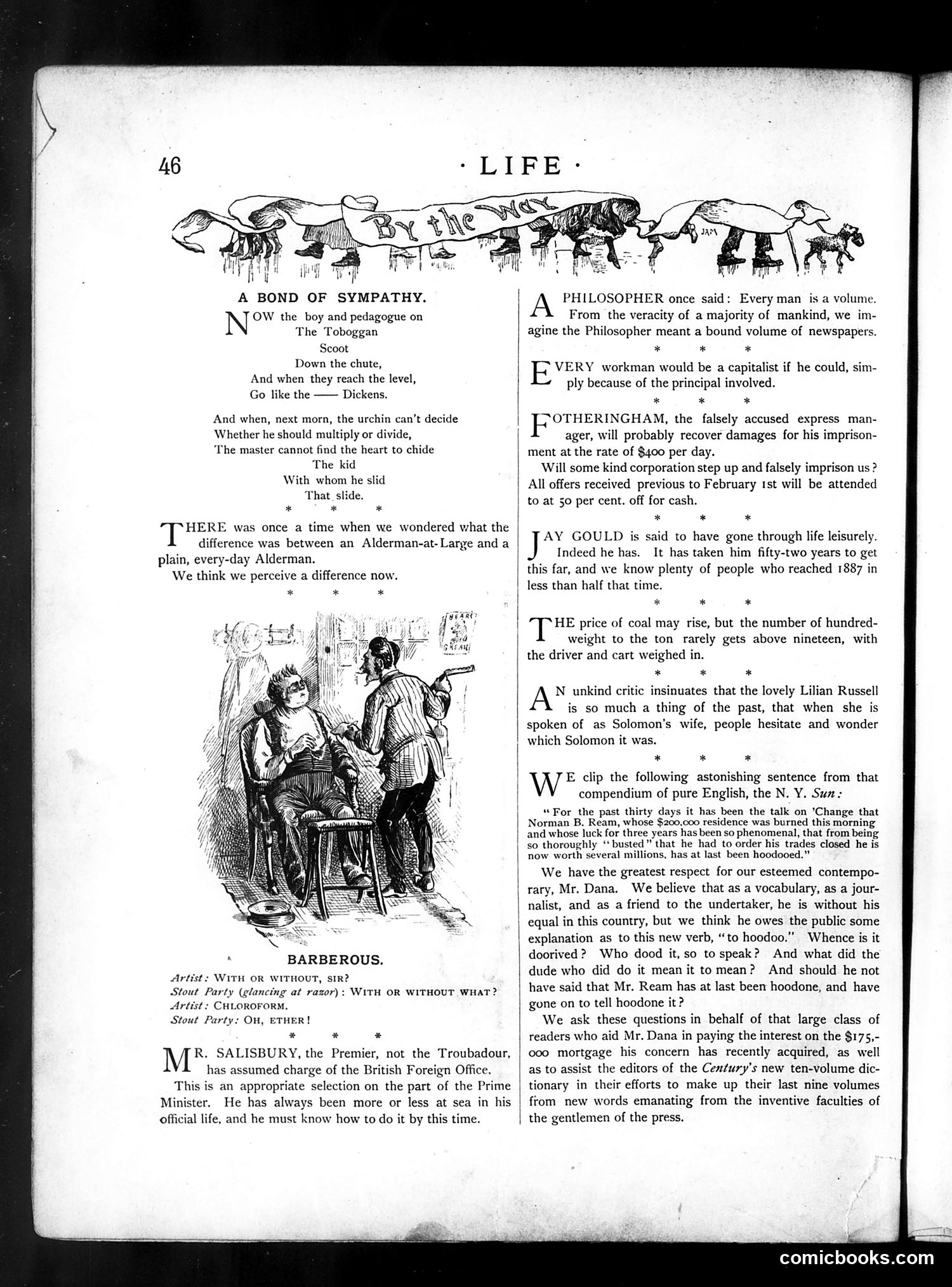
This sketch depicts a barber scene with two figures - a barber attending to a seated customer. The cartoon's title "BARBEROUS" is a pun on "barbarous" (meaning crude or savage). The accompanying dialogue, presented as artist commentary, questions the barber's etiquette: - "Artist: WITH OR WITHOUT, SIR?" - "Stout Party: OF COURSE AT RARE! WITH OR WITHOUT WHAT?" - "Artist: CHLOROFORM" - "Stout Party: OH, FINISH!" The joke satirizes either incompetent or overly aggressive barbers - suggesting the customer might need anesthesia to endure the experience. This reflects period anxiety about barber competence and the discomfort of shaving practices. The text below discusses unrelated political/social topics, including Mr. Salisbury's appointment and journalistic standards.
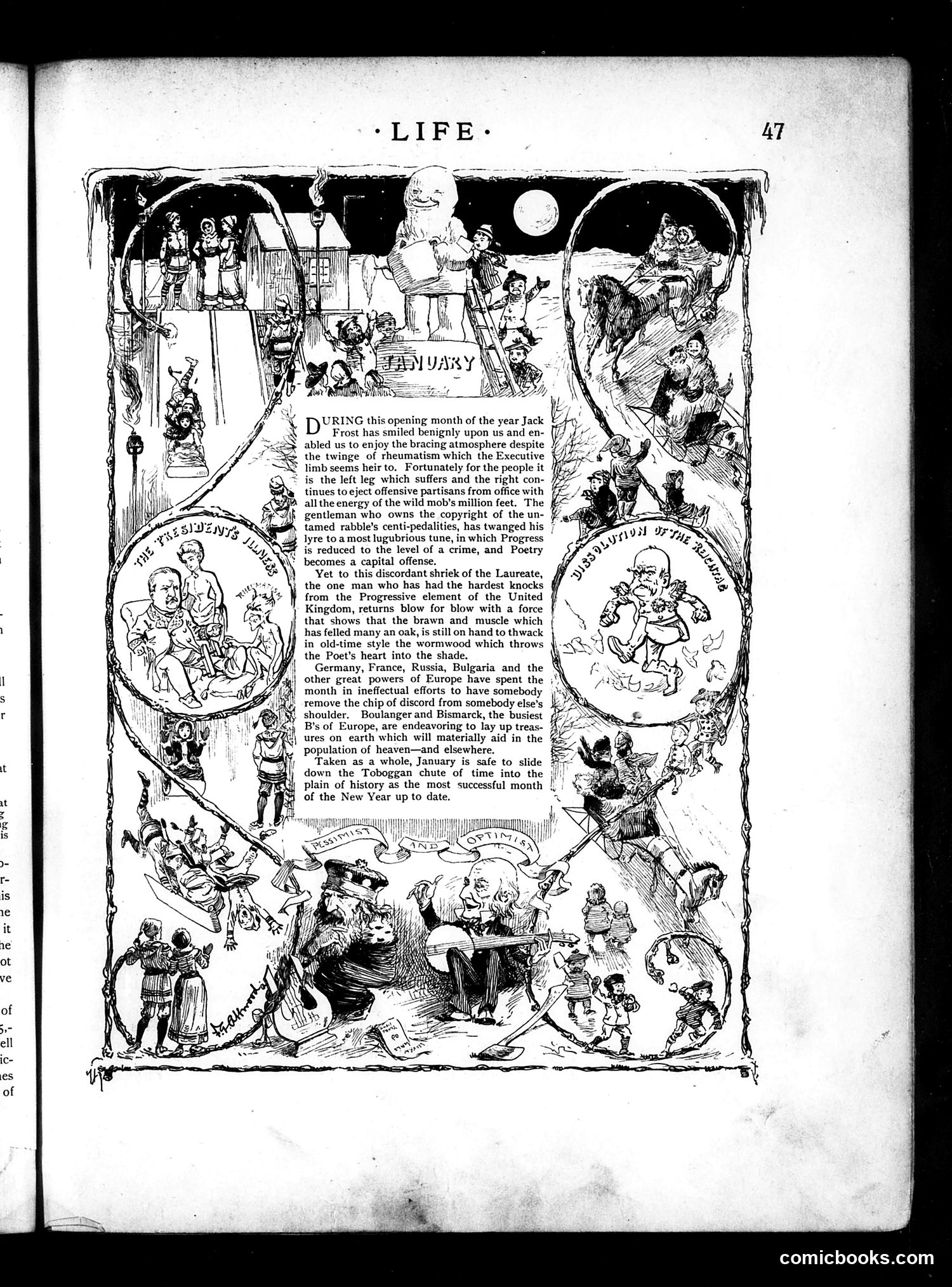
This satirical page mocks January political events, likely from the early 1900s. The central text discusses Jack Frost's arrival and rheumatism affecting an unnamed executive—probably referring to the President's political "left leg" (suffering Progressive opposition) versus his "right" (ejecting partisan critics). The elaborate border illustrations satirize international political figures and conflicts. References to "Boulanger and Bismarck" and disputes between "Russia, Bulgaria and other great powers" suggest European diplomatic tensions. The text mockingly suggests these leaders waste intellectual effort on trivial disagreements while claiming to advance civilization. The ornate, decorative treatment typical of Life's style frames what appears to be commentary on both American executive dysfunction and global great-power posturing as absurd theater.
This page contains literary commentary rather than political cartoons. The main content discusses books of "dignity and value," critiquing the publishing industry's tendency toward cheap, sensational "summer reading." The article references **Edgar Saltus's essay "The Anatomy of Negation,"** praising his epigrammatic style while noting he attacks philosophical systems rather than individual thinkers. The text compares Saltus's dismissive approach to Montaigne's charm. There's also an open letter to **Lord Tennyson** from Carlyle Smith regarding his poem in the *Windswords Courier*, discussing literary merit and the sender's own poetic ambitions. The "Unanimity" poem at the top appears unrelated commentary on domestic matters rather than satire. Overall, this is a books and letters page with no significant political cartoons.
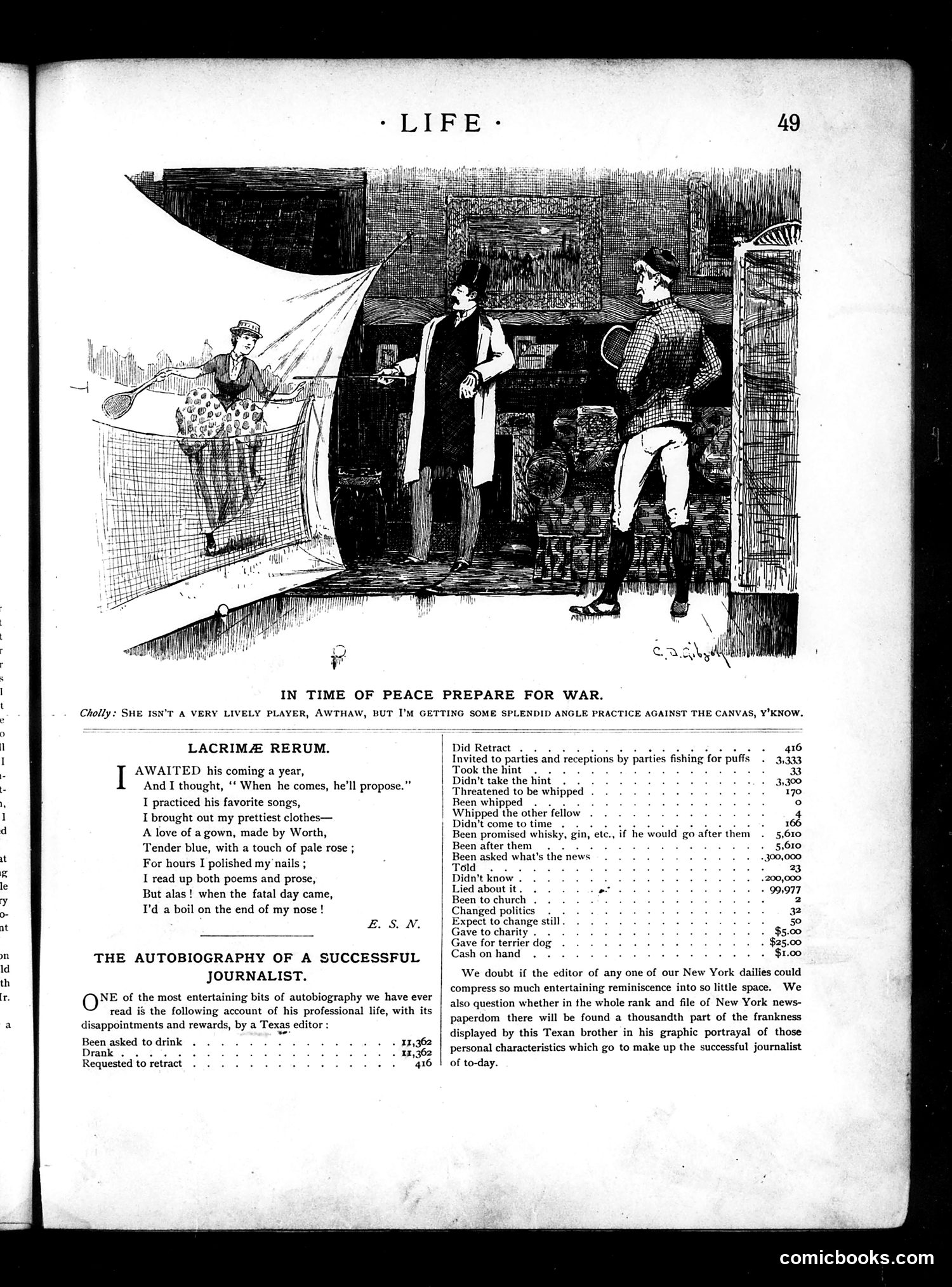
The main cartoon satirizes military preparedness. A man practices fishing with a net while well-dressed officials observe—the caption "IN TIME OF PEACE PREPARE FOR WAR" suggests this is an allegory for building military strength during peacetime. The figure on the left appears to be practicing "angle practice against the canvas" (per the dialogue), though the net-fishing imagery likely represents ineffective or misguided preparation methods. The cartoon mocks either inadequate military readiness or absurd preparatory tactics. Below is a humorous autobiographical piece by a Texas journalist describing his career disappointments—repeatedly asked to drink and retract statements, facing financial ruin despite professional efforts. The "lacrimae rerum" (Latin for "tears of things") frames his failed ambitions ironically against his modest earnings list.
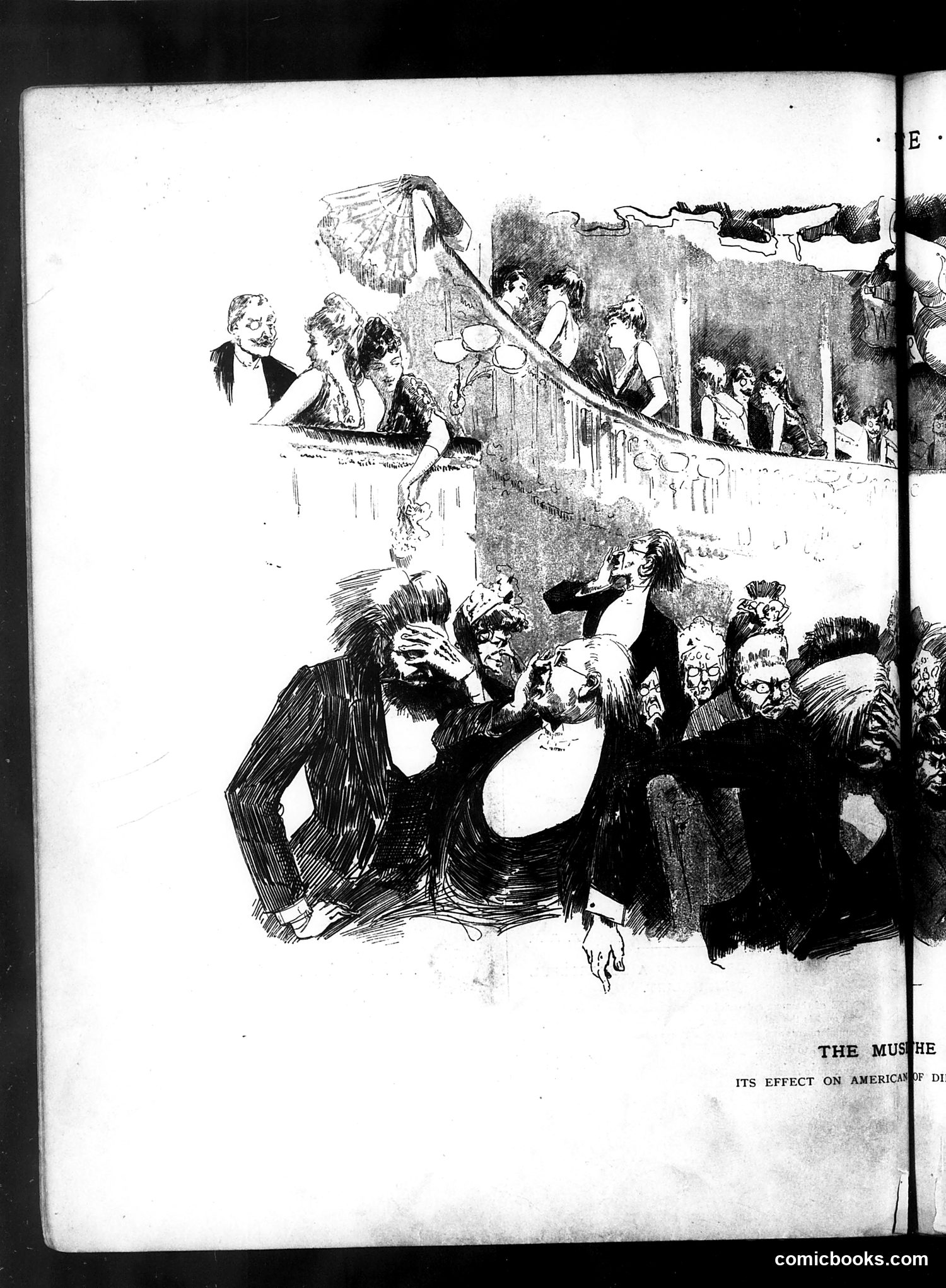
This appears to be a satirical illustration titled "The Mush" with a subtitle referencing "Its Effect on American[s] of Di[stinction]" (text cut off). The cartoon depicts a crowd of well-dressed men in formal attire at what appears to be a high-society event or theater, with an elevated stage or box visible above. The figures display exaggerated, grotesque facial expressions suggesting they are emotional or moved by something they're witnessing. The satire likely mocks American upper-class pretension and sentimentality—the "mush" probably refers to overly sentimental entertainment or art that appeals to refined society despite (or because of) its emotional excess. The caricatured faces suggest the artist is ridiculing how even distinguished gentlemen become swept up in emotional displays when attending fashionable cultural events. The specific work or event being lampooned remains unclear from the visible text.
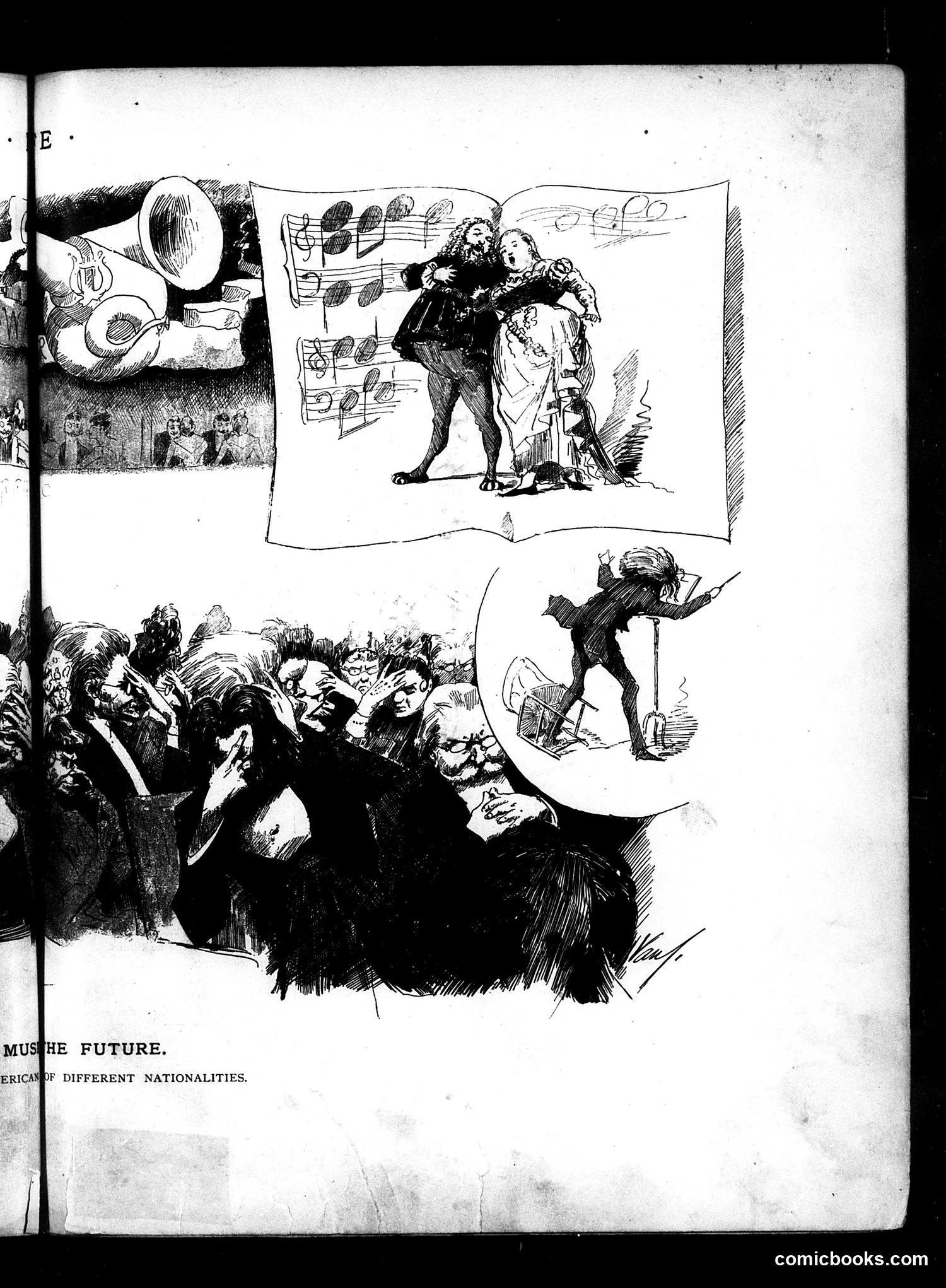
This satirical cartoon mocks what appears to be avant-garde or experimental music and its enthusiastic reception. The top panel shows a couple performing bizarre musical compositions (with scattered, unconventional notation). The bottom panel depicts a diverse crowd of well-dressed audience members reacting with apparent delight or bewilderment to this performance. The title "Music of the Future" suggests satire of modernist musical movements, likely referencing Wagner or similar experimental composers whose work seemed incomprehensible to traditionalists. The subtitle mentions "of different nationalities," implying the trend crosses cultural boundaries. The humor lies in the contrast between the seemingly chaotic, unmelodic performance and the audience's enthusiastic response—mocking both pretentious composers and uncritical admirers of challenging new art forms.
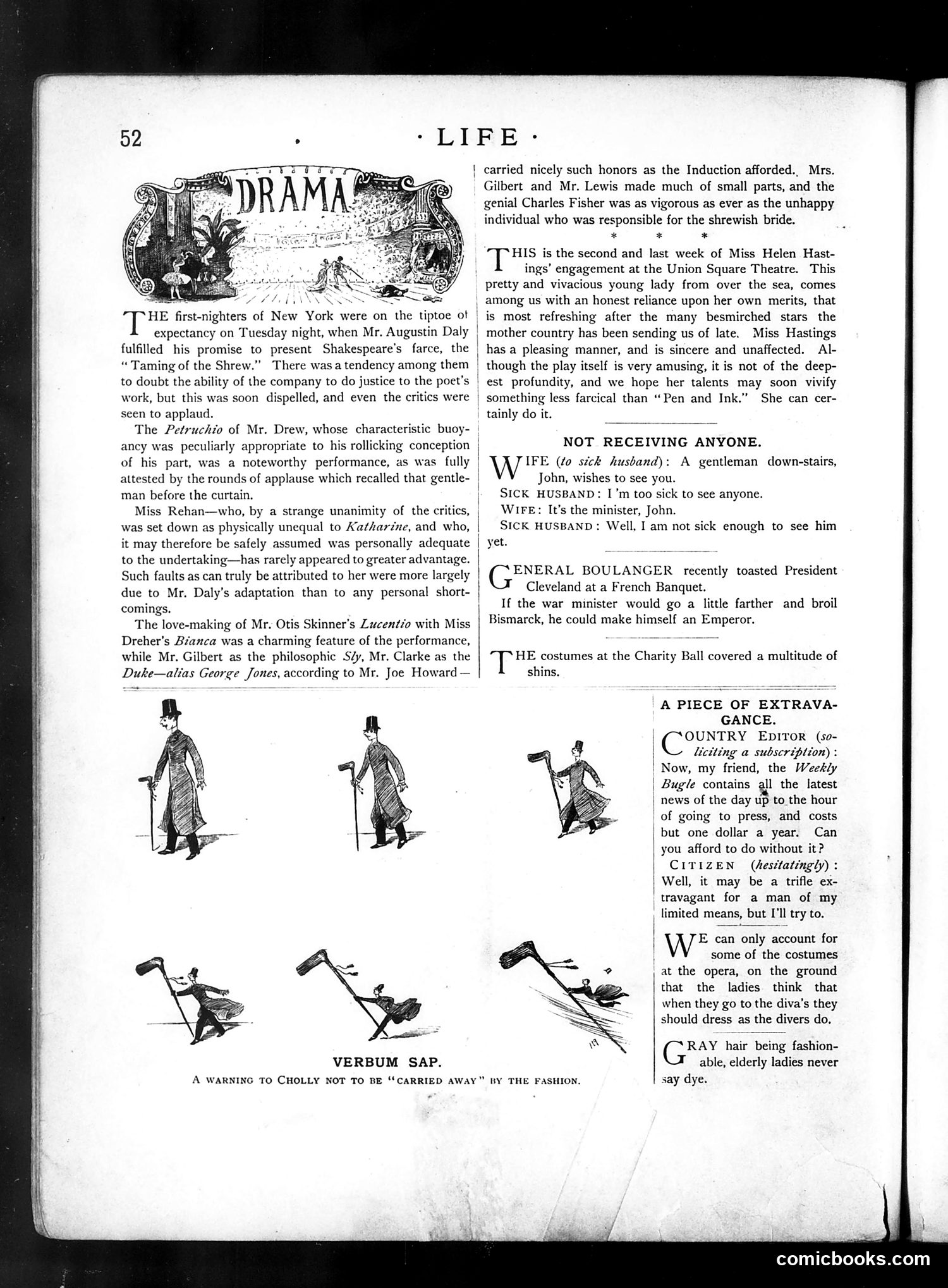
The main cartoon depicts a man in formal dress (top hat and coat) progressively losing his balance and tumbling while using a walking stick or cane—shown in six sequential panels. The caption reads "A WARNING TO CHOLLY NOT TO BE 'CARRIED AWAY' BY THE FASHION." This satirizes fashionable gentlemen (likely "Cholly" refers to a dandified male socialite type) who become so obsessed with appearing stylish that they lose their practical sense. The pun "carried away" works both literally (being swept off his feet/toppling over) and figuratively (being overly influenced by trends). The joke mocks vanity and the exaggerated attention wealthy men paid to their appearance during this era.
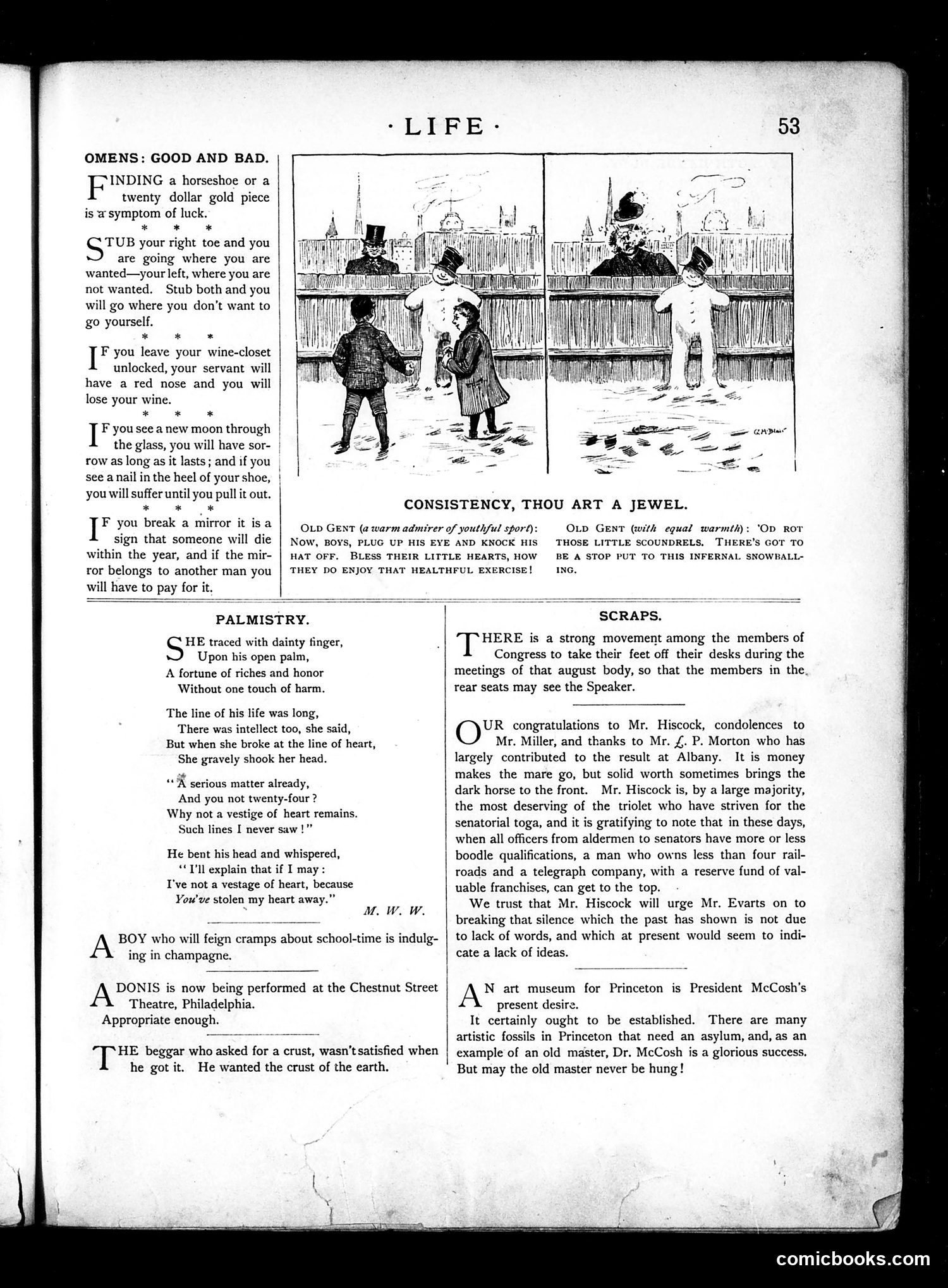
This page from the satirical magazine *Life* contains several distinct sections of humor aimed at educated, upper-class readers: **"Omens: Good and Bad"** mocks superstitious beliefs through absurdist logic—finding money means luck, but stubbing both toes cancels out direction entirely. **"Consistency, Thou Art a Jewel"** presents a visual cartoon showing an old gentleman praising boys for violent snowball fighting as "healthful exercise," then immediately condemning the same boys as "scoundrels" needing to be stopped. The satire targets hypocritical attitudes toward youth behavior. **"Scraps"** contains brief political jokes, including mockery of Congressional members putting their feet on desks, and congratulations to "Mr. Hiscock" (likely a New York politician) for winning a senatorial position, with sarcastic commentary on political corruption and money's role in elections. **"Palmistry"** is a sentimental poem about a woman reading a man's palm and discovering his heartline is broken—he reveals he's lost his heart to her. The page reflects *Life*'s focus on satirizing social conventions, political hypocrisy, and upper-class pretension.
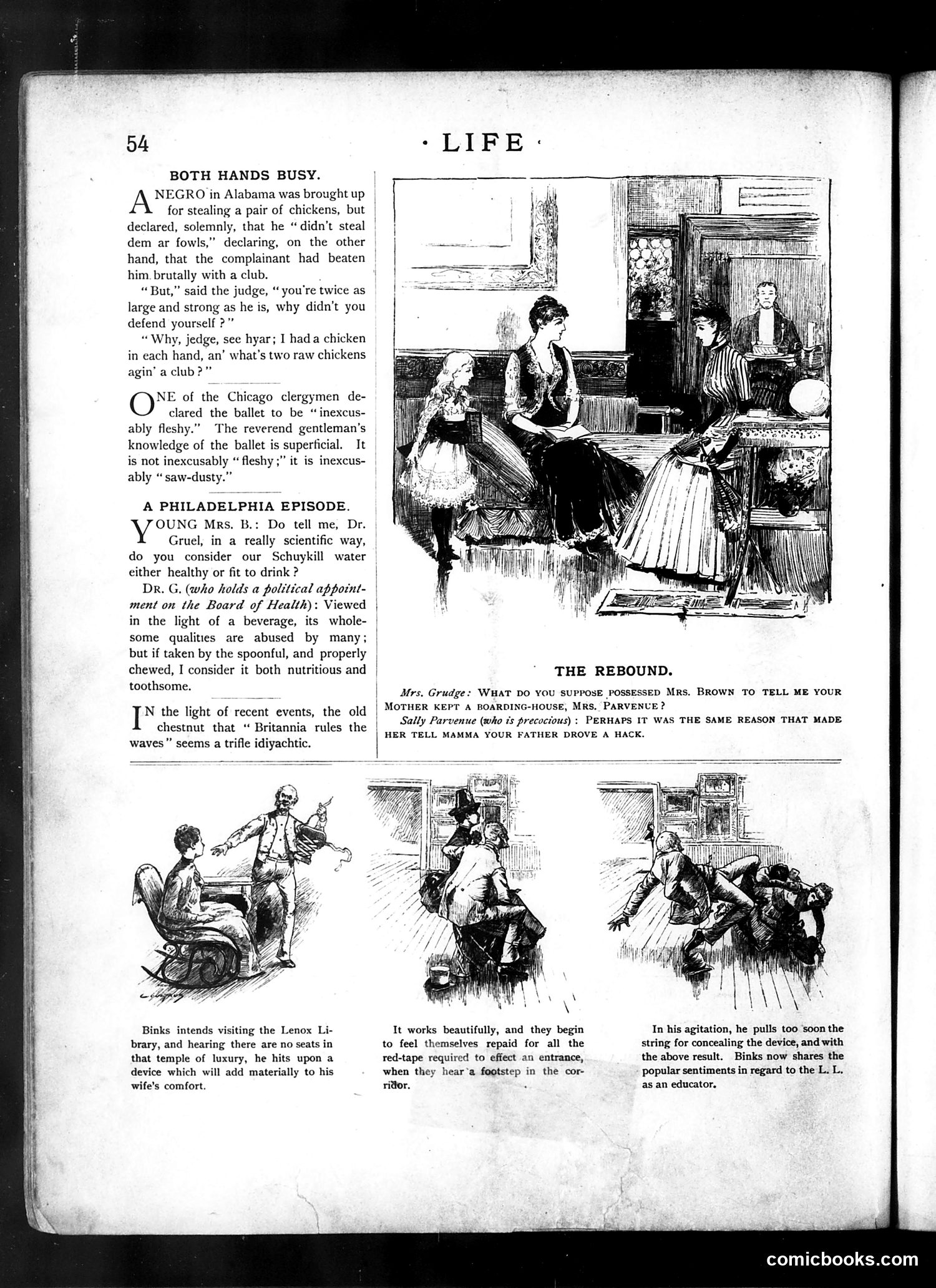
This page contains several unrelated satirical jokes typical of *Life* magazine's format: **"Both Hands Busy"**: A racial stereotype joke about a Black man in Alabama accused of theft. The humor relies on dialect and the absurd excuse that he couldn't defend himself because he held chickens in both hands. **Ballet Critique**: A brief jab at a Chicago clergyman who called ballet dancers "inexcusably fleshy"—the magazine's rejoinder suggests they're "saw-dusty" (artificial/mechanical). **Philadelphia Episode**: Satirizes a public health official who defends obviously contaminated Schuykill River water with absurd scientific rationalization, implying corruption or incompetence among politically-appointed bureaucrats. **"The Rebound"**: A class-conscious exchange where two women trade insults about their families' humble origins (boarding-house keeper, hack driver). **"Binks" cartoons** (bottom): Show a man devising a concealed seat device for the exclusive Lenox Library, which backfires when discovered—mocking both social pretension and library snobbery. The page exemplifies *Life*'s satirical approach: targeting hypocrisy, social climbing, and institutional pomposity through brief, pointed anecdotes.
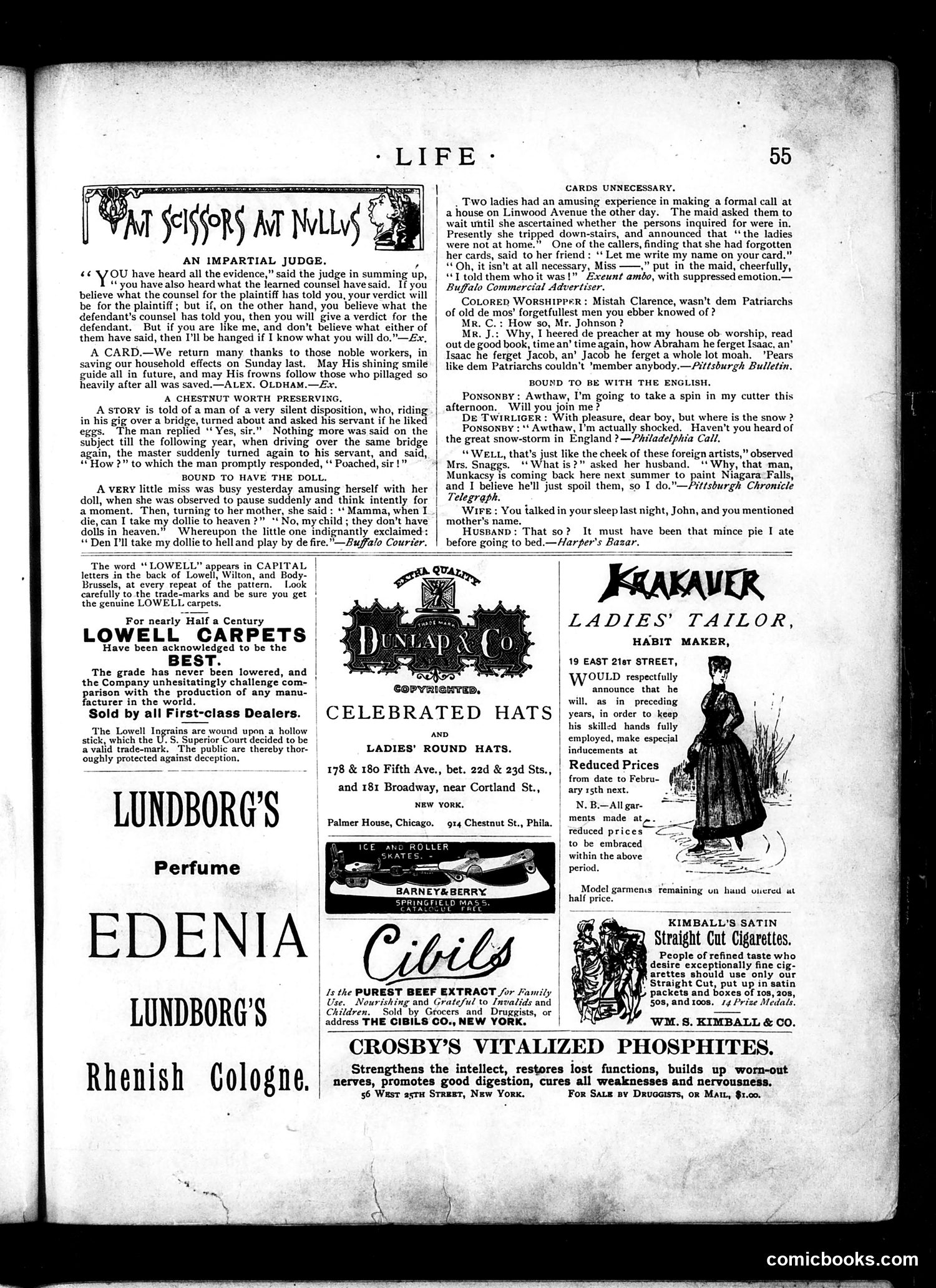
This page from **Life** magazine (a 19th-century American satirical publication) contains several brief humorous anecdotes and advertisements. The cartoons/jokes include: - **"An Impartial Judge"**: A judge admits he believes neither the plaintiff's nor defendant's counsel, so he has no basis for a verdict—satirizing judicial incompetence or judicial despair at contradictory testimony. - **"A Card"**: A thank-you note for help during a fire, likely satirizing formal social conventions by appearing in the magazine itself rather than sent privately. - **"Colored Worshipper"**: A dialect joke where a Black worshipper misunderstands biblical patriarchs' "forgetfulness"—reflecting the magazine's casual racism of the era. - **"Bound to be with the English"**: A joke about English snobbery regarding a European artist painting Niagara Falls, mocking both foreign pretension and American landscape pride. The remainder is **period advertising** for perfume, hats, beef extract, and cigarettes.
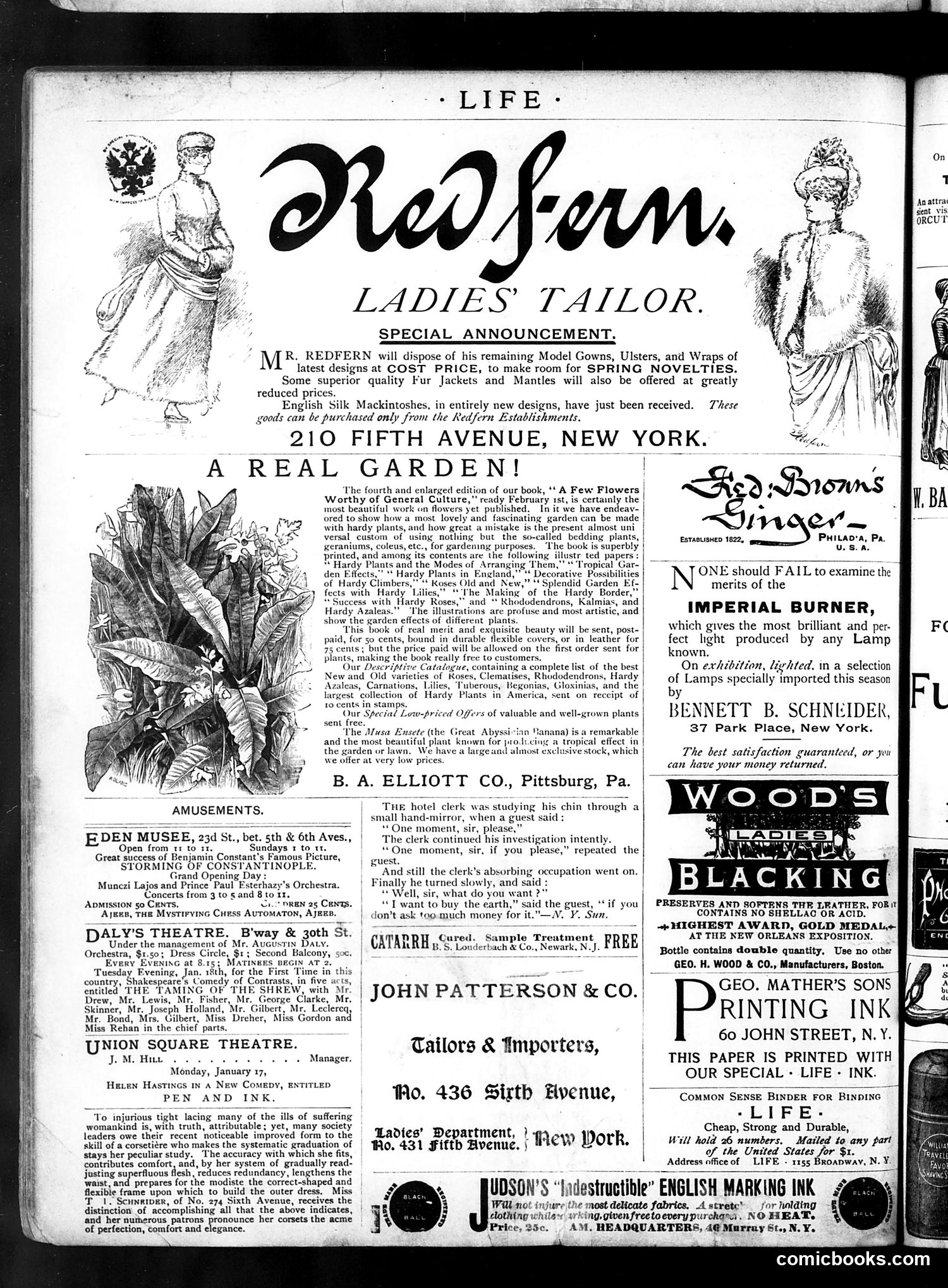
This is primarily an **advertising page**, not a satirical cartoon page. The page features: 1. **Red Fern Ladies' Tailor** advertisement announcing a clearance sale at 210 Fifth Avenue, New York—disposing of model gowns and wraps at cost price to make room for spring inventory. 2. **"A Real Garden" book advertisement** from B. A. Elliott Co. (Pittsburgh), promoting a fourth edition garden book with illustrations about hardy plants and flower arrangement. 3. **Brief humorous anecdote** about a hotel clerk examining his reflection in a hand-mirror while a guest requests his attention—suggesting vanity or distraction, though it's too brief to constitute satire. The remaining space contains advertisements for theater performances, lamps, and other services typical of a late 19th-century magazine page. There are no significant political cartoons or social satire visible on this page. It functions primarily as a commercial and entertainment listing.
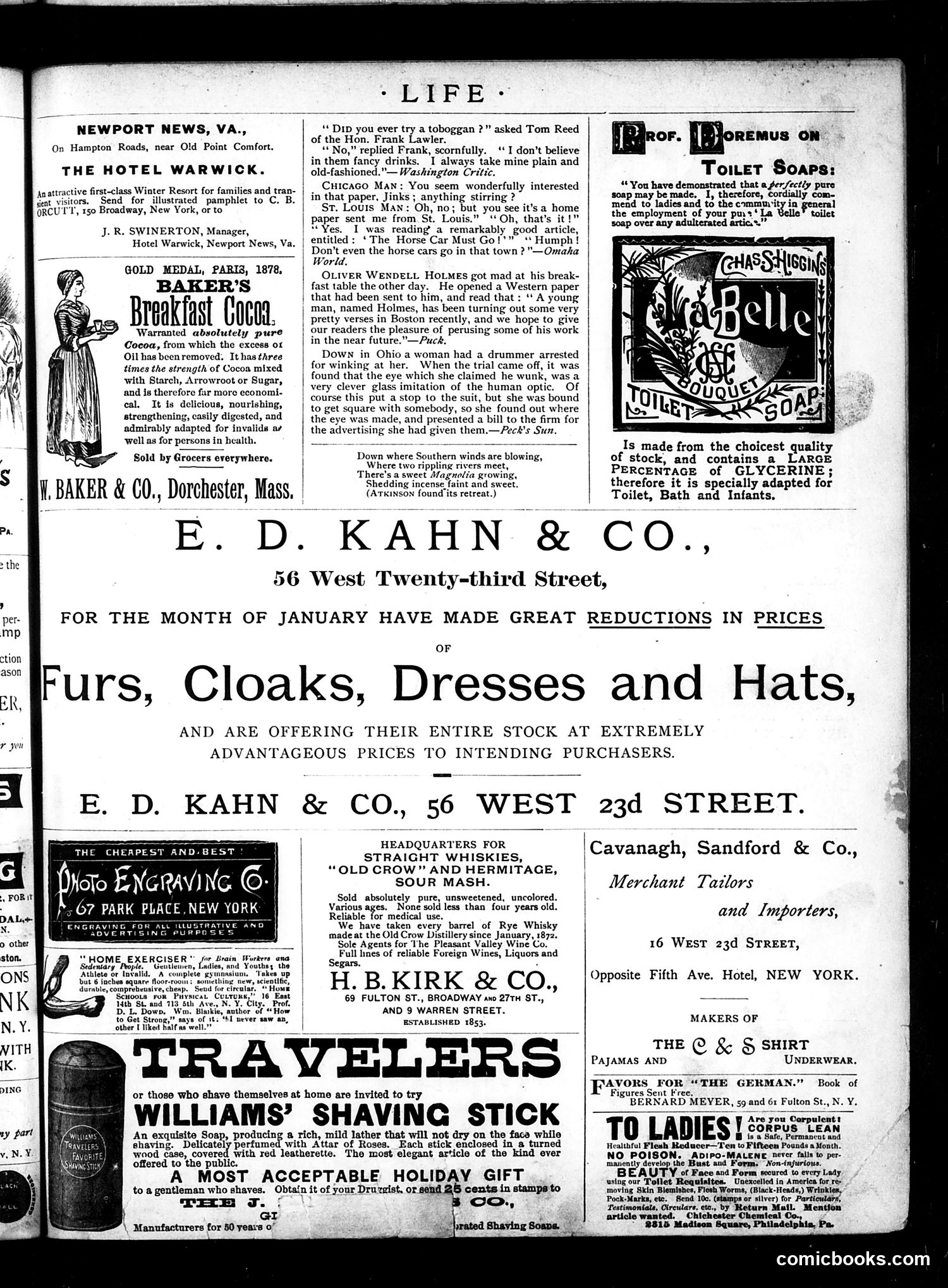
This page is primarily **advertising**, not political satire. It contains several brief humorous anecdotes and numerous commercial ads. The humor pieces include: - A joke about Tom Reed and Frank Lawler discussing "toboggans" (slang for drinks) - Oliver Wendell Holmes's annoyance at a Boston newspaper crediting his poetry - A story about an Ohio woman suing a traveling salesman for winking, discovering his eye was glass - A poem about a magnolia flower These are light social humor rather than political commentary—typical of *Life* magazine's miscellaneous joke format of the era. The ads feature Baker's Cocoa, soap products, clothing retailers, whiskey, and patent medicines. The page reflects late-19th-century commercial America with no identifiable political figures or satirical intent beyond gentle, everyday humor about manners and small-town life.
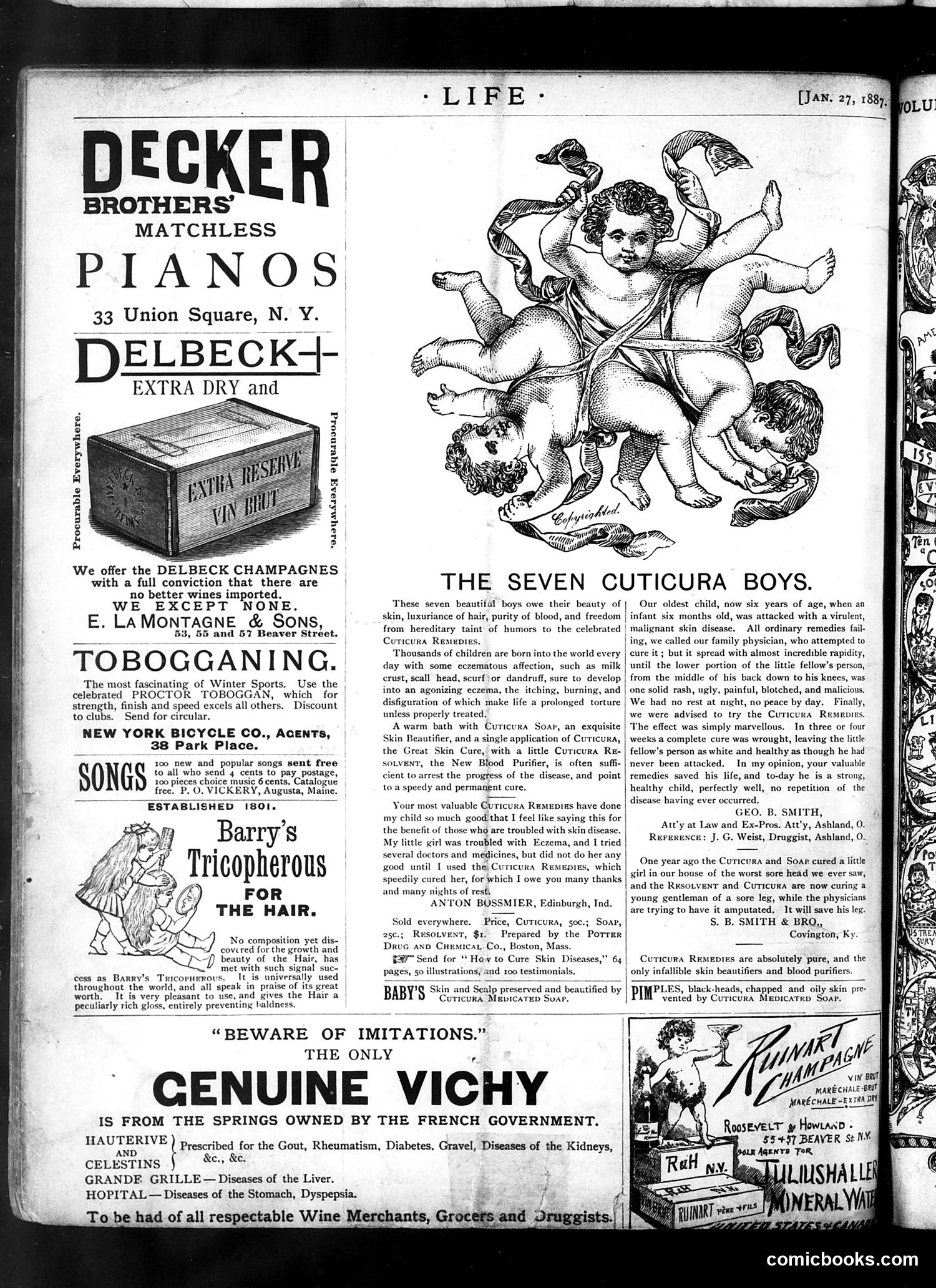
This page is primarily **advertising**, not political satire. The central image shows seven cherubic boys in a classical engraving style, accompanying testimonials for Cuticura Remedies—a patent medicine claiming to cure childhood skin diseases like eczema and "milk crust." The "satire" here is inadvertent: the page presents exaggerated before-and-after claims (miraculous cures in weeks) typical of 19th-century patent medicine marketing. The flowery testimonials from named individuals (Anton Bossmier, G. H. Smith, S. B. Smith & Bro.) lend false credibility. The surrounding ads—for pianos, champagne, hair products, and mineral water—represent typical *Life* magazine content of this era, which mixed genuine satire with lucrative advertising. Modern readers would recognize these health claims as utterly unsubstantiated by scientific evidence, yet presented with complete confidence.