
Life, 1887-01-27 · page 6 of 16
Life — January 27, 1887 — page 6: what you’re looking at
What you’re looking at
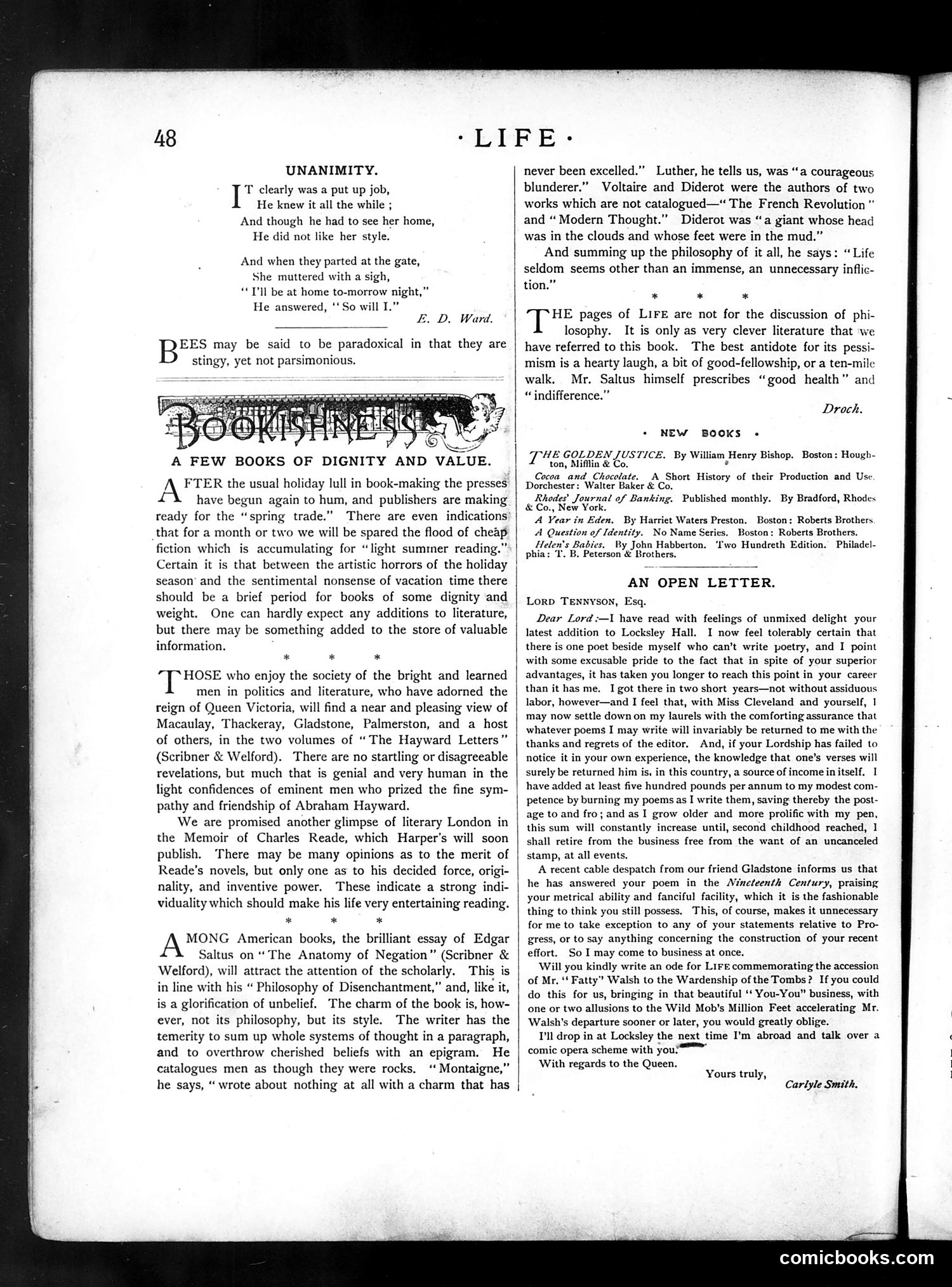
This page contains literary commentary rather than political cartoons. The main content discusses books of "dignity and value," critiquing the publishing industry's tendency toward cheap, sensational "summer reading." The article references **Edgar Saltus's essay "The Anatomy of Negation,"** praising his epigrammatic style while noting he attacks philosophical systems rather than individual thinkers. The text compares Saltus's dismissive approach to Montaigne's charm. There's also an open letter to **Lord Tennyson** from Carlyle Smith regarding his poem in the *Windswords Courier*, discussing literary merit and the sender's own poetic ambitions. The "Unanimity" poem at the top appears unrelated commentary on domestic matters rather than satire. Overall, this is a books and letters page with no significant political cartoons.
📄 Transcribed text from this page (OCR, searchable)
Machine-transcribed from the original scan — historical spelling and the odd misread are preserved.
-EIFE - UNANIMITY. T clearly was a put up job, He knew it all the while ; And though he had to see her home, He did not like her style. And when they parted at the gate, She muttered with a sigh, ““T'll be at home to-morrow night,” He answered, ‘‘ So will I.” E. D. Ward. EES may be said to be paradoxical in that they are | stingy, yet not parsimonious. “TER the usual holiday lull in book-making the presses have begun again to hum, and publishers are making ready for the “spring trade.” There are even indications that for a month or two we will be spared the flood of cheap fiction which is accumulating for “light summer reading.” Certain it is that between the artistic horrors of the holiday season’ and the sentimental nonsense of vacation time there should be a brief period for books of some dignity and weight. One can hardly expect any additions to literature, but there may be something added to the store of valuable information. * * * HOSE who enjoy the society of the bright and learned men in politics and literature, who have adorned the reign of Queen Victoria, will find a near and pleasing view of Macaulay, Thackeray, Gladstone, Palmerston, and a host of others, in the two volumes of “The Hayward Letters” (Scribner & Welford). There are no startling or disagreeable revelations, but much that is genial and very human in the light confidences of eminent men who prized the fine sym- | pathy and friendship of Abraham Hayward. We are promised another glimpse of literary London in the Memoir of Charles Reade, which Harper's will soon publish. There may be many opinions as to the merit of Reade’s novels, but only one as to his decided force, origi- nality, and inventive power. These indicate a strong indi- viduality which should make his life very entertaining reading. * * * MONG American books, the brilliant essay of Edgar Saltus on ‘The Anatomy of Negation” (Scribner & Welford), will attract the attention of the scholarly. This is | in line with his “ Philosophy of Disenchantment,” and, like it, is a glorification of unbelief. The charm of the book is, how- ever, not its philosophy, but its style. The writer has the temerity to sum up whole systems of thought in a paragraph, and to overthrow cherished beliefs with an epigram. He catalogues men as though they were rocks. ‘ Montaigne,” he says, “ wrote about nothing at all with a charm that has never been excelled.” Luther, he tells us, was “‘a courageous blunderer.” Voltaire and Diderot were the authors of two works which are not catalogued—‘“ The French Revolution” and “Modern Thought.” Diderot was “a giant whose head was in the clouds and whose feet were in the mud.” And summing up the philosophy of it all, he says: “Life seldom seems other than an immense, an unnecessary inflic- tion.” * * * Te pages of LiFe are not for the discussion of phi- losophy. It is only as very clever literature that we have referred to this book. The best antidote for its pessi- mism is a hearty laugh, a bit of good-fellowship, or a ten-mile walk. Mr. Saltus himself prescribes “good health” and “ indifference. Droch. + NEW BOOKS - THE GOLDEN JUSTICE. By William Henry Bishop. Boston : Hough- ° ton, Mifilin & Co, Cocoa and Chocolate. A Short History of their Production and Use Dorchester: Walter Baker & Co. Rhodes’ Journal of Banking. Published monthly. By Bradford, Rhodes ¢ Co., New York. A Year in Eden. By Harriet Waters Preston. Boston: Roberts Brothers A Question of Identity. No Name Series, Boston: Roberts Brothers. Helen's Babies, By John Habberton. ‘Iwo Hundreth Edition. Philadel- phia: I’, B, Peterson & Brothers. AN OPEN LETTER. Lorp Tennyson, Esq. Dear Lord :—I have read with feelings of unmixed delight your latest addition to Locksley Hall. I now feel tolerably certain that there is one poet beside myself who can’t write poetry, and I point | with some excusable pride to the fact that in spite of your superior advantages, it has taken you longer to reach this point in your career than it has me. I got there in two short years—not without assiduous labor, however—and I feel that, with Miss Cleveland and yourself, | may now settle down on my laurels with the comforting assurance that whatever poems I may write will invariably be returned to me with the thanks and regrets of the editor. And, if your Lordship has failed to notice it in your own experience, the knowledge that one’s verses will surely be returned him is, in this country, a source of income in itself. 1 have added at least five hundred pounds per annum to my modest com- petence by burning my poems as I write them, saving thereby the post- age to and fro; and as I grow older and more prolific with my pen, this sum will constantly increase until, second childhood reached, 1 shall retire from the business free from the want of an uncanceled stamp, at all events, A recent cable despatch from our friend Gladstone informs us that he has answered your poem in the Néncteenth Century, praising your metrical ability and fanciful facility, which it is the fashionable thing to think you still possess, This, of course, makes it unnecessary for me to take exception to any of your statements relative to Pro- gress, or to say anything concerning the construction of your recent effort. So I may come to business at once. Will you kindly write an ode for Lire commemorating the accession of Mr. ‘ Fatty” Walsh to the Wardenship of the Tombs? If you could | do this for us, bringing in that beautiful ‘‘ You-You” business, with one or two allusions to the Wild Mob’s Million Feet accelerating Mr. Walsh's departure sooner or later, you would greatly oblige. I'll drop in at Locksley the next time I’m abroad and talk over a comic opera scheme with you" With regards to the Queen. Yours truly, Carlyle Smith, oe comicbooks.com