
Life, 1887-01-27 · page 2 of 16
Life — January 27, 1887 — page 2: what you’re looking at
What you’re looking at
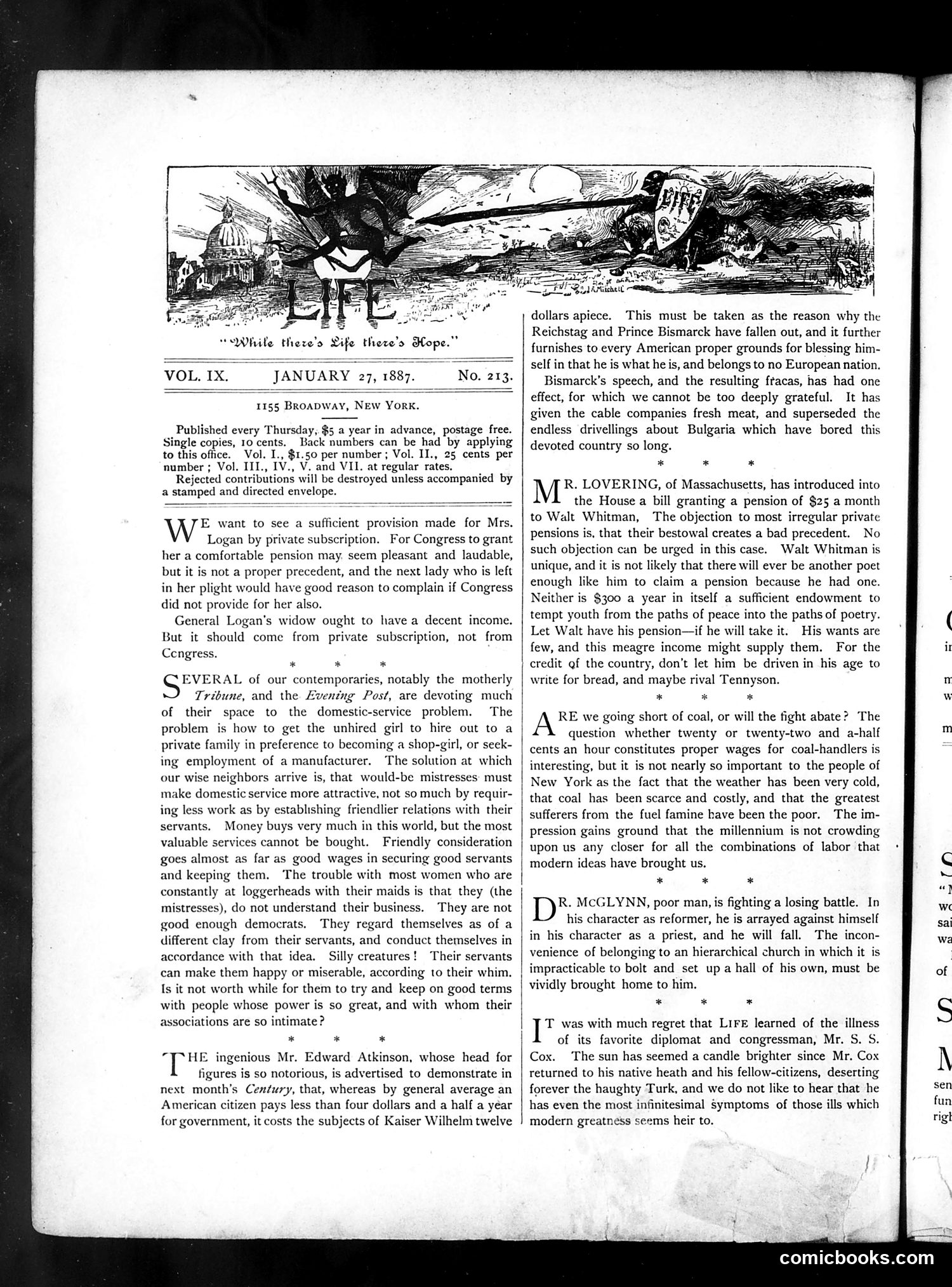
The cartoon's caption reads "While there's Life there's Hope." The sketch depicts a figure in formal dress appearing to fall or stumble, with exaggerated motion lines suggesting chaos or instability. A structure resembling a dome (possibly the Capitol) appears in the background. The page's text focuses on domestic policy debates: pensions for Mrs. Logan (widow of General Logan), household employment issues, coal pricing, and criticism of reformer Dr. McGlynn's conflict with the Catholic Church hierarchy. There's also commentary on Mr. Edward Atkinson's comparative analysis of American versus German citizen taxation. The cartoon likely satirizes political instability or the precarious state of current governance, though the specific reference remains unclear without additional context about 1887 events.
📄 Transcribed text from this page (OCR, searchable)
Machine-transcribed from the original scan — historical spelling and the odd misread are preserved.
“While there's Life theze’s Hope.” No. 213. VOL. IX. JANUARY 27, 1887. 1155 Broapway, New York. Published every Thursday, $5 a year in advance, postage free. Single copies, 10 cents. Back numbers can be had by applying to this office. Vol. I., $1.50 per number ; Vol. II., 25 cents per number ; Vol. III., IV., V. and VII. at regular rates. Rejected contributions will be destroyed unless accompanied by a stamped and directed envelope. E want to see a sufficient provision made for Mrs. Logan by private subscription. For Congress to grant her a comfortable pension may. seem pleasant and laudable, but it is not a proper precedent, and the next lady who is left in her plight would have good reason to complain if Congress did not provide for her also. General Logan's widow ought to have a decent income. But it should come from private subscription, not from Congress. * * * EVERAL of our contemporaries, notably the motherly Tribune, and the Evenzng Post, are devoting much | of their space to the domestic-service problem. The problem is how to get the unhired girl to hire out to a private family in preference to becoming a shop-girl, or seek- ing employment of a manufacturer. The solution at which our wise neighbors arrive is, that would-be mistresses: must make domestic service more attractive, not so much by requir- ing less work as by establishing friendlier relations with their servants. Money buys very much in this world, but the most valuable services cannot be bought. Friendly consideration goes almost as far as good wages in securing good servants and keeping them. ‘The trouble with most women who are constantly at loggerheads with their maids is that they (the mistresses), do not understand their business. good enough democrats. They regard themselves as of a different clay from their servants, and conduct themselves in accordance with that idea. Silly creatures! Their servants can make them happy or miserable, according to their whim. Is it not worth while for them to try and keep on good terms with people whose power is so great, and with whom their associations are so intimate? * * * “TC HE ingenious Mr. Edward Atkinson, whose head for figures is so notorious, is advertised to demonstrate in next month’s Century, that, whereas by general average an American citizen pays less than four dollars and a half a year for government, it costs the subjects of Kaiser Wilhelm twelve They are not | dollars apiece. This must be taken as the reason why the Reichstag and Prince Bismarck have fallen out, and it further furnishes to every American proper grounds for blessing him- self in that he is what he is, and belongs to no European nation. Bismarck’s speech, and the resulting fracas, has had one effect, for which we cannot be too deeply grateful. It has given the cable companies fresh meat, and superseded the endless drivellings about Bulgaria which have bored this devoted country so long. * * * R. LOVERING, of Massachusetts, has introduced into the House a bill granting a pension of $25 a month to Walt Whitman, The objection to most irregular private pensions is, that their bestowal creates a bad precedent. No such objection can be urged in this case. Walt Whitman is unique, and it is not likely that there will ever be another poet enough like him to claim a pension because he had one. Neither is $300 a year in itself a sufficient endowment to tempt youth from the paths of peace into the paths of poetry. Let Walt have his pension—if he will take it. His wants are few, and this meagre income might supply them. For the credit gf the country, don’t let him be driven in his age to write for bread, and maybe rival Tennyson. * * * RE we going short of coal, or will the fight abate? The question whether twenty or twenty-two and a-half cents an hour constitutes proper wages for coal-handlers is interesting, but it is not nearly so important to the people of New York as the fact that the weather has been very cold, that coal has been scarce and costly, and that the greatest sufferers from the fuel famine kave been the poor. The im- pression gains ground that the millennium is not crowding upon us any closer for all the combinations of labor that modern ideas have brought us. * * * R. McGLYNN, poor man, is fighting a losing battle. In his character as reformer, he is arrayed against himself in his character as a priest, and he will fall. The incon- venience of belonging to an hierarchical church in which it is impracticable to bolt and set up a hall of his own, must be vividly brought home to him. * * x T was with much regret that Lire learned of the illness of its favorite diplomat and congressman, Mr. S. S. Cox. The sun has seemed a candle brighter since Mr. Cox returned to his native heath and his fellow-citizens, deserting forever the haughty Turk, and we do not like to hear that he has even the most infinitesimal symptoms of those ills which modern greatness seems heir to. comicbooks.com