
A complete issue · 16 pages · 1886
Life — December 2, 1886
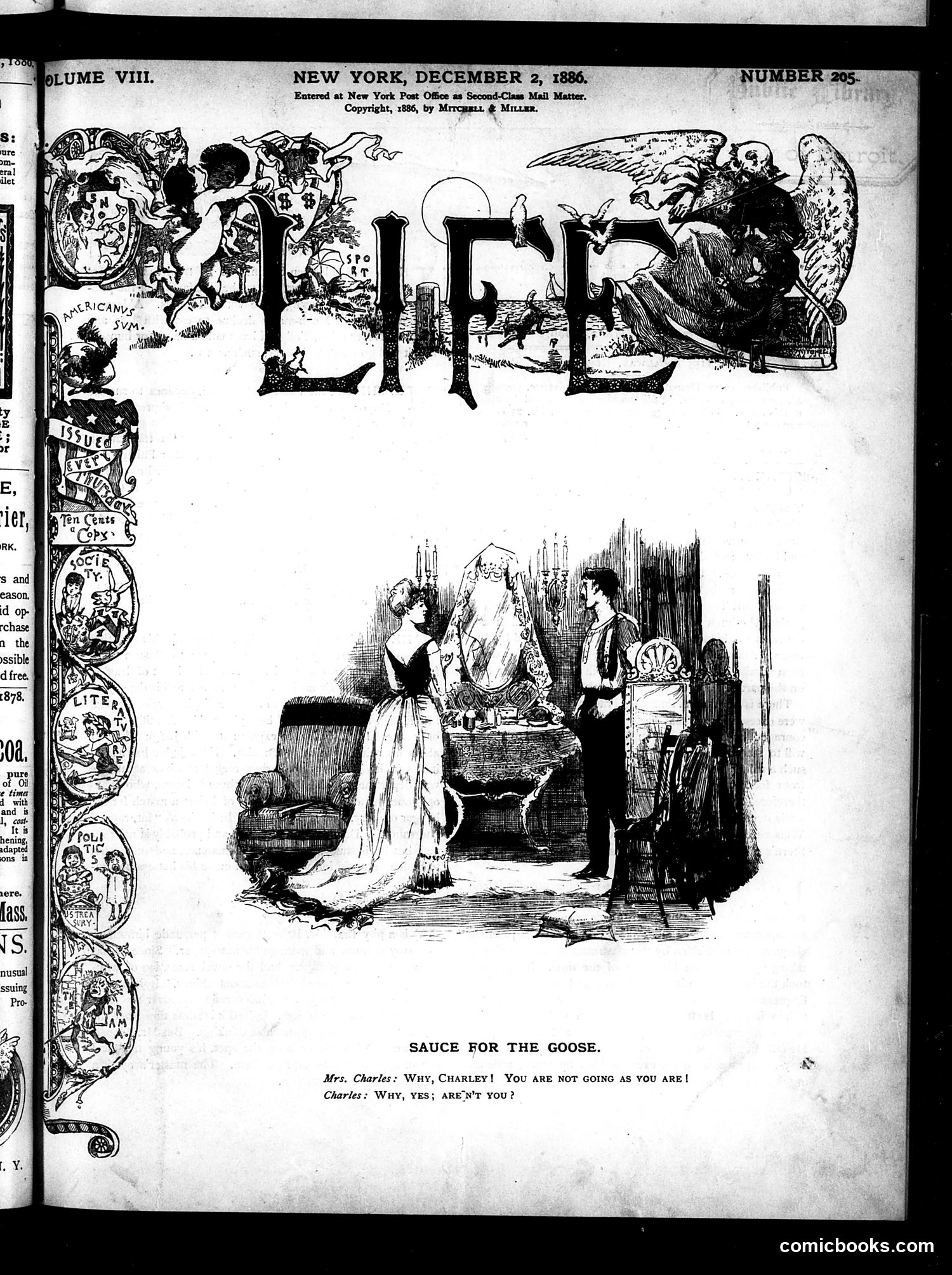
This satirical cartoon depicts a domestic scene with the caption "SAUCE FOR THE GOOSE." The dialogue reads: "Mrs. Charles: Why, Charley! You are not going as you are! / Charles: Why, yes; aren't you?" The joke plays on the phrase "sauce for the goose is sauce for the gander"—meaning equal treatment should apply to both parties. Here, Mrs. Charles objects to her husband's appearance (he's dressed casually), implying he's not appropriately dressed. His response suggests she's equally underdressed, turning her criticism back on her. The satire appears to mock Victorian gender double-standards regarding dress and propriety, where wives held husbands to strict standards while potentially ignoring their own shortcomings.
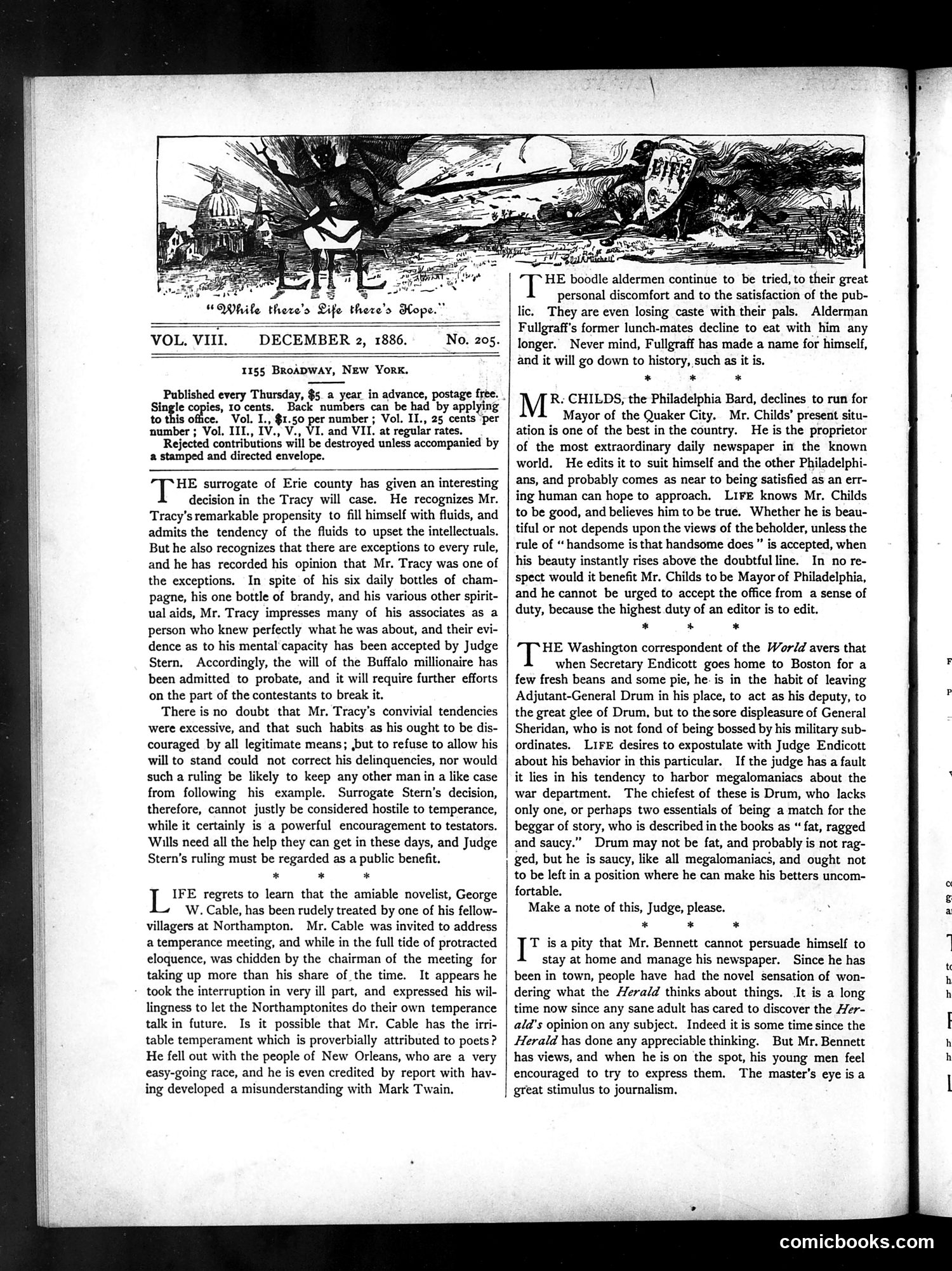
The masthead cartoon depicts a chaotic apocalyptic scene labeled "While there's Life there's Hope." It shows destruction, including a building (possibly the Capitol dome on the left) and a gravestone marked "LIFE," suggesting satirical commentary on the magazine's own survival or relevance amid turbulent times. The page contains editorial commentary rather than single-panel political cartoons. It discusses contemporary figures including Mr. Tracy (apparently someone with drinking problems affecting his judgment), Mr. Childs (Philadelphia newspaper editor), and military figures like General Sheridan and Adjutant-General Drum. The satire critiques their professional conduct and personal failings, typical of Life's gossipy, acerbic editorial style mocking public figures' behavior and competence.
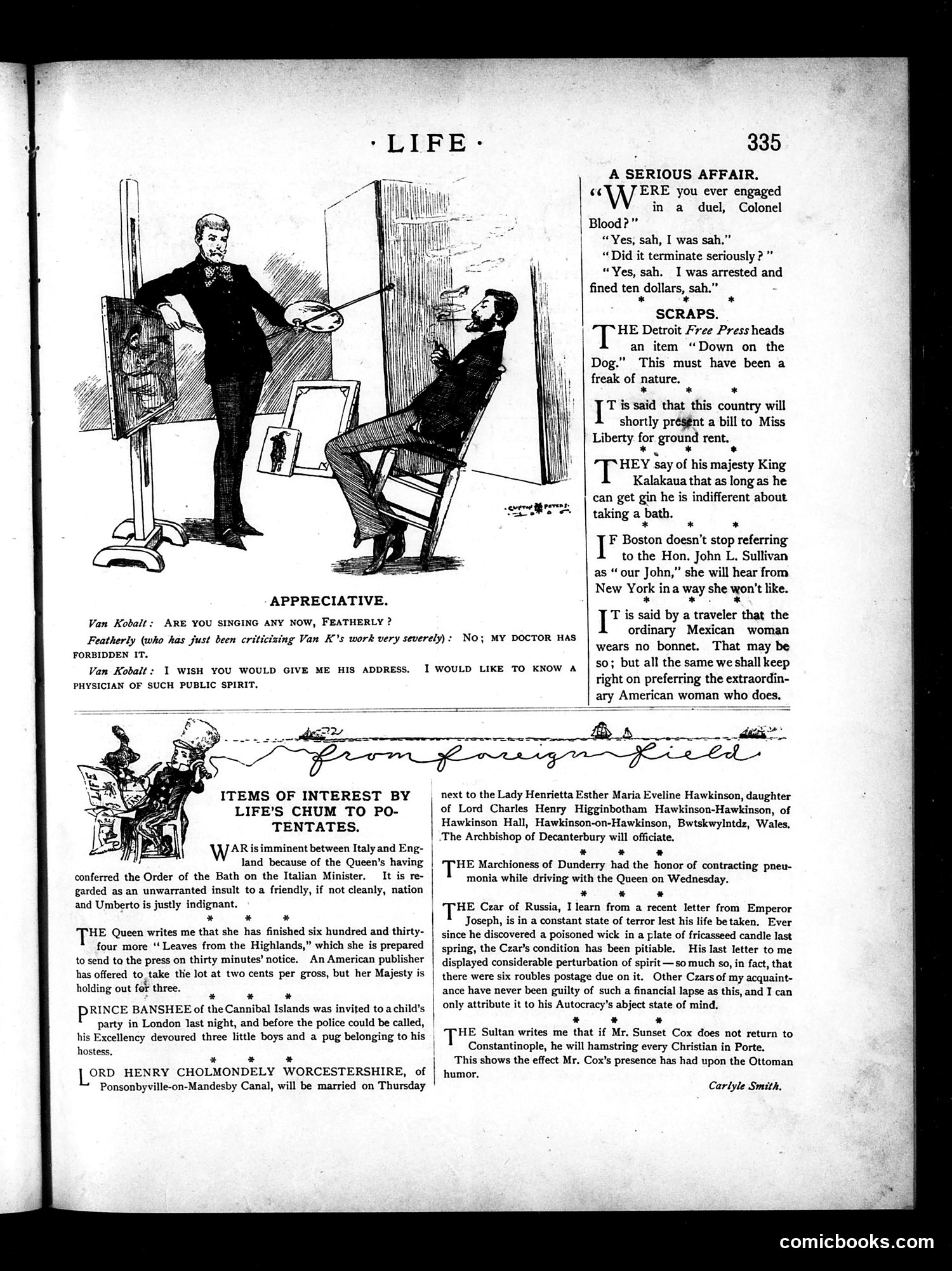
The cartoon depicts an art teacher or critic showing a painting to a seated student or artist named "Van Kobalt." The standing figure says the work has "just been criticizing Van K's work very severely," but the doctor has forbidden it. He then requests the artist's address, saying he wants to know "a physician of such public spirit." The joke is a reversal: by praising the artist's willingness to tolerate harsh criticism without medical complaint, the critic sarcastically suggests that *tolerating* such severe criticism requires exceptional physical and mental health—implying Van Kobalt's work is so bad that hearing criticism about it should cause illness.
This page contains short satirical pieces and jokes rather than a political cartoon. The content includes: **"Christmas Shopping"** - Mocks women's shopping habits and the crowded stores during the holiday season. **"What's One Man's Meat's Another's Pizon"** - A brief joke about the Howery Freak Trade in Philadelphia. **"He Knew the Lady"** - A punny joke playing on the phrase "Good-bye, Mr. Knickerbocker." **"Cause and Effect"** - A short humorous verse about Thanksgiving. **Other items** reference Wilkes Booth, the *Century Magazine*, and various contemporary social observations about ladies calling on ministers and encyclopedia purchases. The right column discusses *Scribners'* new magazine cover design, praising its literary and artistic merit. Overall, this appears to be a miscellaneous humor and commentary page typical of Life magazine's satirical format.
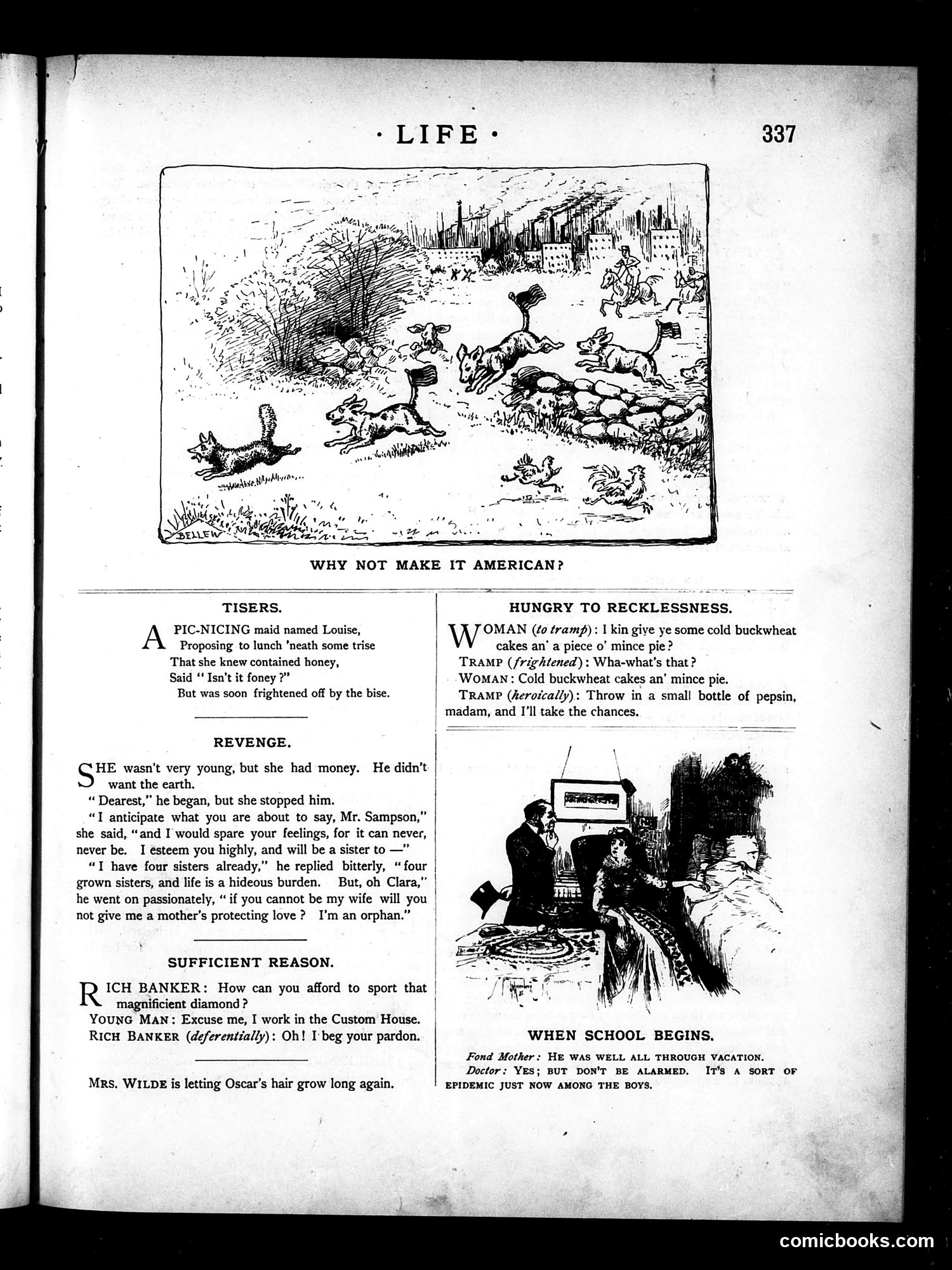
This page contains several brief humorous sketches typical of Life's satirical format: **"Why Not Make It American?"** shows dogs chasing rabbits, with the title suggesting making a European hunting scene "American" — likely satirizing American tendencies to imitate or Americanize foreign customs. The text sections below feature short comedic dialogues: - **"Tisers"** jokes about a maid named Louise proposing lunch with honey - **"Revenge"** depicts a money dispute between a man and woman - **"Sufficient Reason"** shows a banker and customs worker discussing an affordable diamond - **"When School Begins"** mentions a child's illness being "epidemic among boys" These are light social satires mocking class pretensions, romantic misunderstandings, and domestic situations — typical of early 20th-century American humor magazines.
This page is primarily **literary content, not political satire**. The main feature is "Carlyle Rehabilitated," a biographical essay about Thomas Carlyle defending his reputation against charges of "selfishness and cold-heartedness." The text discusses Carlyle's difficult youth and argues he was fundamentally honest and principled despite his reputation. Below are book reviews and a poem titled "An Idle Strain," followed by brief humorous exchanges including jokes about Queen Victoria's Irish visits and progressive jackstraw parties. **No political cartoon appears on this page.** The "Bookshelves" header is decorative, not satirical. This is a typical literary/cultural section of Life magazine, emphasizing humor and book reviews rather than political commentary.
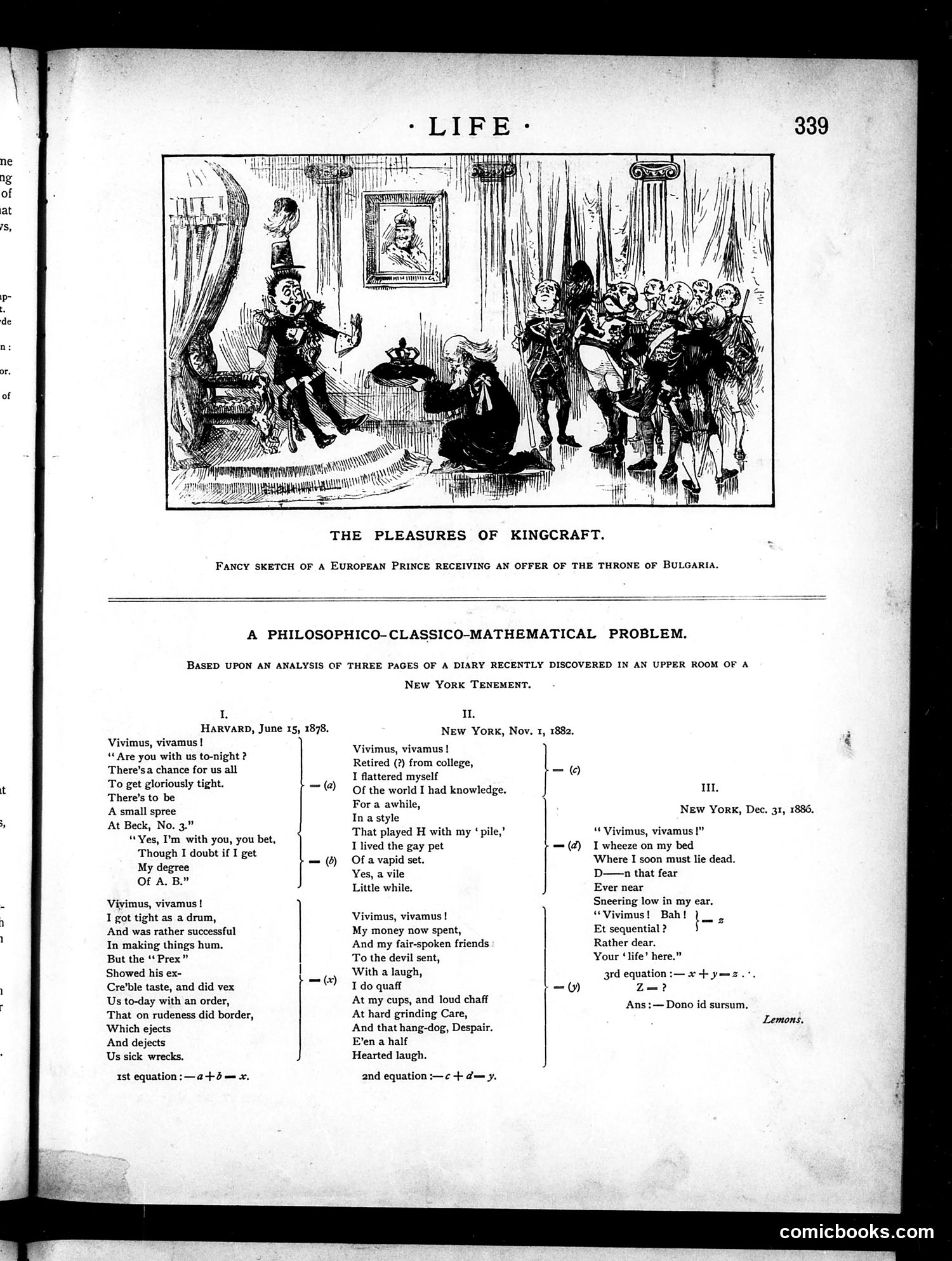
**Top Cartoon:** "The Pleasures of Kingcraft" depicts a European prince (left, gesturing dismissively) receiving courtiers who offer him the throne of Bulgaria. The satire mocks the grandiose pretensions of European royalty and the casual nature of political succession among the continental aristocracy—thrones apparently offered like business transactions. **Bottom Section:** A humorous "Philosophico-Clasico-Mathematical Problem" uses three diary entries (1898, 1882, 1886) from a New York tenant to construct mock-scholarly equations. The joke plays on academic pretension: translating a man's complaints about poverty and failed social climbing into mathematical formulas. It satirizes how intellectuals over-complicate simple human suffering through jargon and pseudo-scientific analysis.
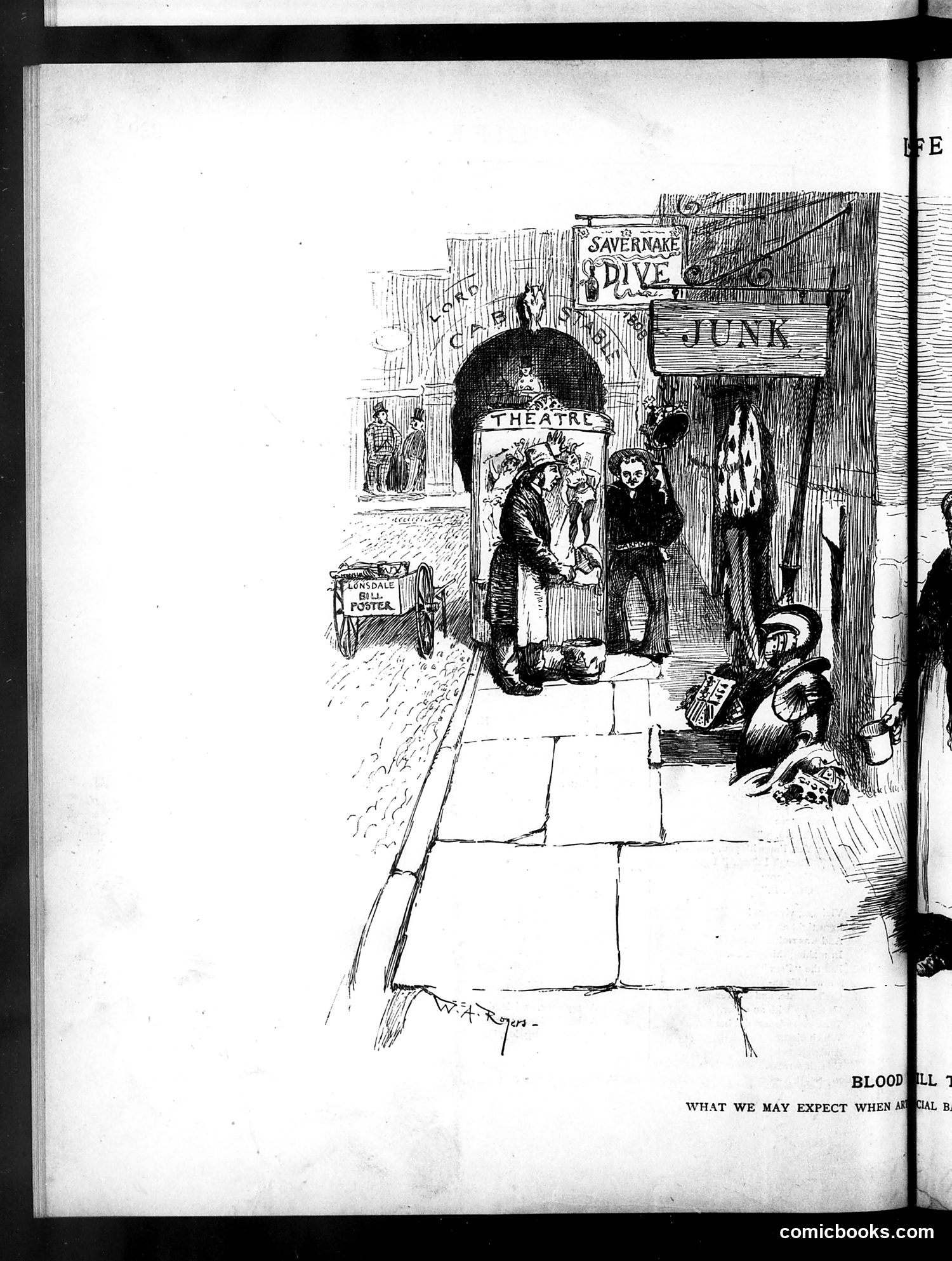
This is a satirical street scene depicting urban entertainment venues and their patrons. Visible signs read "Savernake Dive," "Junk," and "Theatre," suggesting a disreputable neighborhood district. The cartoon appears to satirize low-brow entertainment and the social classes who frequented such establishments. The figures shown include well-dressed pedestrians and what appear to be working-class or vagrant individuals lounging outside these venues. The partial caption at bottom reads "WHAT WE MAY EXPECT WHEN [text cut off]," suggesting social commentary about consequences or predictions regarding urban conditions or entertainment culture. The style and setting indicate this critiques the seedier aspects of urban entertainment districts—likely commenting on moral concerns about theaters, dives, and associated street life in early 20th-century cities. The specific historical context of the caption remains unclear from the visible text.
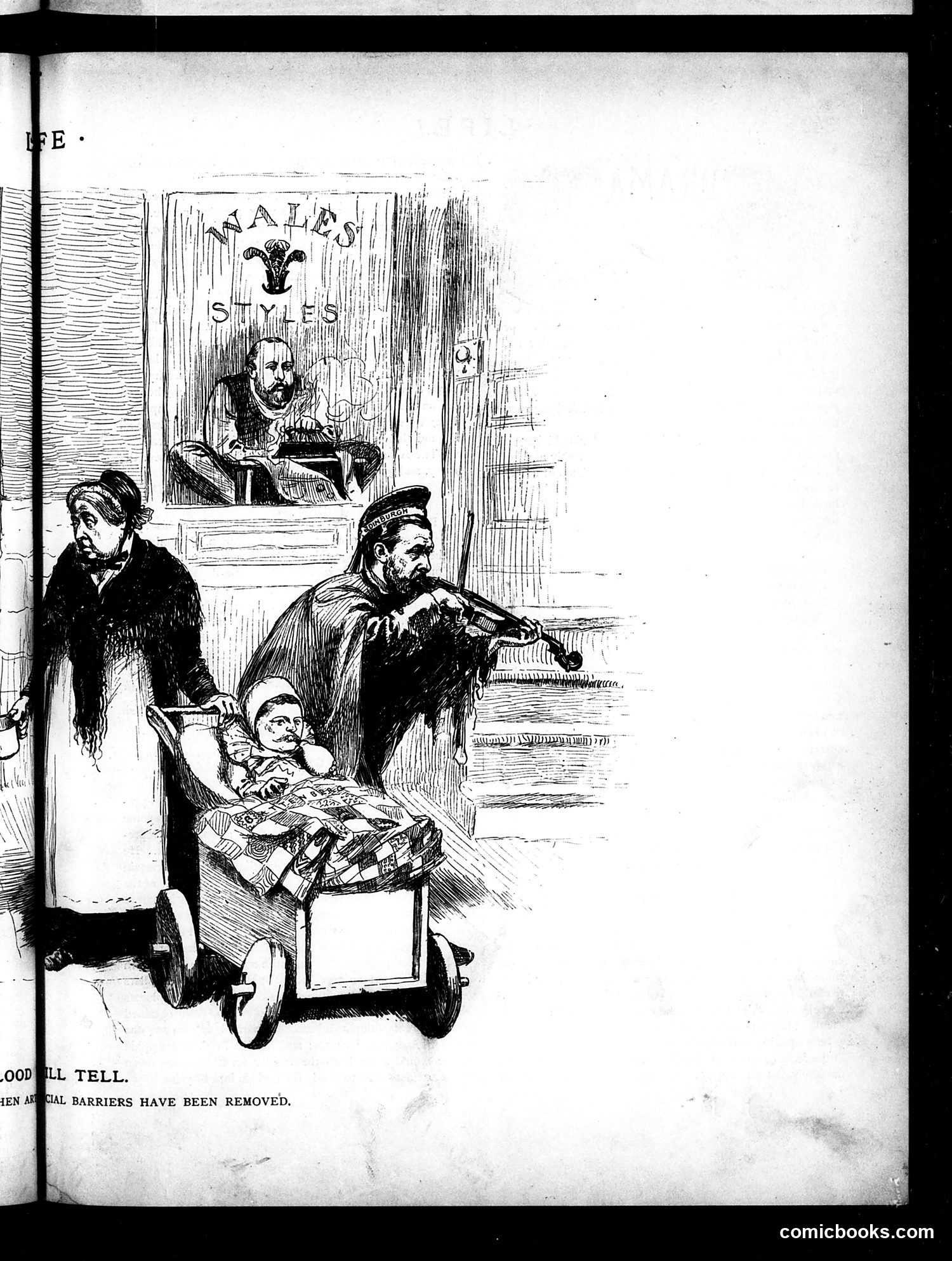
This is a satirical cartoon from *Life* magazine depicting a scene at what appears to be a government building (marked "ALES STYLES" above). Two working-class men with a baby carriage approach the building while a woman waits nearby. The partially visible caption references "GOOD ILL TELL" and mentions "ARTIFICIAL BARRIERS HAVE BEEN REMOVED." The cartoon likely satirizes early 20th-century access to government services or bureaucratic processes. The "removal of artificial barriers" suggests newly democratized access—possibly to welfare, child services, or public assistance programs. The working-class figures and baby carriage emphasize social welfare concerns. The satire appears to mock either the claim that barriers were truly removed, or the irony of improved public access to government institutions.
This page discusses a production of Aristophanes' ancient Greek comedy "The Acharnians" at the Academy of Music, performed by University of Pennsylvania students. The "DRAMA" header illustration shows a theatrical scene. The text praises the production's wit, costumes (particularly Mr. Brinton's blue silk chiton), and the students' Greek pronunciation. The satire mocks Philadelphia's cultural pretensions—the author suggests New York selfishly monopolizes quality theatrical productions, while Philadelphia deserves access to such entertainment too. A secondary section titled "THAT GREEK PLAY" by Life's archaeologist expresses enthusiasm that a classical Greek play could be successfully staged in 1890s Philadelphia, praising the author Aristophanes and the student performers' achievement in bringing ancient comedy to modern audiences.
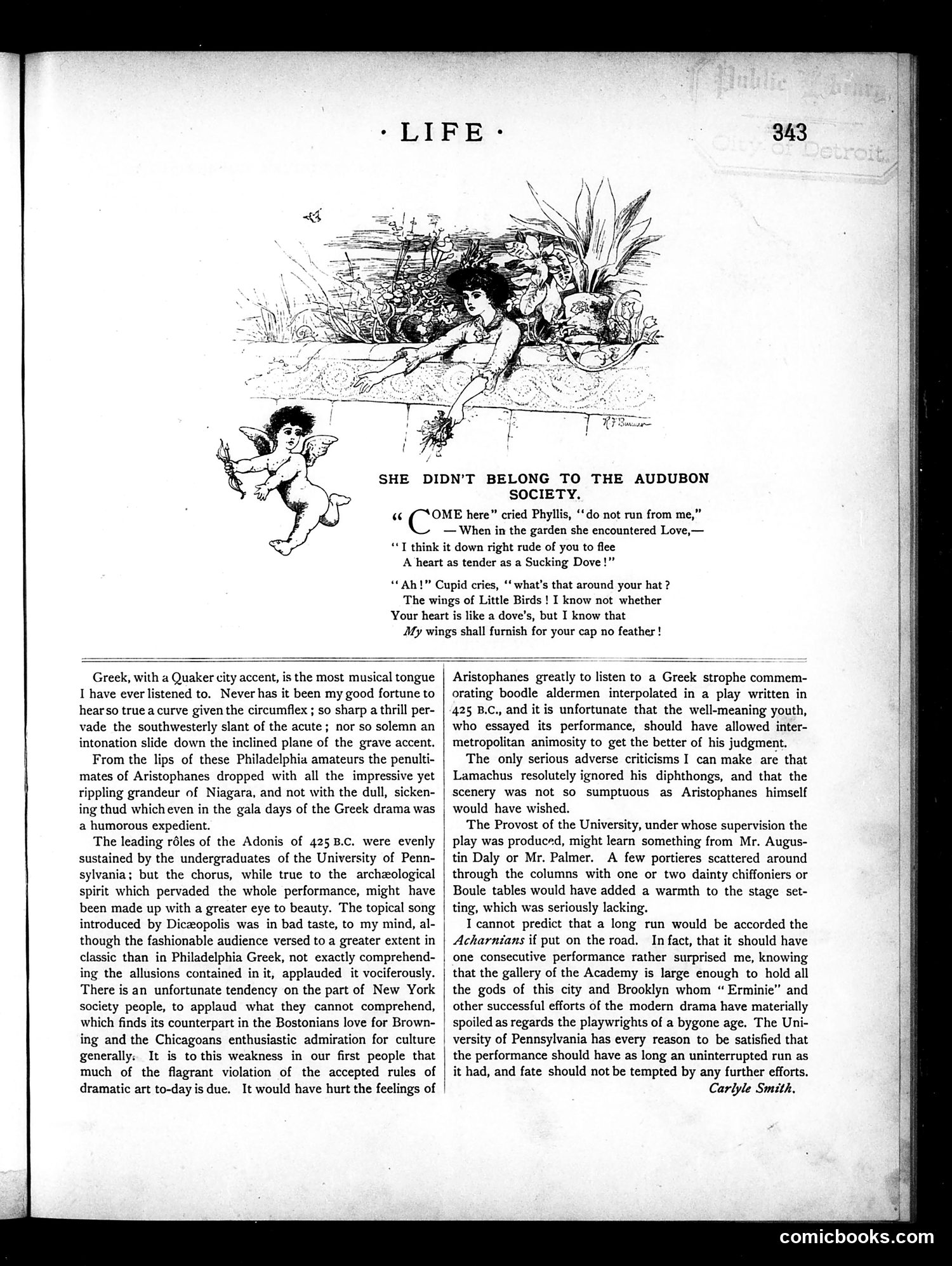
This cartoon satirizes the fashionable practice of women wearing bird feathers and wings on hats. The illustration shows a woman wearing bird wings as a hat decoration while Cupid confronts her, refusing to contribute his feathers to her fashion ensemble. The joke references the Audubon Society, an actual conservation organization founded in 1886 to protect birds. The title's implication is that this woman, by wearing dead birds on her hat, clearly isn't a member of a bird-protection group—she's actively harming them for vanity. The accompanying poem drives the satire home: Cupid declares he won't furnish feathers for her cap, suggesting that even love itself rejects such cruel ornamentation. This reflected genuine Progressive-era tensions over the "Aigrette Wars"—heated debates over the ethical treatment of birds hunted for the millinery trade. Wearing bird plumage was fashionable but increasingly criticized by conservationists as wasteful and cruel.
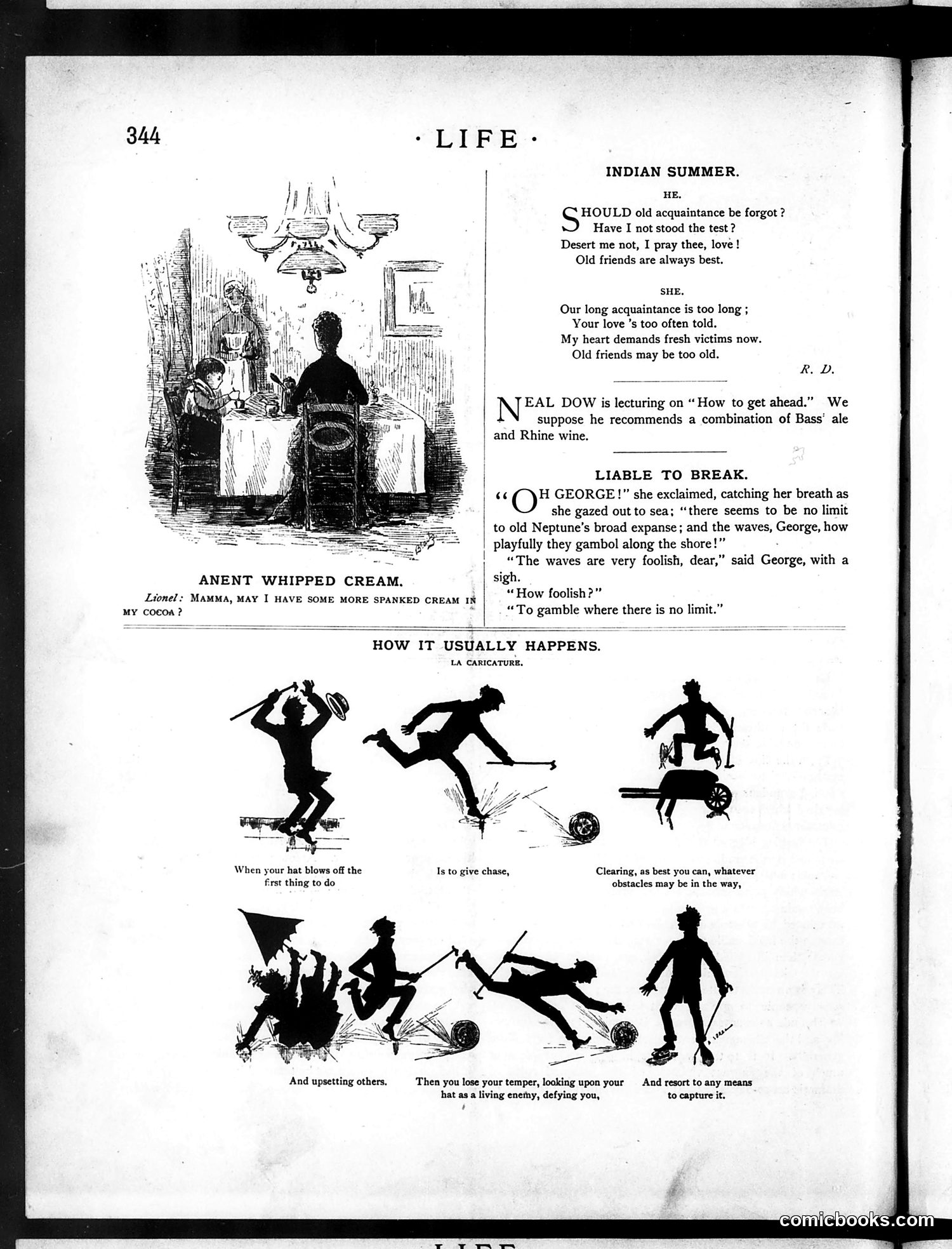
This page contains several satirical pieces mocking Victorian social conventions and human behavior: **"Indian Summer"** presents a cynical dialogue between a man and woman about romance—she rejects his appeals to nostalgic "old friends are best" sentiment, declaring her heart wants "fresh victims," not stale affections. The satire targets both romantic clichés and female fickleness. **"Anent Whipped Cream"** is a child's request for dessert—likely mocking either indulgent parenting or children's relentless demands. **"Liable to Break"** satirizes melodramatic seaside romance, where the woman gushes poetically about Neptune's waves while the man deflates her with cynical wit about waves "gambling where there is no limit"—a pun on financial recklessness. **"How It Usually Happens"** is a humorous silhouette sequence showing the inevitable chaos of losing one's hat outdoors: chasing it, losing your temper, upsetting others—a relatable physical comedy about masculine frustration and undignified behavior. The overall tone mocks romantic sentimentality, social pretension, and human irrationality.
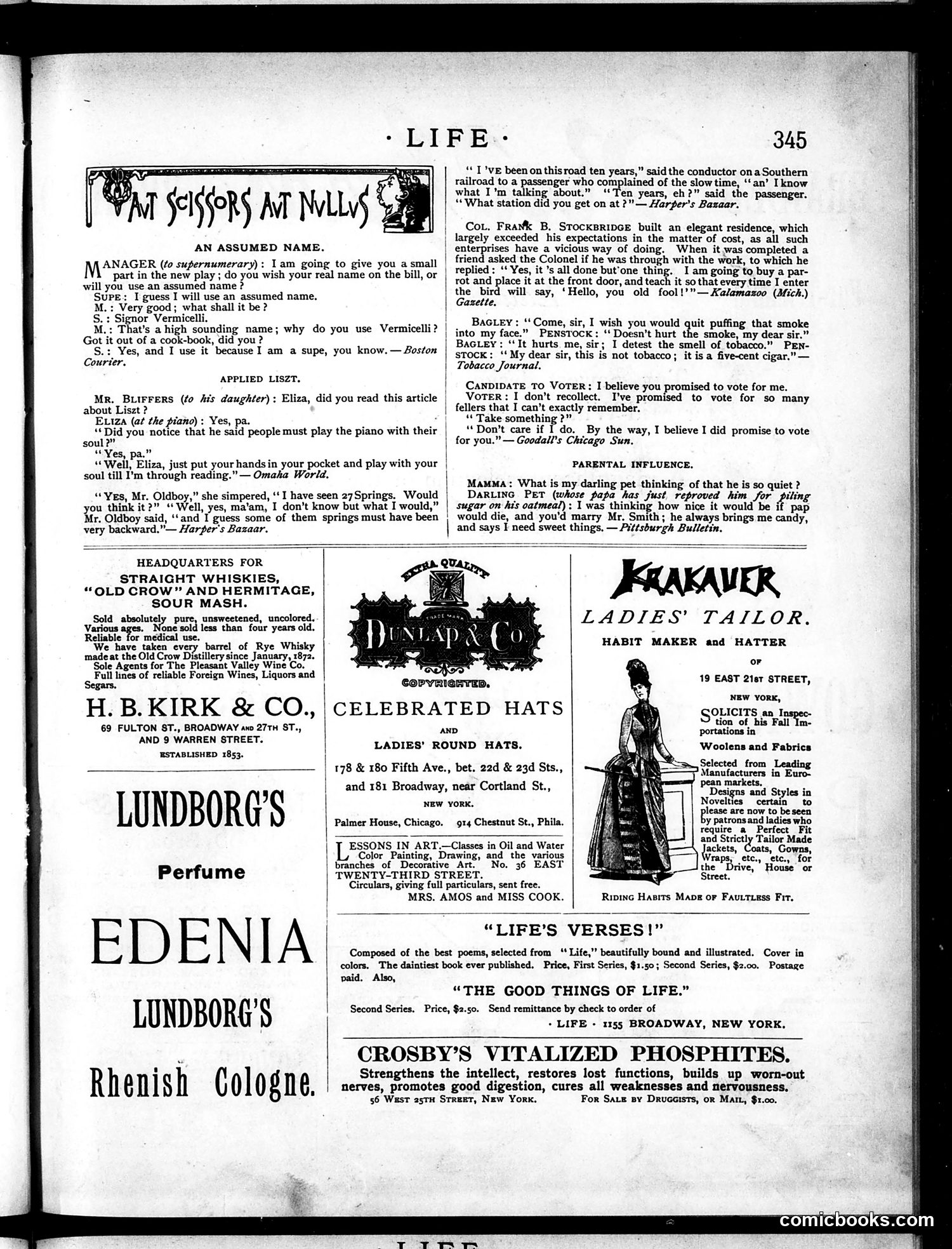
This page from *Life* magazine features six brief humorous sketches, mostly wordplay and observational humor typical of late 19th-century American comedy. The cartoons lack complex political content: 1. **"An Assumed Name"** — A stage performer adopts the fake name "Signor Vermicelli" because he's a "supe" (supernumerary/walk-on), pun-wordplay based on "supe" and "soup." 2. **"Applied Liszt"** — A play on pianist Franz Liszt's claim that piano must be played "with the soul," with a father literalizing this instruction to his daughter. 3. **Other sketches** involve a conductor's dubious service record, a colonel's parrot, smoking etiquette, political promises, and a child fantasizing about his father's death for candy from a potential stepfather. The humor relies on puns, literal interpretations of figurative language, and gentle social observation rather than political satire. The bottom half is primarily advertisements for spirits, hats, and other goods. No significant political cartoons appear on this page.
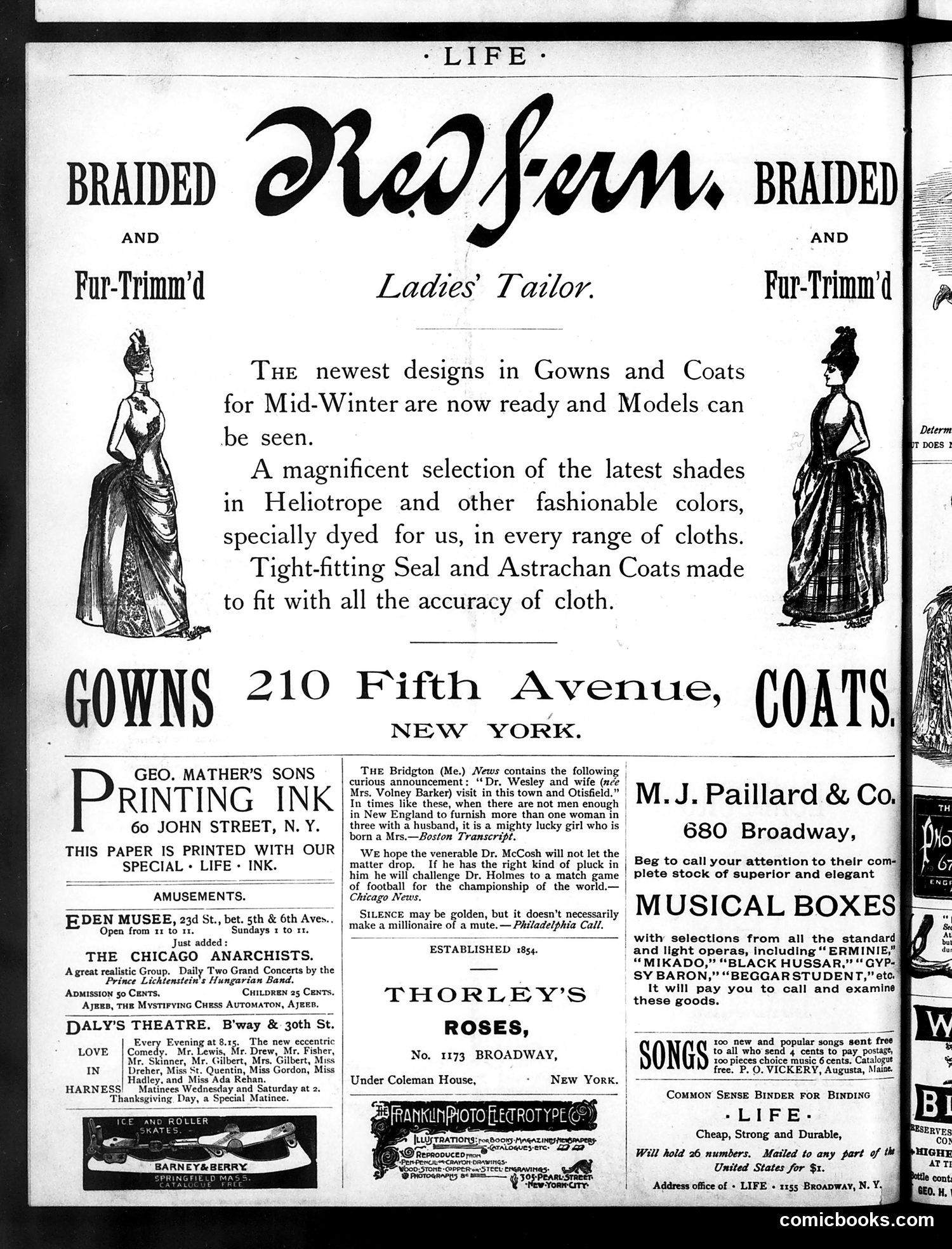
This page is **primarily advertising** with brief satirical commentary interspersed. The main content features fashion advertisements (braided red fern gowns and fur-trimmed coats) and various New York business listings. However, several humorous editorial notes appear: 1. **"The Chicago Anarchists"** amusement exhibit—a wax museum display, reflecting contemporary anxiety about anarchism in 1880s America. 2. **Satirical snippets** mock social concerns: one notes the scarcity of marriageable men in New England; another jokes about Dr. McCosh challenging Dr. Holmes to a football match for "championship of the world." 3. A quip about silence not making one rich—typical light social commentary. The page reflects Gilded Age consumer culture alongside period anxieties (anarchism, gender imbalance, professional rivalry). There are **no political cartoons** per se—just advertisements interspersed with gentle, topical humor typical of *Life* magazine's satirical style.
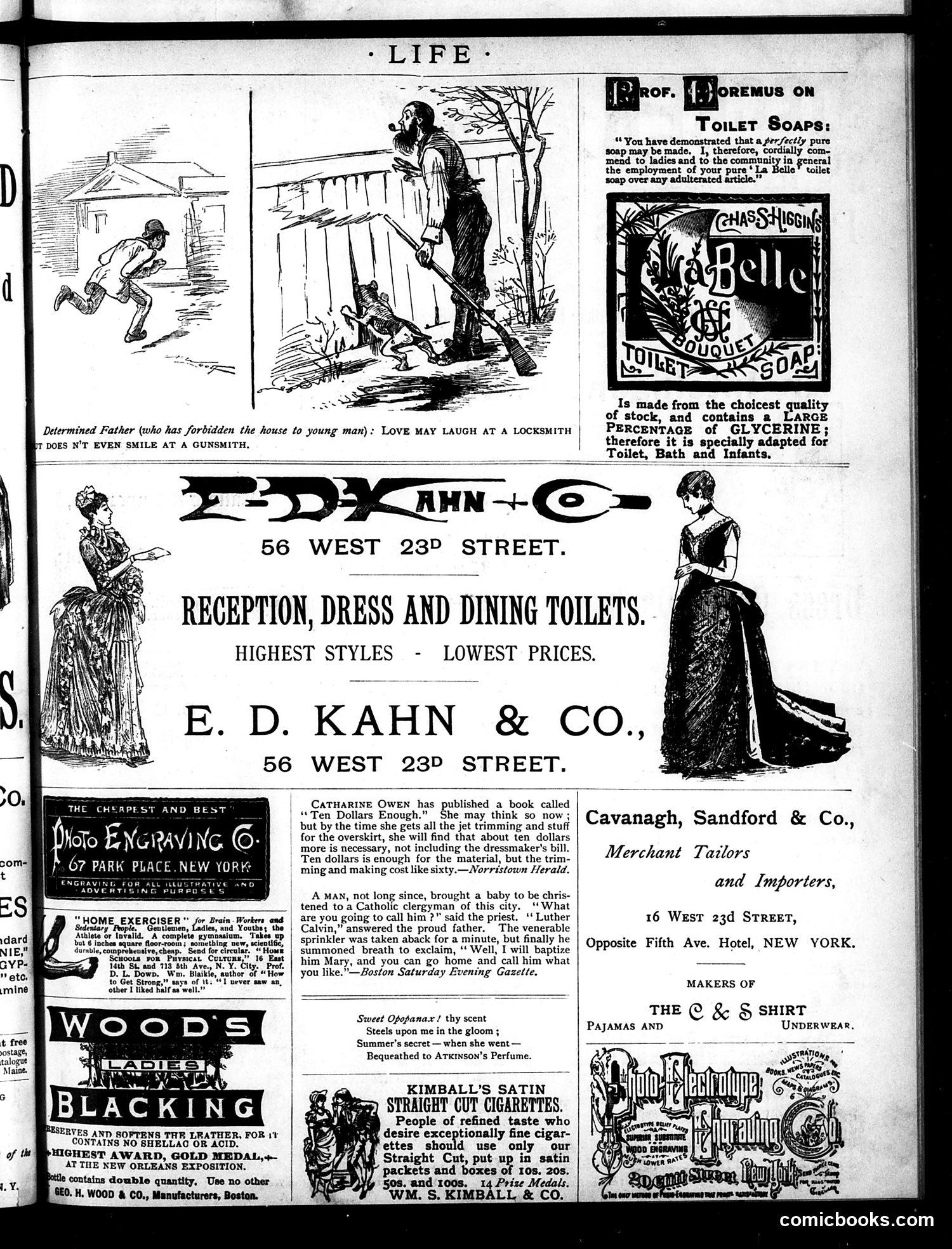
The top cartoon depicts a father who has barred his house to a young suitor, shown climbing through a window or fence. The caption's joke plays on the phrase "love laughs at locksmiths"—a contemporary saying meaning romantic determination overcomes obstacles. The humor is straightforward domestic comedy: despite the father's prohibition, the determined young man finds a way in anyway, suggesting parental authority cannot stop young love. This reflects Victorian-era anxieties about courtship propriety and parental control over daughters' romantic choices. The rest of the page consists primarily of period advertisements for toiletries, clothing, and household goods, with no additional satirical content. The magazine appears to mix social humor with commercial advertising typical of late 19th-century American publications.
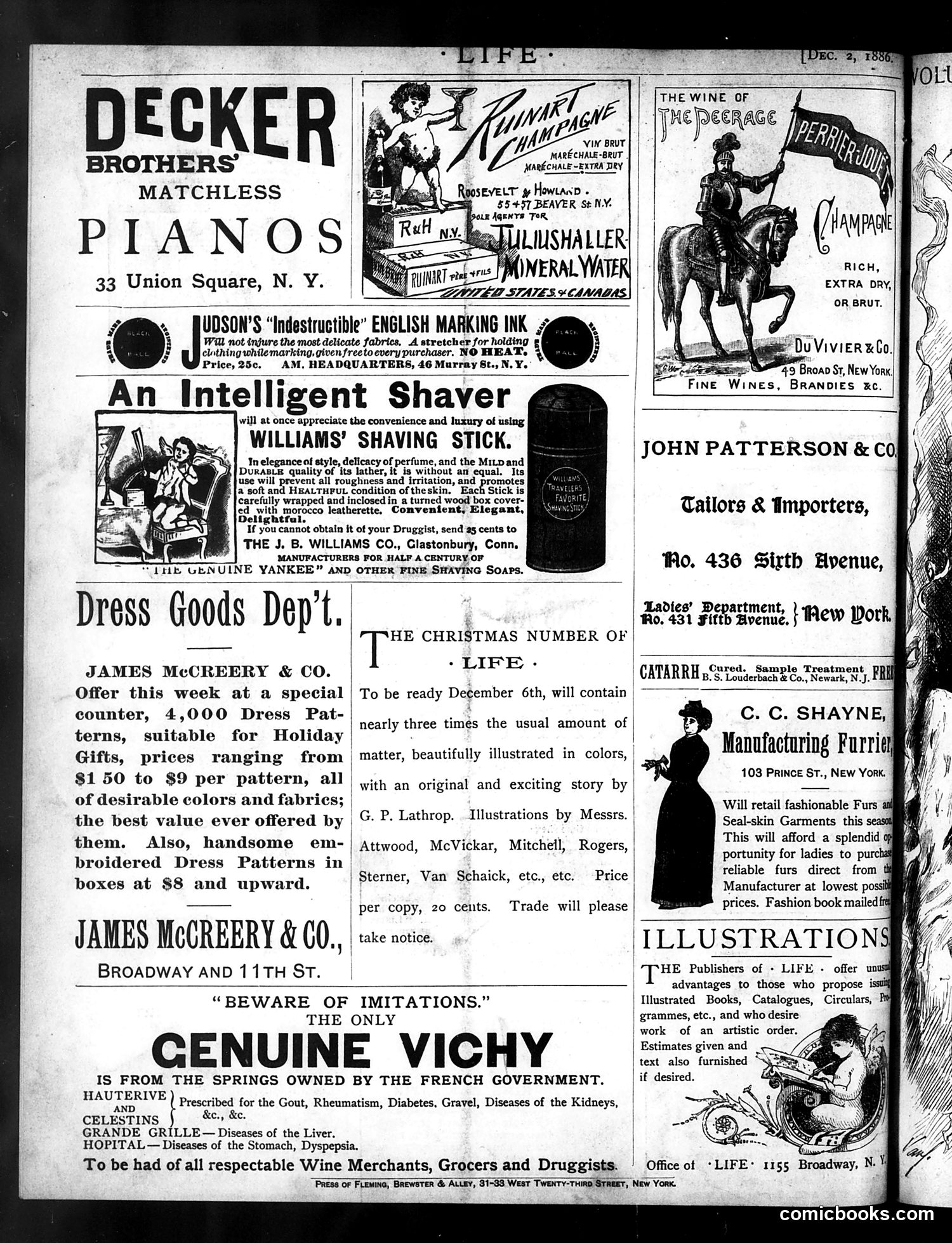
This is primarily an **advertising page** with no political cartoons or satirical content. The page consists entirely of period advertisements for consumer goods and services typical of the 1880s. Notable ads include: - **Decker Brothers Pianos** (luxury goods) - **Williams' Shaving Stick** (personal grooming, targeting "intelligent" gentlemen) - **Hudson's English Marking Ink** (household utility) - **James McCreery & Co.** dress patterns (holiday shopping) - **Genuine Vichy water** (medicinal spa water, prescribed for various ailments) - **Fine wines and champagne** from DuVivier & Co. - **Tailoring and fur services** in New York The advertisements reflect late-Victorian consumer culture and advertising conventions—emphasizing elegance, health benefits, and convenience for middle-to-upper-class readers. There is also an announcement that Life's Christmas issue will contain special illustrated content. No satire, political commentary, or caricature is present on this particular page.