
Life, 1886-12-02 · page 2 of 16
Life — December 2, 1886 — page 2: what you’re looking at
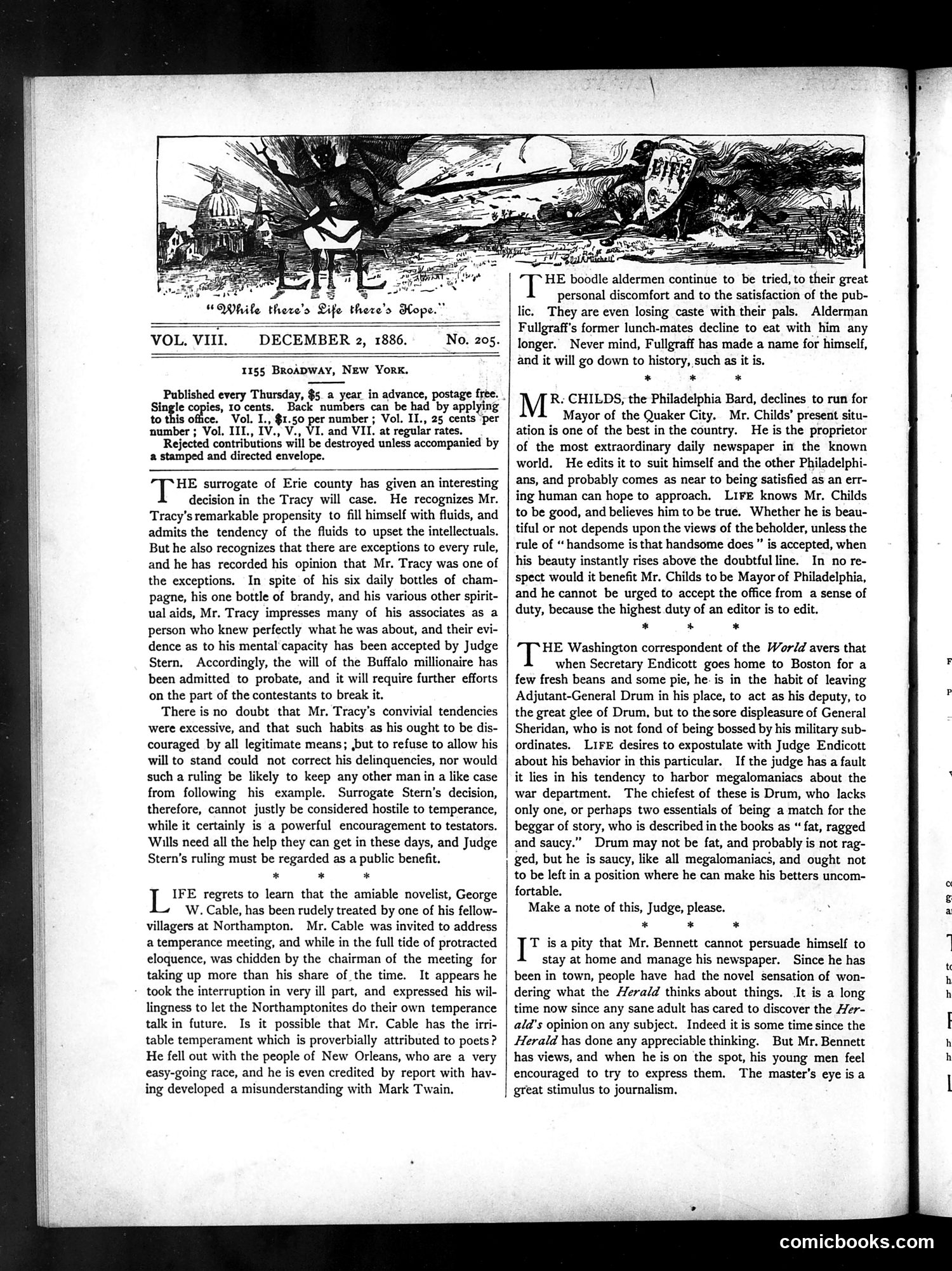
What you’re looking at
The masthead cartoon depicts a chaotic apocalyptic scene labeled "While there's Life there's Hope." It shows destruction, including a building (possibly the Capitol dome on the left) and a gravestone marked "LIFE," suggesting satirical commentary on the magazine's own survival or relevance amid turbulent times. The page contains editorial commentary rather than single-panel political cartoons. It discusses contemporary figures including Mr. Tracy (apparently someone with drinking problems affecting his judgment), Mr. Childs (Philadelphia newspaper editor), and military figures like General Sheridan and Adjutant-General Drum. The satire critiques their professional conduct and personal failings, typical of Life's gossipy, acerbic editorial style mocking public figures' behavior and competence.
📄 Transcribed text from this page (OCR, searchable)
Machine-transcribed from the original scan — historical spelling and the odd misread are preserved.
- - F = “While there’s Life there's Hope.” VOL. VIII. DECEMBER 2, 1886, _No. 205. 1155 BRoADWAY, NEw York. Published every Thursday, $5. a year in advance, postage free. . Single copies, 10 cents. Back numbers can be had by applying to this office. Vol. I., $1.50 per number ; Vol. II., 25 cents ‘per number ; Vol. IT. V., V., VI. and VII. at regular rates. Rejected contributions will be destroyed unless accompanied by a stamped and directed envelope. HE surrogate of Erie county has given an interesting decision in the Tracy will case. He recognizes Mr. Tracy's remarkable propensity to fill himself with fluids, and admits the tendency of the fluids to upset the intellectuals. But he also recognizes that there are exceptions to every rule, and he has recorded his opinion that Mr. Tracy was one of the exceptions. In spite of his six daily bottles of cham- pagne, his one bottle of brandy, and his various other spirit- ual aids, Mr. Tracy impresses many of his associates as a person who knew perfectly what he was about, and their evi- dence as to his mental capacity has been accepted by Judge Stern, Accordingly, the will of the Buffalo millionaire has been admitted to probate, and it will require further efforts on the part of the contestants to break it. There is no doubt that Mr. Tracy’s convivial tendencies were excessive, and that such habits as his ought to be dis- couraged by all legitimate means; ,but to refuse to allow his will to stand could not correct his delinquencies, nor would such a ruling be likely to keep any other man in a like case from following his example. Surrogate Stern’s decision, therefore, cannot justly be considered hostile to temperance, while it certainly is a powerful encouragement to testators. Wills need all the help they can get in these days, and Judge Stern’s ruling must be regarded as a public benefit. * * * IFE regrets to learn that the amiable novelist, George W. Cable, has been rudely treated by one of his fellow- villagers at Northampton. Mr. Cable was invited to address a temperance meeting, and while in the full tide of protracted eloquence, was chidden by the chairman of the meeting for taking up more than his share of the time. It appears he took the interruption in very ill part, and expressed his wil- lingness to let the Northamptonites do their own temperance talk in future. Is it possible that Mr. Cable has the irri- table temperament which is proverbially attributed to poets? He fell out with the people of New Orleans, who are a very easy-going race, and he is even credited by report with hav- ing developed a misunderstanding with Mark Twain. E boodle aldermen continue to be tried, to their great personal discomfort and to the satisfaction of the pub- lic. They are even losing caste with their pals. Alderman Fullgraff's former lunch-mates decline to eat with him any longer. Never mind, Fullgraff has made a name for himself, and it will go down to history, such as it is. * * * R. CHILDS, the Philadelphia Bard, declines to run for Mayor of the Quaker City. Mr. Childs’ present situ- ation is one of the best in the country. He is the proprietor of the most extraordinary daily newspaper in the known world. He edits it to suit himself and the other Philadelphi- ans, and probably comes as near to being satisfied as an err- ing human can hope to approach. LIFE knows Mr. Childs to be good, and believes him to be true. Whether he is beau- tiful or not depends upon the views of the beholder, unless the tule of “‘ handsome is that handsome does ” is accepted, when his beauty instantly rises above the doubtful line. In no re- spect would it benefit Mr. Childs to be Mayor of Philadelphia, and he cannot be urged to accept the office from a sense of duty, because the highest duty of an editor is to edit. * * * HE Washington correspondent of the World avers that when Secretary Endicott goes home to Boston for a few fresh beans and some pie, he- is in the habit of leaving Adjutant-General Drum in his place, to act as his deputy, to the great glee of Drum, but to the sore displeasure of General Sheridan, who is not fond of being bossed by his military sub- ordinates. LIFE desires to expostulate with Judge Endicott about his behavior in this particular. If the judge has a fault it lies in his tendency to harbor megalomaniacs about the war department. The chiefest of these is Drum, who lacks only one, or perhaps two essentials of being a match for the beggar of story, who is described in the books as “ fat, ragged and saucy.” Drum may not be fat, and probably is not rag- ged, but he is saucy, like all megalomaniacs, and ought not to be left in a position where he can make his betters uncom- fortable. Make a note of this, Judge, please. * * * T isa pity that Mr. Bennett cannot persuade himself to stay at home and manage his newspaper. Since he has been in town, people have had the novel sensation of won- dering what the Hera/d thinks about things. It is a long time now since any sane adult has cared to discover the Her- ald’s opinion on any subject. Indeed it is some time since the Herald has done any appreciable thinking. But Mr. Bennett has views, and when he is on the spot, his young men feel encouraged to try to express them. The master's eye is a great stimulus to journalism. comicbooks.com pmo ress! (ape eet” “Taaky ee ae ey