
Life, 1886-12-02 · page 6 of 16
Life — December 2, 1886 — page 6: what you’re looking at
What you’re looking at
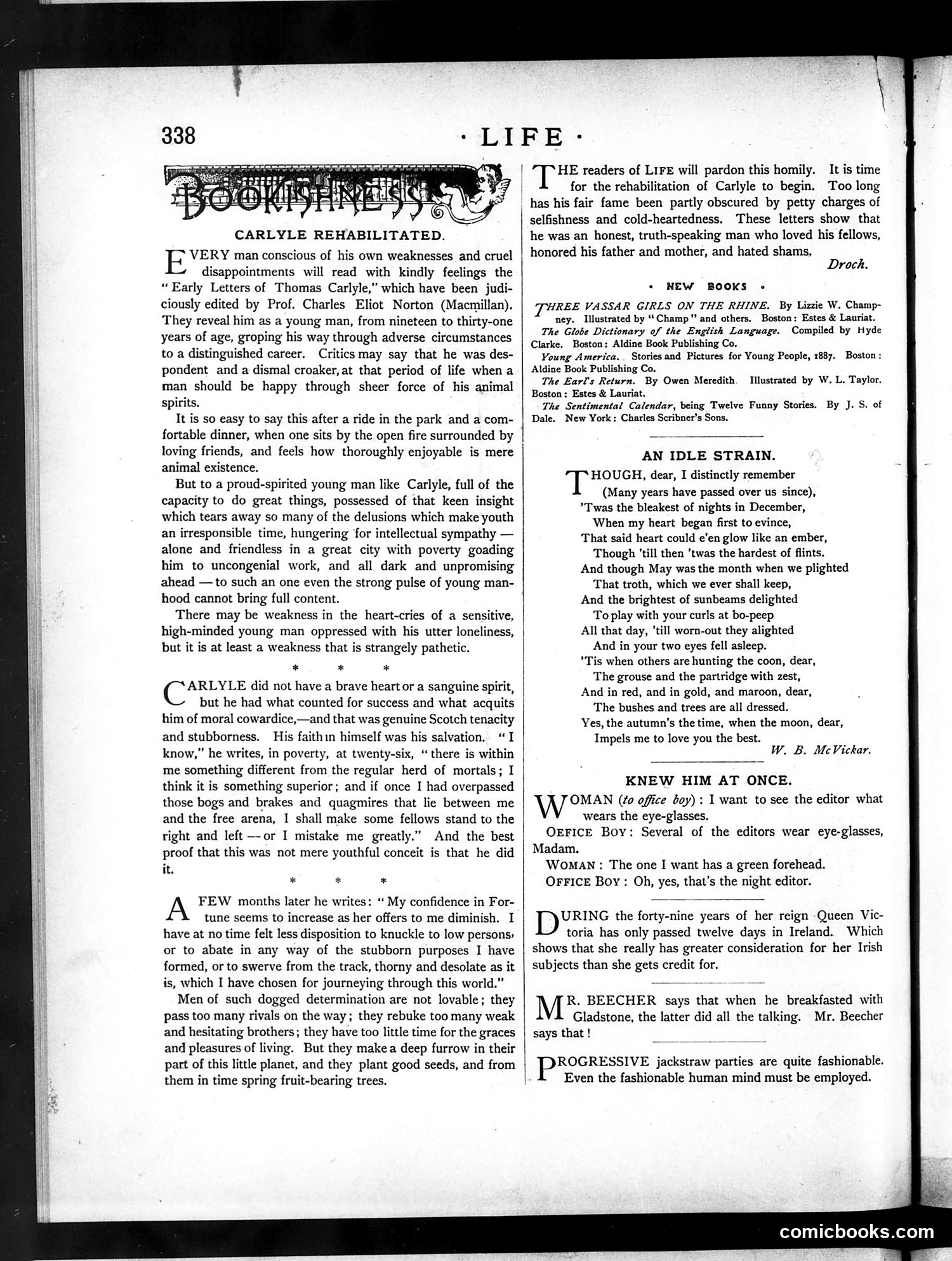
This page is primarily **literary content, not political satire**. The main feature is "Carlyle Rehabilitated," a biographical essay about Thomas Carlyle defending his reputation against charges of "selfishness and cold-heartedness." The text discusses Carlyle's difficult youth and argues he was fundamentally honest and principled despite his reputation. Below are book reviews and a poem titled "An Idle Strain," followed by brief humorous exchanges including jokes about Queen Victoria's Irish visits and progressive jackstraw parties. **No political cartoon appears on this page.** The "Bookshelves" header is decorative, not satirical. This is a typical literary/cultural section of Life magazine, emphasizing humor and book reviews rather than political commentary.
📄 Transcribed text from this page (OCR, searchable)
Machine-transcribed from the original scan — historical spelling and the odd misread are preserved.
VERY man conscious of his own weaknesses and cruel disappointments will read with kindly feelings the “Early Letters of Thomas Carlyle,” which have been judi- ciously edited by Prof. Charles Eliot Norton (Macmillan). They reveal him as a young man, from nineteen to thirty-one years of age, groping his way through adverse circumstances to a distinguished career. Critics may say that he was des- pondent and a dismal croaker, at that period of life when a man should be happy through sheer force of his animal spirits. It is so easy to say this after a ride in the park and a com- fortable dinner, when one sits by the open fire surrounded by loving friends, and feels how thoroughly enjoyable is mere animal existence. But to a proud-spirited young man like Carlyle, full of the capacity to do great things, possessed of that keen insight which tears away so many of the delusions which make youth an irresponsible time, hungering ‘for intellectual sympathy — alone and friendless in a great city with poverty goading him to uncongenial work, and all dark and unpromising ahead —to such an one even the strong pulse of young man- hood cannot bring full content. There may be weakness in the heart-cries of a sensitive, high-minded young man oppressed with his utter loneliness, but it is at least a weakness that is strangely pathetic. * * * ARLYLE did not have a brave heart or a sanguine spirit, but he had what counted for success and what acquits | him of moral cowardice,—and that was genuine Scotch tenacity and stubborness. His faithin himself was his salvation. “I know,” he writes, in poverty, at twenty-six, “there is within me something different from the regular herd of mortals; I think it is something superior; and if once I had overpassed those bogs and brakes and quagmires that lie between me and the free arena, I shall make some fellows stand to the | right and left --or I mistake me greatly.” And the best proof that this was not mere youthful conceit is that he did it. * * * FEW months later he writes: “ My confidence in For- tune seems to increase as her offers to me diminish. I have at no time felt less disposition to knuckle to low persons» or to abate in any way of the stubborn purposes I have formed, or to swerve from the track, thorny and desolate as it is, which I have chosen for journeying through this world.” Men of such dogged determination are not lovable; they pass too many rivals on the way; they rebuke too many weak and hesitating brothers; they have too little time for the graces and pleasures of living. But they make a deep furrow in their part of this little planet, and they plant good seeds, and from them in time spring fruit-bearing trees. HE readers of LiFe will pardon this homily. It is time for the rehabilitation of Carlyle to begin. Too long has his fair fame been partly obscured by petty charges of selfishness and cold-heartedness. These letters show that he was an honest, truth-speaking man who loved his fellows, honored his father and mother, and hated shams, Droch. + NEW BOOKS - WREE VASSAR GIRLS ON THE RHINE, By Lizzie W. Champ- ney. Illustrated by “Champ” and others. Boston: Estes & Lauriat. The Globe Dictionary of the English Language. Compiled by Hyde Clarke. Boston: Aldine Book Publishing Co, Young America. Stories and Pictures for Young People, 1887. Aldine Book Publishing Co. The Earl's Return. By Owen Meredith Boston : Estes & Lauriat. The Sentimental Calendar, being Twelve Funny Stories. By J. S. of Dale. New York: Charles Scribner's Sons. Boston : Illustrated by W. L. Taylor. AN IDLE STRAIN. HOUGH, dear, I distinctly remember (Many years have passed over us since), ’Twas the bleakest of nights in December, When my heart began first to evince, That said heart could e’en glow like an ember, Though 'till then ‘twas the hardest of flints. And though May was the month when we plighted That troth, which we ever shall keep, And the brightest of sunbeams delighted To play with your curls at bo-peep All that day, ’till worn-out they alighted And in your two eyes fell asleep. Tis when others are hunting the coon, dear, The grouse and the partridge with zest, And in red, and in gold, and maroon, dear, The bushes and trees are all dressed. Yes, the autumn’s the time, when the moon, dear, Impels me to love you the best. W. B. McVickar. KNEW HIM AT ONCE. Wy oman (to office boy): 1 want to see the editor what wears the eye-glasses. OEFICE Boy: Several of the editors wear eye-glasses, Madam. Woman: The one I want has a green forehead. OFFICE Boy : Oh, yes, that’s the night editor. URING the forty-nine years of her reign ‘Queen Vic- toria has only passed twelve days in Ireland. Which shows that she really has greater consideration for her Irish subjects than she gets credit for. M*: BEECHER says that when he breakfasted with Gladstone, the latter did all the talking. Mr. Beecher says that ! | PESSRESIVE jackstraw parties are quite fashionable. | Even the fashionable human mind must be employed. comicbooks.com