
A complete issue · 16 pages · 1886
Life — November 25, 1886
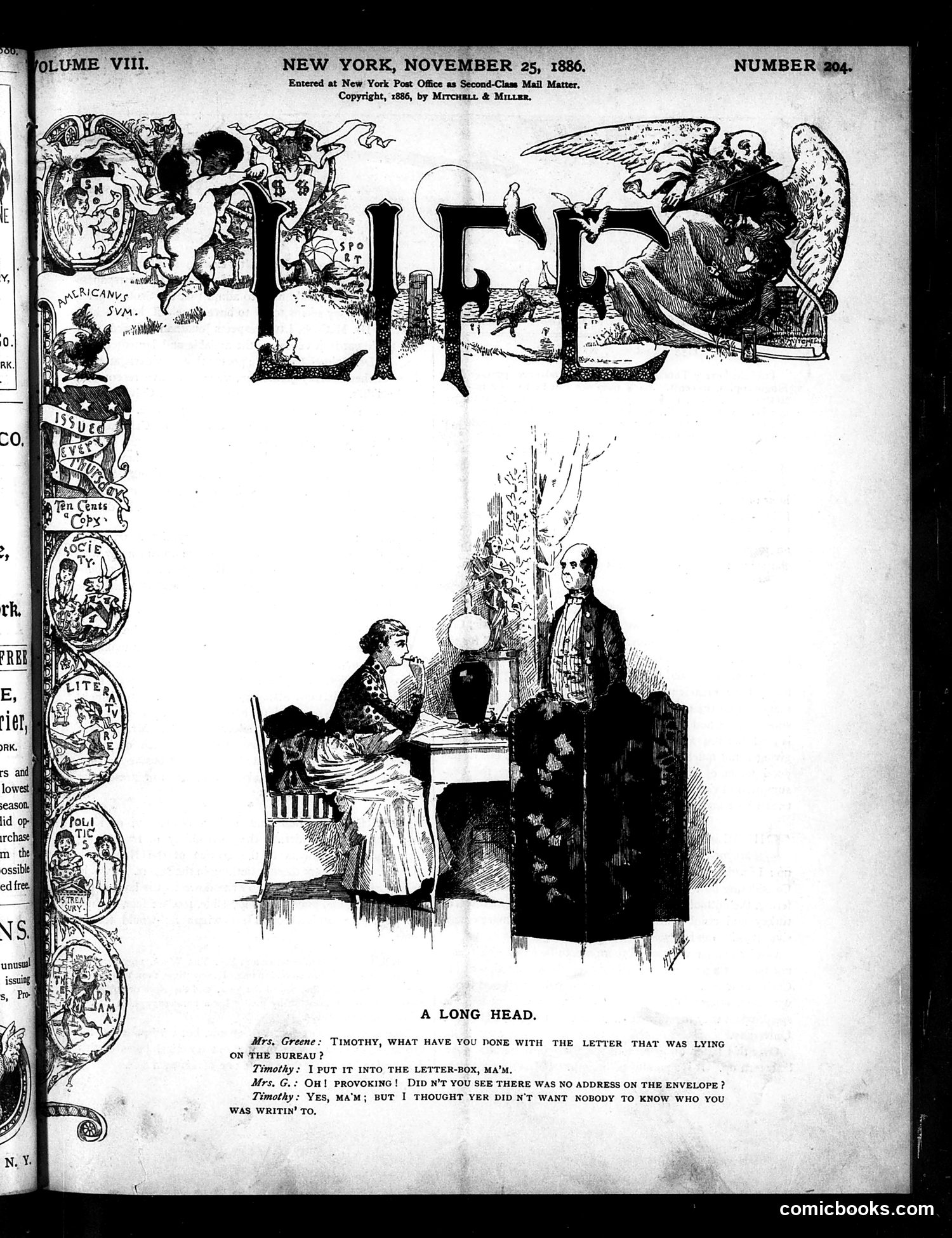
This cartoon satirizes a domestic dispute over a missing letter. Mrs. Greene confronts Timothy about a letter left on the bureau. Timothy claims he put it in the letter-box (mailbox), but Mrs. Greene suspects otherwise—particularly that he didn't want the recipient to know who sent it, given the lack of address on the envelope. The humor relies on the double meaning of "a long head"—suggesting Timothy either has a literally elongated head (visible in his caricature) or possesses cunning/deviousness. The cartoon mocks Timothy's guilty behavior and weak excuse, presenting a common Victorian domestic conflict over mail and secrets within marriage. The title emphasizes his apparent scheming.
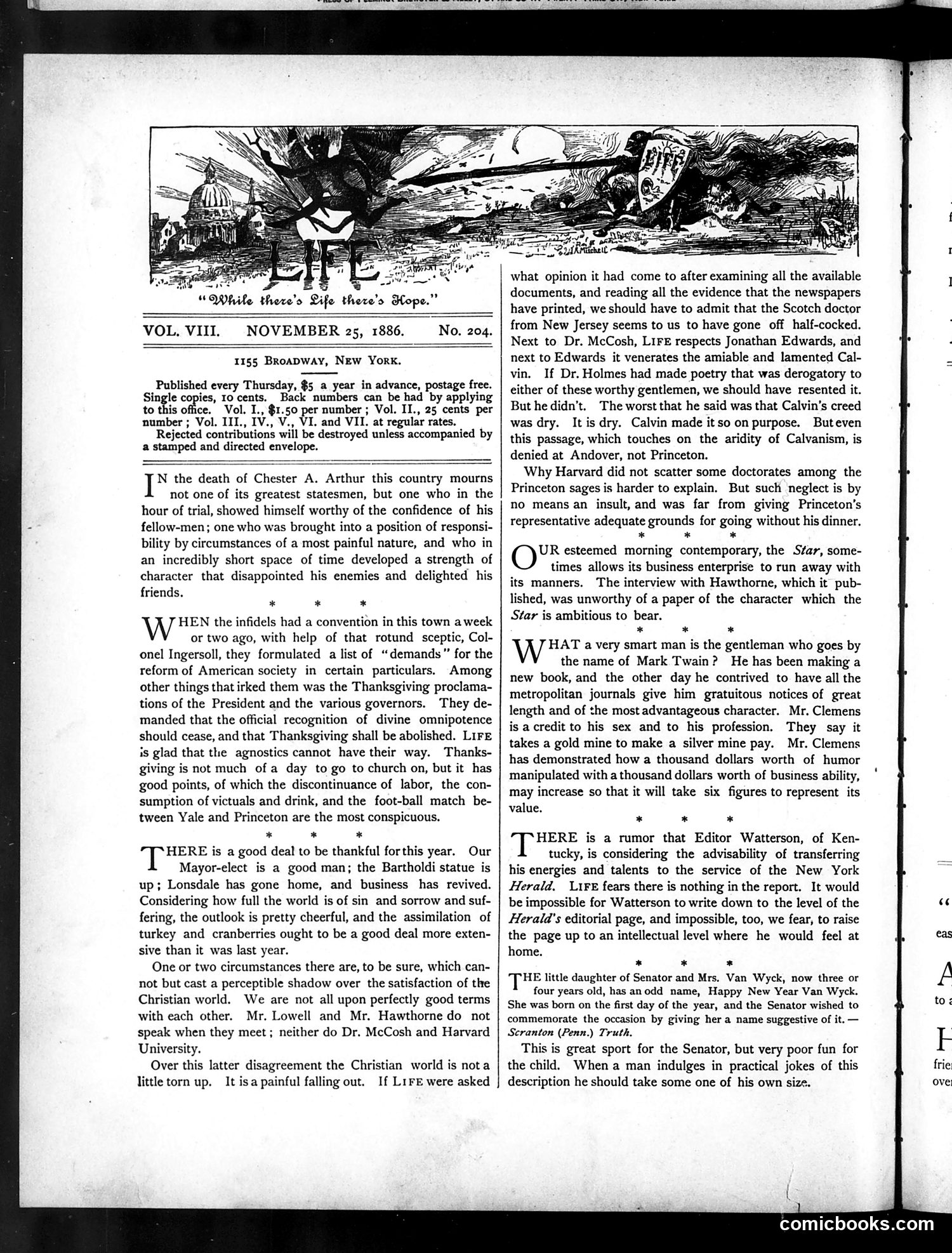
The masthead cartoon shows a classical landscape with a domed building (likely the Capitol) and what appears to be the Statue of Liberty or a similar monument on the right, with the caption "Wouldst there's Life there's Slope." The page contains editorial commentary rather than political cartoons. It discusses Chester A. Arthur's death, mocking his character. The text criticizes the "infidels" convention regarding Thanksgiving abolition, praises the Mayor-elect, and comments on Mark Twain's new book and editor Watterson of the *Herald*. There's gossip about Senator Evarts naming his newborn "Van Wyck" after a newspaper name, which Life ridicules as an undignified practical joke. The satire targets prominent public figures and institutions through written commentary rather than visual caricature on this particular page.
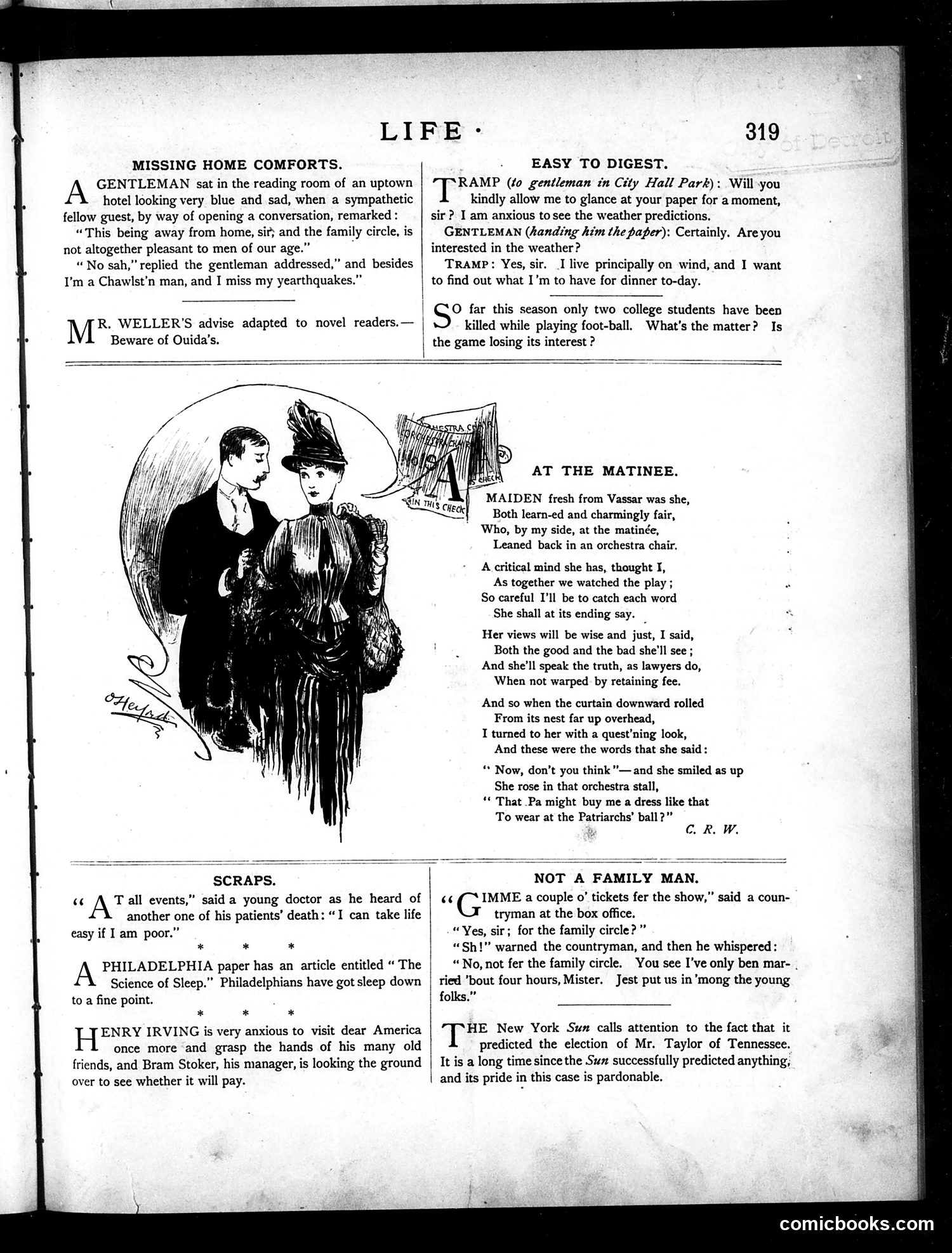
The page contains several satirical pieces rather than a single political cartoon: **"Missing Home Comforts"**: A brief anecdote mocking a homesick gentleman at an uptown hotel who complains about missing "yearearthquakes"—likely referencing California earthquakes, suggesting he's from there and oddly nostalgic for natural disasters. **"At the Matinee"**: A poem with accompanying illustration of a couple at a theater, humorously depicting a woman's critical observation of a play and her expectation of expensive gifts (a dress for the "Patriarch's ball"). **"Scraps" section**: Short humorous observations, including one about a doctor's casual attitude toward patients' deaths and another about Henry Irving visiting America. The content is domestic comedy and light social satire rather than political commentary.
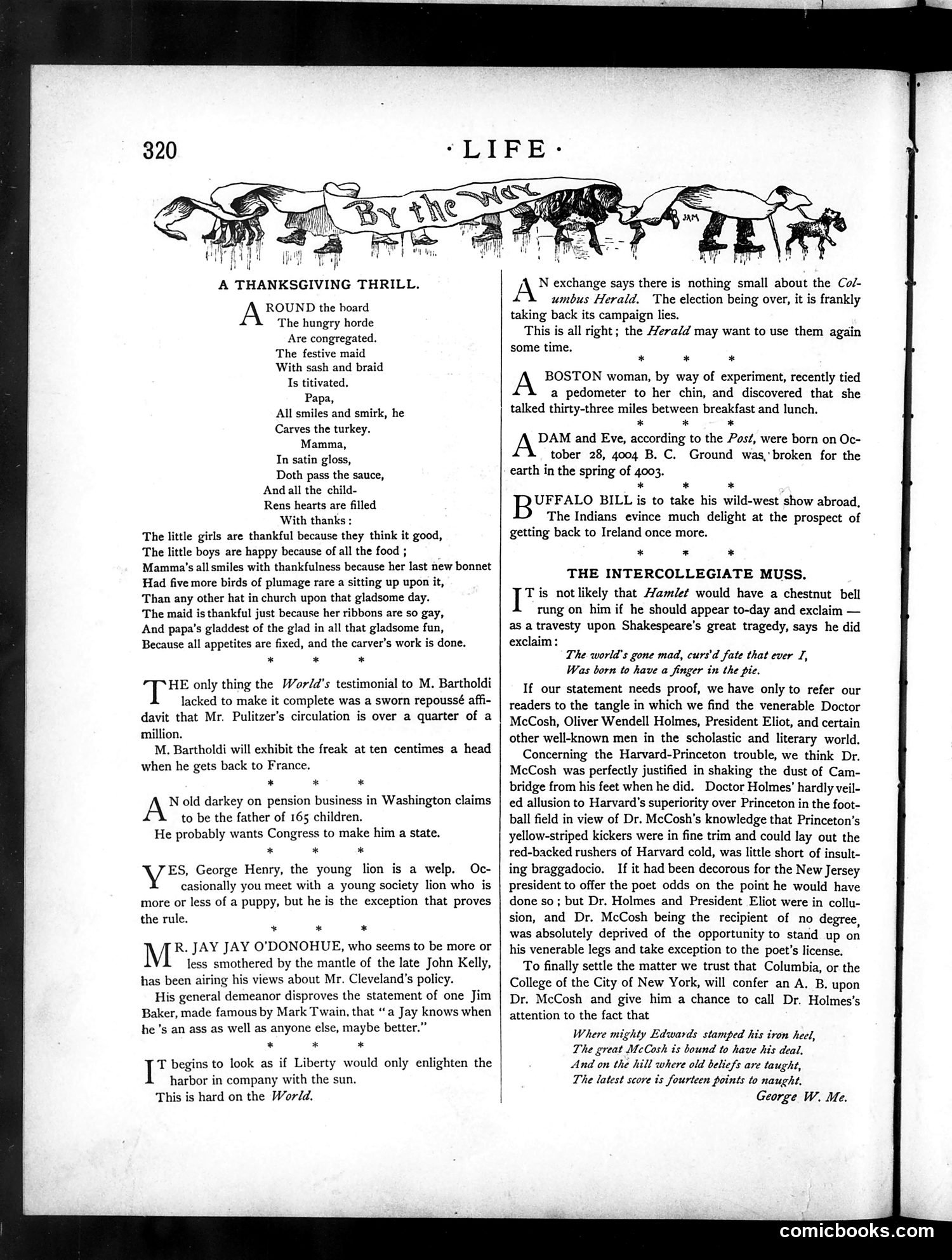
The page contains satirical commentary and verse rather than political cartoons. The decorative header depicts various animals in a procession. **"A Thanksgiving Thrill"** is a humorous poem about a family carving turkey, celebrating the holiday's traditional pleasures. **Other brief items** mock contemporary figures and events: a Boston woman's pedometer experiment, a reference to Adam and Eve's supposed October 28, 4004 B.C. birth date, and Buffalo Bill's planned wild-west show abroad. **"The Intercollegiate Muss"** satirizes an academic dispute, likely involving Harvard-Princeton athletic rivalry and quotations from Hamlet. The piece criticizes Dr. McCosh's handling of a controversy, suggesting Columbia College should resolve the matter by conferring a degree upon the disputant. The satire targets academic pomposity and institutional rivalry common to 1880s higher education.
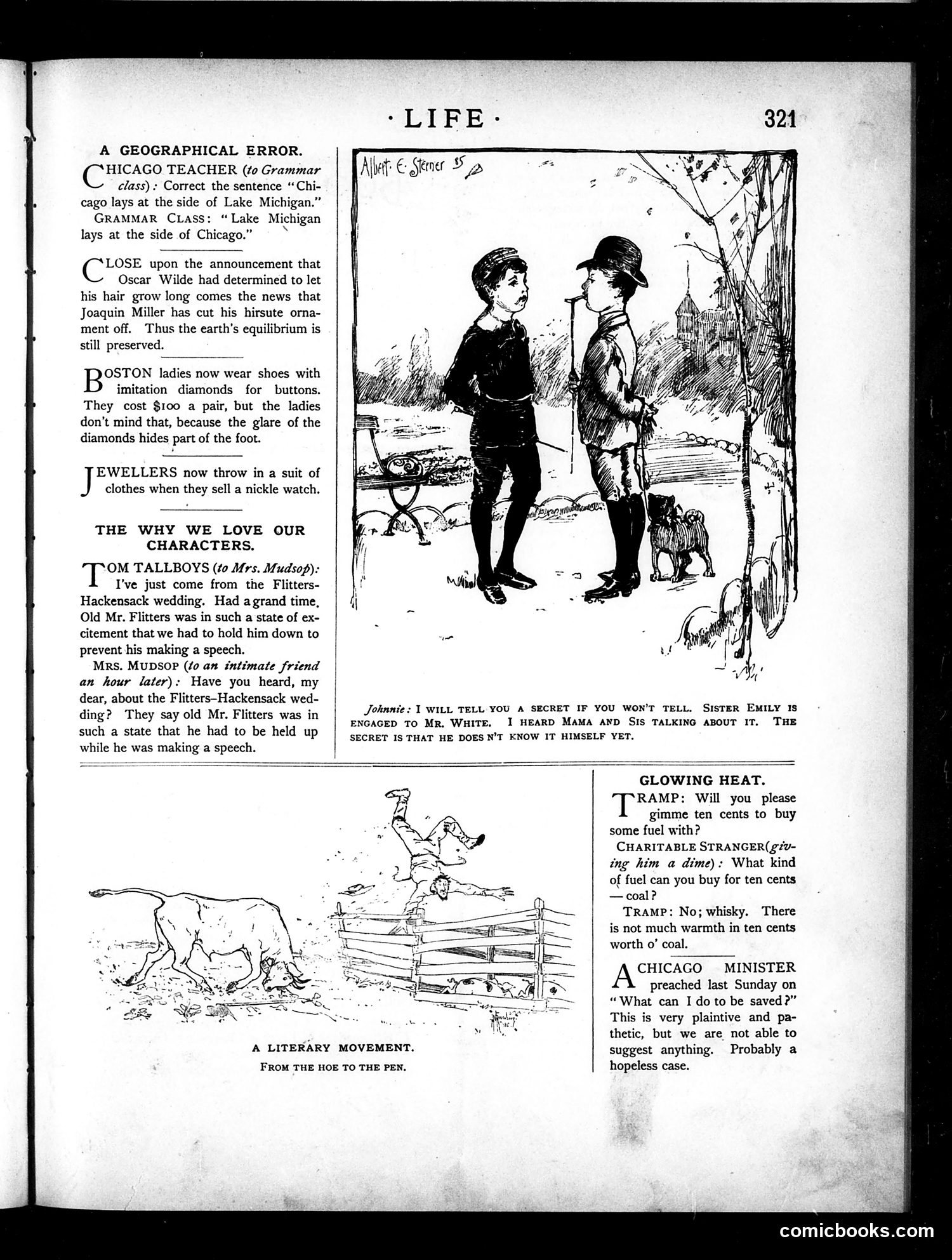
This page contains several brief satirical items rather than a single cartoon: **"A Geographical Error"** mocks a Chicago teacher's correction, creating absurdist humor through circular logic about Lake Michigan's location relative to Chicago. **"Close upon the announcement..."** jokes about Oscar Wilde letting his hair grow long after hearing Joaquin Miller cut his hirsute ornament. **"The Why We Love Our Characters"** section presents humorous anecdotes about fictional characters (Tom Tallboys, Mrs. Mudsop), suggesting readers' attachment to serialized characters. The main illustration shows two boys and a dog on a street, with dialogue about keeping secrets regarding "Sister Emily" and "Mr. White"—a gentle domestic scene with juvenile humor. **"A Literary Movement"** (lower left) uses a cow illustration for wordplay: "From the Hoe to the Pen." The page represents *Life*'s typical mix of light social satire and domestic humor aimed at genteel readers.
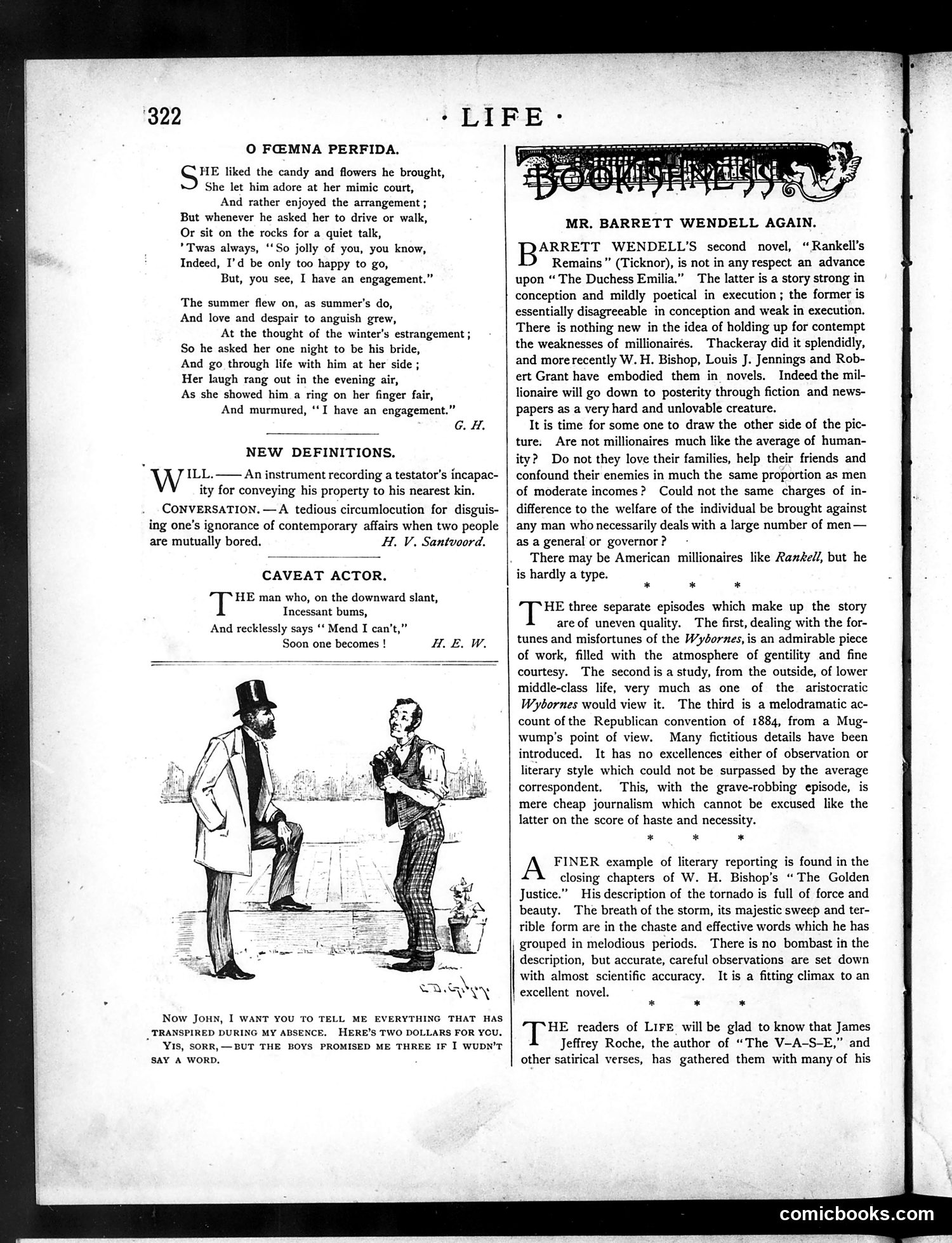
This cartoon illustrates the adage "Caveat Actor" (let the actor beware). It depicts two men in conversation on a street: a well-dressed man in a top hat speaking to a shabbily-dressed working man. The caption reads: "Now John, I want you to tell me everything that has transpired during my absence. Here's two dollars for you. Yes, sore,—but the boys promised me three if I wasn't say a word." The satire critiques **bribery and moral compromise**. The wealthy man attempts to buy silence from the working man by offering payment, while the working man admits others have offered him more to stay quiet. The joke mocks how easily principles are sacrificed for money and how the poor are caught between competing financial inducements—with their integrity becoming a commodity for auction among the wealthy.
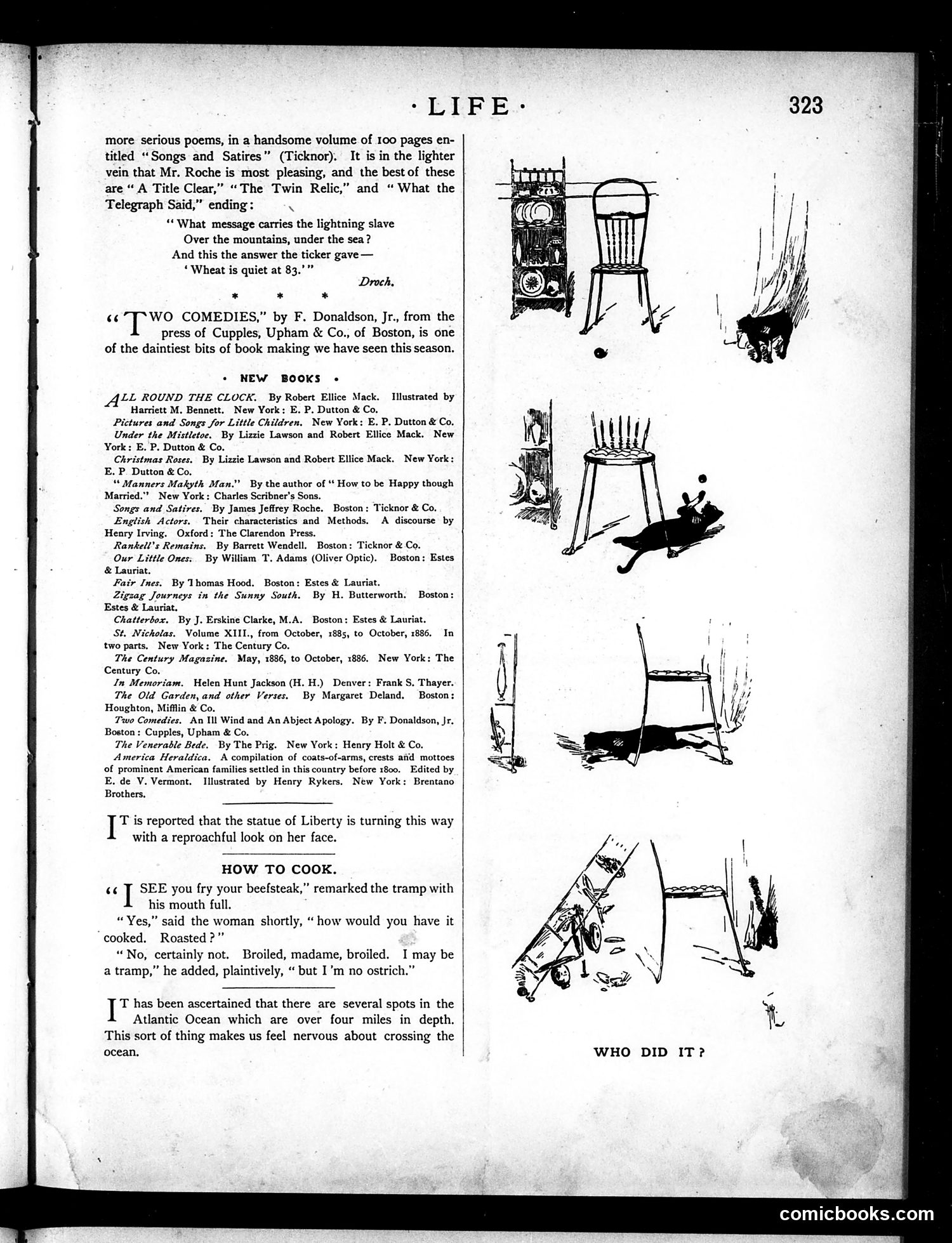
This page contains **three distinct sections**: 1. **Book Reviews** - A literary section listing new publications from the 1880s, including works on cooking, travel, and history. This appears to be standard magazine content rather than satire. 2. **"How to Cook"** - A humorous anecdote about a woman instructing a tramp on cooking beefsteak, with the joke being his insistence on broiling rather than roasting ("I may be a tramp, but I'm no ostrich"). This is gentle domestic humor. 3. **"Who Did It?"** - The right side features **untitled cartoon sketches** showing chairs tipping over and a device malfunctioning. The caption "WHO DID IT?" suggests these are meant to humorously depict accidents or pranks, though without clearer context, the specific satirical target remains unclear. The page mixes literary content with light humor typical of *Life* magazine's era.
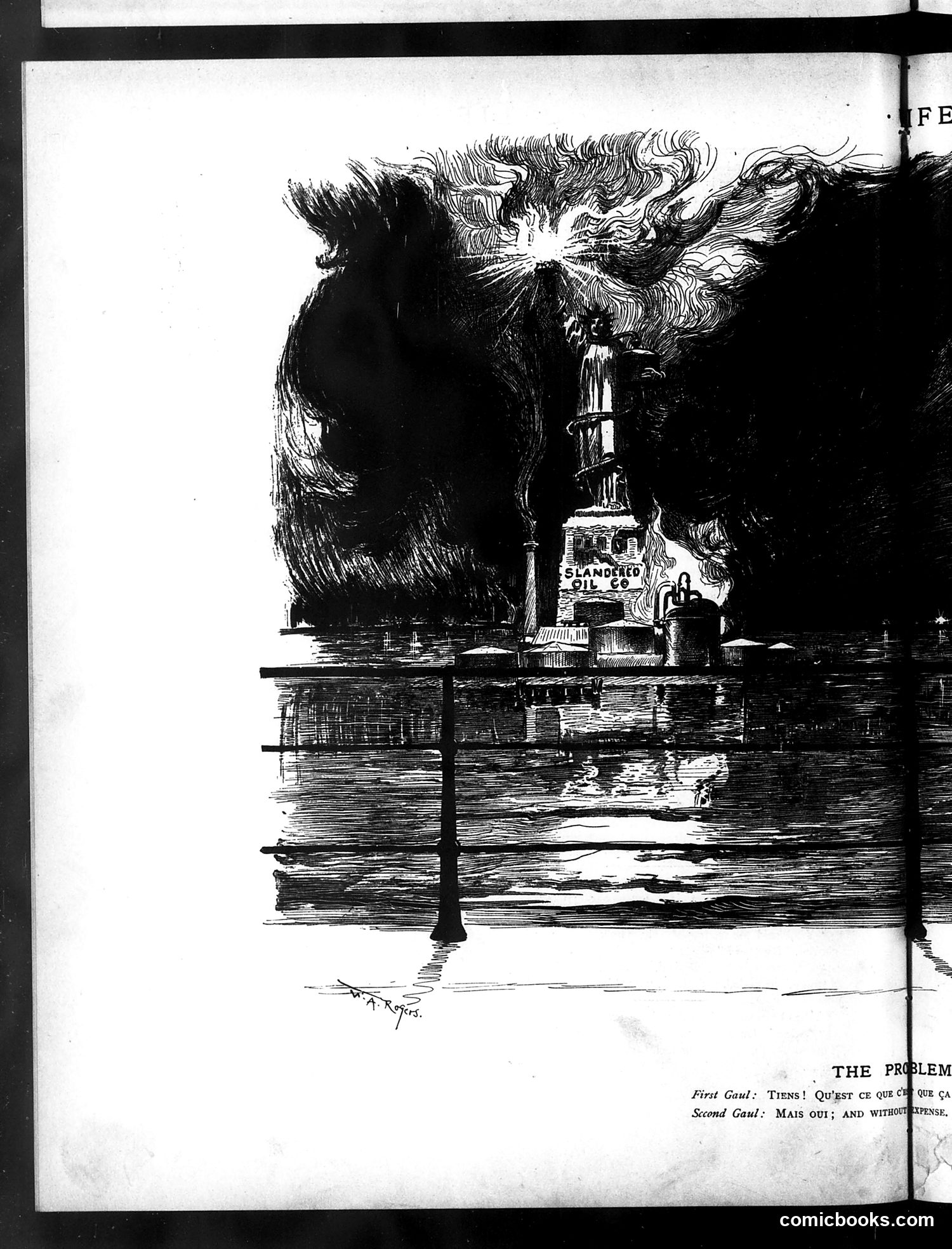
This cartoon depicts an industrial disaster scenario, likely from the early 20th century. A massive oil geyser erupts violently from a "Standard Oil Co." facility situated on a dock or pier. The dramatic, chaotic spray dominates the composition, suggesting catastrophic environmental or industrial damage. The caption's dialogue—in French—indicates this is satirical commentary on Standard Oil's operations, presumably mocking the company's environmental carelessness or public hazard. The contrast between the controlled industrial structure and the uncontrollable natural force suggests criticism of corporate hubris or inadequate safety measures. The "problem" appears to reference the social/environmental consequences of unregulated industrial expansion during the Gilded Age, when Standard Oil faced substantial public scrutiny and antitrust concerns.
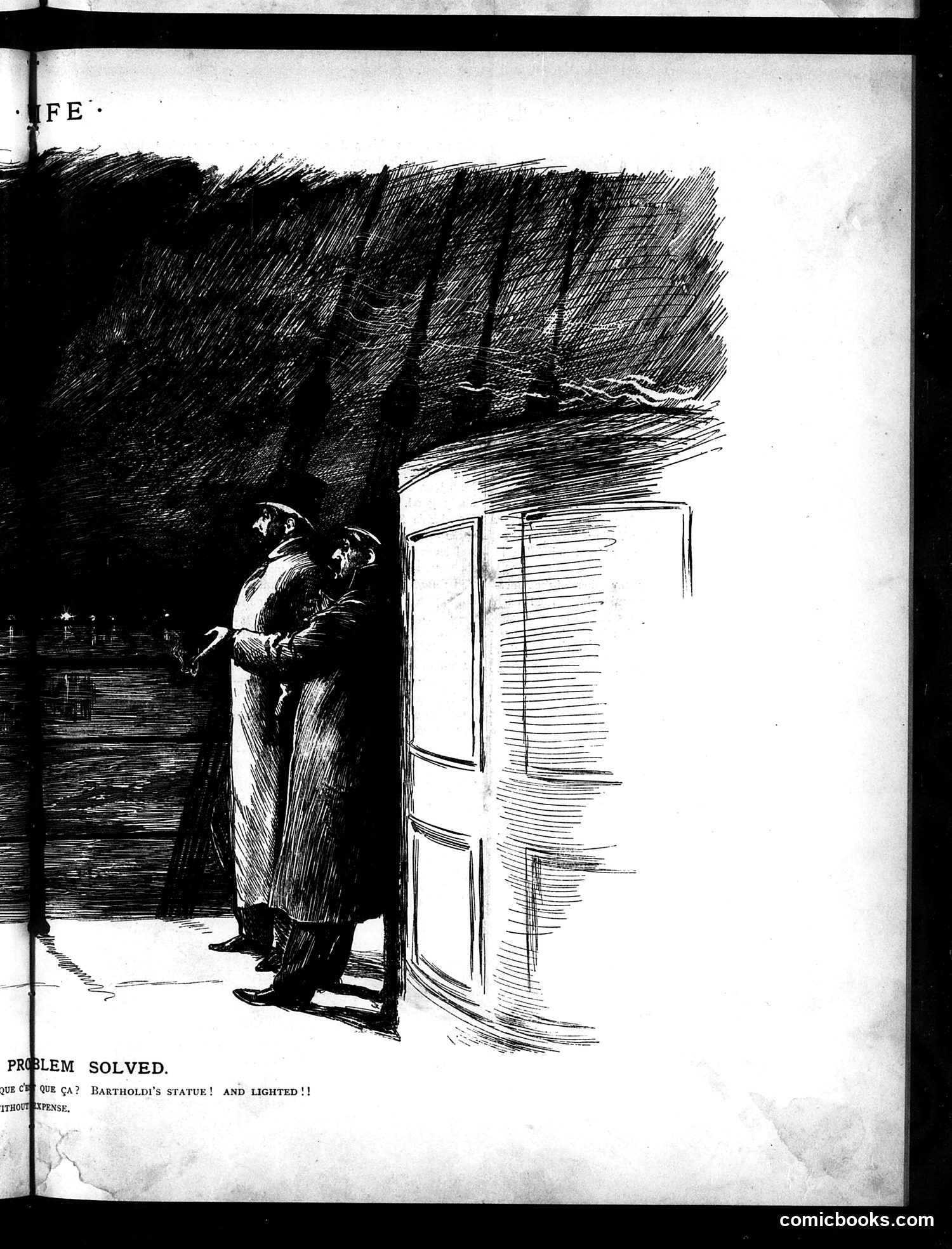
This is a single-panel cartoon titled "PROBLEM SOLVED," showing a figure in period dress standing before an open door, looking outward into darkness. The caption reads: "QUE CA? QUE CA? BARTHOLDI'S STATUE! AND LIGHTED!! WITHOUT EXPENSE." The cartoon appears to reference the Statue of Liberty (created by French sculptor Frédéric Auguste Bartholdi) and likely addresses a contemporary debate about illuminating the monument. The figure's French expressions ("Que ça?") and the ironic tone of "without expense" suggest satire about either proposals to light the statue or disputes over funding its installation/maintenance. The humor lies in the impractical or absurd solution being presented—the door opening to darkness renders the "lighting" solution ironic or nonsensical.
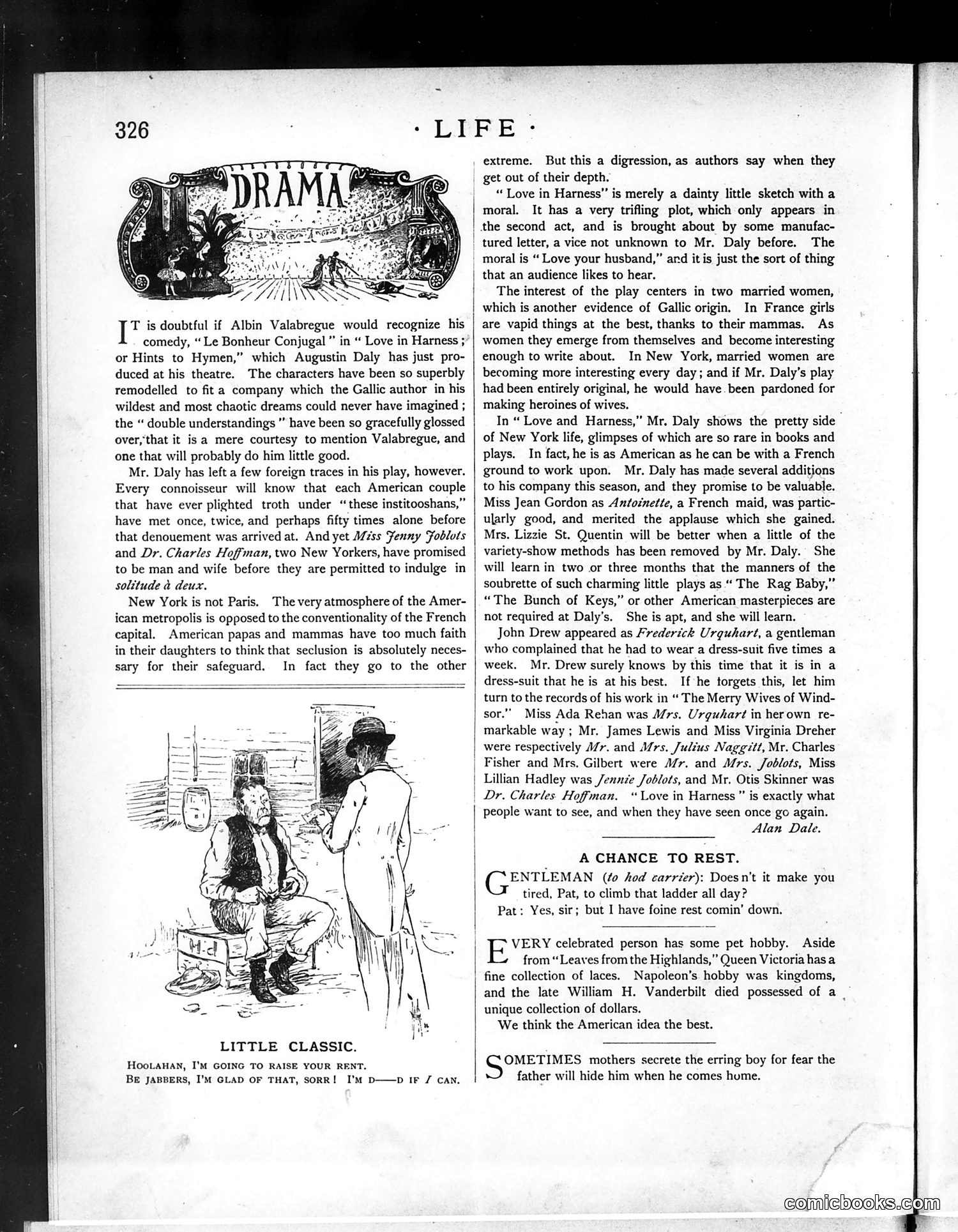
This cartoon depicts a working-class scene where a man sits exhausted while another stands nearby. The caption reads: "Hoolahan, I'm going to raise your rent. Be jabbers, I'm glad of that, sorry! I'm d——d if I can." The joke satirizes Irish immigrant tenants and landlords through ethnic dialect humor (common in early 20th-century Life magazine). "Hoolahan" is a stereotypical Irish name. The tenant paradoxically welcomes a rent increase because it means his landlord will finally receive payment—suggesting he's been unable to pay rent previously. The humor relies on the irony that bad economic circumstances for tenants somehow benefit landlords, and the relieved tone suggests resignation to perpetual financial struggle.
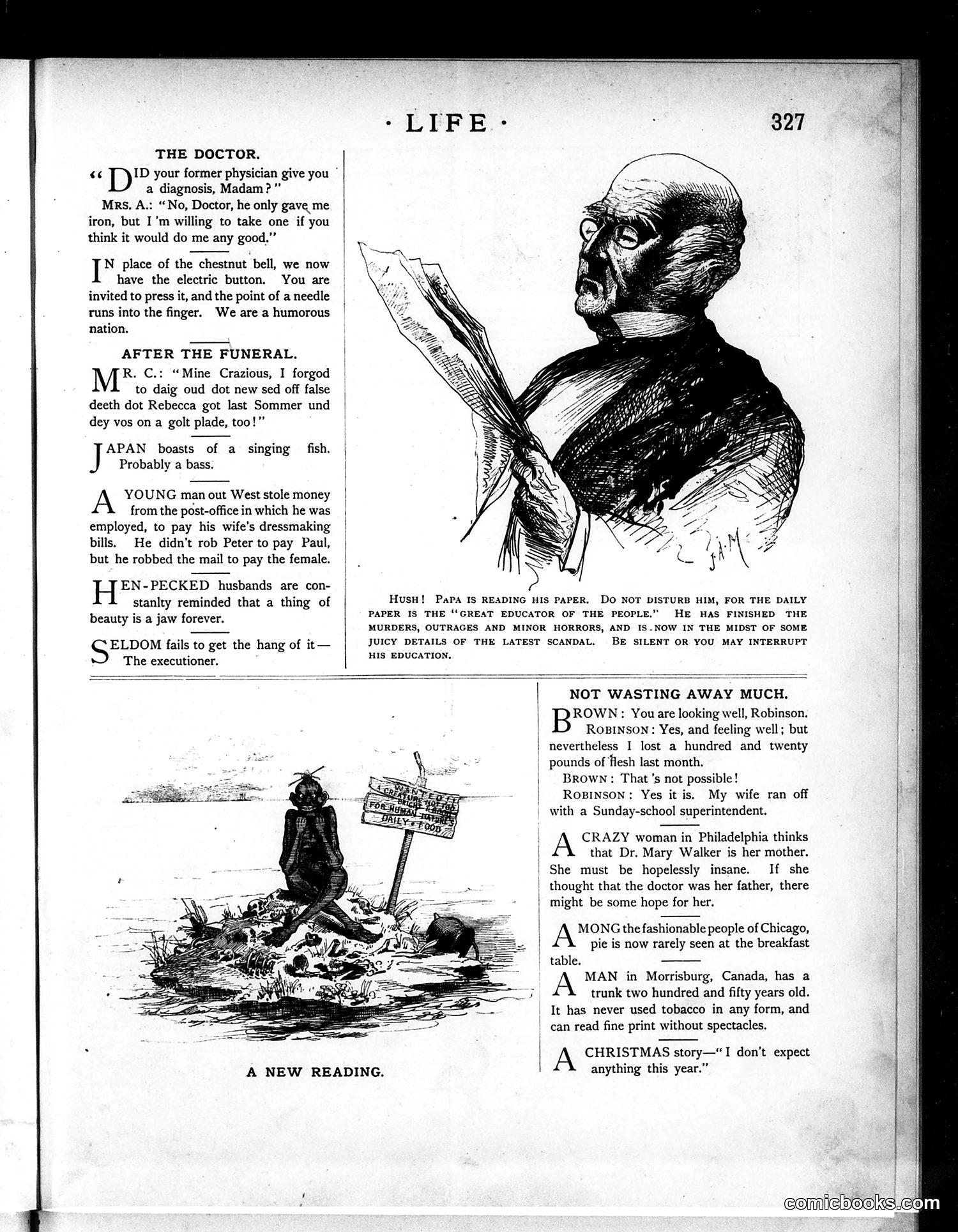
This page from *Life* magazine—America's premier satirical weekly—collects brief jokes and humorous observations on contemporary social life, circa early 20th century. **Key satirical targets:** - **"The Doctor"**: Mocks both physicians' vague diagnoses and patients' gullible acceptance of medical advice. - **"Electric button" joke**: Criticizes Americans' embrace of new technology as inherently amusing rather than practical. - **"After the Funeral"**: Uses exaggerated ethnic dialect (German-Jewish accent) for humor at immigrants' expense—a period convention. - **The large illustration** captioned "A New Reading" satirizes newspaper consumption: men absorbed in scandal and crime coverage while claiming newspapers are "great educators." - **"Not Wasting Away Much"**: Dark humor about a man losing weight because his wife left him—treating marital abandonment as comedic. - **Dr. Mary Walker reference**: Assumes readers know this was a real woman doctor/women's rights advocate, used here to mock female ambition. The page reflects *Life*'s target audience: educated urban readers who enjoyed satirizing social pretension, immigrant stereotypes, and modern anxieties.
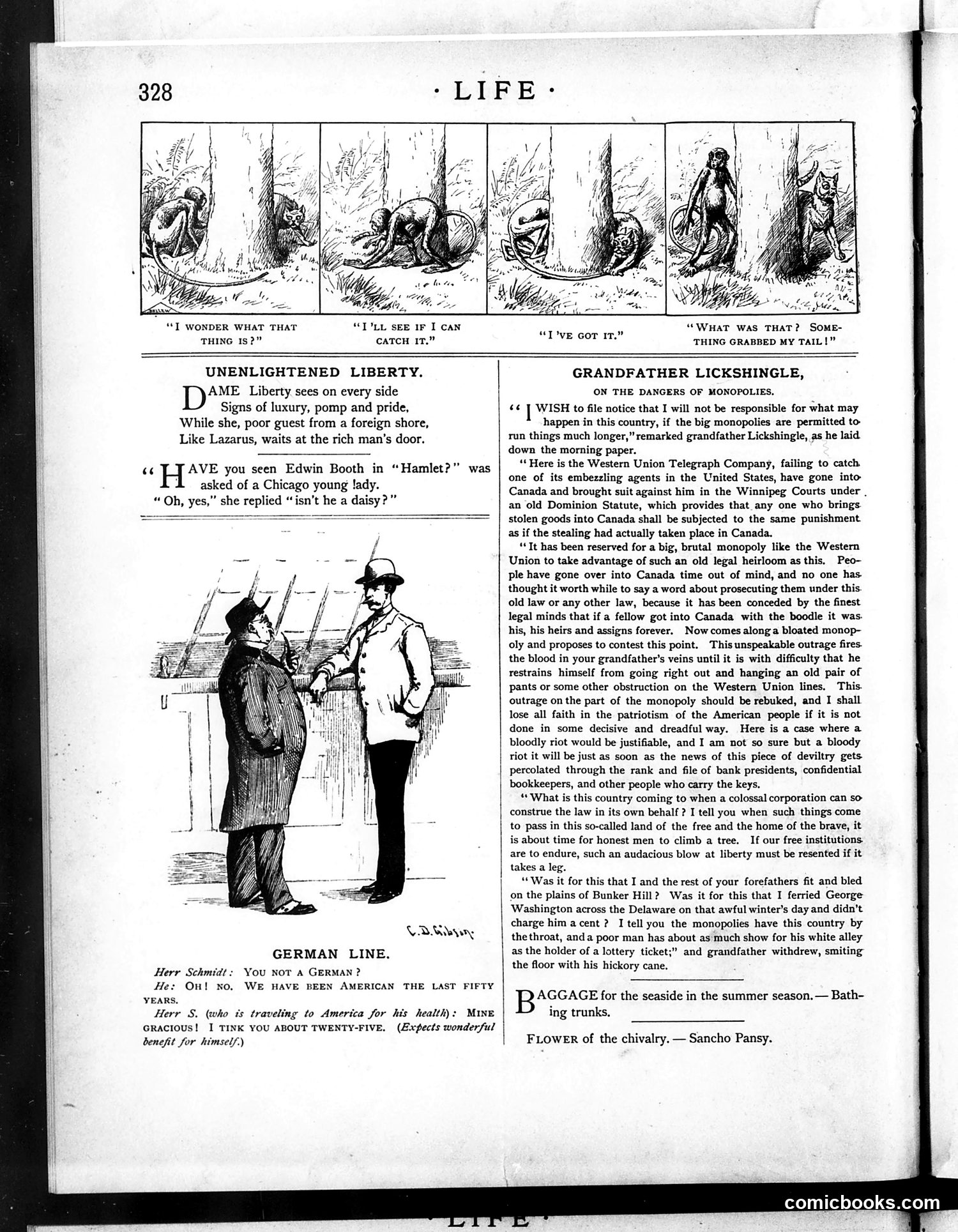
This page contains multiple satirical pieces critiquing American society around the turn of the 20th century. **Top comic strip:** Shows animals encountering something mysterious, likely mocking human curiosity or foolishness. **"Unenlightened Liberty":** A poem lamenting that Lady Liberty, despite America's wealth and luxury, remains poor and neglected—a critique of inequality. **"German Line" joke:** Plays on immigrant assimilation anxiety. A German traveler is mistaken for American, then corrected; the punchline suggests 25 years in America hasn't truly made him American, satirizing nativist skepticism toward immigrants. **"Grandfather Lickshingle":** The main piece attacks **monopolies**, specifically Western Union. The fictional grandfather rails against the telegraph company pursuing an embezzler into Canada using old colonial law—behavior he views as corporate overreach destroying American freedoms. His invocation of Revolutionary heroes (Bunker Hill, Washington) frames monopoly power as anti-patriotic tyranny crushing ordinary citizens. This reflects genuine Progressive Era anxiety about corporate consolidation undermining democratic values.
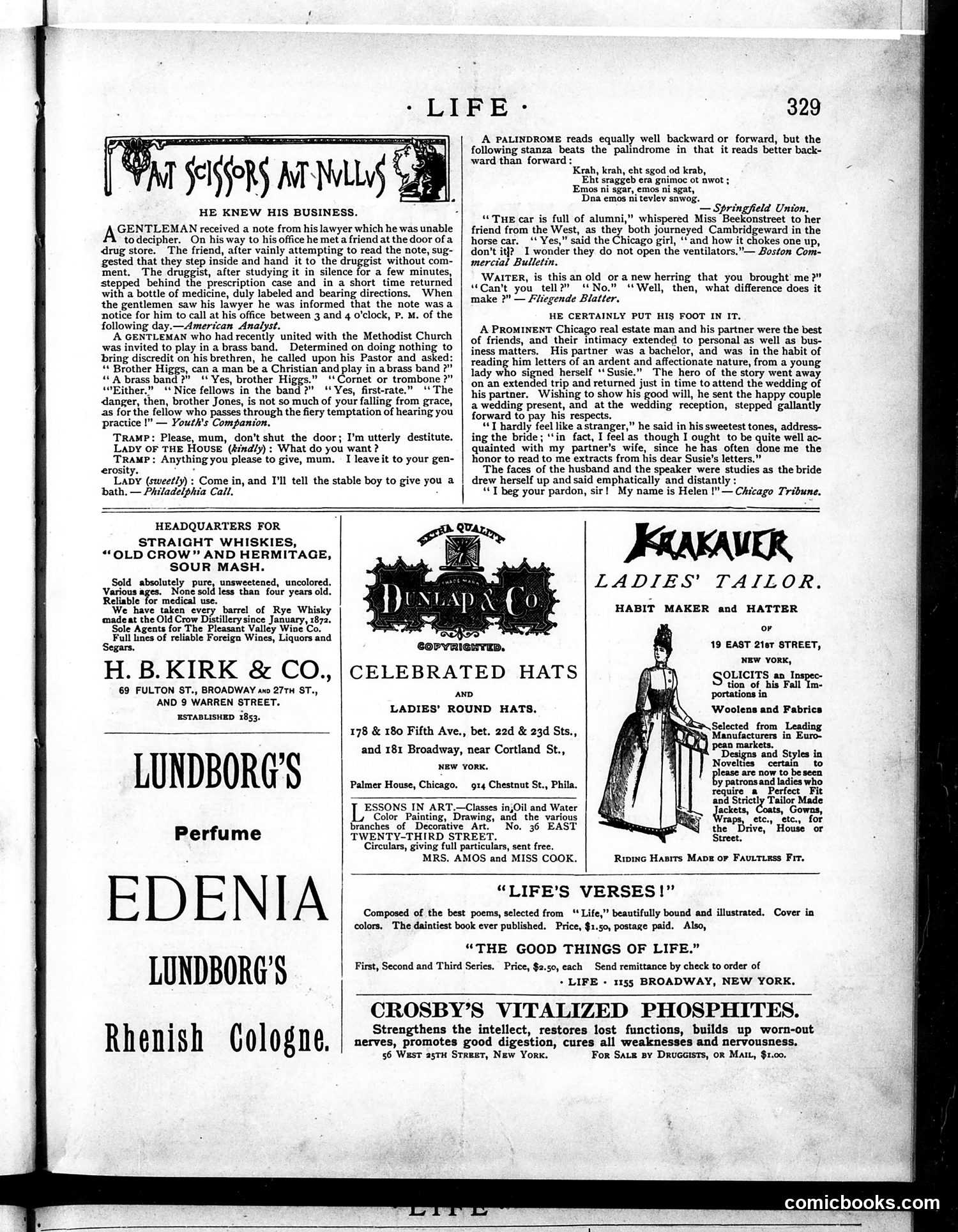
This page contains several short humorous anecdotes typical of early Life magazine's satirical style: 1. **The Lawyer's Note**: A gentleman's illegible lawyer letter is mistaken for a prescription by a druggist—humor based on handwriting illegibility and professional confusion. 2. **The Brass Band Joke**: A Methodist pastor warns a new church member that playing in a brass band poses less danger to *him* than to others who must *hear* him practice—gentle satire of amateur musicians. 3. **The Palindrome**: A reversed verse about dogs barking and beggars arriving reads better backward than forward—wordplay humor. 4. **The Ventilators**: A woman confuses "alumni" with something choking—likely plays on pronunciation or class differences. 5. **The Wedding Disaster**: A man publicly embarrasses himself by claiming intimacy with his partner's bride based on love letters the partner read aloud—humor from miscommunication and social awkwardness. The page is primarily advertising (perfume, whiskey, hats, tailoring services) with these jokes scattered between ads.
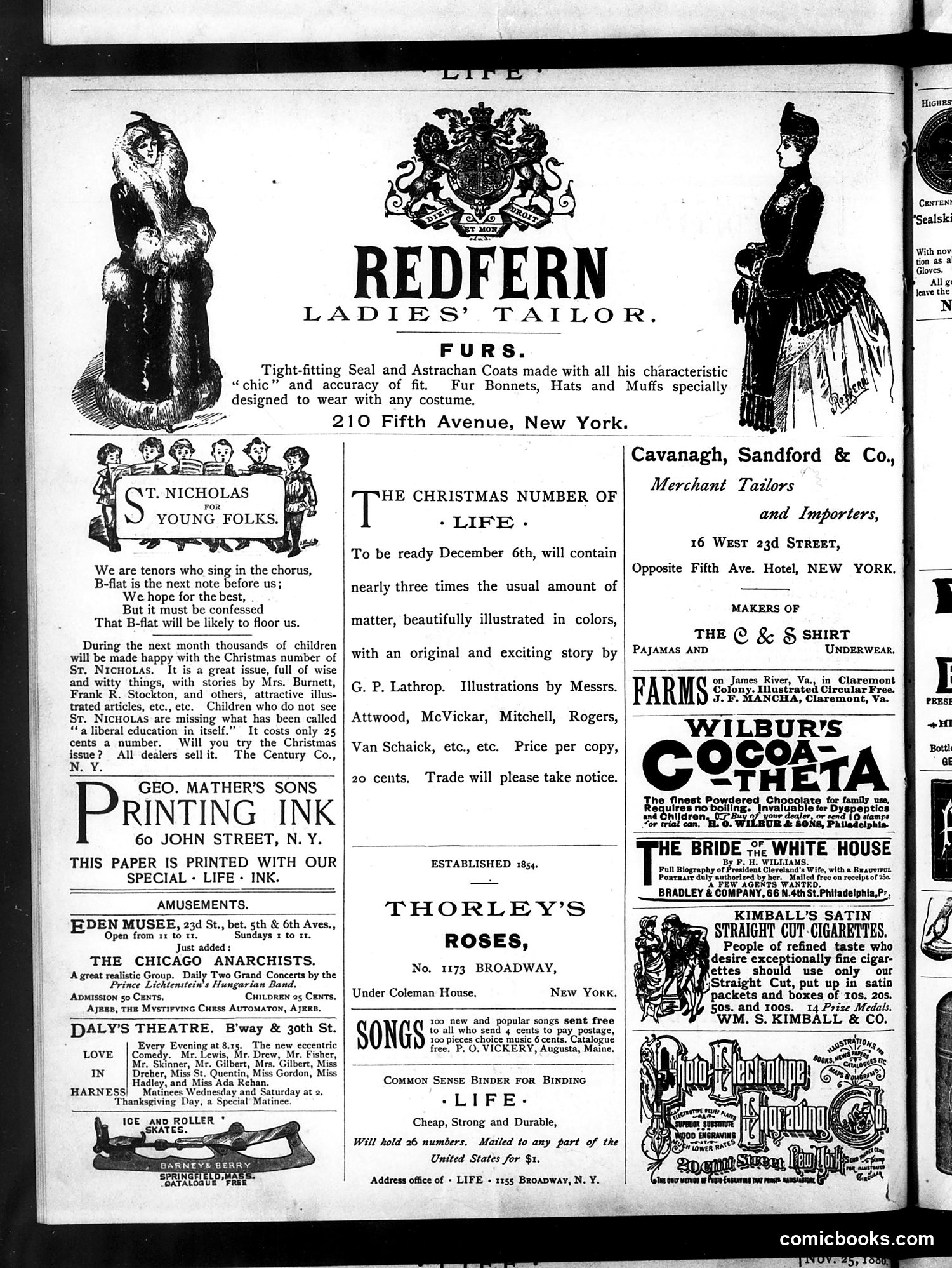
This appears to be primarily an **advertising page** from Life magazine, circa the 1880s, with minimal editorial content. The page contains one small humorous item: a brief verse titled "St. Nicholas for Young Folks" depicting tenors in a chorus struggling to hit the note B-flat—a simple musical joke about singers being out of their depth. The rest is advertising: high-end women's fashion (Redfern furs, Cavanagh tailoring), chocolates, cigarettes, theater listings, and the Christmas issue announcement for Life itself. There's also a reference to Eden Musee's display of "The Chicago Anarchists" (likely a wax museum attraction capitalizing on contemporary anarchist violence concerns), though this isn't satirical commentary—just promotional. No political cartoons, social satire, or caricatures appear on this page. It's essentially a commercial publication page with one minor light-verse joke.
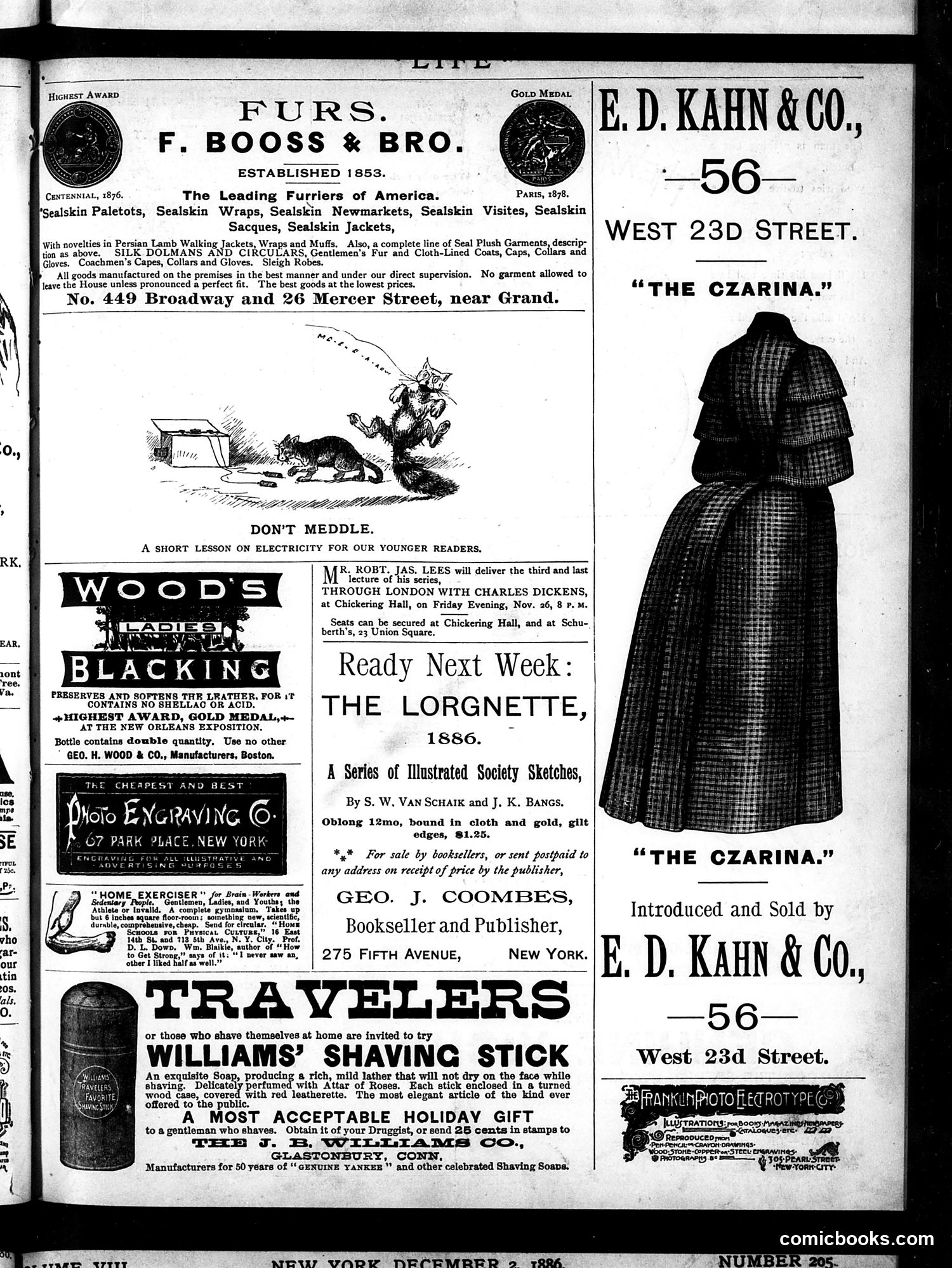
This page is primarily **advertisements** for Victorian-era products (furs, shaving soap, books), but features one small **political cartoon** titled "Don't Meddle: A Short Lesson on Electricity for Our Younger Readers." The cartoon depicts a rat touching an electrified wire or device. The joke is a safety warning: curious children (compared to the rat) should not tamper with electrical equipment, which was still relatively new and dangerous in the 1880s. The "lesson" uses the rat as a cautionary example—just as the rat learns not to "meddle" with electricity through painful consequences, children should similarly avoid touching unfamiliar electrical apparatus. This reflects genuine period concerns about electrical safety during the early era of widespread electrification in American cities. The satire is gentle and educational rather than politically pointed.
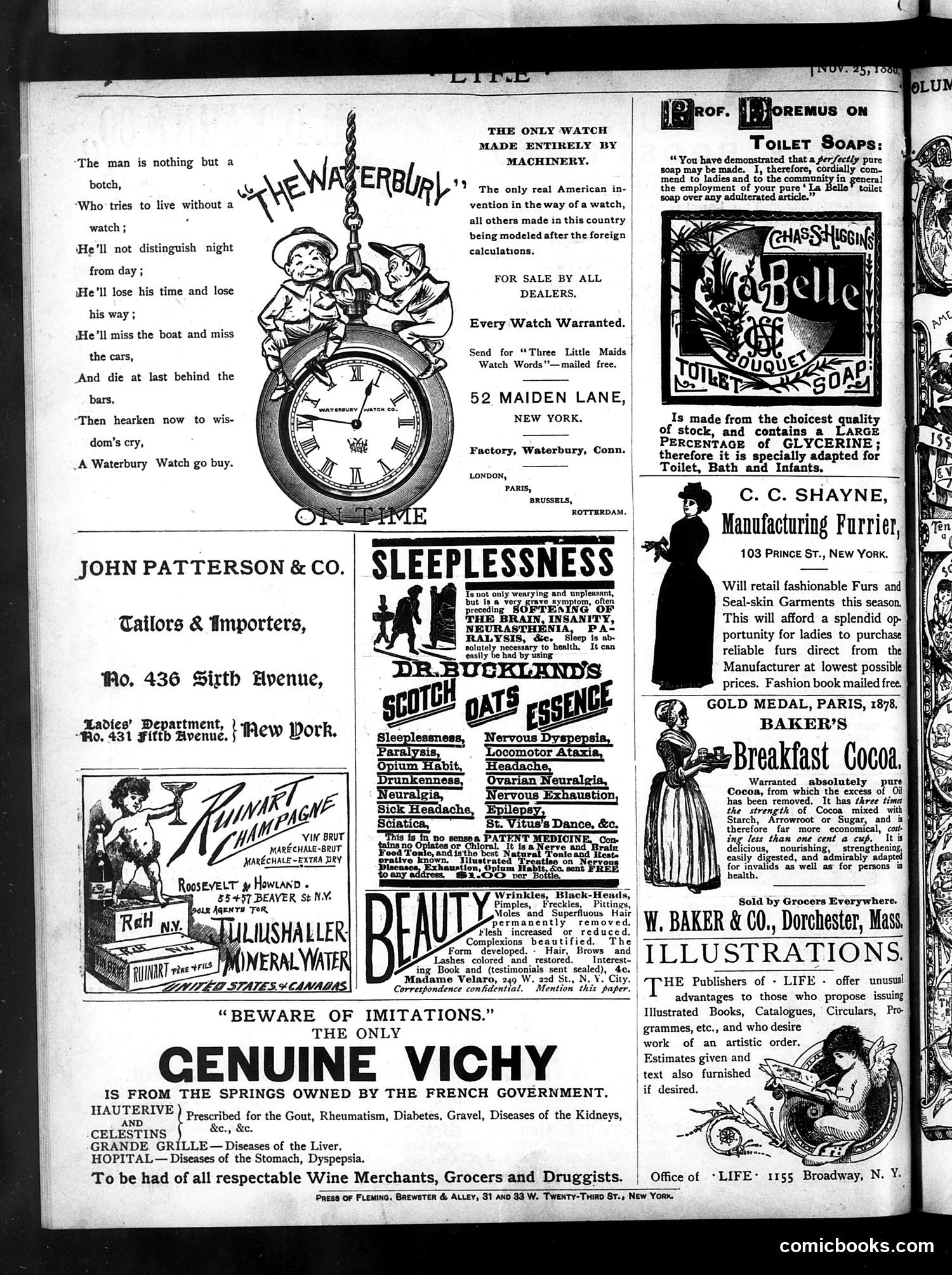
This is primarily an **advertising page** with one notable satirical poem. The main content is: **The Waterbury Watch Advertisement** (left): Features a poem mocking a man without a watch—calling him a "botch" who can't distinguish day from night, loses time and his way, and ultimately dies "behind the bars." It's a humorous exaggeration promoting Waterbury watches as essential to modern life and respectability. The watch imagery shows two figures riding a giant clock face, emphasizing the product's centrality. **Surrounding Advertisements**: The page is dominated by period patent medicines and consumer goods—soaps, mineral water, cocoa, furs—all making health and purity claims typical of late-19th-century marketing. These ads reflect the era's concerns about "adulteration" of products and anxiety about health. **Social Context**: The satire assumes watches symbolize civilization, punctuality, and masculine respectability—lacking one marked you as fundamentally unreliable. This reflects industrial-era values prioritizing timekeeping and efficiency.