
Life, 1886-11-25 · page 10 of 16
Life — November 25, 1886 — page 10: what you’re looking at
What you’re looking at
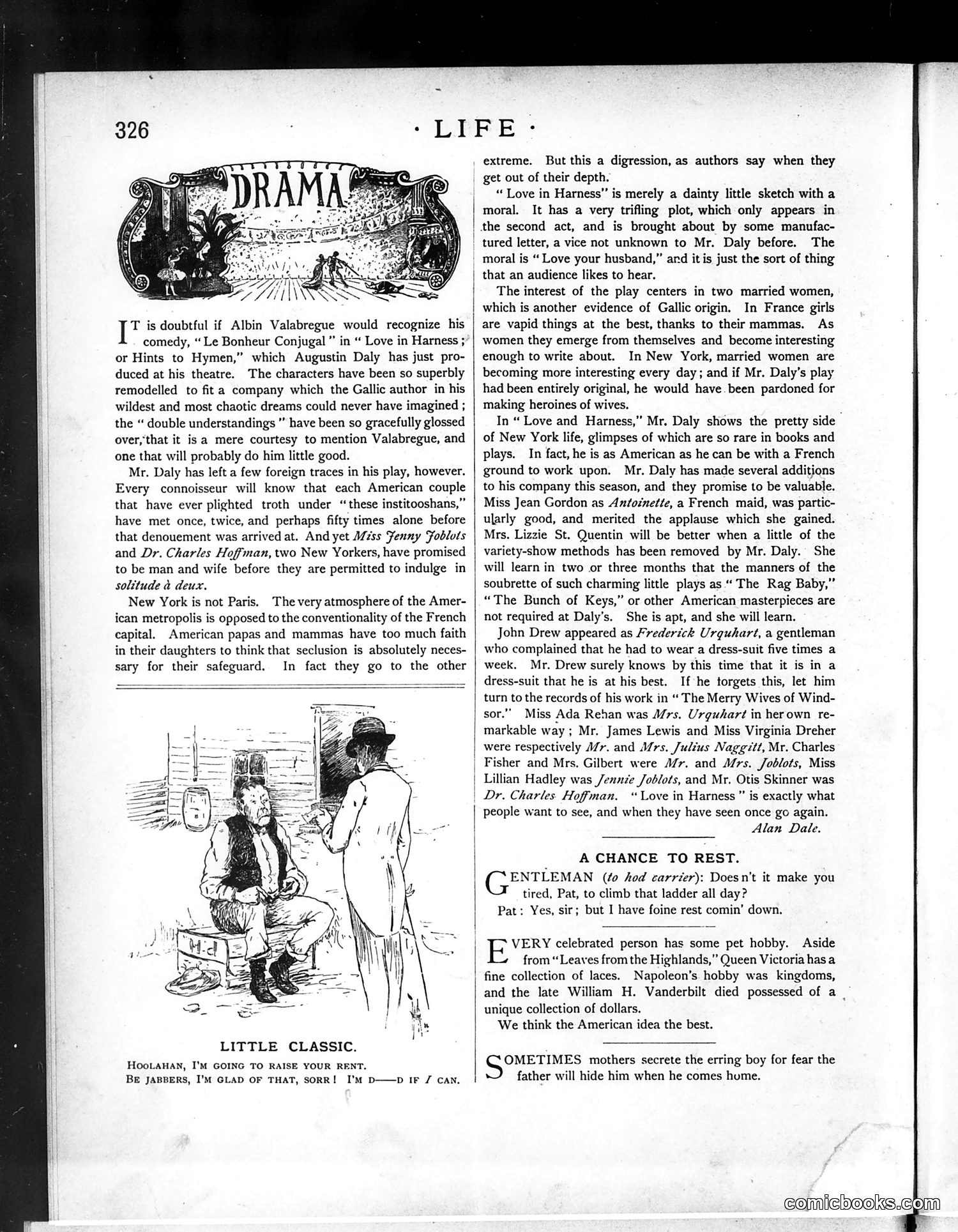
This cartoon depicts a working-class scene where a man sits exhausted while another stands nearby. The caption reads: "Hoolahan, I'm going to raise your rent. Be jabbers, I'm glad of that, sorry! I'm d——d if I can." The joke satirizes Irish immigrant tenants and landlords through ethnic dialect humor (common in early 20th-century Life magazine). "Hoolahan" is a stereotypical Irish name. The tenant paradoxically welcomes a rent increase because it means his landlord will finally receive payment—suggesting he's been unable to pay rent previously. The humor relies on the irony that bad economic circumstances for tenants somehow benefit landlords, and the relieved tone suggests resignation to perpetual financial struggle.
📄 Transcribed text from this page (OCR, searchable)
Machine-transcribed from the original scan — historical spelling and the odd misread are preserved.
- LYFE : T is doubtful if Albin Valabregue would recognize his comedy, “Le Bonheur Conjugal ” in “ Love in Harness ; or Hints to Hymen,” which Augustin Daly has just pro- duced at his theatre. The characters have been so superbly remodelled to fit a company which the Gallic author in his wildest and most chaotic dreams could never have imagined ; the “ double understandings ” have been so gracefully glossed over,that it isa mere courtesy to mention Valabregue, and one that will probably do him little good. Mr. Daly has left a few foreign traces in his play, however. Every connoisseur will know that each American couple that have ever plighted troth under “these institooshans,” have met once, twice, and perhaps fifty times alone before that denouement was arrived at. And yet Miss Fenny Foblots and Dr. Charles Hoffman, two New Yorkers, have promised to be man and wife before they are permitted to indulge in | solitude & deux. New York is not Paris. The very atmosphere of the Amer- ican metropolis is opposed to the conventionality of the French capital. American papas and mammas have too much faith in their daughters to think that seclusion is absolutely neces- sary for their safeguard. In fact they go to the other LITTLE CLASSIC. HooLanan, I'M GOING TO RAISE YOUR RENT. BE JABBERS, I’M GLAD OF THAT, SORR! I'm D——D | fine collection of laces. extreme. But this a digression, as authors say when they get out of their depth. “Love in Harness” is merely a dainty little sketch with a moral. It has a very trifling plot, which only appears in the second act, and is brought about by some manufac- tured letter, a vice not unknown to Mr. Daly before. The moral is “ Love your husband,” and it is just the sort of thing | that an audience likes to hear. The interest of the play centers in two married women, which is another evidence of Gallic origin. In France girls are vapid things at the best, thanks to their mammas. As women they emerge from themselves and become interesting enough to write about. In New York, married women are becoming more interesting every day; and if Mr. Daly’s play had been entirely original, he would have. been pardoned for making heroines of wives. In “ Love and Harness,” Mr. Daly shows the pretty side of New York life, glimpses of which are so rare in books and plays. In fact, he is as American as he can be with a French ground to work upon. Mr. Daly has made several additions to his company this season, and they promise to be valuable. Miss Jean Gordon as Antoinette, a French maid, was partic- ularly good, and merited the applause which she gained. Mrs. Lizzie St. Quentin will be better when a little of the variety-show methods has been removed by Mr. Daly. She will learn in two or three months that the manners of the soubrette of such charming little plays as “ The Rag Baby,” “The Bunch of Keys,” or other American masterpieces are not required at Daly’s. She is apt, and she will learn. John Drew appeared as Frederick Urquhart, a gentleman who complained that he had to wear a dress-suit five times a week. Mr. Drew surely knows by this time that it is in a dress-suit that he is at his best. If he forgets this, let him | turn to the records of his work in “ The Merry Wives of Wind- sor.” Miss Ada Rehan was Mrs. Urguhart in her own re- markable way ; Mr. James Lewis and Miss Virginia Dreher were respectively M/r. and Mrs. Julius Naggitt, Mr. Charles Fisher and Mrs. Gilbert were M/r. and Mrs. Joblots, Miss Lillian Hadley was Jenne /oblots, and Mr. Otis Skinner was Dr. Charles: Hoffman. “ Love in Harness” is exactly what people want to see, and when they have seen once go again. Alan Dale. A CHANCE TO REST. ENTLEMAN (fo hod carrier): Doesn't it make you tired, Pat, to climb that ladder all day? Pat: Yes, sir; but I have foine rest comin’ down. VERY celebrated person has some pet hobby. Aside from “Leaves from the Highlands,” Queen Victoria has a Napoleon’s hobby was kingdoms, and the late William H. Vanderbilt died possessed of a _ unique collection of dollars. We think the American idea the best. OMETIMES mothers secrete the erring boy for fear the father will hide him when he comes hume. comichooks.