
Life, 1886-11-25 · page 6 of 16
Life — November 25, 1886 — page 6: what you’re looking at
What you’re looking at
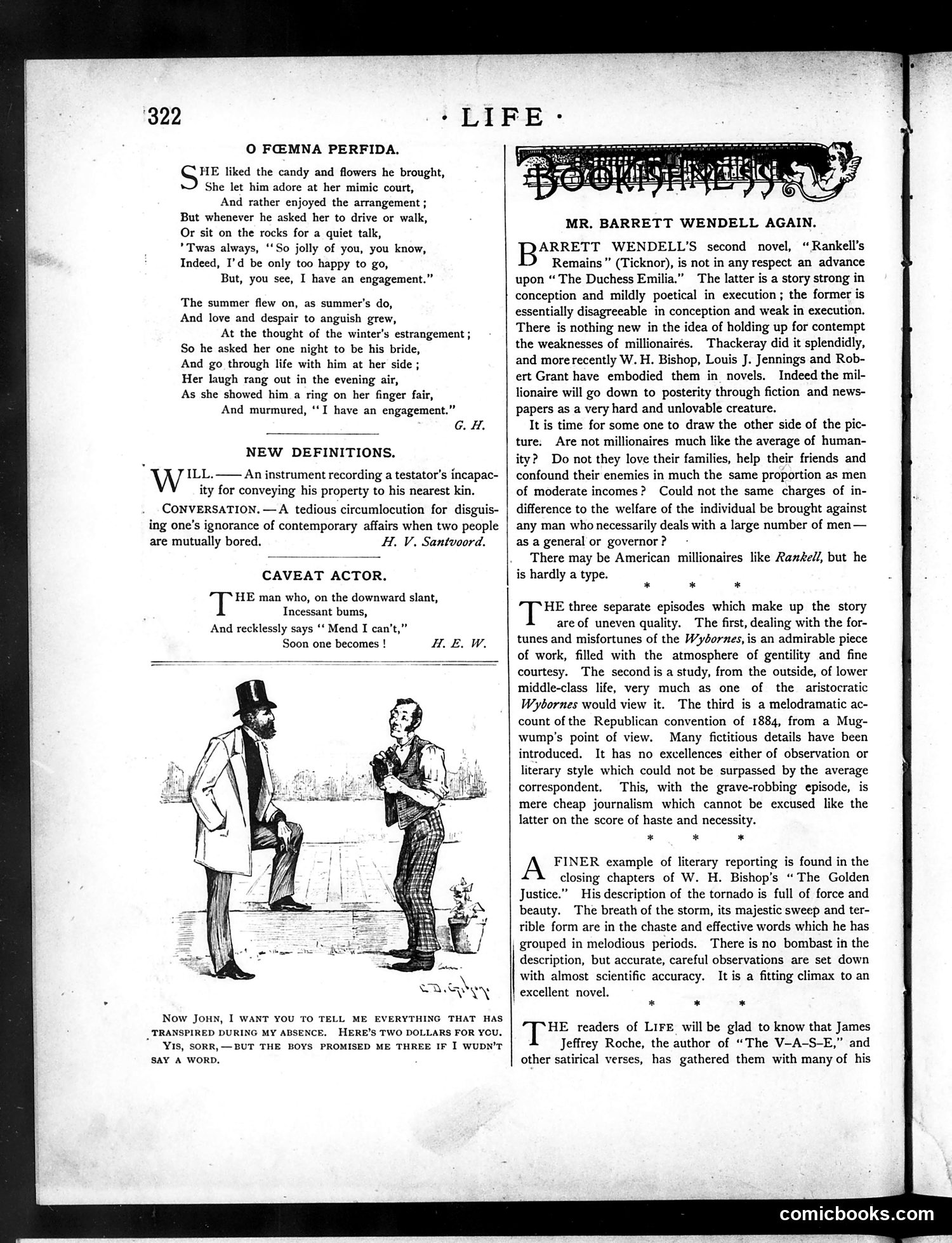
This cartoon illustrates the adage "Caveat Actor" (let the actor beware). It depicts two men in conversation on a street: a well-dressed man in a top hat speaking to a shabbily-dressed working man. The caption reads: "Now John, I want you to tell me everything that has transpired during my absence. Here's two dollars for you. Yes, sore,—but the boys promised me three if I wasn't say a word." The satire critiques **bribery and moral compromise**. The wealthy man attempts to buy silence from the working man by offering payment, while the working man admits others have offered him more to stay quiet. The joke mocks how easily principles are sacrificed for money and how the poor are caught between competing financial inducements—with their integrity becoming a commodity for auction among the wealthy.
📄 Transcribed text from this page (OCR, searchable)
Machine-transcribed from the original scan — historical spelling and the odd misread are preserved.
'322 O FG@MNA PERFIDA. St liked the candy and flowers he brought, She let him adore at her mimic court, And rather enjoyed the arrangement ; But whenever he asked her to drive or walk, Or sit on the rocks for a quiet talk, * Twas always, ‘So jolly of you, you know, Indeed, I’d be only too happy to go, But, you see, I have an engagement.” The summer flew on, as summer's do, And love and despair to anguish grew, At the thought of the winter's estrangement ; So he asked her one night to be his bride, And go through life with him at her side ; Her laugh rang out in the evening air, As she showed him a ring on her finger fair, And murmured, ‘‘I have an engagement.” G. A. NEW DEFINITIONS. ILL.— An instrument recording a testator’s incapac- ity for conveying his property to his nearest kin. CONVERSATION. —A tedious circumlocution for disguis- ing one’s ignorance of contemporary affairs when two people are mutually bored. Hi. V. Santvoord. CAVEAT ACTOR. HE man who, on the downward slant, Incessant bums, And recklessly says ‘‘ Mend I can't,” Soon one becomes ! HE. W. Now Joun, I WANT YOU TO TELL ME EVERYTHING THAT Has _ TRANSPIRED DURING MY ABSENCE. HERE'S TWO DOLLARS FOR YOU. YIs, SORR,—BUT THE BOYS PROMISED ME THREE IF I WUDN'T SAY A WORD. MR. BARRETT WENDELL AGAIN. ARRETT WENDELL’S second novel, “Rankell’s Remains” (Ticknor), is not in any respect an advance upon “ The Duchess Emilia.” The latter is a story strong in conception and mildly poetical in execution ; the former is essentially disagreeable in conception and weak in execution. There is nothing new in the idea of holding up for contempt the weaknesses of millionairés. Thackeray did it splendidly, and morerecently W. H. Bishop, Louis J. Jennings and Rob- ert Grant have embodied them in novels. Indeed the mil- lionaire will go down to posterity through fiction and news- papers as a very hard and unlovable creature. It is time for some one to draw the other side of the pic- ture. Are not millionaires much like the average of human- ity? Do not they love their families, help their friends and confound their enemies in much the same proportion as men of moderate incomes? Could not the same charges of in- difference to the welfare of the individual be brought against any man who necessarily deals with a large number of men— as a general or governor ? There may be American millionaires like Rankel/, but he is hardly a type. 7% ; . HE three separate episodes which make up the story are of uneven quality. The first, dealing with the for- tunes and misfortunes of the Wybornes, is an admirable piece of work, filled with the atmosphere of gentility and fine courtesy. The second is a study, from the outside, of lower middle-class life, very much as one of the aristocratic Wybornes would view it. The third is a melodramatic ac- count of the Republican convention of 1884, from a Mug- wump’s point of view. Many fictitious details have been introduced. It has no excellences either of observation or literary style which could not be surpassed by the average correspondent. This, with the grave-robbing episode, is mere cheap journalism which cannot be excused like the latter on the score of haste and necessity. * * * FINER example of literary reporting is found in the closing chapters of W. H. Bishop’s “The Golden Justice.” His description of the tornado is full of force and beauty. The breath of the storm, its majestic sweep and ter- rible form are in the chaste and effective words which he has grouped in melodious periods. There is no bombast in the description, but accurate, careful observations are set down with almost scientific accuracy. It is a fitting climax to an excellent novel. * * * HE readers of LiFe will be glad to know that James Jeffrey Roche, the author of “The V-A-S-E,” and other satirical verses, has gathered them with many of his comicbooks.com