
A complete issue · 16 pages · 1886
Life — October 28, 1886
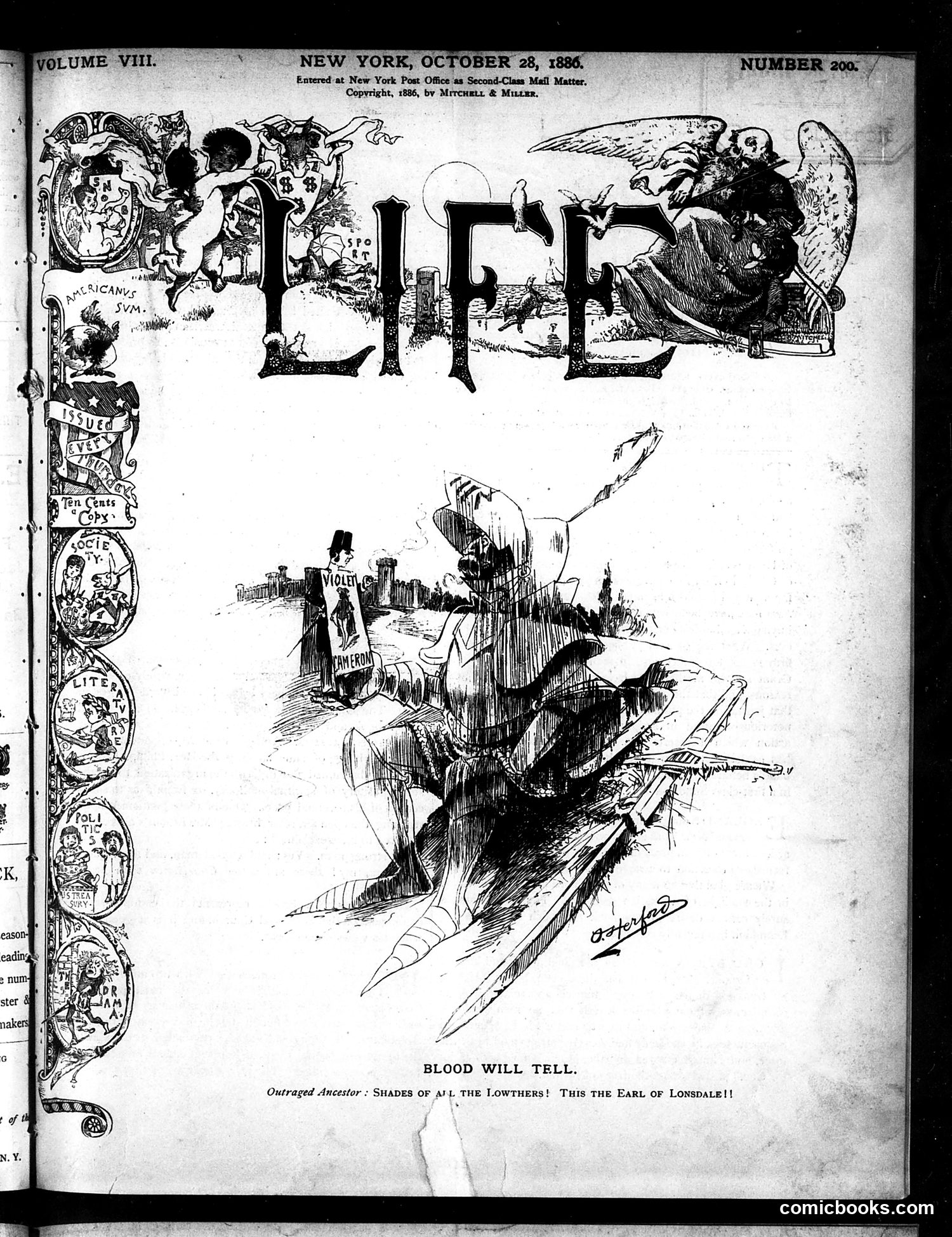
This political cartoon satirizes the Earl of Londonderry, depicted as a grotesque, insect-like creature with aristocratic features. The caption reads: "Outraged Ancestor: Shades of all the Lowthers! This the Earl of Londonderry!!" The satire appears to criticize the Earl's behavior or character as a betrayal of his family lineage (the Lowthers were his ancestors). The exaggerated, monstrous depiction suggests moral degeneracy—that his conduct has "revealed" his true nature despite his noble birth. Without additional context about 1886 events involving Londonderry, the specific scandal or action being mocked remains unclear, but the cartoon clearly uses physical caricature to express contempt for what the artist viewed as his shameful conduct or hypocrisy.
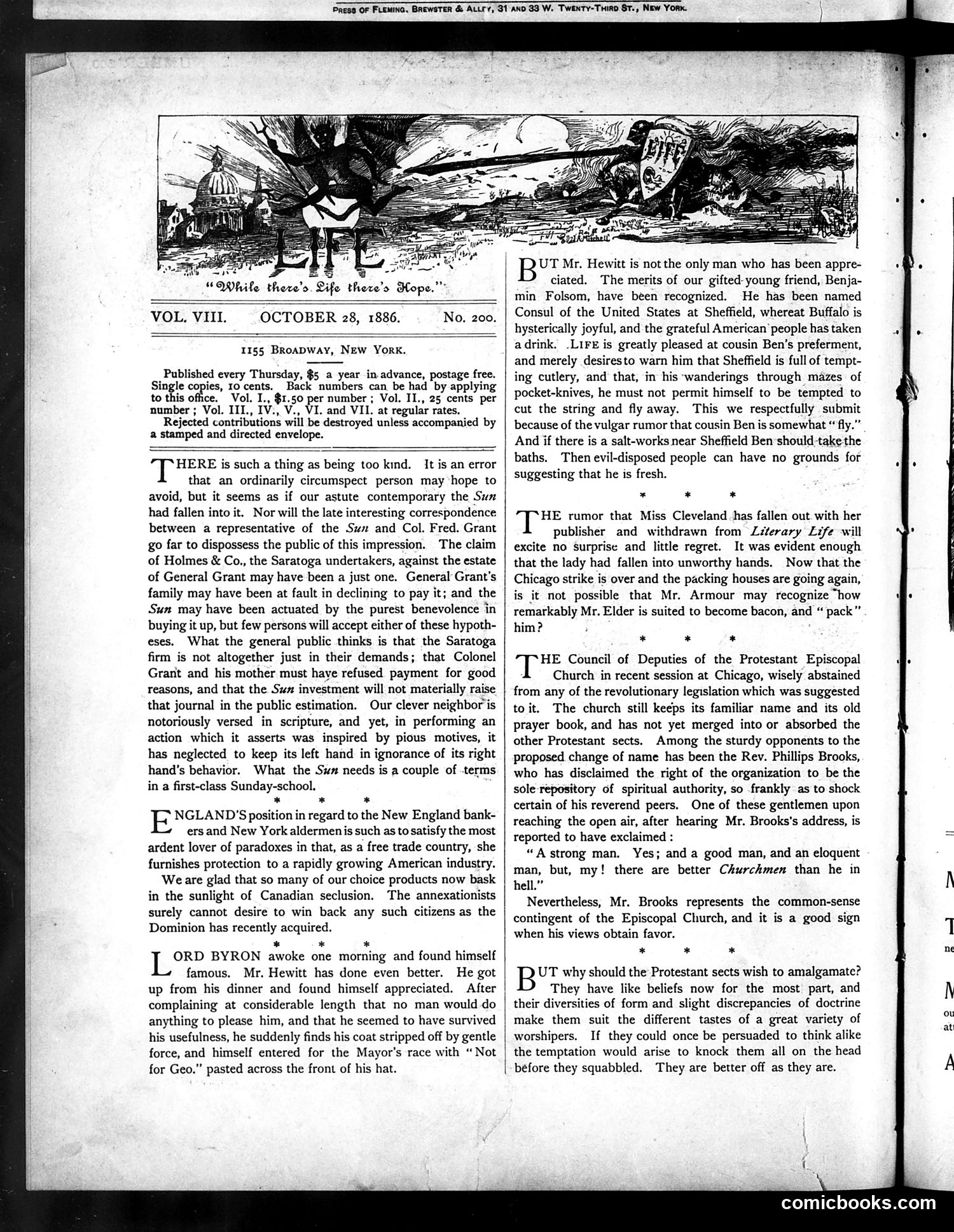
The masthead cartoon depicts a skeletal Death figure labeled "LIFE" beneath the motto "While there's Life there's Hope." This is the magazine's visual identity—a memento mori design using death imagery ironically for a humor publication. The text discusses various contemporary topics: General Grant's estate debts, Miss Cleveland's withdrawal from a literary publication, Episcopal Church governance debates, Lord Byron anecdotes, and Protestant sect amalgamation. Without clearer labels or context in the visible portions, specific political figures remain unclear, though the writing suggests commentary on American financial scandals, women's literary roles, and religious institutional tensions of the 1880s. The page emphasizes satirical social and political criticism typical of Life's editorial approach.
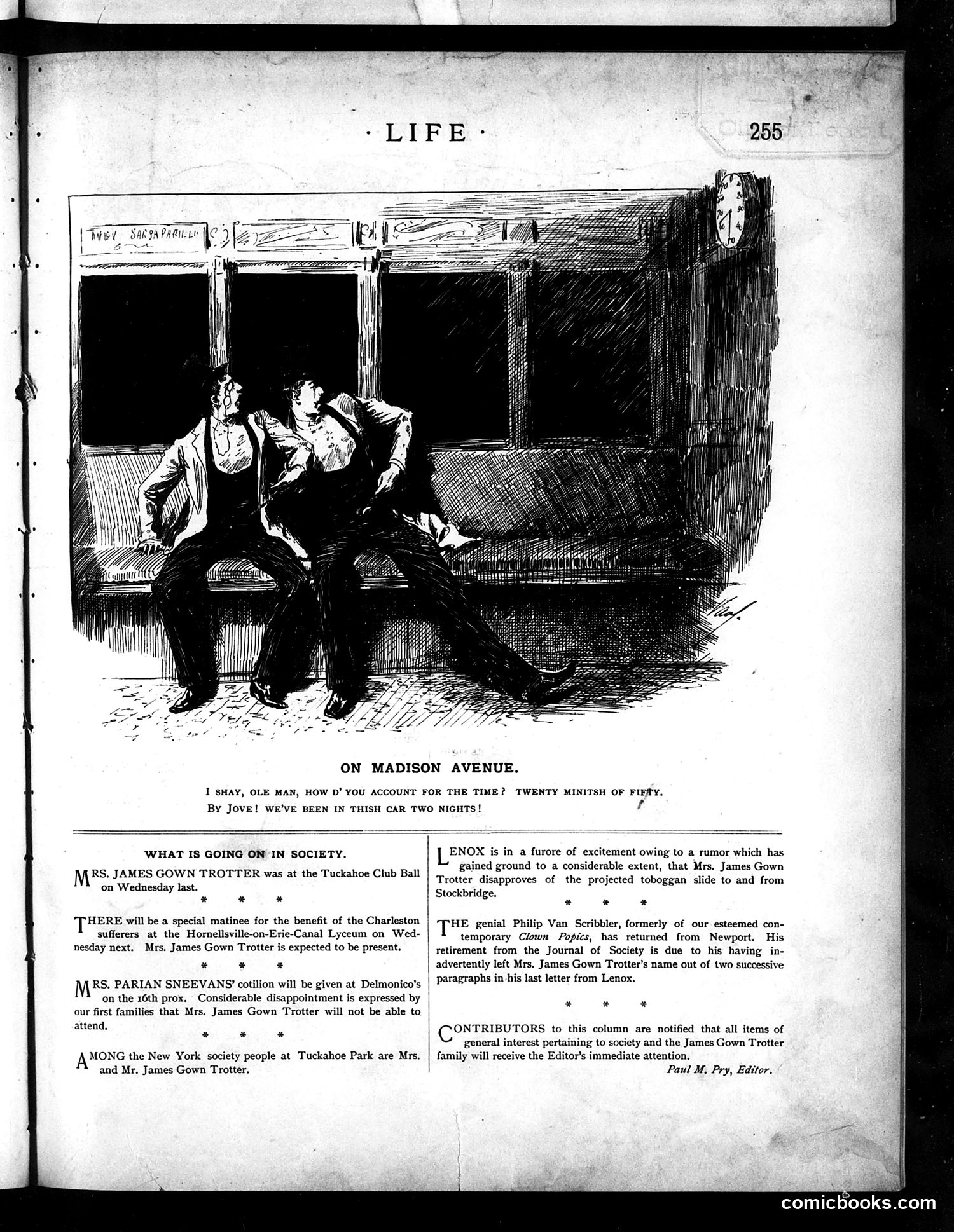
The main cartoon depicts two men on what appears to be a streetcar labeled "Madison Avenue," with a clock visible on the wall. One man complains about the time, saying they've been in the car "two nights" when it should only be "twenty minutes of fifty." This is a satire on the slowness of New York City streetcars—a common complaint in early 20th-century urban life. The exaggeration (two nights versus minutes) mocks how glacially slow public transportation felt to impatient commuters. Below, the "What is Going On in Society" column reports on Mrs. James Gown Trotter's social activities and a controversy involving Philip Van Scribbler's retirement from *Town Topics* magazine, apparently due to his prior involvement with the Trotter family. The satire targets high-society gossip and scandal.
The page contains miscellaneous satirical items rather than a unified cartoon. Key pieces include: **"Not Eligible"** — A poem mocking a New York club man as unfit for membership despite his talents and family background, because he lacks proper dress sense (wearing "an ancient tie"). **Right-column items** reference contemporary figures: Henry George complaining about autograph hunters; comments on Battenberg and Queen (likely royalty); Theodore Roosevelt's nomination; and Clinton Scollard's new book about Lebanon. The scattered nature suggests this is a "miscellany" or humor column typical of Life's format—brief jabs at social pretension, literary figures, and contemporary public personalities. The style emphasizes wit over deep political commentary, targeting etiquette violations and personal quirks rather than major political issues.
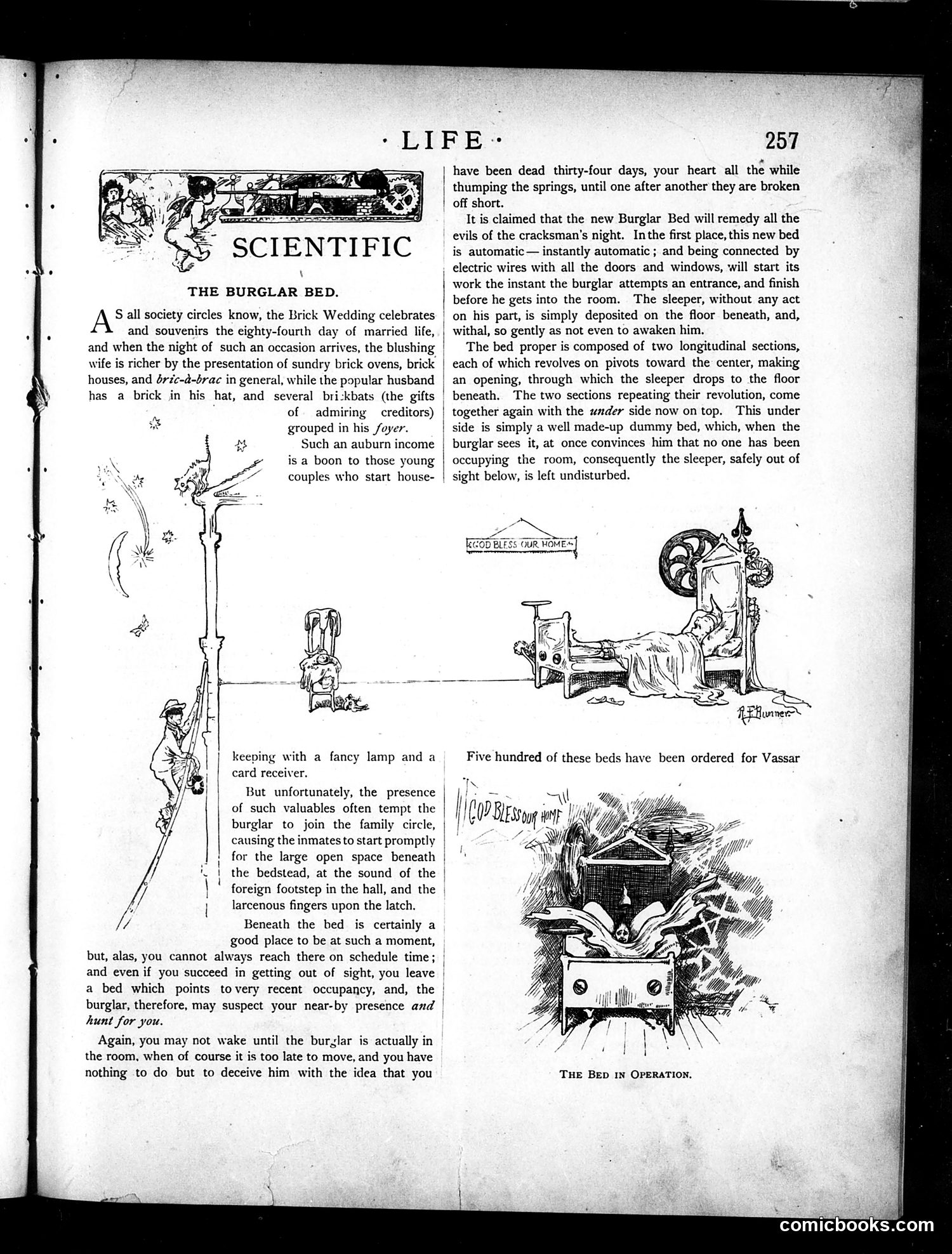
This is a satirical piece about an invention marketed to newly married couples worried about burglary. The "automatic" bed features mechanical mechanisms that supposedly catch intruders: when a burglar enters, electric wires trigger the bed to fold up or collapse, trapping him beneath while the sleeping occupants escape safely to the floor. The humor targets both the anxieties of young homeowners and the period's obsession with mechanical "solutions" to everyday problems. The illustrations show the contraption in action—a burglar caught mid-heist as the bed mechanisms activate. The satire suggests this elaborate device is impractical and ridiculous, mocking both burglar paranoia and over-engineered gadgetry. The note that "five hundred of these beds have been ordered for Vassar" adds a layer of absurdist humor about the invention's supposed popularity.
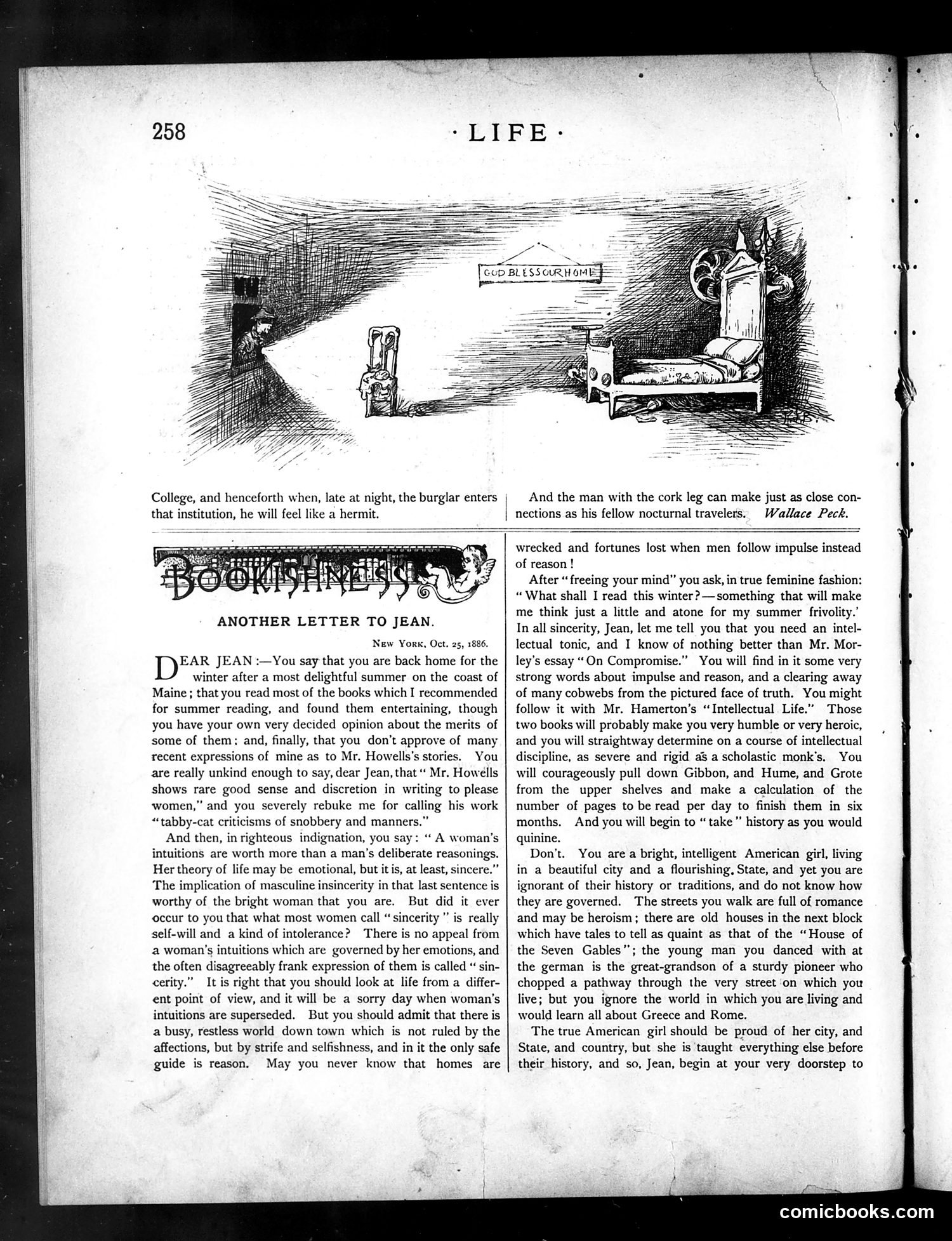
**The Top Cartoon:** This untitled sketch depicts a burglar entering what appears to be a college building at night. The joke, explained below in the Wallace Peck quote, plays on the irony that a burglar would feel "like a hermit" in a college—suggesting colleges are so isolated or removed from civilization that even a criminal would find solitude there. It's a jab at academic insularity. **"Another Letter to Jean":** This essay-style piece satirizes women's intellectual pretensions. The author mocks a young woman (Jean) for seeking serious literature to improve her mind, dismissing women's reasoning as fundamentally emotional rather than rational. The satire critiques both women's educational aspirations and (implicitly) the condescending male attitudes preventing their advancement—though the piece presents this condescension as reasonable advice.
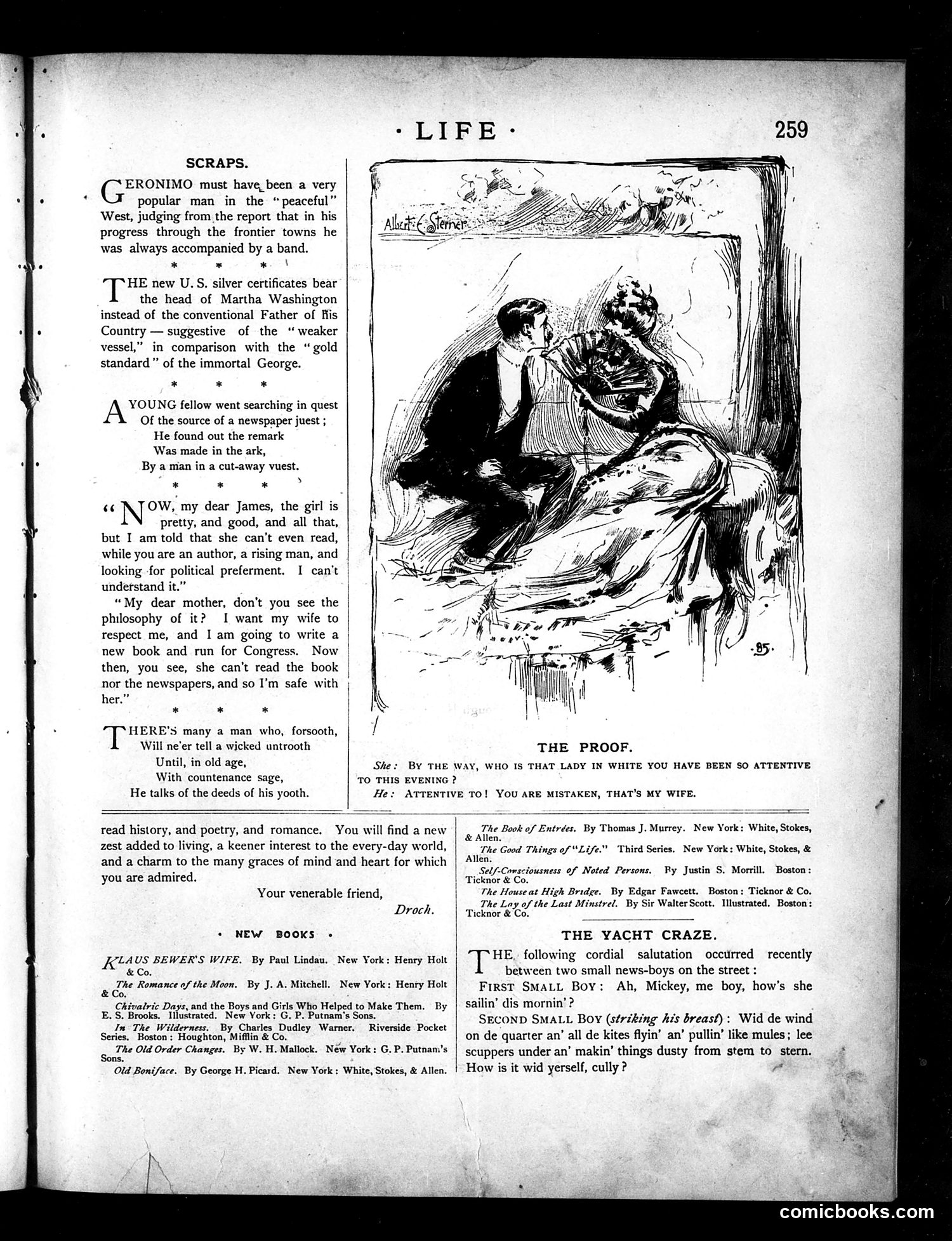
The main cartoon titled "THE PROOF" depicts a domestic scene where a man confronts a woman he's been attentive to, claiming she's his wife. The humor hinges on a misunderstanding—he's apparently been flirting with someone he mistakenly believed was available, only to discover she's already married. The page also contains brief satirical "scraps" about topical matters: commentary on Geronimo's popularity in the Old West, a joke about new U.S. silver certificates featuring Martha Washington instead of traditional imagery, and wordplay about newspaper journalism. The remaining content consists of book advertisements and a section called "THE YACHT CRAZE" featuring dialect humor between two boys discussing sailing. The overall tone is lighthearted social satire typical of late-19th-century American humor magazines.
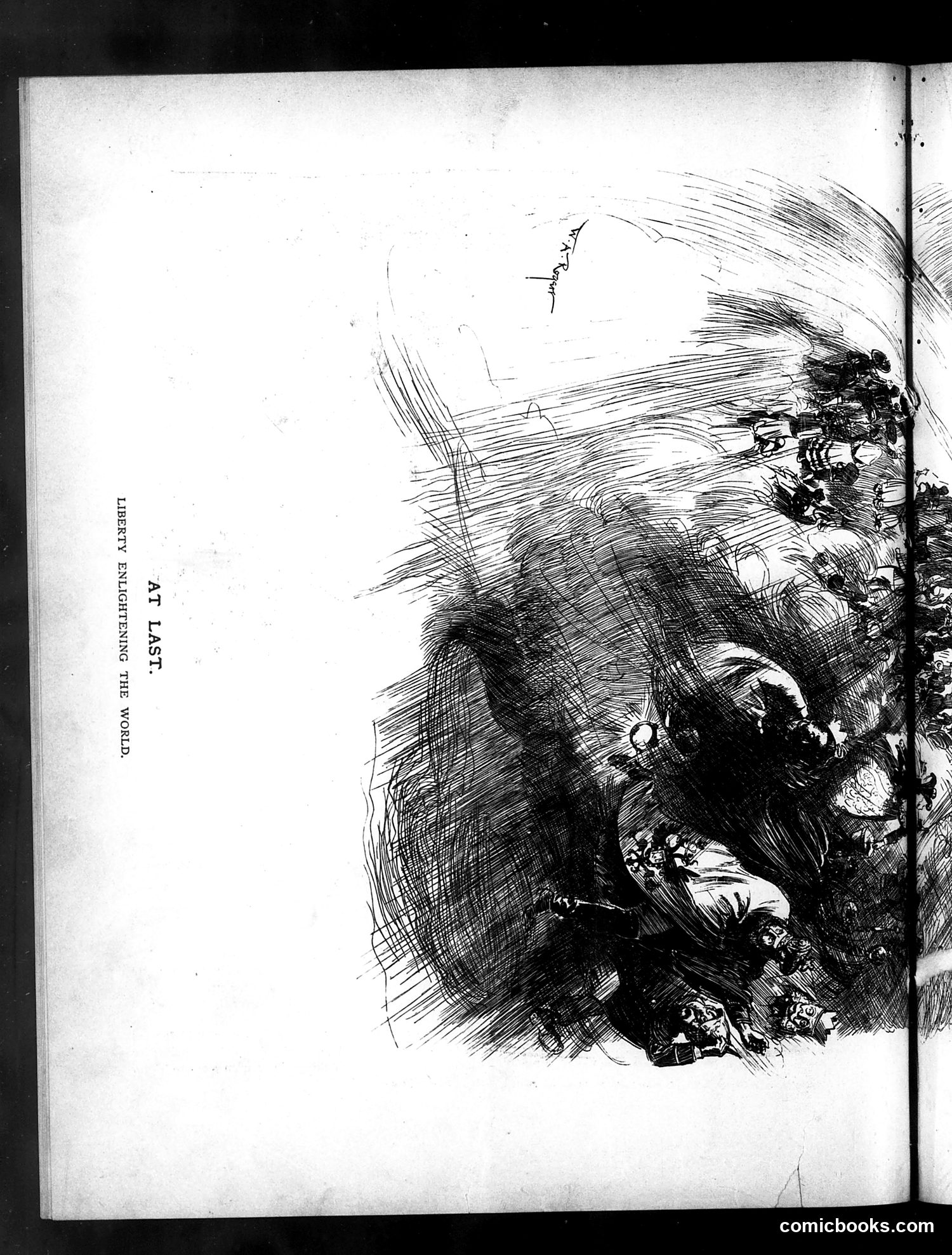
This appears to be a satirical illustration showing a figure (likely a political leader or public figure) experiencing some form of downfall or defeat. The sketch-style drawing emphasizes dramatic action—the figure seems to be falling or being thrown, with wind-swept hair and dynamic motion lines suggesting urgency or collapse. The title "AT LAST" suggests long-anticipated consequences finally occurring. Without clearer identification of the specific figure or historical context visible in the image, I cannot definitively state which political event this references. However, the style and composition suggest this is commentary on a prominent figure's overdue removal from power or a delayed reckoning for misconduct. The artistic technique—bold cross-hatching and expressive linework—emphasizes the gravity of the depicted moment.
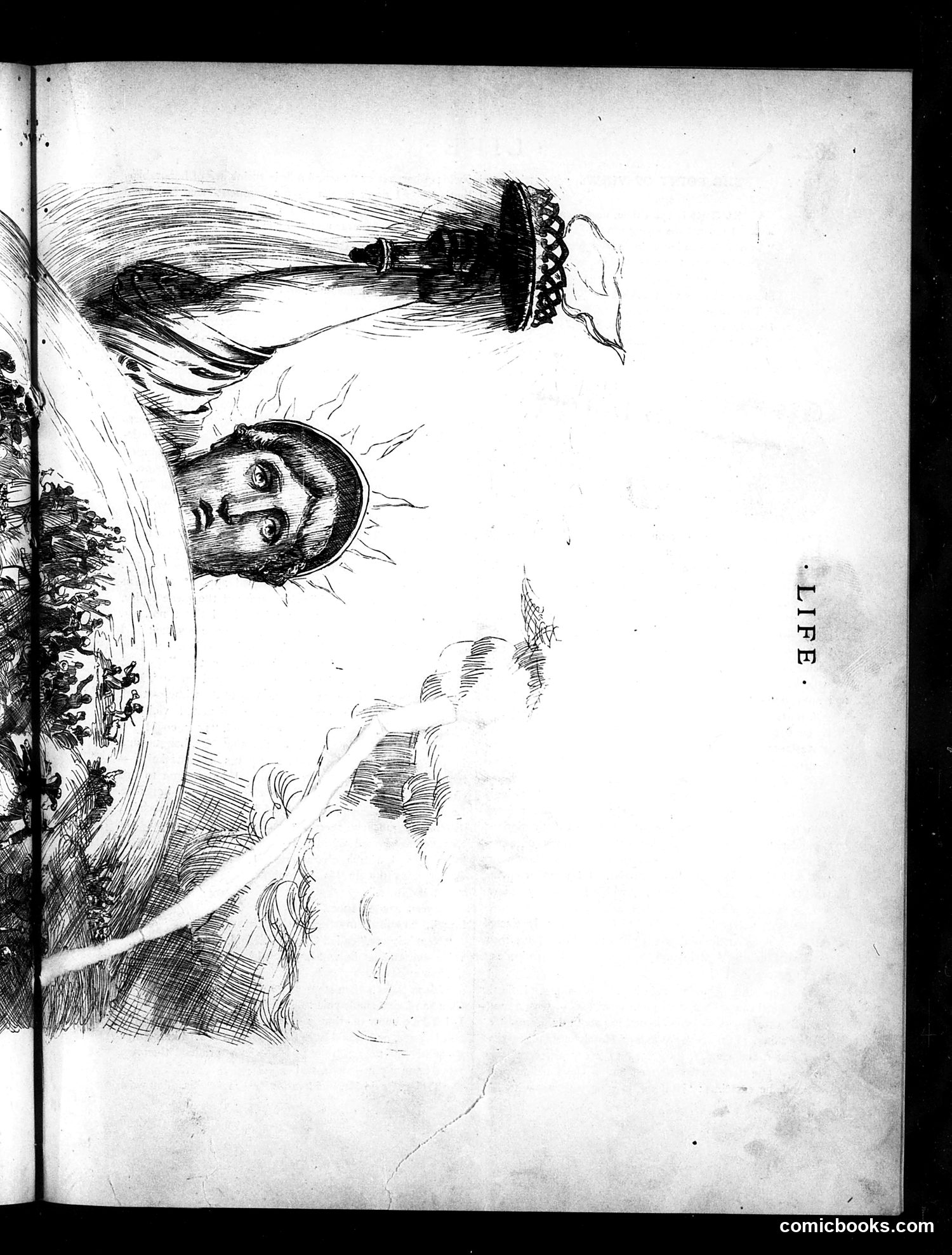
This page appears to be a title page or section divider from *Life* magazine, labeled "LIFE" on the right margin. The illustration shows a figure in profile (rotated on the page) with an exaggerated facial expression and long, flowing hair adorned with what appears to be an ornamental headpiece or crown. The figure is depicted in black ink with cross-hatching typical of period engraving. Without additional OCR text or context visible on this page, I cannot definitively identify the specific political or social figure being caricatured, the historical moment referenced, or the satirical point being made. The style suggests late 19th or early 20th-century American satirical art, but more information would be needed for accurate interpretation.
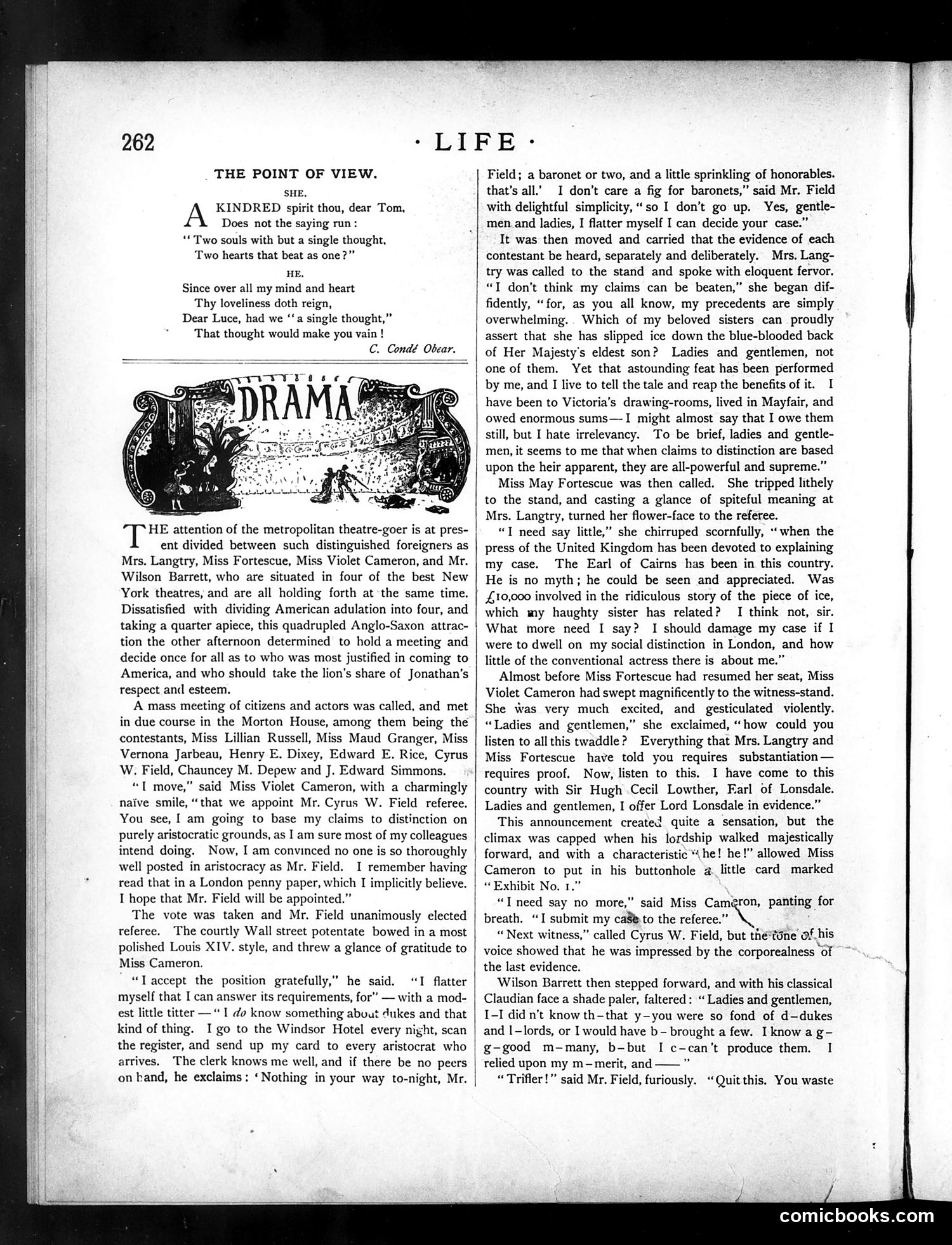
This page features a satirical drama review about a theater dispute. The text describes a meeting of metropolitan theater-goers including Mrs. Langtry, Miss Fortescue, Miss Violet Cameron, and Mr. Wilson Barrett, all prominent actors of the era, who convened to decide a case involving competing claims to distinction. The central joke concerns aristocratic pretension: various actors present conflicting evidence of social superiority—references to Victoria's drawing rooms, the Earl of Cairns, and Sir Hugh Cecil Lowther. The satire mocks how actors and society figures obsess over social rank and "distinction," with each witness providing increasingly absurd proof of their elevated status. The humor lies in exposing the pettiness and absurdity of such hierarchical social obsessions among the theatrical elite.
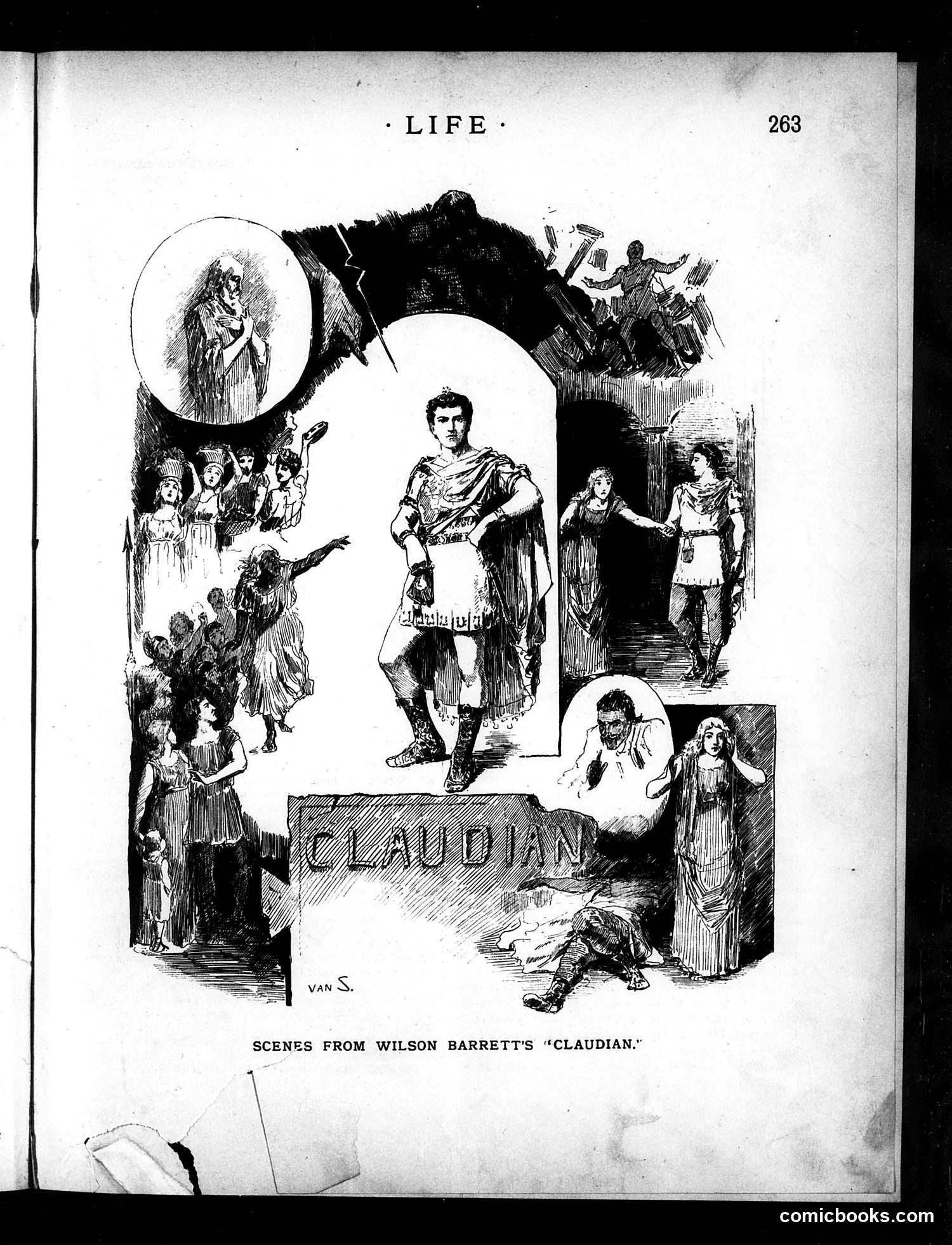
This page illustrates scenes from Wilson Barrett's theatrical production "Claudian," a historical drama. The central figure appears to be Claudian, a Roman character depicted in classical military dress standing on a pedestal labeled "CLAUDIAN." Surrounding him are various supporting characters in classical Roman and period costume, arranged in dramatic tableau scenes typical of stage productions. The composition uses the large letter "Q" as a decorative framing device, containing these theatrical vignettes. This appears to be theater coverage in *Life* magazine, documenting Barrett's dramatic adaptation rather than political satire. The artist "VAN S." has illustrated key dramatic moments from the play to showcase its historical setting and theatrical spectacle for readers interested in contemporary stage productions.
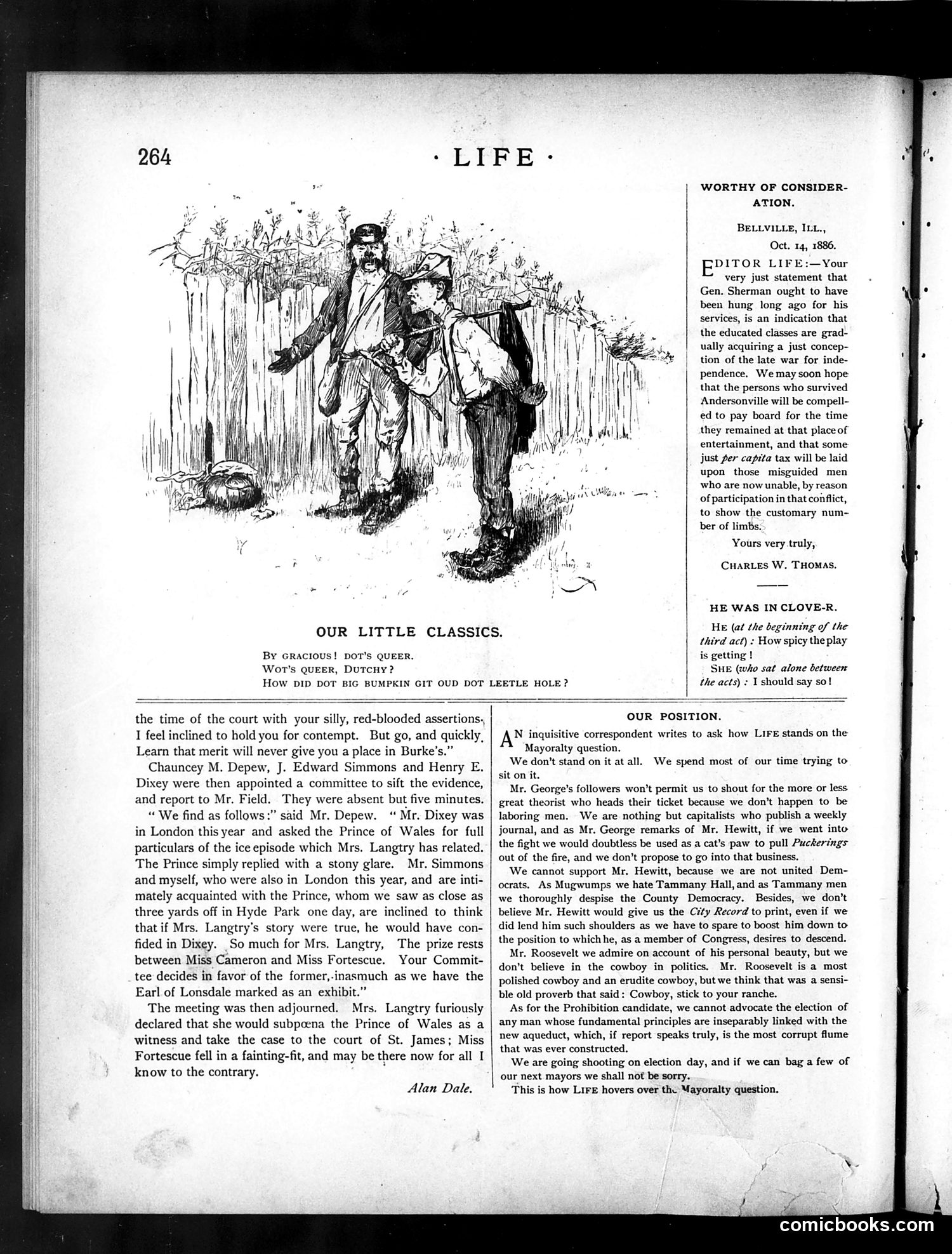
**The cartoon** (top left) depicts two men in a cornfield—one appears to be a farmer showing another a large hole in corn stalks. The dialogue, written in exaggerated German-immigrant dialect ("Dot's queer," "Bumpkin"), makes a crude joke: the larger farmer has apparently squeezed through a small opening, defying physical logic. It's a simple visual gag mocking immigrant speech patterns, common in 1880s American humor. **The letter section** includes satirical editorial commentary on contemporary politics (the mayoralty race, mentions of Roosevelt, Hewitt, George) and a bitter letter mocking General Sherman and Civil War survivors—expressing darkly ironic views about compensation for war injuries. **"He Was in Clove-R"** is a mild theatrical joke playing on the phrase "in clover" (living luxuriously)—implying the woman gained satisfaction during intermission. The page demonstrates Life's mix of lowbrow visual comedy, ethnic stereotyping, and sharp political commentary typical of 1880s American satire.
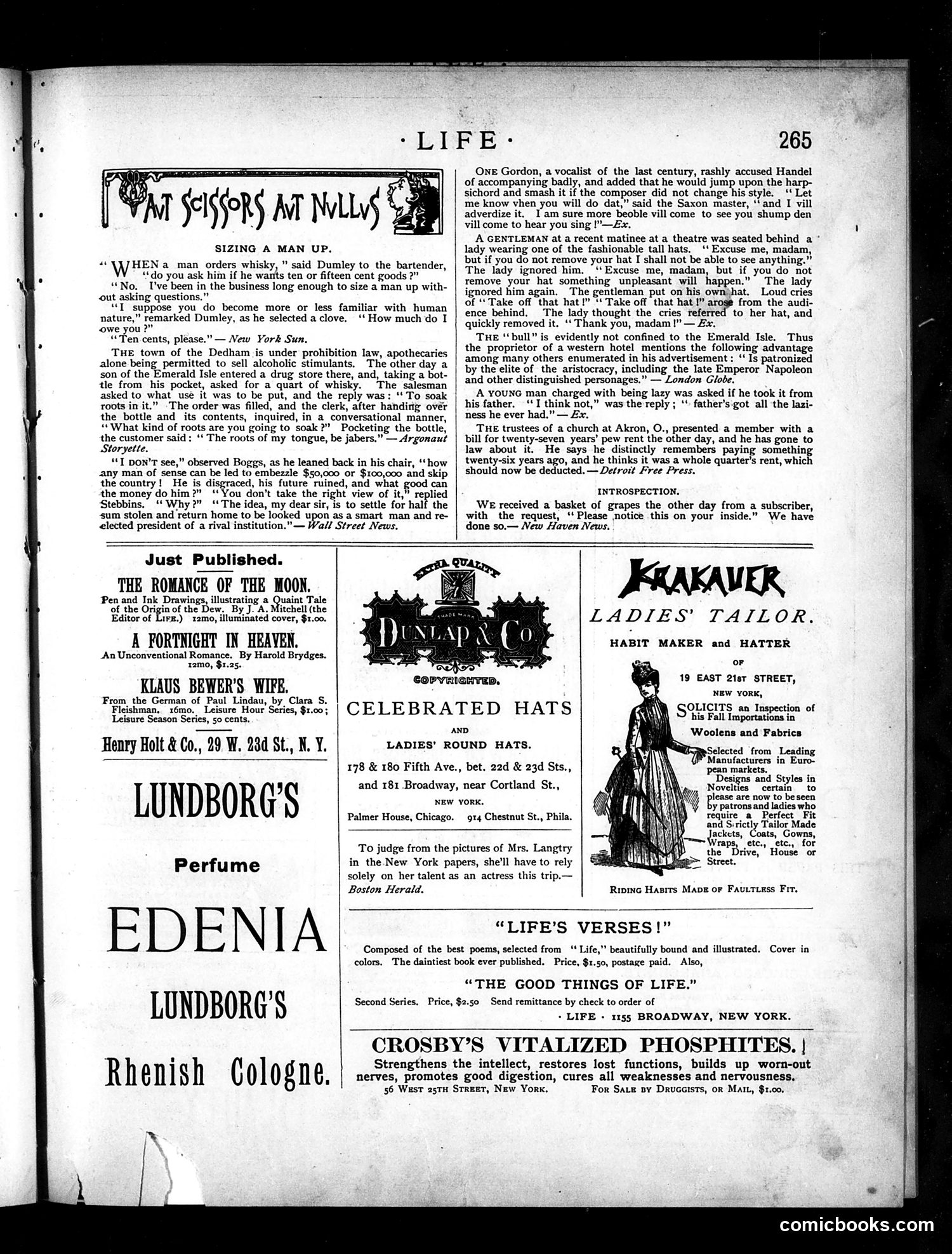
This page is primarily **humorous anecdotes** rather than political cartoons. The "Sizing a Man Up" collection presents brief satirical observations about American life and human nature. Key jokes: 1. A bartender claims he can judge customers' character without questions—when asked his fee, he reveals he's simply guessing, undercutting his own claim 2. An Irishman evades prohibition laws by claiming whiskey is for "soaking roots," then admits it's for loosening his tongue 3. A scoundrel justifies embezzlement as profitable because he can negotiate reduced restitution and return home as a "smart" businessman—mocking institutional corruption and re-election of compromised officials 4. A woman at a theater refuses to remove a fashionable tall hat; the man's strategic solution (wearing his own hat) shames her into compliance—commentary on social obstruction and female fashion excess 5. A youth claims laziness isn't inherited, sarcastically suggesting his father hoarded it—plays on paternity and inherited traits The humor targets social hypocrisy, Irish stereotypes, corruption, fashion absurdity, and family dynamics. These are largely social rather than political satires.
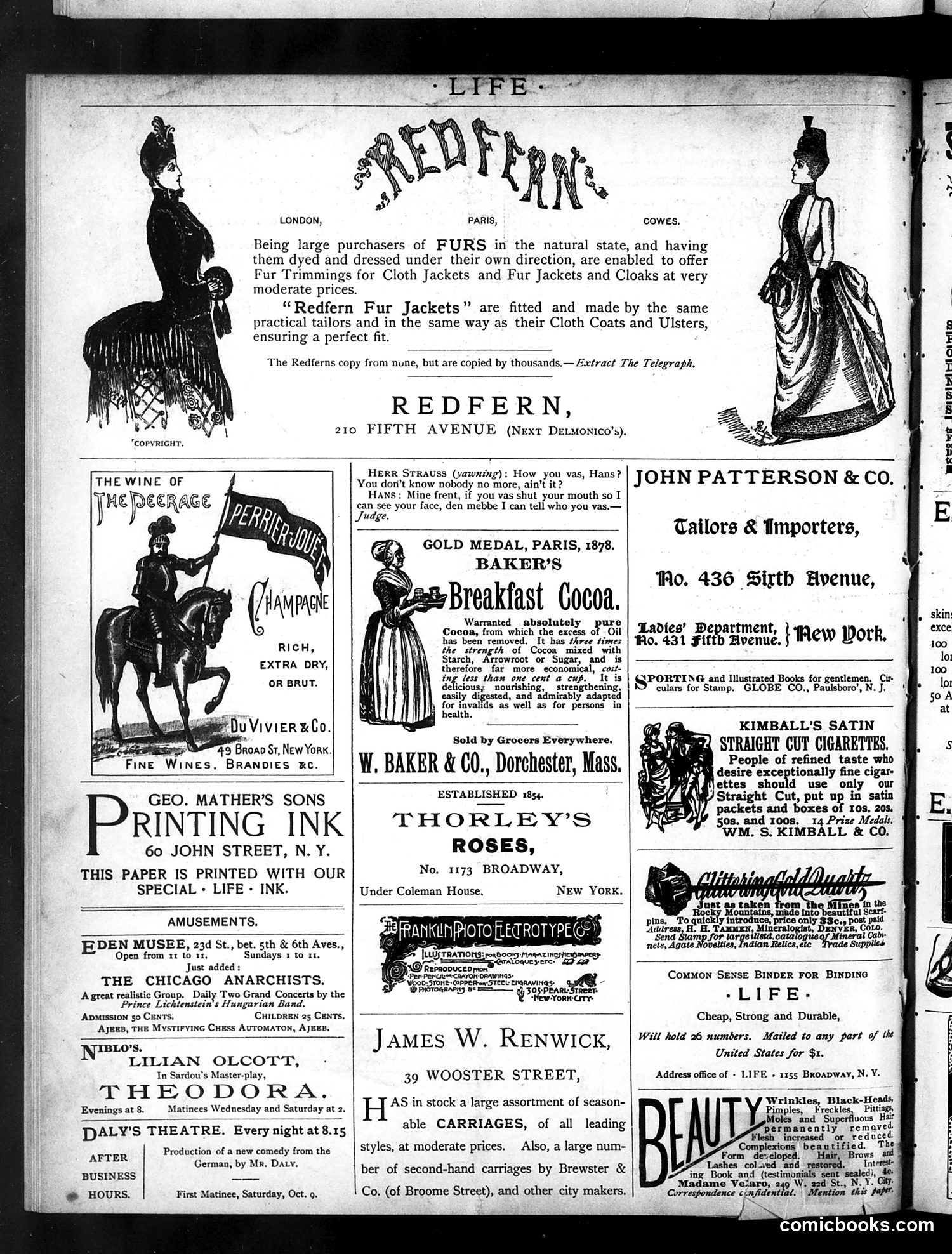
This page is primarily **advertising**, not political satire. The cartoons are minor comedic interludes among dozens of product advertisements. The main cartoon shows two men with German accents—"Herr Strauss" and "Hans"—in a joke about facial recognition. Strauss yawns with mouth wide open; Hans jokes that if Strauss would shut his mouth, he could actually see his face well enough to recognize him. The humor relies on ethnic stereotyping (German-accented speech, depicted as humorous dialect) and physical comedy about Strauss's exaggerated yawning. The other cartoon advertises wine, showing a figure on horseback holding a French flag, labeled "The Wine of Champagne." Both are light, non-political humor typical of *Life* magazine's satirical style. The page otherwise contains advertisements for furs, cocoa, carriages, tailoring services, and theatrical announcements—reflecting the magazine's dual role as satirical publication and society advertising venue.
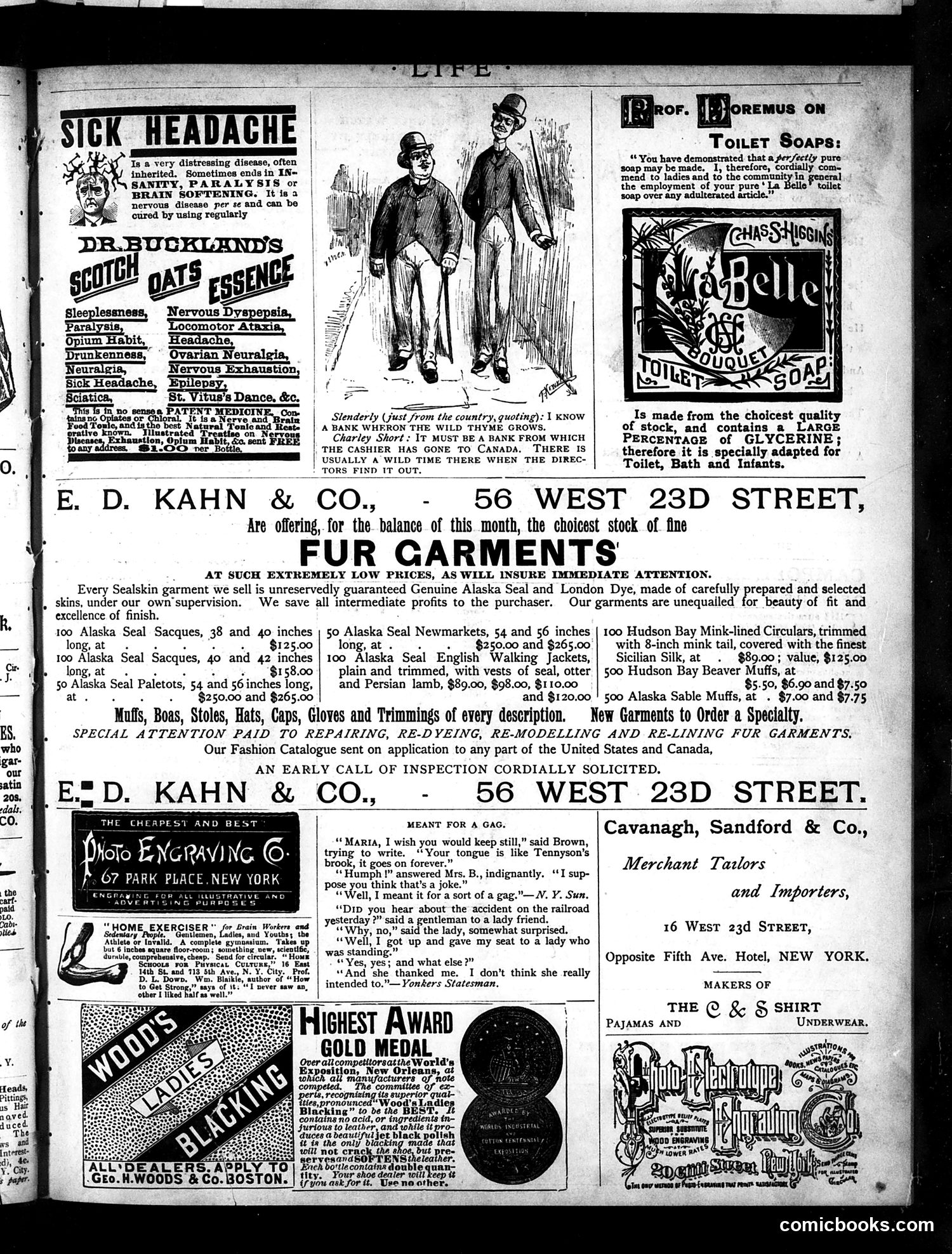
This page is primarily **advertisements** with two small comic interludes. The main feature is E.D. Kahn & Co.'s fur garment sale (56 West 23rd Street), prominently advertising sealskin jackets, beaver muffs, and Alaska sable furs at competitive prices. The two **cartoon jokes** are minor: 1. **"A Bank Wheron the Wild Thyme Grows"**: A country person quotes Shakespeare; a city character (Charley Short) makes a pun, suggesting the "bank" must have lost its "cashier" to Canada and experienced financial chaos when directors discovered it. 2. **"Meant for a Gag"**: A husband tells his wife her talking resembles Tennyson's brook (eternal), she takes offense, he claims it was a "gag" (joke). The secondary joke involves a man giving his seat to a woman, expecting thanks she didn't actually intend. These are mild Victorian-era humor—wordplay and domestic comedy. The page reflects late 19th-century *Life* magazine's mix of satirical content and commercial advertising.
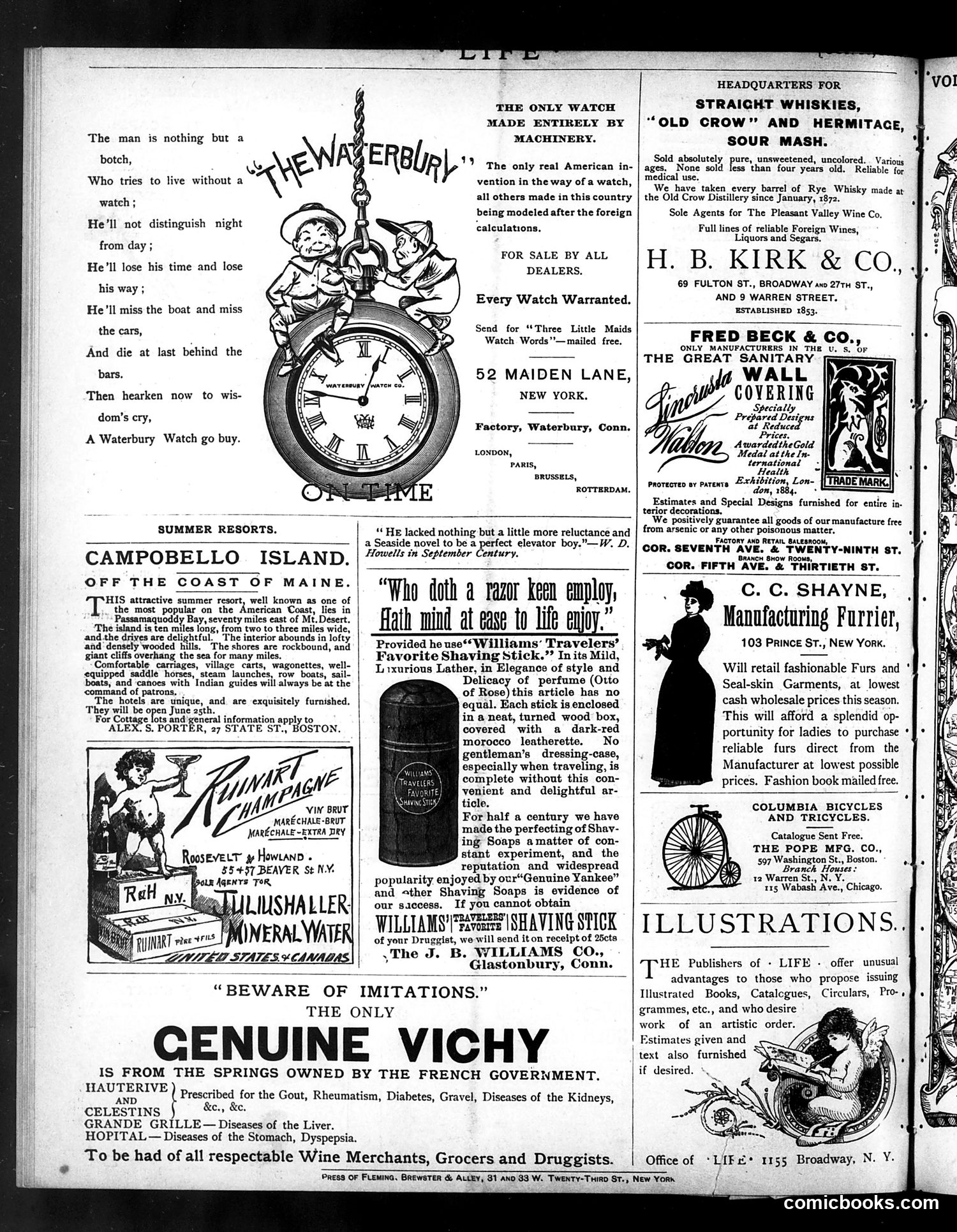
This page is primarily **advertising**, typical of late 19th-century American magazines. The dominant content includes: **Main Advertisement**: A Waterbury Watch ad featuring a moralizing poem warning that a man without a watch becomes a failure—missing boats, losing his way, and dying "behind the bars" (in prison). The rhetoric positions the watch as essential to respectability and success, claiming it's the "only real American invention" in watchmaking. **Satirical Quote**: A W.D. Howells excerpt mocking an elevator boy who "lacked nothing but a little more reluctance," poking fun at working-class service positions. **Product Ads**: Williams' Shaving Stick, Vichy water (mineral water marketed for medical ailments), and various whiskeys and wines positioned as health products—common in this era before FDA regulations. The page reflects Gilded Age consumer culture: advertisements disguised as lifestyle advice, dubious health claims, and anxious messaging about social status tied to consumer purchases.