
Life, 1886-10-28 · page 6 of 16
Life — October 28, 1886 — page 6: what you’re looking at
What you’re looking at
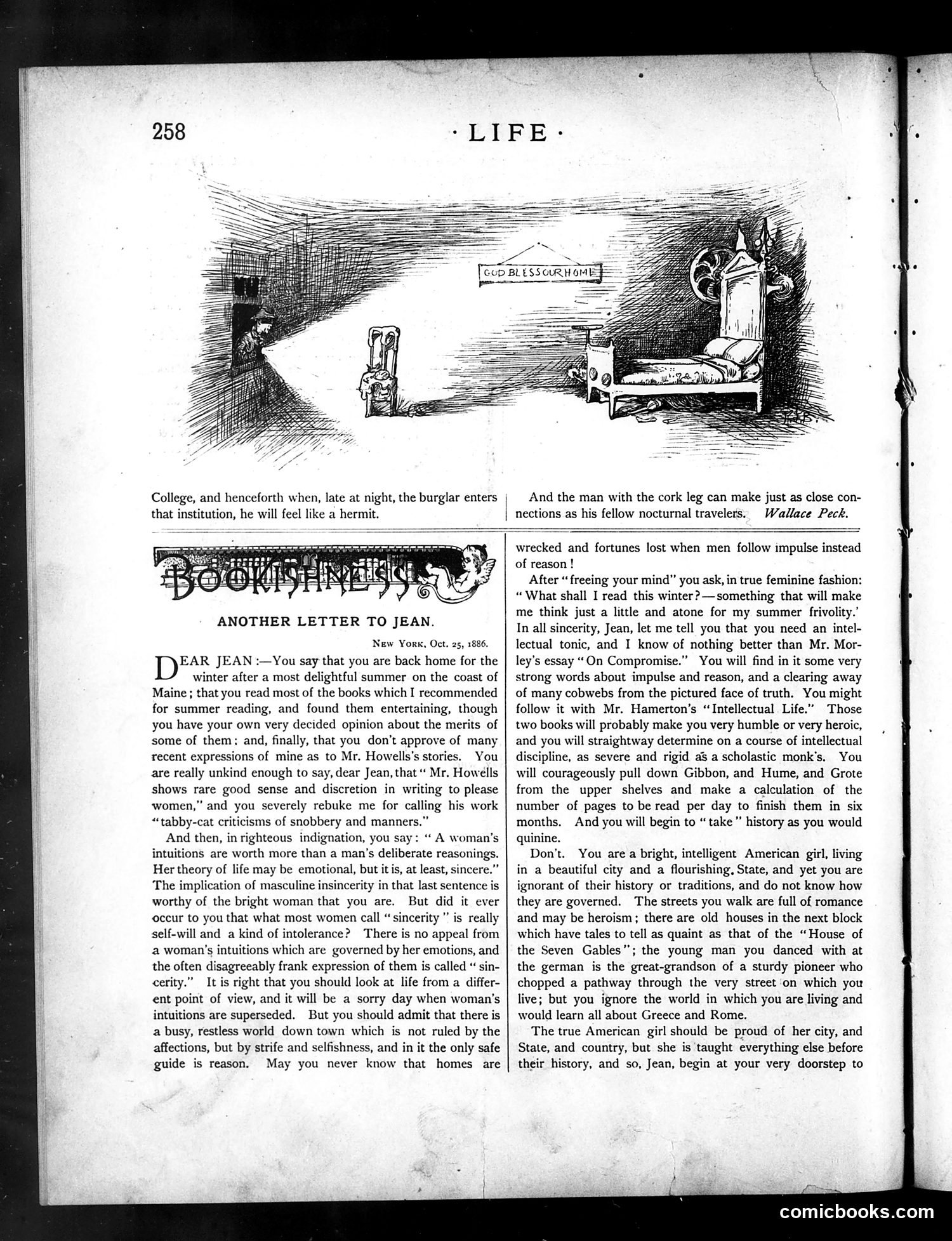
**The Top Cartoon:** This untitled sketch depicts a burglar entering what appears to be a college building at night. The joke, explained below in the Wallace Peck quote, plays on the irony that a burglar would feel "like a hermit" in a college—suggesting colleges are so isolated or removed from civilization that even a criminal would find solitude there. It's a jab at academic insularity. **"Another Letter to Jean":** This essay-style piece satirizes women's intellectual pretensions. The author mocks a young woman (Jean) for seeking serious literature to improve her mind, dismissing women's reasoning as fundamentally emotional rather than rational. The satire critiques both women's educational aspirations and (implicitly) the condescending male attitudes preventing their advancement—though the piece presents this condescension as reasonable advice.
📄 Transcribed text from this page (OCR, searchable)
Machine-transcribed from the original scan — historical spelling and the odd misread are preserved.
College, and henceforth when, late at night, the burglar enters that institution, he will feel like a hermit. yee And the man with the cork leg can make just as close con- nections as his fellow nocturnal travelers. Wallace Peck. ANOTHER LETTER TO JEAN. New York, Oct. 25, 1886. EAR JEAN :—You say that you are back home for the winter after a most delightful summer on the coast of Maine ; that you read most of the books which I recommended for summer reading, and found them entertaining, though you have your own very decided opinion about the merits of some of them; and, finally, that you don’t approve of many recent expressions of mine as to Mr. Howells’s stories. You are really unkind enough to say, dear Jean, that “ Mr. Howells shows rare good sense and discretion in writing to please women,” and you severely rebuke me for calling his work “tabby-cat criticisms of snobbery and manners.” And then, in righteous indignation, you say: “ A woman's intuitions are worth more than a man’s deliberate reasonings. Her theory of life may be emotional, but itis, at least, sincere.” The implication of masculine insincerity in that last sentence is worthy of the bright woman that you are. But did it ever occur to you that what most women call “sincerity ” is really self-will and a kind of intolerance? There is no appeal from a woman’s intuitions which are governed by her emotions, and the often disagreeably frank expression of them is called “ sin- cerity.” It is right that you should look at life from a differ- ent point of view, and it will be a sorry day when woman's intuitions are superseded. But you should admit that there is a busy, restless world down town which is not ruled by the affections, but by strife and selfishness, and in it the only safe guide is reason. May you never know that homes are of reason ! After “freeing your mind” you ask, in true feminine fashion: “What shall I read this winter? —something that will make me think just a little and atone for my summer frivolity.’ In all sincerity, Jean, let me tell you that you need an intel- lectual tonic, and I know of nothing better than Mr. Mor- ley’s essay “On Compromise.” You will find in it some very strong words about impulse and reason, and a clearing away of many cobwebs from the pictured face of truth. You might follow it with Mr. Hamerton’s “Intellectual Life.” Those two books will probably make you very humble or very heroic, and you will straightway determine on a course of intellectual discipline, as severe and rigid as a scholastic monk's. You will courageously pull down Gibbon, and Hume, and Grote from the upper shelves and make a calculation of the number of pages to be read per day to finish them in six months. And you will begin to “take” history as you would quinine. Don't. You are a bright, intelligent American girl, living in a beautiful city and a flourishing, State, and yet you are ignorant of their history or traditions, and do not know how they are governed. The streets you walk are full of romance and may be heroism; there are old houses in the next block which have tales to tell as quaint as that of the “House of the Seven Gables”; the young man you danced with at the german is the great-grandson of a sturdy pioneer who chopped a pathway through the very street on which you live; but you ignore the world in which you are living and would learn all about Greece and Rome. The true American girl should be proud of her city, and State, and country, but she is ‘taught everything else before their history, and so, Jean, begin at your very doorstep to comicbooks.com