
A complete issue · 16 pages · 1886
Life — October 7, 1886
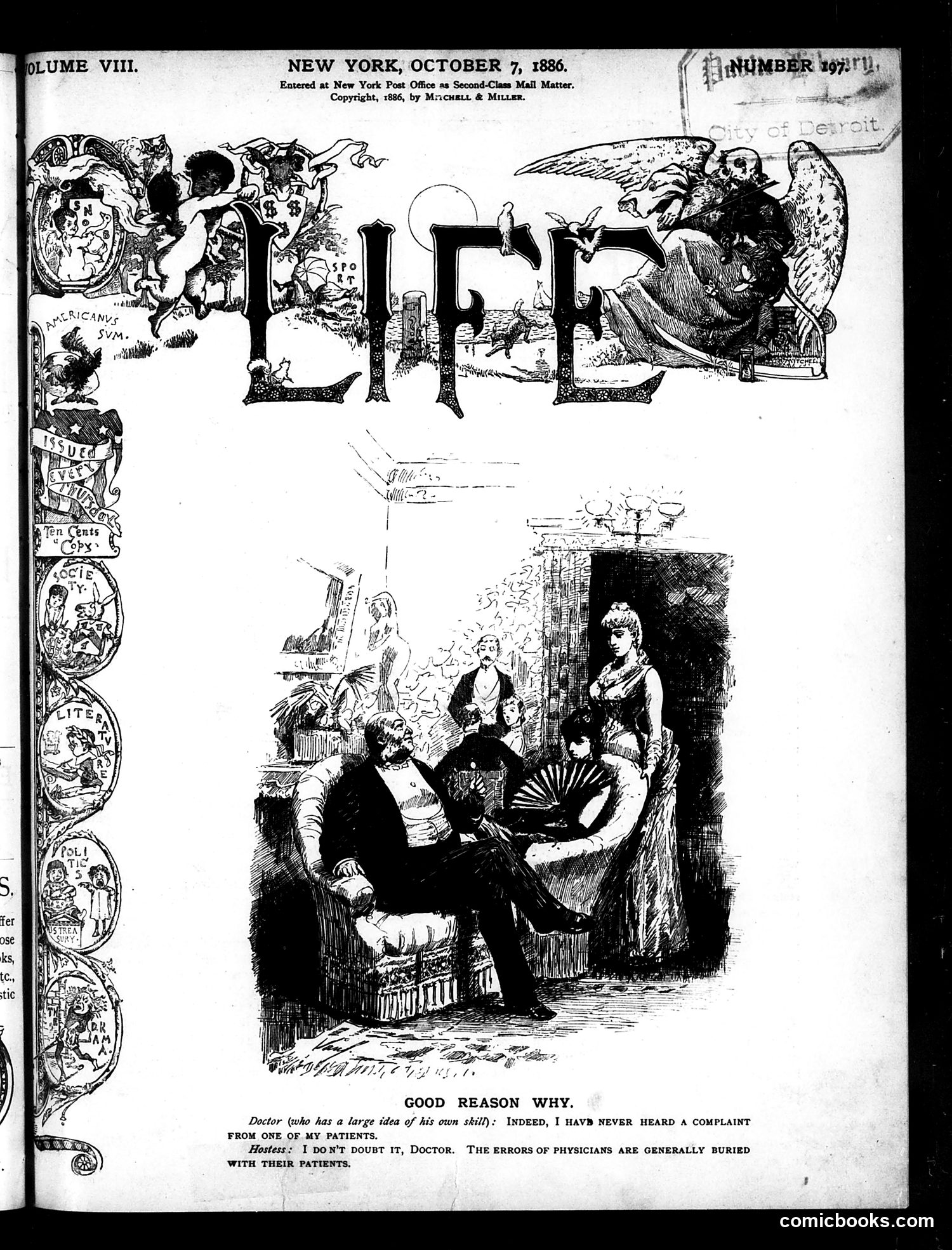
This cartoon satirizes a doctor's confidence in his medical practice. The doctor boasts he's "never heard a complaint from one of my patients," and the hostess responds with dark humor: "The errors of physicians are generally buried with their patients." The joke is a classic gallows humor jab at medical incompetence—patients who die can't complain. In 1886, medicine was still transitioning from folk remedies and bloodletting toward modern germ theory, so physician errors and high mortality rates were genuine public concerns. The cartoon mocks both the doctor's obliviousness to his own failures and the euphemistic silence surrounding medical deaths in polite Victorian society.
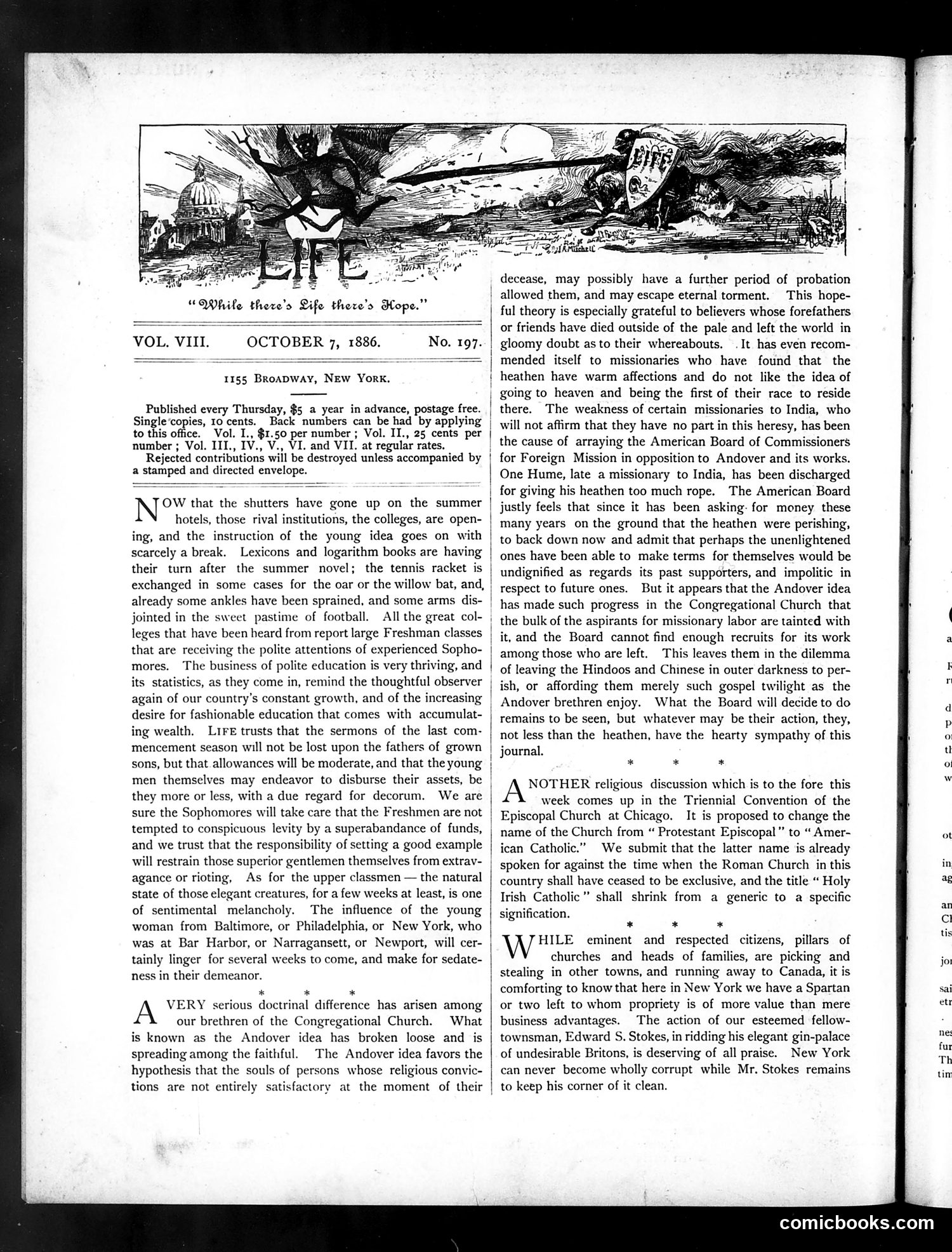
The masthead illustration depicts "Life" as a classical figure seated amid worldly chaos—suggesting the magazine's role as satirical observer of society's contradictions. The article text discusses serious religious controversies rather than presenting visual satire. Key topics include: 1. **The "Andover idea"** — a theological debate within the Congregational Church about whether non-Christians receive afterlife probation, viewed as heretical by traditionalists. 2. **Episcopal Church naming dispute** — a proposal to rename "Protestant Episcopal" to "American Catholic," seen as mimicking Rome. 3. **Social commentary** — praise for Edward S. Stokes, a wealthy New Yorker, for maintaining moral integrity despite temptations. This page prioritizes editorial commentary over visual satire, addressing contemporary religious schisms and ethics among the educated classes.
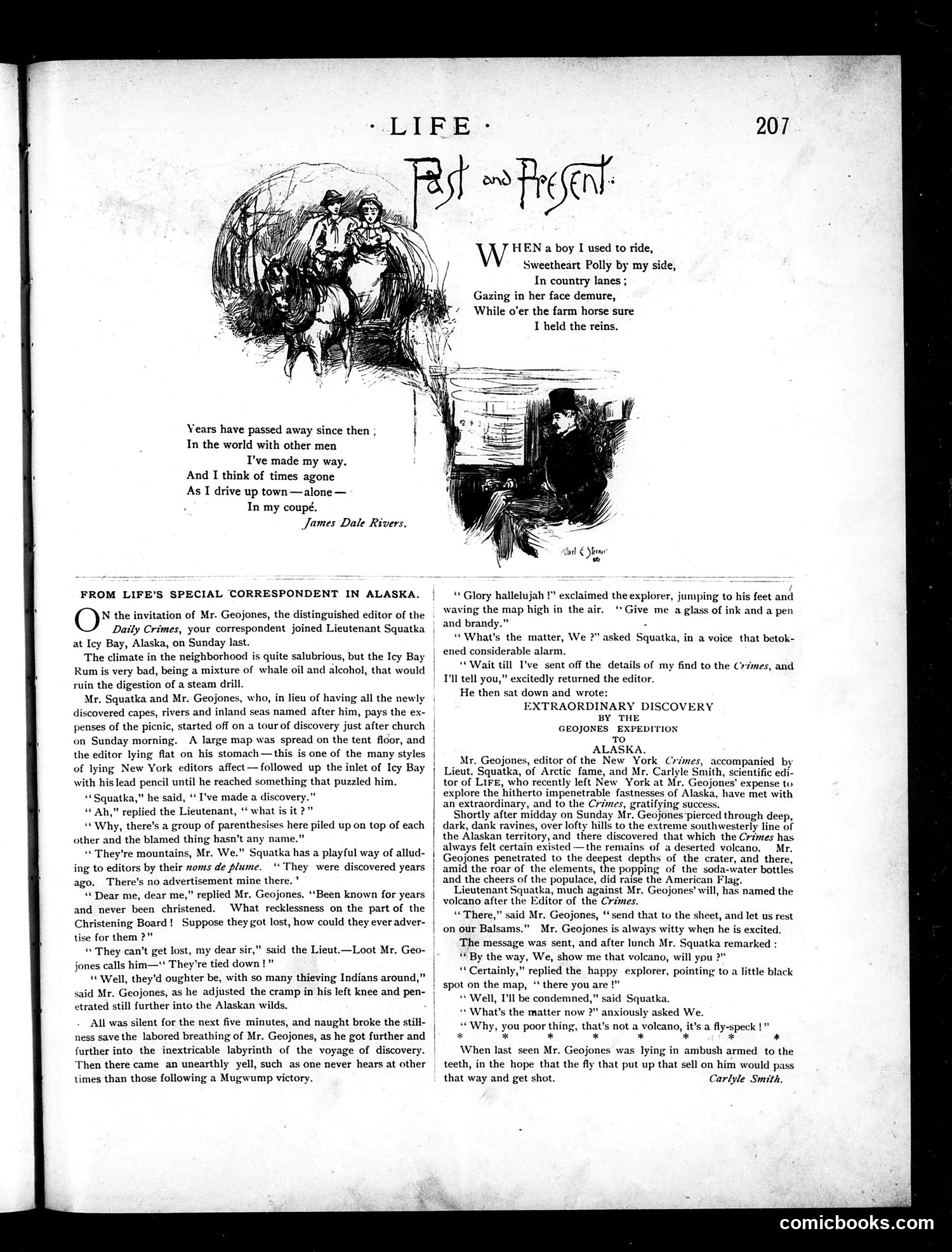
This page contains two distinct elements: **Upper section:** A nostalgic poem titled "Past and Present" by James Dale Rivers, illustrated with sketches of a young couple riding horseback together and an older man alone in a carriage. The poem contrasts youthful romance with solitary middle age, a sentimental rather than satirical piece. **Lower section:** A humorous travel narrative titled "Extraordinary Discovery by the Geojones Expedition in Alaska." The text describes Mr. Geojones (editor of the *New York Crimes*) and companions exploring Alaska, discovering a volcano, and encountering comic misadventures. The humor derives from their misidentifications and absurd situations rather than political satire. The page emphasizes *Life* magazine's characteristic blend of sentimental poetry and light comedic prose, not political commentary.
The top illustration shows a parade of circus performers and animals—acrobats, clowns, musicians, and elephants—under the banner "By the Way." The left column contains satirical brief items mocking contemporary absurdities: a poet seeking help naming his forthcoming book of verses; complaints about Mephistopheles and his "Sing Sing" procession jokes; jokes about Columbus's discovery; Boston's cultural pretensions; and the Emperor William visiting Ems for gossip. The right column extends these humorous observations, particularly discussing the challenge of titling new poetry collections. It mentions several mock-serious titles like "Screams From Scholarie" and "Chirups From Chicago." This appears to be a miscellaneous humor section rather than focused political satire—typical of Life's light social commentary on American foibles, publishing trends, and minor current events.
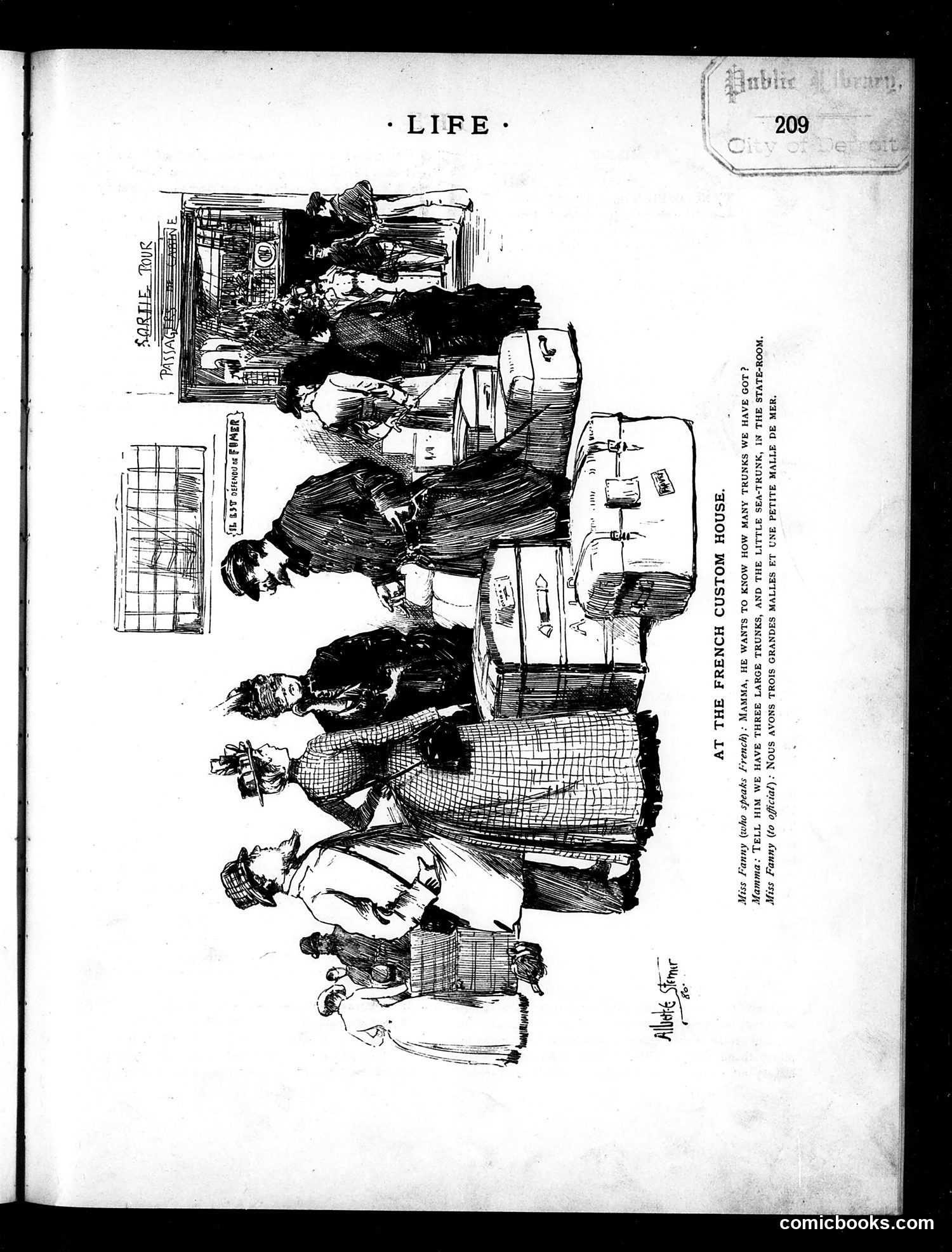
This satirical cartoon depicts the chaos of French customs inspection, likely from the early 20th century. The scene shows various travelers and their belongings being examined by a customs official at what appears to be a border crossing. The humor derives from the stereotype of French customs bureaucracy as absurdly inefficient and invasive—officers thoroughly inspecting luggage while creating disorder. Multiple figures struggle with trunks, packages, and personal effects, suggesting the frustration and delays travelers experienced. The cartoon mocks both French administrative excess and the travails of international border crossing during this era, when customs procedures were genuinely intricate and time-consuming. The visual chaos emphasizes the bureaucratic nightmares that made crossing into France a dreaded experience for visitors and merchants alike.
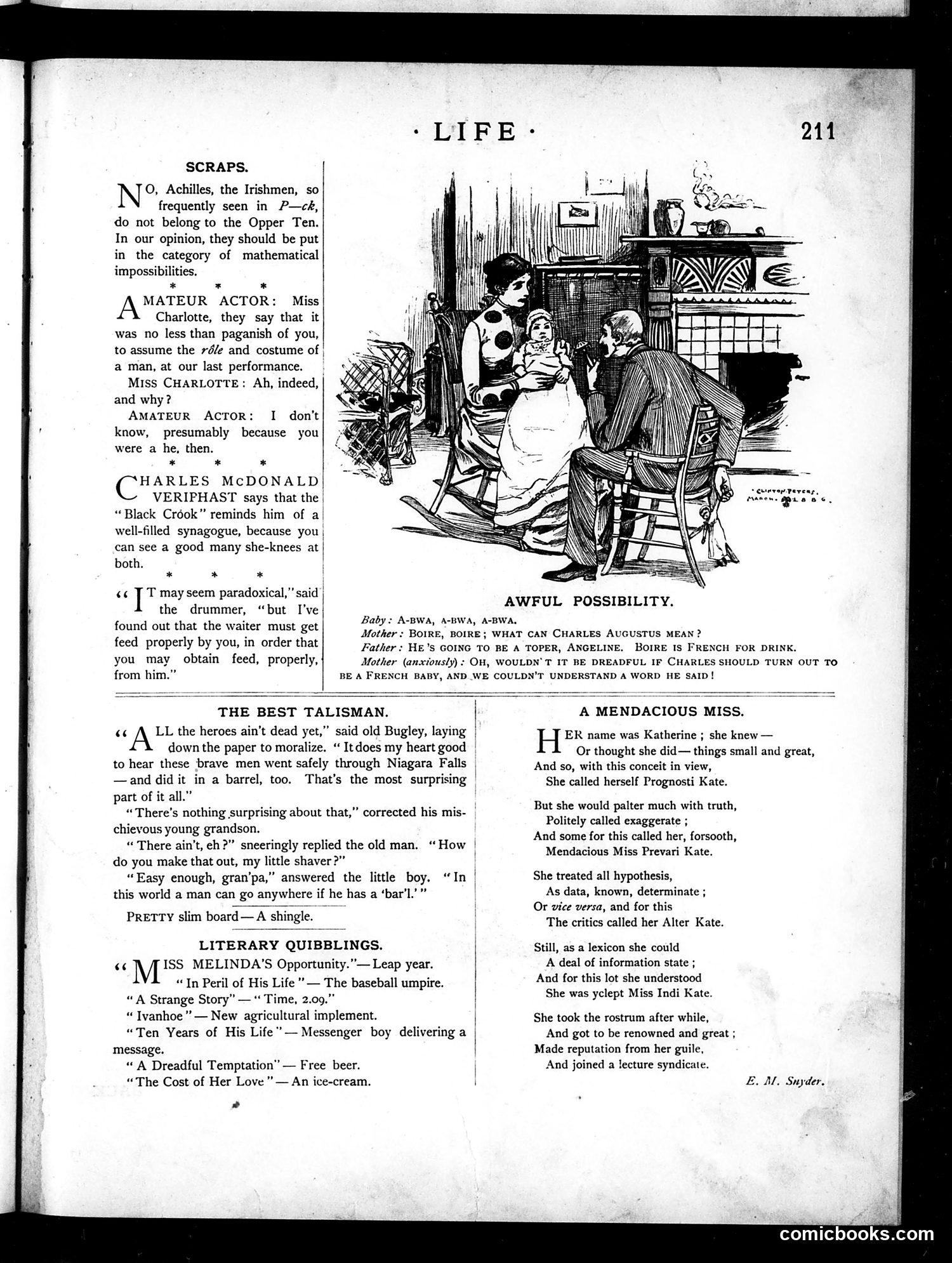
The page contains several short humor pieces rather than political cartoons. "Awful Possibility" depicts a domestic scene where a baby cries while parents discuss naming their child "Charles Augustus." The joke hinges on the mother's concern that a French name might make the child French, which she finds objectionable—reflecting early 20th-century anti-French sentiment or xenophobic attitudes of the era. Other sections include brief comedic anecdotes ("The Best Talisman," "Literary Quibblings") and a poem titled "A Mendacious Miss" about a woman named Katherine who was called "Prognosti Kate" for her exaggerations. The humor relies on wordplay, puns, and domestic comedy typical of Life's satirical style during this period.
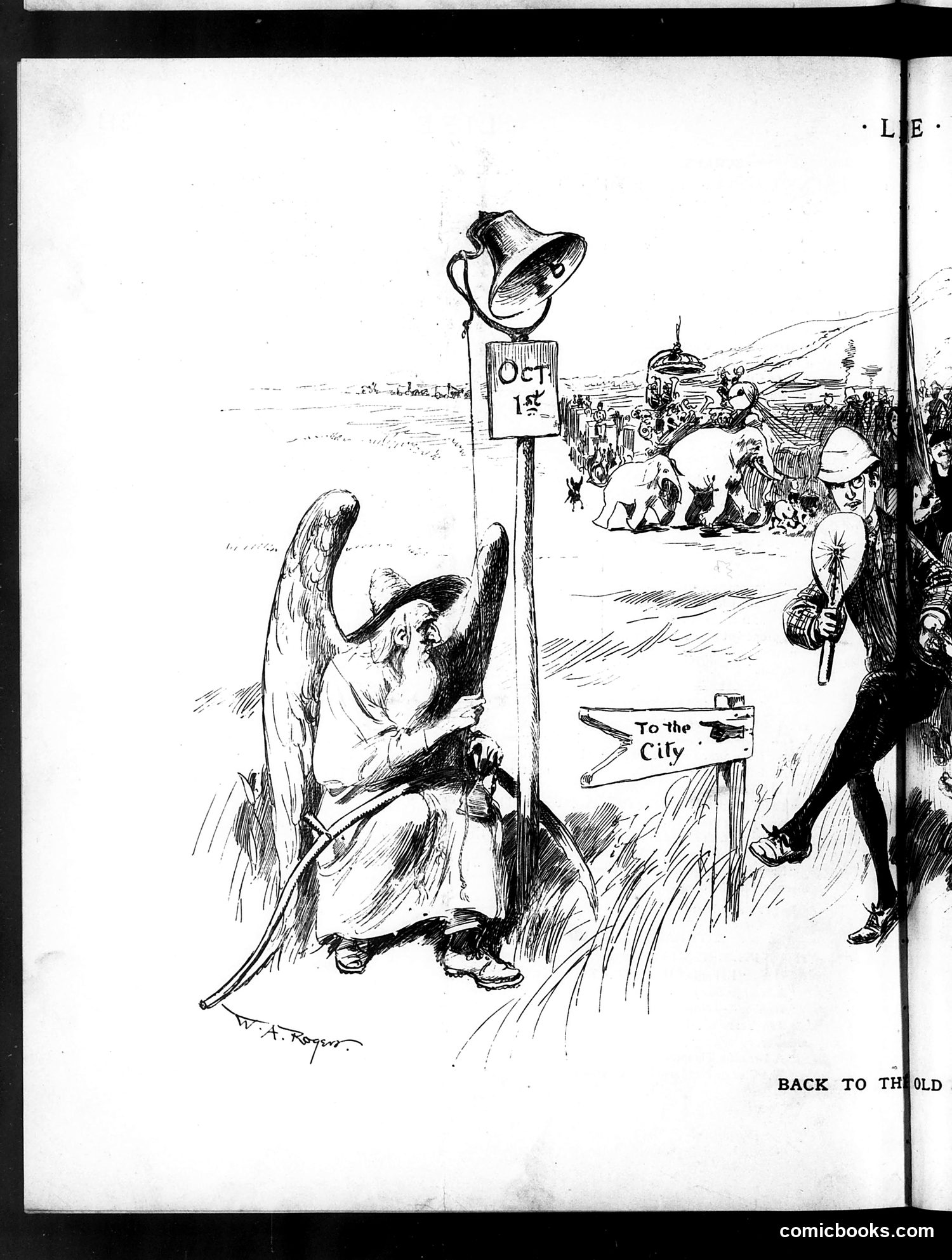
This cartoon depicts an **angel ringing a bell** marked "OCT 1st" while pointing toward "To the City" and a distant crowd. The title "BACK TO TH OLD" (likely "BACK TO THE OLD") suggests the cartoon comments on **seasonal return to urban life after summer**. The angel figure and bell-ringing imagery suggest a call or summons—possibly mocking the annual exodus of city dwellers returning from rural or vacation areas as October arrives. The contrast between the solitary angel in the foreground and the crowd gathering in the distance emphasizes this mass movement back to city life. The satire likely targets the predictable, almost ritualistic nature of this seasonal migration, treating it as something almost divine or inevitable that "calls" people back to urban existence after their break away.
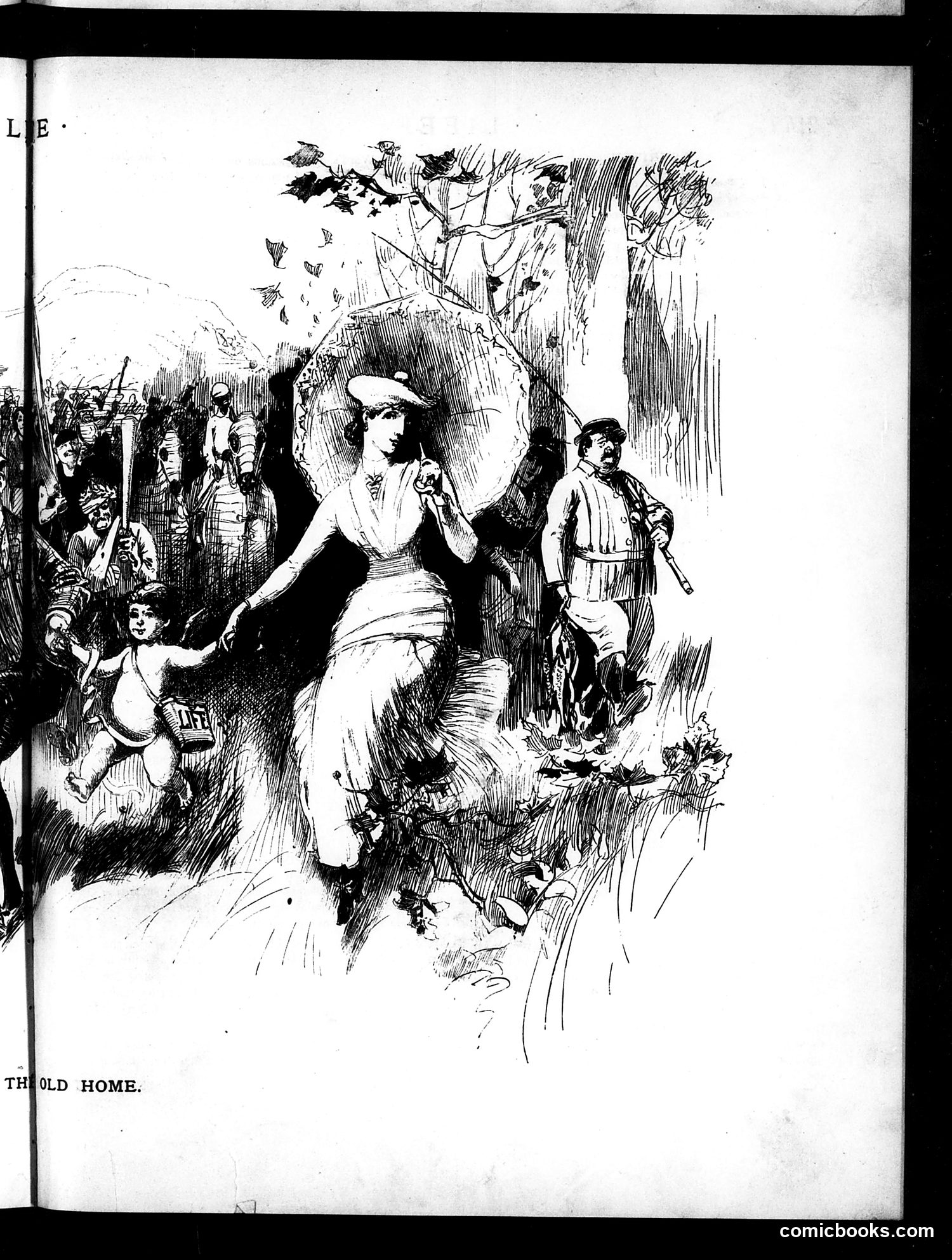
This appears to be a nostalgic or sentimental illustration titled "The Old Home," showing a well-dressed woman in a large decorative hat and white dress as the central figure, surrounded by cherubs and what seem to be working-class or rural figures in the background. The artistic style—detailed cross-hatching and ink work—is typical of late 19th or early 20th-century Life magazine illustrations. Without additional context or caption text visible, the specific satirical point is unclear. It may be commenting on idealized notions of "home" or domestic life, or possibly contrasting refined urban fashion (represented by the woman's elegant dress) with rural or working-class reality. The cherubs suggest sentimentality being mocked or explored.
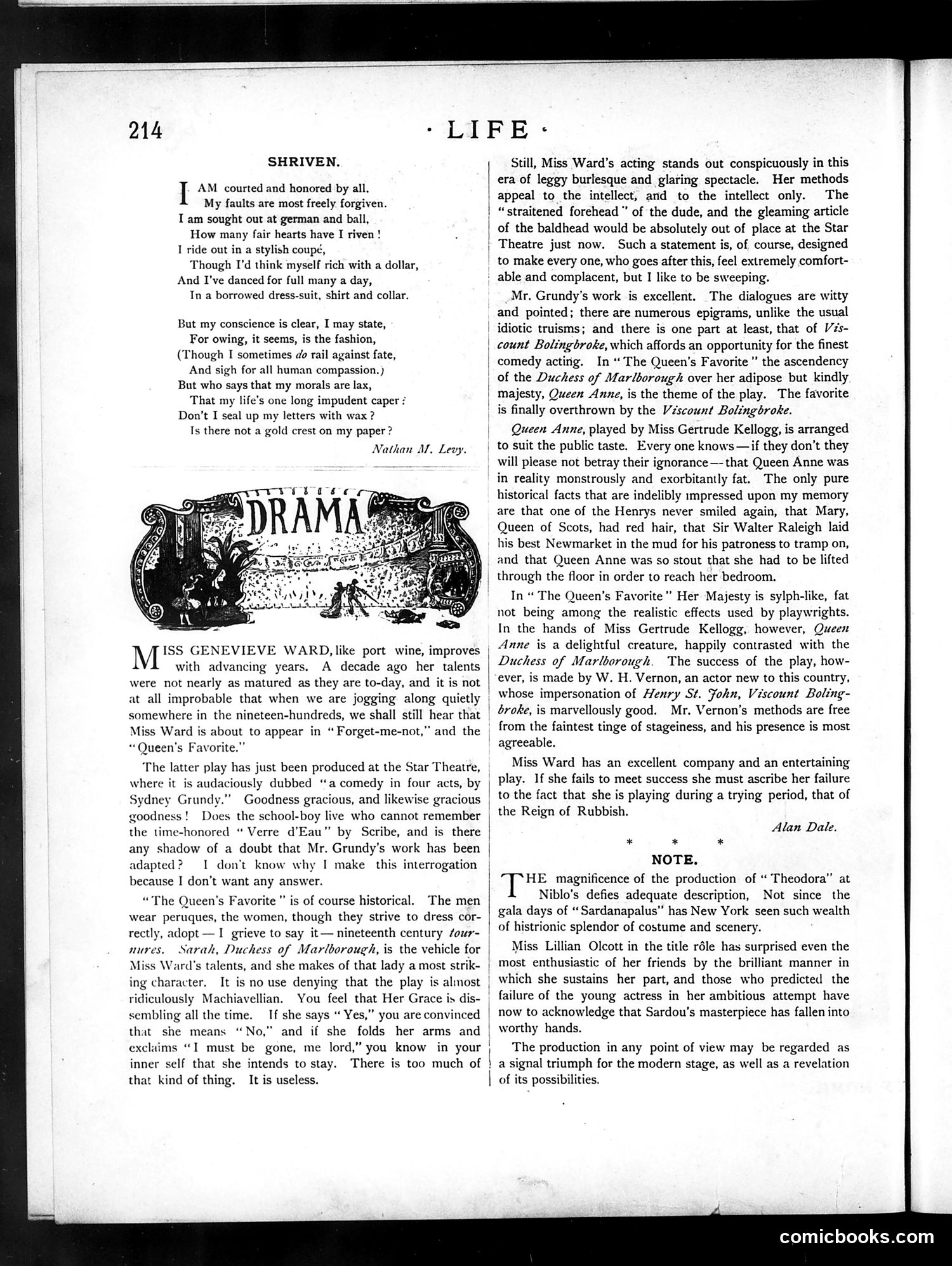
This page contains theater criticism rather than political cartoons. The main content discusses actress **Miss Genevieve Ward** and her performance in "The Queen's Favorite" at the Star Theatre. The critic praises Ward's talents while noting she's in her later career years. The text critiques the play itself—a historical comedy featuring Queen Anne—as somewhat implausible (particularly regarding historical facts about Queen Anne's appearance). However, the critic commends supporting actor **W. H. Vernon** and fellow actress **Miss Gertrude Kellogg** for their performances. A "DRAMA" header decorates the section. A brief note at page's end mentions a production of "Theodora" at Niblo's theater, praising actress Lillian Olcott's performance. The page reflects late 19th-century theater criticism conventions.
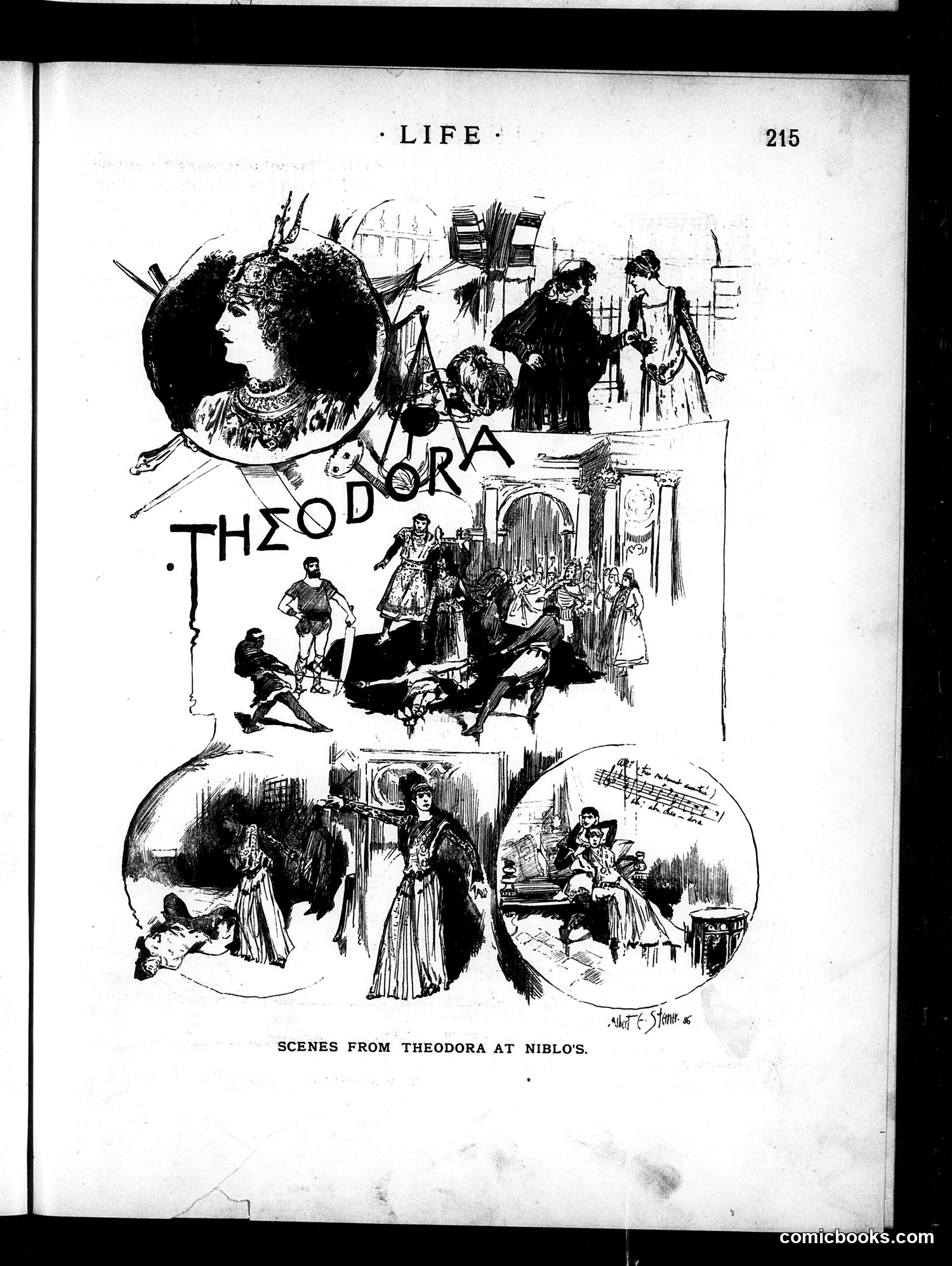
This page presents theatrical illustrations from a production of "Theodora" performed at Niblo's Garden, a prominent New York theatre. The sketches show various dramatic scenes: the upper circular portrait depicts the lead actress in elaborate costume and headdress; the central scene appears to show court or palace intrigue with multiple figures in period dress; the lower circular vignettes show additional dramatic moments, likely depicting plot developments. Without additional context, the specific satirical intent remains unclear. This could be either straightforward theatre coverage or subtle commentary on the production's quality, acting, or historical accuracy. The detailed costume work and dramatic posing suggest this was a major theatrical production of the era worthy of Life magazine's attention.
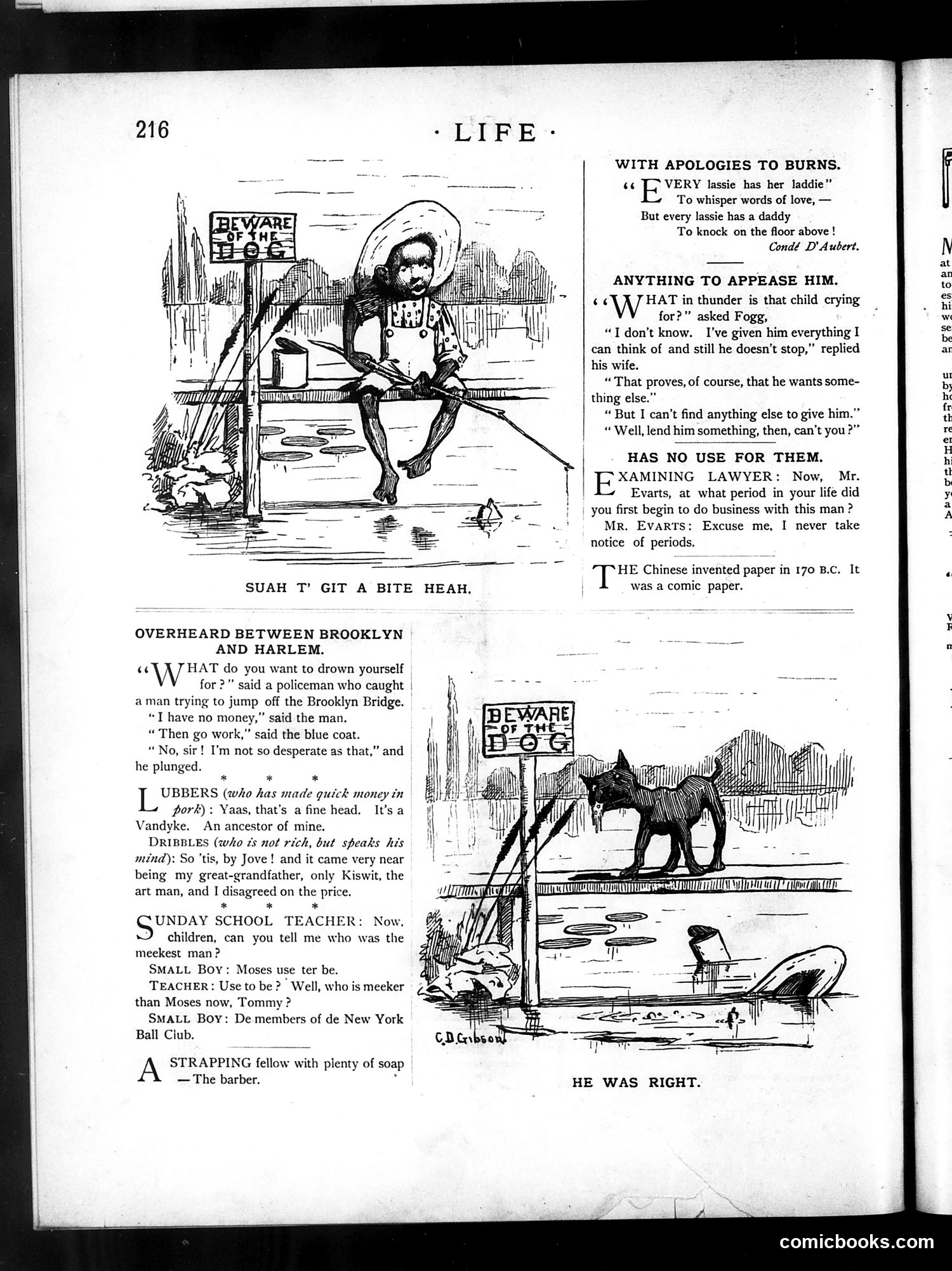
This page collects various short jokes and comic sketches typical of Life magazine's format. Key content includes: **"Suah T' Git a Bite Heah"**: A racist caricature depicting a Black figure with exaggerated features—reflecting the offensive stereotyping common in early 20th-century American humor publications. **"Overheard Between Brooklyn and Harlem"**: A dark joke about a suicide attempt, where a jobless man jumps off Brooklyn Bridge after a policeman tells him to "go work," suggesting economic desperation was treated as fodder for satire. **Other pieces** mock gender dynamics (the "appeasing" husband joke), professional speech patterns (the lawyer's period joke), and social climbing (the pork-money nouveaux riches). The cartoons feature "BEWARE OF DOG" signs and feature Charles Dana Gibson's characteristic illustration style. Overall, the page reflects early-1900s American middle-class humor: often cruel, frequently reliant on ethnic/racial stereotypes and class mockery.
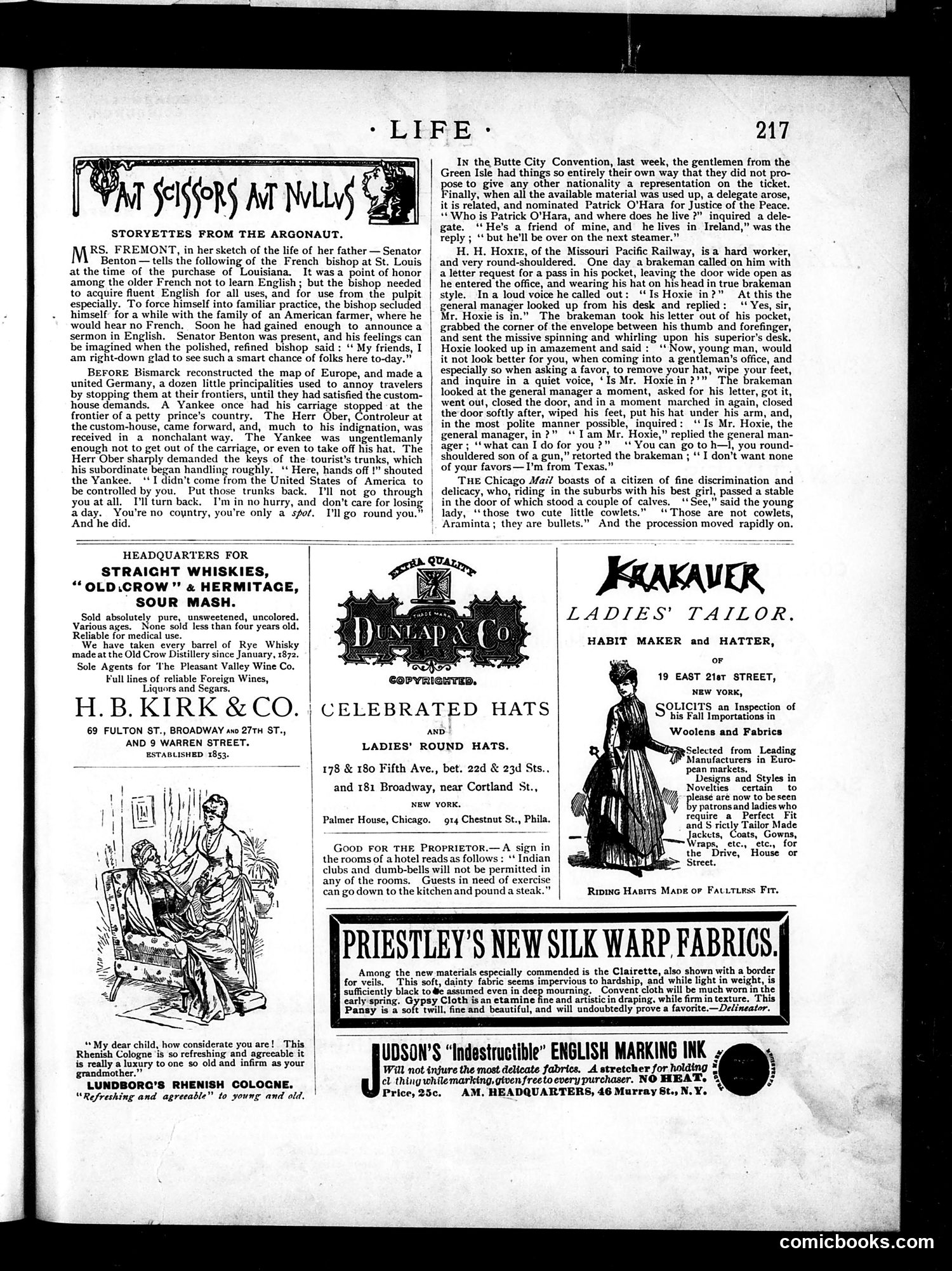
This page contains three humorous anecdotes mocking various groups and behaviors: 1. **The French Bishop**: A refined clergyman forced to learn English by isolation adopts crude American frontier dialect—satire on the contrast between Old World sophistication and American roughness. 2. **The Yankee Traveler**: An American deliberately insults a German customs official by refusing basic courtesies (removing his hat, exiting his carriage), then simply leaves. This celebrates American informality and independence while mocking German bureaucratic pretension. 3. **The Brakeman and Mr. Hoxie**: A railroad worker disrespectfully enters a superior's office with hat on and throws his letter casually. After correction, he returns performing exaggerated politeness. This satirizes working-class rudeness while praising proper decorum. The page also contains period advertisements for whiskey, hats, fabrics, and marking ink—typical of Life's commercial content.
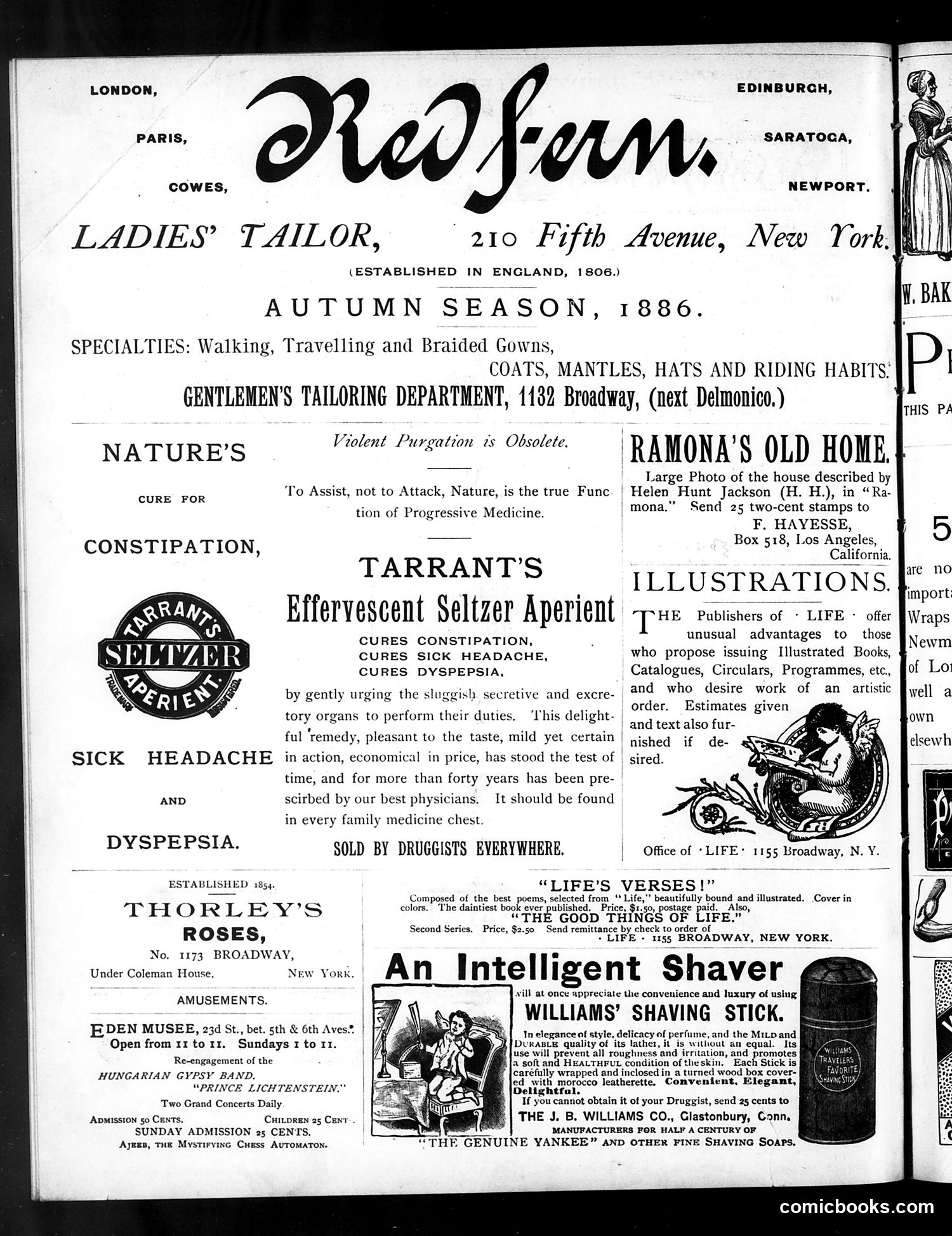
This is primarily an **advertising page** from the autumn 1886 issue of *Life*, a satirical magazine. The page contains no political cartoons or satirical commentary—it's filled with period advertisements typical of the era. Notable ads include: - **Red Fern Ladies' Tailor** (Fifth Avenue, NYC) offering autumn fashions and gentlemen's tailoring - **Tarrant's Effervescent Seltzer Aperient**, a patent medicine promising to cure constipation, headaches, and dyspepsia—typical of the period's dubious medicinal claims - **Williams' Shaving Stick**, marketed to the "intelligent shaver" - References to cultural attractions like the **Eden Musee** wax museum and concerts - **Life's own merchandise**: poetry collections and illustrated books The page reflects 1880s consumer culture, fashion consciousness among wealthy New Yorkers, and the era's unregulated patent medicine industry. There is no satirical content visible—it's a straightforward commercial advertisement section.
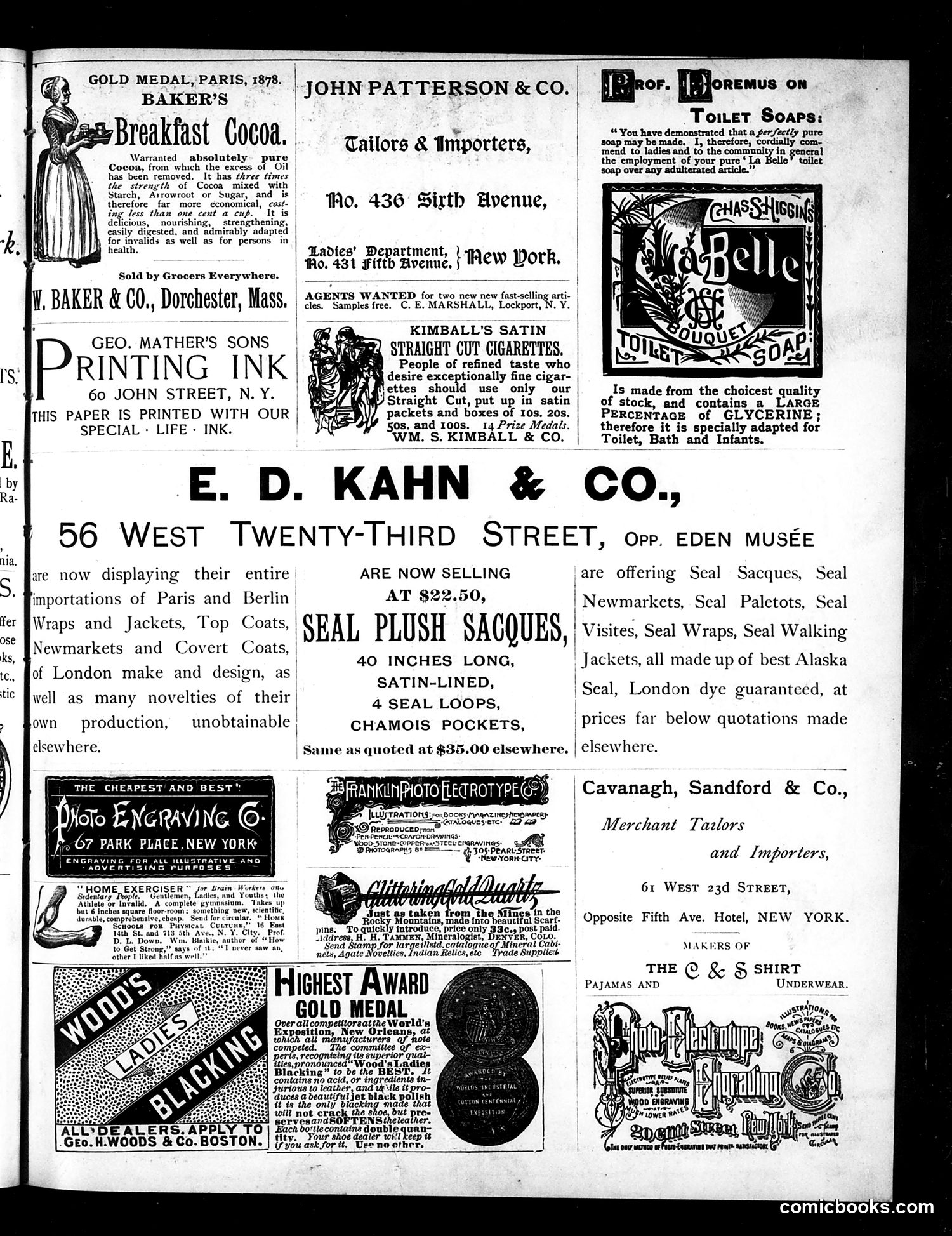
This is primarily an **advertising page** from Life magazine (circa 1898, based on the Paris Gold Medal references from 1878). The page displays commercial advertisements for various products and services: Baker's Breakfast Cocoa, printing ink, clothing tailors and importers, cigarettes, toilet soaps, seal fur garments, photo engraving services, mineral specimens, and shoe blacking. There are **no political cartoons or satirical content** visible. While Life magazine was known for satire, this particular page is devoted entirely to period advertisements targeting late 19th-century consumers—clothing, luxury goods, and household products typical of the era. The only illustration of note is a woman in period dress advertising cocoa, which is a straightforward product endorsement rather than social commentary.
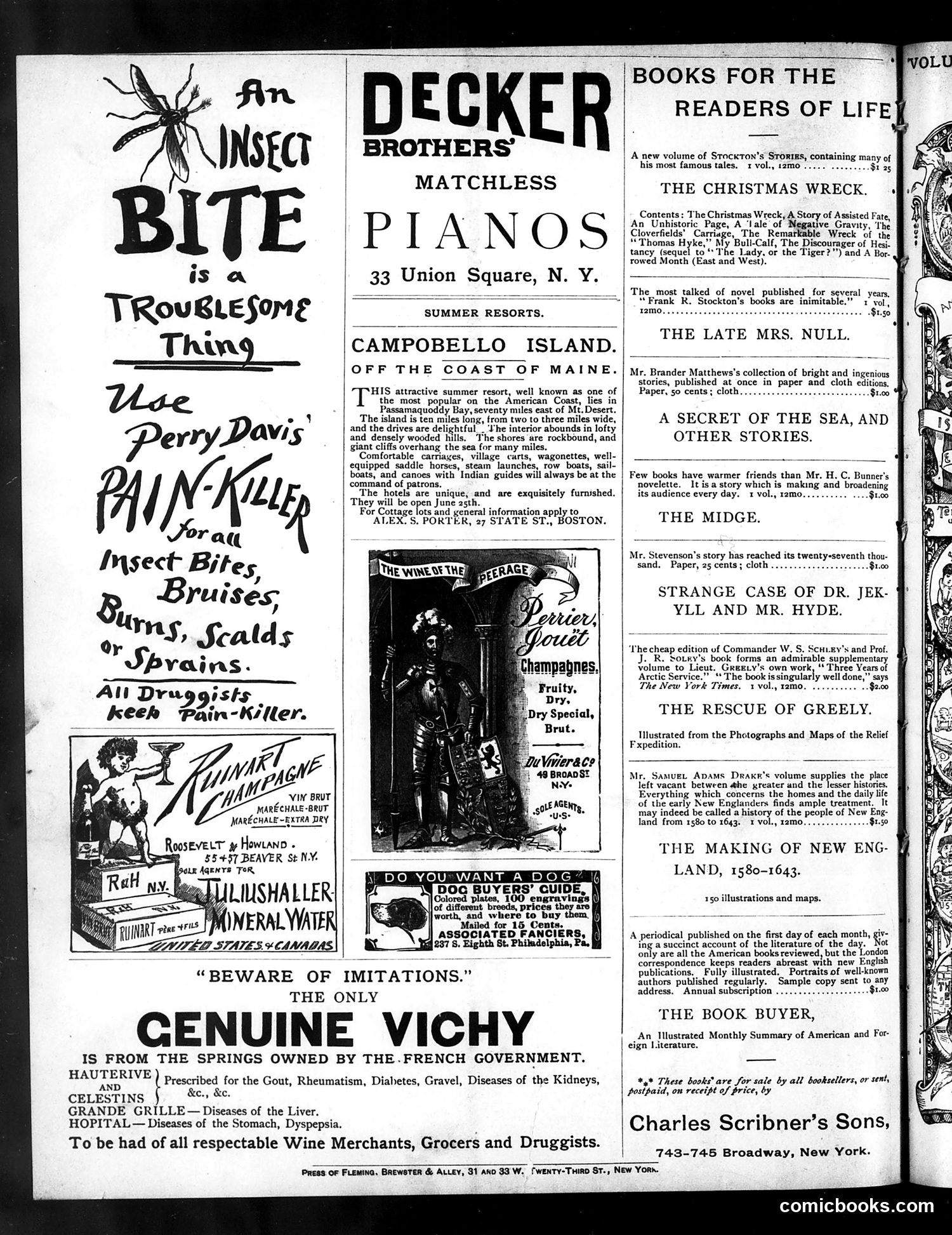
This page is primarily **advertising and book promotions**, not political satire. The main content includes: **Left side**: Advertisement for Perry Davis's Pain-Killer, marketed as a remedy for "insect bites, bruises, burns, scalds or sprains." An accompanying illustration shows a classical female figure with a champagne bottle labeled "Dinart Champagne." **Center**: Advertisement for Decker Brothers matchless pianos and Campobello Island summer resort in Maine. **Right side**: Book listings from Charles Scribner's Sons, featuring titles like Stockton's *The Christmas Wreck*, *Strange Case of Dr. Jekyll and Mr. Hyde*, and *The Making of New England*. **Bottom**: Advertisement for genuine Vichy water, warning "beware of imitations" and listing various medicinal springs owned by the French government for treating gout, rheumatism, and other ailments. There is **no political cartoon or satire present** on this page—it's a standard magazine advertising section typical of late 19th-century publications.