
Life, 1886-10-07 · page 2 of 16
Life — October 7, 1886 — page 2: what you’re looking at
What you’re looking at
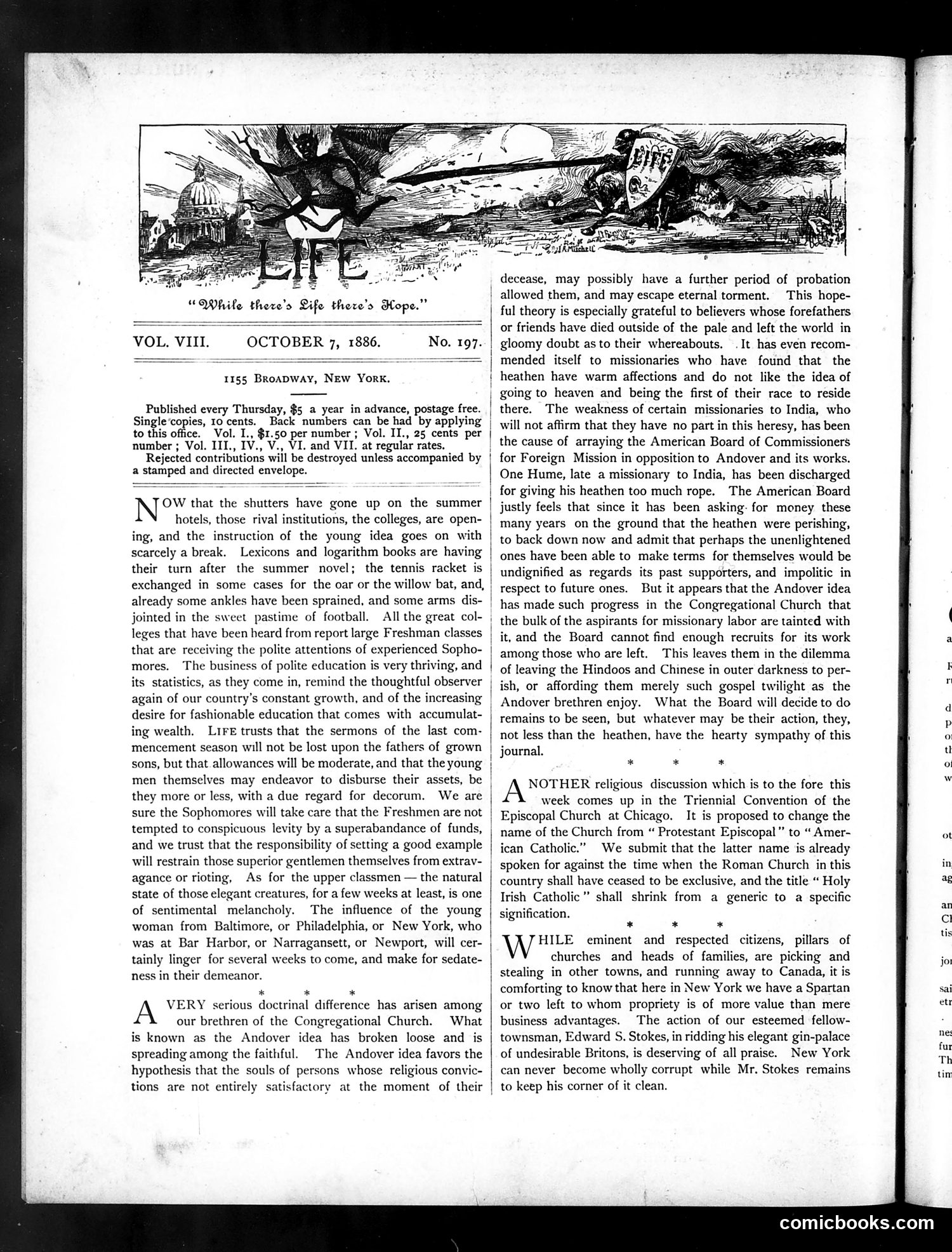
The masthead illustration depicts "Life" as a classical figure seated amid worldly chaos—suggesting the magazine's role as satirical observer of society's contradictions. The article text discusses serious religious controversies rather than presenting visual satire. Key topics include: 1. **The "Andover idea"** — a theological debate within the Congregational Church about whether non-Christians receive afterlife probation, viewed as heretical by traditionalists. 2. **Episcopal Church naming dispute** — a proposal to rename "Protestant Episcopal" to "American Catholic," seen as mimicking Rome. 3. **Social commentary** — praise for Edward S. Stokes, a wealthy New Yorker, for maintaining moral integrity despite temptations. This page prioritizes editorial commentary over visual satire, addressing contemporary religious schisms and ethics among the educated classes.
📄 Transcribed text from this page (OCR, searchable)
Machine-transcribed from the original scan — historical spelling and the odd misread are preserved.
“While there's Life there’s Hope.” VOL. VIII. OCTOBER 7, 1886. 1155 Broapway, NEw York, Published every Thursday, $5 a year in advance, postage free. Single‘copies, 10 cents. Back numbers can be had by applying to this office. Vol. I., $1.50 per number ; Vol. II., 25 cents per number ; Vol. III., IV., V., VI. and VII. at regular rates. Rejected contributions will be destroyed unless accompanied by a stamped and directed envelope. OW that the shutters have gone up on the summer hotels, those rival institutions, the colleges, are open- ing, and the instruction of the young idea goes on with scarcely a break. Lexicons and logarithm books are having their turn after the summer novel; the tennis racket is exchanged in some cases for the oar or the willow bat, and, | already some ankles have been sprained, and some arms dis- | jointed in the sweet pastime of football. All the great col- leges that have been heard from report large Freshman classes | that are receiving the polite attentions of experienced Sopho- | mores. The business of polite education is very thriving, and | its statistics, as they come in, remind the thoughtful observer | again of our country’s constant growth, and of the increasing desire for fashionable education that comes with accumulat- | ing wealth. LIFE trusts that the sermons of the last com- mencement season will not be lost upon the fathers of grown sons, but that allowances will be moderate, and that the young men themselves may endeavor to disburse their assets, be | they more or less, with a due regard for decorum. We are sure the Sophomores will take care that the Freshmen are not tempted to conspicuous levity by a superabandance of funds, and we trust that the responsibility of setting a good example agance or rioting, As for the upper classmen — the natural state of those elegant creatures, for a few weeks at least, is one of sentimental melancholy. The influence of the young woman from Baltimore, or Philadelphia, or New York, who was at Bar Harbor, or Narragansett, or Newport, will cer- | tainly linger for several weeks to come, and make for sedate- ness in their demeanor. * * * VERY serious doctrinal difference has arisen among our brethren of the Congregational Church. What is known as the Andover idea has broken loose and is | spreading among the faithful. The Andover idea favors the hypothesis that the souls of persons whose religious convic- tions are not entirely satisfactory at the moment of their decease, may possibly have a further period of probation | allowed them, and may escape eternal torment. This hope- ful theory is especially grateful to believers whose forefathers or friends have died outside of the pale and left the world in gloomy doubt as to their whereabouts. . It has even recom- mended itself to missionaries who have found that the heathen have warm affections and do not like the idea of going to heaven and being the first of their race to reside there. The weakness of certain missionaries to India, who will not affirm that they have no part in this heresy, has been the cause of arraying the American Board of Commissioners for Foreign Mission in opposition to Andover and its works. One Hume, late a missionary to India, has been discharged for giving his heathen too much rope. The American Board justly feels that since it has been asking: for money these many years on the ground that the heathen were perishing, to back down now and admit that perhaps the unenlightened ones have been able to make terms for themselves would be undignified as regards its past supporters, and impolitic in respect to future ones. But it appears that the Andover idea has made such progress in the Congregational Church that the bulk of the aspirants for missionary labor are tainted with it, and the Board cannot find enough recruits for its work among those who are left. This leaves them in the dilemma of leaving the Hindoos and Chinese in outer darkness to per- ish, or affording them merely such gospel twilight as the Andover brethren enjoy. What the Board will decide to do remains to be seen, but whatever may be their action, they, not less than the heathen, have the hearty sympathy of this journal. * * * NOTHER religious discussion which is to the fore this week comes up in the Triennial Convention of the Episcopal Church at Chicago. It is proposed to change the name of the Church from “ Protestant Episcopal” to “‘ Amer- | ican Catholic.” We submit that the latter name is already will restrain those superior gentlemen themselves from extrav- | spoken for against the time when the Roman Church in this country shall have ceased to be exclusive, and the title “ Holy Irish Catholic” shall shrink from a generic to a specific signification. * * * HILE eminent and respected citizens, pillars of churches and heads of families, are picking and stealing in other towns, and running away to Canada, it is comforting to know that here in New York we have a Spartan or two left to whom propriety is of more value than mere business advantages. The action of our esteemed fellow- townsman, Edward S. Stokes, in ridding his elegant gin-palace of undesirable Britons, is deserving of all praise. New York can never become wholly corrupt while Mr. Stokes remains to keep his corner of it clean. comicbooks.com