
A complete issue · 16 pages · 1886
Life — September 16, 1886
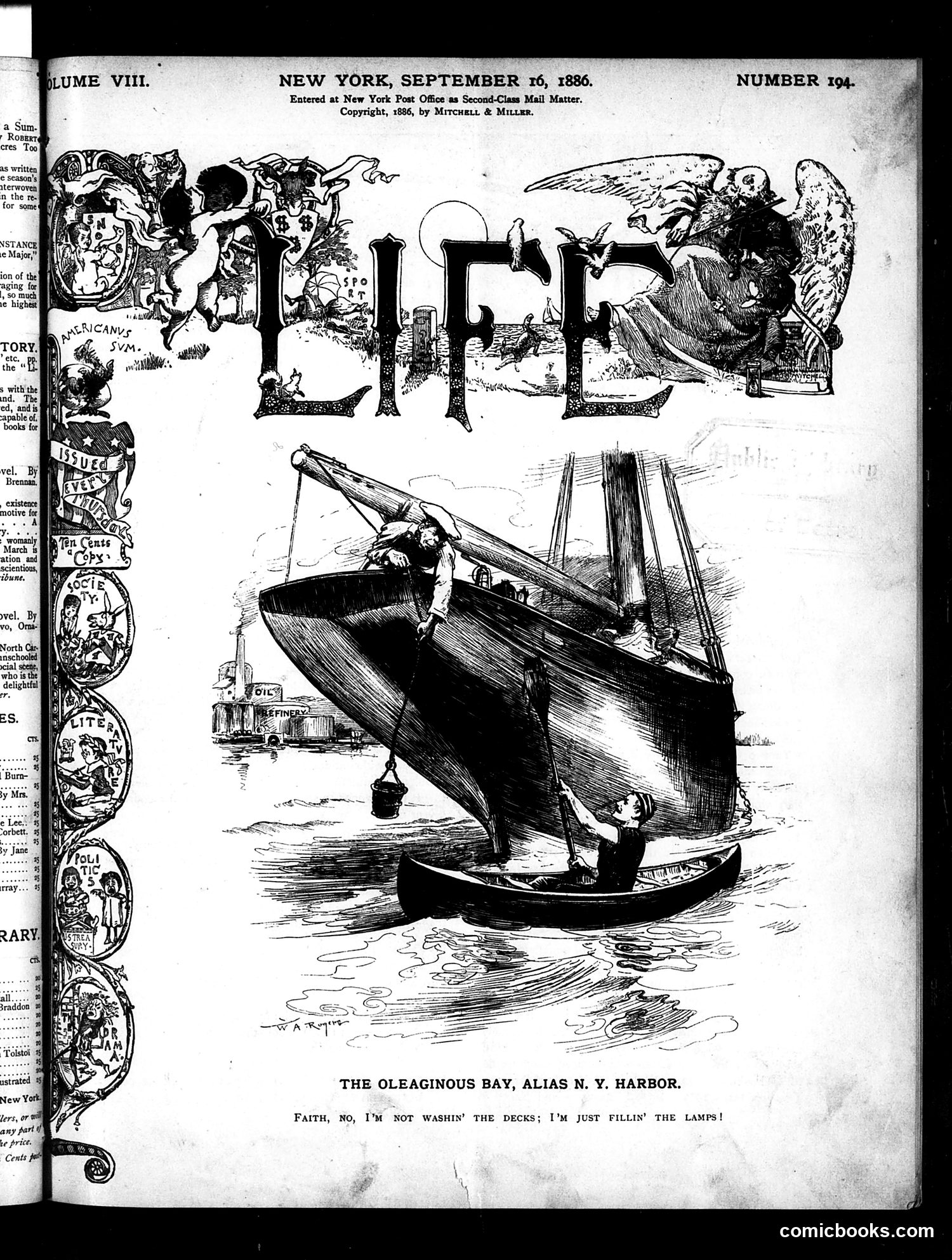
This 1886 *Life* cartoon satirizes New York Harbor's notorious pollution problem. The illustration shows a worker in a small boat beneath a massive oil tanker, with the caption: "Faith, no I'm not washin' the decks; I'm just fillin' the lamps!" The joke is sardonic: the worker claims he's filling oil lamps, but he's actually collecting the oily sludge covering the harbor's surface—suggesting the water itself has become so contaminated with oil residue that it's indistinguishable from lamp fuel. "Oleaginous" (meaning oily) emphasizes the satirical title. This reflects genuine public concern about industrial pollution transforming New York's harbor into a contaminated, unusable body of water. The cartoon mocks both the environmental damage and the casual attitude toward it.
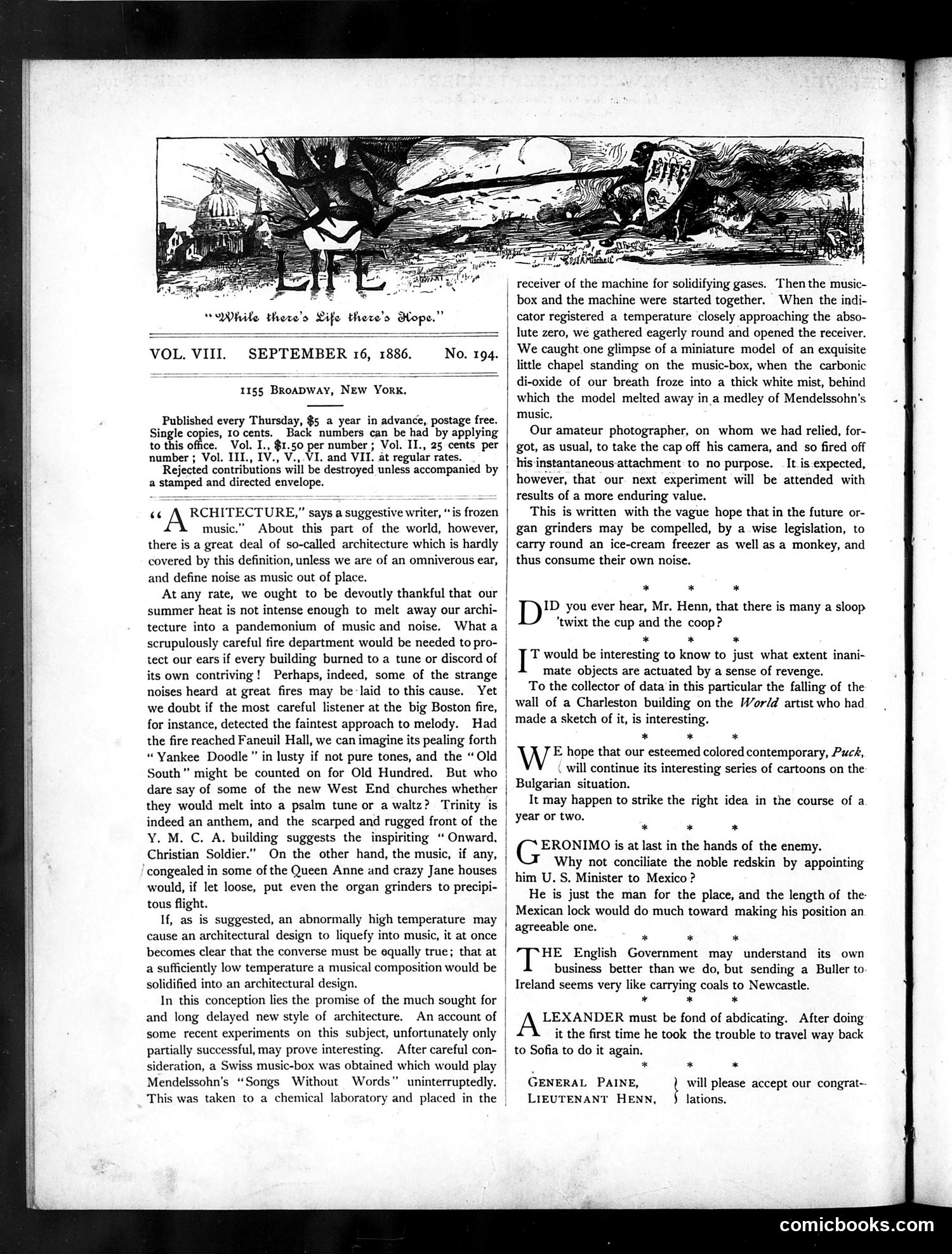
The page's main cartoon illustrates an article about architecture as "frozen music." The satirical point is that just as intense heat can melt architecture, sufficiently low temperatures can transform music into physical form—here, a tiny chapel model made from frozen carbon dioxide from human breath, which melts away while playing Mendelssohn. The accompanying text offers brief satirical comments on contemporary events: General Paine and Lieutenant Henn receiving congratulations (military context unclear), criticism of the English government's Irish policy ("carrying coals to Newcastle"), and commentary on Alexander's abdication and Geronimo's capture. The humor relies on absurdist logic and wordplay rather than identifying specific caricatures.
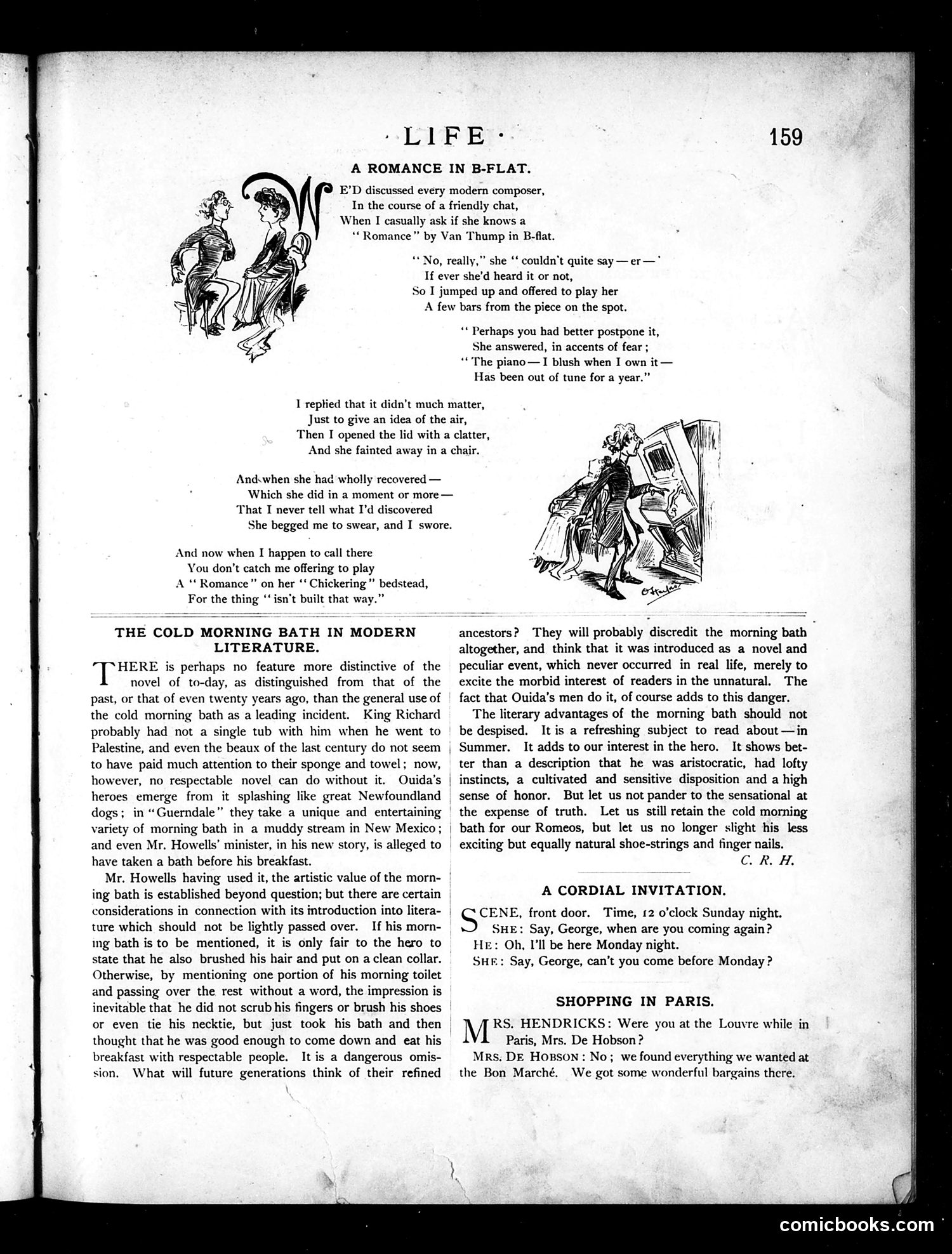
**"A Romance in B-Flat"** is a humorous poem about a social mishap. The narrator offers to play piano for a female acquaintance who claims unfamiliarity with a Van Thamp composition. When he opens the piano lid, she faints—apparently from shock at its poor condition (out of tune for a year). The joke satirizes both the woman's exaggerated Victorian sensibility and the narrator's obliviousness to the piano's deplorable state. The accompanying sketches show the two characters and the woman fainting dramatically in a chair. The remaining articles discuss the "cold morning bath" in literature and contain brief social vignettes ("A Cordial Invitation," "Shopping in Paris"), typical of Life's light satirical content targeting upper-class American manners and pretensions.
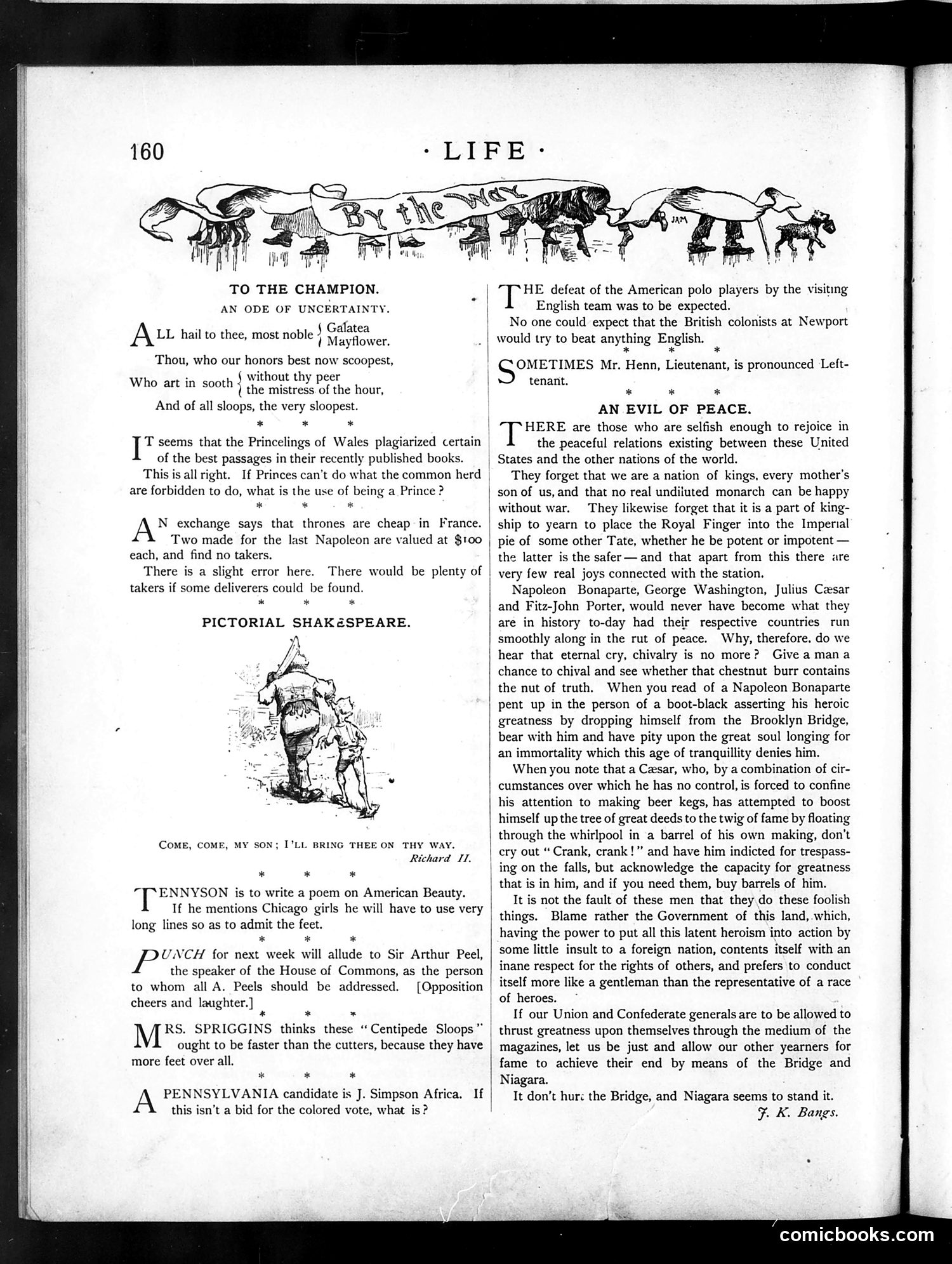
This page contains several satirical pieces typical of 19th-century *Life* magazine: **"To the Champion: An Ode of Uncertainty"** mocks an unidentified "Galatea Mayflower"—likely a society figure or debutante. **"Pictorial Shakespeare"** shows a sketch captioned with a Richard II quote, appearing to lampoon theatrical pretension or contemporary politics through Shakespearean reference. The brief notes mock various targets: American polo players defeated by the English; Lieutenant Henn's pronunciation; a Pennsylvania political candidate named "J. Simpson Africa"; and proposed Chicago beauty pageants requiring "very long lines." **"An Evil of Peace"** is the page's substantial political commentary, criticizing American complacency about peace while foreign nations (referencing Napoleon, Caesar, Washington, Porter) achieved greatness through conflict. The author argues the U.S. government should support generals seeking glory—likely referencing contemporary Civil War-era tensions or Reconstruction politics.
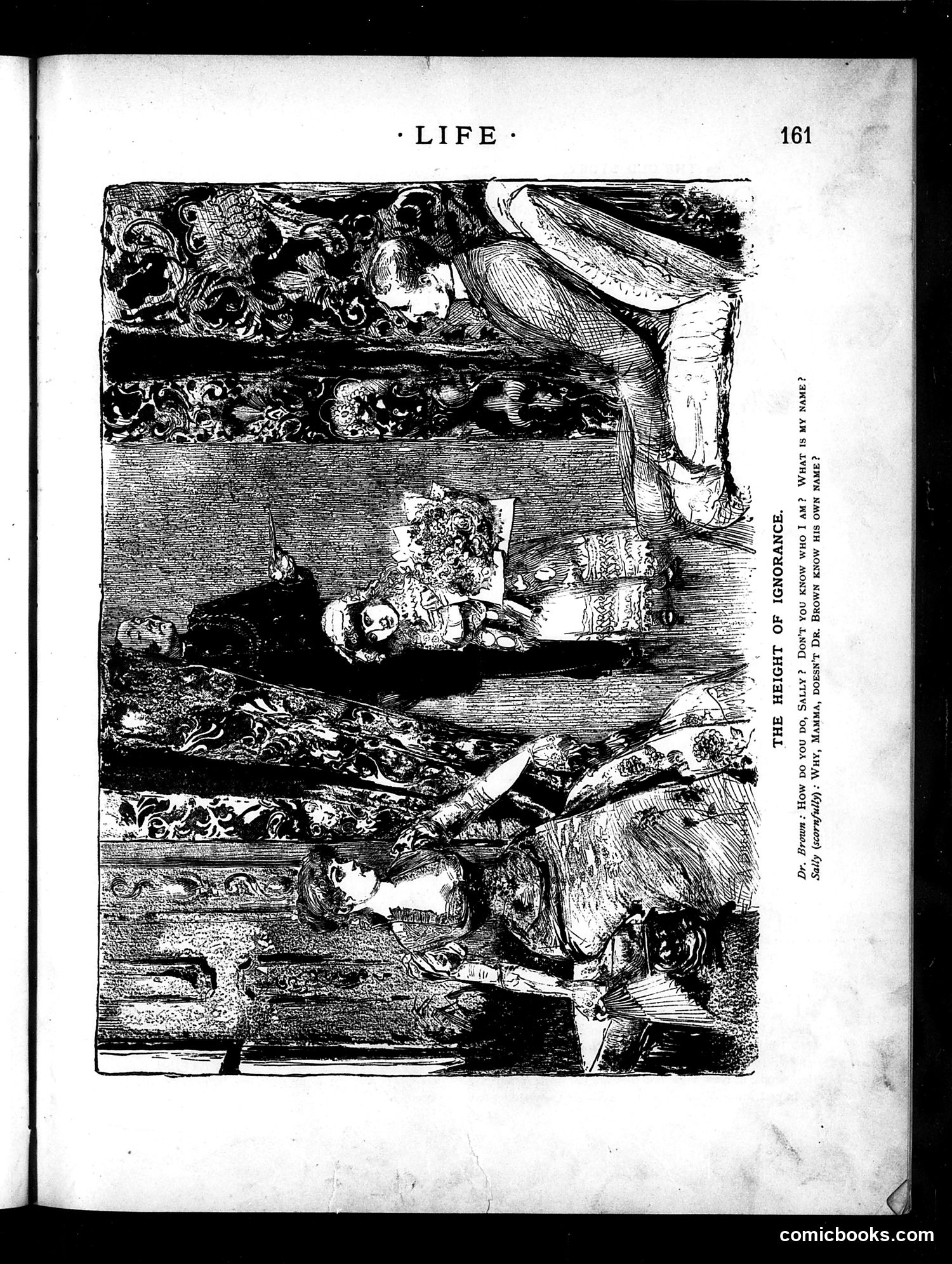
This appears to be a satirical illustration titled "The Hereit of Gowdanae," though the exact reference remains unclear from the OCR text alone. The image shows an inverted or upside-down scene with figures in elaborate period dress and decorative furnishings, suggesting either a literal inversion of social order or a commentary on chaos and disorder. The ornate textiles and formal clothing indicate this likely satirizes aristocratic or upper-class pretensions. The compositional inversion—turning the image upside down—was a common satirical device in early 20th-century magazines to mock social hierarchies or suggest things "turned on their head." Without clearer context about "Gowdanae," the specific political target remains uncertain.
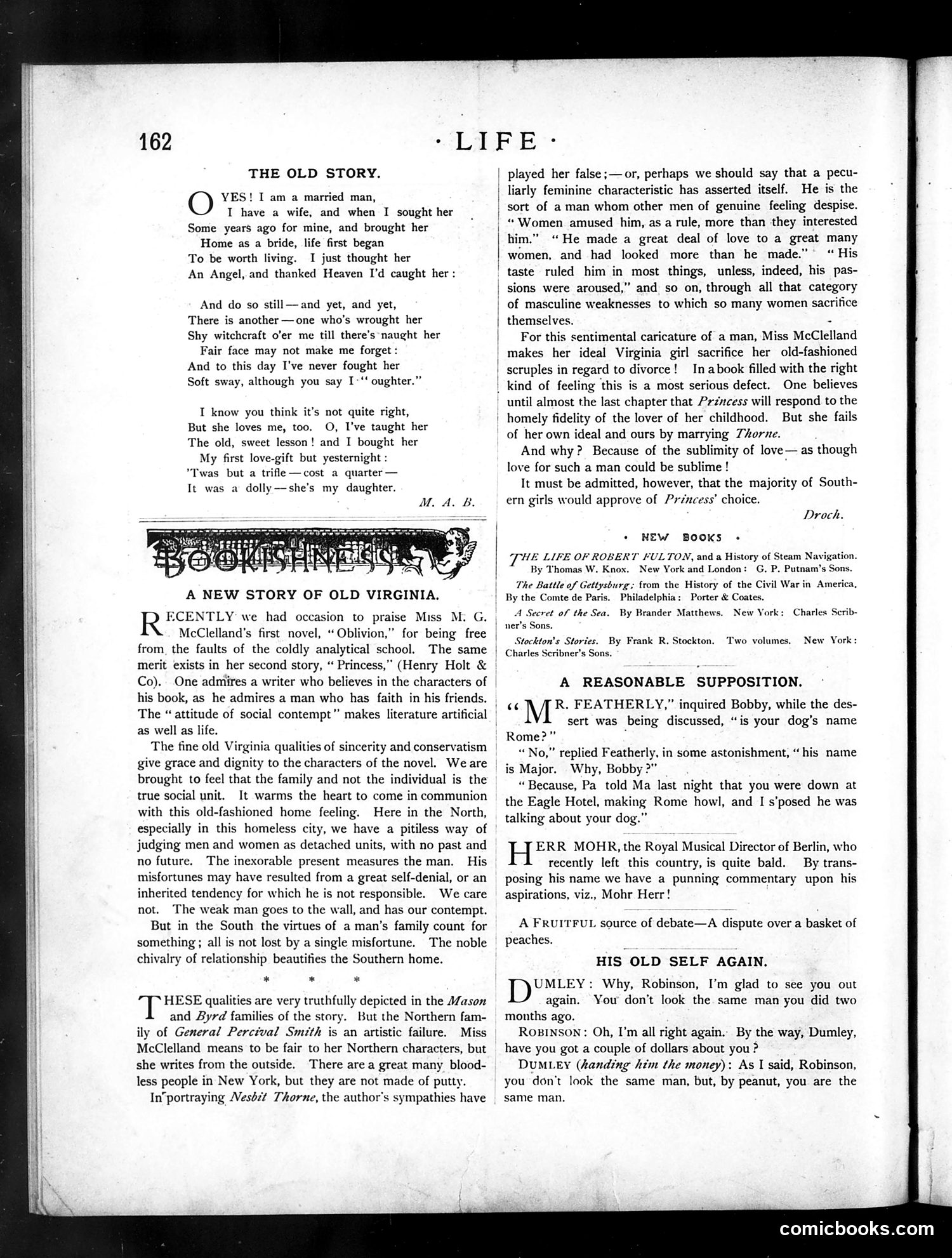
This page contains literary criticism and social commentary rather than political cartoons. The main content includes: **"The Old Story"** — a poem by M.A.B. critiquing a married man's romantic nostalgia, presenting his idealized past as self-deceptive. **"A New Story of Old Virginia"** — a review praising M.G. McClelland's novel *Princess* for depicting Southern family values and social conservatism with sincerity. The reviewer notes McClelland, a Northern writer, fairly represents Southern characters. **"A Reasonable Supposition"** — a brief humorous anecdote about mistaken identity involving someone named Featherly and a dog. **"His Old Self Again"** — a dialogue between Dumley and Robinson about Robinson's changed appearance after two months, implying financial difficulty ("don't look the same man"). The page demonstrates Life's mix of literary criticism, social observation, and gentle humor typical of early 20th-century American magazines.
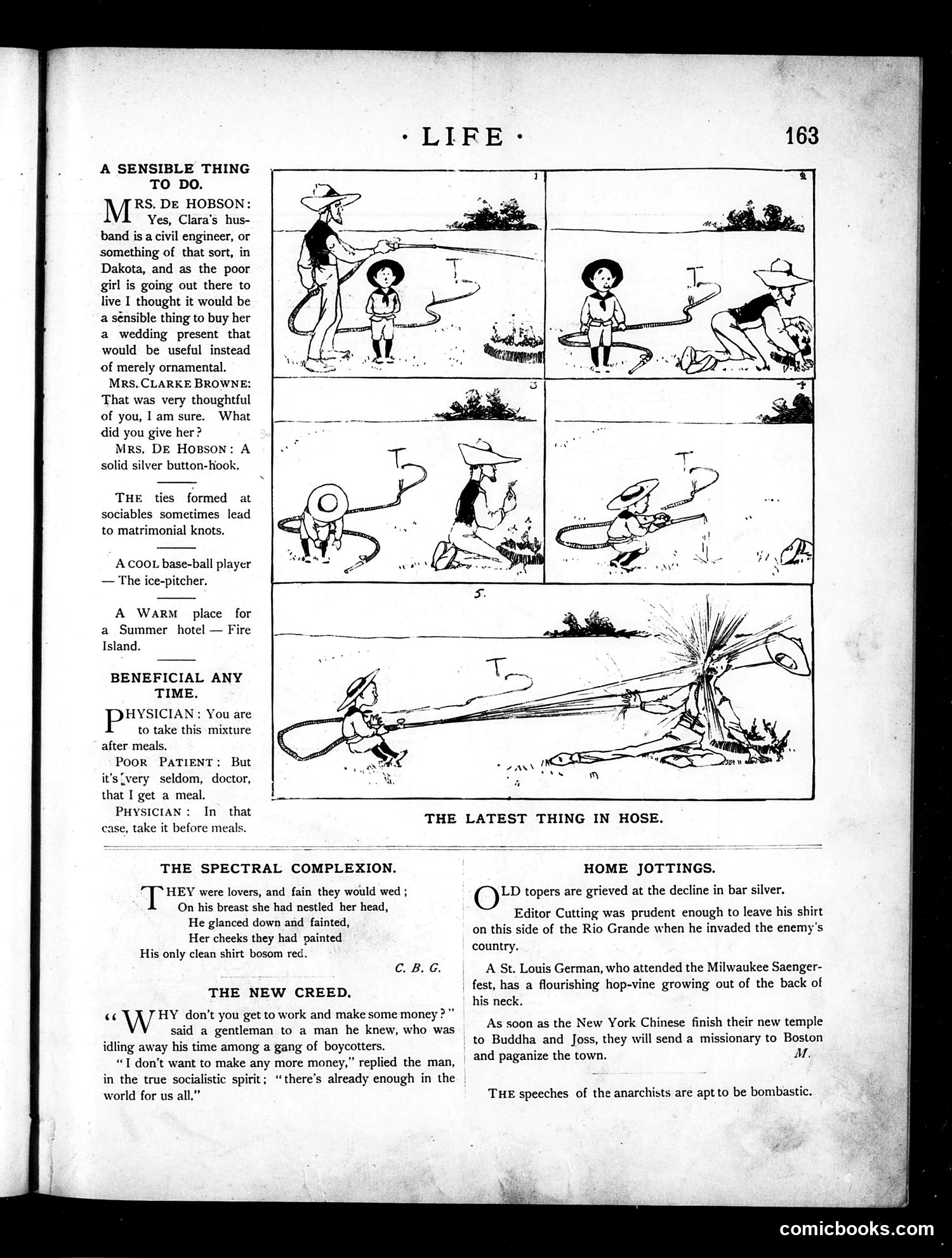
This comic strip satirizes the fashionable activity of using a garden hose, likely a relatively new household convenience at the time. The sequence shows a woman and child using increasingly elaborate and comedic methods to manage a hose—wrapping it around themselves, struggling with its unwieldy length, and ultimately getting tangled or knocked down by water pressure. The humor lies in contrasting the hose's promised practicality with the actual chaotic results. The title's phrase "latest thing" mocks how Americans quickly adopted new technologies as status symbols, even when they created more problems than solutions. This reflects early-20th-century satire about consumer culture and domestic life.
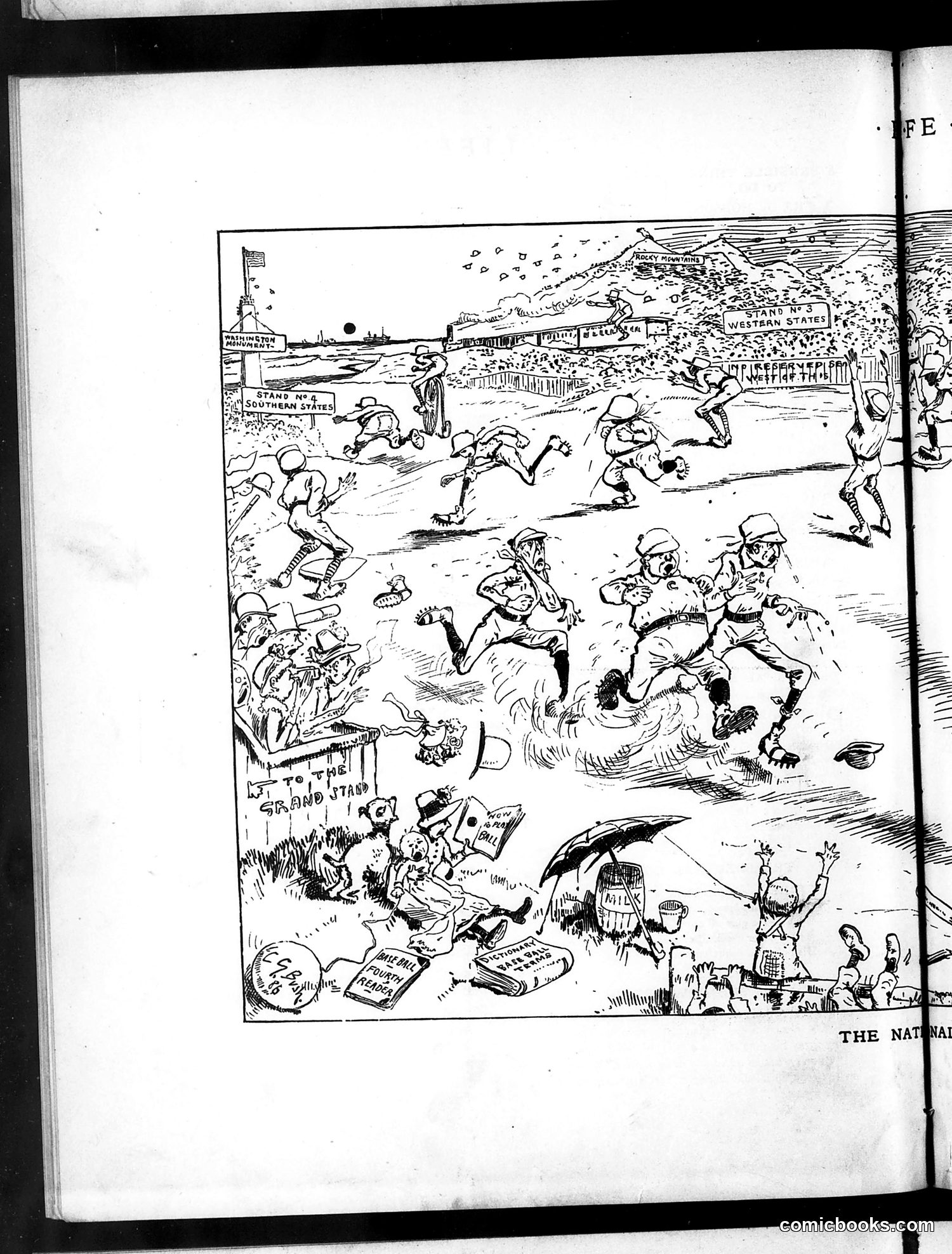
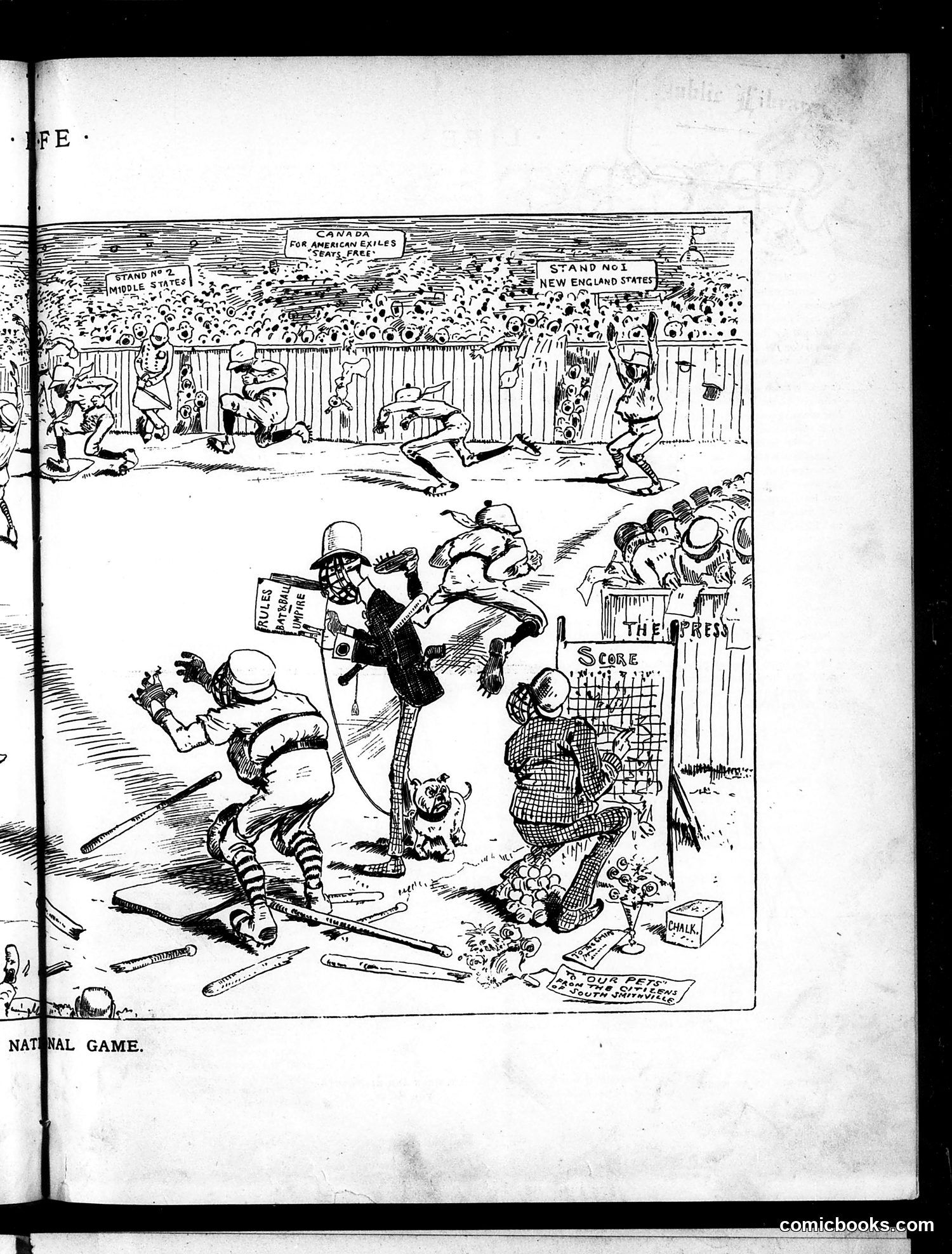
This is a satirical cartoon about baseball titled "The National Game." The sketch depicts a chaotic baseball scene with stands labeled "Canada," "Stand No. 2" (Middle States), and "Stand No. 1" (New England States), along with "The Press" box. The central figures appear to be caricatured players engaged in exaggerated, slapstick baseball action. Various props scattered on the field—including a sign reading "Rules of the Game," bats, balls, and chalk—suggest commentary on baseball's rules or governance. The cartoon likely satirizes either a specific baseball controversy or uses the sport metaphorically to comment on regional American tensions or media coverage. The prominent stands labeled by region suggest the joke may involve sectional politics or regional rivalries being played out through baseball. Without a visible publication date, the precise historical reference remains unclear.
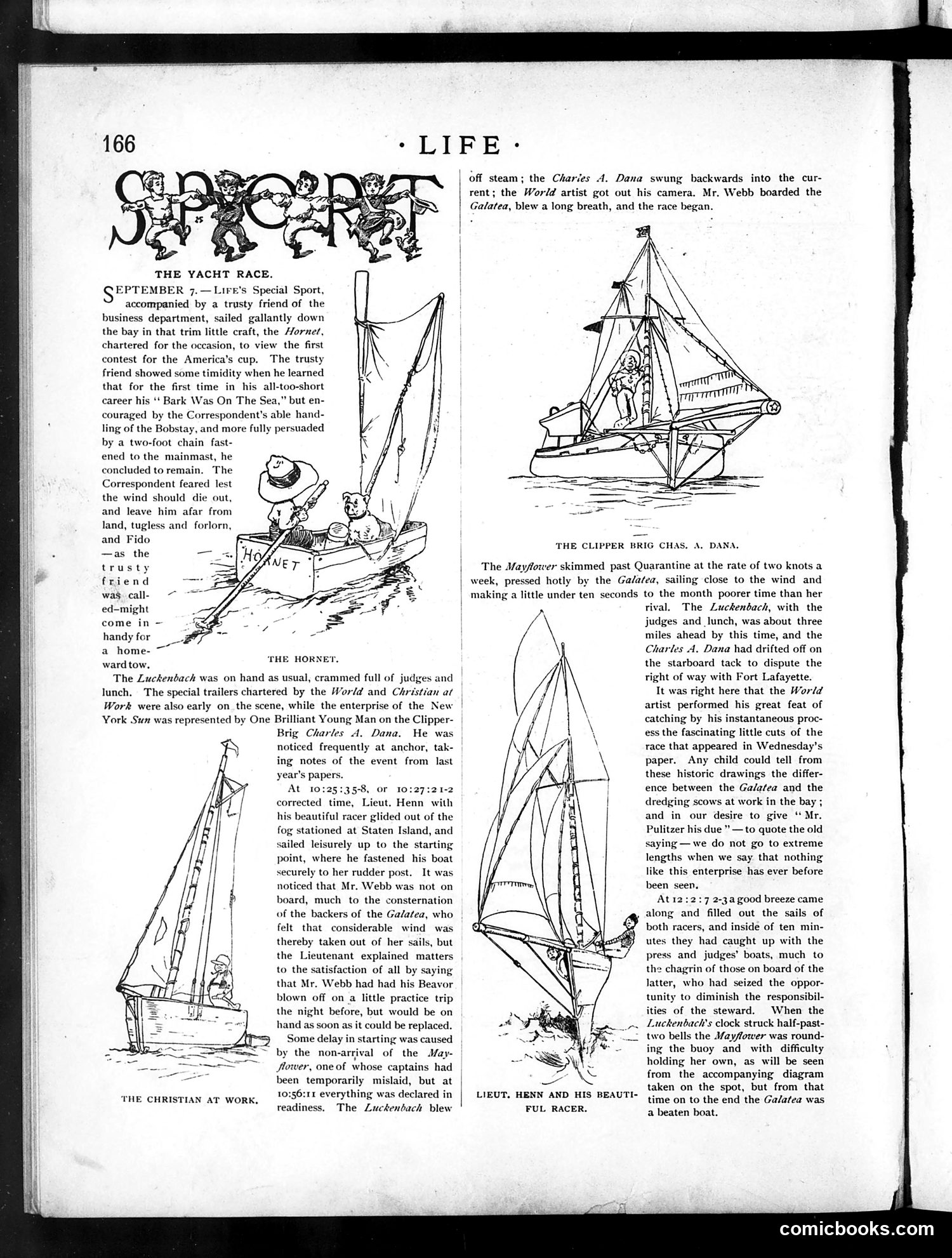
This page documents America's Cup yacht racing in September (date unclear from image). The article describes an actual competitive sailing event featuring multiple vessels: the *Hornet*, *Luckenbach*, *Charles A. Dana*, and *Galateas*. The illustrations show detailed technical drawings of period sailing ships and their rigging. The text emphasizes the drama of competition—wind conditions, positioning, and tactical advantages between vessels. Notable figures mentioned include Mr. Webb (who appears central to the narrative) and various boat captains and judges. This appears to be straightforward sports reporting rather than political satire. Life magazine's "Sport" section covered contemporary athletic events with both illustrations and narrative commentary for readers interested in competitive yachting.
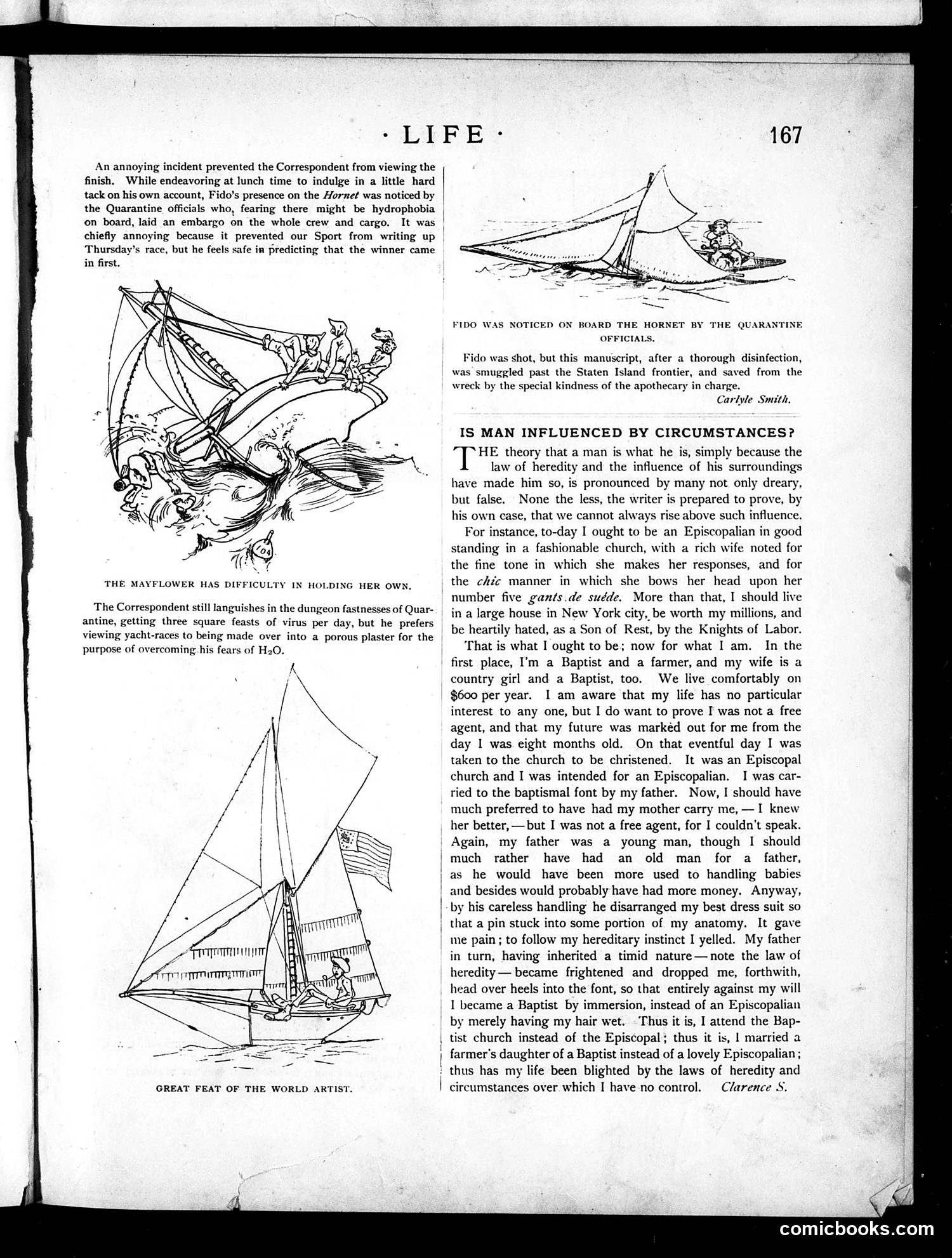
This page combines **yacht-race reporting with philosophical humor**. The top cartoons depict the America's Cup yacht races (the "Mayflower" and "Hornet"), interrupted when a dog named Fido aboard the *Hornet* triggers quarantine protocols, preventing a correspondent from completing his race coverage. The main article, titled "Is Man Influenced by Circumstances?", presents a humorous first-person essay arguing that heredity and circumstance control destiny—despite claims to the contrary. The author (Clarence S.) illustrates this through absurdist autobiography: intended to be a wealthy, fashionable Episcopalian, he instead became a poor Baptist farmer because his careless father dropped him into a baptismal font as an infant, causing him to be immersed rather than sprinkled. **The satire targets** Victorian-era debates about nature versus nurture, determinism versus free will. By tracing his entire "blighted" life to one accident—a dropped baby—the author mocks both those claiming absolute personal agency and those blaming all outcomes on circumstances. The joke's irony: we're supposedly free agents, yet random events dictate everything.
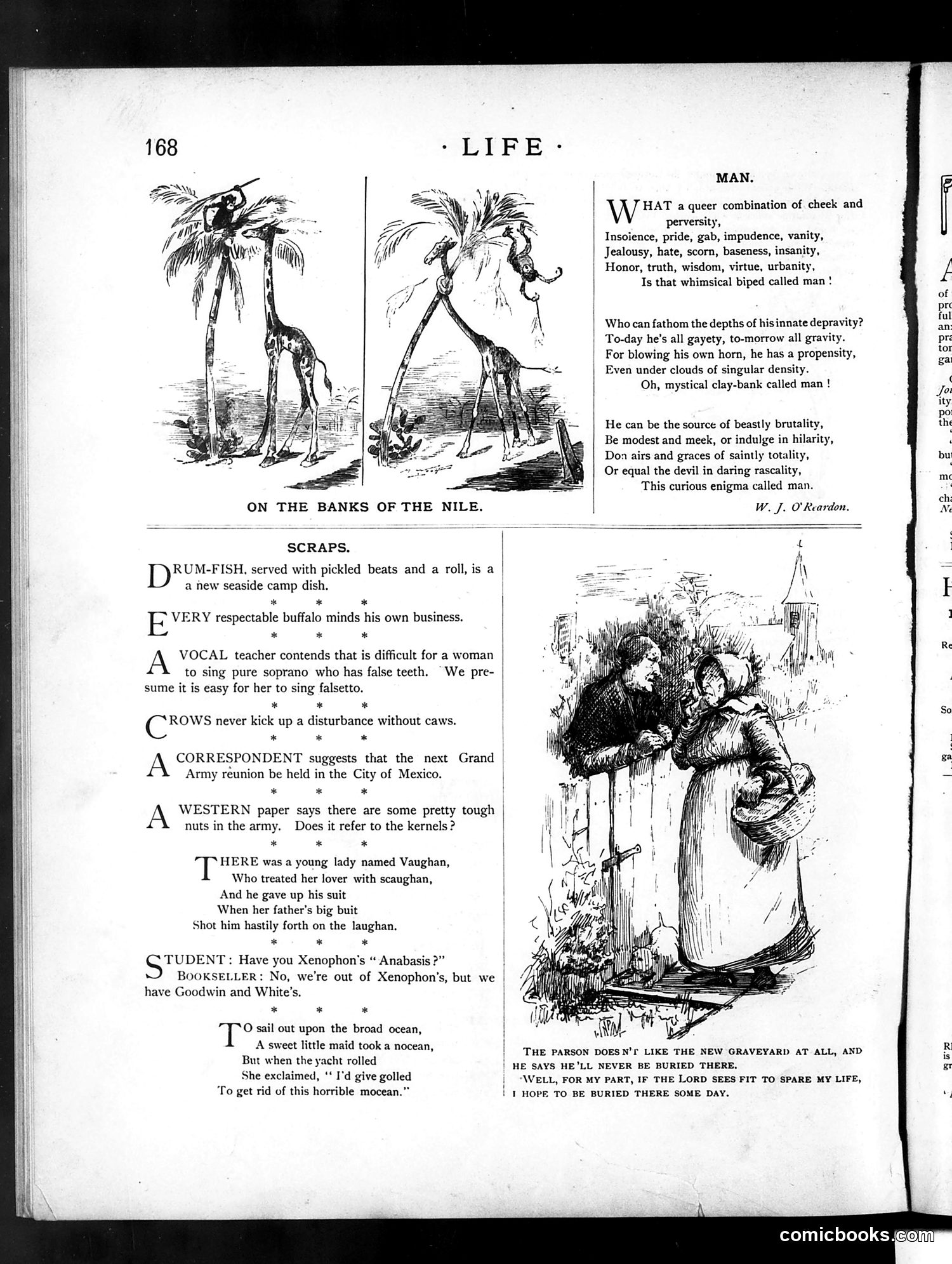
This page contains miscellaneous satirical content typical of Life magazine's humor section. **Top:** Two etchings labeled "On the Banks of the Nile" show giraffes in exaggerated poses. Accompanying them is a poem by W.J. O'Reardon mocking human nature—describing man as a contradictory creature embodying both virtue and vice, nobility and depravity. The satirical point is humanity's inherent inconsistency. **Bottom:** A "Scraps" section collects brief jokes and puns, many relying on wordplay (e.g., "crows" without "caws," a parson's dark humor about graveyards). These include commentary on military life, vocal technique, and social absurdities. One anecdote mocks a young lady who rejects her suitor after her father intervenes violently. The illustration shows a woman with a child and a clergyman—likely accompanying the graveyard joke about the parson's reluctance to be buried in a new cemetery. The overall tone reflects 19th-century genteel satire targeting human foibles and contemporary social customs.
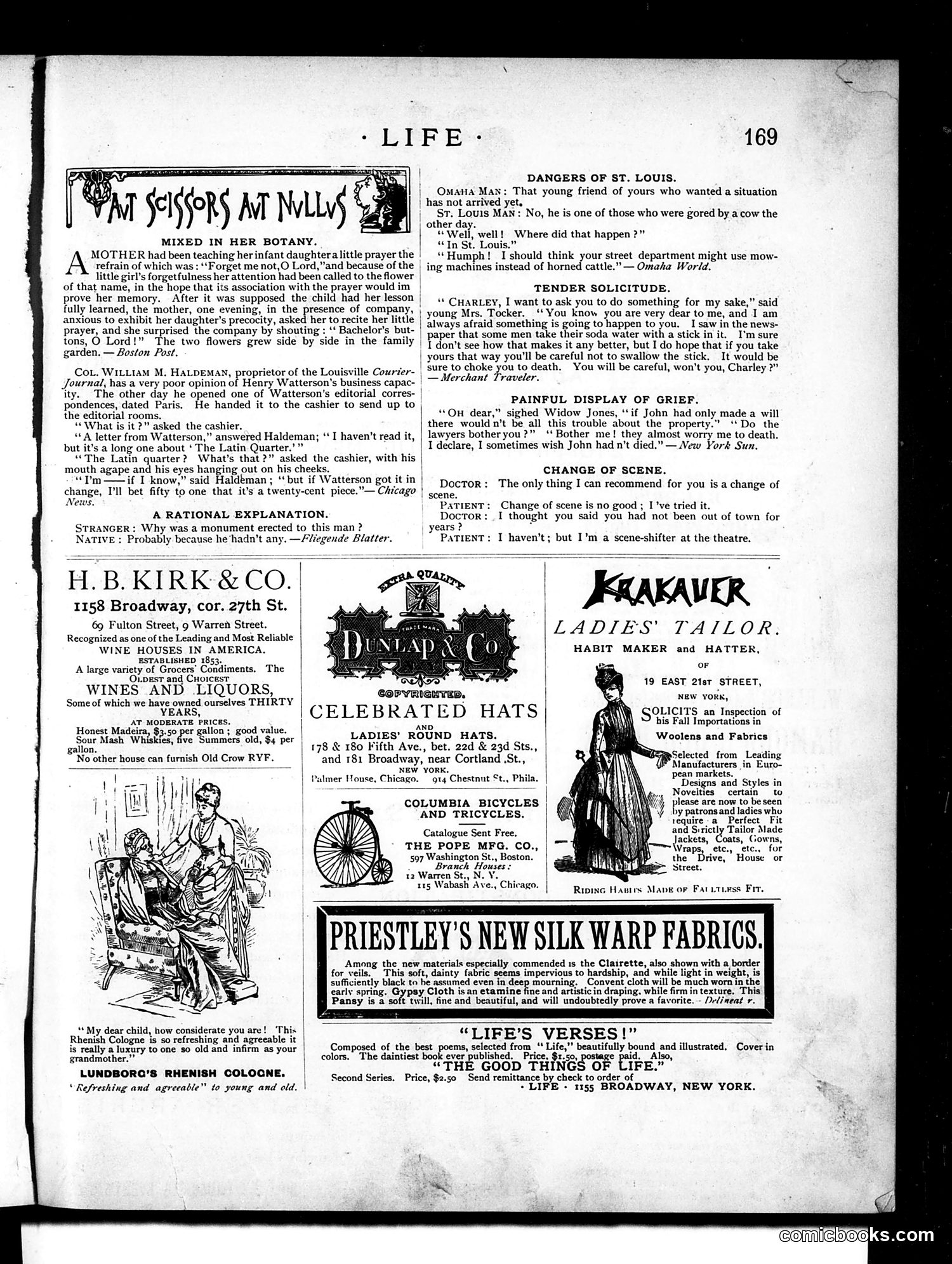
This page contains **multiple short humorous anecdotes** rather than political cartoons, typical of Life's satirical format. The jokes mock everyday absurdities: a child confuses "forget-me-nots" with "bachelor's buttons" (playing on proximity and childhood logic); a Louisville newspaper editor wastes money on frivolous Paris correspondence; a monument's purpose becomes unclear; and a wife frets over her husband swallowing a stick from soda water—anxiety masked as concern. One item references St. Louis dangers (a cow goring), likely referencing the city's reputation or a contemporary incident. Another mocks widows' theatrical grief over legal troubles rather than actual loss. The **dense advertisement section** dominates the lower half, promoting wines, bicycles, hats, and fabrics—typical of Life's revenue model. These are gentle, domestic satires targeting **middle-class pretension, feminine anxiety, and newspaper profiteering**—reflecting Gilded Age concerns about propriety and commercialism.
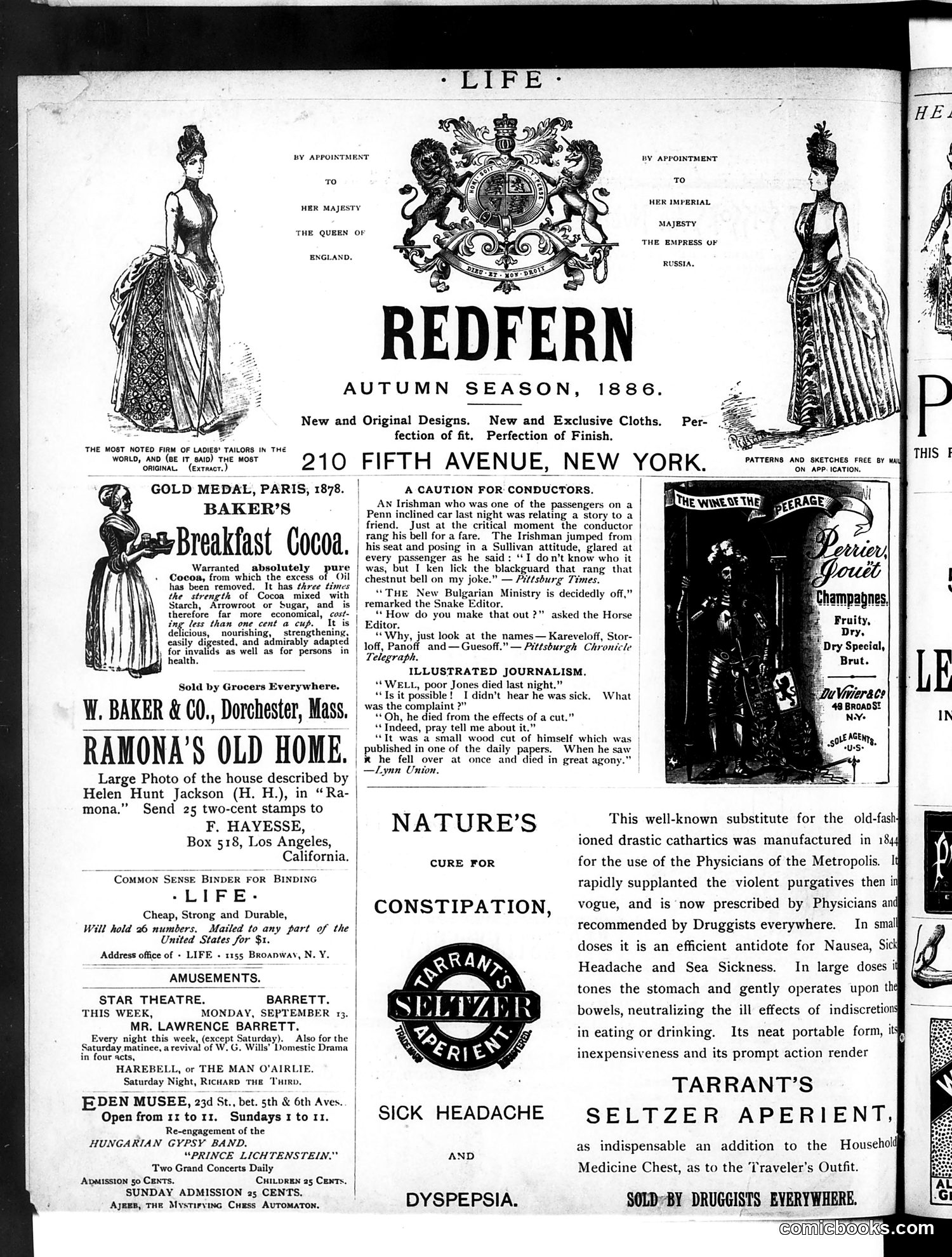
This is primarily a **fashion advertisement and classified ads page**, not a political cartoon. The main content advertises Redfern, a high-end ladies' tailoring firm, positioned as having royal warrants from both the British Queen and Russian Empress—a status symbol claiming elite European approval. The page includes several brief **humorous anecdotes** rather than satire: - An Irish conductor story playing on ethnic humor (the "Sullivan attitude" references boxer John L. Sullivan) - A joke about Bulgaria's new ministry, mocking unfamiliar Eastern European names - "Illustrated Journalism" mocking a newspaper woodcut causing someone's death These are lightweight jokes typical of Life's era, exploiting ethnic stereotypes and absurdist humor rather than targeting specific political figures or events. The remainder comprises **patent medicine advertisements** (Baker's Cocoa, Seltzer Aperient) and theater listings—standard period magazine filler.
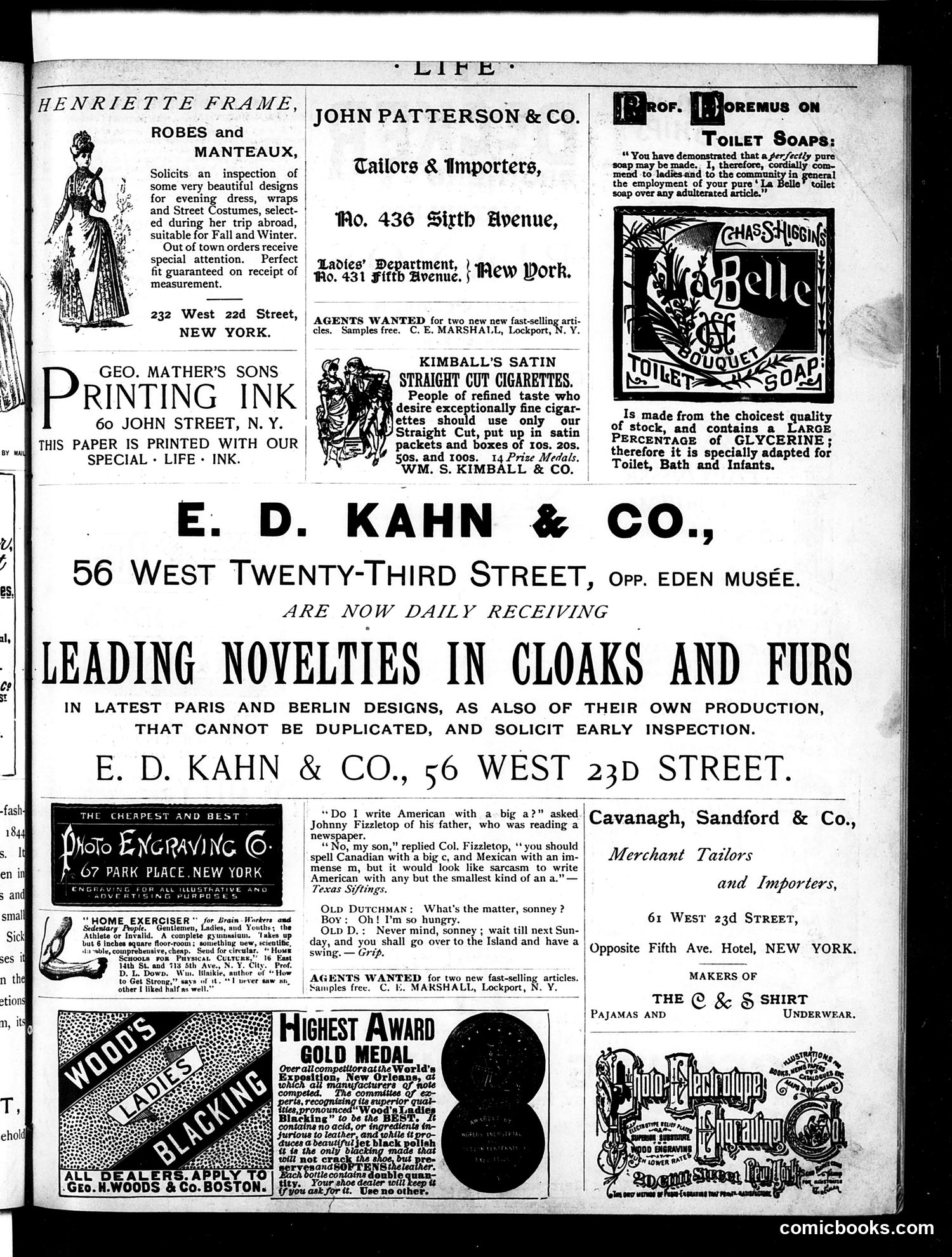
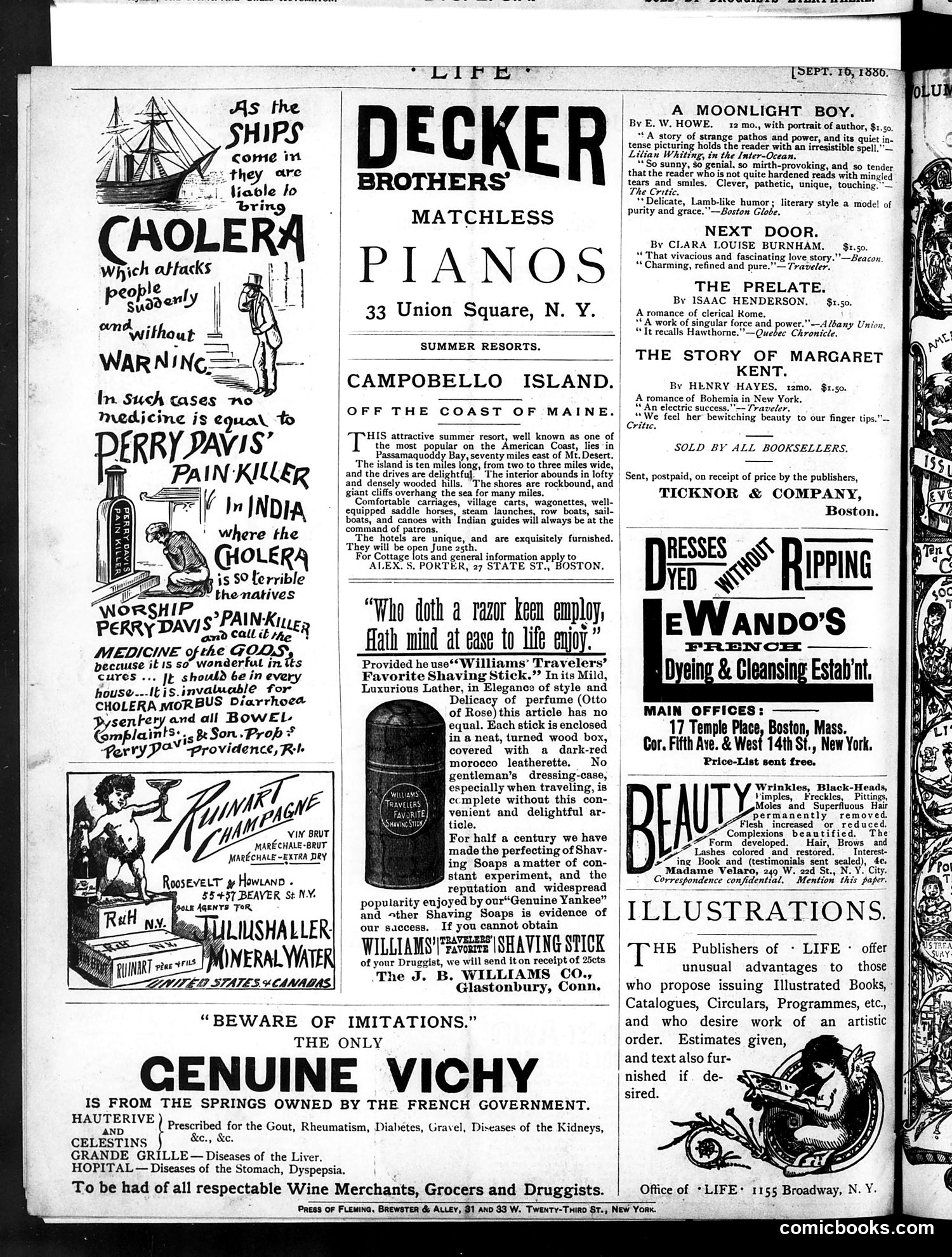
This is primarily an **advertising and book review page**, not a political cartoon. The content reflects 1880s commercial culture: **Left side:** Patent medicine ads, notably **Perry Davis's Pain Killer**, promoted with xenophobic imagery depicting cholera in India. The ad exploits fears of exotic diseases to sell medicine—a common 19th-century marketing tactic. **Center:** Advertisement for **Decker Brothers' pianos** and **Williams' Travelers' Shaving Stick**, alongside a tourist promotion for **Campobello Island** resort in Maine. **Right side:** Book reviews for contemporary romance novels and beauty product ads (**LeWando's French Dyeing**). The page's primary function is commercial rather than satirical. Any "satire" is incidental—the exaggerated health claims and orientalist imagery in the medicine ads reflect genuine (if problematic) marketing practices of the era, not intentional social commentary.