
Life, 1886-09-16 · page 3 of 16
Life — September 16, 1886 — page 3: what you’re looking at
What you’re looking at
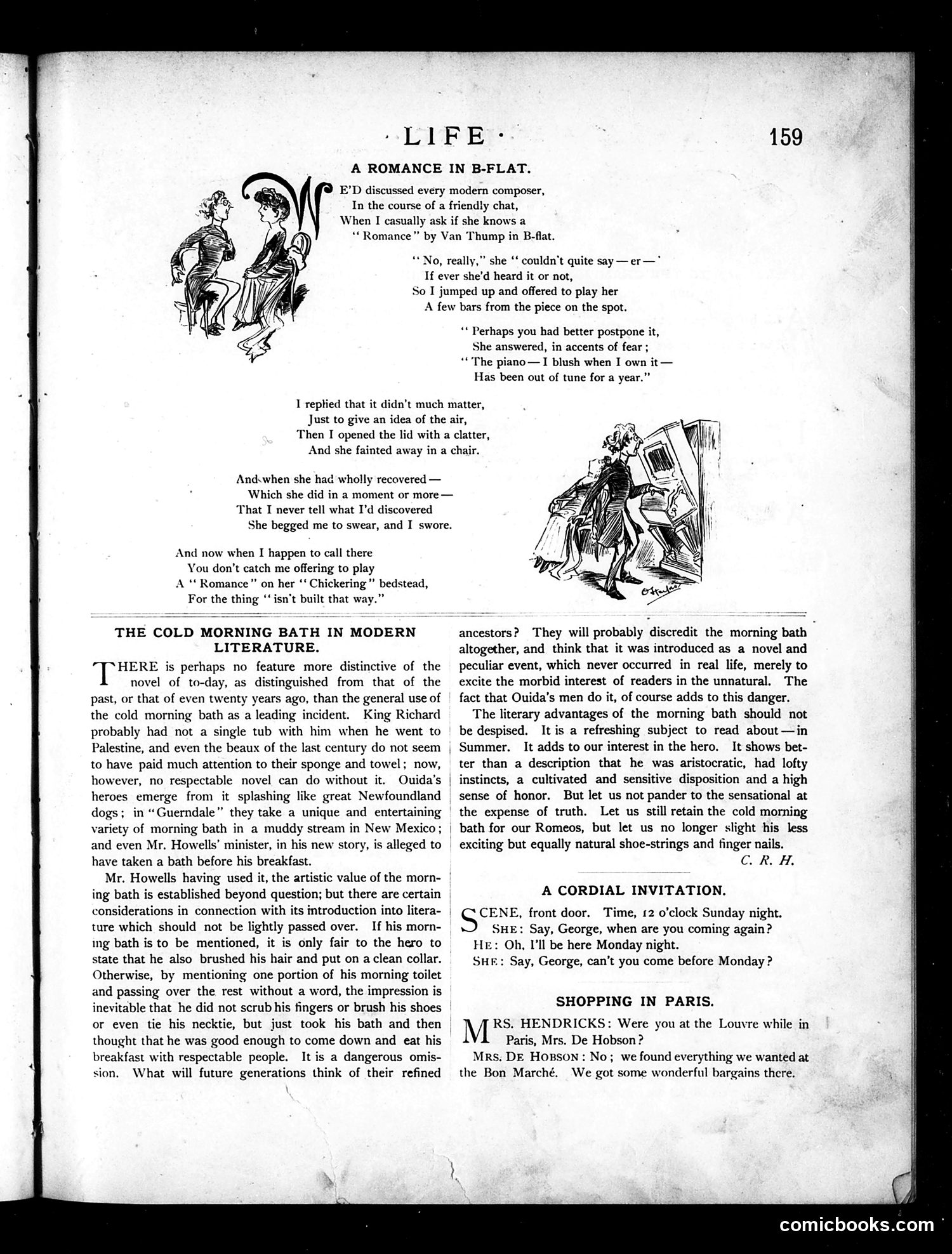
**"A Romance in B-Flat"** is a humorous poem about a social mishap. The narrator offers to play piano for a female acquaintance who claims unfamiliarity with a Van Thamp composition. When he opens the piano lid, she faints—apparently from shock at its poor condition (out of tune for a year). The joke satirizes both the woman's exaggerated Victorian sensibility and the narrator's obliviousness to the piano's deplorable state. The accompanying sketches show the two characters and the woman fainting dramatically in a chair. The remaining articles discuss the "cold morning bath" in literature and contain brief social vignettes ("A Cordial Invitation," "Shopping in Paris"), typical of Life's light satirical content targeting upper-class American manners and pretensions.
📄 Transcribed text from this page (OCR, searchable)
Machine-transcribed from the original scan — historical spelling and the odd misread are preserved.
- TOV BF A ROMANCE IN B-FLAT. E'D discussed every modern composer, In the course of a friendly chat, When I casually ask if she knows a “Romance” by Van Thump in B-flat. “No, really,” she ‘‘ couldn't quite say —er—* If ever she'd heard it or not, So I jumped up and offered to play her A few bars from the piece on the spot. “* Perhaps you had better postpone it, She answered, in accents of fear ; “The piano— I blush when I own it — Has been out of tune for a year.” I reptied that it didn’t much matter, Just to give an idea of the air, Then I opened the lid with a clatter, And she fainted away in a chair. Andvwhen she had wholly recovered — Which she did in a moment or more— That I never tell what I’d discovered She begged me to swear, and I swore. And now when I happen to call there You don’t catch me offering to play A ‘** Romance” on her ‘‘ Chickering” bedstead, For the thing ‘‘isn’t built that way.” THE COLD MORNING BATH IN MODERN LITERATURE. HERE is perhaps no feature more distinctive of the novel of to-day, as distinguished from that of the past, or that of even twenty years ago, than the general use of the cold morning bath as a leading incident. King Richard probably had not a single tub with him when he went to Palestine, and even the beaux of the last century do not seem to have paid much attention to their sponge and towel; now, however, no respectable novel can do without it. heroes emerge from it splashing like great Newfoundland dogs; in “Guerndale” they take a unique and entertaining variety of morning bath in a muddy stream in New Mexico; and even Mr. Howells’ minister, in his new story, is alleged to have taken a bath before his breakfast. Mr. Howells having used it, the artistic value of the morn- ing bath is established beyond question; but there are certain considerations in connection with its introduction into litera- | ture which should not be lightly passed over. If his morn- ing bath is to be mentioned, it is only fair to the hero to state that he also brushed his hair and put on a clean collar. Otherwise, by mentioning one portion of his morning toilet and passing over the rest without a word, the impression is inevitable that he did not scrub his fingers or brush his shoes or even tie his necktie, but just took his bath and then thought that he was good enough to come down and eat his breakfast with respectable people. It is a dangerous omis- sion. What will future generations think of their refined Ouida’s | ancestors? They will probably discredit the morning bath altogether, and think that it was introduced as a novel and peculiar event, which never occurred in real life, merely to excite the morbid interest of readers in the unnatural. The fact that Ouida’s men do it, of course adds to this danger. The literary advantages of the morning bath should not be despised. It is a refreshing subject to read about —in Summer. It adds to our interest in the hero. It shows bet- ter than a description that he was aristocratic, had lofty instincts, a cultivated and sensitive disposition and a high sense of honor. But let us not pander to the sensational at the expense of truth. Let us still retain the cold morning bath for our Romeos, but let us no longer slight his less exciting but equally natural shoe-strings and finger nails. CR. A. A CORDIAL INVITATION. CENE, front door. Time, 12 o'clock Sunday night. SHE: Say, George, when are you coming again? : Oh, I’ll be here Monday night. Say, George, can’t you come before Monday ? SHOPPING IN PARIS. RS. HENDRICKS: Were you at the Louvre while in Paris, Mrs. De Hobson? Mrs. DE Hopson: No; we found everything we wanted at the Bon Marché. We got some wonderful bargains there. comicbooks.com °