
Life, 1886-09-16 · page 2 of 16
Life — September 16, 1886 — page 2: what you’re looking at
What you’re looking at
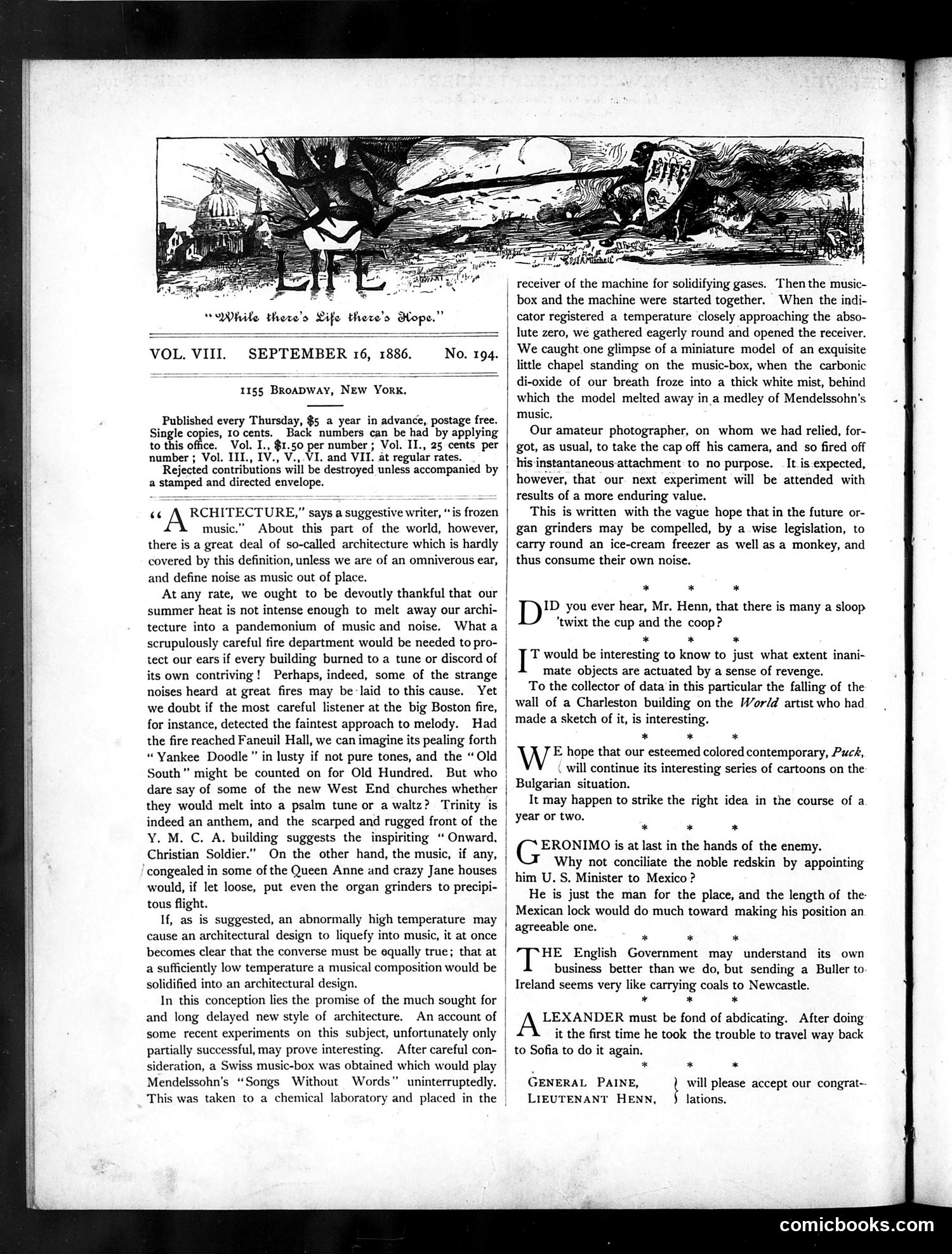
The page's main cartoon illustrates an article about architecture as "frozen music." The satirical point is that just as intense heat can melt architecture, sufficiently low temperatures can transform music into physical form—here, a tiny chapel model made from frozen carbon dioxide from human breath, which melts away while playing Mendelssohn. The accompanying text offers brief satirical comments on contemporary events: General Paine and Lieutenant Henn receiving congratulations (military context unclear), criticism of the English government's Irish policy ("carrying coals to Newcastle"), and commentary on Alexander's abdication and Geronimo's capture. The humor relies on absurdist logic and wordplay rather than identifying specific caricatures.
📄 Transcribed text from this page (OCR, searchable)
Machine-transcribed from the original scan — historical spelling and the odd misread are preserved.
“oWDhite there's Life there's Hope.” VOL. VIII. No. 194. SEPTEMBER 16, 1886. 1155 BRoaDway, NEw York. Published every Thursday, $5 a year in advance, postage free. Single copies, 10 cents. Back numbers can be had by applying to this office. Vol. I., $1.50 per number ; Vol. II., 25 cents per number ; Vol. III., IV., V.,.VI. and VII, at regular rates. Rejected contributions will be destroyed unless accompanied by a stamped and directed envelope. ““ RCHITECTURE,” says a suggestive writer, “is frozen music.” About this part of the world, however, there is a great deal of so-called architecture which is hardly covered by this definition, unless we are of an omniverous ear, and define noise as music out of place. At any rate, we ought to be devoutly thankful that our summer heat is not intense enough to melt away our archi- tecture into a pandemonium of music and noise. scrupulously careful fire department would be needed to pro- tect our ears if every building burned to a tune or discord of its own contriving! Perhaps, indeed, some of the strange noises heard at great fires may be-laid to this cause. Yet we doubt if the most careful listener at the big Boston fire, for instance, detected the faintest approach to melody. Had the fire reached Faneuil Hall, we can imagine its pealing forth “Yankee Doodle” in lusty if not pure tones, and the “Old South” might be counted on for Old Hundred. But who | dare say of some of the new West End churches whether they would melt into a psalm tune or a waltz? Trinity is indeed an anthem, and the scarped and rugged front of the Y. M. C. A. building suggests the inspiriting “ Onward, Christian Soldier.” On the other hand, the music, if any, congealed in some of the Queen Anne and crazy Jane houses would, if let loose, put even the organ grinders to precipi- tous flight. If, as is suggested, an abnormally high temperature may cause an architectural design to liquefy into music, it at once becomes clear that the converse must be equally true; that at a sufficiently low temperature a musical composition would be solidified into an architectural design. In this conception lies the promise of the much sought for | and long delayed new style of architecture. An account of some recent experiments on this subject, unfortunately only partially successful, may prove interesting. After careful con- sideration, a Swiss music-box was obtained which would play Mendelssohn's “Songs Without This was taken to a chemical laboratory and placed in the What a | Words” uninterruptedly. | receiver of the machine for solidifying gases. Then the music- box and the machine were started together. When the indi- cator registered a temperature closely approaching the abso- lute zero, we gathered eagerly round and opened the receiver. We caught one glimpse of a miniature model of an exquisite little chapel standing on the music-box, when the carbonic di-oxide of our breath froze into a thick white mist, behind which the model melted away in a medley of Mendelssohn's music. Our amateur photographer, on whom we had relied, for- got, as usual, to take the cap off his camera, and so fired off his instantaneous attachment to no purpose. _It.is expected, however, that our next experiment will be attended with results of a more enduring value. This is written with the vague hope that in the future or- gan grinders may be compelled, by a wise legislation, to carry round an ice-cream freezer as well as a monkey, and thus consume their own noise. * * * ID you ever hear, Mr. Henn, that there is many a sloop “twixt the cup and the coop? * * * T would be interesting to know to just what extent inani~ mate objects are actuated by a sense of revenge. To the collector of data in this particular the falling of the wall of a Charleston building on the Wor/d artist who had made a sketch of it, is interesting. * * * E hope that our esteemed colored contemporary, Puck, ( will continue its interesting series of cartoons on the Bulgarian situation. It may happen to strike the right idea in the course of a year or two. * * * ERONIMO is at last in the hands of the enemy. Why not conciliate the noble redskin by appointing | him U.S. Minister to Mexico ? He is just the man for the place, and the length of the: Mexican lock would do much toward making his position an agreeable one. * * * HE English Government may understand its own business better than we do, but sending a Buller to Ireland seems very like carrying coals to Newcastle. * * * LEXANDER must be fond of abdicating. After doing it the first time he took the trouble to travel way back to Sofia to do it again. * * * GENERAL PAINE, \ LIEUTENANT HENN, will please accept our congrat~ lations. comicbooks.com