
Life, 1886-09-16 · page 4 of 16
Life — September 16, 1886 — page 4: what you’re looking at
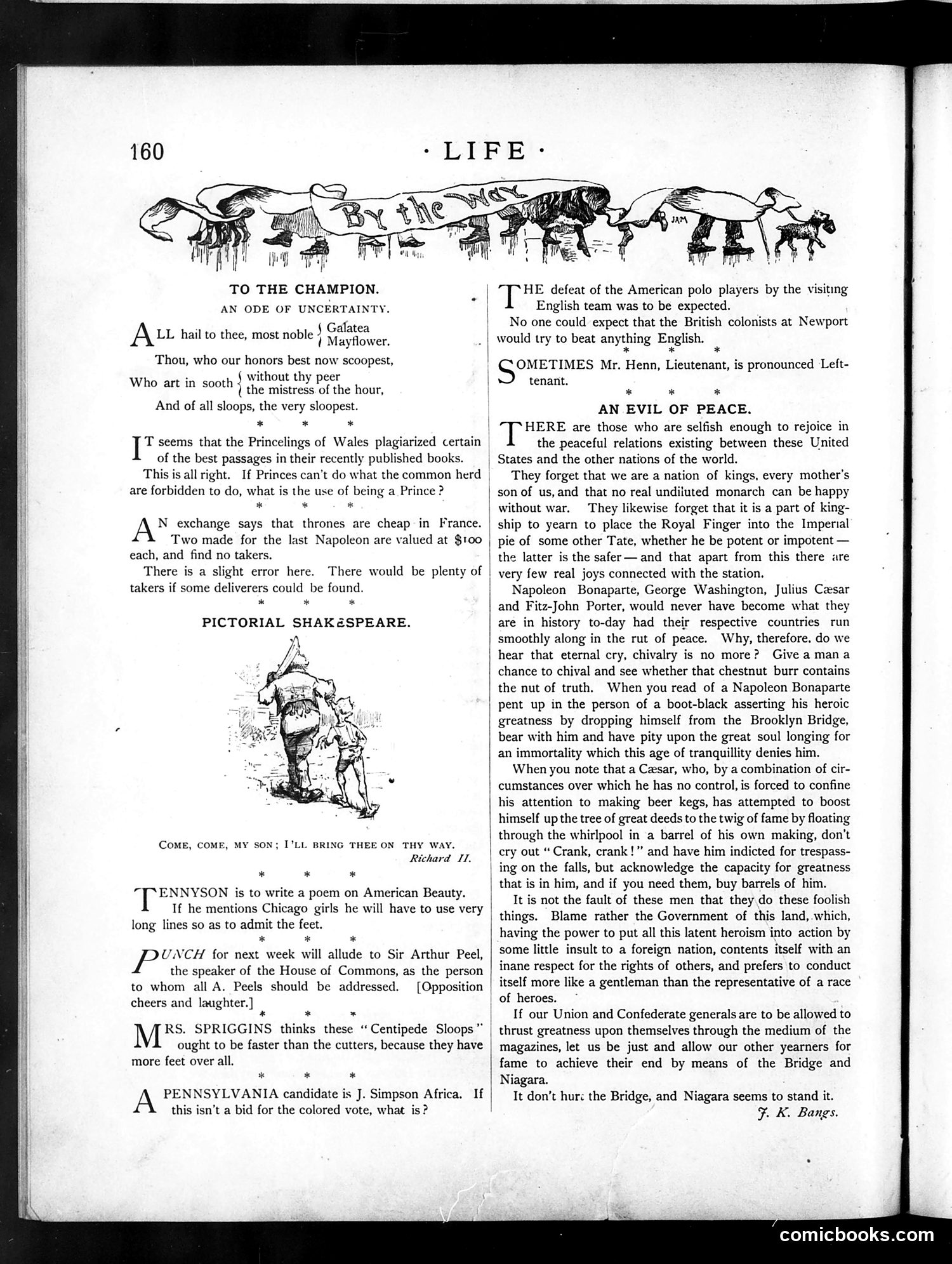
What you’re looking at
This page contains several satirical pieces typical of 19th-century *Life* magazine: **"To the Champion: An Ode of Uncertainty"** mocks an unidentified "Galatea Mayflower"—likely a society figure or debutante. **"Pictorial Shakespeare"** shows a sketch captioned with a Richard II quote, appearing to lampoon theatrical pretension or contemporary politics through Shakespearean reference. The brief notes mock various targets: American polo players defeated by the English; Lieutenant Henn's pronunciation; a Pennsylvania political candidate named "J. Simpson Africa"; and proposed Chicago beauty pageants requiring "very long lines." **"An Evil of Peace"** is the page's substantial political commentary, criticizing American complacency about peace while foreign nations (referencing Napoleon, Caesar, Washington, Porter) achieved greatness through conflict. The author argues the U.S. government should support generals seeking glory—likely referencing contemporary Civil War-era tensions or Reconstruction politics.
📄 Transcribed text from this page (OCR, searchable)
Machine-transcribed from the original scan — historical spelling and the odd misread are preserved.
TO THE CHAMPION. AN ODE OF UNCERTAINTY. Att hail to thee, most noble } Manet Thou, who our honors best now scoopest, without thy peer the mistress. of the hour, And of all sloops, the very sloopest. * * * Who art in sooth } T seems that the Princelings of Wales plagiarized certain of the best passages in their recently published books. This is all right. If Princes can’t do what the common herd are forbidden to do, what is the use of being a Prince ? * * * N exchange says that thrones are cheap in France. Two made for the last Napoleon are valued at $100 | each, and find no takers. There is a slight error here. There would be plenty of takers if some deliverers could be found. * * * PICTORIAL SHAKESPEARE. CoME, COME, MY SON; I'LL BRING THEE ON THY WAY. Richard Il. * * * “TENNYSON is to write a poem on American Beauty. If he mentions Chicago girls he will have to use very long lines so as to admit the feet. * * * UNCH for next week will allude to Sir Arthur Peel, the speaker of the House of Commons, as the person to whom all A. Peels should be addressed. [Opposition cheers and laughter.] * * * RS. SPRIGGINS thinks these “Centipede Sloops” | ought to be faster than the cutters, because they have more feet over all. * * * PENNSYLVANIA candidate is J. Simpson Africa. If | this isn’t a bid for the colored vote, what is? HE defeat of the American polo players by the visiting English team was to be expected. No one could expect that the British colonists at Newport | would try to beat anything English. * * * OMETIMES Mr. Henn, Lieutenant, is pronounced Left- tenant. * * * AN EVIL OF PEACE. HERE are those who are selfish enough to rejoice in the peaceful relations existing between these United | States and the other nations of the world. They forget that we are a nation of kings, every mother’s | son of us, and that no real undiiuted monarch can be happy | without war. They likewise forget that it is a part of king- ship to yearn to place the Royal Finger into the Imperial pie of some other Tate, whether he be potent or impotent — | the latter is the safer— and that apart from this there are very few real joys connected with the station. Napoleon Bonaparte, George Washington, Julius Caesar and Fitz-John Porter, would never have become what they are in history to-day had their respective countries run smoothly along in the rut of peace. Why, therefore, do we hear that eternal cry, chivalry is no more? Give a mana chance to chival and see whether that chestnut burr contains the nut of truth. When you read of a Napoleon Bonaparte pent up in the person of a boot-black asserting his heroic greatness by dropping himself from the Brooklyn Bridge, bear with him and have pity upon the great soul longing for an immortality which this age of tranquillity denies him. When you note that a Caesar, who, by a combination of cir- cumstances over which he has no control, is forced to confine his attention to making beer kegs, has attempted to boost himself up the tree of great deeds to the twig of fame by floating through the whirlpool in a barrel of his own making, don’t cry out “ Crank, crank!” and have him indicted for trespass- ing on the falls, but acknowledge the capacity for greatness that is in him, and if you need them, buy barrels of him. It is not the fault of these men that they do these foolish things. Blame rather the Government of this land, which, having the power to put all this latent heroism into action by some little insult to a foreign nation, contents itself with an inane respect for the rights of others, and prefers to conduct itself more like a gentleman than the representative of a race of heroes. If our Union and Confederate generals are to be allowed to thrust greatness upon themselves through the medium of the magazines, let us be just and allow our other yearners for fame to achieve their end by means of the Bridge and Niagara. It don’t hur: the Bridge, and Niagara seems to stand it. ¥. K. Bangs. “comicbooks.com