
A complete issue · 16 pages · 1886
Life — July 22, 1886
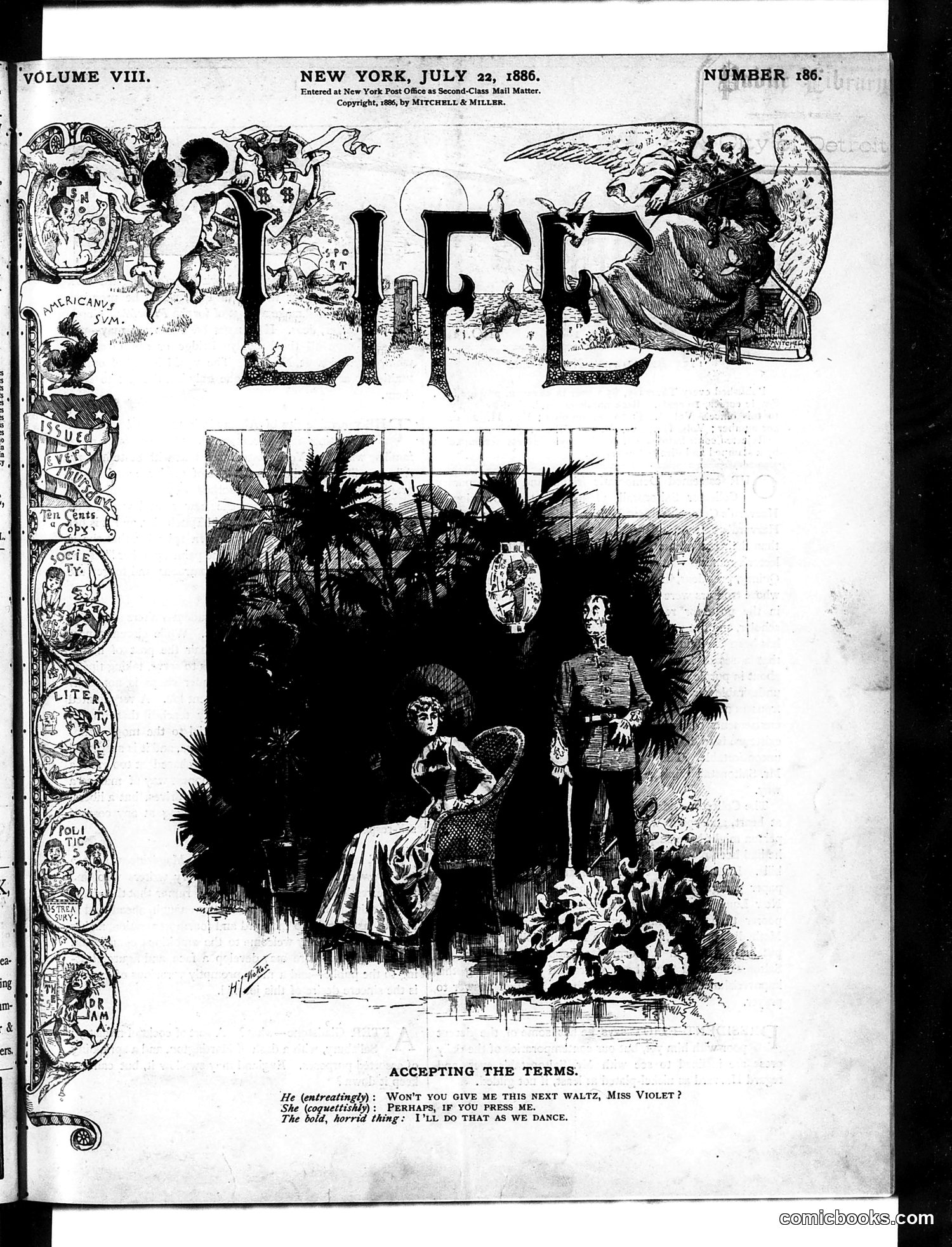
This cartoon depicts a romantic scene in a tropical conservatory. A woman (labeled "Miss Violet") is being courted by a military officer, while an older woman observes. The dialogue shows the officer requesting a waltz and the woman agreeing, with the final line—"I'll do that as we dance"—suggesting she's accepting his romantic proposal on the dance floor. The satire appears to target Victorian courtship conventions, particularly how women strategically "accepted terms" (marriage proposals) during social dancing. The exotic setting with palms and decorative plants emphasizes the romantic atmosphere while mocking the formalized, almost diplomatic nature of upper-class romance and marriage negotiations of the era.
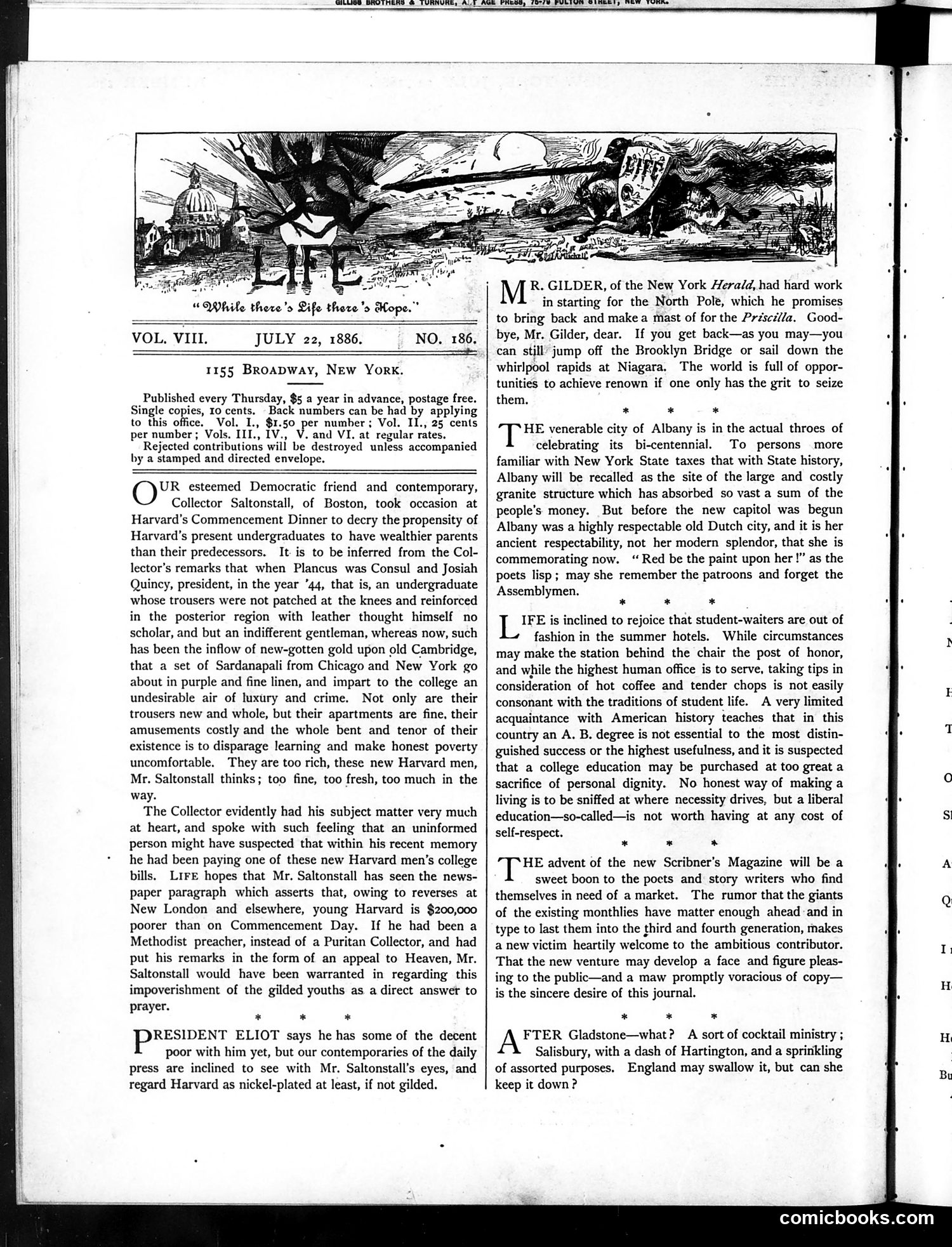
The masthead cartoon "While there's Life there's Hope" depicts a chaotic scene of destruction—buildings burning, a ship sinking, and general devastation—yet a figure persists amid the ruin. The image appears to be a visual metaphor for the magazine's satirical mission: maintaining optimism and commentary despite societal turmoil. The text discusses Harvard's wealthy undergraduates, Collector Saltonstall's remarks about their gilded excess, and criticism of student-waiters working summer hotel jobs as beneath college dignity. There's also commentary on Albany's bicentennial and a note about a new *Scribner's Magazine* launch. The overall tone mixes social criticism of aristocratic pretension with dry humor about class anxieties and institutional pride among America's elite.
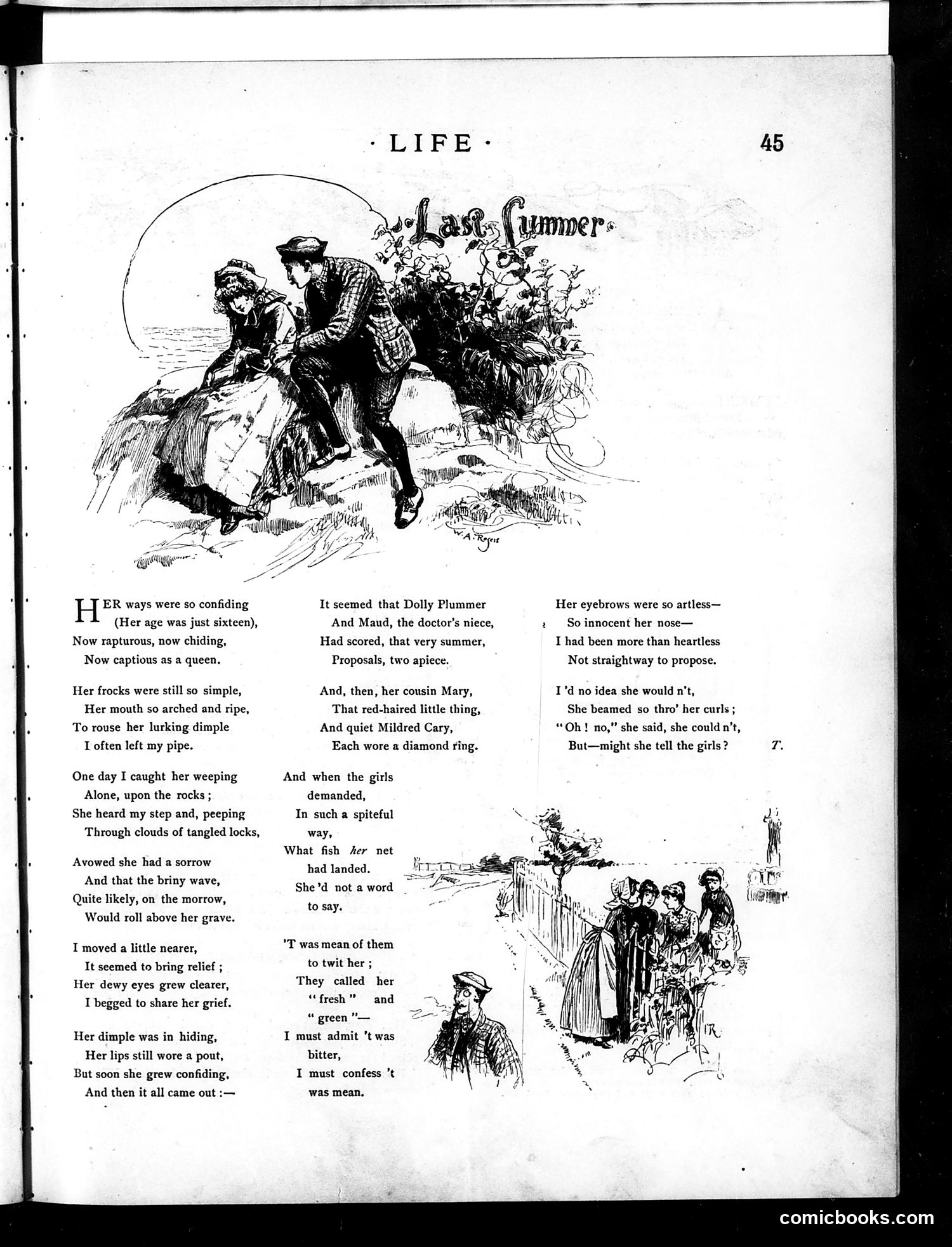
This page from *Life* magazine presents a romantic narrative poem titled "Last Summer" with accompanying illustrations. The story describes a male narrator's summer romance with a young woman named Dolly Plummer, aged sixteen. The poem recounts how the narrator fell in love with Dolly, who was initially receptive but whose cousins—Mary, Mildred Cary, and others—mocked her as "fresh" and "green." Their taunting apparently discouraged the romance. The narrator confesses his feelings were genuine ("I must admit 'twas bitter / I must confess 'twas mean"), expressing regret about how peer pressure and social judgment interfered with their budding relationship. The illustrations show young people in Victorian-era clothing in various seaside scenes, depicting the social dynamics and romantic disappointment described in the verse.
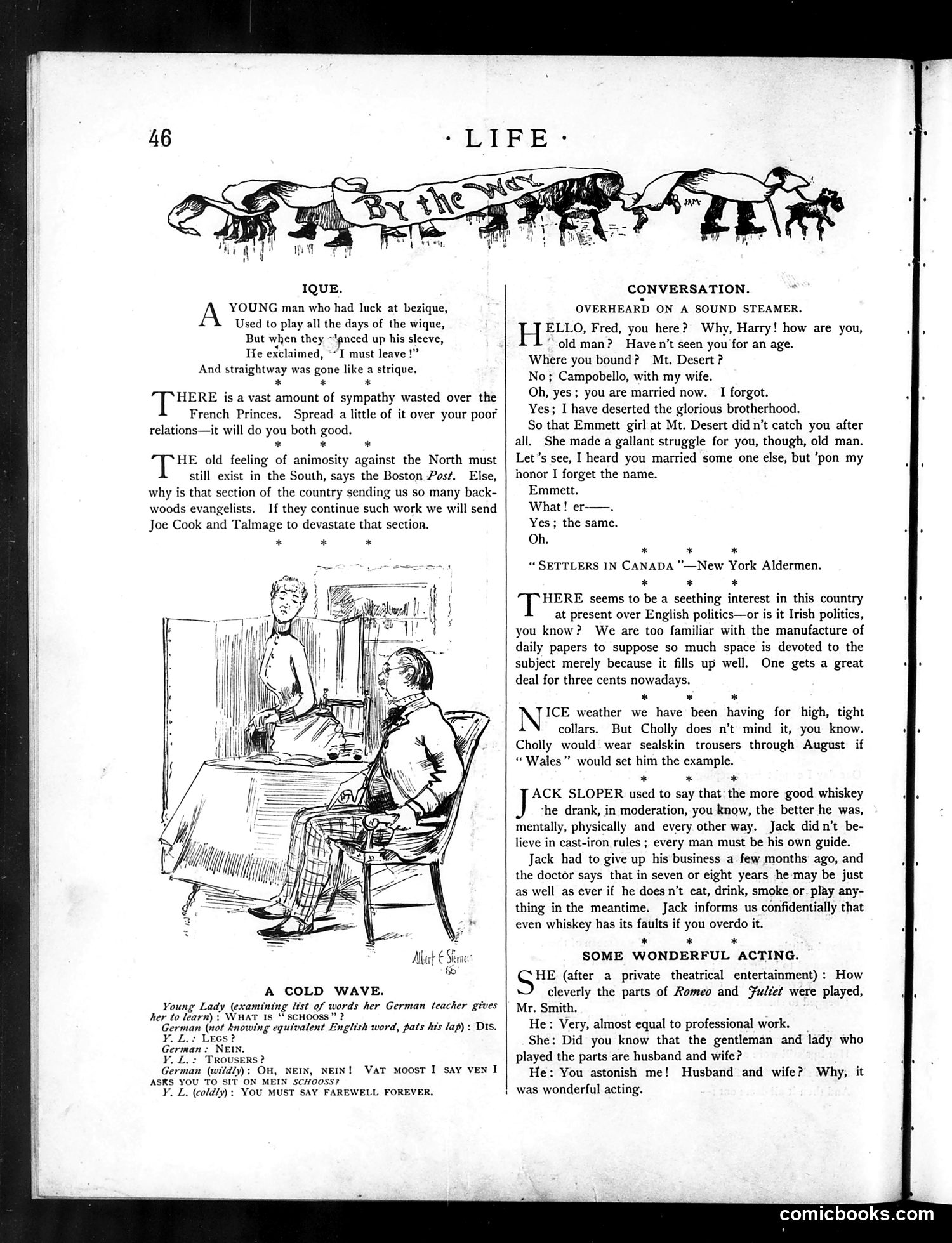
**"A Cold Wave"** (bottom left): A sketch showing a German language teacher instructing an English student. The humor plays on the difficulty of learning German grammar—the teacher insists "NEIN" (no) must be said "farewell forever," mocking the complexity and harshness of German linguistic rules compared to English. **"Conversation"** (right column): A dialogue between two men meeting on a steamship, discussing an acquaintance named Emmett who married someone else. The satire appears gentle, poking fun at romantic entanglements and gossip among travelers. **"Some Wonderful Acting"** (bottom right): Discusses a theatrical performance of *Romeo and Juliet*, with surprise that husband and wife actors played the leads convincingly. The page combines light social satire with conversational humor typical of Life magazine's style.
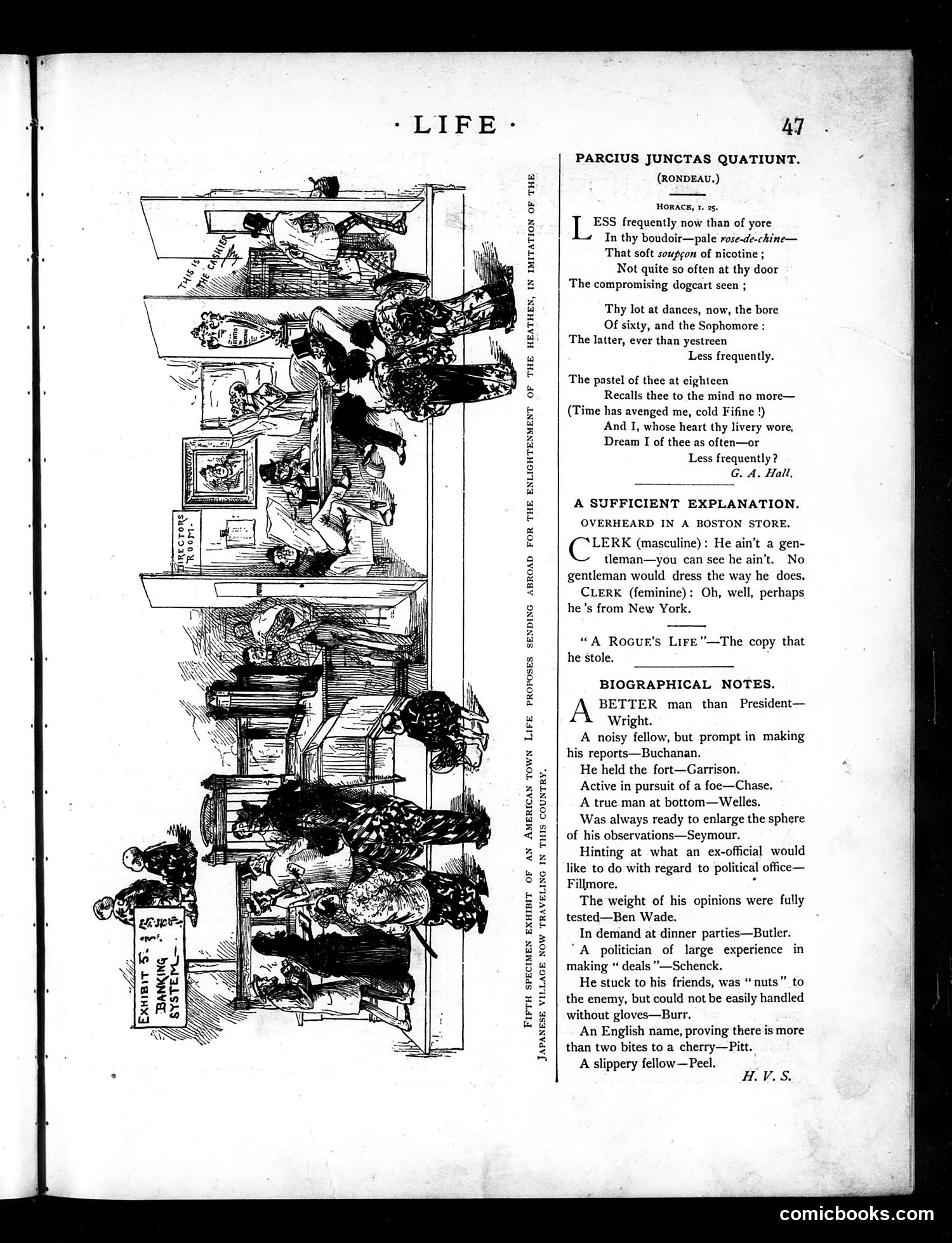
This page features a tall vertical cartoon depicting a crowded building or structure filled with numerous human figures stacked vertically, suggesting social satire about overcrowding or institutional hierarchy. The right side contains two sections: a poem titled "PARCIUS JUNCTAS QUATIUNT" (attributed to Horace and Rondeau), followed by "A Sufficient Explanation"—a brief dialogue between male and female clerks discussing someone's origins ("he's from New York"), suggesting class commentary on urban transplants. Below that, "Biographical Notes" lists character sketches with surnames and brief descriptive phrases (Wright, Buchanan, Chase, Welles, etc.), appearing to satirize various professional and political types—politicians, officials, and social figures—through unflattering but witty one-liners. The humor targets their character flaws and pretensions. The overall effect mocks American social hierarchies and professional archetypes of the period.
This page contains several short satirical pieces rather than a political cartoon: 1. **"The Cheap Notoriety of Story Writing"** - Critiques the flood of poor-quality fiction from "reputable publishing houses," arguing that literary talent has been diverted to other pursuits. The author advocates for action over passive dreaming. 2. **Senator Kenna anecdote** - Mocks Senator Kenna of West Virginia for supposedly holding "two pairs of queens in his hand" at cards, suggesting naïveté or gullibility about basic customs. 3. **Short humorous items** on topics like the Brooklyn Bridge's size, Venus/Mars comparison, and criticism of the Marquis of Lorne's formal attire. 4. **"An American Novelist in His Workshop"** - A lengthy article about writer William Dean Howells' home and working methods. The page exemplifies Life's format: satirical commentary on contemporary figures and literary culture.
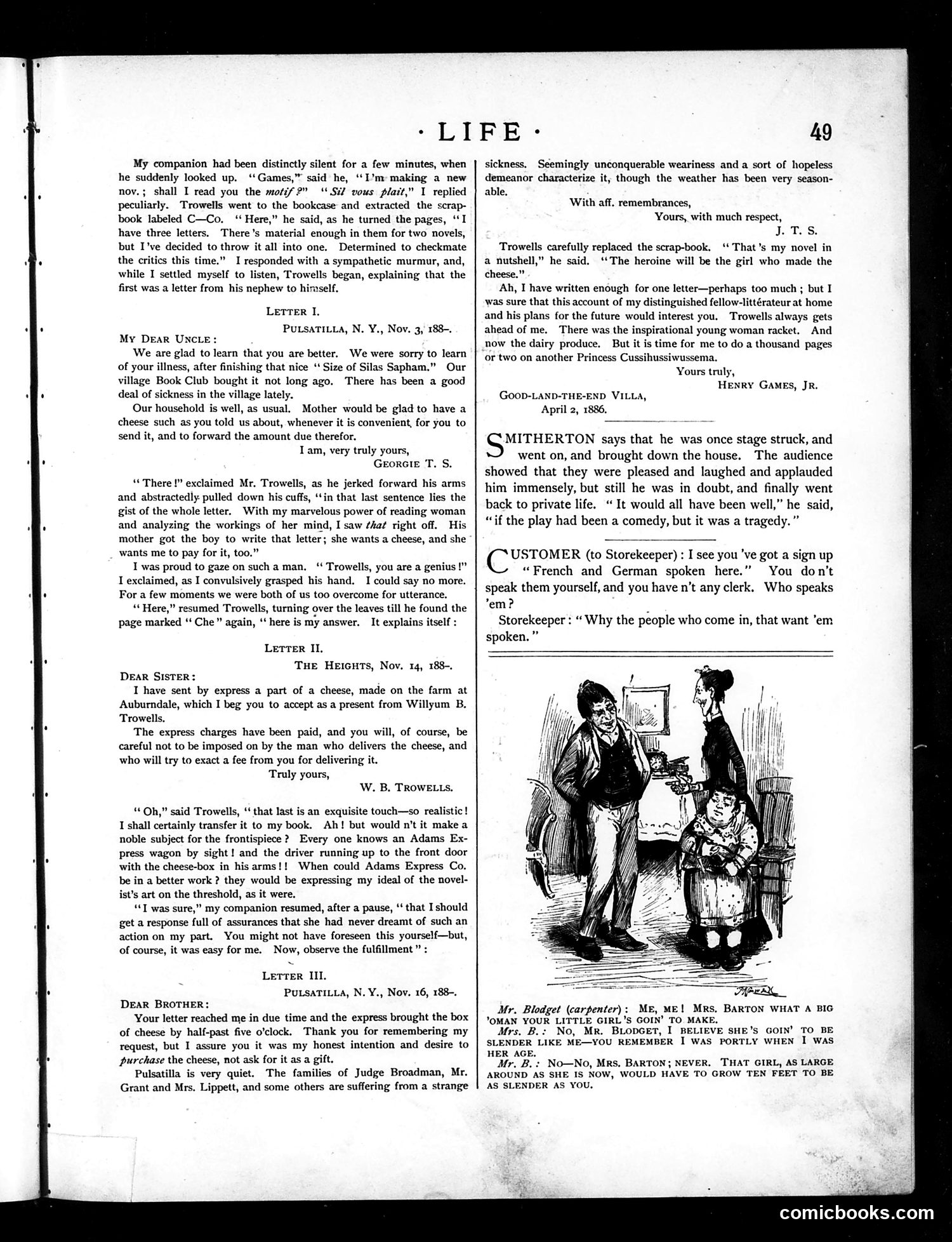
This page is primarily **literary content**, not political cartoon commentary. It contains three letters from readers responding to serialized fiction ("Size of Silas Sapham" and a Princess Cushiboutsouema story), plus editorial responses from the magazine. The single **illustration** shows a shopkeeper and customer in a brief humorous exchange about foreign language skills—a storekeeper admits he can't provide French and German-speaking clerks because customers simply request these languages without actually speaking them themselves. This is gentle satire on pretension and consumer expectations rather than political commentary. The page reflects Life's role as a **literary and humor magazine** for educated readers, mixing serialized novels with reader correspondence and light social observation.
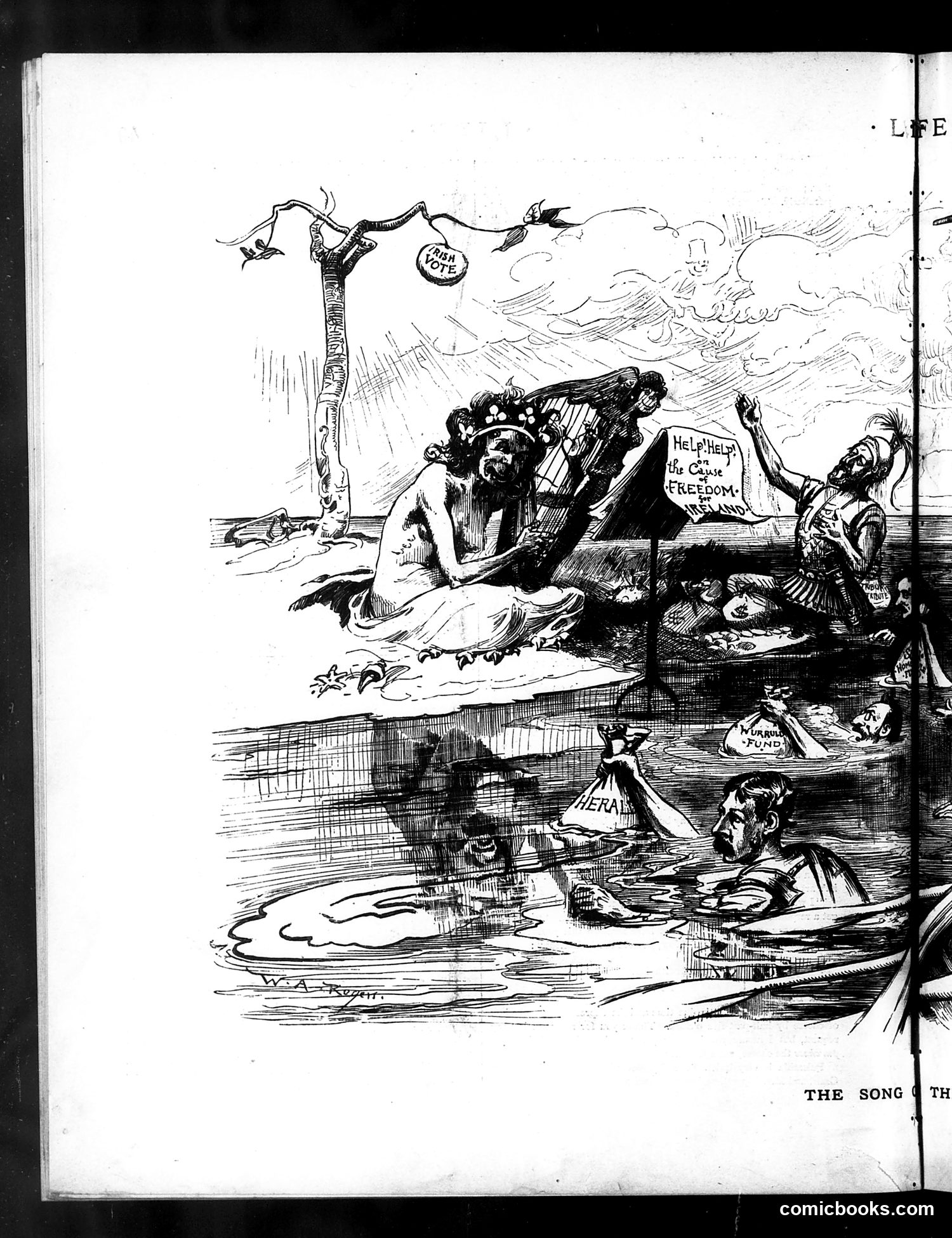
This is a satirical cartoon commenting on Irish independence and British colonial rule. The scene depicts figures in water—likely representing Ireland or Irish people—in distress, calling for "HELP" and "FREEDOM" from oppressive conditions. On shore, there's a figure labeled "RELIEF FUND" and other onlookers. The "POOR OLD IRELAND" reference and the visual metaphor of drowning suggest the cartoon critiques Britain's inadequate response to Irish suffering, possibly referencing famine relief or colonial exploitation. The contrast between those struggling in water and those observing from safety satirizes the disconnect between Ireland's desperate need and the insufficient aid provided. The artist's signature appears to be "W.A. Rogers," a known political cartoonist of the era.
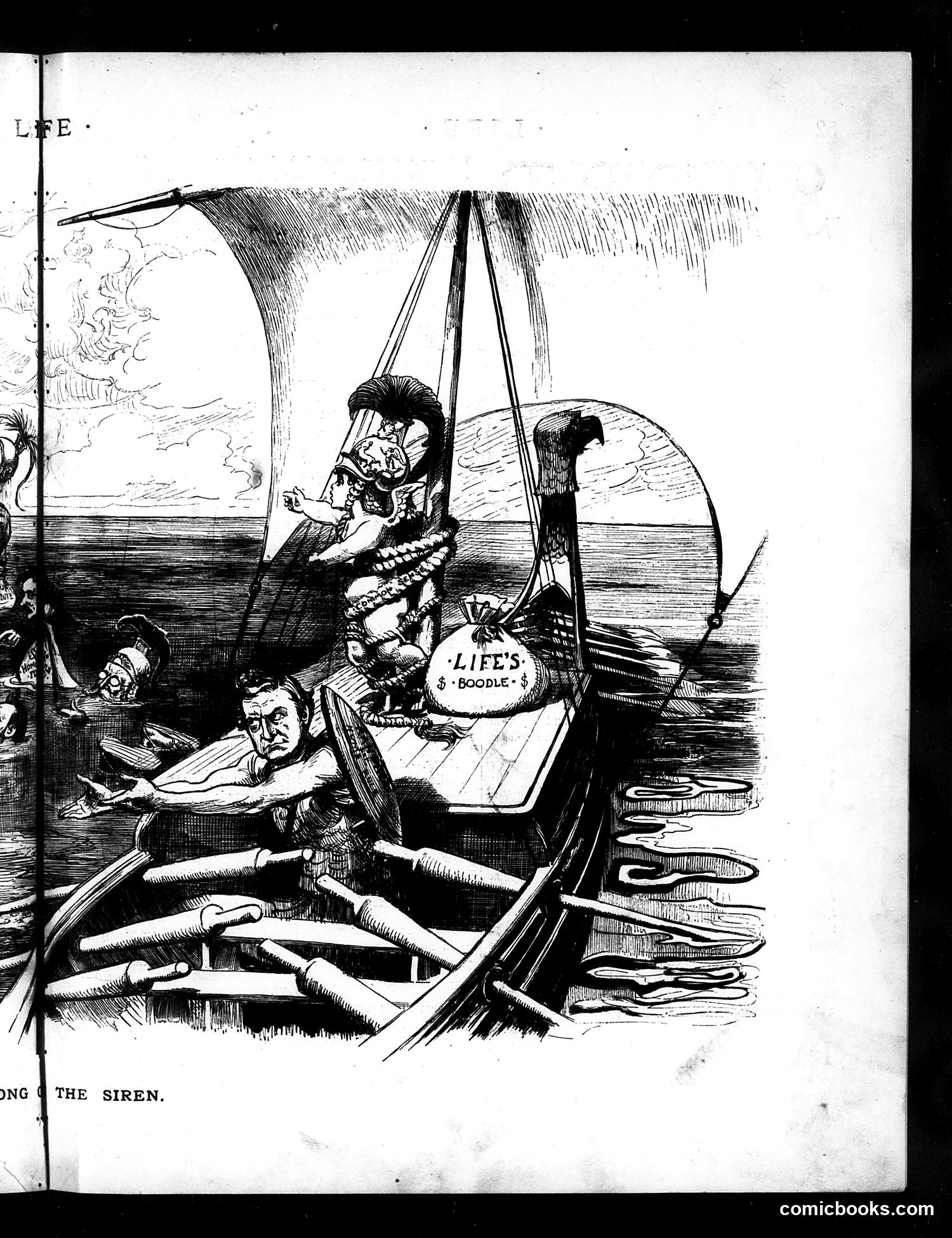
This is a political allegory depicting "Life's Boodle" (a bag of money/bribes) as bait. A siren figure—a mythological woman who lures sailors to destruction—sits suspended above water, representing temptation or corruption. Below, a man in the water appears to be swimming toward or struggling with the boodle, while another figure (possibly a politician or businessman) reaches for it from a boat. The satire critiques how public figures are lured by financial corruption and bribes. The siren mythology suggests such temptation leads to ruin, much as mythological sirens dragged sailors to their doom. "Boodle" was period slang for ill-gotten political money, making this a commentary on American political corruption and how easily officials could be seduced by monetary gain.
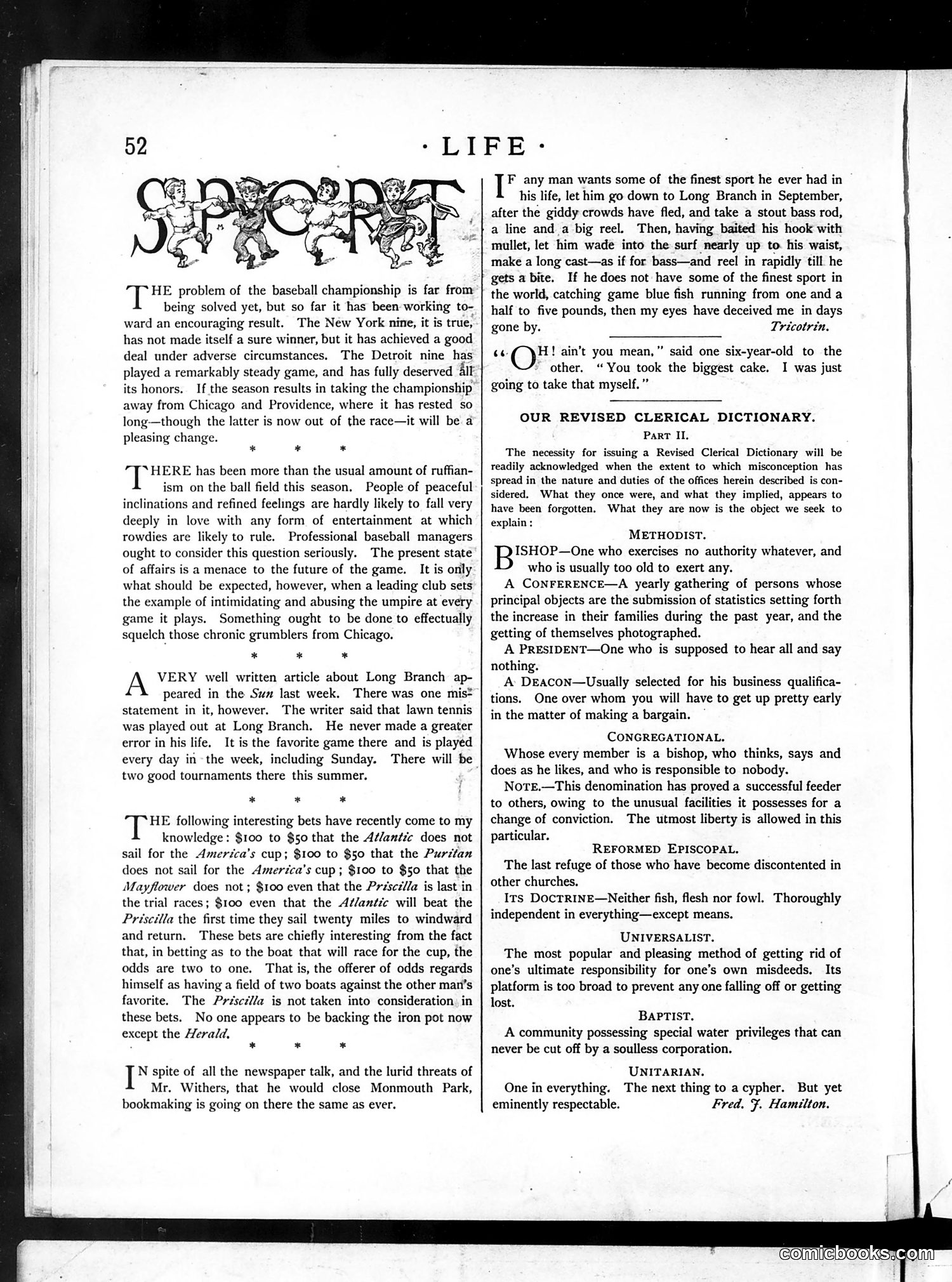
The page features a decorative header labeled "SPORT" with illustrated figures in playful poses, introducing sports commentary. The main articles discuss **baseball's championship race** (noting the New York nine's strong performance), **Long Branch fishing** (promoting recreational sport), and **yacht racing bets** involving ships like the *Atlantic*, *Puritan*, and *Priscilla*. The right column presents "Our Revised Clerical Dictionary," a satirical glossary defining religious positions (Methodist Bishop, Congregational, Reformed Episcopal, Universalist, Baptist, Unitarian) with humorous, often critical descriptions. For example, a Bishop "exercises no authority" and a Congregational member "thinks, says and does as he likes." This religious satire appears aimed at mocking denominational pretensions and highlighting contradictions between stated doctrine and actual practice—typical of Life's satirical approach to American institutions.
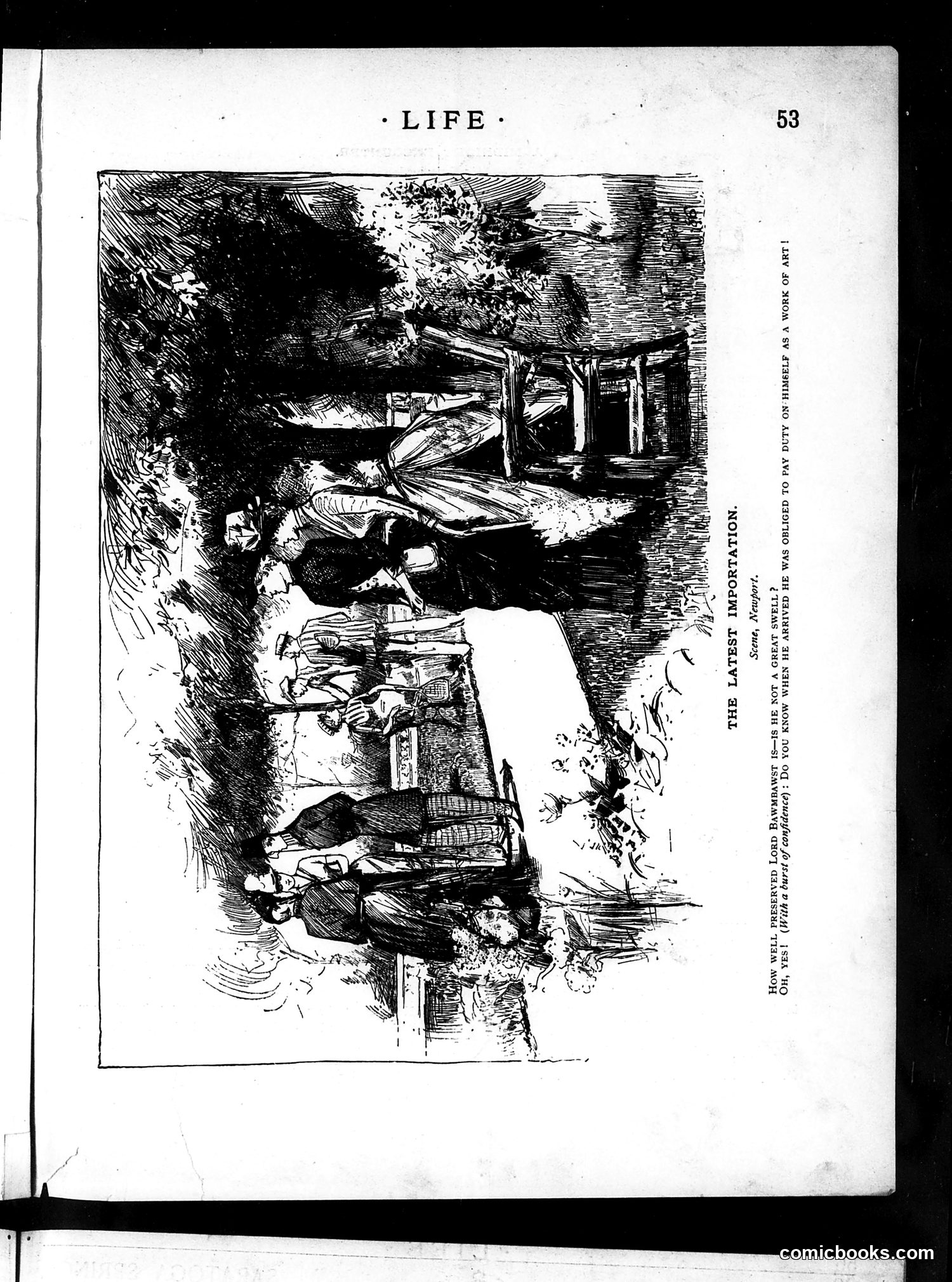
This appears to be a satirical illustration commenting on immigration, likely from the early 20th century based on the style. The sketch depicts what seems to be a crowded, chaotic scene—possibly a ship or arrival point—with multiple figures in period dress. The title "The Largest Importation" suggests mockery of large-scale immigration waves to America. The composition's disorder and the caricatured rendering of figures implies social commentary about xenophobic anxieties regarding foreign arrivals. The degrading term "importation" compares immigrants to goods rather than people, reflecting historical nativist attitudes. Without clearer OCR text or visible artist attribution, the specific satirical angle—whether criticizing immigration fears themselves or the immigrants—remains ambiguous. The work reflects Life magazine's satirical tradition of addressing contemporary social controversies.
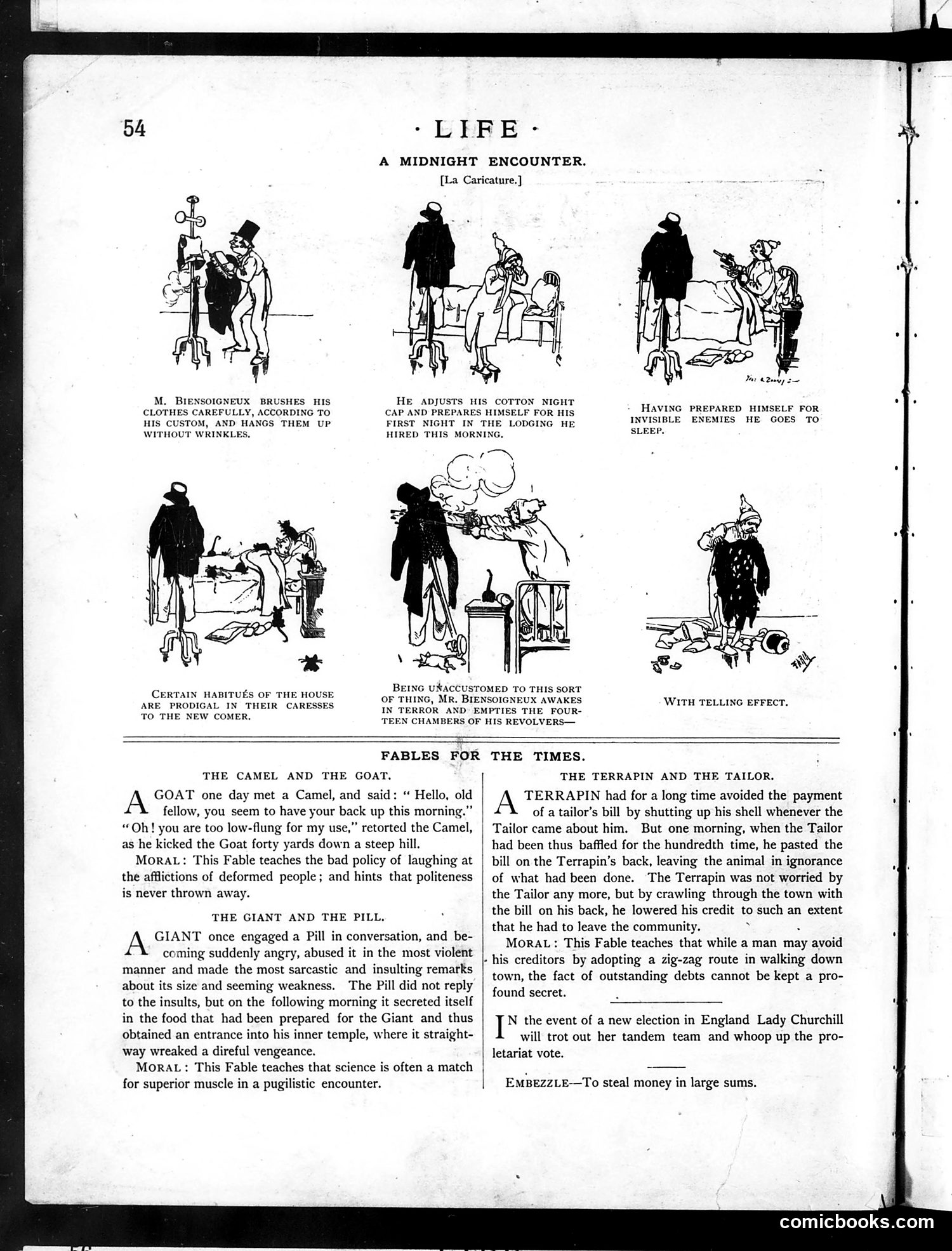
This French-sourced satirical cartoon (credited "[La Caricature]") depicts the misadventure of M. Biensoigneux, a fastidious man obsessed with neatness who meticulously hangs his clothes without wrinkles. When he rents new lodging and encounters an unfamiliar sound at night—likely a burglar or intruder—his panic causes him to fire all four chambers of his revolver indiscriminately. The joke targets obsessive tidiness and overcaution: Biensoigneux's careful habits don't prevent chaos when danger (real or imagined) strikes. His weapon-fire creates the "telling effect" mentioned, presumably destroying the very orderliness he cherishes. The accompanying "Fables for the Times" use animal allegories to mock human flaws: a camel's violent dismissal of a goat teaches politeness; a tiny pill defeats a giant through cunning (suggesting science beats brute force); and a terrapin's evasion of debt ultimately ruins him. The final note references Lady Churchill campaigning to working-class voters during an English election.
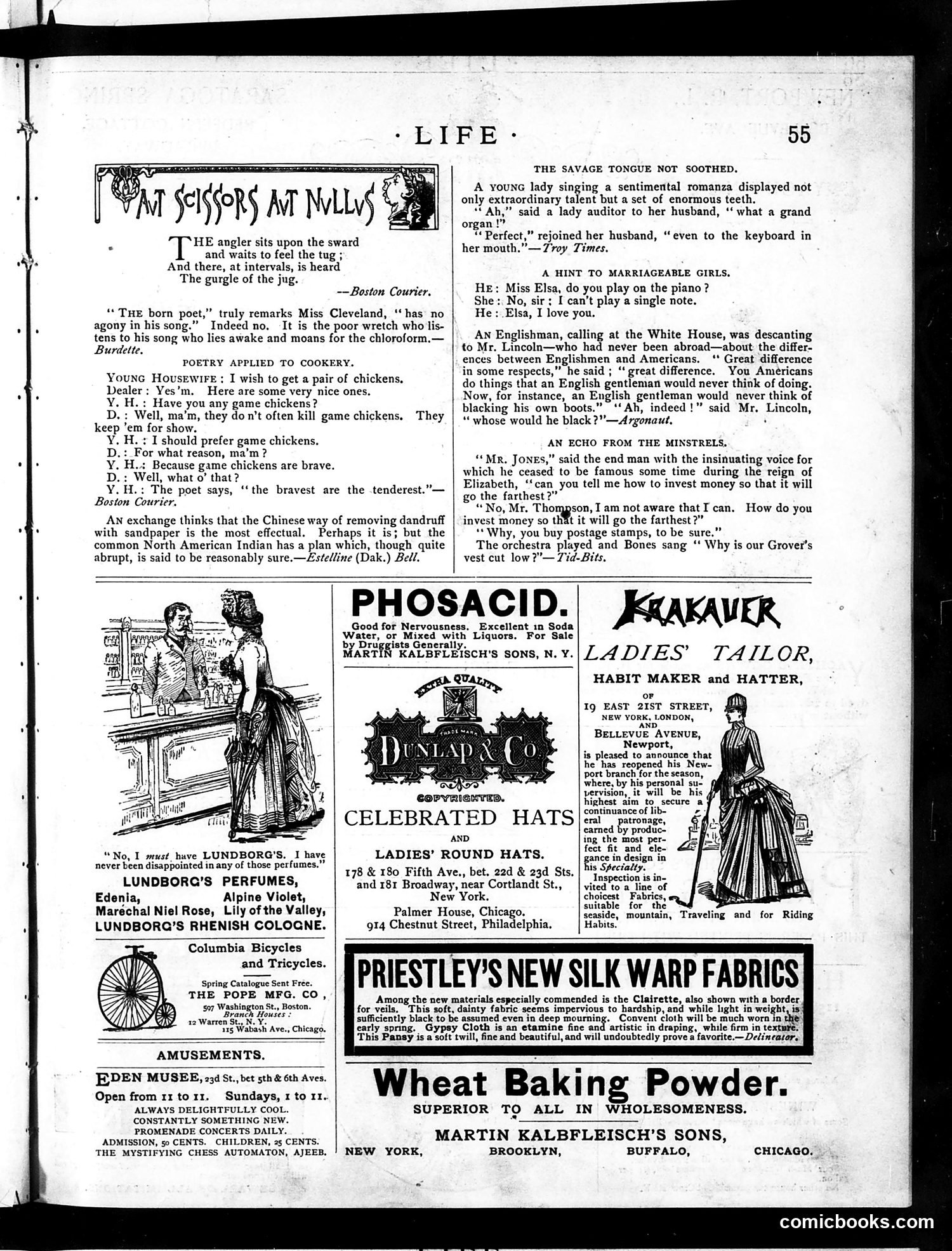
This is primarily a **humor and satire page** from Life magazine, featuring brief jokes on literary, social, and domestic topics, interspersed with period advertisements. The jokes mock contemporary pretensions: a lady singer with enormous teeth ("what a grand organ"), a housewife confusing "game chickens" (a breed) with brave chickens based on poetry, and Lincoln humorously exposing an Englishman's snobbery about boot-blacking. A minstrel show joke plays on the phrase "go the farthest" with a punchline about postage stamps. The page also includes satirical commentary on poetry and song-writing, suggesting poor singers cause suffering worse than chloroform. **The advertisements** reflect 1880s-90s consumer culture: perfumes (Lundborg's), ladies' fashion (tailors, hats), bicycles, and food products (baking powder). These ads appear targeted at middle-to-upper-class readers. The overall tone is light satirical humor aimed at urban, educated audiences aware of current social conventions and literary pretensions.
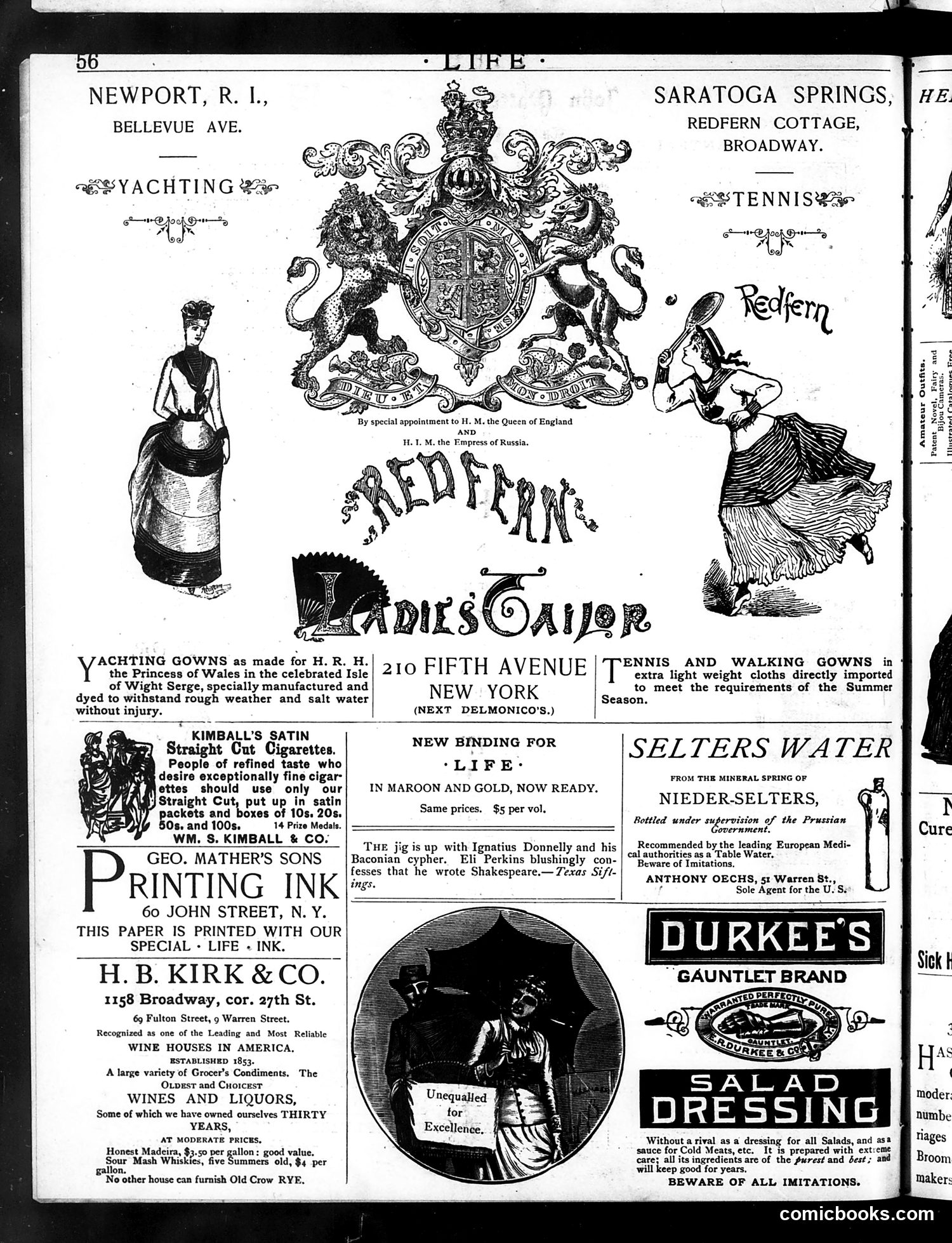
This is primarily an **advertising page** rather than editorial content or political satire. The page showcases luxury goods and services aimed at wealthy Americans during the Gilded Age. The modest editorial content includes a brief note mocking **Ignatius Donnelly and Eli Perkins**, referencing the "Baconian cipher"—a then-popular but ultimately discredited theory that Francis Bacon wrote Shakespeare's plays. The joke: Perkins supposedly "confesses" to writing Shakespeare himself, a comedic jab at the absurdity of the cipher theory. The bulk of the page features high-end advertising: **Redfern's couture** (with royal patronage credentials), wine merchants, printing ink suppliers, and mineral water importers. These ads target Life's affluent readership, emphasizing exclusivity and European sophistication—reflecting Gilded Age aspirations for Old World refinement and status symbols. The page reflects late-19th-century American consumer culture and leisure pursuits among the elite.
This page is primarily **advertising**, not satirical content. It contains commercial advertisements for late-19th century consumer goods and services. Notable ads include: - **Perry Davis's Son** (left): A quack medicine pitch offering a free "treatise" on cholera symptoms—typical of the era's dubious patent medicines before FDA regulation. - **Vichy Water** (bottom): Promoted as a genuine French spring water for gout, rheumatism, and kidney disease—legitimate mineral water marketed with medicinal claims. - **Sporting goods, champagnes, and whiskeys**: Standard luxury import advertisements. - **Summer resorts** (Campobello Island, Tower Hill House): Tourist destination promotions. - **Williams' Shaving Stick and Wood's Blacking**: Grooming product advertisements. The page reflects consumer culture of the 1880s, when patent medicines, imported luxury goods, and emerging tourism were significant commercial enterprises. The ads reveal period attitudes toward health and marketing before modern consumer protection laws.