
Life, 1886-07-22 · page 6 of 16
Life — July 22, 1886 — page 6: what you’re looking at
What you’re looking at
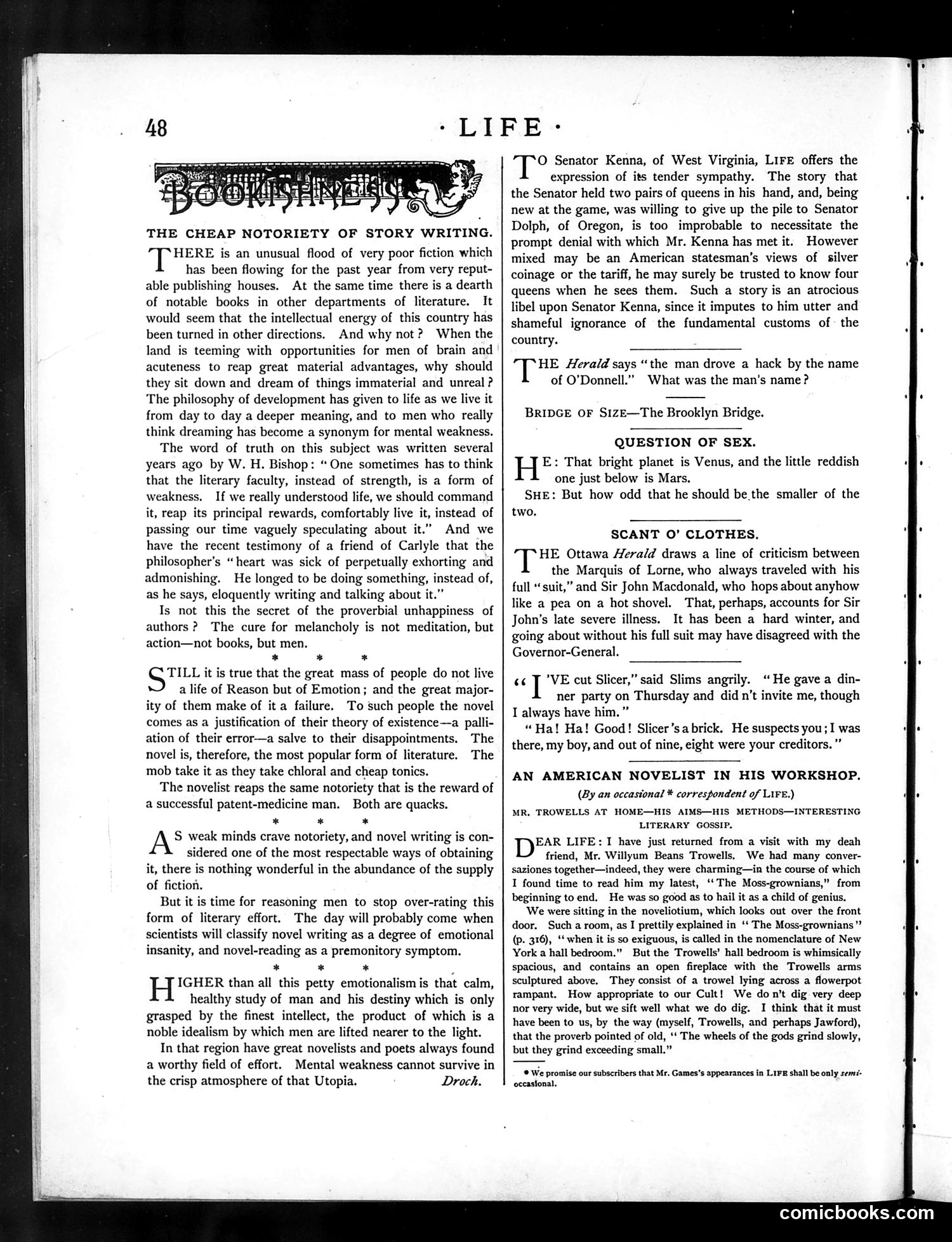
This page contains several short satirical pieces rather than a political cartoon: 1. **"The Cheap Notoriety of Story Writing"** - Critiques the flood of poor-quality fiction from "reputable publishing houses," arguing that literary talent has been diverted to other pursuits. The author advocates for action over passive dreaming. 2. **Senator Kenna anecdote** - Mocks Senator Kenna of West Virginia for supposedly holding "two pairs of queens in his hand" at cards, suggesting naïveté or gullibility about basic customs. 3. **Short humorous items** on topics like the Brooklyn Bridge's size, Venus/Mars comparison, and criticism of the Marquis of Lorne's formal attire. 4. **"An American Novelist in His Workshop"** - A lengthy article about writer William Dean Howells' home and working methods. The page exemplifies Life's format: satirical commentary on contemporary figures and literary culture.
📄 Transcribed text from this page (OCR, searchable)
Machine-transcribed from the original scan — historical spelling and the odd misread are preserved.
*LIFE~ THE CHEAP NOTORIETY OF STORY WRITING. HERE is an unusual flood of very poor fiction which has been flowing for the past year from very reput- able publishing houses. At the same time there is a dearth of notable books in other departments of literature. It would seem that the intellectual energy of this country has been turned in other directions. And why not? When the land is teeming with opportunities for men of brain and acuteness to reap great material advantages, why should they sit down and dream of things immaterial and unreal ? The philosophy of development has given to life as we live it from day to day a deeper meaning, and to men who really think dreaming has become a synonym for mental weakness. The word of truth on this subject was written several years ago by W. H. Bishop: “ One sometimes has to think that the literary faculty, instead of strength, is a form of weakness. If we really understood life, we should command it, reap its principal rewards, comfortably live it, instead of passing our time vaguely speculating about it.” And we have the recent testimony of a friend of Carlyle that the philosopher’s “heart was sick of perpetually exhorting and admonishing. He longed to be doing something, instead of, as he says, eloquently writing and talking about it.” Is not this the secret of the proverbial unhappiness of authors? The cure for melancholy is not meditation, but action—not books, but men. * * * TILL it is true that the great mass of people do not live a life of Reason but of Emotion; and the great major- ity of them make of it a failure. To such people the novel comes as a justification of their theory of existence—a palli- ation of their error—a salve to their disappointments. The novel is, therefore, the most popular form of literature. The mob take it as they take chloral and cheap tonics. The novelist reaps the same notoriety that is the reward of a successful patent-medicine man. Both are quacks. * * * S weak minds crave notoriety, and novel writing is con- sidered one of the most respectable ways of obtaining it, there is nothing wonderful in the abundance of the supply of fiction. But it is time for reasoning men to stop over-rating this form of literary effort. The day will probably come when scientists will classify novel writing as a degree of emotional insanity, and novel-reading as a premonitory symptom. * * * IGHER than all this petty emotionalism is that calm, healthy study of man and his destiny which is only grasped by the finest intellect, the product of which is a noble idealism by which men are lifted nearer to the light. In that region have great novelists and poets always found a worthy field of effort. Mental weakness cannot survive in the crisp atmosphere of that Utopia. Droch. O Senator Kenna, of West Virginia, LIFE offers the expression of its tender sympathy. The story that the Senator held two pairs of queens in his hand, and, being new at the game, was willing to give up the pile to Senator Dolph, of Oregon, is too improbable to necessitate the prompt denial with which Mr. Kenna has met it. However mixed may be an American statesman’s views of silver coinage or the tariff, he may surely be trusted to know four queens when he sees them. Such a story is an atrocious libel upon Senator Kenna, since it imputes to him utter and shameful ignorance of the fundamental customs of: the country. HE Herald says “the man drove a hack by the name of O'Donnell.” What was the man’s name? BRIDGE OF S1ZE—The Brooklyn Bridge. QUESTION OF SEX. E: That bright planet is Venus, and the little reddish one just below is Mars. SHE: But how odd that he should be the smaller of the two. SCANT O’ CLOTHES. HE Ottawa Herald draws a line of criticism between the Marquis of Lorne, who always traveled with his full “suit,” and Sir John Macdonald, who hops about anyhow like a pea on a hot shovel. That, perhaps, accounts for Sir John’s late severe illness. It has been a hard winter, and going about without his full suit may have disagreed with the Governor-General. “cc J ’VE cut Slicer,” said Slims angrily. “He gave a din- ner party on Thursday and did n’t invite me, though I always have him.” “Ha! Ha! Good! Slicer’sa brick. He suspects you ; 1 was there, my boy, and out of nine, eight were your creditors.” AN AMERICAN NOVELIST IN HIS WORKSHOP. (By an occasional * correspondent of LAFE.) MR, TROWELLS AT HOME—HIS AIMS—HIS METHODS—INTERESTING LITERARY GOSSIP. EAR LIFE: I have just returned from a visit with my deah friend, Mr. Willyum Beans Trowells. We had many conver- saziones together—indeed, they were charming—in the course of which I found time to read him my latest, “The Moss-grownians,” from beginning to end, He was so good as to hail it as a child of genius. We were sitting in the noveliotium, which looks out over the front door, Such a room, as I prettily explained in ‘ The Moss-grownians”” (p. 316), “when it is so exiguous, is called in the nomenclature of New York a hall bedroom.” But the Trowells’ hall bedroom is whimsically spacious, and contains an open fireplace with the Trowells arms sculptured above, They consist of a trowel lying across a flowerpot rampant. How appropriate to our Cult! We don’t dig very deep nor very wide, but we sift well what we do dig. I think that it must have been to us, by the way (myself, Trowells, and perhaps Jawford), that the proverb pointed of old, ‘ The wheels of the gods grind slowly, but they grind exceeding small.” ® We promise our subscribers that Mr. Games’s appearances in LIFE shall be only semi: occasional. comicbooks.com