
A complete issue · 12 pages · 1886
Life — July 15, 1886
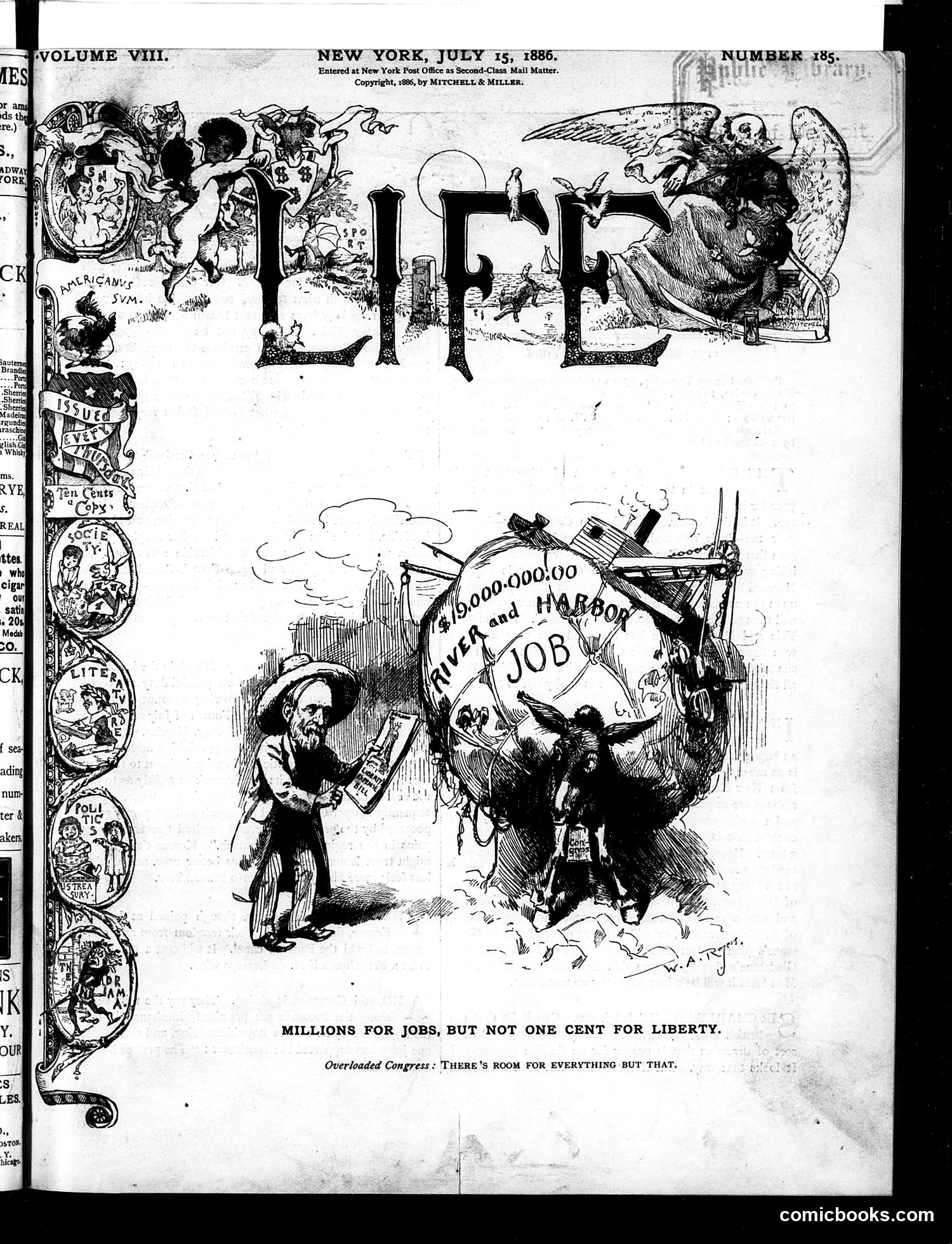
This cartoon satirizes Congress's priorities during the Gilded Age. The main illustration shows a massive balloon labeled "RIVER and HARBOR JOB" worth "$16,000,000" being held by Congressional figures, while an impoverished man on the left holds a small sign reading "LIBERTY." The caption reads: "MILLIONS FOR JOBS, BUT NOT ONE CENT FOR LIBERTY" with a subtitle: "Overloaded Congress: THERE'S ROOM FOR EVERYTHING BUT THAT." The satire criticizes Congress for lavishly funding pork-barrel "river and harbor" construction projects (infrastructure spending benefiting specific districts) while neglecting fundamental American principles of liberty. The cartoon suggests government resources are squandered on political patronage and local interests rather than defending constitutional freedoms. This reflects 1880s debates over government spending priorities and corruption.
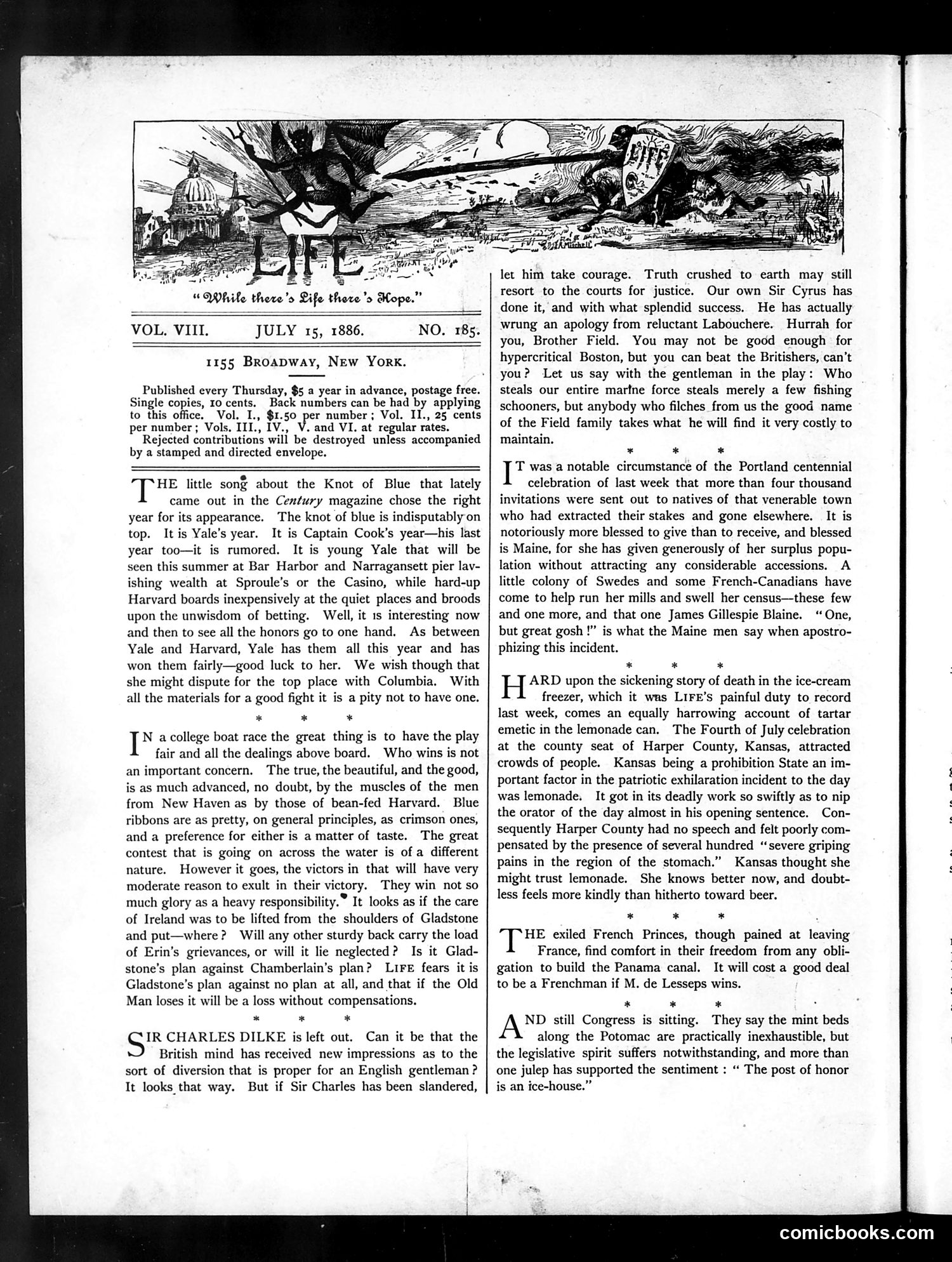
The prominent cartoon titled "While there's Life there's Slope" depicts a sinking ship or vessel in distress. The visual pun combines the magazine's title ("Life") with "slope" (nautical slang for escape or abandonment), suggesting that as long as there's life, there's a way out—even by abandoning ship. The accompanying text discusses Yale and Harvard boat racing, college athletic competition, and disputes over honor and reputation. The cartoon appears to satirize the fickleness of institutional loyalty and the willingness to "abandon ship" (abandon one's college) when circumstances change—a commentary on collegiate rivalry and shifting allegiances in 1880s elite American institutions.
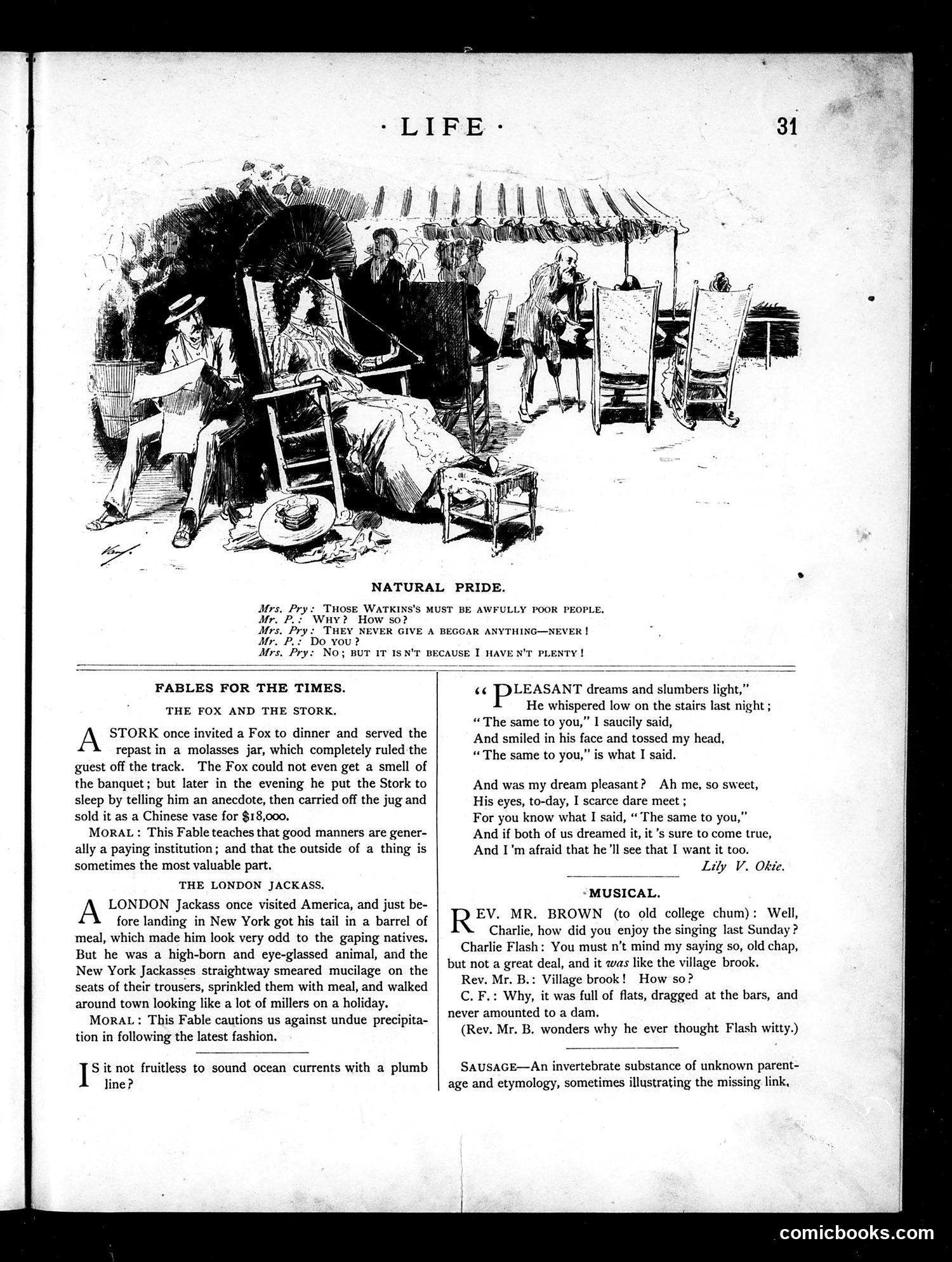
This satirical cartoon depicts a beach scene where poor people sit under a makeshift shelter. The dialogue mocks "natural pride"—the notion that poor people maintain dignity by refusing charity. **The satire:** Mrs. Fry claims the Watkins family "must be awfully poor people" because they never beg. Mr. Fry asks why that matters. Mrs. Fry responds they're "poor because" they lack plenty—implying poverty results from refusing handouts rather than circumstance. **Social commentary:** The cartoon critiques wealthy Victorians who romanticized poor people's "dignity" while ignoring systemic poverty. It suggests the wealthy used "natural pride" as justification for withholding aid, blaming poverty on the poor's own refusal to ask rather than on economic inequality or lack of opportunity.
This page contains brief satirical items rather than a traditional political cartoon. The content includes: **"ORPS"** - A humorous poem mocking a young officer in the British Army Corps who is "well versed both in logic and lorps" (unclear term). **"TO CLARENCE"** - An editorial response to a reader's marriage inquiry. The magazine advises against marriage on $15 weekly wages, using satirical reasoning to mock both the correspondent's unrealistic expectations and the pretensions of lower-middle-class aspiration. **Other brief items** mock contemporary figures and situations: a remark about Spain's new king, dogs' journals, Minister Cox's dinner, a Swiss powder mill, Mr. Daly's theatrical success, and a child's malapropism. The overall tone is light, gossipy satire typical of Life magazine's humor-focused content from this era.
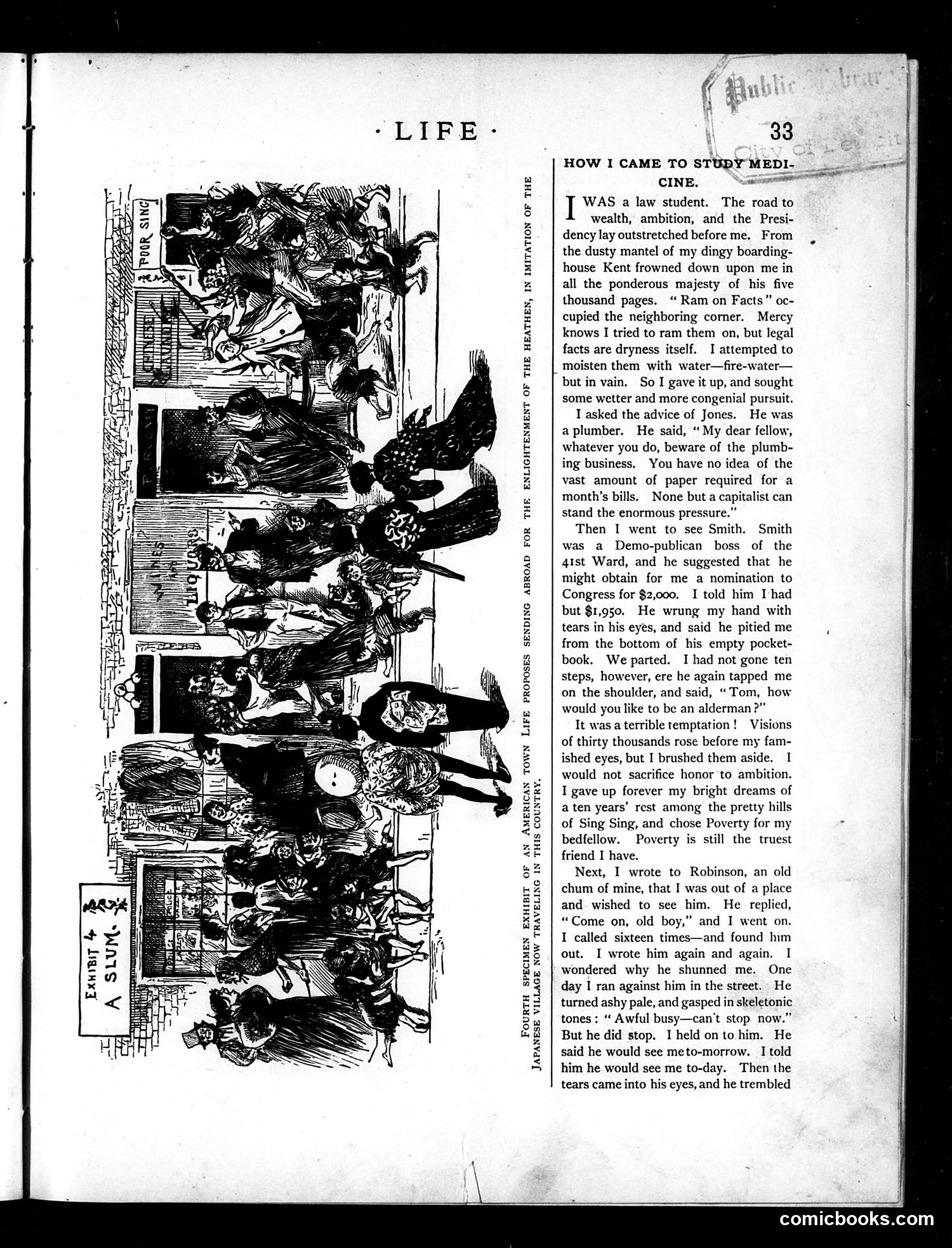
This illustration satirizes the chaotic reality of urban poverty and tenement housing in America. The densely-packed, vertical composition shows numerous figures crammed into a ramshackle building, depicting overcrowded living conditions, domestic disorder, and squalor. The accompanying article, "How I Came to Study Medicine," uses ironic juxtaposition: the narrator describes ambitious dreams of becoming a congressman and alderman, only to be confronted with the harsh realities of poverty. The cartoon visually reinforces this—contrasting idealistic aspirations with the grim actual conditions facing poor urban residents. This reflects late 19th/early 20th-century Progressive Era social criticism, when *Life* magazine frequently exposed urban poverty and inadequate living standards to shame comfortable middle-class readers into supporting reform.
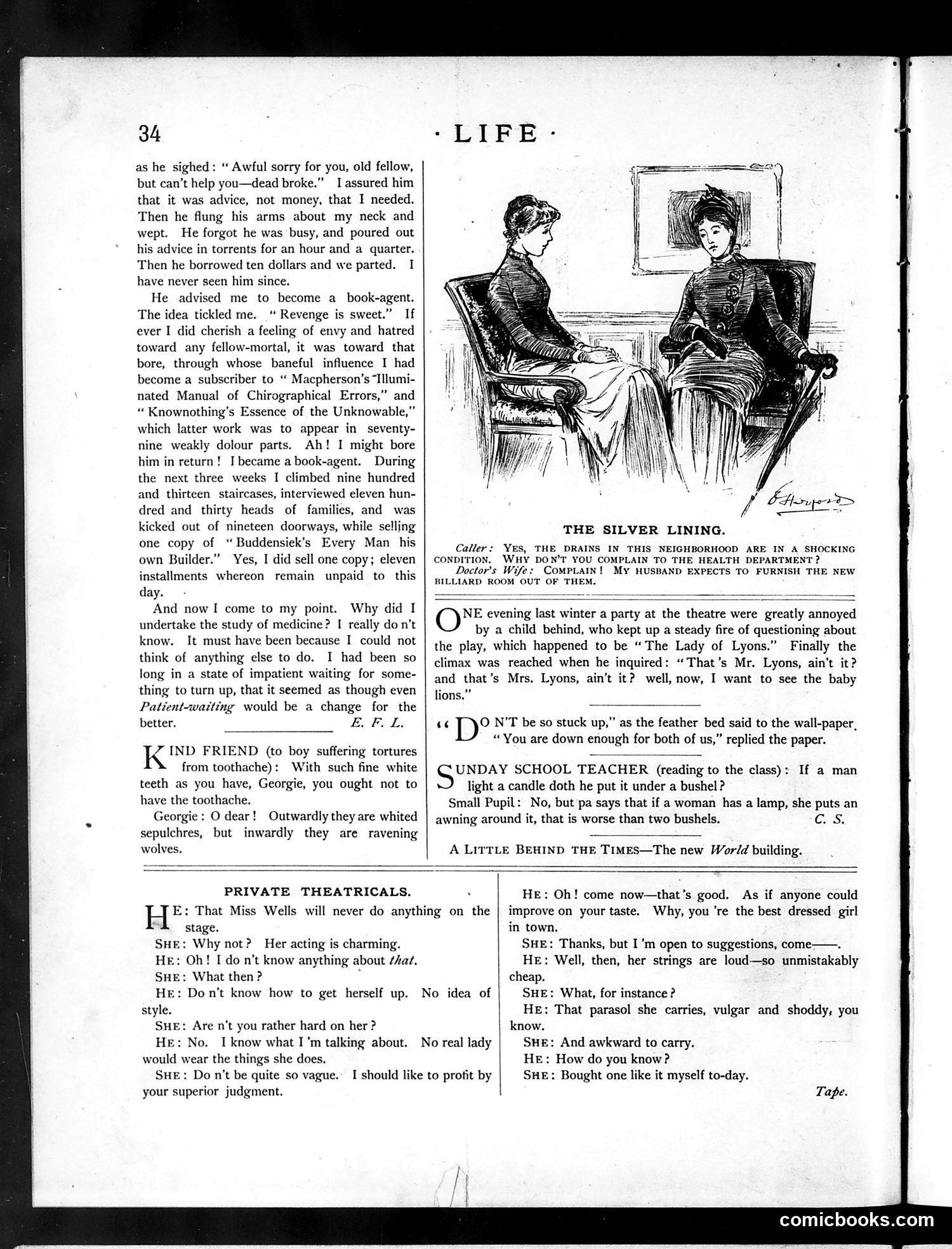
This page contains satirical humor pieces rather than political cartoons. The main illustrated feature, "The Silver Lining," depicts two women in conversation about neighborhood gossip—specifically about a disruptive child at a theater performance and someone named Mrs. Lyons. Below are comedic dialogues mocking various social types: a man with toothache problems, a Sunday school teacher and pupil discussing candles under bushels (biblical reference), and a theatrical scene about Miss Wells' acting ability. The humor relies on Victorian-era social pretensions, linguistic pomposity, and observational comedy about everyday life. These are character sketches and one-liners rather than topical satire, showing Life's format of light social comedy aimed at middle-class readers.
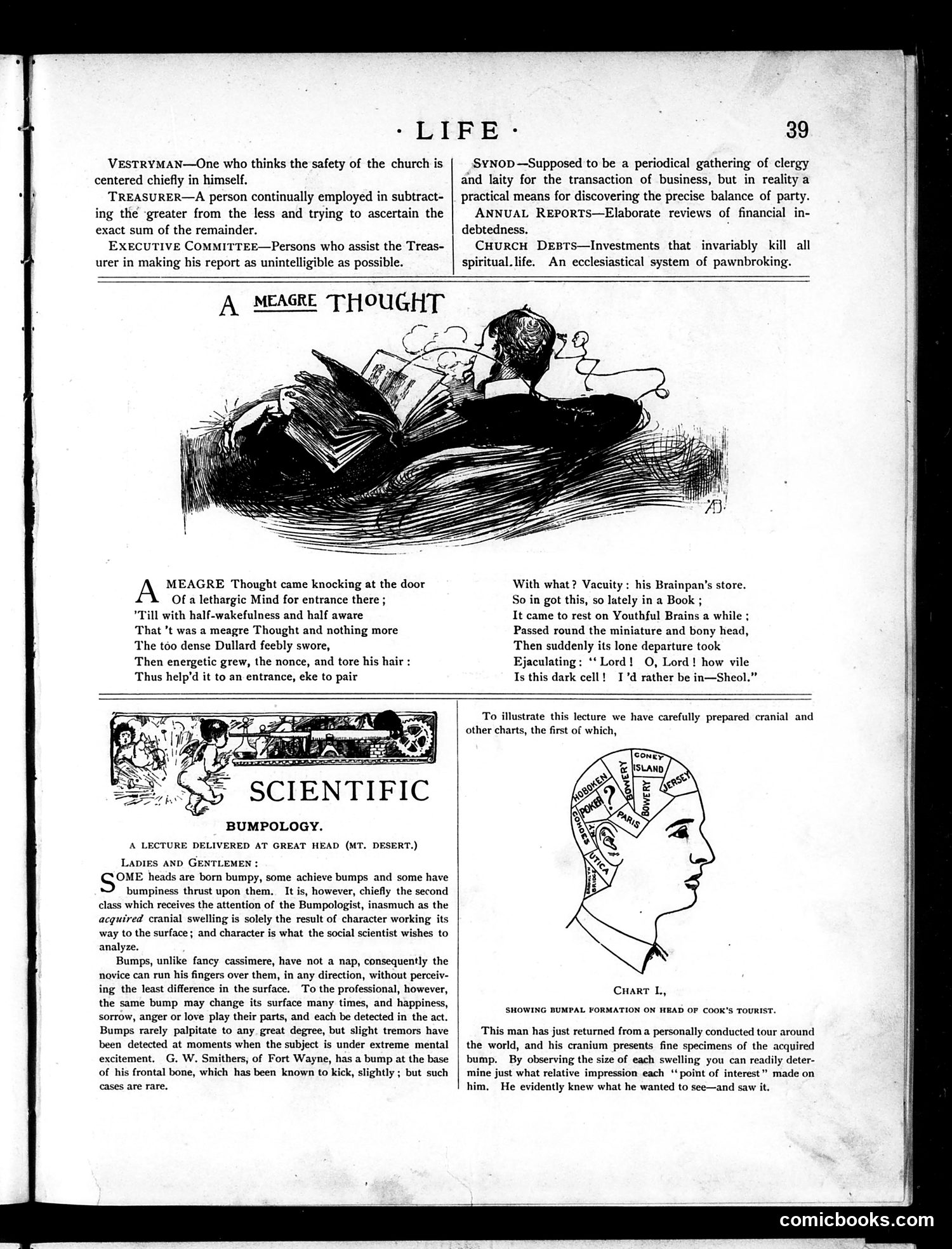
This page satirizes intellectual laziness and superficial learning. The illustration shows a man reading while reclining, with sparse, thin wisps of thought emanating from his head—visualizing "meagre" (weak/inadequate) thinking. The accompanying poem mocks someone whose mind is "lethargic" and seeks easy entrance to knowledge without genuine effort. The figure represents the dilettante or lazy scholar—someone who wants intellectual credibility but lacks the rigor to achieve it. Below, "Scientific Bumpology" parodies phrenology (the pseudoscience claiming skull bumps indicate character/ability). The satirical lecture on this fraudulent practice further mocks pretentious pseudo-intellectualism of the era. Together, the page ridicules both lazy thinking and the charlatans who exploit it.
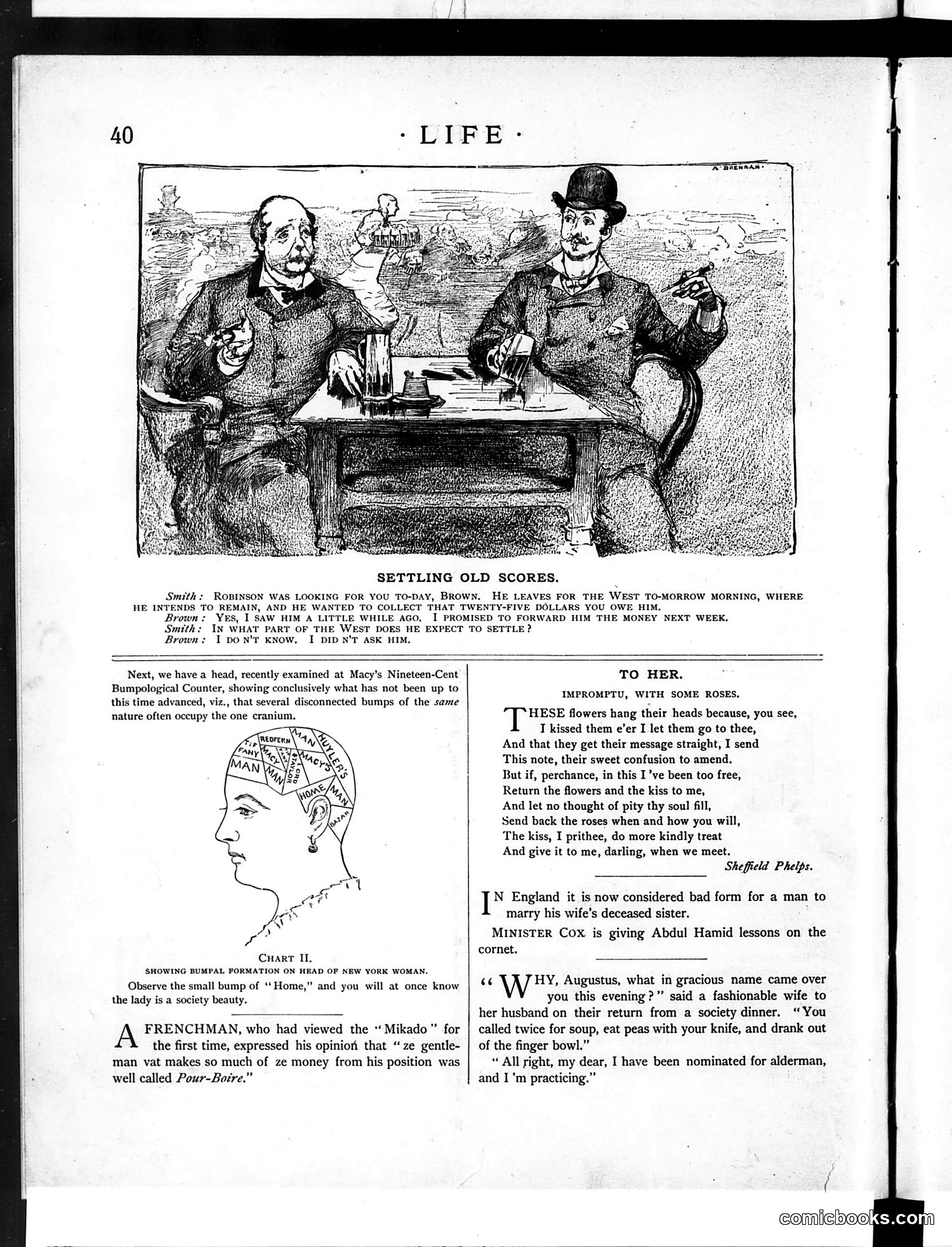
**Top Cartoon - "Settling Old Scores":** Two men at a table discuss a debt. Smith tells Brown that Robinson was looking for him to collect twenty-five dollars owed. Brown responds he'll pay Robinson when Robinson returns from the West, but questions *why* Robinson should expect to settle—implying the debt may be disputed or that Brown doubts Robinson's claim is legitimate. **Lower Content:** A phrenology diagram shows a woman's head with labeled regions of the brain (marked "Home," "Man," etc.), satirizing pseudoscientific attempts to determine character from head shape—a discredited practice popular in the 19th century. The remaining text includes a poem "To Her" and brief humorous anecdotes about social etiquette and a minister teaching cornet lessons. The page primarily mocks debt disputes, pseudoscience, and social conventions of its era.
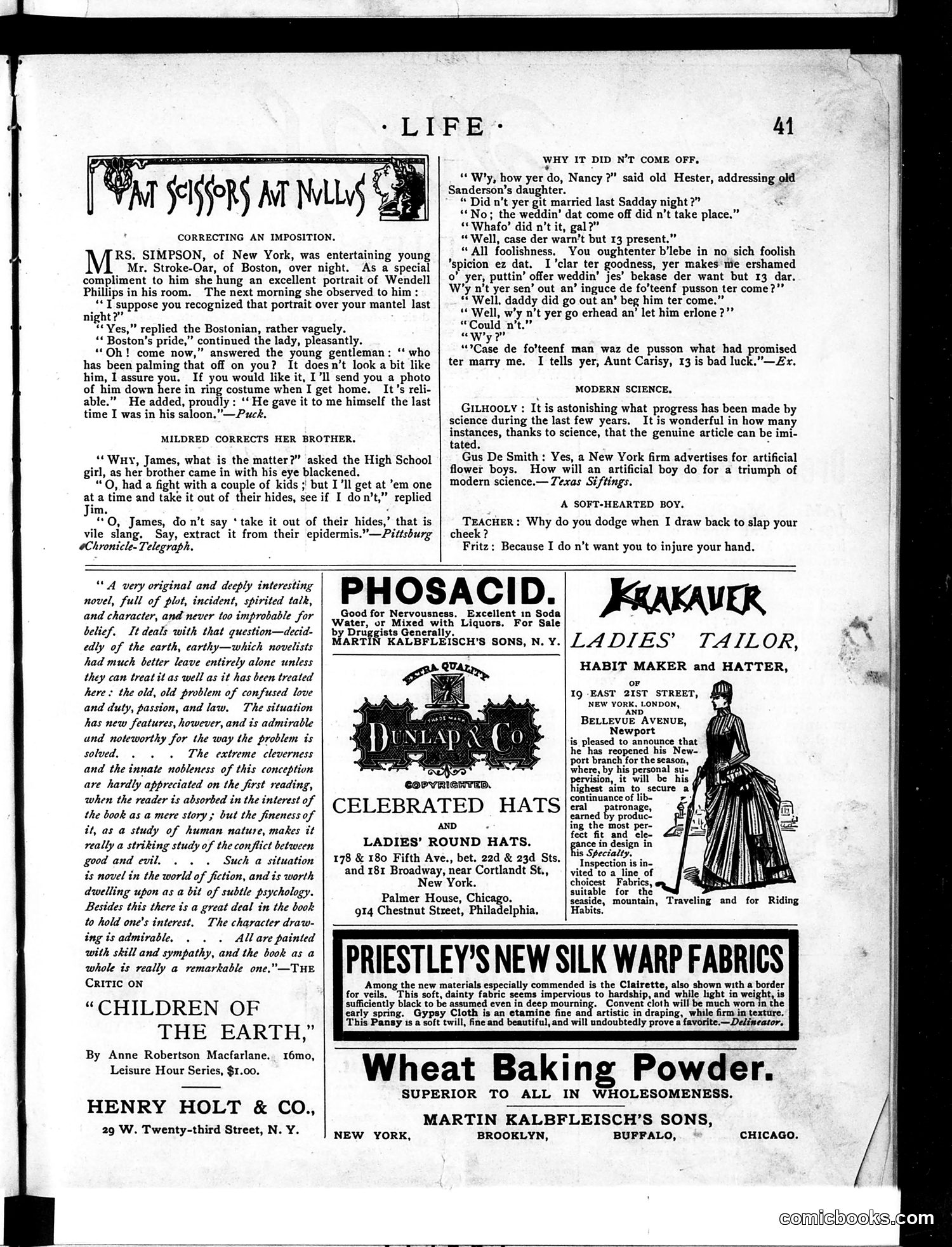
This page is primarily **advertising and short humor pieces** rather than political commentary. The top section, "SCISSORS AT NULLS," contains two brief satirical anecdotes: 1. **"Correcting an Imposition"**: Mrs. Simpson of New York complains that a portrait painter depicted her husband poorly, claiming he doesn't resemble a photograph. The humor lies in the husband's deadpan reply that he looked better before she married him. 2. **"Mildred Corrects Her Brother"**: A High School girl corrects her brother's crude slang, instructing him to say "extract it from their epidermis" instead of a vulgar phrase—satire on affected speech and class pretension. The remainder consists of product advertisements (Phosacid, Krakauer Ladies Tailor, Dunlap Hats, Priestley Fabrics, and Wheat Baking Powder). No significant political content is present.
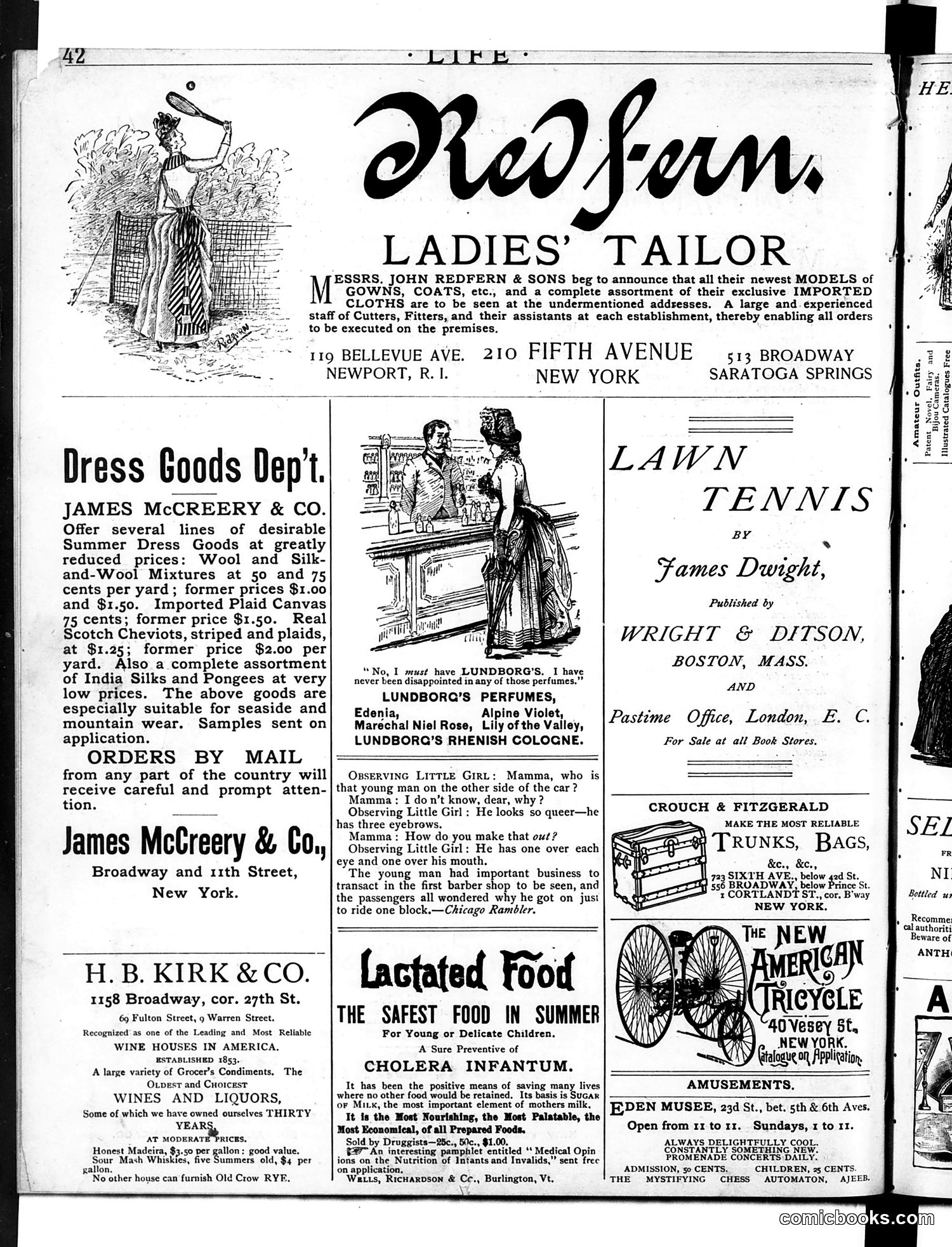
This page is primarily advertising, typical of *Life* magazine's revenue model in this era. The notable comic content is a brief joke titled "Observing Little Girl," which satirizes social awkwardness and masculine grooming habits. The humor centers on a young man with an excessively prominent mustache—described as having "three eyebrows" (one over each eye, one over his mouth). The joke mocks his appearance as so ridiculous that he rushes to a barber after riding just one block on a streetcar, while other passengers puzzled by his behavior. This reflects late-19th-century social satire about masculine presentation and the era's emphasis on proper grooming standards. The joke's gentleness and focus on a stranger's facial hair rather than political targets suggests *Life's* general-audience humor approach during this period. The rest of the page consists of department store advertisements, luxury goods (wines, perfumes, clothing), and entertainment notices—reflecting the magazine's affluent readership.
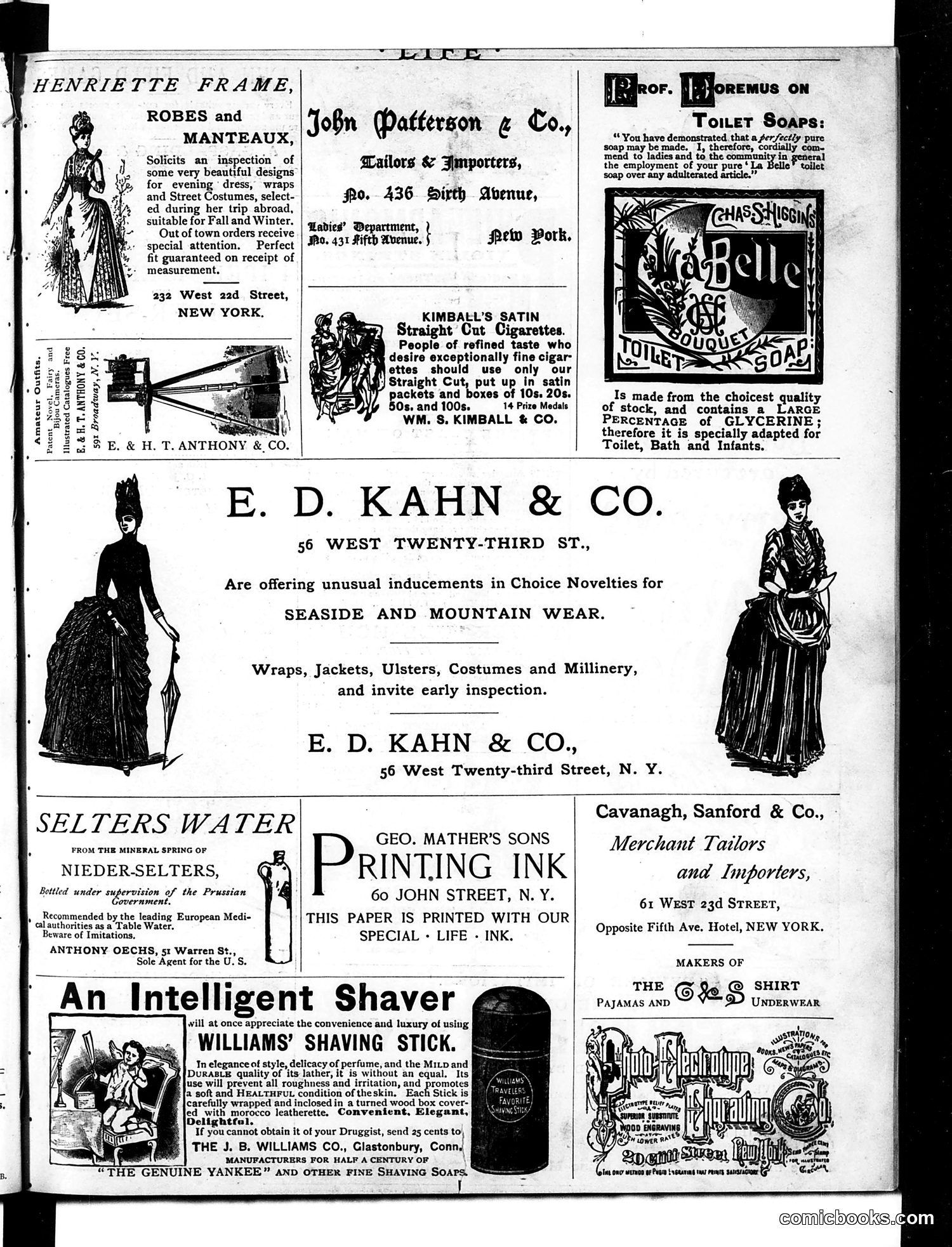
This is primarily an **advertisement page** from Life magazine, not a satirical cartoon page. It contains approximately 12 commercial advertisements for late 19th-century products and services. The ads target affluent urban consumers—featuring women's clothing (Henriette Frame robes, E.D. Kahn & Co. seaside wear), luxury grooming products (Williams' Shaving Stick, La Belle toilet soap), imported goods (Selters mineral water from Prussia), and specialized services (merchant tailors, printing ink). **Notable aspect**: The endorsement format in the "Prof. Boremus" toilet soap ad mimics scientific authority to market consumer goods—a common advertising strategy of the era. The repeated emphasis on "purity," "quality," and "refined taste" reflects Gilded Age consumer culture's aspirations. No political satire or notable caricatures appear. This is representative advertising content rather than editorial or satirical material.
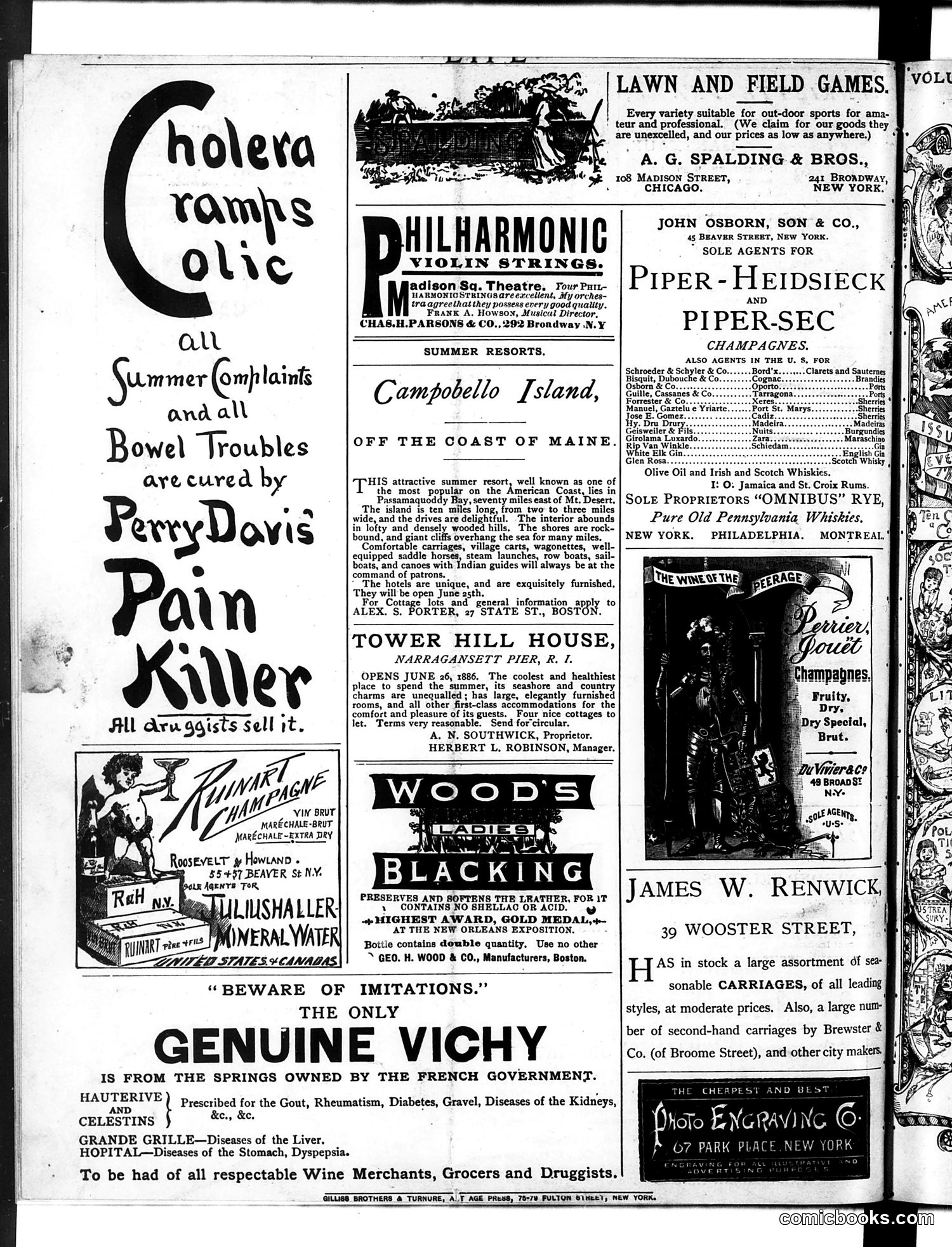
This is primarily an **advertisement page** from Life magazine (circa 1886, based on references to the New Orleans Exposition). It contains no political cartoons or satirical content—just commercial ads typical of the era. Notable advertisements include: - **Perry Davis Pain Killer** (left): A patent medicine claiming to cure "cholera," summer complaints, and bowel troubles—representative of the era's largely unregulated medical market - **Genuine Vichy water** (bottom): Mineral water "prescribed" for gout, rheumatism, diabetes, and kidney disease - **Wood's Lady Blacking**: Shoe polish advertised with a gold medal - **Summer resorts** (Campobello Island, Tower Hill House): Luxury vacation destinations - Various **champagne, whiskey, and carriage** merchants The page reflects Gilded Age consumer culture: patent medicines with broad health claims, imported luxury goods, and leisure activities for the affluent. The "beware of imitations" warning for Vichy suggests contemporary concerns about product authenticity and counterfeiting.