
A complete issue · 16 pages · 1886
Life — May 20, 1886
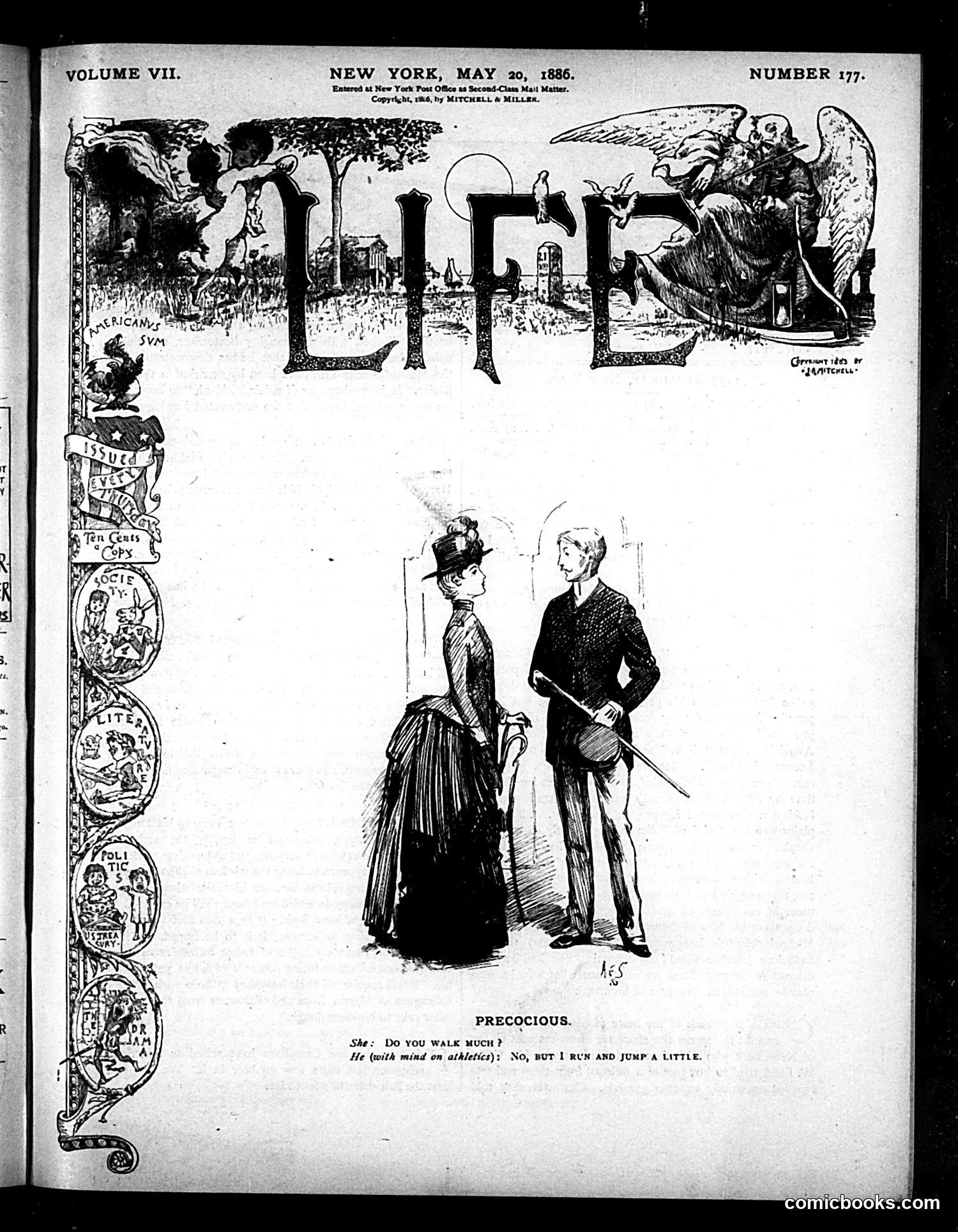
This single-panel cartoon depicts a Victorian-era social interaction. A woman asks a man "Do you walk much?" and he replies (with mind on athletics): "No, but I run and jump a little." The joke plays on the double meaning of "run and jump"—literal athletic activities versus the Victorian slang phrase meaning to behave recklessly or live a wild lifestyle. The man's parenthetical aside "(with mind on athletics)" suggests his innocent interpretation, while the woman's question implies she's asking about his moral character or social reputation. The humor derives from this miscommunication and the tension between his straightforward athletic answer and her likely social concern about his behavior.
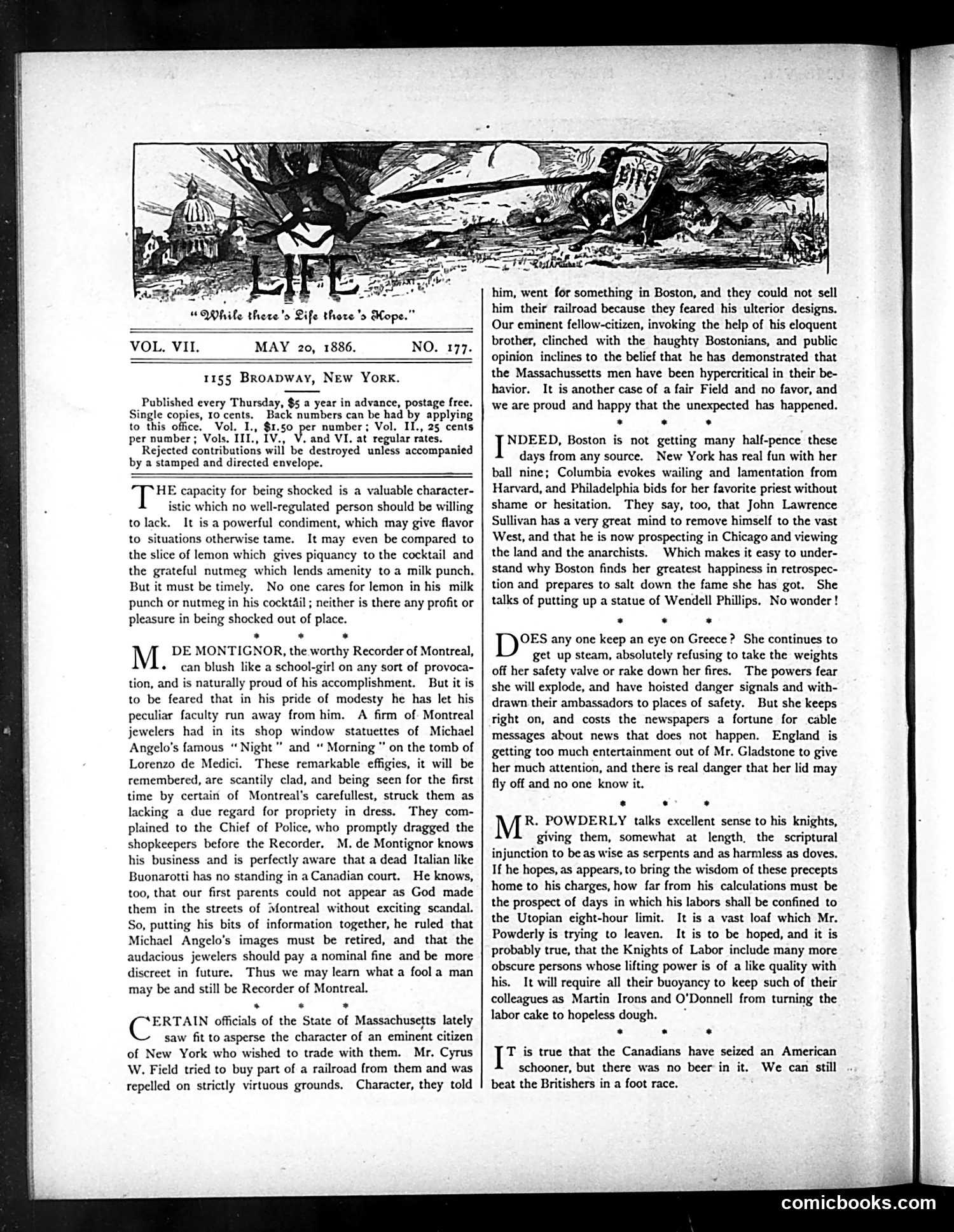
The masthead cartoon "While there's Life there's Hope" depicts allegorical figures representing Life itself—likely personifying American optimism and resilience during the Gilded Age. The page's text consists of brief satirical commentary on contemporary issues: criticism of Boston's provincial attitudes toward New York business ventures; mockery of Boston's self-satisfied nostalgia; commentary on a steamship (appears to be British) refusing safety precautions; and discussion of labor movement rhetoric from "Mr. Powderly" (likely Terence Powderly, leader of the Knights of Labor), critiquing the movement's utopian messaging while acknowledging genuine worker hardship. The tone is urbane, often mocking provincial sensibilities while engaging seriously with labor tensions of the era.
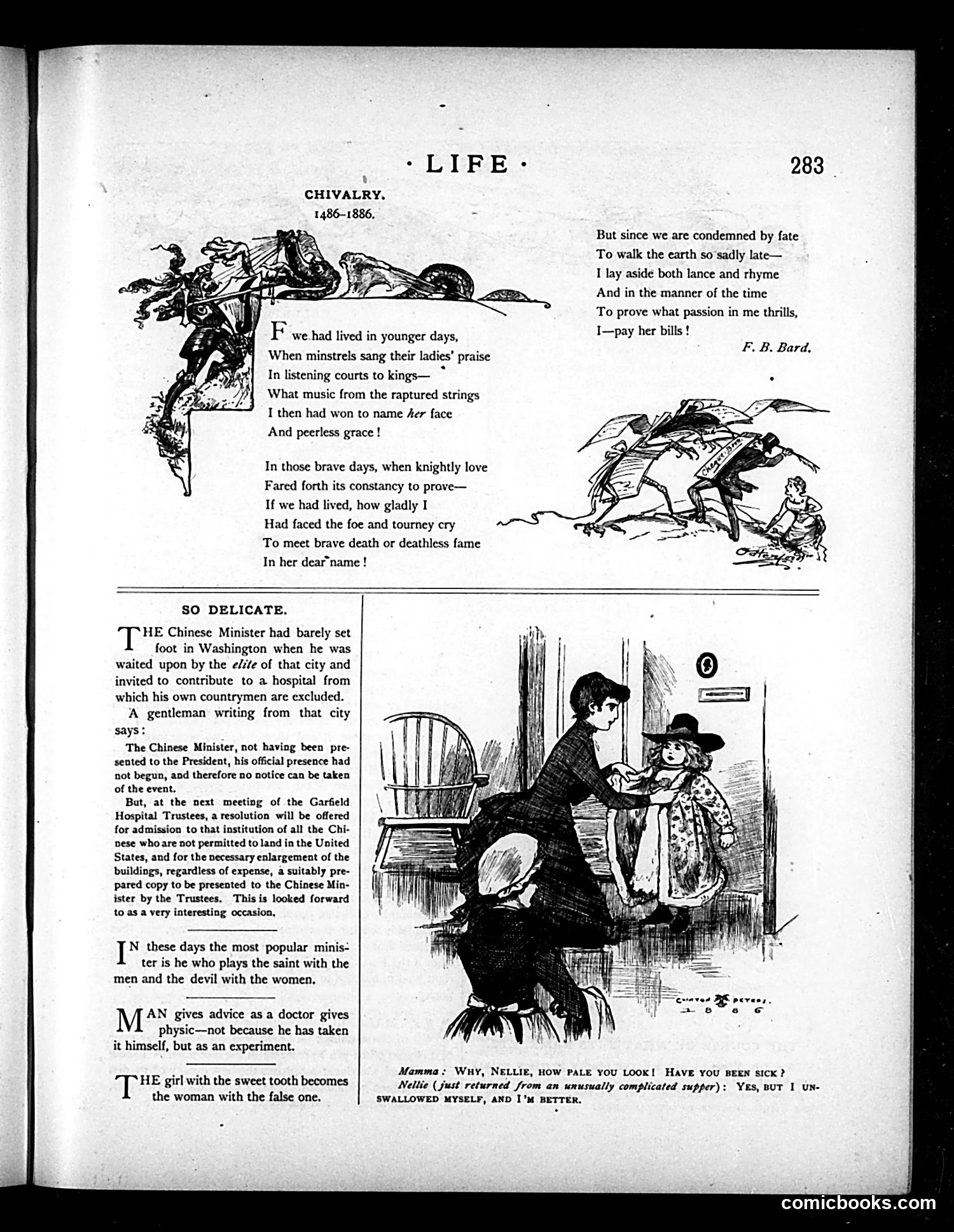
**Top Section - "Chivalry" (1486-1856):** This poem nostalgically contrasts medieval courtly love with the speaker's present circumstances. The knight illustrations reference idealized chivalric tradition. The satire suggests that romantic devotion and noble ideals have disappeared from modern life—the speaker must now "pay her bills" rather than win glory through knightly deeds. **Bottom Section - "So Delicate":** This satirizes diplomatic exclusion. A Chinese Minister visiting Washington faces discrimination—excluded from hospital events because Chinese nationals cannot own U.S. property. The accompanying cartoon shows a woman claiming illness (having "swallowed myself") to avoid social obligation. The piece mocks both the discriminatory policy and the petty excuses used to avoid uncomfortable social situations.
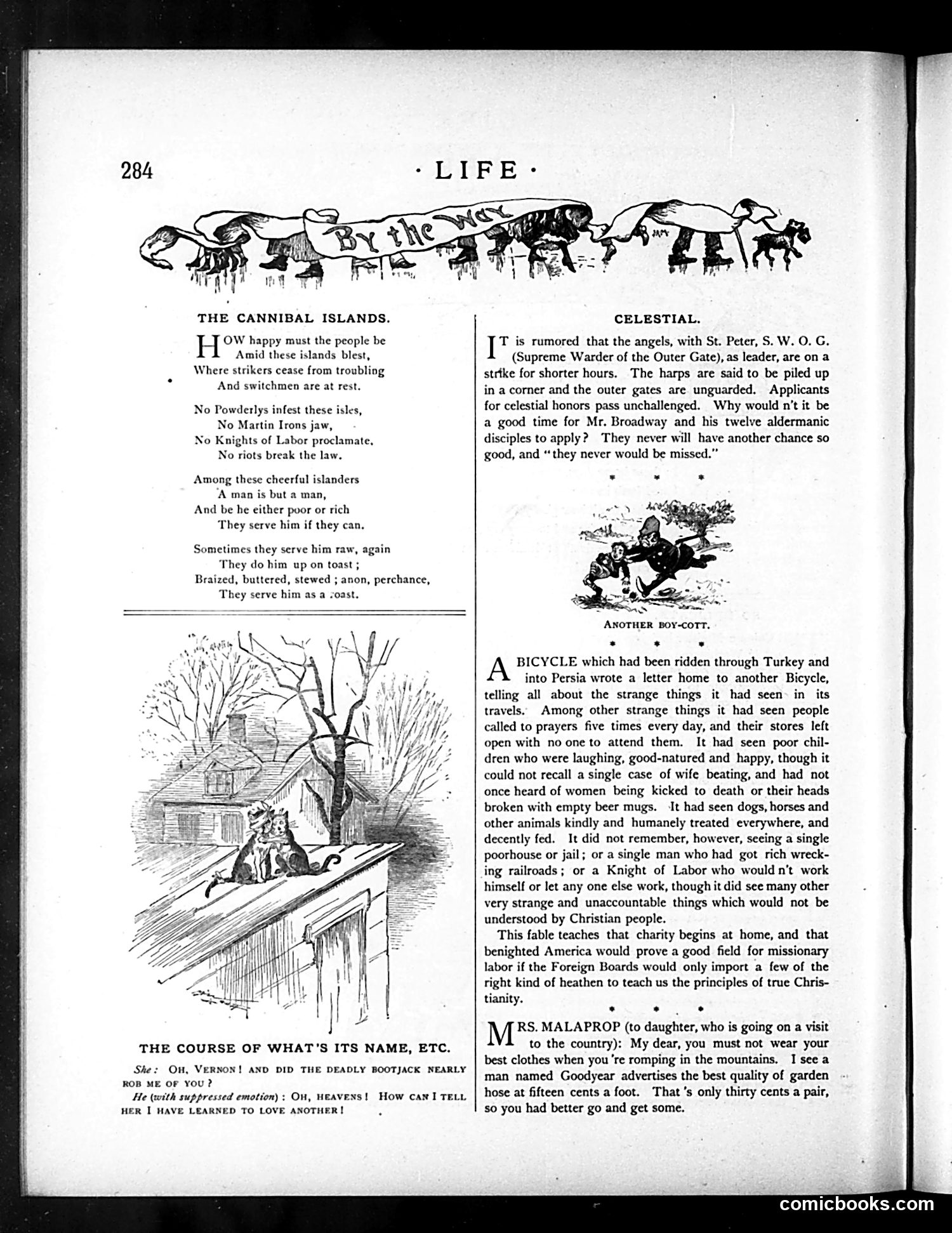
This page contains three separate satirical pieces: **"The Cannibal Islands"** (left): A poem mocking the Cannibal Islands as a utopia free of social problems—no poverty, labor disputes, or civil unrest. The satire suggests American society suffers from these issues while the "savage" islands don't. **"Celestial"** (upper right): Humorous commentary on heaven's bureaucracy, joking that angels and St. Peter work shorter hours and harps sit unused, with a jab at Broadway impresarios and "aldermanic disciples." **"Another Boy-Cott"** (center right): A story about a bicycle traveling through Turkey and Persia, contrasting foreign lands' treatment of animals and poor people favorably against American conditions—the "charity begins at home" moral criticizing American missionary efforts abroad while domestic poverty persists.
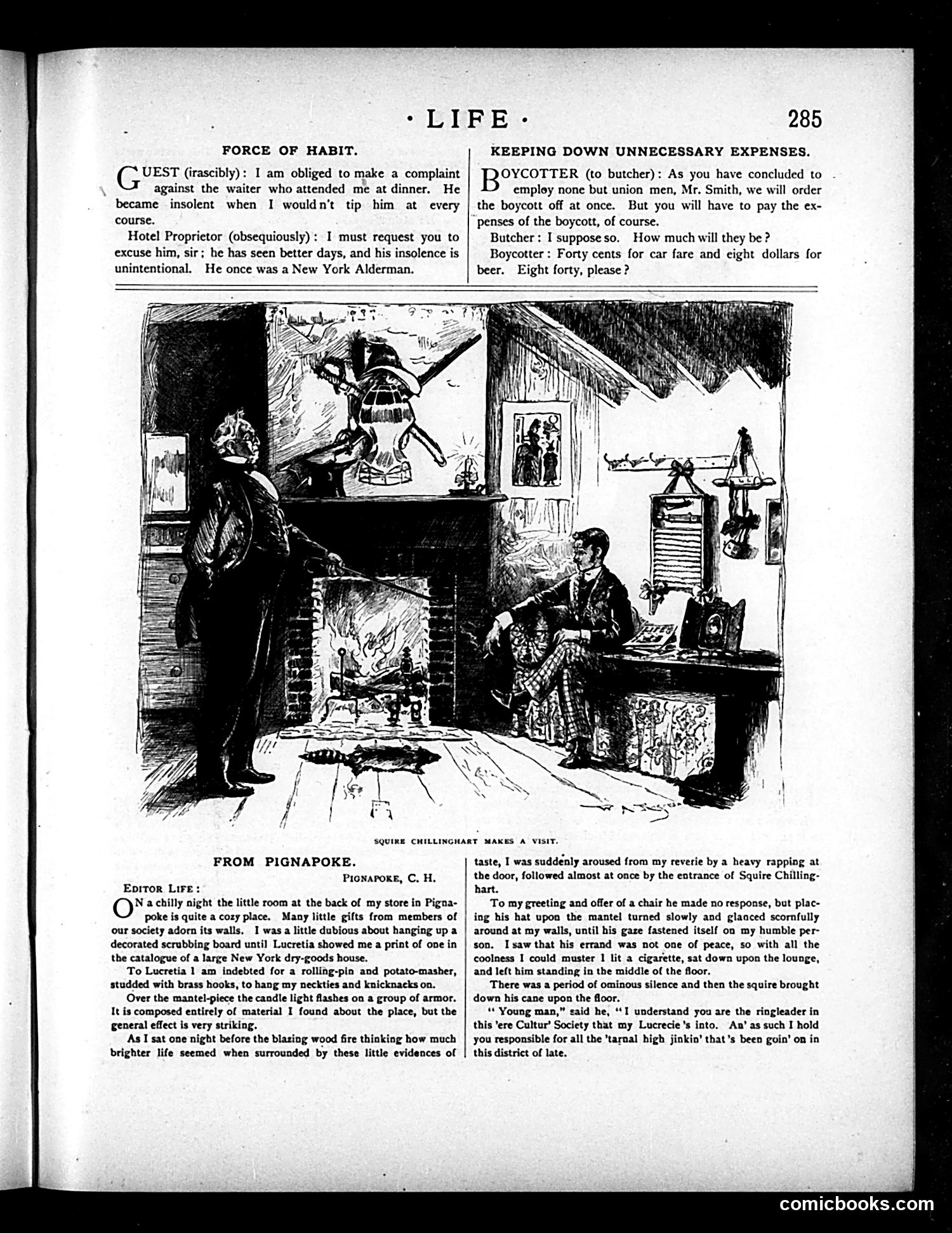
This page contains three separate satirical pieces: 1. **"Force of Habit"** (top): A brief dialogue mocking a hotel proprietor who excuses an insulting waiter by claiming he "once was a New York Alderman"—suggesting corrupt or rude behavior was typical of that political position. 2. **"Keeping Down Unnecessary Expenses"** (top right): A butcher and boycotter discuss costs of a labor boycott, with the boycotter paying $8.40 for beer and car fare—the humor lies in protesting "unnecessary expenses" while spending lavishly. 3. **"Squire Chillinghart Makes a Visit"** (main illustration): A gentleman visitor confronts what appears to be a shopkeeper about alleged "high jinking" and disorderly conduct in the district. The satire targets either working-class behavior or labor activism, depending on the historical context of "Squire Chillinghart." All three pieces use humor to critique social pretension, labor disputes, or class conflict.
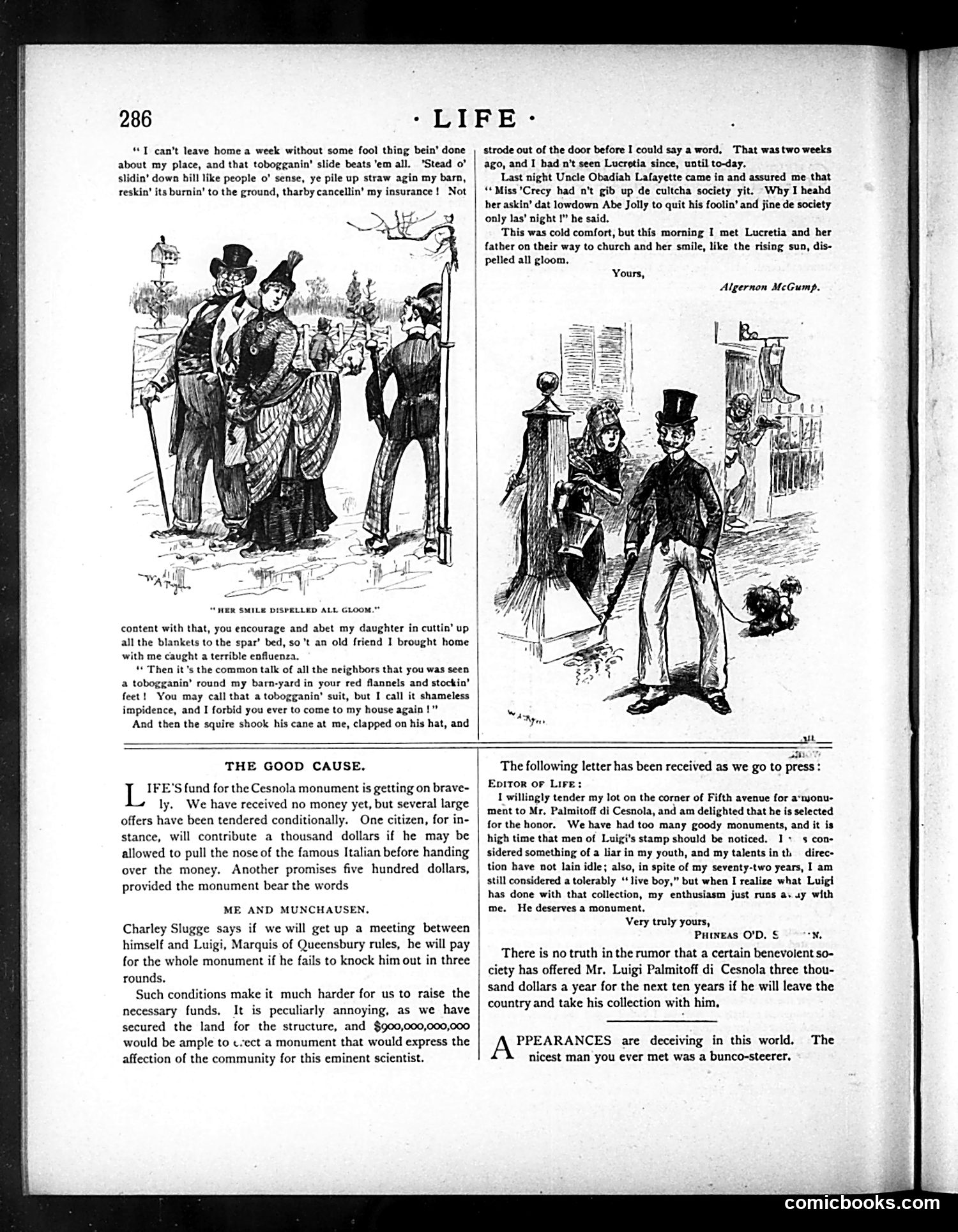
**Left cartoon ("Her Smile Dispelled All Gloom"):** This appears to satirize domestic conflict. A well-dressed man confronts a woman about household mismanagement—specifically, her lending blankets to neighbors and befriending a vagrant. The accompanying text shows him angrily ejecting the visitor, sarcastically calling her charitable impulses "shameless impudence." The joke mocks both the woman's naive charity and the man's petulant, controlling response. **Right cartoon and text:** References the Cesnola monument fundraising campaign. The text discusses securing donations for an Italian scientist's memorial, with one donor offering to "pull the nose" of an Italian who refuses to contribute—dark humor about coercive fundraising tactics. **Overall theme:** Social satire targeting domestic tyranny, class condescension, and public fundraising absurdities of the era.
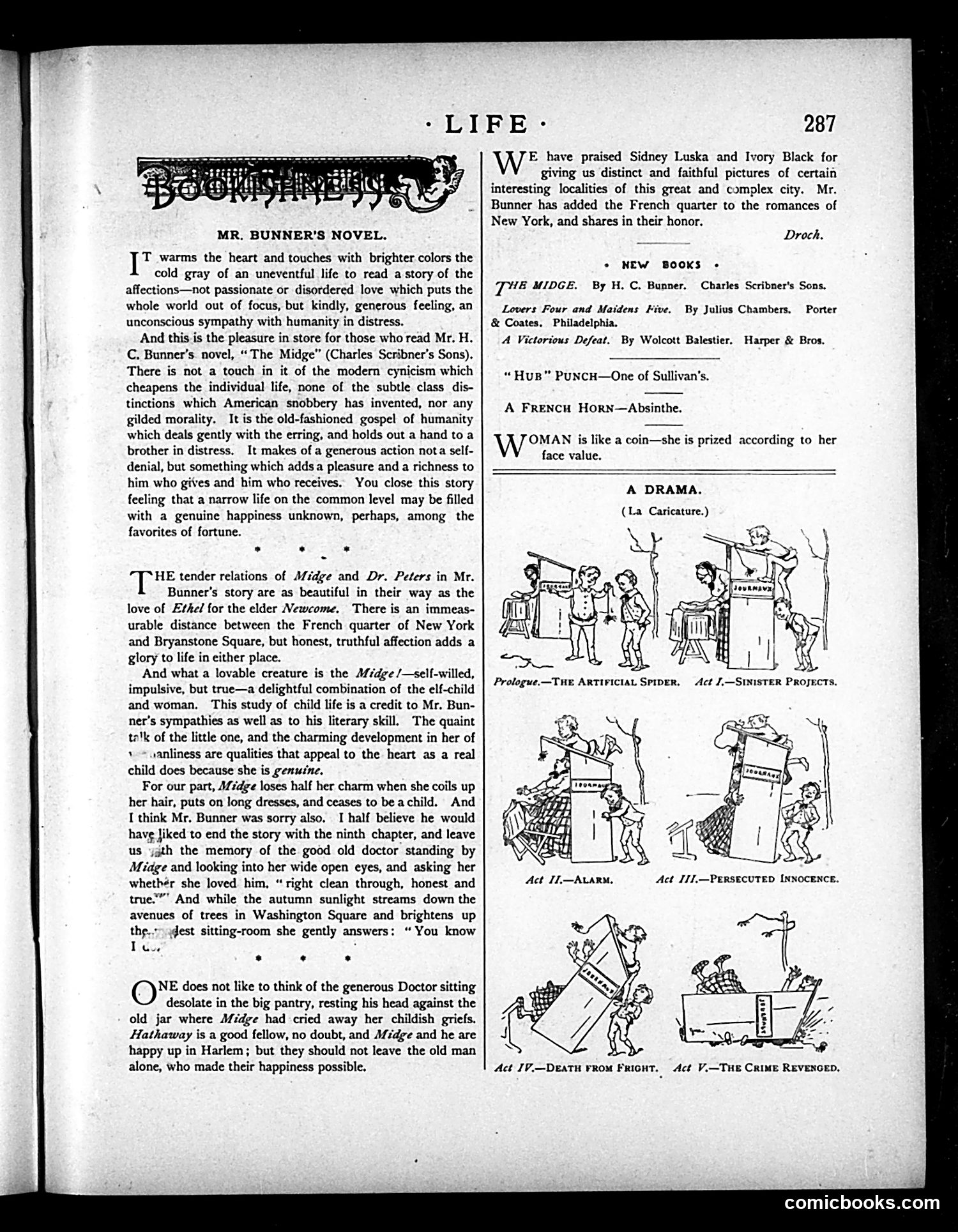
This page primarily reviews **"The Midge," a novel by H.C. Bunner** (published by Charles Scribner's Sons). The left column praises the story for its "kindly, generous feeling" and "old-fashioned gospel of humanity," contrasting it with modern cynicism. The right side contains **"A Drama" (La Caricature)** — a five-act satirical comic strip showing increasingly chaotic "sinister projects" that escalate from scheming to slapstick disaster. The progression from "Artificial Spider" through "Alarm," "Persecuted Innocence," "Death from Fright," to "Crime Revenged" depicts a darkly humorous sequence where elaborate pranks backfire catastrophically. The cartoon satirizes overwrought melodramatic plotting common in contemporary theater.
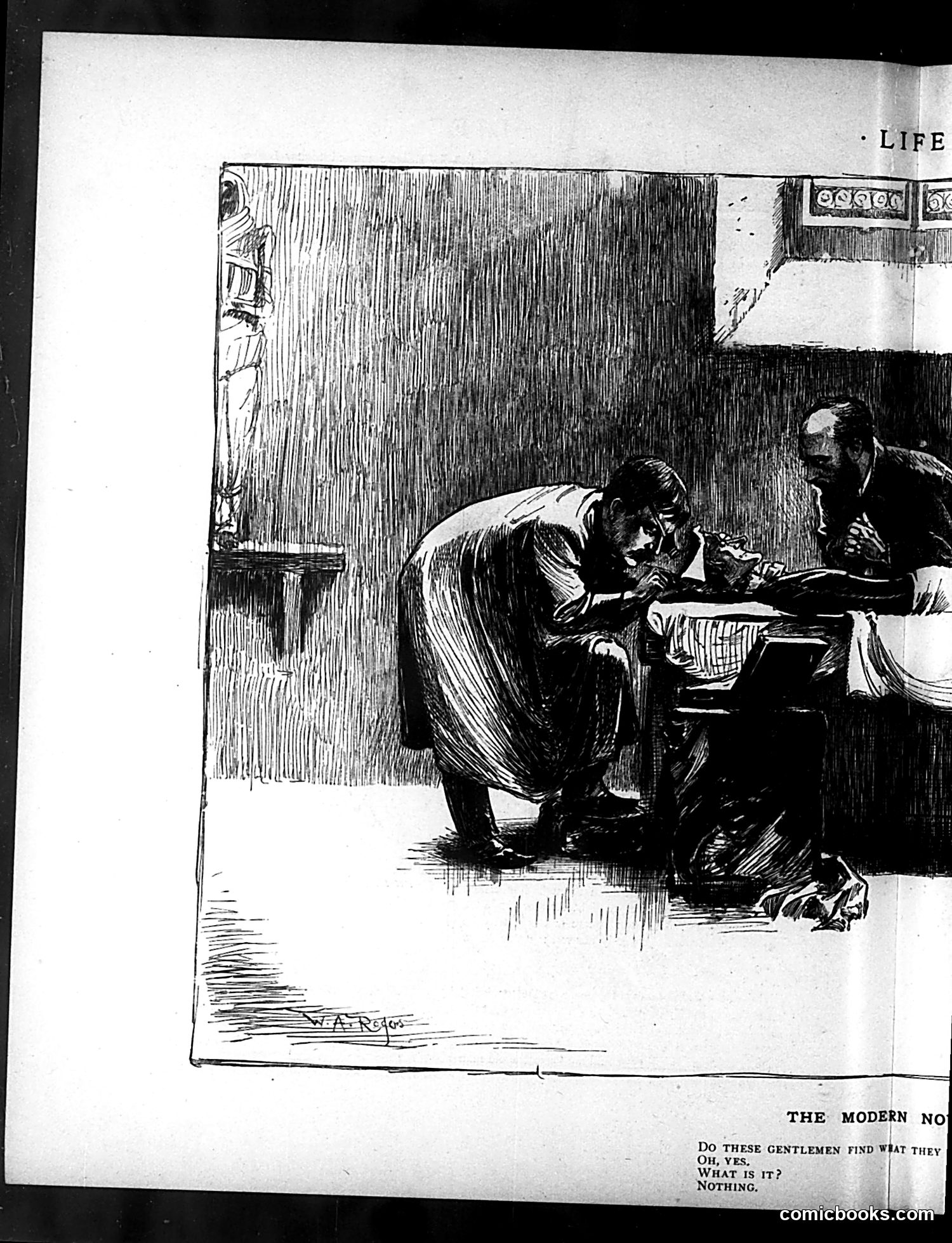
This cartoon from *Life* magazine satirizes wealthy or prominent gentlemen seeking something (likely a favor, loan, or business proposition). The caption reads: "Do these gentlemen find what they oh, yes. What is it? Nothing." The joke plays on the contrast between the men's apparent earnestness—one leans forward intently at a desk—and the punchline's revelation that they find "nothing." This suggests they've been rejected or denied their request despite their expectations. The satire likely targets the entitled attitudes of the upper class, mocking how such men assume they'll receive favorable treatment, only to be disappointed. The title "The Modern No" emphasizes how even these privileged figures now face refusal—a pointed commentary on changing social or economic conditions.
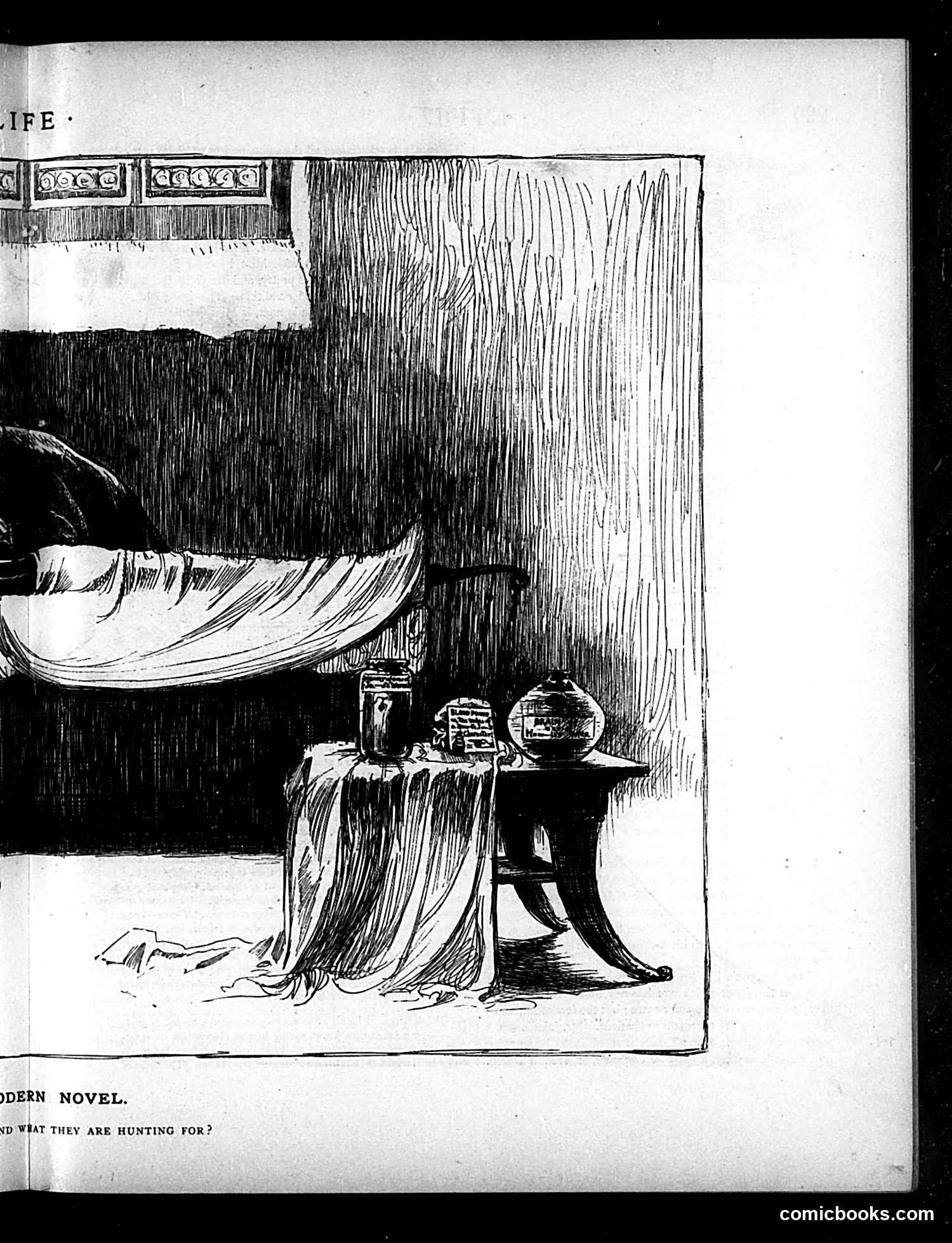
This appears to be an illustration from Life magazine accompanying a section titled "THE MODERN NOVEL" with the subtitle "AND WHAT THEY ARE HUNTING FOR?" The image shows an interior bedroom scene with a bed and a small table holding decorative objects. The composition emphasizes the sparse, intimate domestic space. The satirical point seems to critique modern novels of the era—likely their focus on romantic or sensual subjects within domestic settings. The question "and what they are hunting for?" suggests the satire targets what contemporary fiction writers sought to portray or what readers pursued in these narratives. Without clearer text or identified authors/titles visible, the exact literary works or figures being mocked remain unclear, but the bedroom setting indicates the satire concerns modern fiction's preoccupation with intimate domestic life.
This is a theater review of the comic opera "Erminie," recently produced at the Casino theater. The critic praises composer E. Jakabowski and producer Rudolph Aronson for breaking from the tedious "sausage-and-sauerkraut" German operas that had dominated New York comic opera. The piece satirizes contemporary critics' prejudice against new artists—noting they assume unknowns are "dolts" until proven otherwise, dismissing Jakabowski as merely "a certain Mr. Jakabowski" or "whoever he may be." The review celebrates "Erminie" for its French refinement, witty plot, and charming music (praising the thieves' chorus and lullaby). It praises actor Francis Wilson's performance as the thief Cadeaux and commends most of the female cast, though it criticizes Marion Manola's performance as "nothing." The satire targets both critical snobbery and repetitive, low-quality opera production in New York theater.
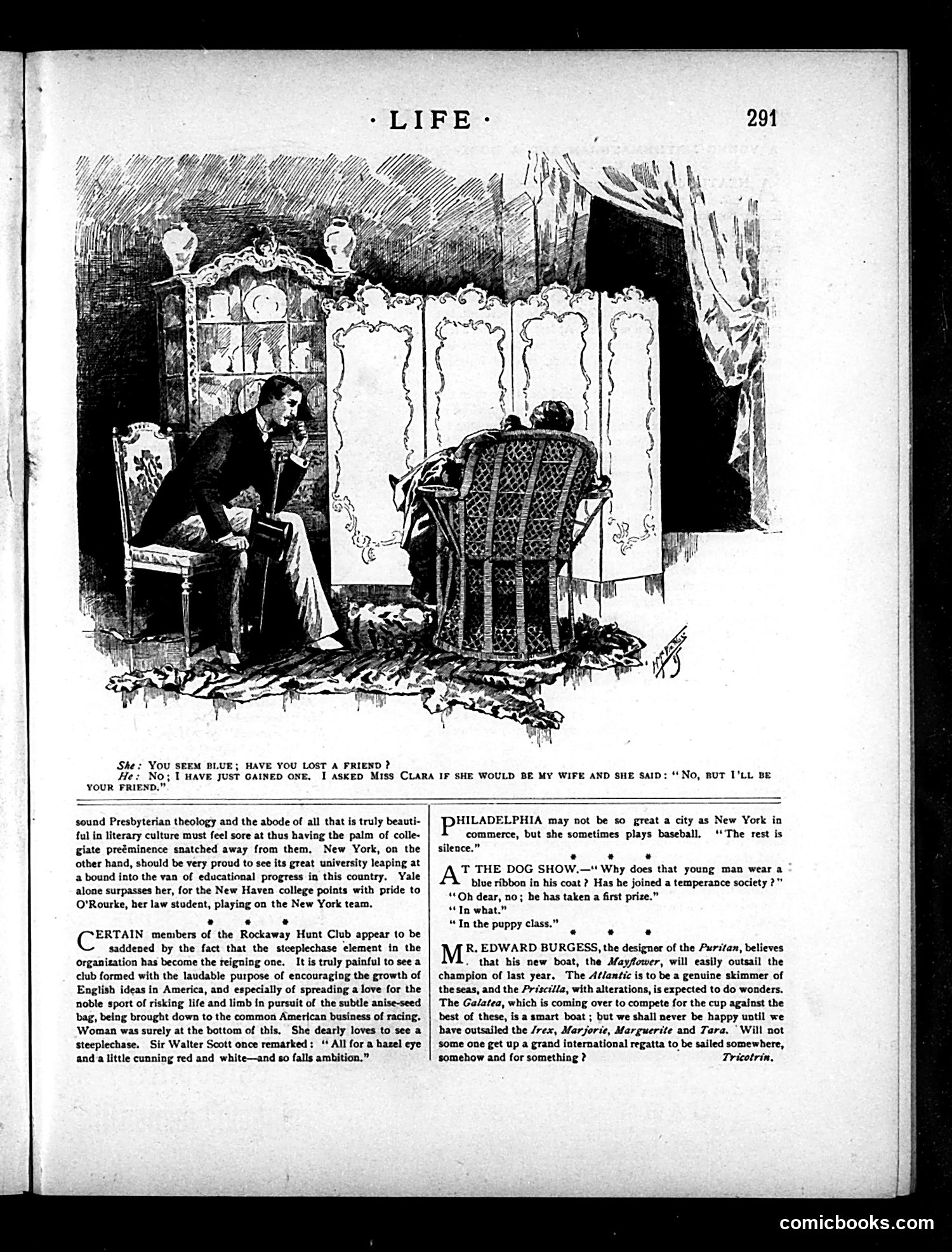
The main cartoon depicts a rejection joke: a man has proposed to Miss Clara, who declined marriage but agreed to be his "friend" instead. His sad expression reflects the disappointment of being "friend-zoned"—a social awkwardness that appears to have been a recognized phenomenon even in this era. The surrounding text discusses various American institutions and leisure activities: Yale and Columbia universities competing academically, the Rockaway Hunt Club's shift from steeplechase to horse racing (blamed on women's influence), Philadelphia's baseball prowess, a dog show where blue ribbons indicate prize wins, and yacht racing competitions featuring boats like the *Puritan*, *Mayflower*, and *Galateia*. The satire targets educated elites' pursuits—academic rivalry, aristocratic hunting clubs, and competitive yachting—while using the opening cartoon to suggest romantic rejection was a relatable universal experience across social classes.
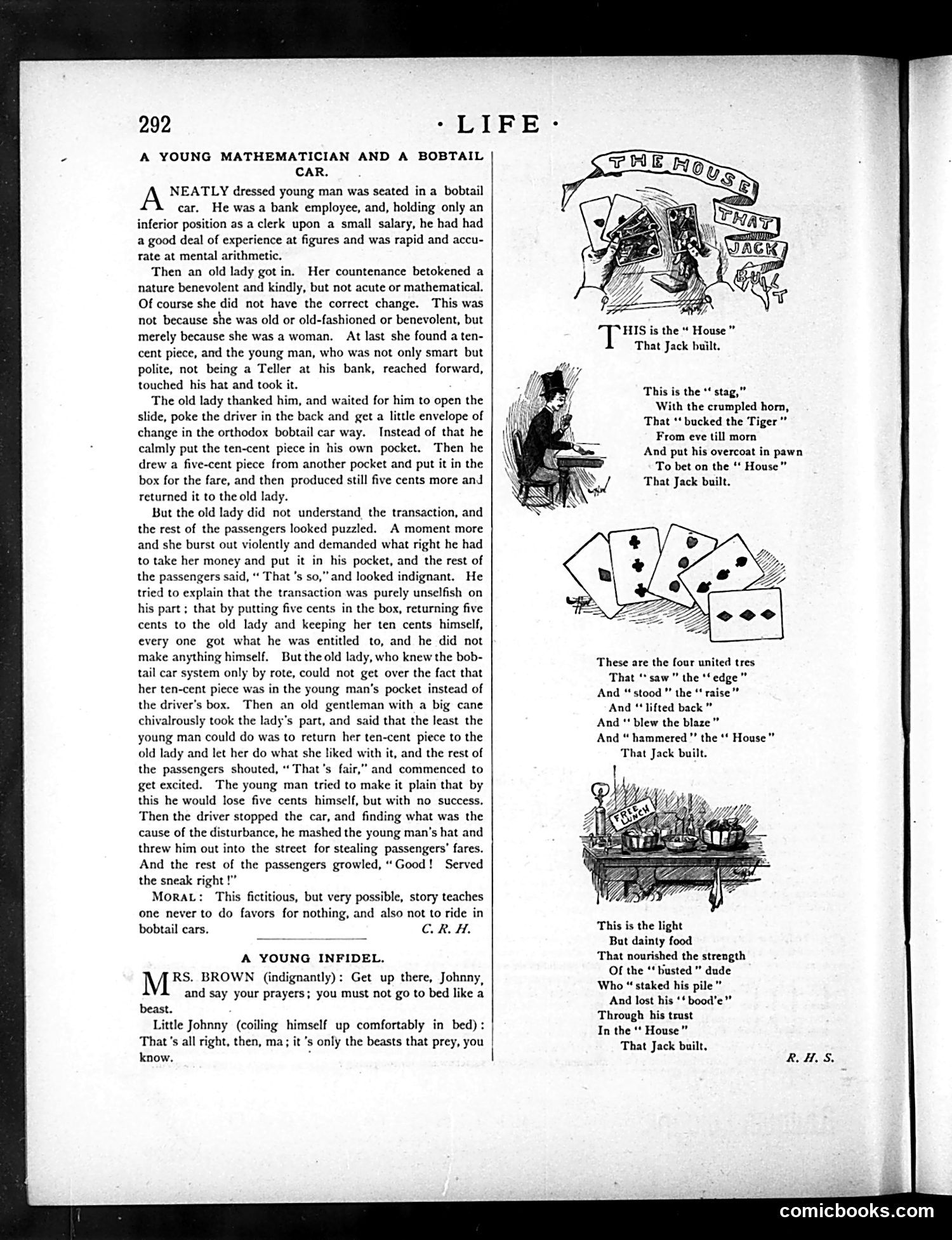
**"A Young Mathematician and a Bobtail Car"** satirizes public irrationality and mob mentality. A bank clerk performs a mathematically sound transaction with an elderly passenger: he takes her 10-cent coin, deposits 5 cents for her fare, returns 5 cents to her—meaning everyone benefits fairly and he gains nothing. However, the other passengers cannot grasp this logic and become outraged that "her money" went into his pocket, demanding he return the original coin. The moral: people often reject rational fairness when it violates their intuitive sense of propriety. The story mocks both human mathematical illiteracy and the danger of crowds making emotional judgments. **"The House That Jack Built"** (right side) parodies the nursery rhyme while satirizing gambling culture. References like "bucked the Tiger," "the edge," "the raise," and "staked his pile" describe a ruined gambler who lost everything betting on card games—the cumulative consequences building like the original rhyme's structure. **"A Young Infidel"** shows a clever child's logic: when told not to pray like "a beast," he notes only predatory beasts prey, so skipping prayers proves he's *not* bestial.
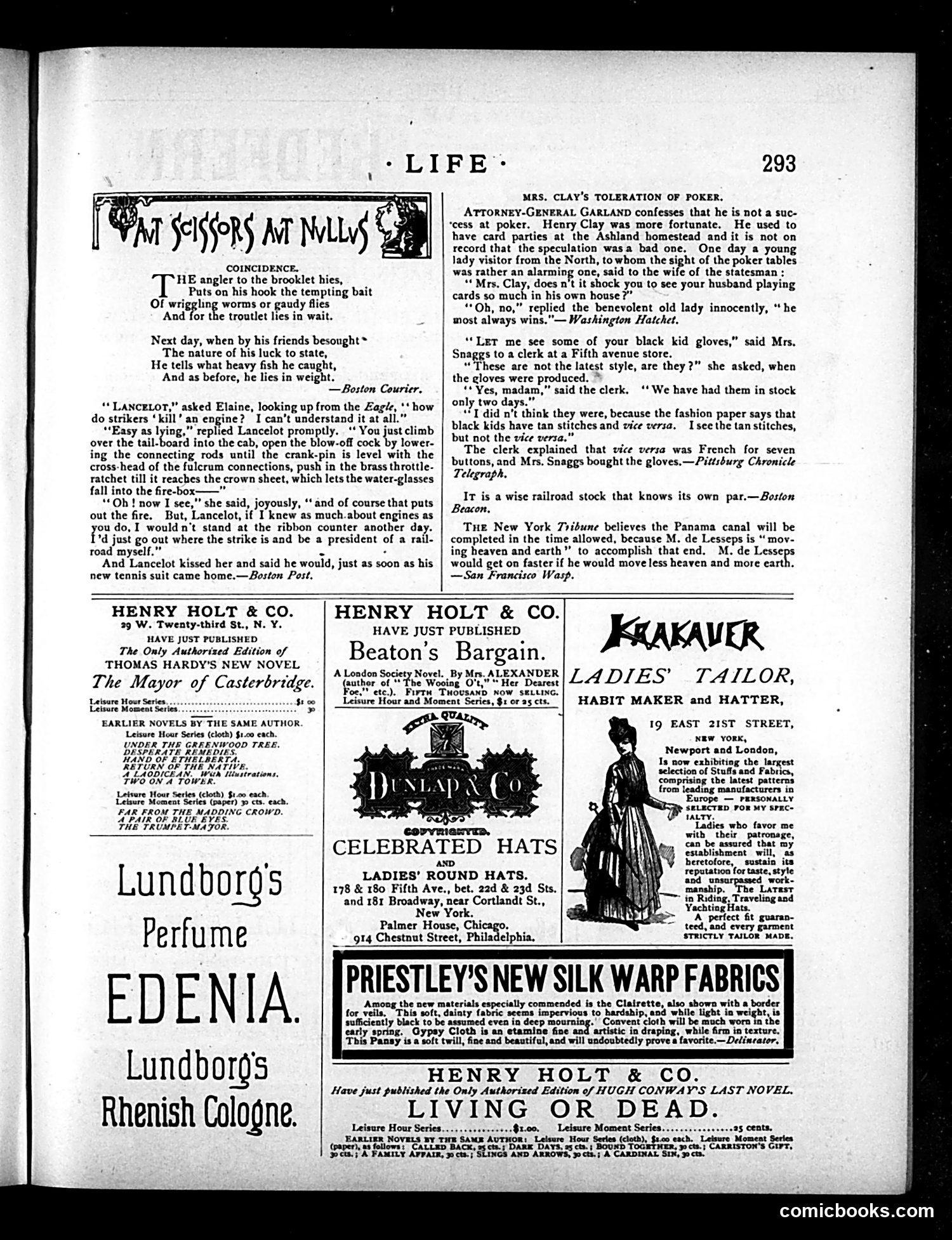
This page is primarily **advertisements and humorous anecdotes** rather than political cartoons. The title "Am Scissors at Nulls" appears to be decorative section header. The content includes three brief satirical stories mocking human nature: 1. **"Coincidence"** - Jokes about fishermen exaggerating their catches, playing on the irony that they lie about success as consistently as they lie about failure. 2. **"Lancelot & Elaine"** - Parodies medieval romance while satirizing labor strikes; a woman suggests a railroad worker use his engine knowledge to become company president rather than strike. 3. **Mrs. Clay's Toleration** - Anecdotes about Henry Clay and Attorney-General Garland's poker playing, suggesting wealthy/powerful men gamble regularly, with the humor that Mrs. Clay accepts it because "he most always wins." Minor satirical quips target the Panama Canal project and railroad stock speculation. The page is primarily filled with **book advertisements** (Thomas Hardy novels, Beaton's Bargain) and **commercial ads** for perfume, clothing, and millinery—typical of Life magazine's revenue model.
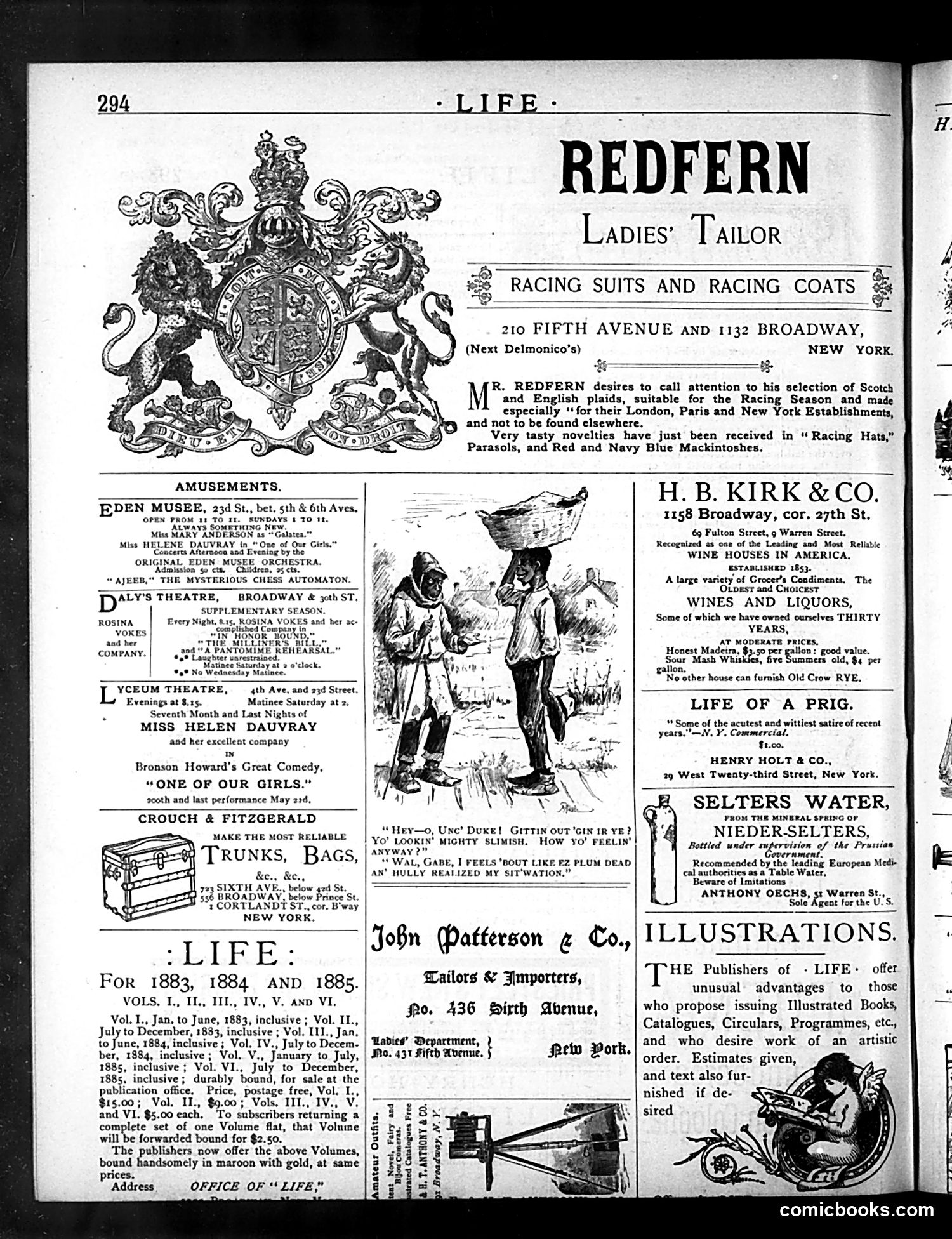
This page is primarily **advertisements and announcements** from Life magazine (circa 1883-1885), with one cartoon visible in the center. The cartoon depicts **two Black men in dialect conversation**. One asks the other ("Unc' Duke") if he's getting gin, noting he looks "slimish." The response uses heavy stereotypical dialect ("WaL, GABE, I FEELS 'BOUT LIKE FZ PLUM DEAD"). **What this represents:** This is a **racist caricature** typical of 1880s American humor. The exaggerated dialect, the casual reference to alcohol, and the overall degrading portrayal reflect the period's deeply prejudiced entertainment conventions. The "joke" relies entirely on ethnic stereotyping for alleged humor. **Modern context:** This would be considered offensive and unacceptable today. It represents how mainstream publications normalized racist depictions as acceptable comedy during the post-Reconstruction era. The rest of the page consists of advertisements for ladies' tailoring, theatrical productions, luggage, wines, and other services typical of 1880s New York commercial publishing.
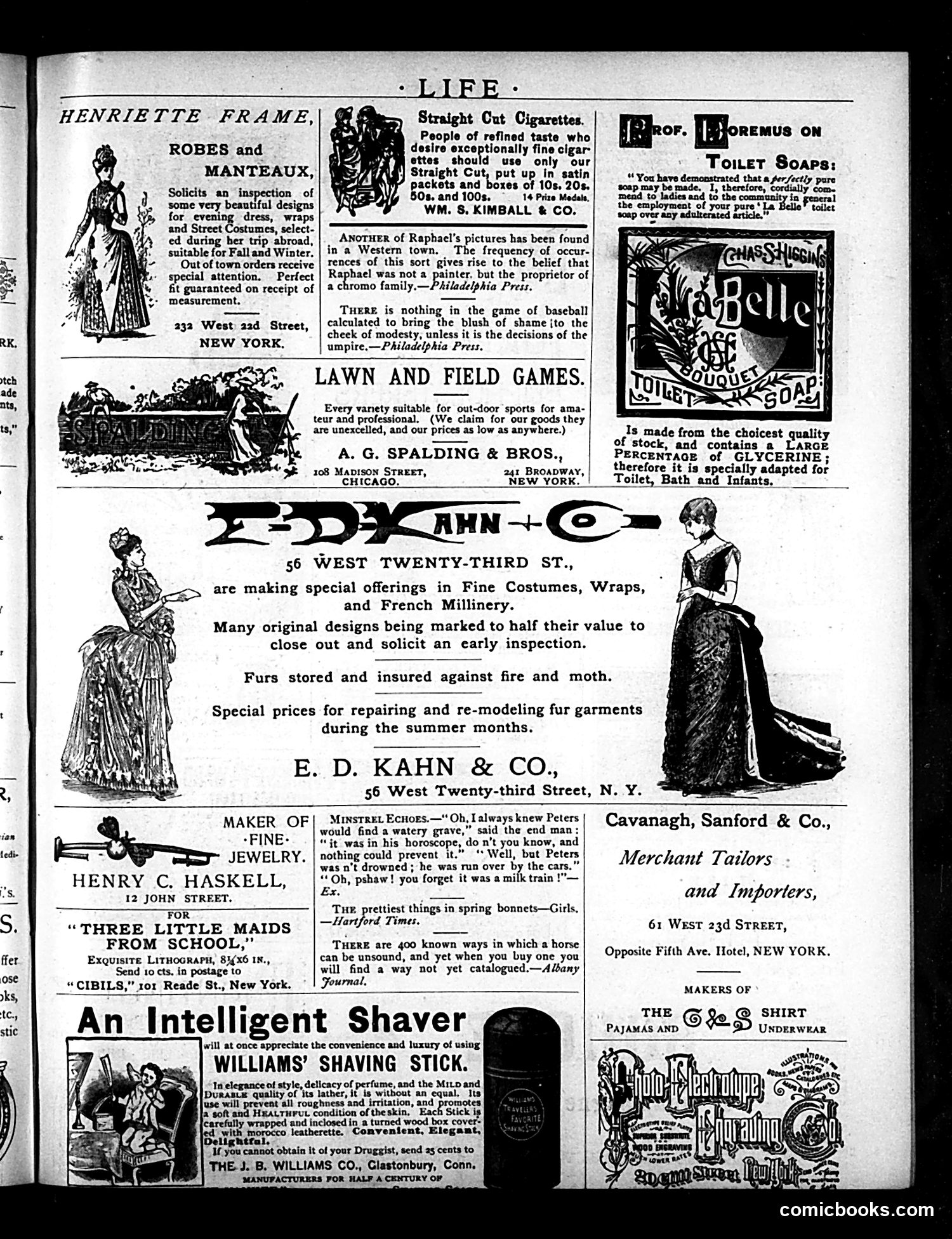
This page is primarily **advertising**, not political satire or comics. It contains luxury product advertisements typical of late 19th-century American magazines. The notable content includes: **Fashion advertisements** dominating the page—Henriette Frame offers imported robes and mantels; E.D. Kahn & Co. advertises fine costumes and French millinery with designs "marked to half their value." **Brief satirical snippets** embedded among ads: - A joke about Raphael paintings appearing constantly in Western towns, suggesting they're mass-produced chromos rather than originals - A quip about baseball umpires making questionable decisions - Minstrel show humor (period-typical racial entertainment) - Jokes about horse quality and spring bonnets **Product advertisements** for sporting goods (Spalding), toiletries (Belle Soap, Williams' Shaving Stick), cigarettes, jewelry, and clothing dominate the visual space. The page reflects Gilded Age consumer culture aimed at affluent readers—emphasizing European refinement, luxury goods, and leisure activities. The scattered humor serves mainly to break up commercial copy.
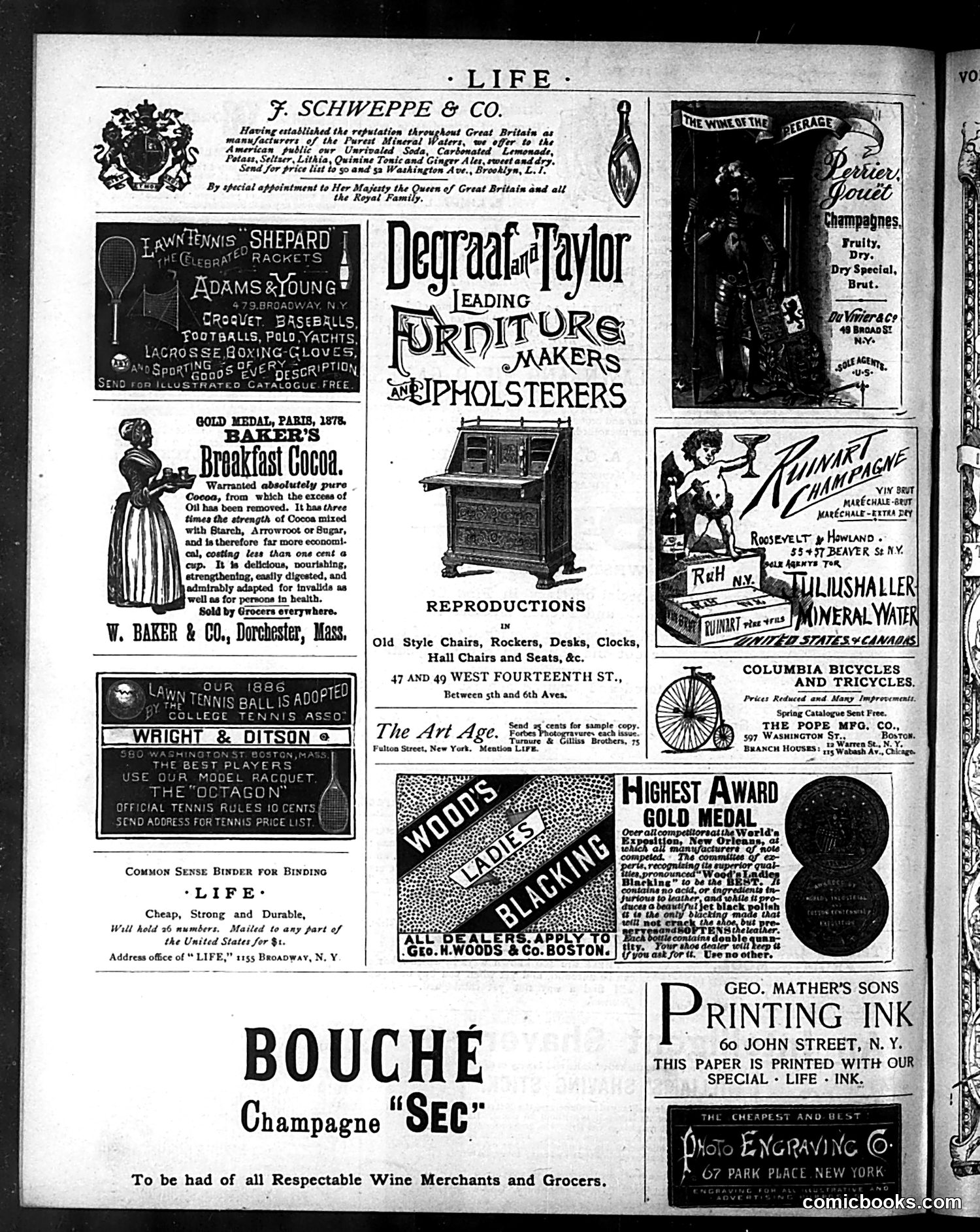
This appears to be primarily an **advertisement page** rather than satirical content. It features various Victorian-era product endorsements, including: **Notable ads:** - Schweppe & Co. mineral waters (with royal appointment) - Breakfast Cocoa by W. Baker & Co. - Degraf and Taylor furniture makers - Tennis rackets and sporting goods - Bouché champagne - Various other luxury goods (printing ink, mineral water, bicycles) **What's striking to modern readers:** The heavy reliance on **royal patronage claims** ("By special appointment to Her Majesty") and **health claims** (cocoa's medicinal properties) as selling points. The advertisements emphasize purity, strength, and exclusivity—markers of middle-to-upper-class consumption in the Gilded Age. There is **no apparent political cartoon or satire** on this page. The content reflects how *Life* magazine monetized through advertising while serving affluent readers who could afford imported champagne and expensive furnishings.