
Life, 1886-05-20 · page 10 of 16
Life — May 20, 1886 — page 10: what you’re looking at
What you’re looking at
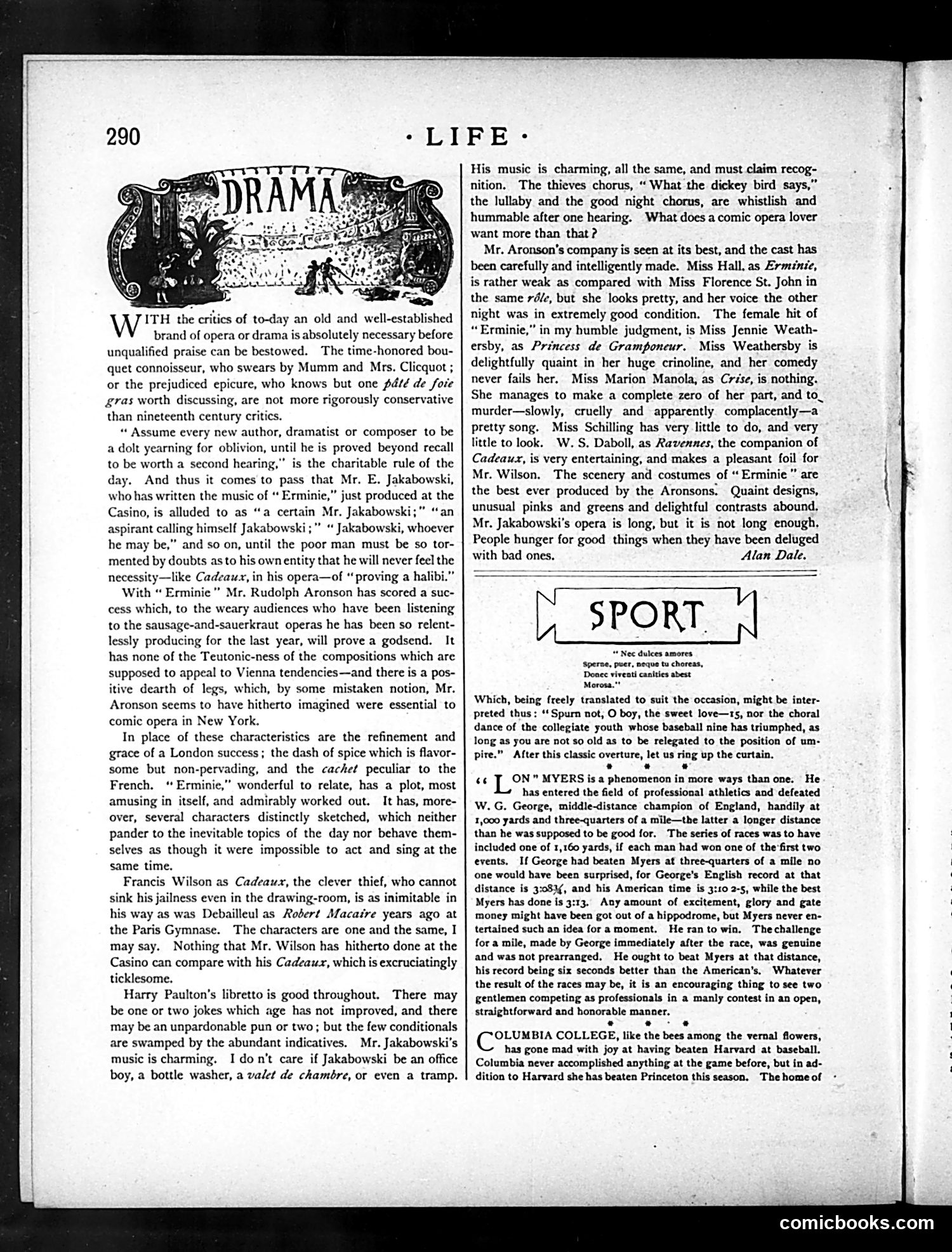
This is a theater review of the comic opera "Erminie," recently produced at the Casino theater. The critic praises composer E. Jakabowski and producer Rudolph Aronson for breaking from the tedious "sausage-and-sauerkraut" German operas that had dominated New York comic opera. The piece satirizes contemporary critics' prejudice against new artists—noting they assume unknowns are "dolts" until proven otherwise, dismissing Jakabowski as merely "a certain Mr. Jakabowski" or "whoever he may be." The review celebrates "Erminie" for its French refinement, witty plot, and charming music (praising the thieves' chorus and lullaby). It praises actor Francis Wilson's performance as the thief Cadeaux and commends most of the female cast, though it criticizes Marion Manola's performance as "nothing." The satire targets both critical snobbery and repetitive, low-quality opera production in New York theater.
📄 Transcribed text from this page (OCR, searchable)
Machine-transcribed from the original scan — historical spelling and the odd misread are preserved.
‘LIFE: ITH the critics of to-day an old and well-established brand of opera or drama is absolutely necessary before unqualified praise can be bestowed. The time-honored bou- quet connoisseur, who swears by Mumm and Mrs. Clicquot ; or the prejudiced epicure, who knows but one pdté de fore gras worth discussing, are not more rigorously conservative than nineteenth century critics. “ Assume every new author, dramatist or composer to be a dolt yearning for oblivion, until he is proved beyond recall to be worth a second hearing,” is the charitable rule of the day. And thus it comes to pass that Mr. E, Jakabowski, who has written the music of “ Erminie,” just produced at the Casino, is alluded to as “a certain Mr. Jakabowski aspirant calling himself Jakabowski ;"" “ Jakabowski, whoever he may be,” and so on, until the poor man must be so tor- mented by doubts as to his own entity that he will never feel the necessity—like Cadeaux, in his opera—of “ proving a halib With “ Erminie " Mr. Rudolph Aronson has scored a suc- cess which, to the weary audiences who have been listening to the sausage-and-sauerkraut operas he has been so relent- lessly producing for the last year, will prove a godsend. It has none of the Teutonic-ness of the compositions which are supposed to appeal to Vienna tendencies—and there is a pos- itive dearth of legs, which, by some mistaken notion, Mr. Aronson seems to have hitherto imagined were essential to comic opera in New York. In place of these characteristics are the refinement and grace of a London success; the dash of spice which is flavor- some but non-pervading, and the cachet peculiar to the French. ‘ Erminie,” wonderful to relate, has a plot, most amusing in itself, and admirably worked out. It has, more- over, several characters distinctly sketched, which neither pander to the inevitable topics of the day nor behave them- selves as though it were impossible to act and sing at the same time. Francis Wilson as Cadeaux, the clever thief, who cannot sink his jailness even in the drawing-room, is as inimitable in his way as was Debailleul as Robert Macaire years ago at the Paris Gymnase. The characters are one and the same, I may say. Nothing that Mr. Wilson has hitherto done at the Casino can compare with his Cadeauzx, which is excruciatingly ticklesome. Harry Paulton’s libretto is good throughout. There may be one or two jokes which age has not improved, and there may be an unpardonable pun or two; but the few conditionals are swamped by the abundant indicatives. Mr. Jakabowski’s music is charming. I don't care if Jakabowski be an office boy, a bottle washer, a valet de chambre, or even a tramp. His music is charming, all the same, and must claim recog- nition. The thieves chorus, ‘“ What the dickey bird says,” the lullaby and the good night chorus, are whistlish and hummable after one hearing. What does a comic opera lover want more than that ? Mr. Aronson’s company is seen at its best, and the cast has been carefully and intelligently made. Miss Hall, as Erminie, is rather weak as compared with Miss Florence St. John in the same ré/e, but she looks pretty, and her voice the other night was in extremely good condition. The female hit of “Erm ’ in my humble judgment, is Miss Jennie Weath- ersby, as Princess de Gramponeur. Miss Weathersby is delightfully quaint in her huge crinoline, and her comedy never fails her. Miss Marion Manola, as Crése, is nothing. She manages to make a complete zero of her part, and to_ murder—slowly, cruelly and apparently complacently—a pretty song. Miss Schilling has very little to do, and very little to look. W. S, Daboll, as Ravennes, the companion of Cadeaux, is very entertaining, and makes a pleasant foil for Mr. Wilson. The scenery and costumes of “ Erminie” are the best ever produced by the Aronsons. Quaint designs, unusual pinks and greens and delightful contrasts abound, Mr. Jakabowski’s opera is long, but it is not long enough. People hunger for good things when they have been deluged with bad ones. Alan Dale, SPORT + Nec dulces amores Sperne, peer, neque tu choreas, Donec viventi canities abest Morosa."* Which, being freely translated to suit the occasion, might be inter- preted thus: “Spurn not, O boy, the sweet love—rs, nor the choral dance of the collegiate youth whose baseball nine has triumphed, as long as you are not so old as to be relegated to the position of um- pire.” After this classic overture, let us ring up the curtain, oe ¢¢ T ON” MYERS isa phenomenon in more ways thanone. He has entered the field of professional athletics and defeated W. G. George, middle-distance champion of England, handily at 1,000 yards and three-quarters of a mile—the latter a longer distance than he was supposed to be good for. The series of races was to have included one of 1,160 yards, if each man had won one of the'first two events. If George had beaten Myers at three-quarters of a mile no one would have been surprised, for George's English record at that distance is 3:083/, and his American time is 3:10 2-5, while the best Myers has done is 3:13. Any amount of excitement, glory and gate money might have been got out of a hippodrome, but Myers never en- tertained such an idea fora moment. He ranto win. Thechallenge for a mile, made by George immediately after the race, was genuine and was not prearranged. He ought to beat Myers at that distance, his record being six seconds better than the American's. Whatever the result of the races may be, it is an encouraging thing to see two gentlemen competing as professionals in a manly contest in an open, straightforward and honorable manner. * ce OLUMBIA COLLEGE, like the bees among the vernal flowers, has gone mad with joy at having beaten Harvard at baseball. Columbia never accomplished anything at the game before, but in ad- dition to Harvard she has beaten Princeton this season. The home of comicbooks.com