
Life, 1886-05-20 · page 2 of 16
Life — May 20, 1886 — page 2: what you’re looking at
What you’re looking at
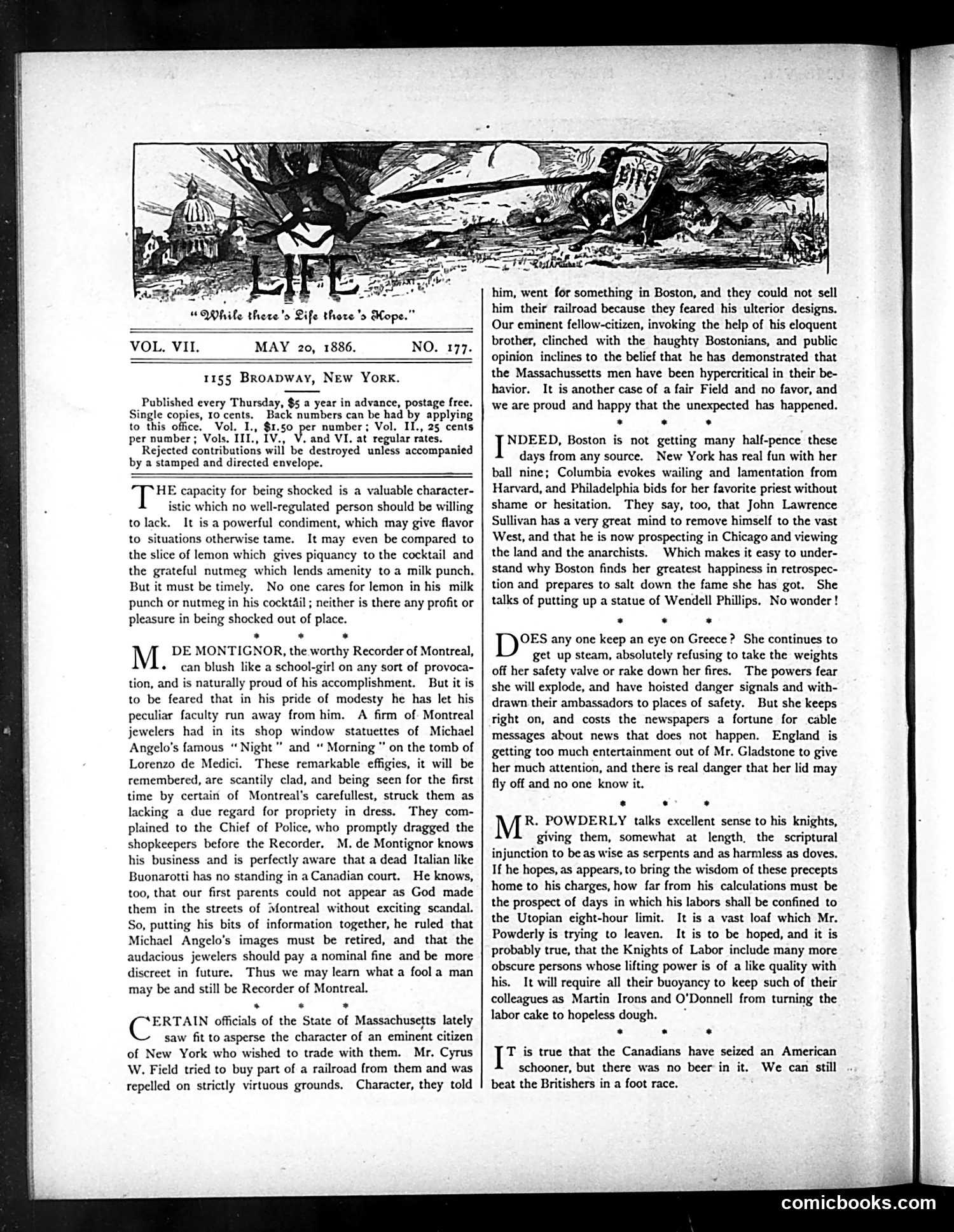
The masthead cartoon "While there's Life there's Hope" depicts allegorical figures representing Life itself—likely personifying American optimism and resilience during the Gilded Age. The page's text consists of brief satirical commentary on contemporary issues: criticism of Boston's provincial attitudes toward New York business ventures; mockery of Boston's self-satisfied nostalgia; commentary on a steamship (appears to be British) refusing safety precautions; and discussion of labor movement rhetoric from "Mr. Powderly" (likely Terence Powderly, leader of the Knights of Labor), critiquing the movement's utopian messaging while acknowledging genuine worker hardship. The tone is urbane, often mocking provincial sensibilities while engaging seriously with labor tensions of the era.
📄 Transcribed text from this page (OCR, searchable)
Machine-transcribed from the original scan — historical spelling and the odd misread are preserved.
“Dhile there's Life there's Hope.” MAY 20, 1886. NO. 177. VOL. VII. 1155 Broapway, New York. Published every Thursday, $5 a year in advance, postage free. Single copies, ro cents. Back numbers can be had by applying to this office. Vol. I., $1.50 per number; Vol. II., 25 cents per number; Vols, III., IV., V. and VI. at regular rates. Rejected contributions will be destroyed unless accompanied by a stamped and directed envelope. HE capacity for being shocked is a valuable character- istic which no well-regulated person should be willing to lack. It is a powerful condiment, which may give flavor to situations otherwise tame. It may even be compared to the slice of lemon which gives piquancy to the cocktail and the grateful nutmeg which lends amenity toa milk punch. But it must be timely. No one cares for lemon in his milk punch or nutmeg in his cocktail; neither is there any profit or pleasure in being shocked out of place. . . . DE MONTIGNOR, the worthy Recorder of Montreal, + can blush like a school-girl on any sort of provoca- tion, and is naturally proud of his accomplishment. But it is to be feared that in his pride of modesty he has let his peculiar faculty run away from him. A firm of. Montreal jewelers had in its shop window statuettes of Michael Angelo’s famous “Night” and “ Morning ” on the tomb of Lorenzo de Medici. These remarkable effigies, it will be remembered, are scantily clad, and being seen for the first time by certain of Montreal's carefullest, struck them as lacking a due regard for propriety in dress. They com- plained to the Chief of Police, who promptly dragged the shopkeepers before the Recorder. M. de Montignor knows his business and is perfectly aware that a dead Italian like Buonarotti has no standing in a Canadian court. He knows, too, that our first parents could not appear as God made them in the streets of Montreal without exciting scandal. So, putting his bits of information together, he ruled that Michael Angelo’s images must be retired, and that the audacious jewelers should pay a nominal fine and be more discreet in future. Thus we may learn what a fool a man may be and still be Recorder of Montreal. . . . ERTAIN officials of the State of Massachusetts lately saw fit to asperse the character of an eminent citizen of New York who wished to trade with them. Mr. Cyrus W. Field tried to buy part of a railroad from them and was repelled on strictly virtuous grounds, Character, they told him, went for something in Boston, and they could not sell him their railroad because they feared his ulterior designs. Our eminent fellow-citizen, invoking the help of his eloquent brother, clinched with the haughty Bostonians, and public opinion inclines to the belief that he has demonstrated that the Massachussetts men have been hypercritical in their be- havior. It is another case of a fair Field and no favor, and we are proud and happy that the unexpected has happened. . . . [RBEEP: Boston is not getting many half-pence these days from any source. New York has real fun with her ball nine; Columbia evokes wailing and lamentation from Harvard, and Philadelphia bids for her favorite priest without shame or hesitation. They say, too, that John Lawrence Sullivan has a very great mind to remove himself to the vast West, and that he is now prospecting in Chicago and viewing the land and the anarchists. Which makes it easy to under- stand why Boston finds her greatest happiness in retrospec- tion and prepares to salt down the fame she has got. She talks of putting up a statue of Wendell Phillips. No wonder! . . * OES any one keep an eye on Greece? She continues to get up steam, absolutely refusing to take the weights off her safety valve or rake down her fires. The powers fear she will explode, and have hoisted danger signals and with- drawn their ambassadors to places of safety. But she keeps right on, and costs the newspapers a fortune for cable messages about news that does not happen. England is getting too much entertainment out of Mr. Gladstone to give her much attention, and there is real danger that her lid may fly off and no one know it. * . . R. POWDERLY talks excellent sense to his knights, giving them, somewhat at length, the scriptural injunction to be as wise as serpents and as harmless as doves. If he hopes, as appears, to bring the wisdom of these precepts home to his charges, how far from his calculations must be the prospect of days in which his labors shall be confined to the Utopian eight-hour limit. It is a vast loaf which Mr. Powderly is trying to leaven. It is to be hoped, and it is probably true, that the Knights of Labor include many more obscure persons whose lifting power is of a like quality with his. It will require all their buoyancy to keep such of their colleagues as Martin Irons and O'Donnell from turning the labor cake to hopeless dough. . . . T is true that the Canadians have seized an American schooner, but there was no beer in it. We can still beat the Britishers in a foot race. comicbooks.com