
Life, 1886-05-20 · page 4 of 16
Life — May 20, 1886 — page 4: what you’re looking at
What you’re looking at
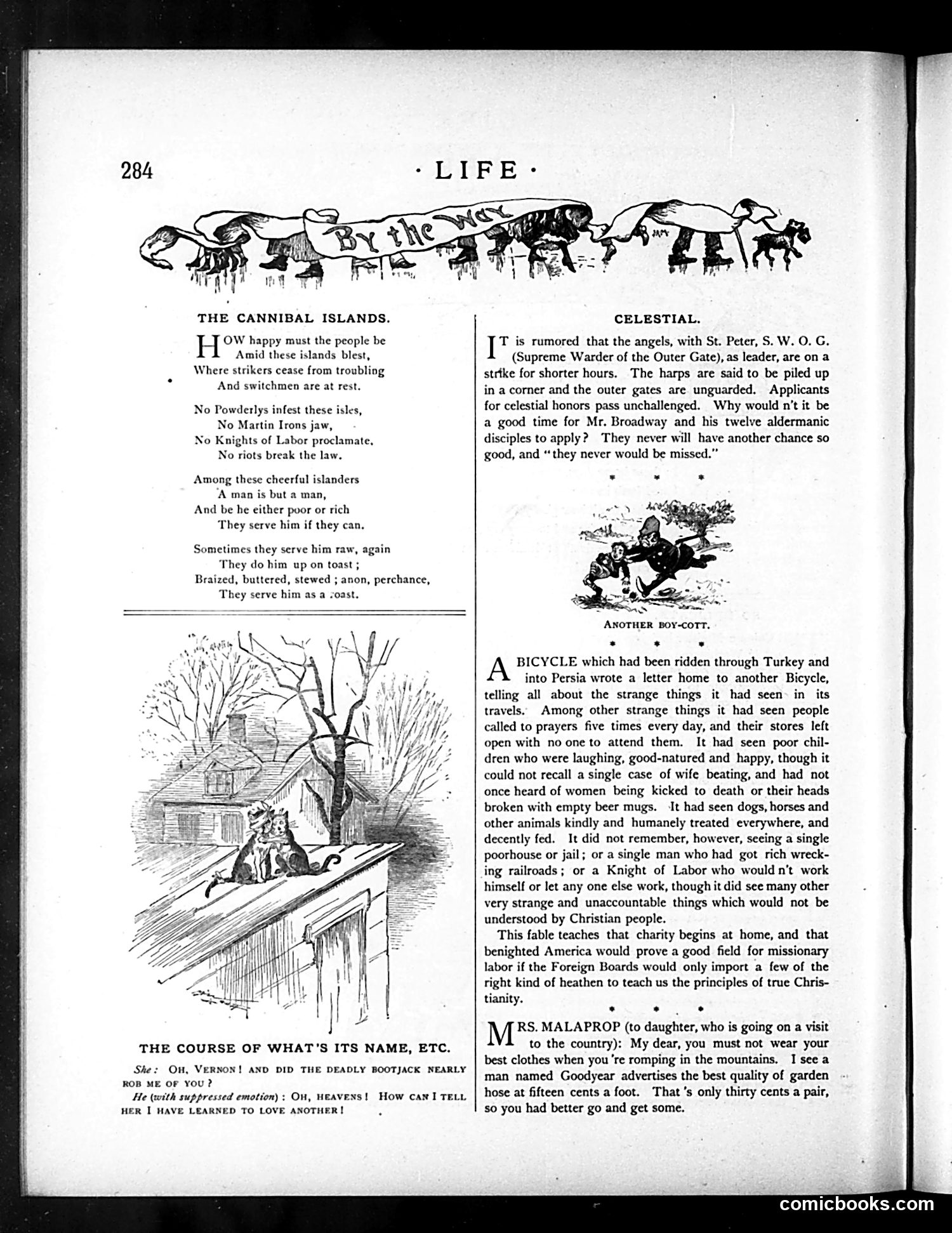
This page contains three separate satirical pieces: **"The Cannibal Islands"** (left): A poem mocking the Cannibal Islands as a utopia free of social problems—no poverty, labor disputes, or civil unrest. The satire suggests American society suffers from these issues while the "savage" islands don't. **"Celestial"** (upper right): Humorous commentary on heaven's bureaucracy, joking that angels and St. Peter work shorter hours and harps sit unused, with a jab at Broadway impresarios and "aldermanic disciples." **"Another Boy-Cott"** (center right): A story about a bicycle traveling through Turkey and Persia, contrasting foreign lands' treatment of animals and poor people favorably against American conditions—the "charity begins at home" moral criticizing American missionary efforts abroad while domestic poverty persists.
📄 Transcribed text from this page (OCR, searchable)
Machine-transcribed from the original scan — historical spelling and the odd misread are preserved.
THE CANNIBAL ISLANDS. } OW happy must the people be Amid these islands blest, Where strikers cease from troubling And switchmen are at rest. No Powderlys infest these isles, No Martin Irons jaw, No Knights of Labor proclamate, No riots break the law. Among these cheerful islanders A man is but a man, And be he either poor or rich They serve him if they can, Sometimes they serve him raw, again They do him up on toast ; THE COURSE OF WHAT'S ITS NAME, ETC. She: OW, VERNON! AND DID THE DEADLY BOOTJACK NEARLY ROB ME OF YOU? He (with suppressed emotion): ON, HEAVENS! How CAN I TELL HER I HAVE LEARNED TO LOVE ANOTHER! CELESTIAL. J" is rumored that the angels, with St. Peter, S. W. O. G. (Supreme Warder of the Outer Gate), as leader, are on a strike for shorter hours. The harps are said to be piled up in a corner and the outer gates are unguarded. Applicants for celestial honors pass unchallenged. Why would n’t it be a good time for Mr. Broadway and his twelve aldermanic disciples to apply? They never will have another chance so good, and “they never would be missed.” Sn ANOTHER BOY-COTT. * * . BICYCLE which had been ridden through Turkey and into Persia wrote a letter home to another Bicycle, telling all about the strange things it had seen: in its travels. Among other strange things it had seen people called to prayers five times every day, and their stores left open with no one to attend them. It had seen poor chil- dren who were laughing, good-natured and happy, though it could not recall a single case of wife beating, and had not once heard of women being kicked to death or their heads broken with empty beer mugs. It had seen dogs, horses and other animals kindly and humanely treated everywhere, and decently fed. It did not remember, however, seeing a single poorhouse or jail; or a single man who had got rich wreck- ing railroads; or a Knight of Labor who wouldn't work himself or let any one else work, though it did see many other very strange and unaccountable things which would not be understood by Christian people. This fable teaches that charity begins at home, and that benighted America would prove a good field for missionary labor if the Foreign Boards would only import a few of the right kind of heathen to teach us the principles of true Chris- tianity. . PPinieeQ RS. MALAPROP (to daughter, who is going on a visit to the country): My dear, you must not wear your best clothes when you ‘re romping in the mountains. I see a man named Goodyear advertises the best quality of garden hose at fifteen cents a foot. That's only thirty cents a pair, so you had better go and get some. comicbooks.com