
A complete issue · 16 pages · 1886
Life — February 18, 1886
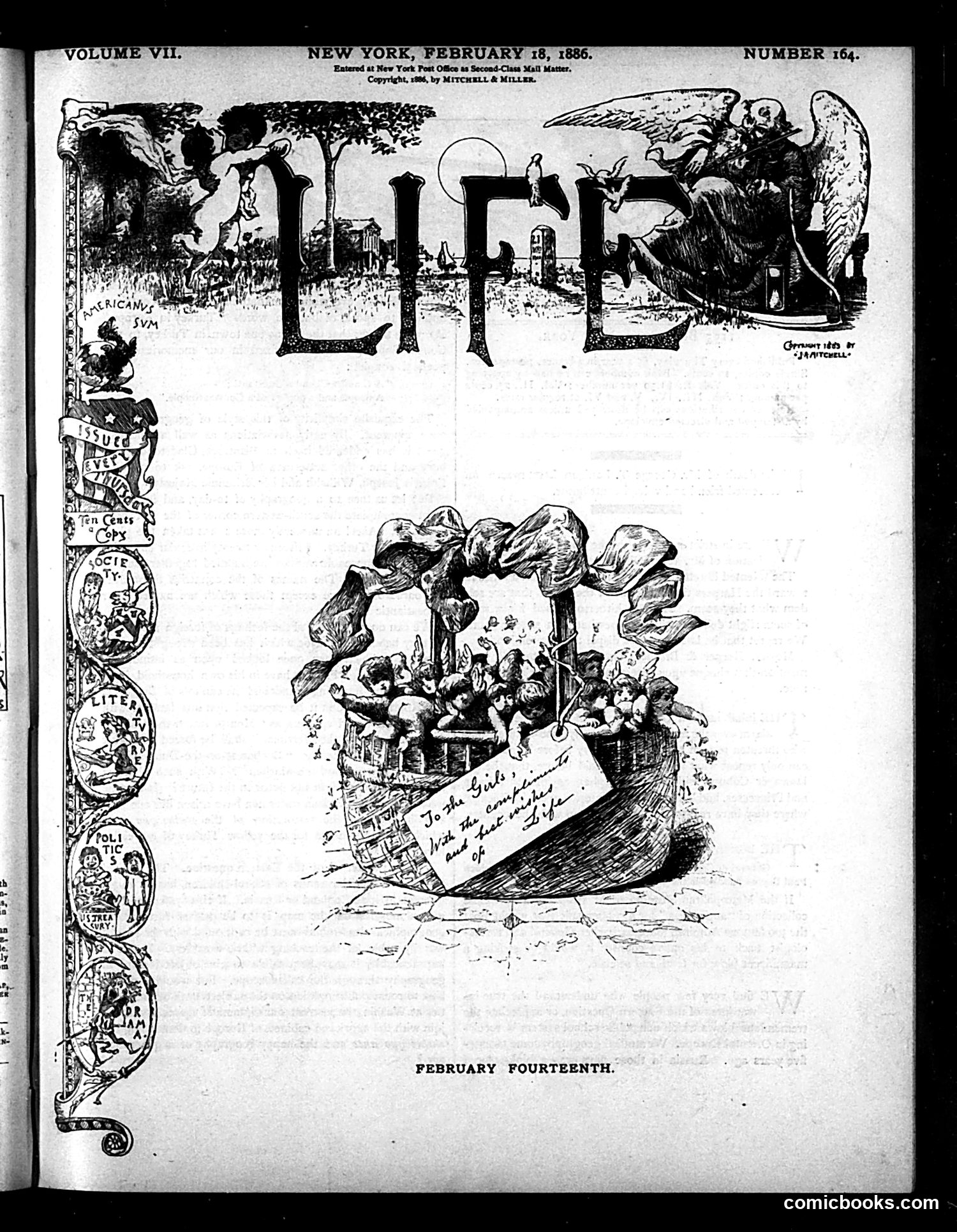
This page features a Valentine's Day theme ("February Fourteenth" at bottom). The main illustration depicts a large valentine envelope or card overflowing with cherubs and celebratory figures, with a banner reading text that appears to reference a gift or romantic gesture. The decorative left border contains small circular vignettes with classical and allegorical scenes, typical of Life's ornamental design style. The magazine's masthead and title artwork at top show pastoral and mythological imagery. Without clearer OCR text identifying specific political figures or events referenced, the precise satirical target remains unclear. However, the valentine format suggests this may be commenting on romantic or social customs of 1886 New York society, or possibly a political figure being humorously "courted" through holiday sentiment.
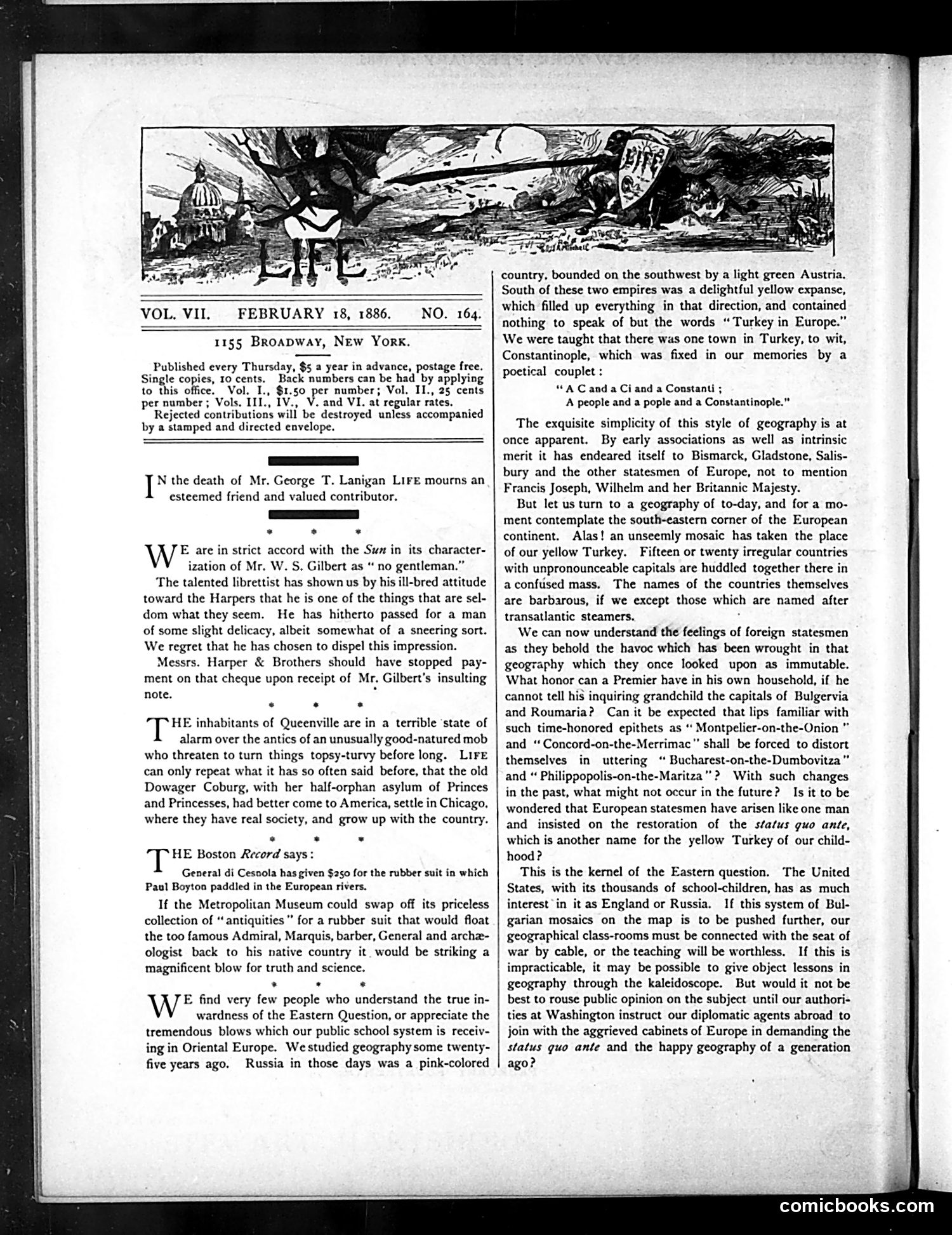
The page contains editorial commentary rather than political cartoons. The masthead illustration shows a classical scene with a moon and architectural elements. The text addresses the "Eastern Question"—the geopolitical instability in Ottoman Turkey and Eastern Europe. The editors critique American geography education, arguing that outdated textbooks (using 25-year-old maps where "Russia was a pink-colored country") fail to help students understand current international conflicts. They reference Constantinople, Bulgaria, Hungary, and Romania—disputed territories central to 19th-century European power struggles. The satire targets public ignorance: Americans cannot understand contemporary diplomacy regarding Turkish decline without updated geographical knowledge. The editors suggest the State Department should educate diplomats and the public about actual territorial realities shaping European politics.
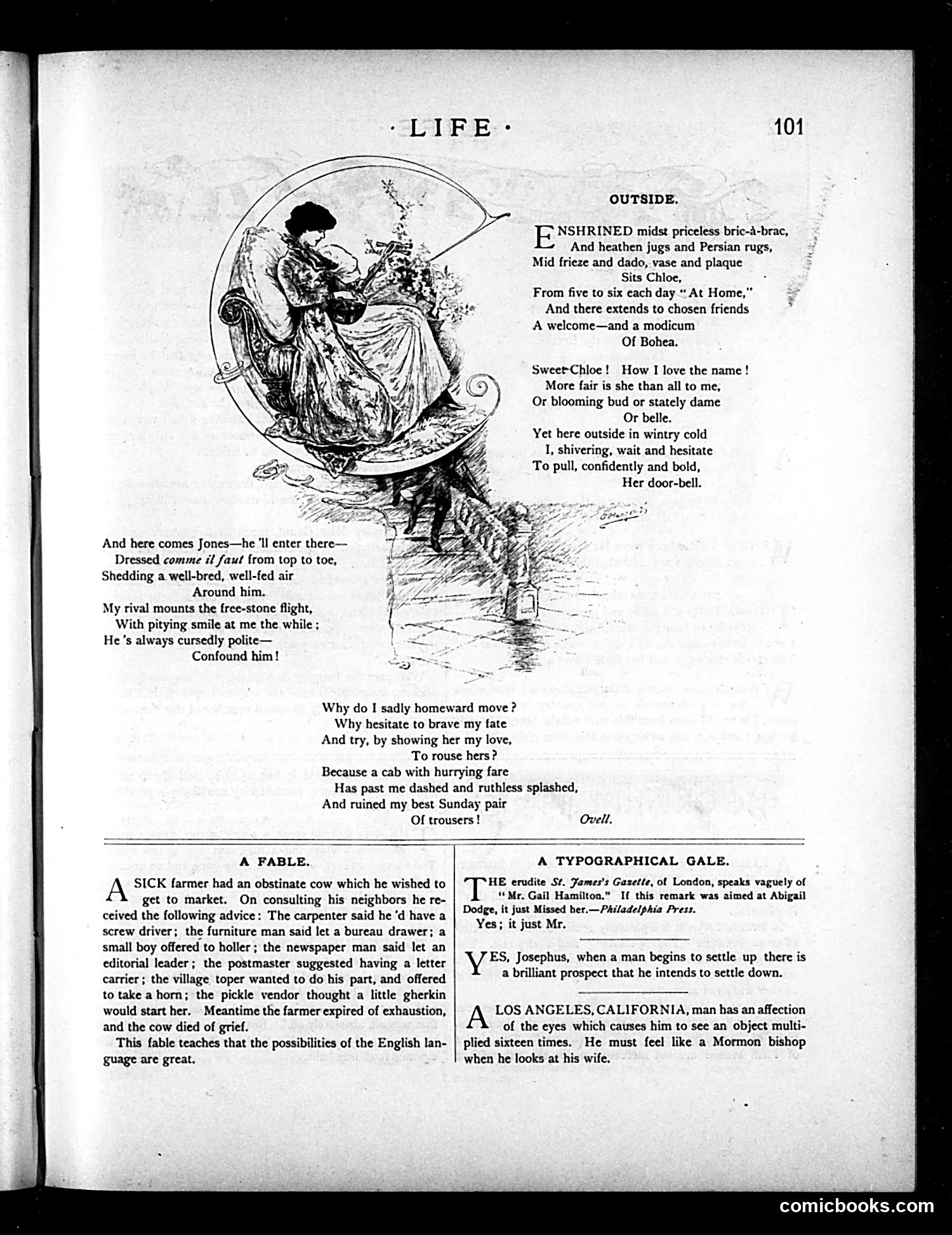
The page contains three distinct pieces: **"Outside"** (top): A poem about visiting someone named Chloe, featuring an illustration of a woman in classical dress sitting in a crescent moon. The speaker describes hesitating to ring her doorbell, then mentions Jones arriving "dressed comme il faut" (fashionably). The poem concludes with the speaker frustrated after a cab splashed mud on his Sunday trousers. This appears to be light romantic/social satire about courtship etiquette and urban inconveniences. **"A Fable"** (bottom left): A brief tale mocking the English language's versatility. A farmer seeking to market an obstinate cow receives contradictory advice from various professionals (carpenter, bureau drawer, newspaper editor, etc.), each suggesting their specialized jargon. The cow dies of grief. The satire targets over-specialization and obfuscating professional language. **"A Typographical Gale"** (bottom right): Three humorous notices about people with unusual characteristics or predicaments—likely satirizing absurd personal advertisements or social notices.
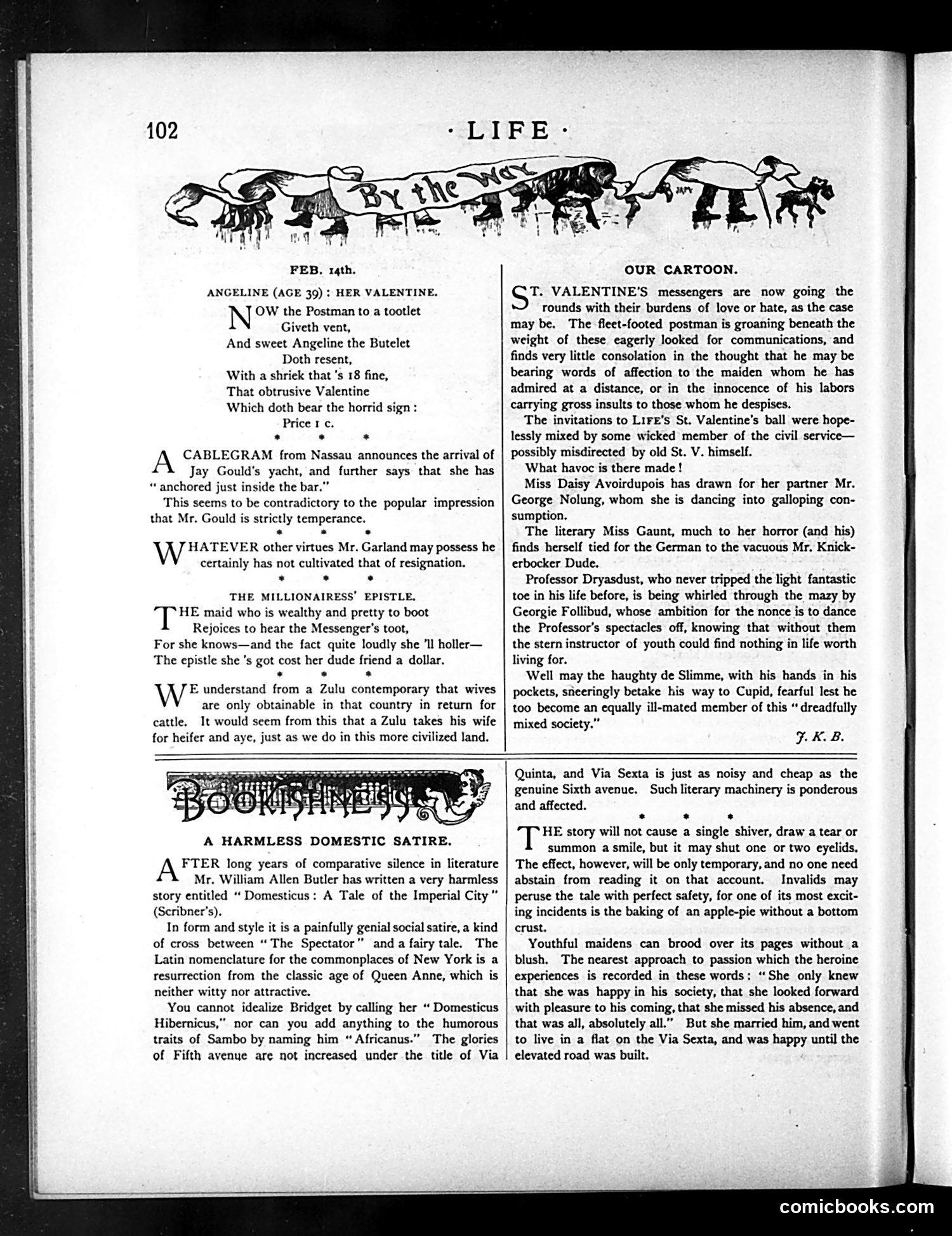
This page contains Valentine's Day-themed satirical content from early 20th-century Life magazine. The left column features short poems and witty observations mocking various social figures: a wealthy woman ("Angeline"), a postman, and commentary on marriage customs among wealthy Americans and Zulu peoples. "Our Cartoon" on the right discusses St. Valentine's Day messengers and satirizes contemporary New York society figures, including "Miss Daisy Avoirdupois" and literary personalities. The satire targets pretentious behavior in high society—particularly misdirected romance and affected intellectualism. The "Domesticus" section reviews a book by William Allen Butler, using satirical Latin nomenclature to mock both the work and New York's social elite. The overall tone ridicules vanity, pretension, and romantic folly among the wealthy and culturally ambitious.
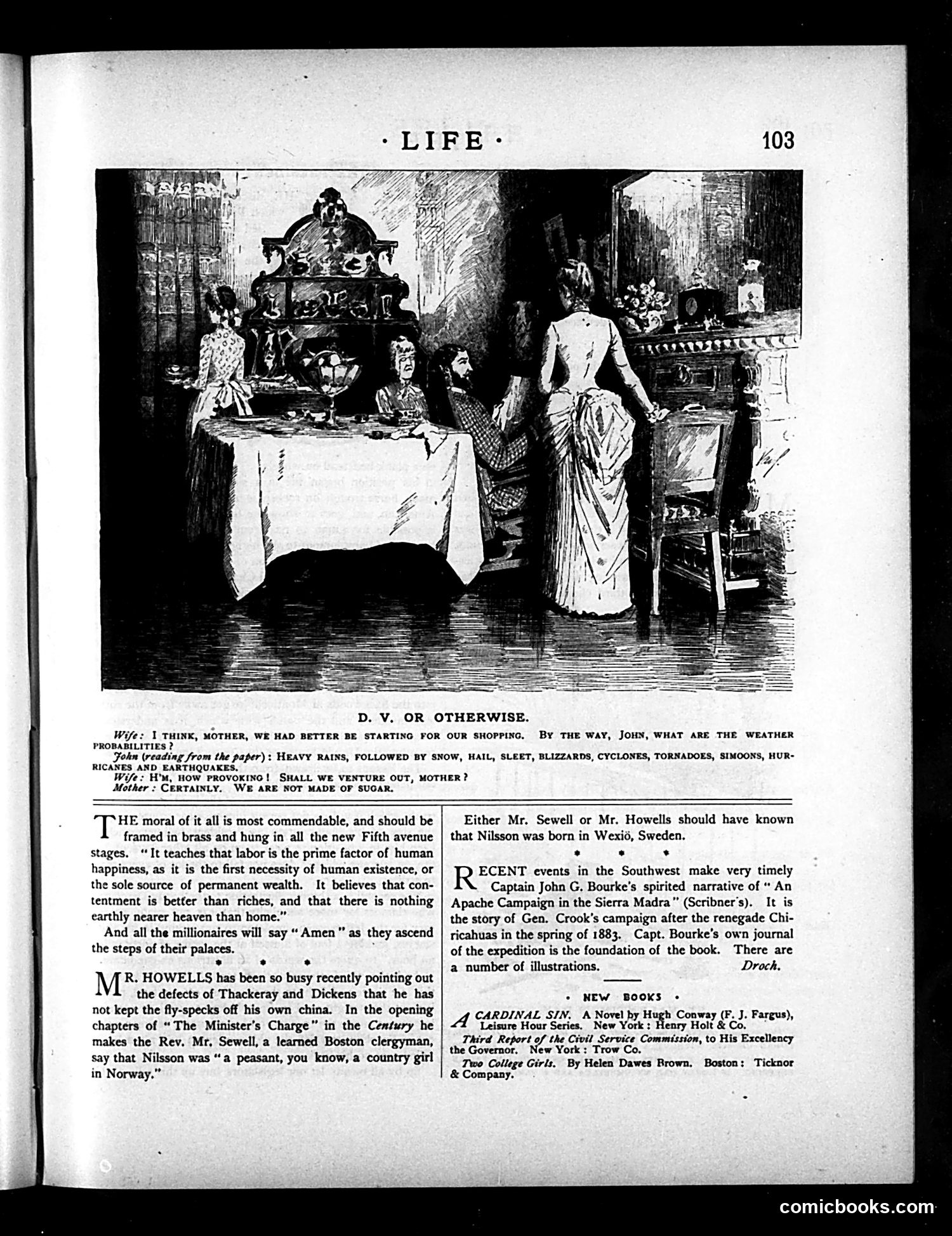
This cartoon satirizes upper-class anxieties about weather and travel. A well-dressed woman suggests to her mother that they should begin shopping, while a man (John) responds with an absurdly comprehensive list of catastrophic weather scenarios: "Heavy rains, followed by snow, hail, sleet, blizzards, cyclones, tornadoes, simoons, hurricanes." The joke targets wealthy society's tendency to find excuses for postponing activities. The elaborate meteorological doom—presented as inevitable—mocks both the dramatic pessimism of weather forecasts and the frivolous concerns of the leisure class. The title "D.V. Or Otherwise" (Latin: *Deo Volente*, "God willing") suggests that human plans are subject to divine or natural whim, making the woman's maternal certainty ("We are not made of sugar") the punchline's pragmatic counterpoint.
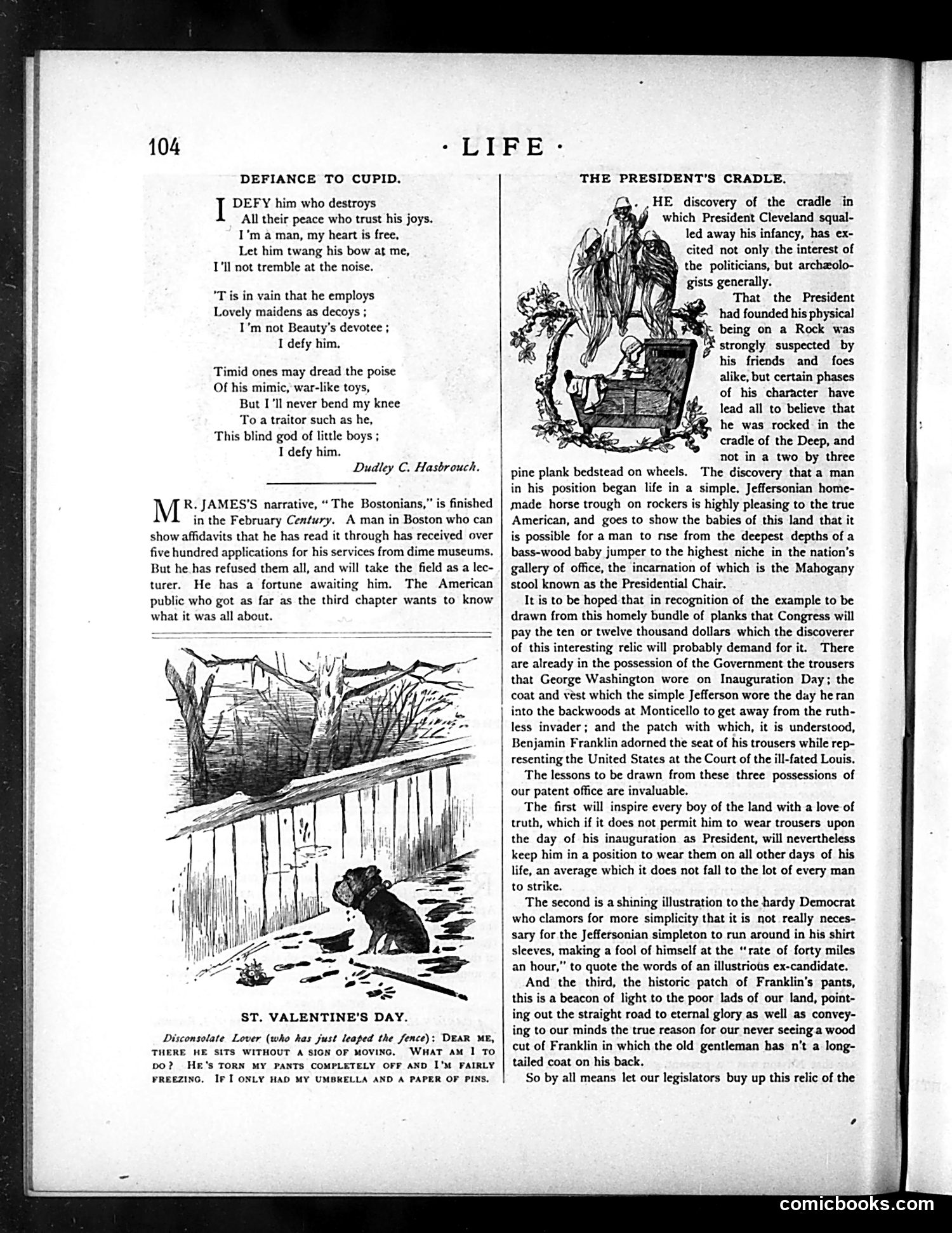
**"Defiance to Cupid"** is a poem asserting romantic independence—the speaker rejects Cupid's (love's) power, claiming masculine autonomy over sentiment. **"St. Valentine's Day"** cartoon depicts a disconsolate lover sitting outdoors in winter. The caption's humor derives from the lover's pitiful condition: he sits "without a sign of moving" while freezing, lacking even an umbrella or pins to hold his pants together. The joke plays on Valentine's Day as a romantic holiday, contrasting the lover's miserable, undignified state with romantic idealization. **"The President's Cradle"** discusses President Cleveland's childhood origins in modest circumstances—a pine plank bedstead on rockers. The text celebrates this as evidence that American social mobility allows even humble-born individuals to reach high office, using the cradle as a symbol of democratic potential.
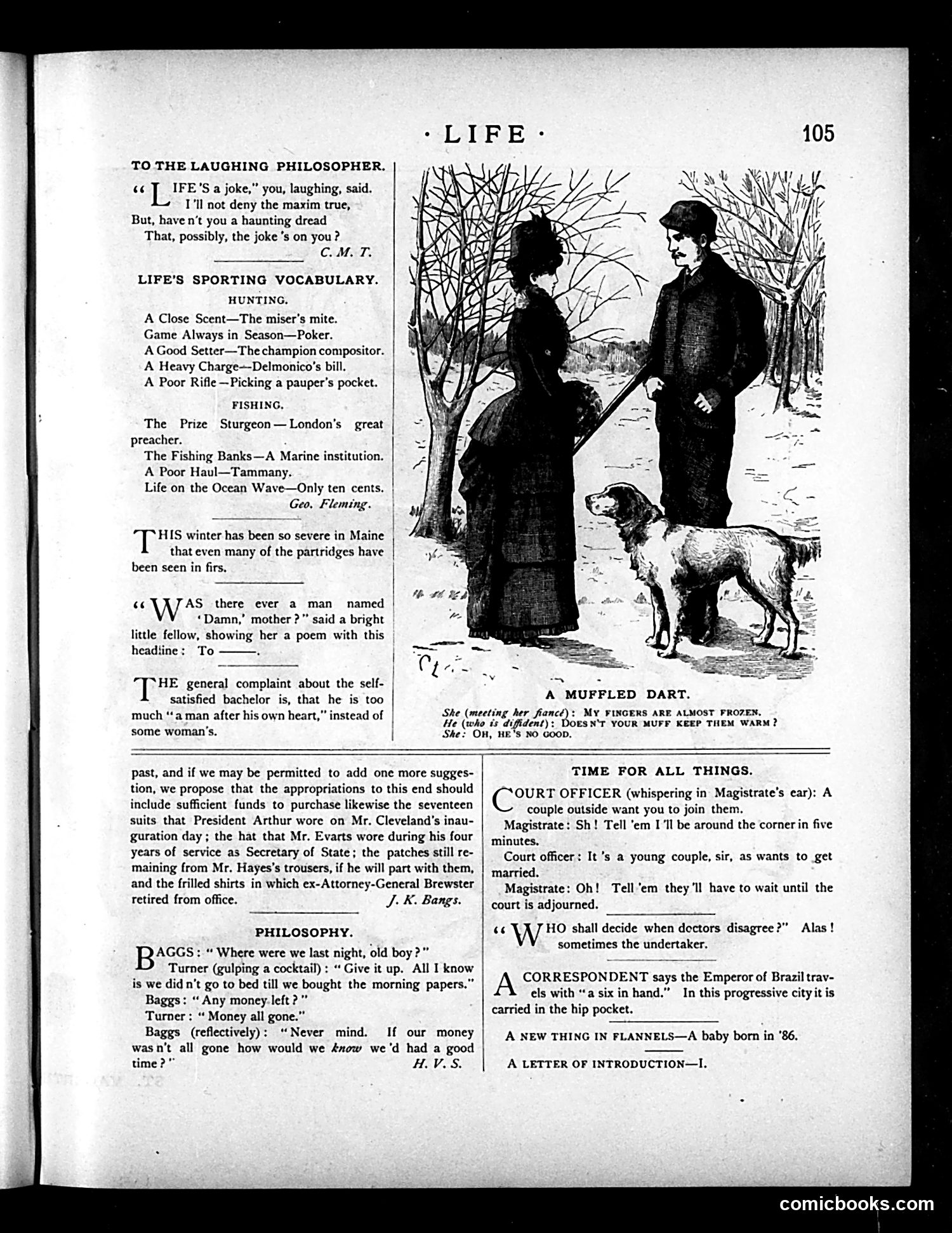
This cartoon satirizes courtship propriety in the Victorian/Edwardian era. Two well-dressed women encounter a man on a winter path with a dog. The caption presents their exchange: one woman remarks her "fingers are almost frozen," the other asks "Doesn't your muff keep them warm?" He replies "Oh, he's so good." The humor relies on double meaning: "muff" refers both to the cylindrical fur hand-warmer women wore and to the dog (a spaniel or similar breed). His innocent response about the dog's warmth creates an awkward misunderstanding, playing on era-typical prudishness about physical contact between unmarried people. The satire gently mocks both rigid social conventions and the suggestiveness lurking beneath polite conversation.
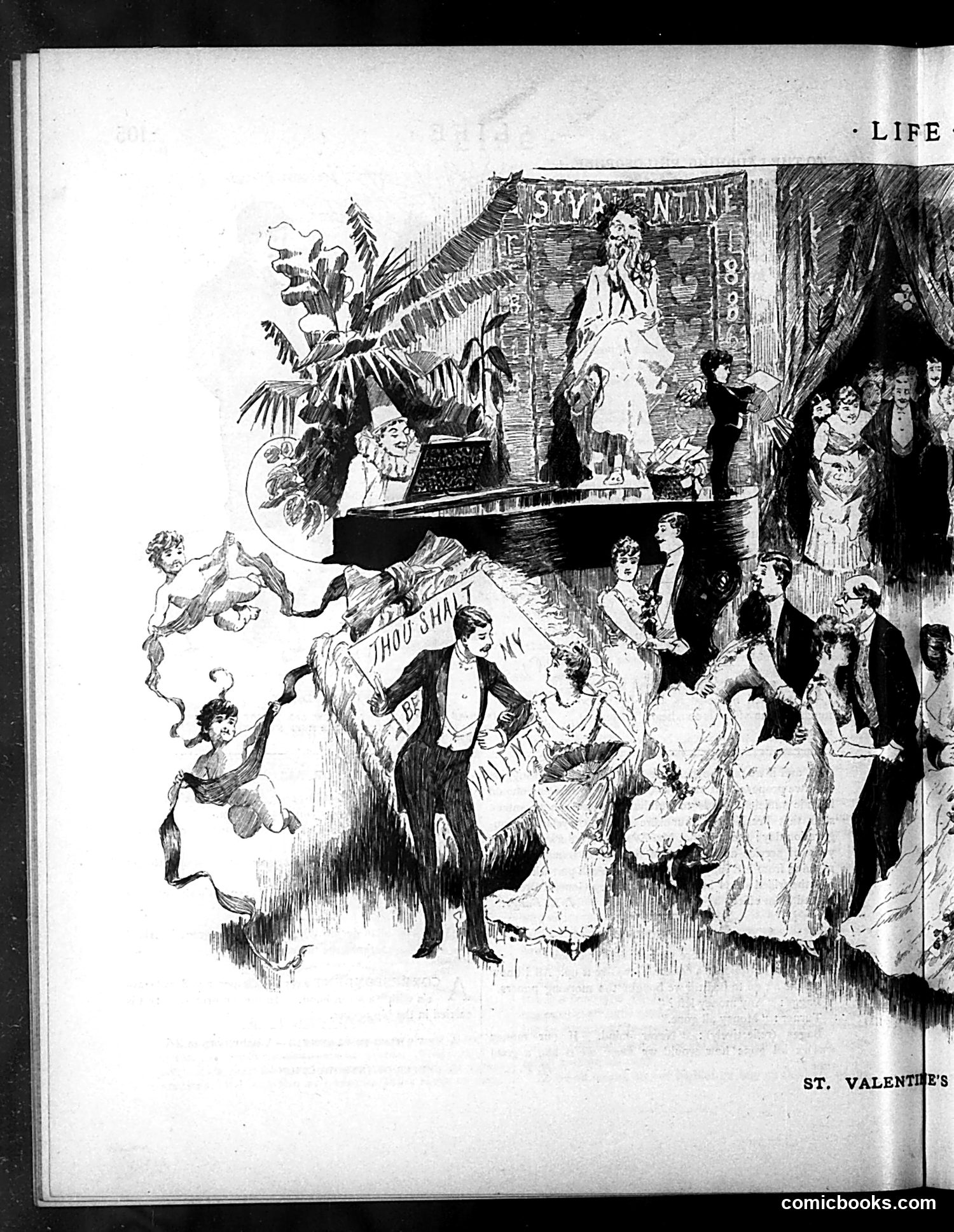
This Life magazine page depicts a fashionable St. Valentine's Day celebration, likely from the early 20th century. The illustration shows an elegant indoor social gathering with well-dressed attendees in formal attire. A theatrical stage or platform features performers, while cherubs (Cupids) float on the left side—traditional Valentine's Day imagery. The satire appears to mock upper-class romantic pretension and theatrical excess surrounding the holiday. The banner reading "THOU SHALT" (partially visible) suggests commentary on social expectations or romantic obligations. The contrast between the ornate stage setting and the crowd's reactions satirizes how commercialized and performative Valentine's celebrations had become among the wealthy elite. The overall composition critiques the artificiality of fashionable society's romantic displays.
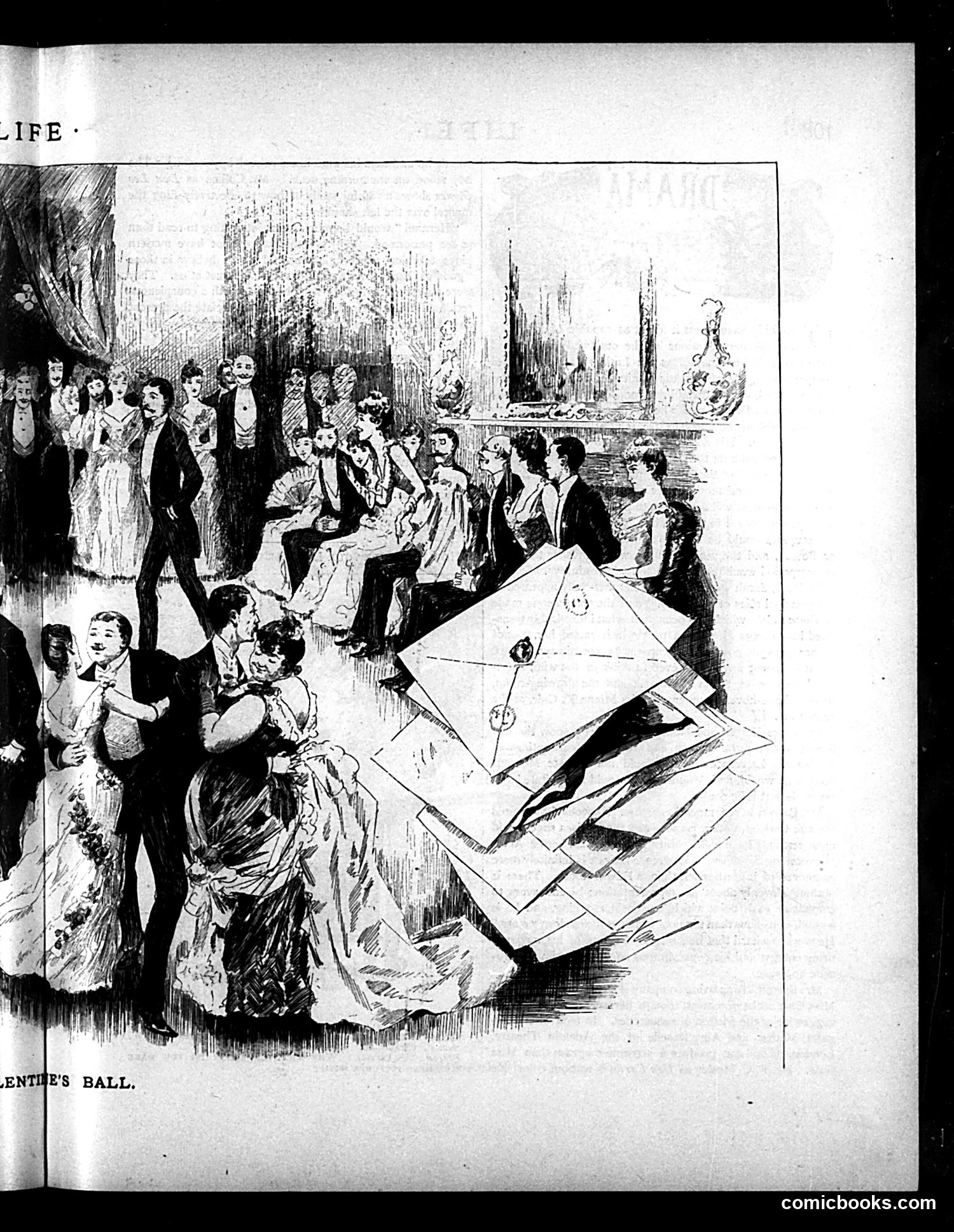
This satirical illustration titled "Valentine's Ball" depicts an elegant formal gathering where the central joke involves oversized love letters or valentines piled prominently in the foreground. The cartoon appears to mock the commercialization of Valentine's Day and the social practice of exchanging elaborate cards. The well-dressed attendees—depicted in formal attire typical of early 20th-century high society—surround these comically oversized envelopes as if they're the main attraction of the ball itself. The satire likely critiques how the holiday had become about material display and card-giving excess rather than genuine sentiment. The incongruous focus on the massive letters amid the formal social gathering creates the humorous effect—suggesting the superficiality of fashionable Valentine's Day celebrations among the wealthy elite.
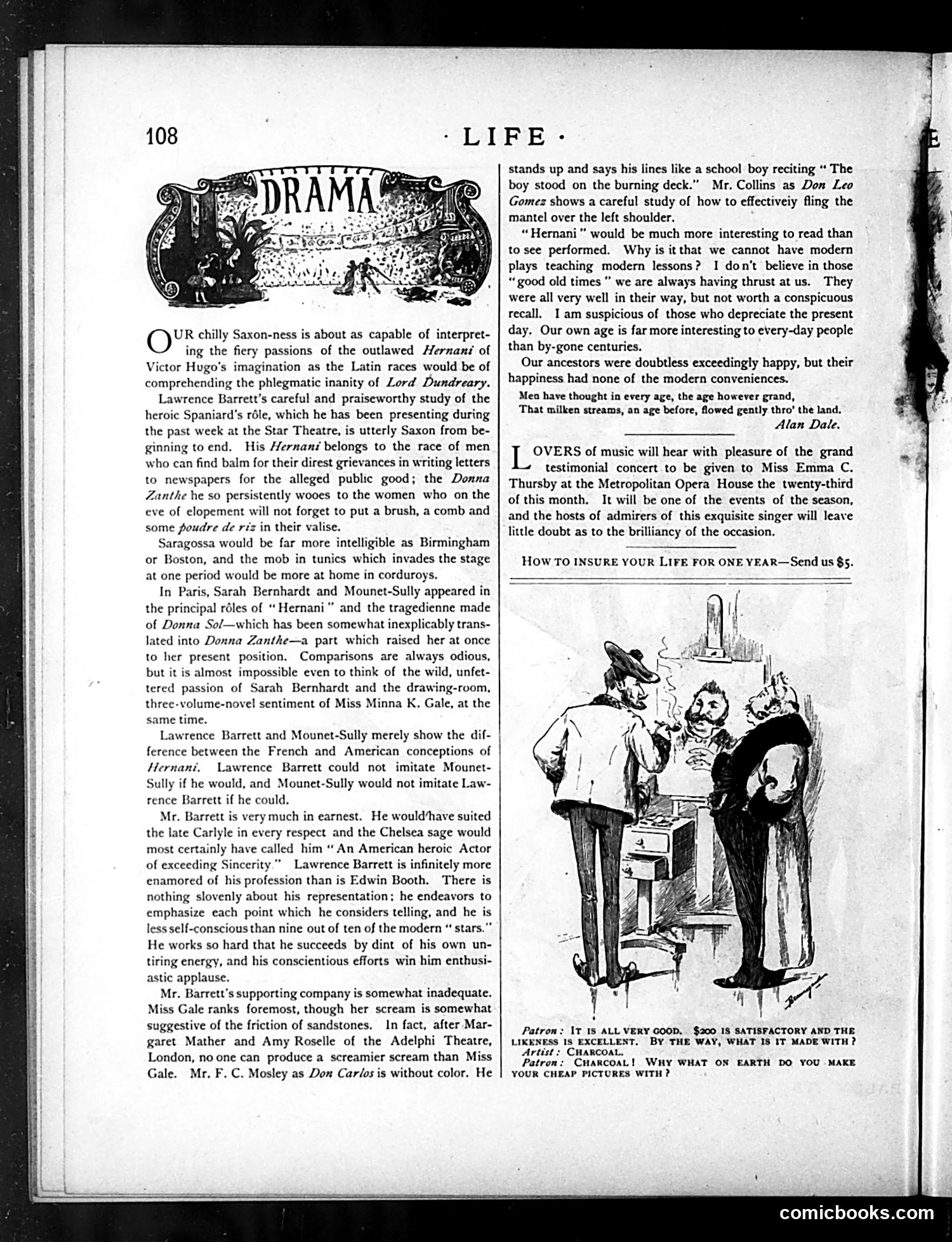
This page reviews Lawrence Barrett's theatrical production of Victor Hugo's *Hernani* at the Star Theatre. The critic (likely "Alan Dale," the era's prominent theater reviewer) contrasts Barrett's restrained, earnest American interpretation with the passionate French performances of Sarah Bernhardt and Mounet-Sully in Paris. The satire targets cultural differences: Barrett, described as "chilly Saxon," cannot capture the Spanish passion Hugo intended. The critic jokes that Barrett's supporting actors lack skill—Miss Gale's scream resembles "friction of sandstones," and other performers recite lines mechanically. The bottom cartoon depicts a patron praising a portrait's likeness and price ("$300 is satisfactory"), while the artist boasts it's made with charcoal. The patron mockingly asks why charcoal produces such cheap work, satirizing pretentious art-world pricing and the gap between materials and claimed artistic value.
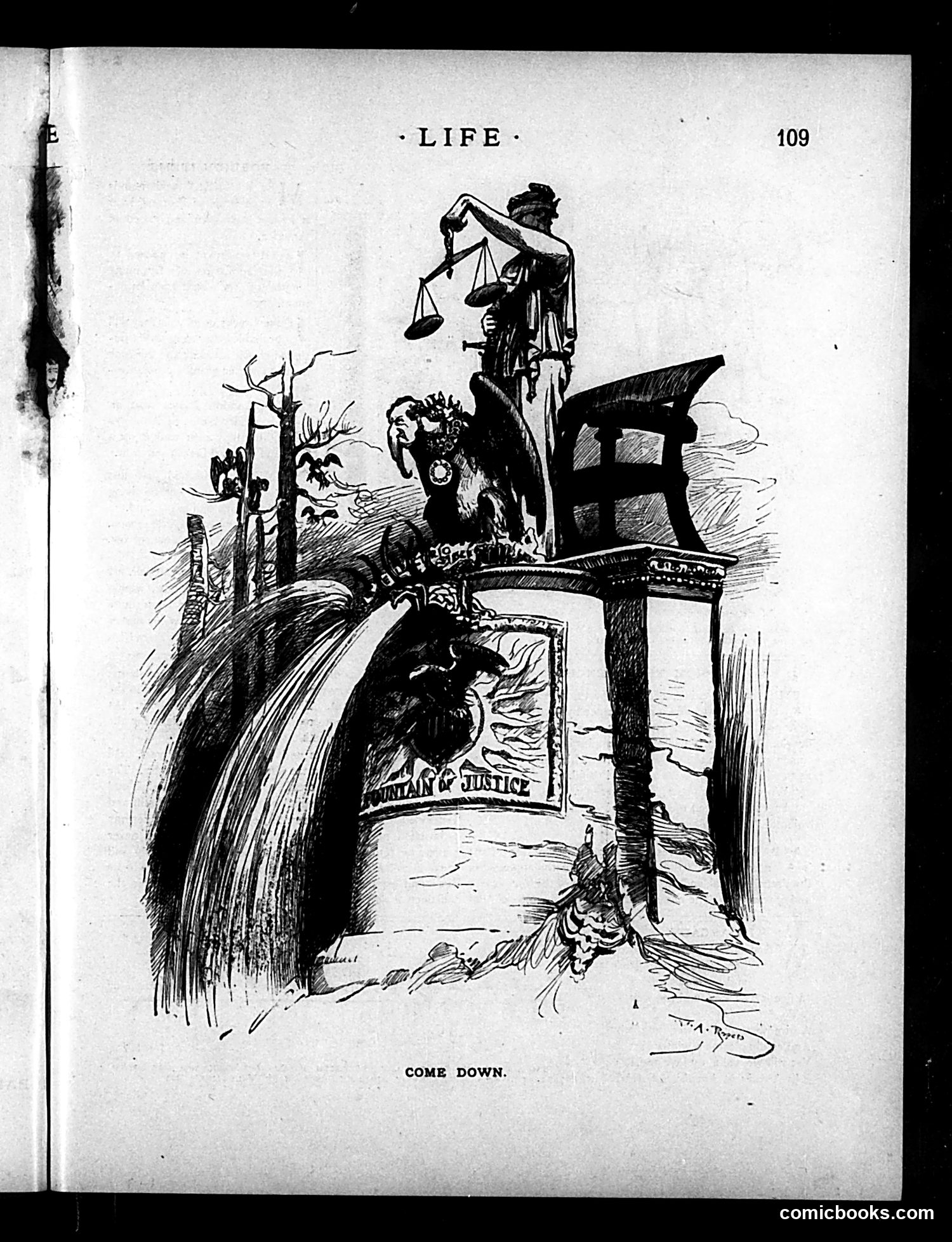
This satirical cartoon depicts Lady Justice (identifiable by the scales she holds) perched precariously atop a structure labeled "Fountain of Justice." Below her, a figure appears to be drowning or struggling in turbulent water. A skeletal or death-like figure looms nearby, while a barren, twisted tree suggests devastation. The cartoon's title "Come Down" appears to mock the gap between Justice's elevated, symbolic position and the actual chaos and suffering occurring below. The satire suggests that abstract ideals of justice remain remote and ineffective while real people suffer. The exact historical context is unclear without the publication date, but the imagery indicates criticism of judicial or institutional failure to protect or serve the public.
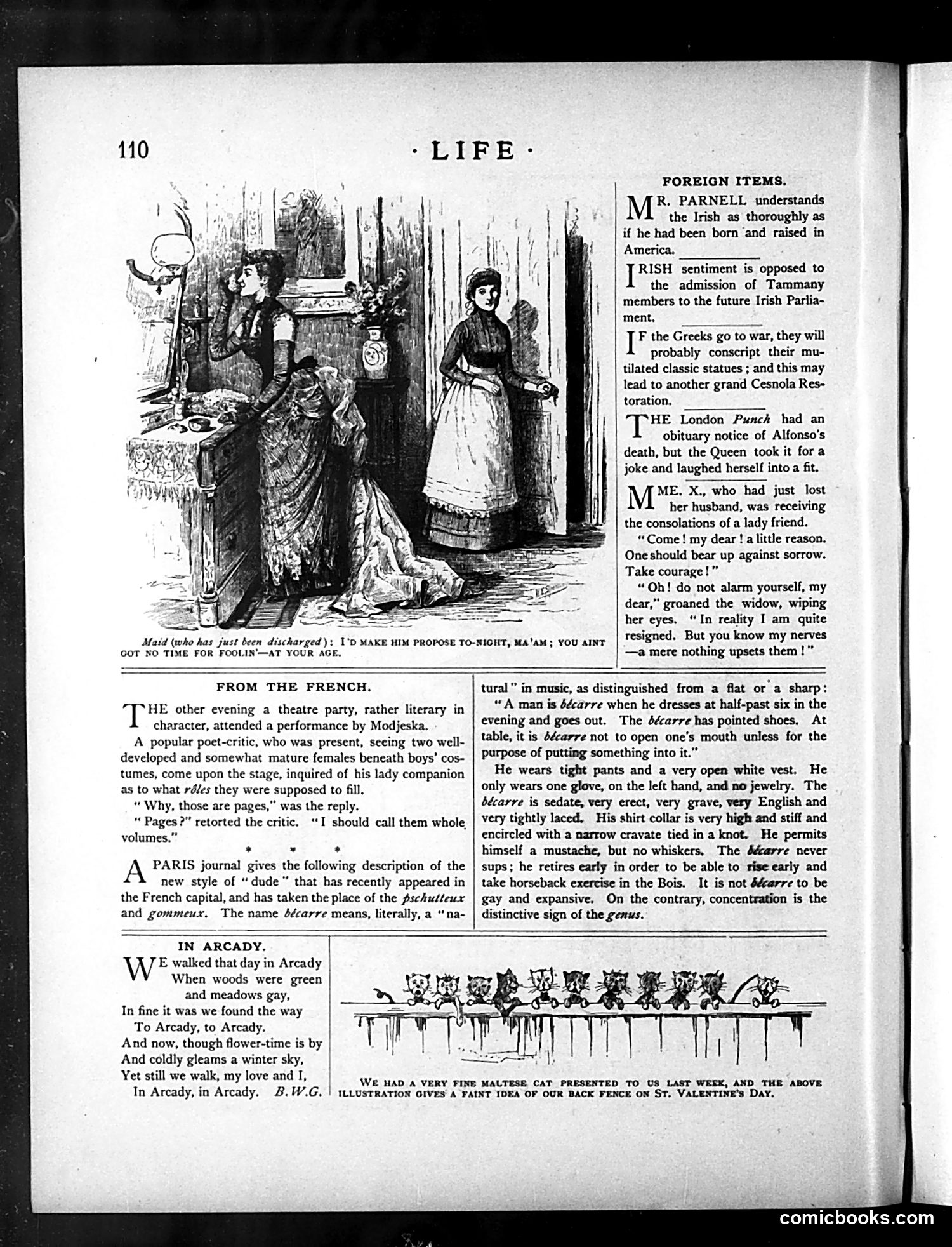
The main cartoon depicts a discharged maid advising her aging employer to pressure a man into proposing immediately—implying the woman's marriageability is rapidly expiring due to age. This satirizes both the precarious social position of unmarried women and the desperation that accompanies aging in Victorian society. The "Foreign Items" section offers brief satirical jabs: Irish politician Parnell is mocked for his Irish expertise despite American origins; a London *Punch* obituary about King Alfonso's death is so poorly written the Queen mistakes it for humor; and a widow claims her "nerves" prevent genuine grief, satirizing performative mourning. "From the French" describes a new Parisian dandy type—the *décarre*—who affects studied nonchalance through peculiar fashion choices (one glove, tight pants, severe deportment). The satire targets affectation and pretentious masculinity. The page concludes with nostalgic verse "In Arcady" and a humorous illustration of cats on a fence, likely referencing St. Valentine's Day romance.
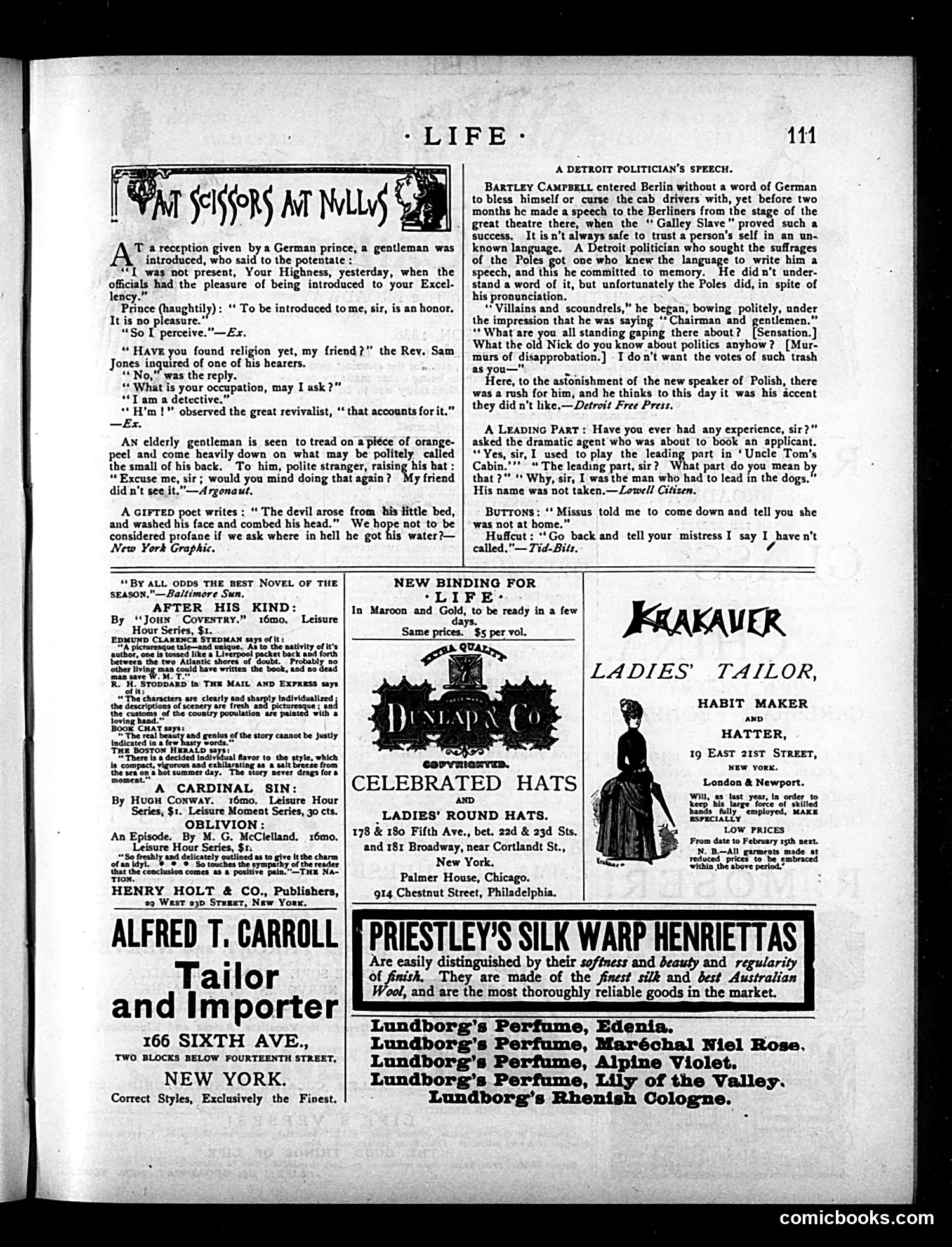
This page contains several brief humorous anecdotes. The main piece, "A Detroit Politician's Speech," satirizes a Polish-American politician who attempted to give a speech in Polish without understanding the language. His speechwriter provided the text phonetically, but the politician mispronounced it so badly that his opening words—intended as "Chairman and gentlemen"—came out as "Villains and scoundrels." The audience, understanding Polish properly, took offense and rushed him, apparently to attack him. The politician later attributed their reaction to his accent rather than the insulting content. The satire mocks both the politician's arrogance in attempting a language he didn't know and the incompetence of relying on phonetic memorization without comprehension. It's a commentary on political pandering to ethnic constituencies without genuine respect or preparation. The page is otherwise filled with book advertisements and other brief jokes on unrelated topics.
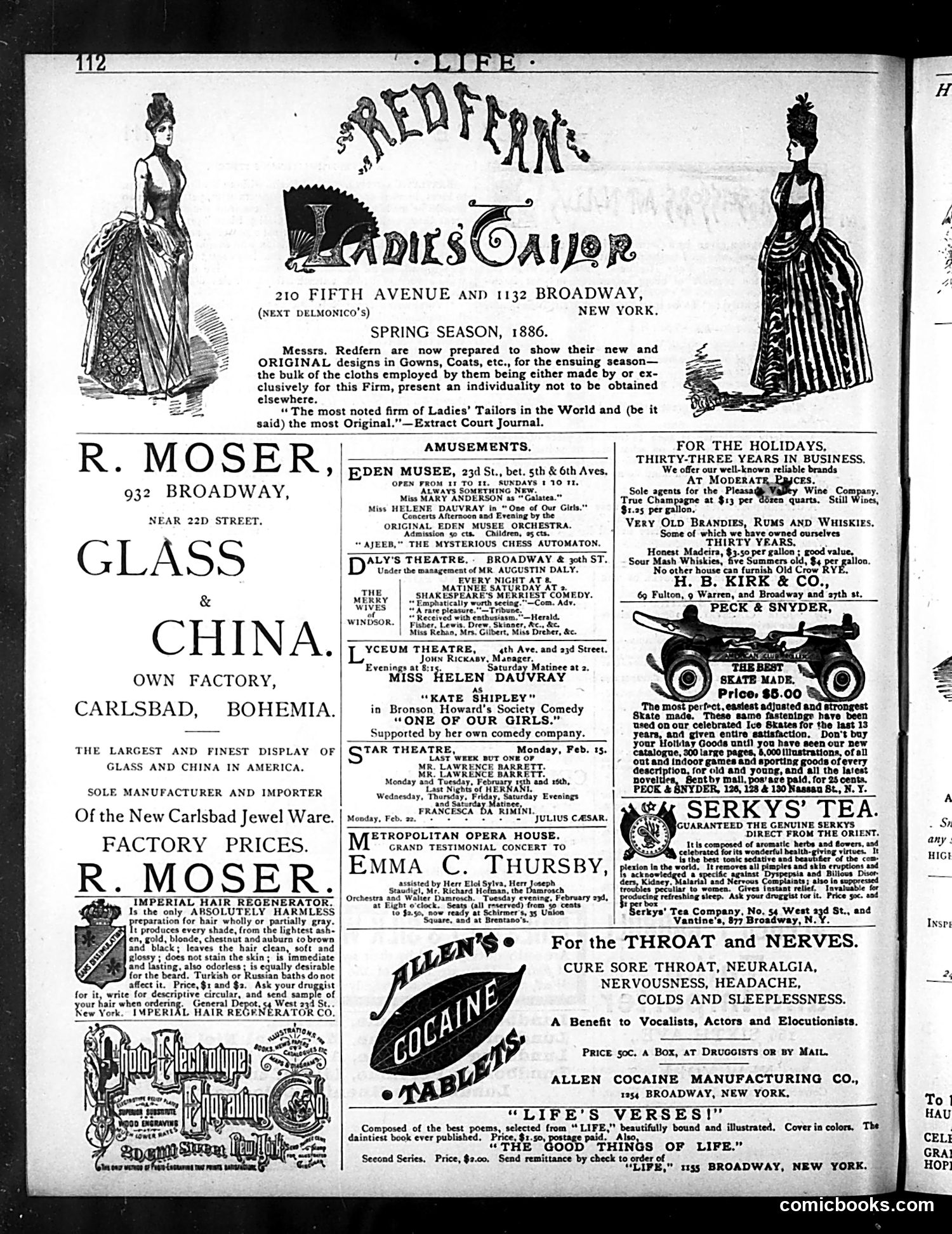
This is primarily a **commercial advertising page** from Life magazine's 1886 spring season issue, not a satirical cartoon page. The page features advertisements for upscale goods and services targeting wealthy New York consumers: Redfern Ladies' Tailor (fashionable gowns), R. Moser (glassware and china from Carlsbad), hair products, and entertainment venues (Eden Musee wax museum, various theaters). Notable is an **advertisement for Allen's Cocaine Tablets**—marketed as a cure for sore throat, neuralgia, and nervousness, with particular appeal to "vocalists, actors and elocutionists." This reflects the historical period before cocaine was federally regulated (pre-1914), when it was freely sold as patent medicine. The page includes playbills for performances by actress Helen Dauvray and a grand concert for singer Emma C. Thursby. There are no visible political cartoons or satire on this particular page—it's essentially a commercial section targeting elite New York society circa 1886.
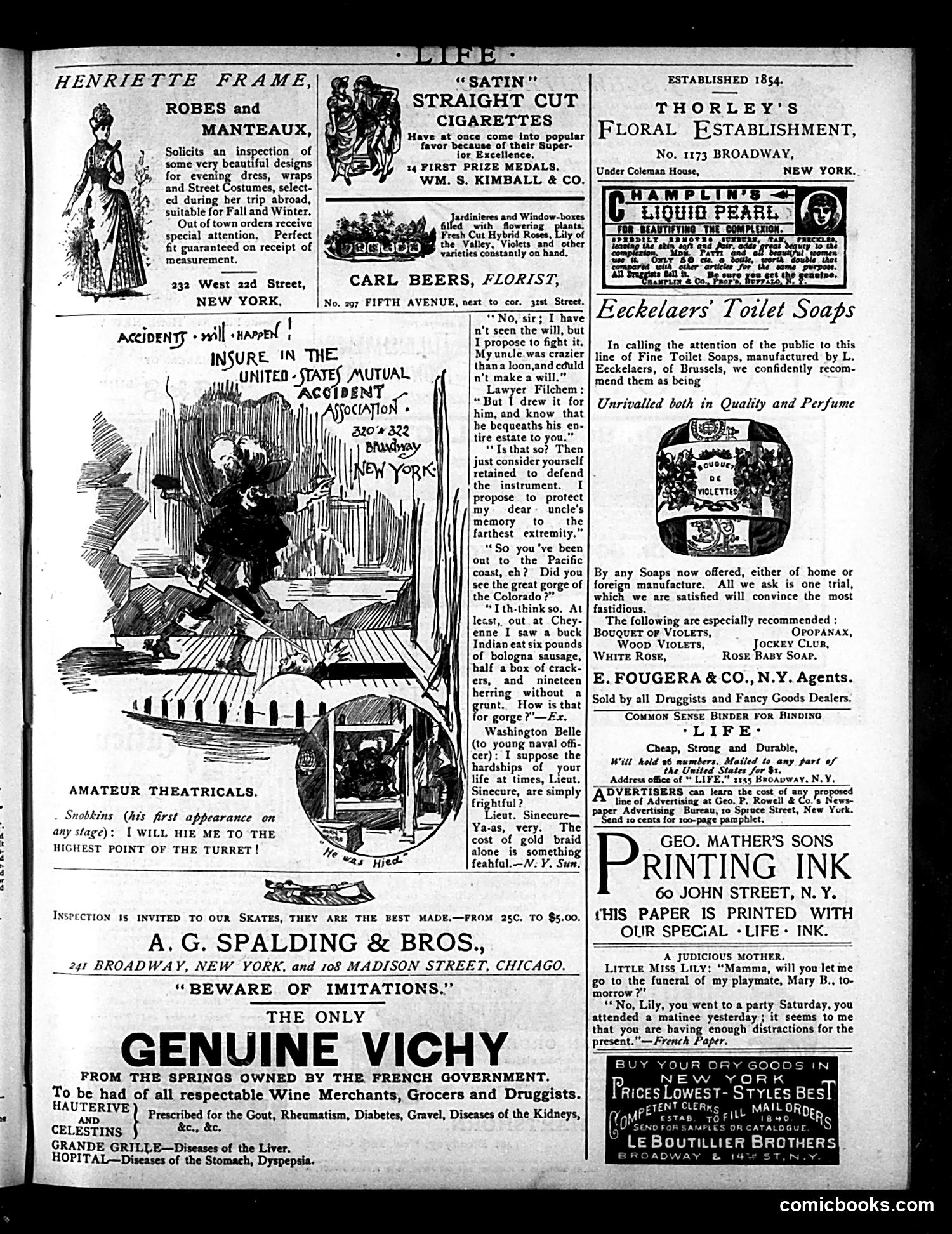
This page is primarily **advertisements and brief comedic sketches**, typical of Life's satirical format from this era. The main cartoon depicts an amateur actor named Snobkins making his stage debut, declaring he will "hie me to the highest point of the turret"—a grandiose theatrical gesture. The humor lies in the contrast between his dramatic ambitions and his obvious inexperience, satirizing amateur theatricals' pretentiousness. Secondary sketches mock social types: a greedy lawyer defending a will he wrote for an eccentric uncle to inherit the estate; and a naval officer claiming the "hardship" of his life is the cost of maintaining his gold-braid uniform—satirizing vanity and privilege among the military elite. The page is otherwise filled with period advertisements for ladies' fashions, flowers, cigarettes, insurance, and patent medicines (notably "Vichy" water, marketed for gout and kidney disease)—reflecting 1880s-90s consumer culture and medical quackery concerns.
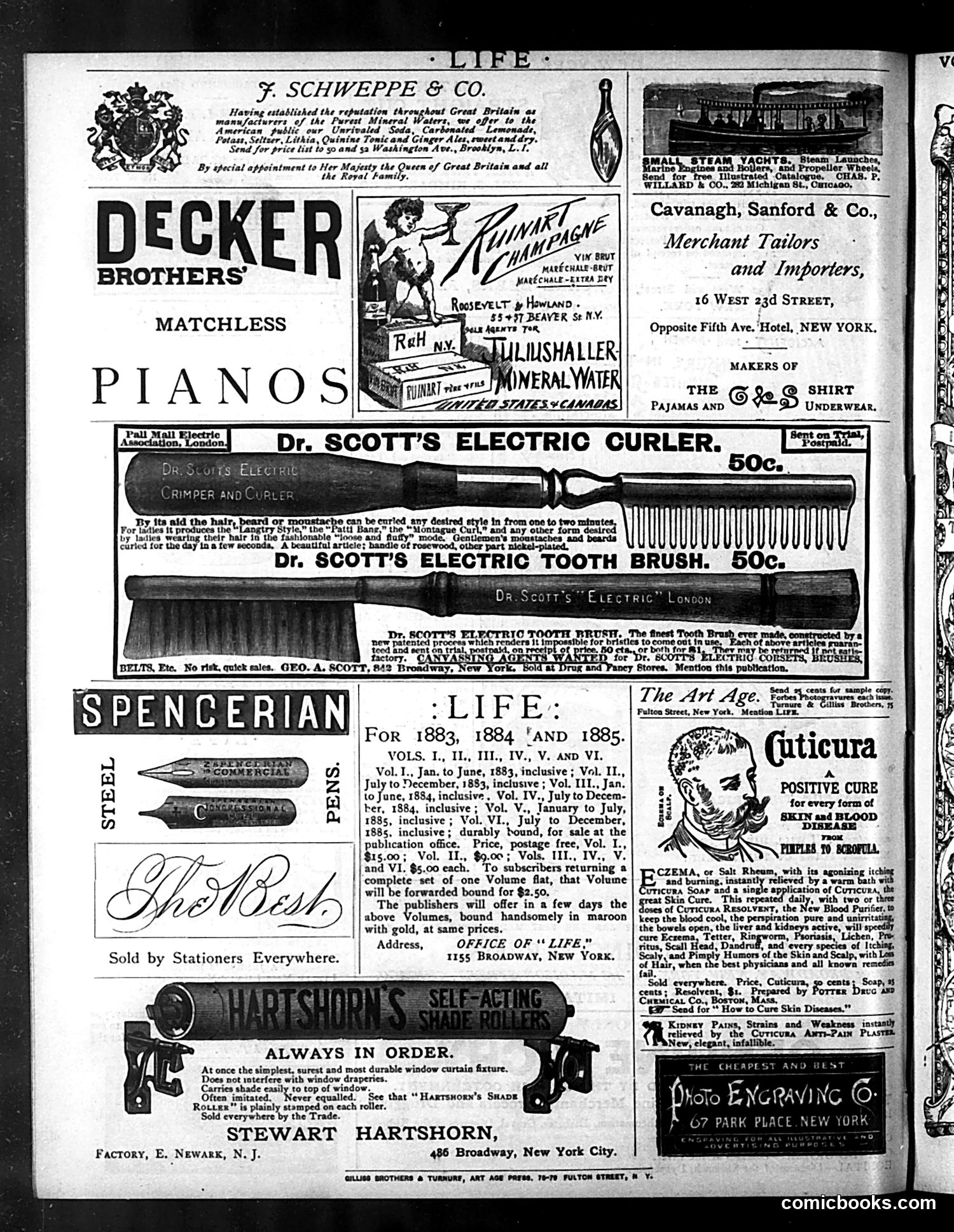
This is primarily an **advertising page** from Life magazine (circa 1883-1885, based on the publication dates mentioned). There are no political cartoons or satirical content visible. The page showcases period consumer products and services typical of the Gilded Age: - **Decker Brothers pianos** and mineral waters from Schwepppes - **Dr. Scott's Electric products** (curler and toothbrush)—representing the era's fascination with electricity as a cure-all, a common marketing trend of the 1880s - **Cuticura** skin treatment and the **Spencerian pen** (for handwriting) - **Hartshorn's Self-Acting Shade Rollers** for windows - **Merchant tailors and medical remedies** The repeated use of "electric" in product names reflects contemporary enthusiasm for electrical technology as modern and therapeutic, even when the actual benefits were dubious. This page documents consumer culture and advertising strategies of the 1880s rather than satire or political commentary.