
Life, 1886-02-18 · page 2 of 16
Life — February 18, 1886 — page 2: what you’re looking at
What you’re looking at
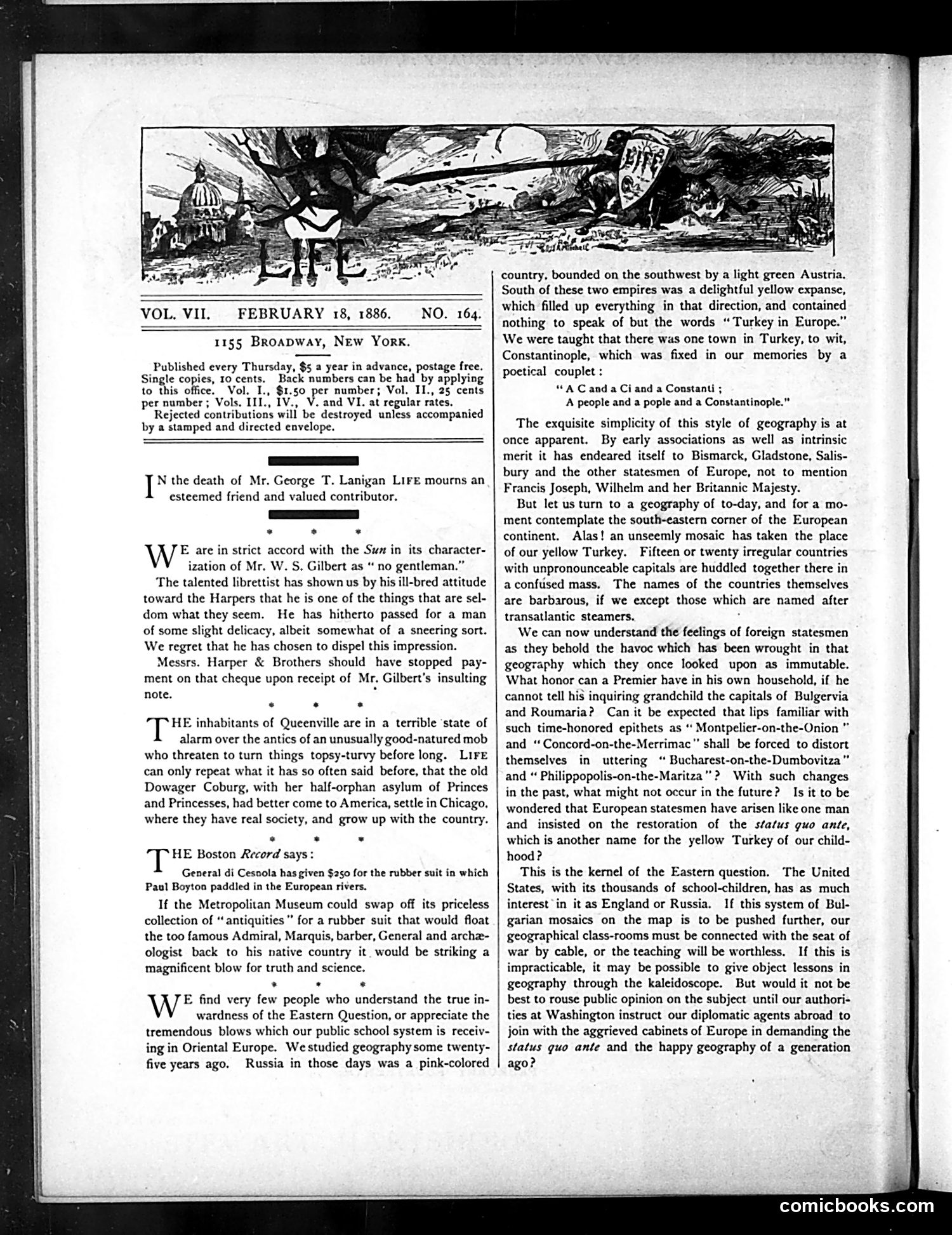
The page contains editorial commentary rather than political cartoons. The masthead illustration shows a classical scene with a moon and architectural elements. The text addresses the "Eastern Question"—the geopolitical instability in Ottoman Turkey and Eastern Europe. The editors critique American geography education, arguing that outdated textbooks (using 25-year-old maps where "Russia was a pink-colored country") fail to help students understand current international conflicts. They reference Constantinople, Bulgaria, Hungary, and Romania—disputed territories central to 19th-century European power struggles. The satire targets public ignorance: Americans cannot understand contemporary diplomacy regarding Turkish decline without updated geographical knowledge. The editors suggest the State Department should educate diplomats and the public about actual territorial realities shaping European politics.
📄 Transcribed text from this page (OCR, searchable)
Machine-transcribed from the original scan — historical spelling and the odd misread are preserved.
VOL, VII. FEBRUARY 18, 1886. NO. 164. 1155 Broapway, New York. Published every Thursday, $5 a year in advance, postage free. Single copies, 10 cents. Back numbers can be had by applying to this office. Vol. I., $1.50 per number; Vol. II., 25 cents per number ; Vols. III., 1V., V. and VI. at regular rates. Rejected contributions will be destroyed unless accompanied by a stamped and directed envelope. =a) N the death of Mr. George T. Lanigan LiFe mourns an esteemed friend and valued contributor. SES . * . E are in strict accord with the Sua in its character- ization of Mr. W. S. Gilbert as “ no gentleman.” The talented librettist has shown us by his ill-bred attitude toward the Harpers that he is one of the things that are sel- dom what they seem. He has hitherto passed for a man of some slight delicacy, albeit somewhat of a sneering sort. We regret that he has chosen to dispel this impression. Messrs. Harper & Brothers should have stopped pay- ment on that cheque upon receipt of Mr. Gilbert's insulting note. : . . . HE inhabitants of Queenville are in a terrible ‘state of alarm over the antics of an unusually good-natured mob who threaten to turn things topsy-turvy before long. LIFE can only repeat what it has so often said before, that the old Dowager Coburg, with her half-orphan asylum of Princes and Princesses, had better come to America, settle in Chicago, where they have real society, and grow up with the country. . . . HE Boston Record says: General di Cesnola has given $250 for the rubber suit in which Paul Boyton paddled in the European rivers. If the Metropolitan Museum could swap off its priceless collection of “antiquities " for a rubber suit that would float the too famous Admiral, Marquis, barber, General and archae- ologist back to his native country it. would be striking a magnificent blow for truth and science. . . . E find very few people who understand the true in- wardness of the Eastern Question, or appreciate the tremendous blows which our public school system is receiv- ing in Oriental Europe. We studied geography some twenty- five years ago. Russia in those days was a pink-colored | country, bounded on the southwest by a light green Austria. South of these two empires was a delightful yellow expanse, which filled up everything in that direction, and contained nothing to speak of but the words “Turkey in Europe.” We were taught that there was one town in Turkey, to wit, Constantinople, which was fixed in our memories by a poetical couplet : **A C and a Ci and a Constanti ; A people and a pople and a Constantinople.” The exquisite simplicity of this style of geography is at once apparent. By early associations as well as intrinsic merit it has endeared itself to Bismarck, Gladstone, Salis- bury and the other statesmen of Europe, not to mention Francis Joseph, Wilhelm and her Britannic Majesty. But let us turn to a geography of to-day, and for a mo- ment contemplate the south-eastern corner of the European continent. Alas! an unseemly mosaic has taken the place of our yellow Turkey. Fifteen or twenty irregular countries with unpronounceable capitals are huddled together there in aconfused mass. The names of the countries themselves are barbarous, if we except those which are named after transatlantic steamers. t We can now understand the feelings of foreign statesmen as they behold the havoc which has been wrought in that geography which they once looked upon as immutable. What honor can a Premier have in his own household, if he cannot tell his inquiring grandchild the capitals of Bulgervia and Roumaria? Can it be expected that lips familiar with such time-honored epithets as “ Montpelier-on-the-Onion " and ‘Concord-on-the-Merrimac”’ shall be forced to distort themselves in uttering ‘“ Bucharest-on-the-Dumbovitza” and “ Philippopolis-on-the-Maritza" ? With such changes in the past, what might not occur in the future? Is it to be wondered that European statesmen have arisen like one man and insisted on the restoration of the status guo ante, which is another name for the yellow Turkey of our child- hood ? This is the kernel of the Eastern question. The United States, with its thousands of school-children, has as much interest in it as England or Russia. If this system of Bul- garian mosaics on the map is to be pushed further, our geographical class-rooms must be connected with the seat of war by cable, or the teaching will be worthless. If this is impracticable, it may be possible to give object lessons in geography through the kaleidoscope. But would it not be best to rouse public opinion on the subject until our authori- ties at Washington instruct our diplomatic agents abroad to join with the aggrieved cabinets of Europe in demanding the status guo ante and the happy geography of a generation ago? comicbooks.com