
Life, 1886-02-18 · page 4 of 16
Life — February 18, 1886 — page 4: what you’re looking at
What you’re looking at
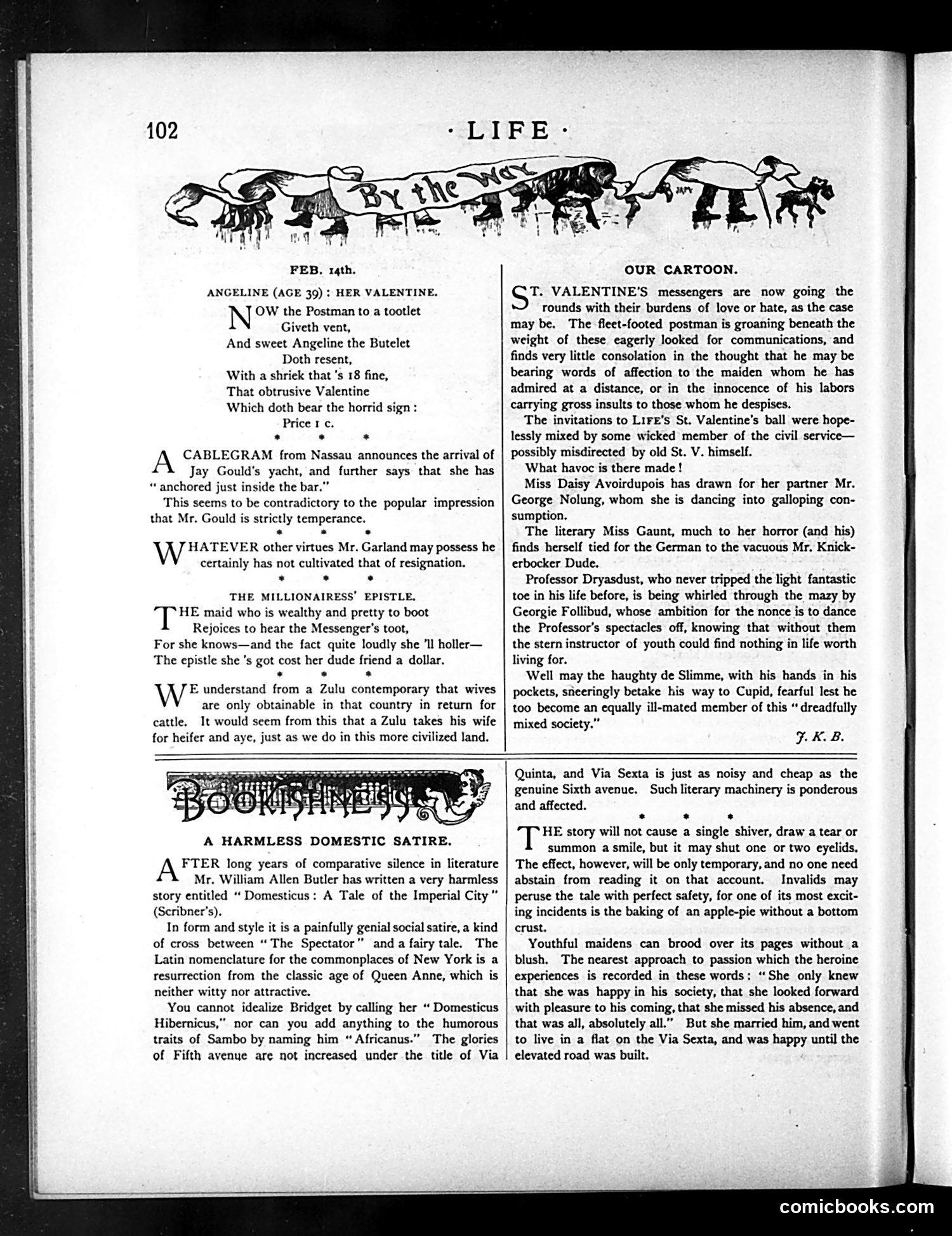
This page contains Valentine's Day-themed satirical content from early 20th-century Life magazine. The left column features short poems and witty observations mocking various social figures: a wealthy woman ("Angeline"), a postman, and commentary on marriage customs among wealthy Americans and Zulu peoples. "Our Cartoon" on the right discusses St. Valentine's Day messengers and satirizes contemporary New York society figures, including "Miss Daisy Avoirdupois" and literary personalities. The satire targets pretentious behavior in high society—particularly misdirected romance and affected intellectualism. The "Domesticus" section reviews a book by William Allen Butler, using satirical Latin nomenclature to mock both the work and New York's social elite. The overall tone ridicules vanity, pretension, and romantic folly among the wealthy and culturally ambitious.
📄 Transcribed text from this page (OCR, searchable)
Machine-transcribed from the original scan — historical spelling and the odd misread are preserved.
FEB, 14th. ANGELINE (AGE 39) : HER VALENTINE. OW the Postman to a tootlet Giveth vent, And sweet Angeline the Butelet Doth resent, With a shriek that's 18 fine, That obtrusive Valentine Which doth bear the horrid sign : Price 1c. . . . CABLEGRAM from Nassau announces the arrival of Jay Gould's yacht, and further says that she has “anchored just inside the bar.” This seems to be contradictory to the popular impression that Mr. Gould is strictly temperance. . * . HATEVER other virtues Mr. Garland may possess he certainly has not cultivated that of resignation. . * . THE MILLIONAIRESS’ EPISTLE. HE maid who is wealthy and pretty to boot Rejoices to hear the Messenger’s toot, For she knows—and the fact quite loudly she ‘ll holler— The epistle she ’s got cost her dude friend a dollar. . . . E understand from a Zulu contemporary that wives are only obtainable in that country in return for cattle. It would seem from this that a Zulu takes his wife for heifer and aye, just as we do in this more civilized land. OUR CARTOON. T. VALENTINE’S messengers are now going the rounds with their burdens of love or hate, as the case may be. The fleet-footed postman is groaning beneath the weight of these eagerly looked for communications, and finds very little consolation in the thought that he may be bearing words of affection to the maiden whom he has admired at a distance, or in the innocence of his labors carrying gross insults to those whom he despises. The invitations to L1FE’s St. Valentine’s ball were hope- lessly mixed by some wicked member of the civil service— possibly misdirected by old St. V. himself. What havoc is there made! Miss Daisy Avoirdupois has drawn for her partner Mr. George Nolung, whom she is dancing into galloping con- sumption. The literary Miss Gaunt, much to her horror (and his) finds herself tied for the German to the vacuous Mr. Knick- erbocker Dude. Professor Dryasdust, who never tripped the light fantastic toe in his life before, is being whirled through the mazy by Georgie Follibud, whose ambition for the nonce is to dance the Professor's spectacles off, knowing that without them the stern instructor of youth could find nothing in life worth living for. Well may the haughty de Slimme, with his hands in his pockets, sneeringly betake his way to Cupid, fearful lest he too become an equally ill-mated member of this “ dreadfully mixed society.” GF. KB. A HARMLESS DOMESTIC SATIRE. ATT long years of comparative silence in literature Mr. William Allen Butler has written a very harmless story entitled “ Domesticus: A Tale of the Imperial City” (Scribner's). In form and style it is a painfully genial social satire, a kind of cross between “The Spectator” and a fairy tale. The Latin nomenclature for the commonplaces of New York is a resurrection from the classic age of Queen Anne, which is neither witty nor attractive. You cannot idealize Bridget by calling her “ Domesticus Hibernicus,” nor can you add anything to the humorous traits of Sambo by naming him “ Africanus.” The glories of Fifth avenue are not increased under the title of Via Quinta, and Via Sexta is just as noisy and cheap as the genuine Sixth avenue. Such literary machinery is ponderous and affected. . . . HE story will not cause a single shiver, draw a tear or summon a smile, but it may shut one or two eyelids, The effect, however, will be only temporary, and no one need abstain from reading it on that account. Invalids may peruse the tale with perfect safety, for one of its most excit- ing incidents is the baking of an apple-pie without a bottom crust. Youthful maidens can brood over its pages without a blush. The nearest approach to passion which the heroine experiences is recorded in these words: “She only knew that she was happy in his society, that she looked forward with pleasure to his coming, that she missed his absence, and that was all, absolutely all.” But she married him, and went to live in a flat on the Via Sexta, and was happy until the elevated road was built. comicbooks.com