
A complete issue · 16 pages · 1886
Life — January 7, 1886
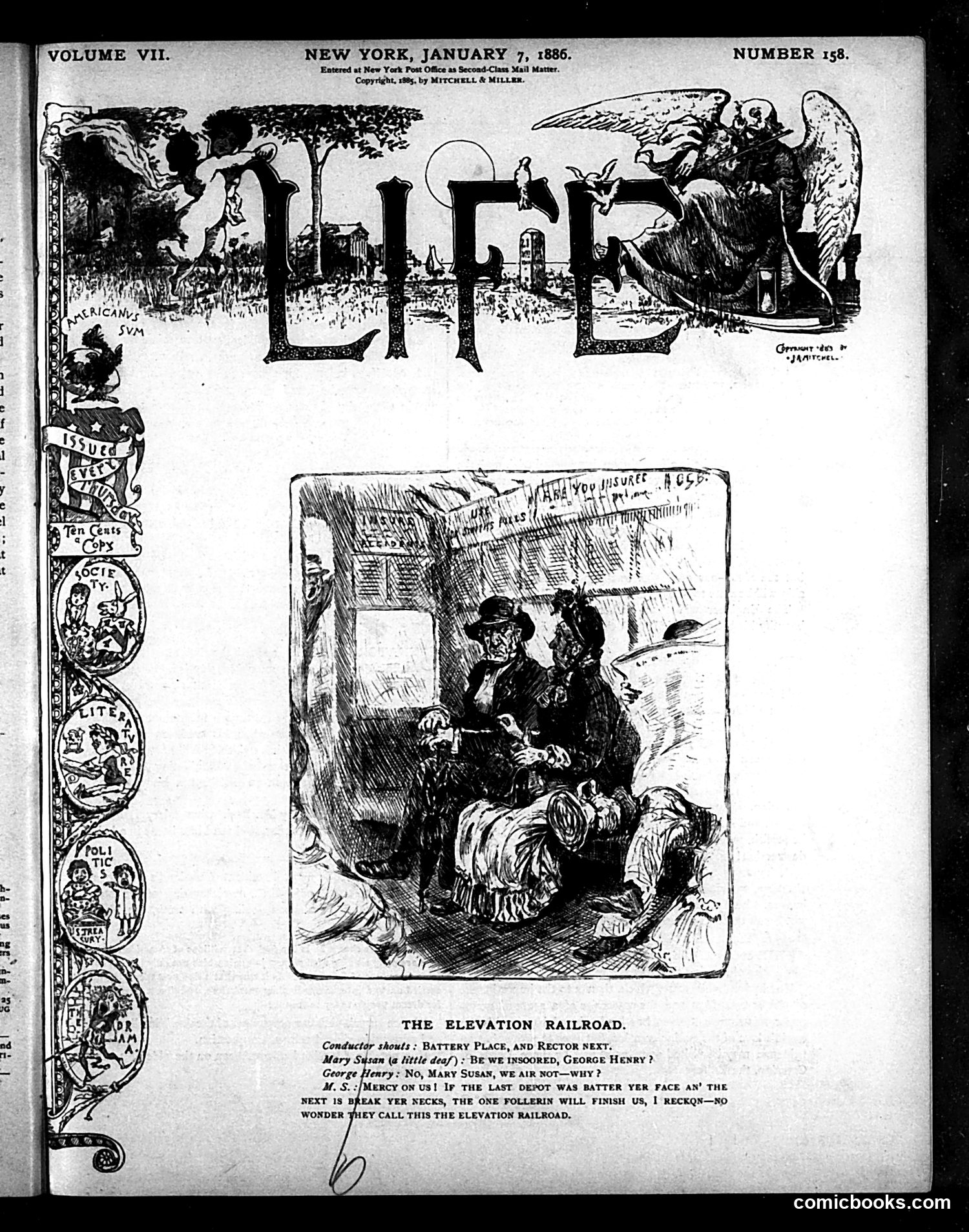
This satirical cartoon depicts a crowded elevated train car with two well-dressed men (labeled as "Conductor" and "Rector") conversing above working-class passengers. The dialogue mocks the operators' indifference to overcrowding and safety concerns. The joke centers on the elevated railroad's notorious poor conditions in 1880s New York. When a passenger (Mary Susan) complains about dangerous overcrowding, the conductor dismissively responds that if the last depot was "better yer face an'" the next is a "break yer necks," passengers shouldn't complain about the "elevation railroad"—sarcastically suggesting the only thing "elevated" is the fare, while conditions remain deplorable. This critiques both the railroad company's negligence and class indifference to working passengers' welfare.
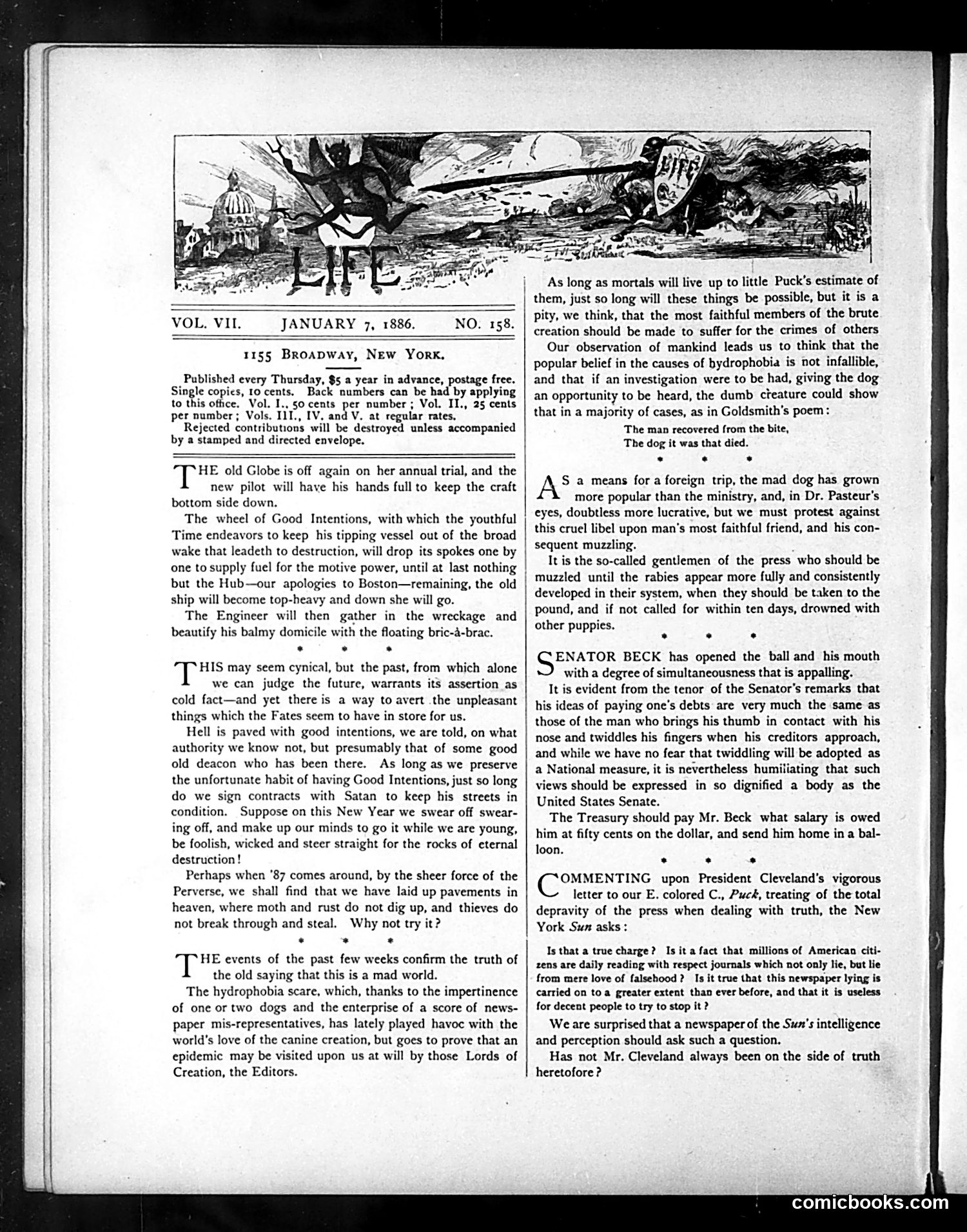
This page contains two separate items: **"A Disappointment"** (top): A domestic cartoon showing a mother reading to children, with Little Billy expressing disappointment that lions didn't eat the biblical Daniel. The humor relies on a child's literal, violent interpretation of a religious story versus its moral lesson about faith and protection. **"Break, Break, Break"** (bottom left): A poem about broken household items—specifically a Dresden vase—lamenting domestic accidents and their permanence ("the words that should not be said" suggests regretted harsh reactions to breakage). **"The Religious School of Art"** (bottom right): A brief dialogue joking that a son painting "religious pictures" is actually painting Madonnas—a common, somewhat pedestrian subject in art history, implying the son isn't particularly original or ambitious artistically. The page is miscellaneous humor and light satire rather than political commentary.
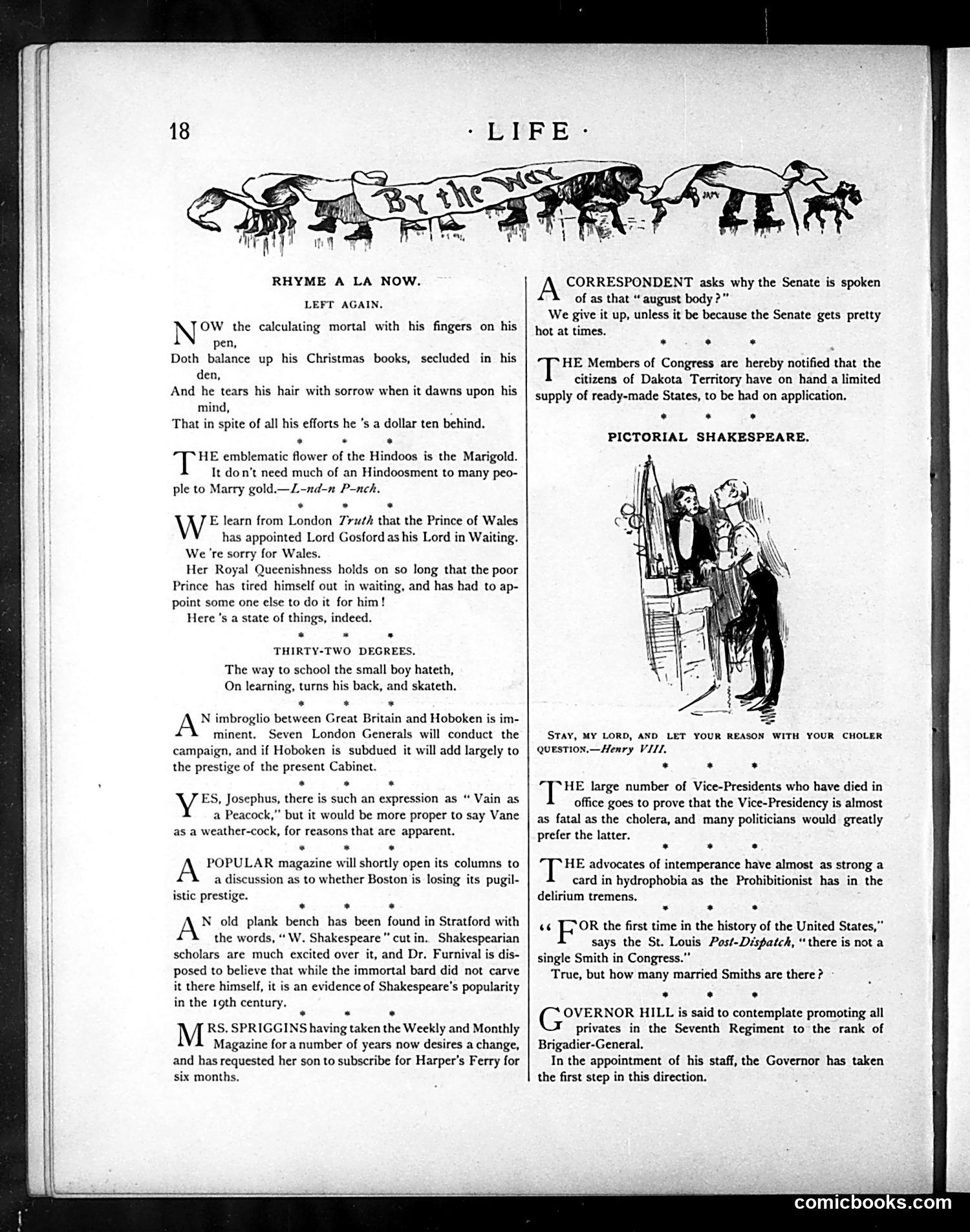
This page contains satirical commentary and a Shakespeare illustration rather than political cartoons. Key content includes: **"Rhyme a la Now"**: A poem mocking a man's financial struggles—he's calculating debts on Christmas while falling behind by ten dollars. **Political humor**: Jokes about the Senate being an "august body" (implying it gets heated), and Congress being offered "ready-made States" from Dakota Territory. **"Pictorial Shakespeare"**: An illustration showing a Shakespeare scene with the caption "Stay, my lord, and let your reason with your choler question"—satirizing dramatic dialogue. **Miscellaneous satire**: Quips about Vice-Presidents dying in office, temperance advocates, and Governor Hill promoting soldiers to brigadier-general rank. The page emphasizes everyday financial anxiety and political absurdity rather than specific contemporary events.
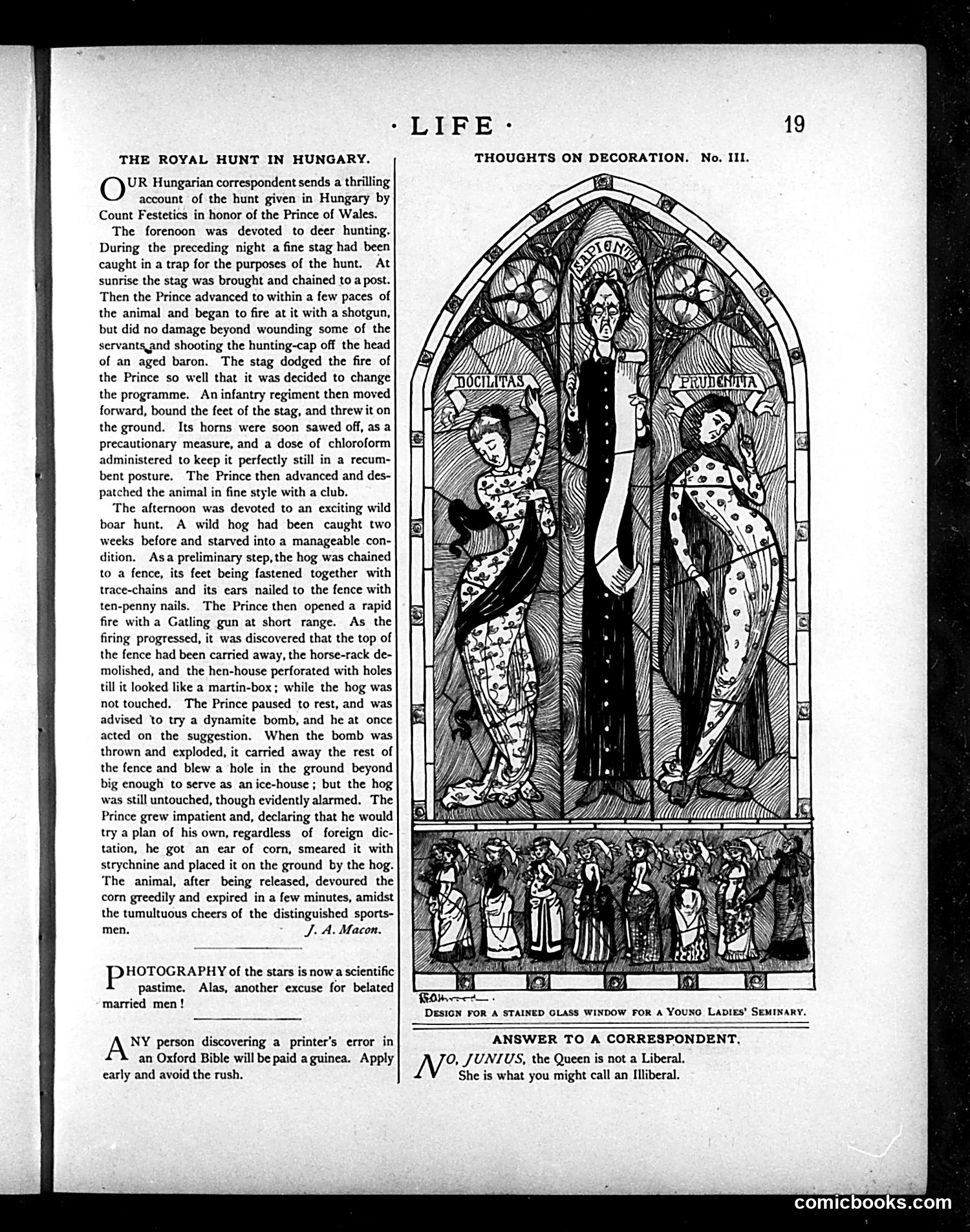
This page contains three distinct items: 1. **"The Royal Hunt in Hungary"** - A humorous account of a hunting expedition hosted by Count Festetics for the Prince of Wales. The narrative describes an absurdly chaotic series of events: a stag escaping gunfire, an infantry regiment intervening, a wild boar hunt gone wrong (with dynamite used), and finally the Prince improvising by shooting a corn-covered ear of corn at the hog. The piece satirizes the incompetence and absurdity of the royal hunting party. 2. **"Thoughts on Decoration No. III"** - A stained glass window design showing religious figures in an ornate Gothic style, likely demonstrating artistic trends of the period. 3. **Brief notices** including a joke about photography and married men, and a response about Queen Junius not being liberal. The hunting story is the primary satirical content, mocking upper-class sporting pretensions.
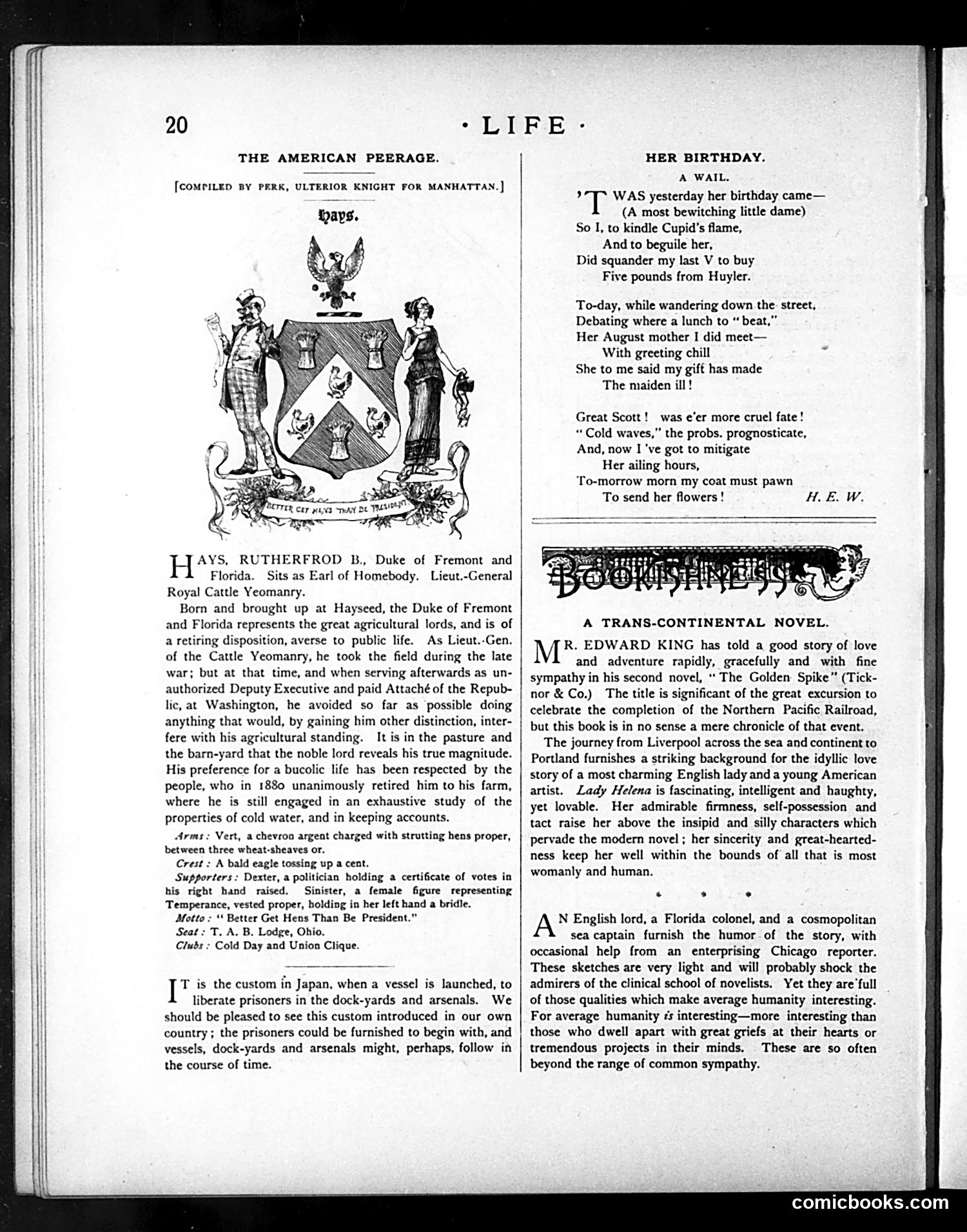
This heraldic coat of arms satirizes **Rutherford B. Hayes**, Duke of Fremont and Florida, presented as American nobility. The text explains Hayes represents "great agricultural lords" yet reveals his true character through his farm management during and after the Civil War, particularly his avoidance of military service while holding a government position. The satire mocks the pretension of treating American political figures as European aristocracy—a common *Life* magazine critique of the Gilded Age elite. By granting Hayes a mock-heraldic pedigree with supporters and heraldic symbols, the cartoonist ridicules both his social pretensions and his actual record: avoiding distinction while accumulating agricultural wealth and political power.
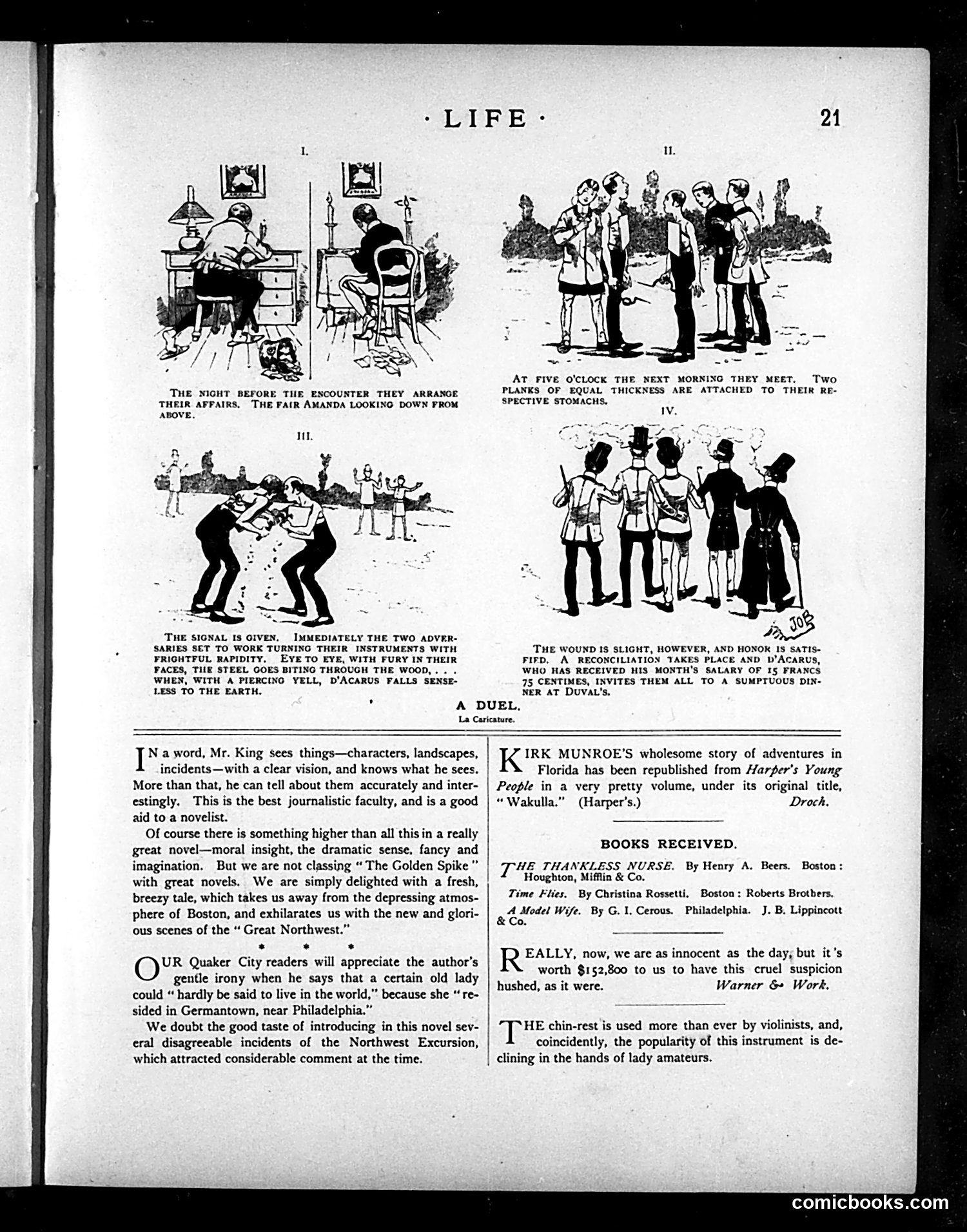
This page contains a humorous four-panel comic strip titled "A Duel" depicting a confrontation between two men arranging a formal duel. Panel I shows them meeting the night before to plan details. Panel II depicts them meeting at dawn with seconds present. Panel III shows them beginning to turn their instruments—apparently musical instruments rather than weapons. Panel IV reveals the resolution: the "wound is slight" and they reconcile over dinner at Duvál's restaurant, each paying 75 centimes. The satire mocks the absurdity of formal dueling practices by substituting musical performance for lethal combat, transforming a serious affair of honor into an anticlimactic, trivial event. The joke undercuts the pretension and bloodlust surrounding dueling culture by making it financially modest and comically harmless.
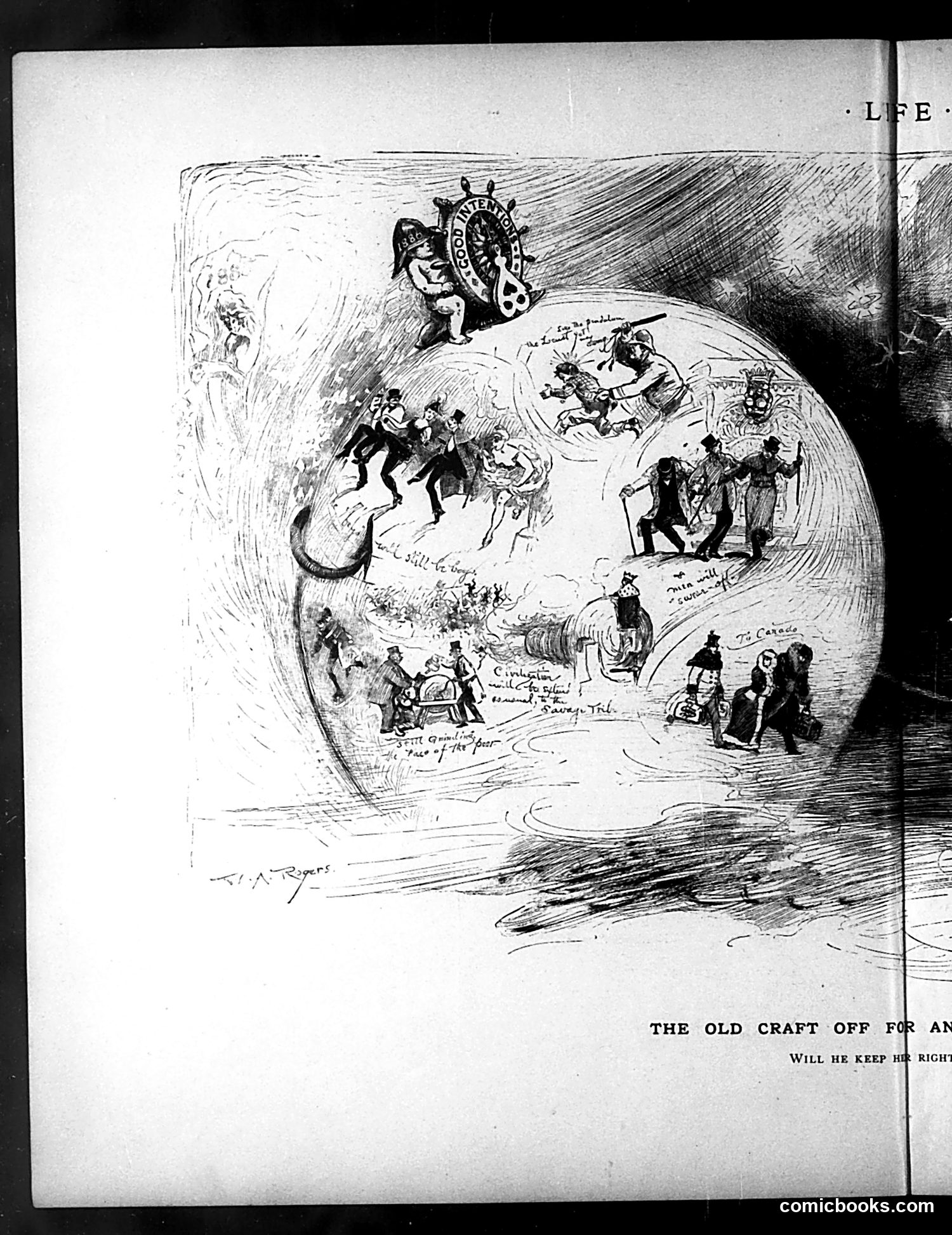
This is a political cartoon titled "The Old Craft Off For An[other voyage]" with the subtitle "Will He Keep His Right[Course?]" The image depicts a large ship's wheel at the top, with various figures engaged in different activities within and around a large spherical globe or vessel. The scattered text labels within the scenes are difficult to read clearly in this reproduction, but the composition suggests commentary on political navigation or leadership during a journey (likely national or governmental). The cartoon appears to satirize concerns about whether a political leader or administration will "stay the course" or maintain proper direction during uncertain times. Without clearer text labels identifying specific figures or historical context, the exact political references remain unclear, though the maritime metaphor was common in early-to-mid 20th century American political satire.
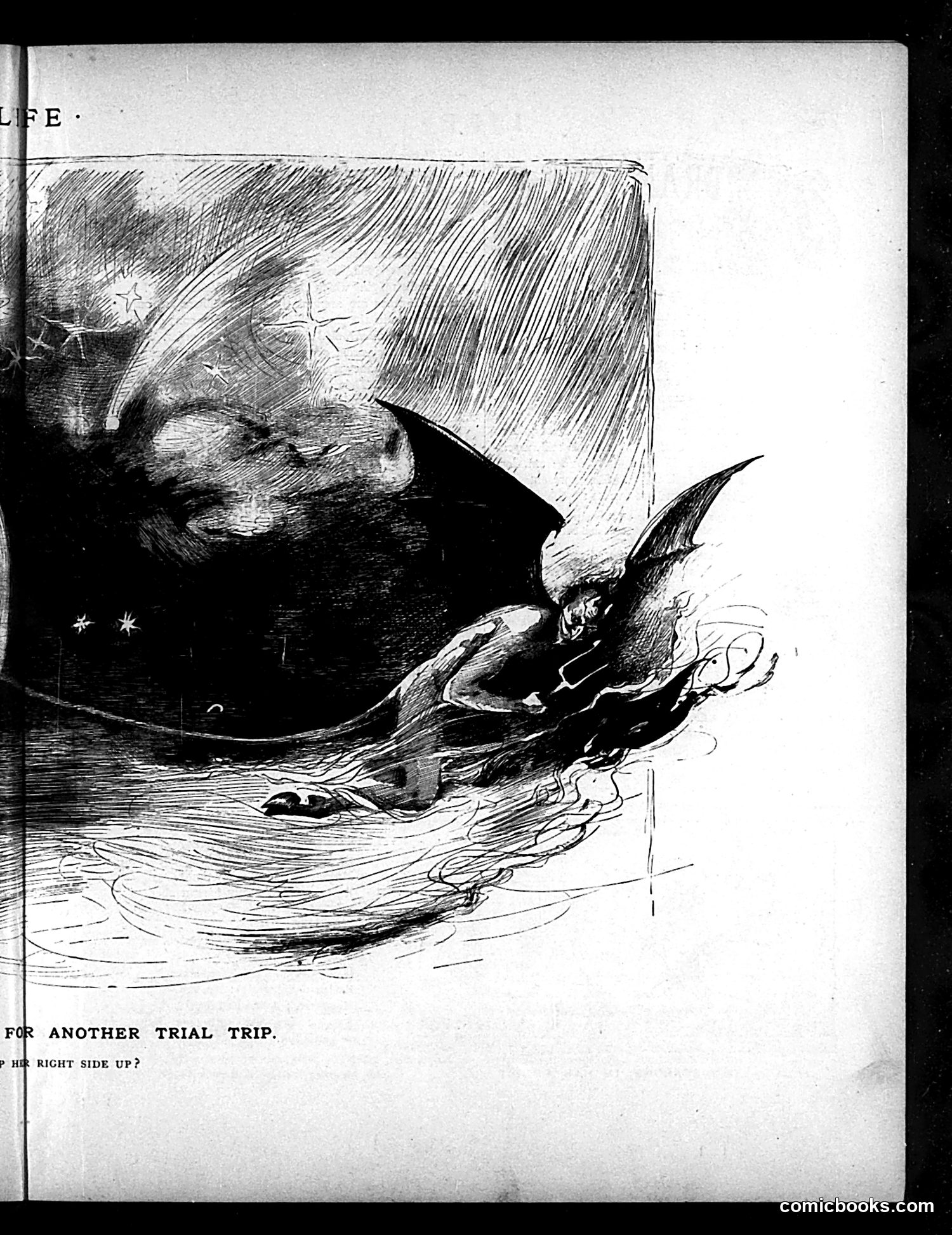
This appears to be a satirical cartoon from *Life* magazine depicting a witch or demonic figure riding a broomstick through stormy skies. The figure wears a pointed hat and flowing cape, rendered in dramatic cross-hatching. Two stars appear in the darker background. The caption reads "FOR ANOTHER TRIAL TRIP" with a partial line below asking "P HIS RIGHT SIDE UP?" Without clearer context about the publication date or visible identifying features, I cannot definitively identify which specific political figure or event this references. The imagery suggests criticism of someone or something associated with supernatural/evil connotations undertaking another controversial action or "trip." The "trial trip" language implies testing or another attempt at something previously attempted. More information about the issue date would be needed for precise interpretation.
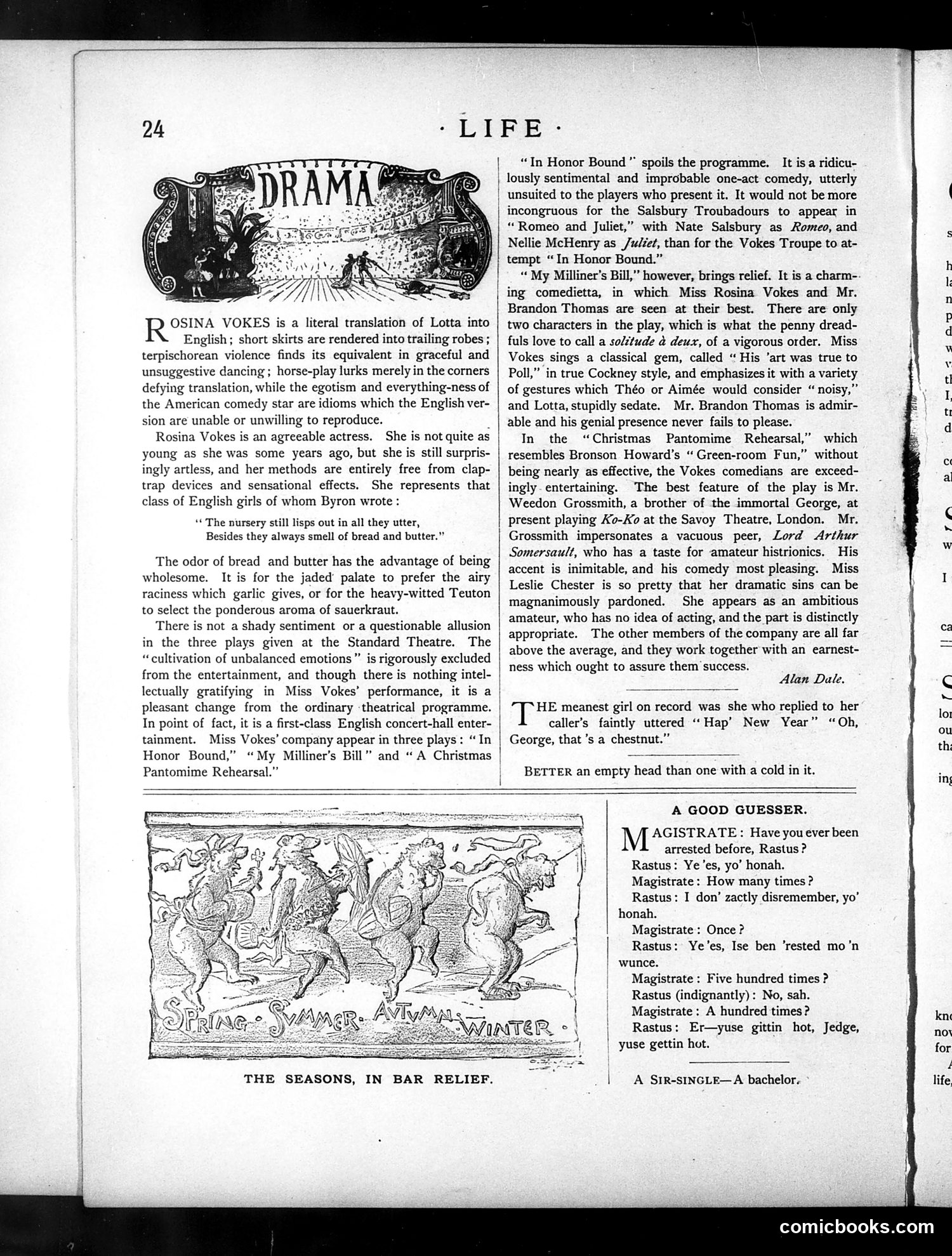
This page contains **theater reviews**, not political satire. The main content criticizes actress **Rosina Vokes**, an English performer presenting three plays at the Standard Theatre. The review contrasts English and American theatrical styles—English actresses like Vokes are modest and wholesome ("smell of bread and butter"), while American stars employ "horse-play" and sensational effects. The critic praises Vokes's artlessness but finds her three-play program uneven: "In Honor Bound" is dismissed as inappropriately sentimental, "My Milliner's Bill" is charming, and the "Christmas Pantomime Rehearsal" is entertaining largely due to **Weedon Grossmith's** comic performance as Lord Arthur Somersault. The bar-relief illustration below shows allegorical figures representing the seasons—decorative rather than satirical. The page reflects **Victorian-era theater criticism**, valuing refined entertainment over crude sensationalism. References to contemporary performers (Nate Salsbury, Lotta) are meaningful only to period audiences.
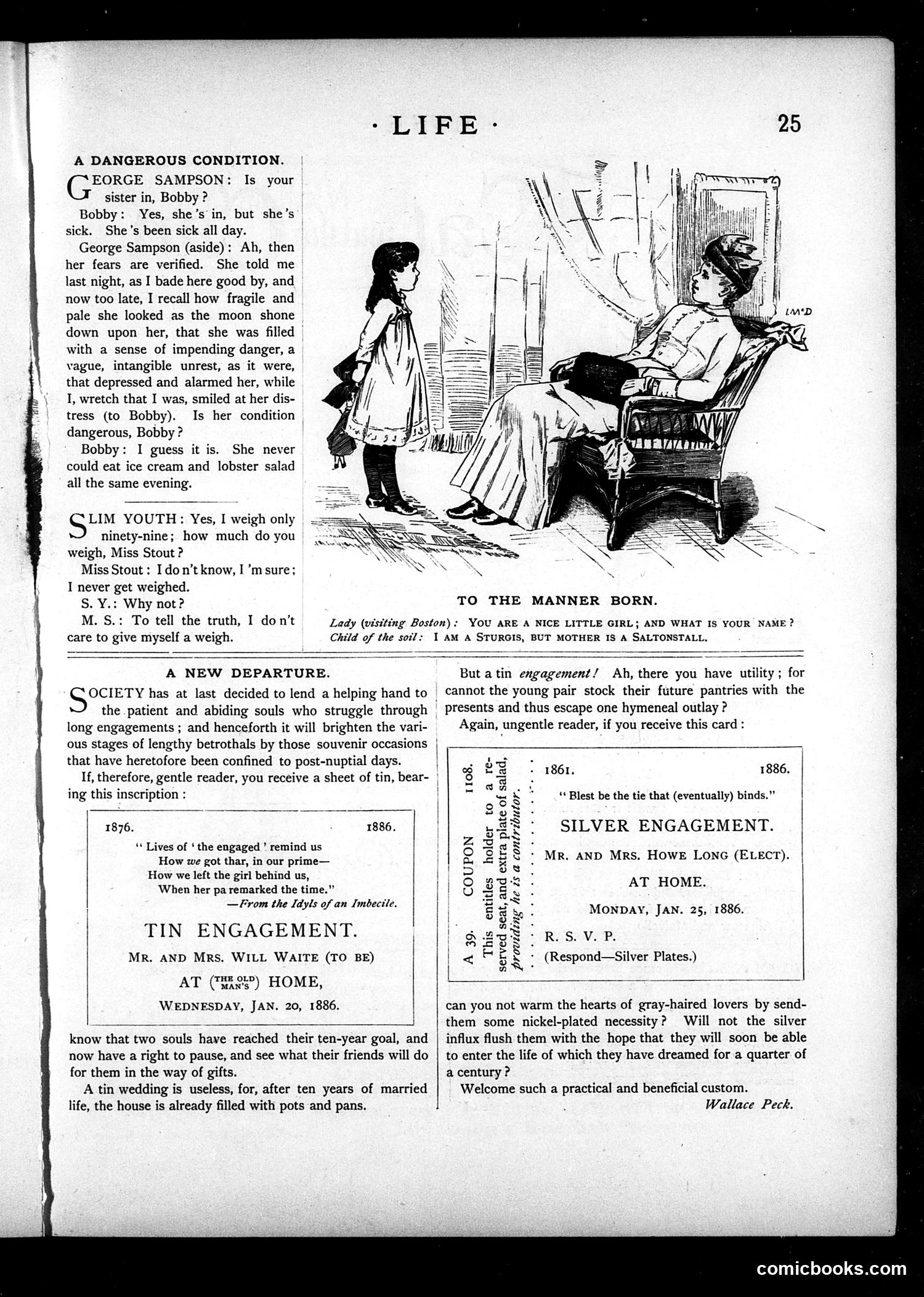
This page satirizes the emerging Victorian custom of milestone wedding anniversaries with prescribed gift materials. The main article announces that "Society" has introduced tin gifts for ten-year engagements and silver gifts for longer ones—a practical solution to gift-giving during prolonged betrothals. The satire mocks this commercialization: the author notes that tin is useless (homes already overflow with pots and pans after ten years), and jokes that silver gifts would give aging couples false hope of eventually marrying. The fictional engagement announcements for "Will Waite (To Be)" and "Howe Long (Elect)"—clearly pun names suggesting perpetual engagement—reinforce the joke about couples stuck in endless betrothals. The side cartoons provide comedic relief: one depicts a young woman's mysterious "dangerous condition" (she ate ice cream and lobster together), and another shows a Boston visitor's surprise at hearing local names like "Sturgis" and "Saltonstall"—likely references to prominent New England families. The piece gently satirizes both commercial materialism and the social peculiarities of prolonged Victorian courtship practices.
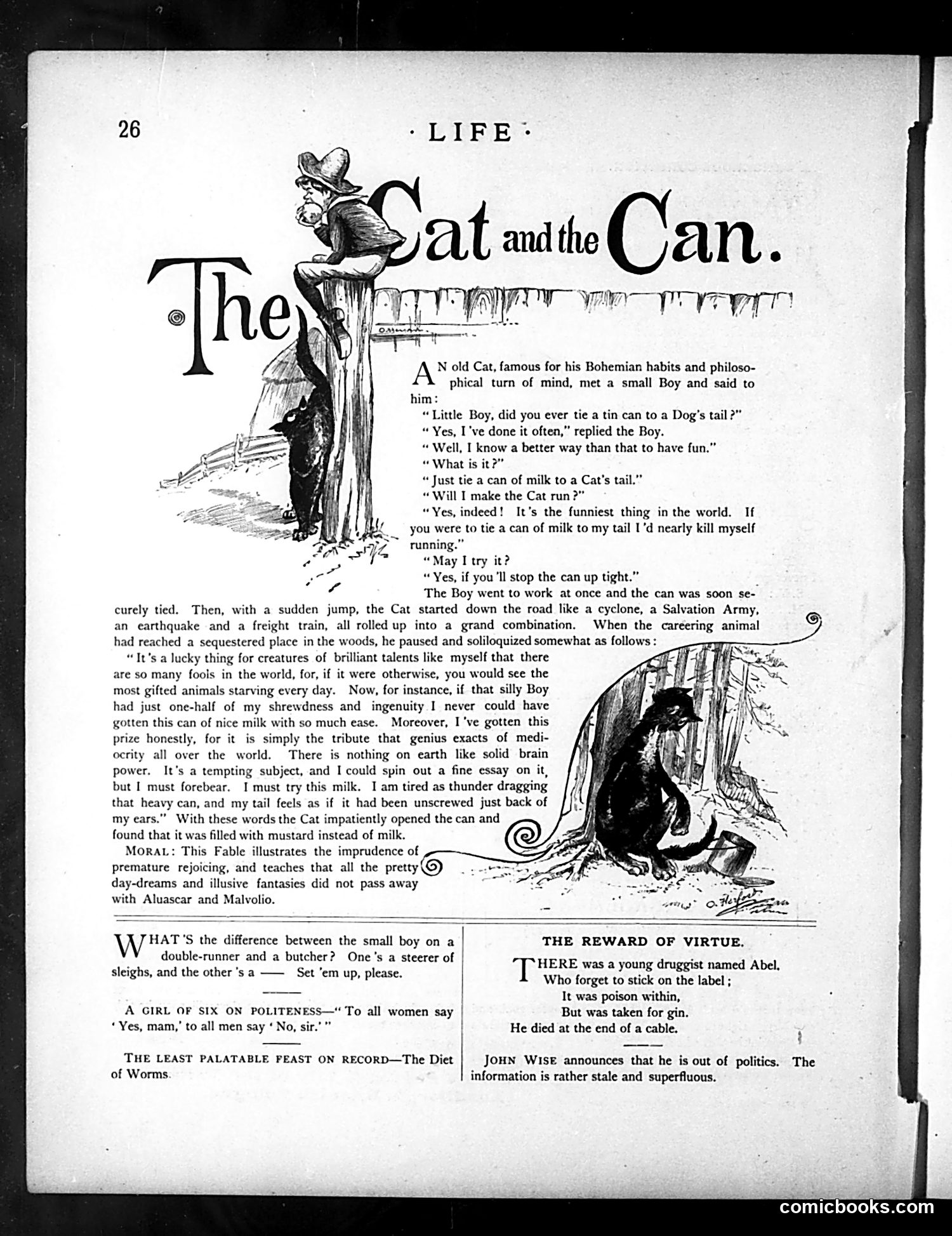
This is a moral fable using animal characters to teach a lesson about overconfidence. A clever cat tricks a naive boy into tying a can of milk to his tail. The cat boasts about his superior intelligence and cunningness, convinced he's outwitted the boy and earned an easy reward. When he opens the can in the woods, he discovers it contains mustard, not milk—his scheme backfires. The **moral** explicitly states the lesson: don't celebrate prematurely, and don't rely on daydreams and fantasies. The references to "Aluascar and Malvolio" (literary characters known for foolish pride) reinforce that the tale warns against arrogance and false confidence. The page also includes other brief humorous items typical of *Life* magazine's satirical miscellany—wordplay, jokes about children, and social commentary.
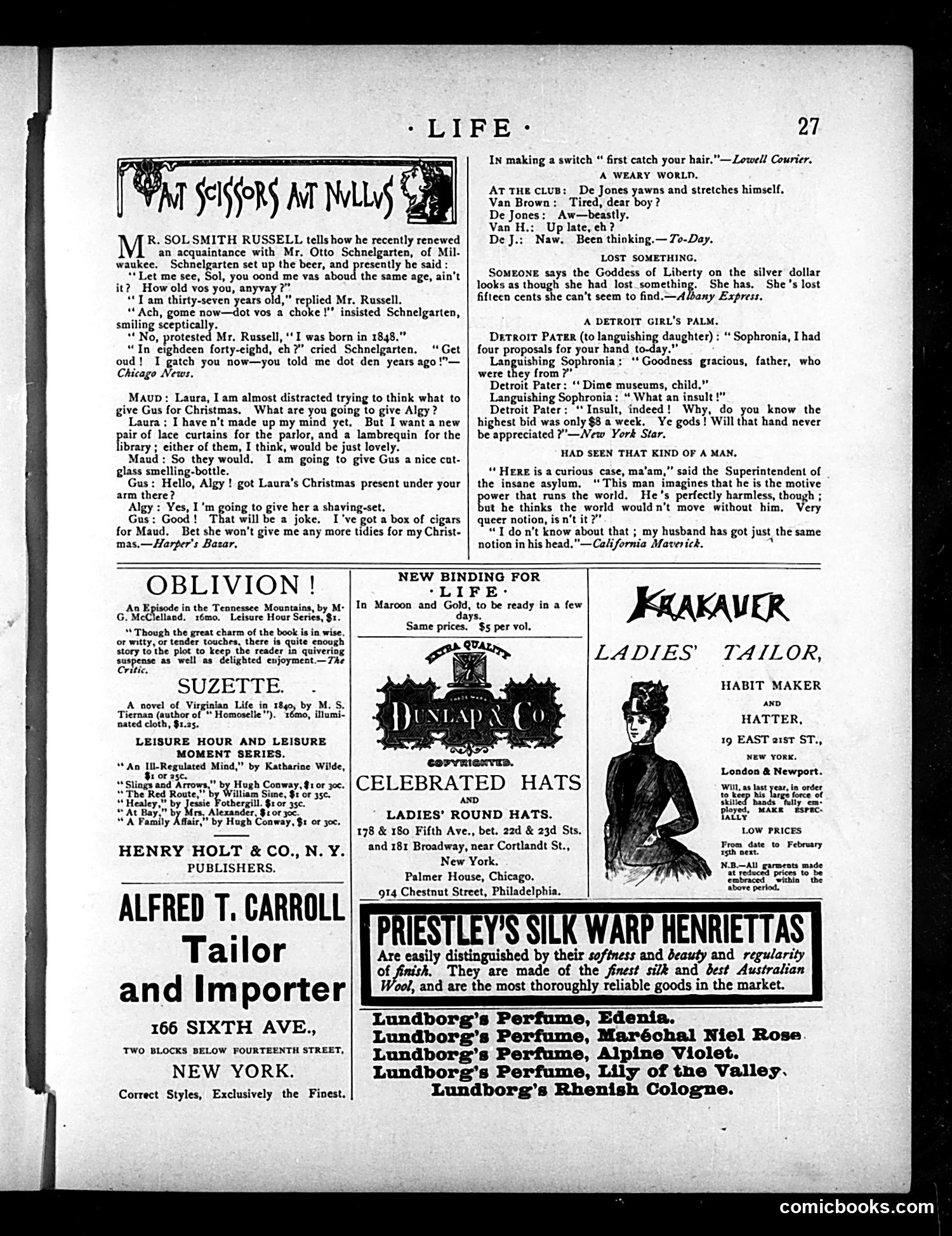
This page is primarily **advertising and short humor pieces**, typical of Life magazine's format. The cartoons/jokes satirize everyday American life: **Key humor pieces:** 1. **"At Scissors at Nullys"** - A German-accented Milwaukee beer-hall keeper catches Sol Smith Russell in an inconsistency about his age, poking fun at forgetfulness and immigration dialect humor (common in period comedy). 2. **Christmas gift exchanges** - Mock the gap between what women *want* (practical home furnishings) versus what men *give* (shaving sets, cigars), satirizing gender expectations and marital misunderstandings. 3. **"A Detroit Girl's Palm"** - A father jokingly "sells" his daughter's hand to dime museums for $8/week, satirizing both poor marriage prospects for women and the era's popular dime museum attractions. 4. **"Had Seen That Kind of a Man"** - An asylum superintendent's anecdote about a man who thinks he runs the world—the punchline being that the visitor's *husband* has the same delusion, satirizing male ego. The bulk of the page consists of book advertisements and fashion/perfume promotions typical of the era.
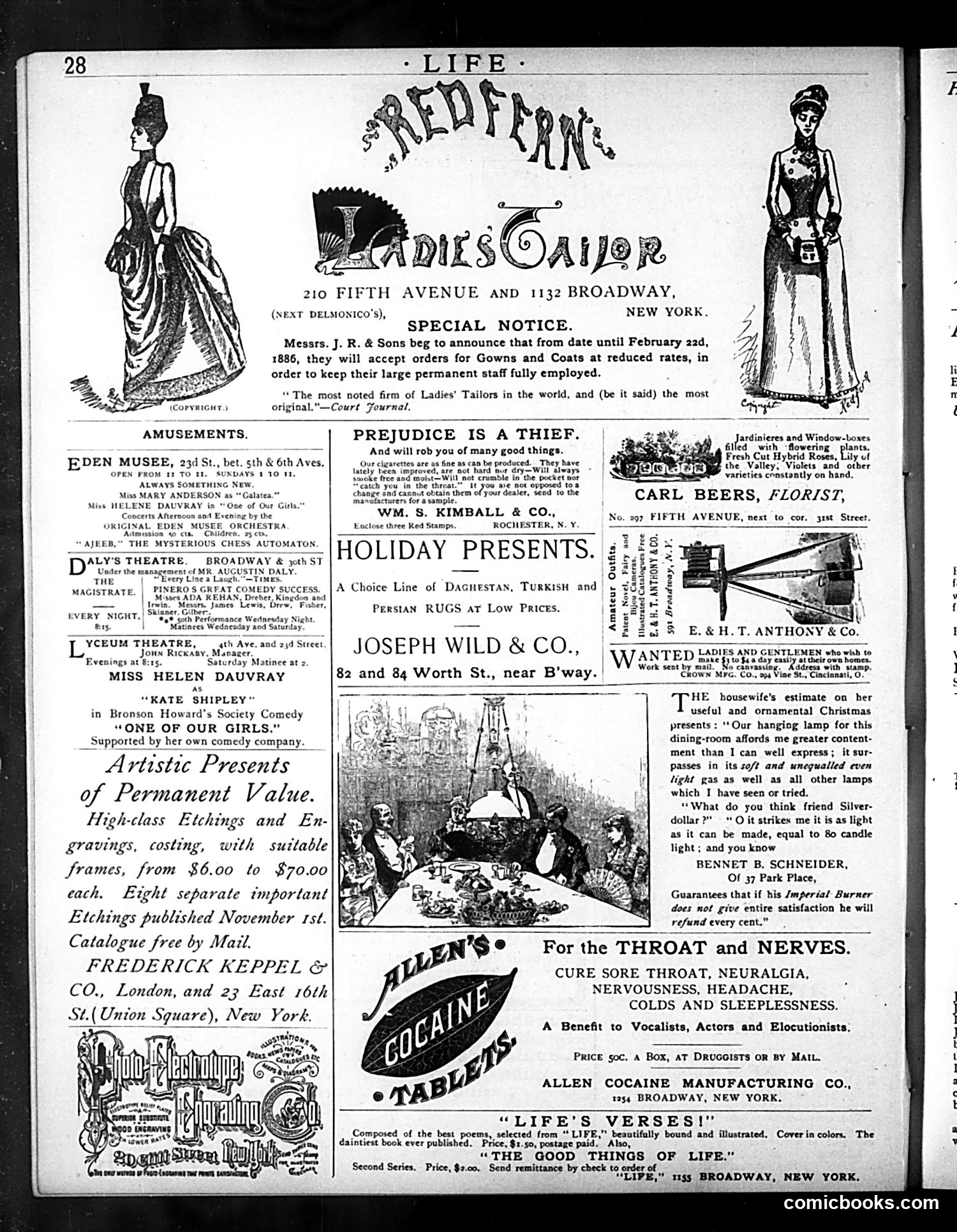
This is primarily a **commercial advertising page** with one substantive editorial piece. The main illustrated content is the **"Prejudice Is a Thief"** moral essay by WM. S. Kimball & Co. (a tobacco company). The accompanying engraving depicts a personified "Prejudice" as a thief robbing a man, warning consumers against brand bias—a self-interested pitch encouraging readers to try their products despite competitor loyalty. The page is otherwise dominated by **advertisements** for New York businesses: ladies' tailors (Redfern), theaters, rug merchants, flower shops, photography studios, and notably **Allen Cocaine Tablets**—marketed as a cure for sore throat and nervousness. This reflects the era before cocaine regulation; such products were legally sold as patent medicines. The amusement listings advertise contemporary theater productions featuring performers like Miss Helen Dauvray. The "**Special Notice**" from Redfern's tailor shop announces reduced rates through February 1886 to keep their staff employed, suggesting economic pressure during this period.
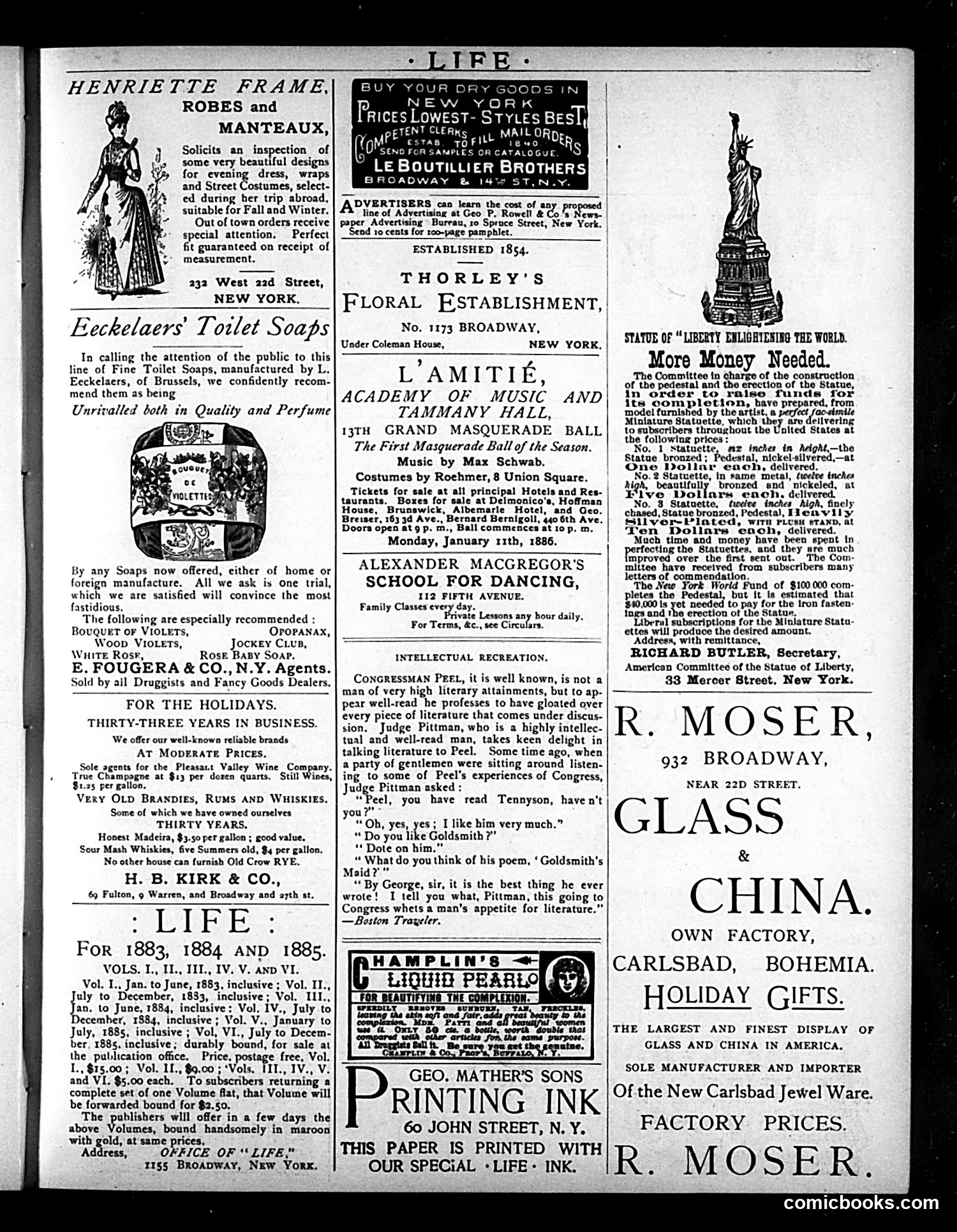
This page is primarily **advertising** for New York City businesses and services from January 1886, with no significant political cartoons or satirical content visible. The one editorial piece, titled "Intellectual Recreation," presents a **mild satirical anecdote**: It describes Congressman Peel, a man of limited education who pretends to be well-read to appear cultured. At a social gathering, he's overheard claiming to admire literary figures and Tennyson extensively. When asked by Judge Pittman if he's read Tennyson, Peel enthusiastically claims he has, though his confusion about basic literary references (mistaking Goldsmith's identity) reveals his pretense. The joke mocks politicians who affect intellectual sophistication they don't possess. This reflects late 19th-century satire targeting self-important public figures and class pretension.
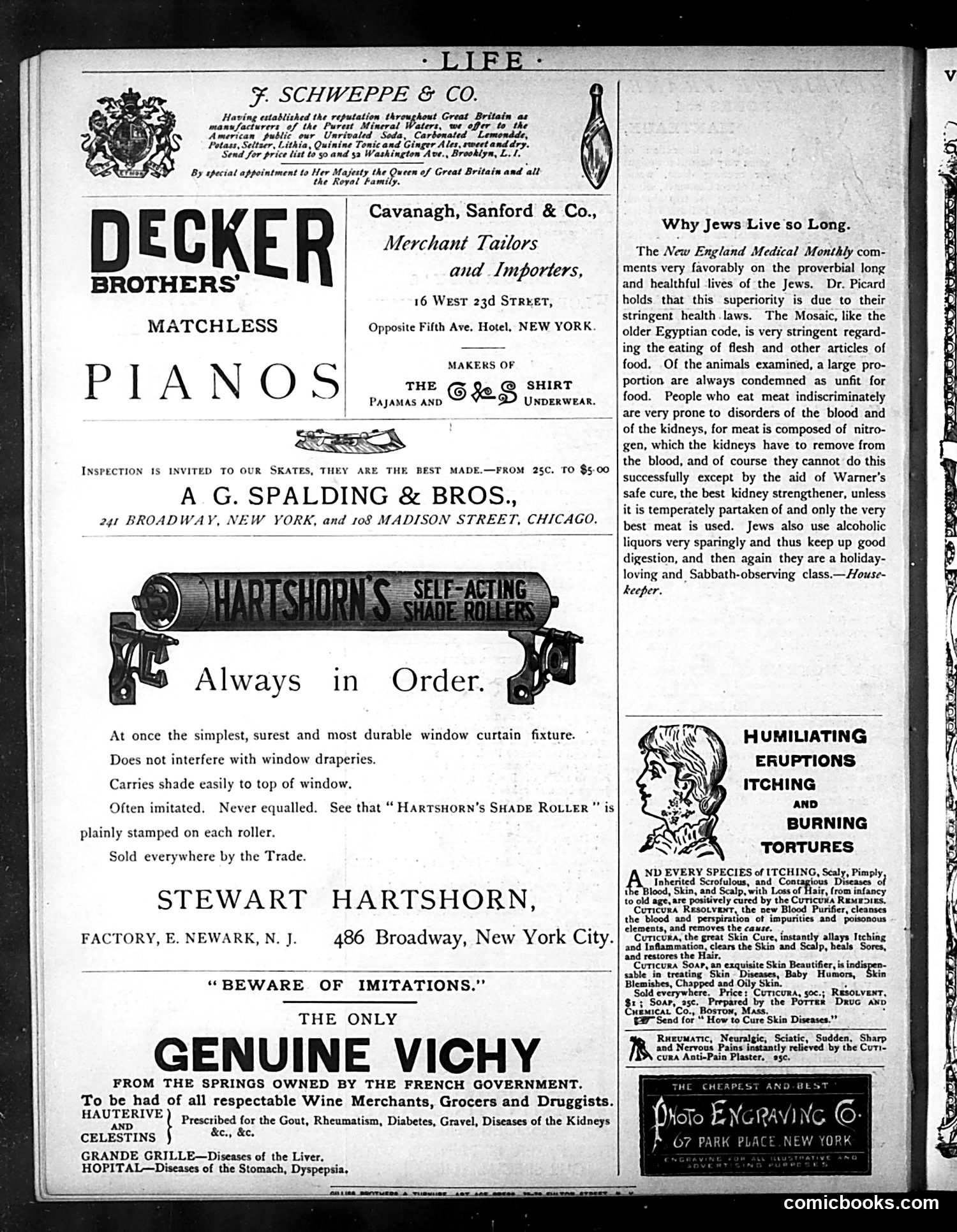
This page is primarily **commercial advertising**, not political cartoons or satire. It contains no satirical content requiring historical interpretation. The right column includes a brief editorial piece titled "Why Jews Live so Long," which references a *New England Medical Monthly* article. It attributes Jewish longevity to adherence to Mosaic dietary laws (kosher restrictions), moderate alcohol consumption, and observance of the Sabbath. The piece then pivots to promoting Warner's kidney cure—a common 19th-century patent medicine tactic of co-opting health claims for commercial purposes. The rest of the page advertises pianos, merchant tailors, window shade rollers, imported mineral water, and various patent medicines (Vichy water, Cuticura remedies). These are standard period advertisements with no satirical or political dimension.