
Life, 1886-01-07 · page 6 of 16
Life — January 7, 1886 — page 6: what you’re looking at
What you’re looking at
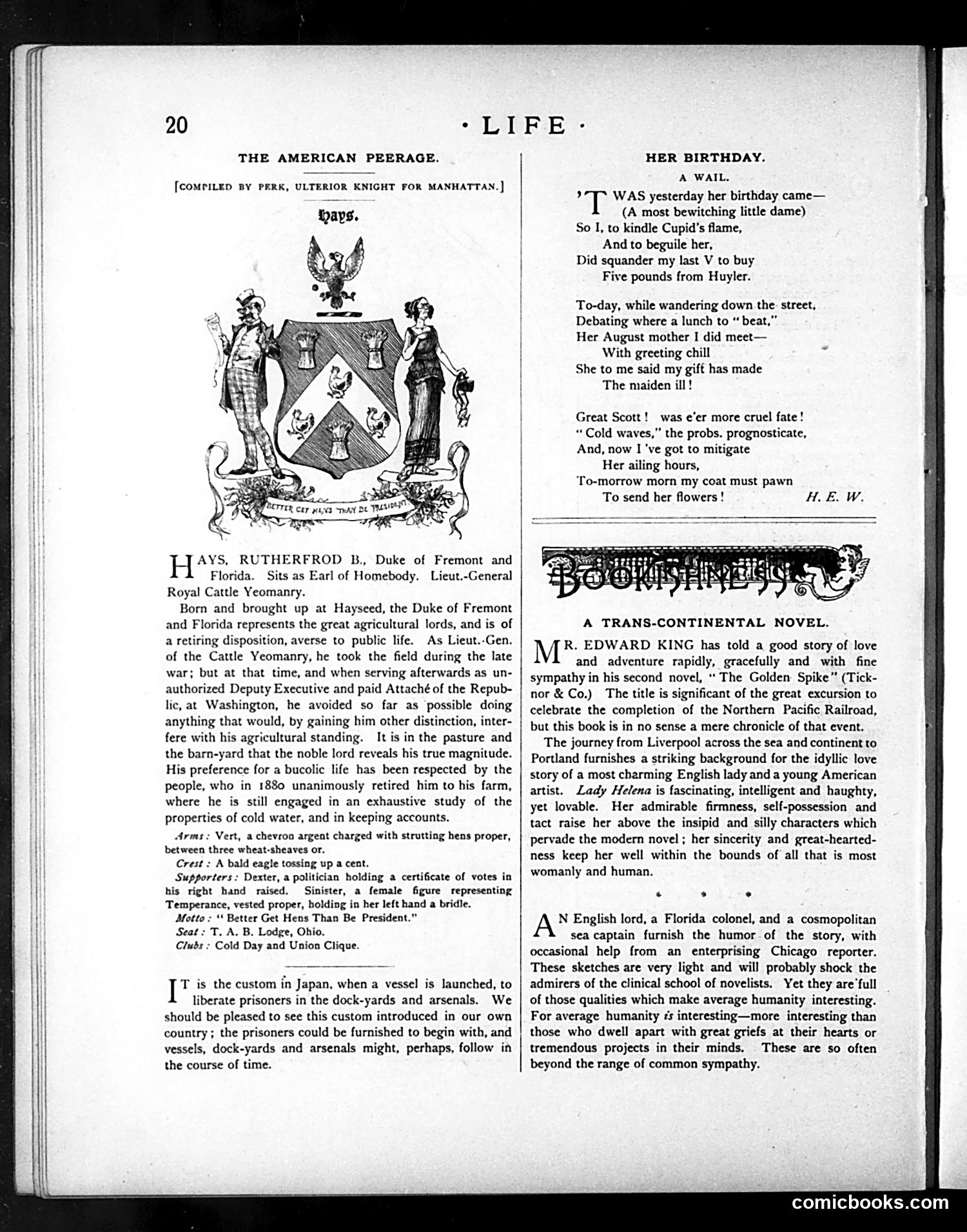
This heraldic coat of arms satirizes **Rutherford B. Hayes**, Duke of Fremont and Florida, presented as American nobility. The text explains Hayes represents "great agricultural lords" yet reveals his true character through his farm management during and after the Civil War, particularly his avoidance of military service while holding a government position. The satire mocks the pretension of treating American political figures as European aristocracy—a common *Life* magazine critique of the Gilded Age elite. By granting Hayes a mock-heraldic pedigree with supporters and heraldic symbols, the cartoonist ridicules both his social pretensions and his actual record: avoiding distinction while accumulating agricultural wealth and political power.
📄 Transcribed text from this page (OCR, searchable)
Machine-transcribed from the original scan — historical spelling and the odd misread are preserved.
20 THE AMERICAN PEERAGE. [coMPILED BY PERK, ULTERIOR KNIGHT FOR MANHATTAN. ] AYS, RUTHERFROD B., Duke of Fremont and Florida. Sits as Earl of Homebody. Lieut.-General Royal Cattle Yeomanry. Born and brought up at Hayseed, the Duke of Fremont and Florida represents the great agricultural lords, and is of a retiring disposition, averse to public life. As Lieut.-Gen. of the Cattle Yeomanry, he took the field during the late war; but at that time, and when serving afterwards as un- authorized Deputy Executive and paid Attaché of the Repub- lic, at Washington, he avoided so far as possible doing anything that would, by gaining him other distinction, inter- fere with his agricultural standing. It is in the pasture and the barn-yard that the noble lord reveals his true magnitude. His preference for a bucolic life has been respected by the people, who in 1880 unanimously retired him to his farm, where he is still engaged in an exhaustive study of the properties of cold water, and in keeping accounts. Arms: Vert, a chevron argent charged with strutting hens proper, between three wheat-sheaves or. Crest ; A bald eagle tossing up a cent. Supporters: Dexter, a politician holding a certificate of votes in his right hand raised. Sinister, a female figure representing Temperance, vested proper, holding in her left hand a bridle. Motto: “ Better Get Hens Than Be President.” Seat ; T. A. B. Lodge, Ohio. Clubs : Cold Day and Union Clique. I’ is the custom in Japan, when a vessel is launched, to liberate prisoners in the dock-yards and arsenals. We should be pleased to see this custom introduced in our own country ; the prisoners could be furnished to begin with, and vessels, dock-yards and arsenals might, perhaps, follow in the course of time. “LIFE: HER BIRTHDAY. A WAIL, ’ WAS yesterday her birthday came— (A most bewitching little dame) So I, to kindle Cupid's flame, And to beguile her, Did squander my last V to buy Five pounds from Huyler. To-day, while wandering down the: street, Debating where a lunch to “ beat,” Her August mother I did meet— With greeting chill She to me said my gift has made The maiden ill! Great Scott! was e’er more cruel fate! “Cold waves,” the probs. prognosticate, And, now I ‘ve got to mitigate Her ailing hours, ‘To-morrow morn my coat must pawn To send her flowers! HALE. W. A TRANS-CONTINENTAL NOVEL. R. EDWARD KING has told a good story of love and adventure rapidly, gracefully and with fine sympathy in his second novel, “ The Golden Spike” (Tick- nor & Co.) The title is significant of the great excursion to celebrate the completion of the Northern Pacific Railroad, but this book is in no sense a mere chronicle of that event. The journey from Liverpool across the sea and continent to Portland furnishes a striking background for the idyllic love story of a most charming English lady and a young American artist. Lady Helena is fascinating, intelligent and haughty, yet lovable. Her admirable firmness, self-possession and tact raise her above the insipid and silly characters which pervade the modern novel ; her sincerity and great-hearted- ness keep her well within the bounds of all that is most womanly and human, . . . AY English lord, a Florida colonel, and a cosmopolitan sea captain furnish the humor of the story, with occasional help from an enterprising Chicago reporter. These sketches are very light and will probably shock the admirers of the clinical school of novelists. Yet they are’full of those qualities which make average humanity interesting. For average humanity ¢s interesting—more interesting than those who dwell apart with great griefs at their hearts or tremendous projects in their minds. These are so often beyond the range of common sympathy. comicbooks.com