
Life, 1886-01-07 · page 10 of 16
Life — January 7, 1886 — page 10: what you’re looking at
What you’re looking at
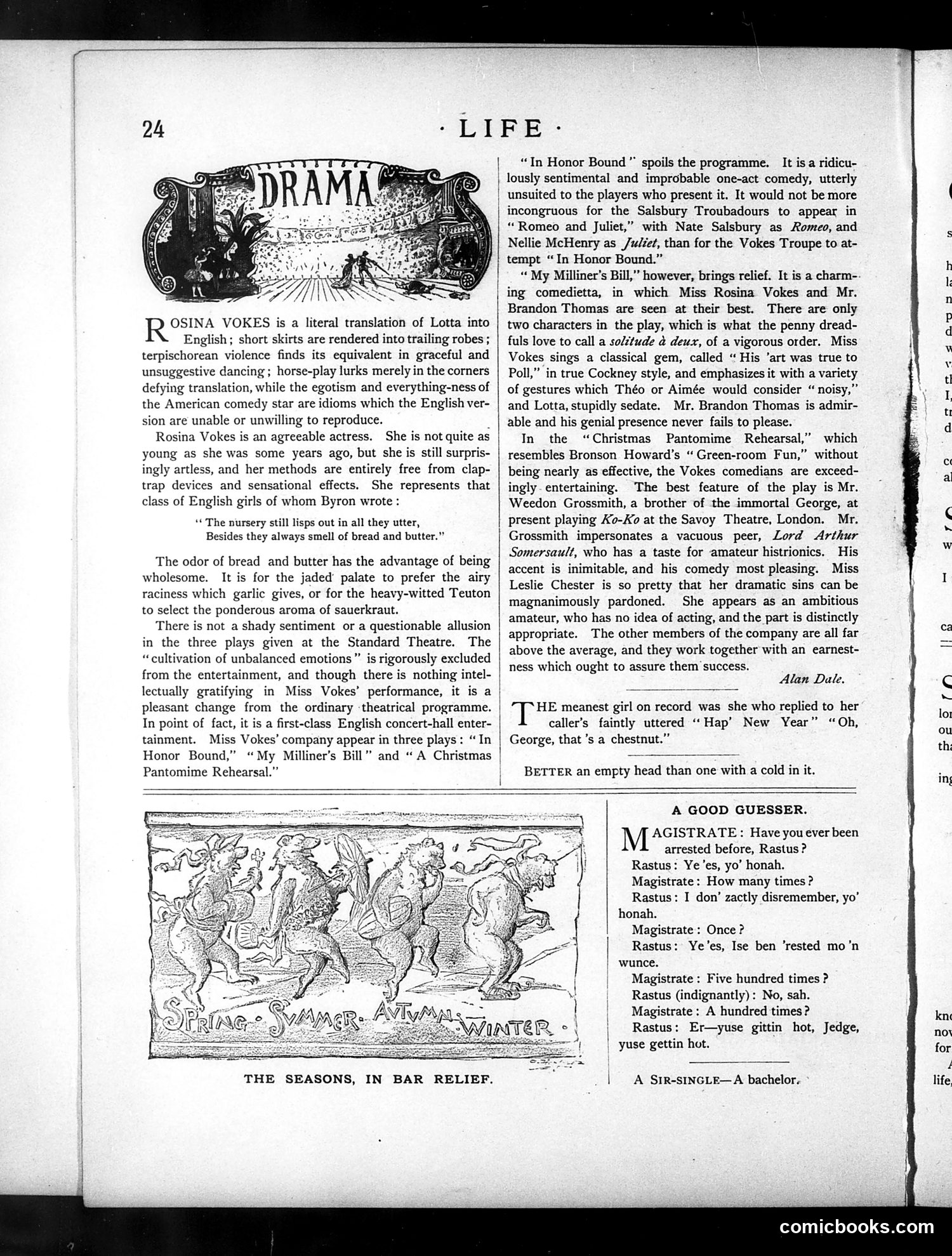
This page contains **theater reviews**, not political satire. The main content criticizes actress **Rosina Vokes**, an English performer presenting three plays at the Standard Theatre. The review contrasts English and American theatrical styles—English actresses like Vokes are modest and wholesome ("smell of bread and butter"), while American stars employ "horse-play" and sensational effects. The critic praises Vokes's artlessness but finds her three-play program uneven: "In Honor Bound" is dismissed as inappropriately sentimental, "My Milliner's Bill" is charming, and the "Christmas Pantomime Rehearsal" is entertaining largely due to **Weedon Grossmith's** comic performance as Lord Arthur Somersault. The bar-relief illustration below shows allegorical figures representing the seasons—decorative rather than satirical. The page reflects **Victorian-era theater criticism**, valuing refined entertainment over crude sensationalism. References to contemporary performers (Nate Salsbury, Lotta) are meaningful only to period audiences.
📄 Transcribed text from this page (OCR, searchable)
Machine-transcribed from the original scan — historical spelling and the odd misread are preserved.
24 - LIFE Ros VOKES is a literal translation of Lotta into English; short skirts are rendered into trailing robes ; terpischorean violence finds its equivalent in graceful and unsuggestive dancing ; horse-play lurks merely in the corners defying translation, while the egotism and everything-ness of the American comedy star are idioms which the English ver- sion are unable or unwilling to reproduce. Rosina Vokes is an agreeable actress. She is not quite as young as she was some years ago, but she is still surpris- ingly artless, and her methods are entirely free from clap- trap devices and sensational effects. She represents that class of English girls of whom Byron wrote : ‘The nursery still lisps out in all they utter, Besides they always smell of bread and butter.” The odor of bread and butter has the advantage of being wholesome. It is for the jaded’ palate to prefer the airy raciness which garlic gives, or for the heavy-witted Teuton to select the ponderous aroma of sauerkraut. There is not a shady sentiment or a questionable allusion in the three plays given at the Standard Theatre. The “cultivation of unbalanced emotions” is rigorously excluded from the entertainment, and though there is nothing intel- | lectually gratifying in Miss Vokes’ performance, it is a | pleasant change from the ordinary ‘theatrical programme. In point of fact, it is a first-class English concert-hall enter- tainment. Honor Bound,” “My Milliner’s Bill” and “ A Christmas Pantomime Rehearsal.” Miss Vokes’ company appear in three plays: “In | | “In Honor Bound” spoils the programme. It is a ridicu- lously sentimental and improbable one-act comedy, utterly | unsuited to the players who present it. It would not be more incongruous for the Salsbury Troubadours to appear in “Romeo and Juliet,” with Nate Salsbury as Romeo, and Nellie McHenry as /u/ze?, than for the Vokes Troupe to at- tempt “In Honor Bound.” “My Milliner’s Bill,” however, brings relief. It is a charm- | ing comedietta, in which Miss Rosina Vokes and Mr. Brandon Thomas are seen at their best. There are only two characters in the play, which is what the penny dread- fuls love to call a solztude 4 deux, of a vigorous order. Miss Vokes sings a classical gem, called “ His ‘art was true to Poll,” in true Cockney style, and emphasizes it with a variety of gestures which Théo or Aimée would consider “ noisy,” and Lotta, stupidly sedate. Mr. Brandon Thomas is admir- able and his genial presence never fails to please. In the “Christmas Pantomime Rehearsal,” which resembles Bronson Howard’s “ Green-room Fun,” without being nearly as effective, the Vokes comedians are exceed- ingly- entertaining. The best feature of the play is Mr. ‘Weedon Grossmith, a brother of the immortal George, at present playing Ko-Ko at the Savoy Theatre, London. Mr. | Grossmith impersonates a vacuous peer, Lord Arthur Somersault, who has a taste for amateur histrionics. His accent is inimitable, and his comedy most pleasing. Miss Leslie Chester is so pretty that her dramatic sins can be magnanimously pardoned. She appears as an ambitious amateur, who has no idea of acting, and the part is distinctly appropriate. The other members of the company are all far above the average, and they work together with an earnest- ness which ought to assure them success. Alan Dale, HE meanest girl on record was she who replied to her caller’s faintly uttered ‘Hap’ New Year” “Oh, George, that ’s a chestnut.” THE SEASONS, IN BAR RELIEF. A GOOD GUESSER. AGISTRATE: Have you ever been arrested before, Rastus ? Rastus: Ye’es, yo’ honah. Magistrate: How many times? Rastus: I don’ zactly disremember, yo’ honah. Magistrate: Once ? Rastus: Ye’es, Ise ben ‘rested mo’n | wunce, Magistrate : Five hundred times ? Rastus (indignantly): No, sah. Magistrate: A hundred times? Rastus: Er—yuse gittin hot, Jedge, | yuse gettin hot. | A S1r-SINGLE—A bachelor. Te es Casa be eae ee agate kn no\ for life comicbooks.com