
A complete issue · 18 pages · 1885
Life — November 19, 1885
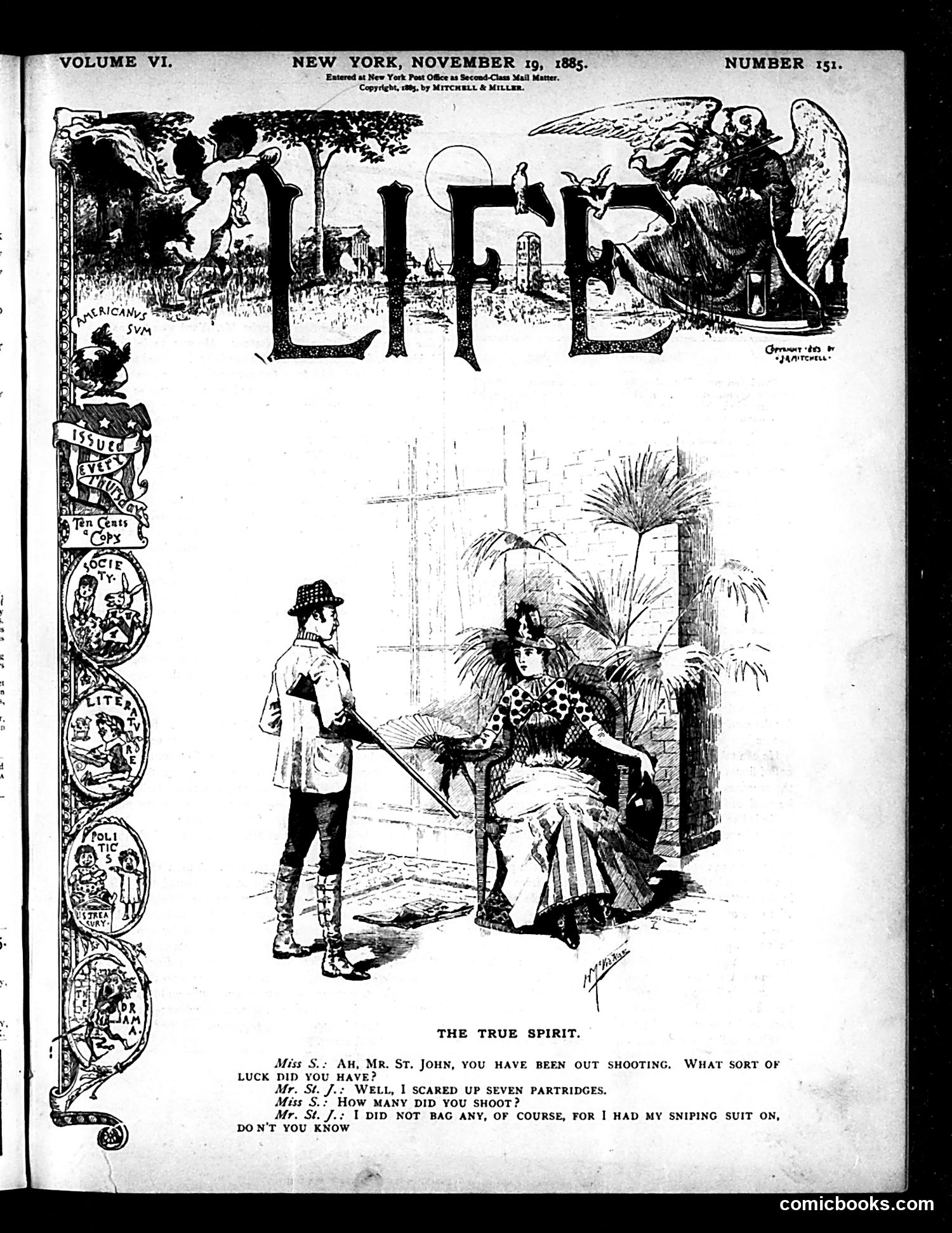
This cartoon satirizes gender roles and hunting culture among the Victorian upper class. A man (Mr. St. John) returns from a shooting expedition, and his female companion (Miss S.) inquires about his hunting success. The humor lies in his response: he shot no game because he forgot his "sniping suit"—suggesting he prioritized fashionable hunting attire over actual hunting competence. The satire targets two things: the pretentiousness of wealthy sportsmen who care more about appearing the part than performing it, and the absurdity of women accepting such transparent excuses. The "true spirit" of the title is ironic—St. John demonstrates the opposite: vanity rather than genuine sportsman's dedication.
The cartoon's left panel depicts a figure labeled "THE" (partially visible) representing the "genius crank" — a prohibitionist crusader. The accompanying editorial attacks prohibitionists as self-righteous hypocrites who preach abstinence while engaging in dubious financial practices and moral compromises. The right panel discusses Ferdinand Ward, a financier involved in a major scandal (the text mentions stolen millions and "running away"). The piece sarcastically contrasts Ward's crimes with the moral posturing of prohibitionists, suggesting wealthy criminals escape accountability while reformers focus on controlling the poor's behavior. The editorial critiques the hypocrisy of elite reformers and an "aristocracy of wealth" that operates by different rules than ordinary citizens, particularly regarding the "Sing Sing dungeon" (prison).
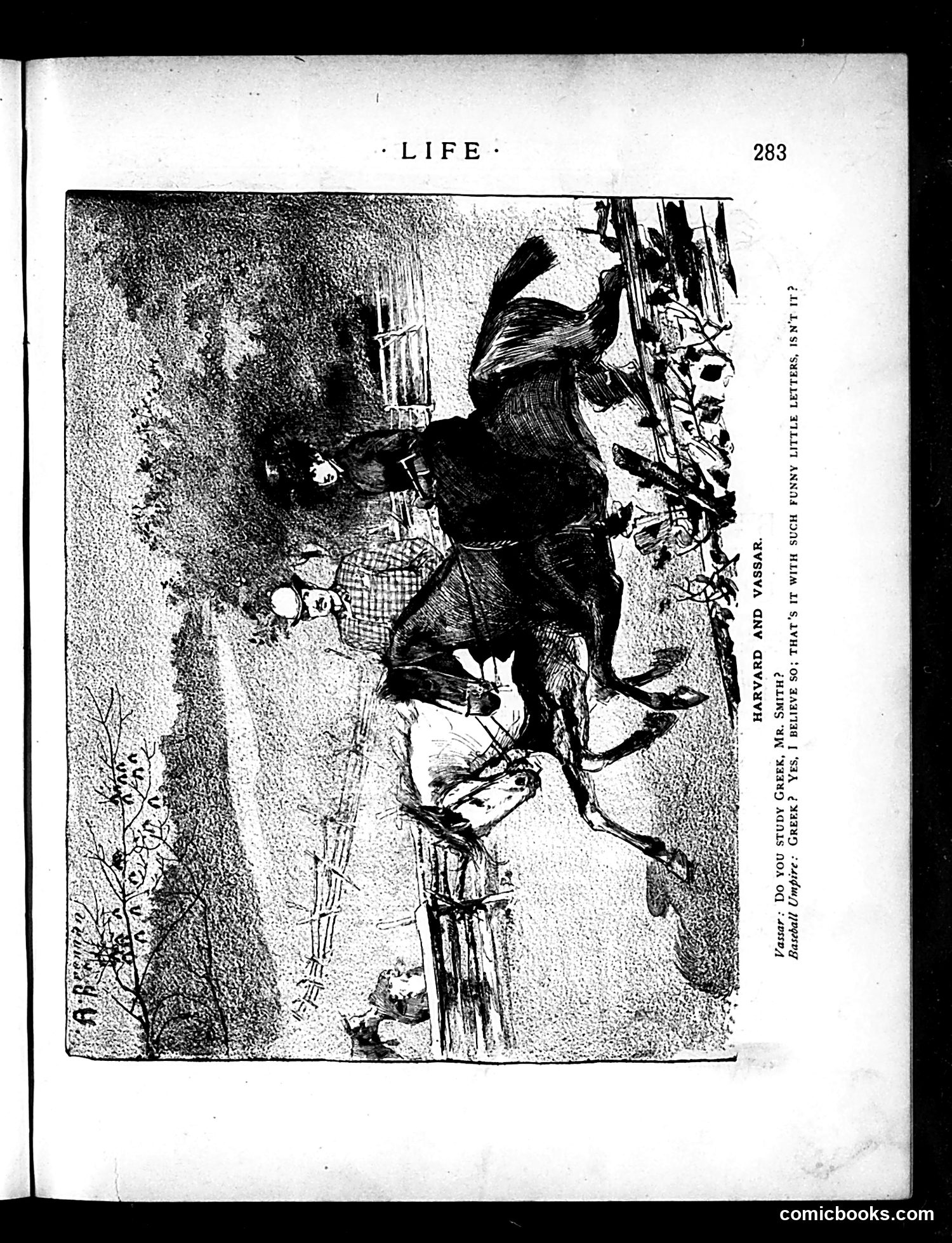
The caption reads: "PRATER DO YOU STUDY GREEK, MR. SMITH? / BEARDED TROPHIES? YES, I BELIEVE SO THAT'S IT WITH SUCH LITTLE LETTERS INSIST?" This appears to be a satirical cartoon about language study or academic pretension. The image shows a figure (presumably "Mr. Smith") with exaggerated features being questioned about Greek studies. The humor seems to mock someone claiming classical education credentials they don't fully possess—note the confusion over "Greek" and the dismissive "little letters" comment. The satire likely targets Victorian-era social climbing or academic snobbery, where people claimed cultural sophistication without genuine knowledge. The bearded figure's appearance and the questioner's condescending tone reinforce this critique of affected intellectualism. Without clearer context about the specific date or public figures involved, the exact target remains somewhat unclear.
The page contains satirical commentary and short humor pieces rather than a political cartoon. Key content includes: **"An Idyll of Mugwumpery"** — A poem mocking Republican "Mugwumps" (independent Republicans who switched allegiance), depicted as indecisive about political outcomes. **Political commentary** addresses Republican Party failures, General Carr's potential defeat, and Republican strategy regarding the "Bloody Shirt" (Reconstruction-era rhetoric) versus newer "Tweed Collar" politics—referencing Boss Tweed's corruption scandals. **Other items mock**: Football violence at colleges, Carl Schurz's newspaper editing career, and a child with many grandparents (implying illegitimacy). The page reflects 1870s-80s American politics, particularly Reconstruction-era Republican discord and debates over party identity.
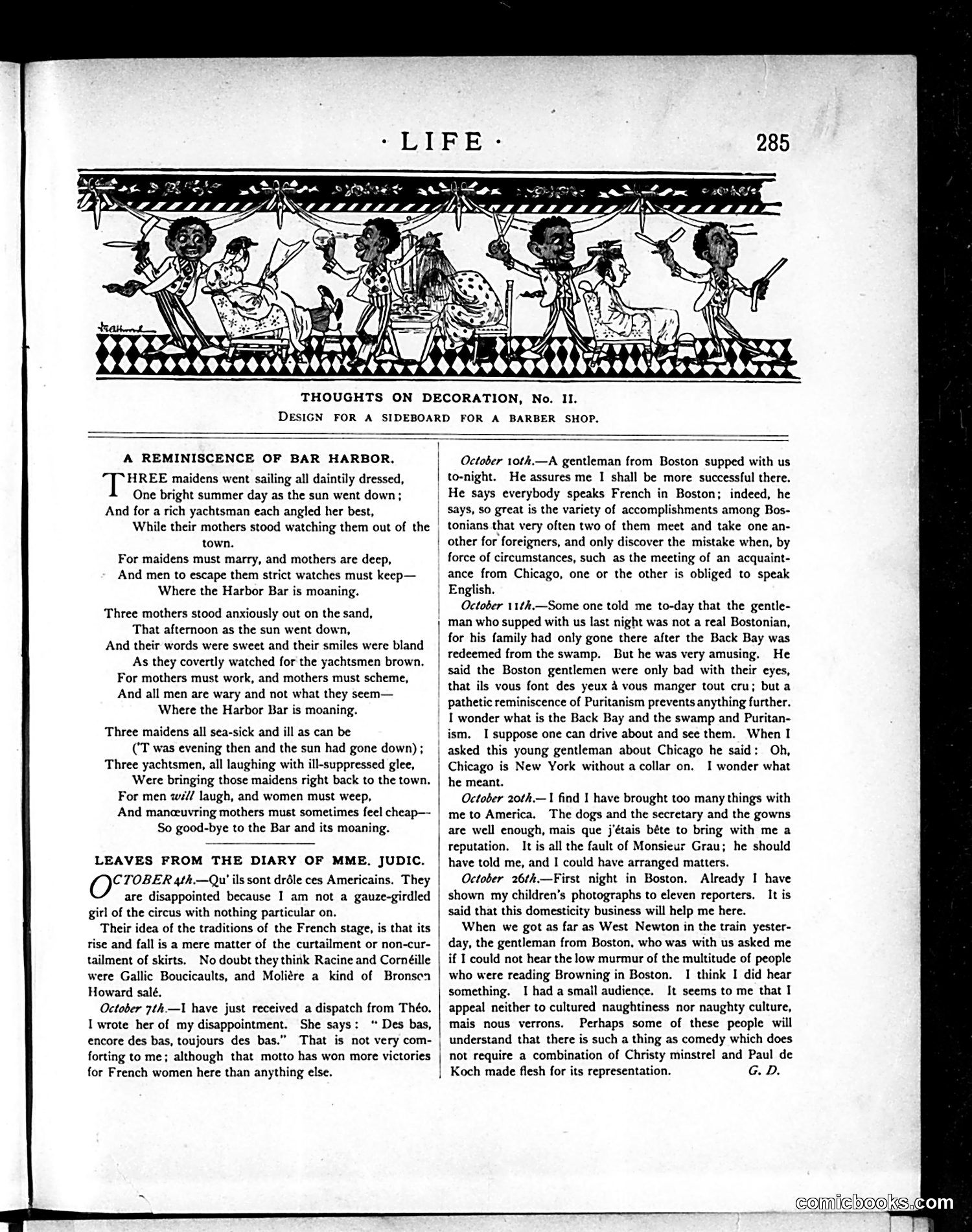
This page contains two distinct sections: **"Thoughts on Decoration, No. II"** features a decorative frieze design for a barber shop sideboard, showing caricatured figures in exaggerated poses engaged in grooming and barbering activities. The art style employs racial caricature typical of early 20th-century satirical magazines. **"A Reminiscence of Bar Harbor"** is a poem romanticizing a seaside resort location, while **"Leaves from the Diary of Mme. Judic"** consists of diary entries mocking French theatrical traditions and critiquing American society through a French visitor's perspective. The entries satirize perceived differences between French and American cultural values, gender roles, and social customs, with commentary on Boston society and American pretensions. The content reflects period attitudes about class, nationality, and gender.
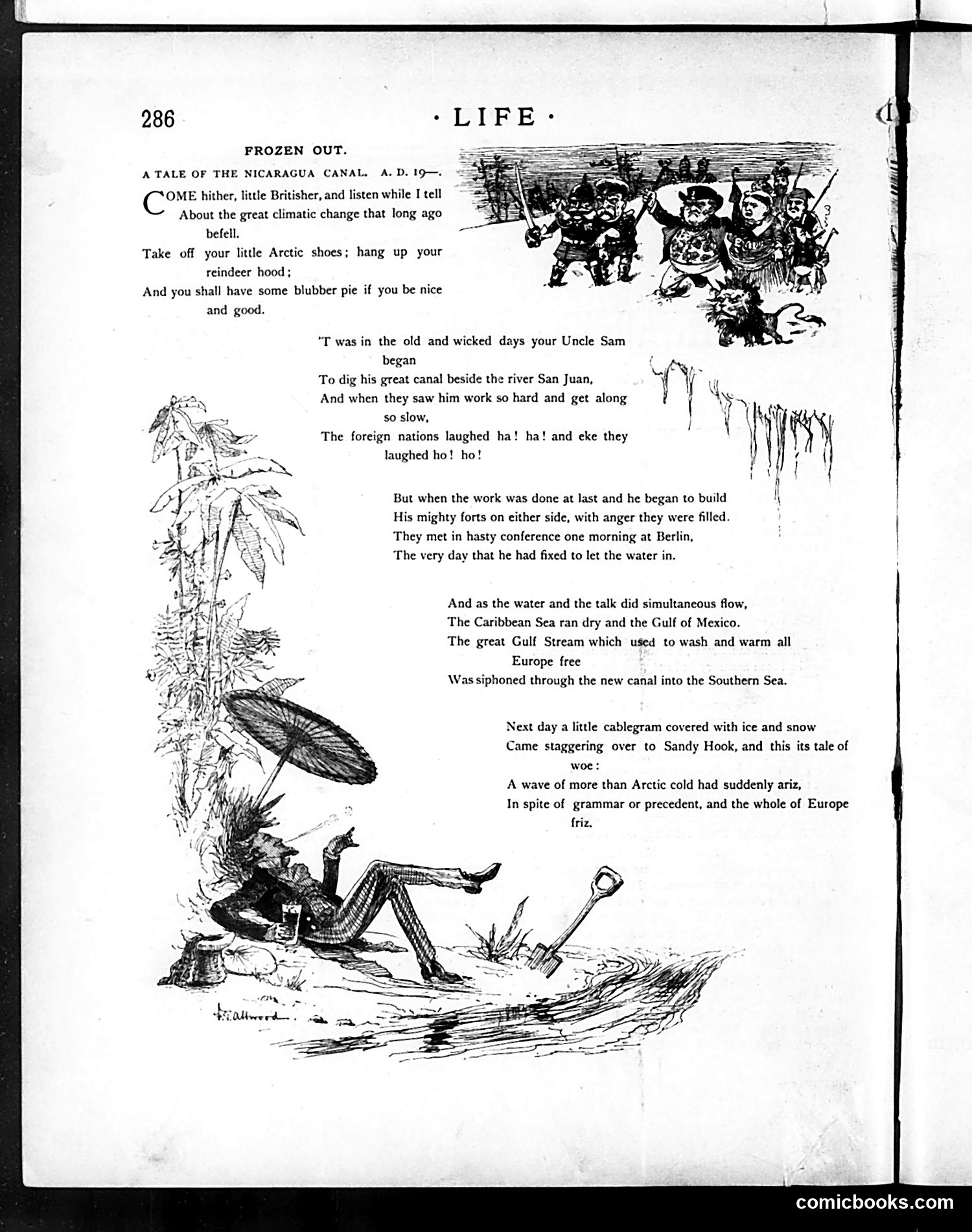
This satirical piece mocks the failed Nicaragua Canal project. The narrative describes Uncle Sam (personified U.S. government) attempting to dig a canal beside the San Juan River, while foreign nations laugh at his slow progress. The satire's punchline: when the work finally completes and he begins fortifying it, European powers meet in Berlin, angrily fixing the water level. As a result, the Caribbean Sea drains, the Gulf of Mexico empties, and the Gulf Stream is diverted southward—freezing Europe. The final image shows a frozen European figure, illustrating the consequence: Arctic cold replaces the warming Gulf Stream. This critiques both American canal ambitions and international diplomatic tensions over Central American interests during the late 19th/early 20th century.
This page contains literary criticism and book reviews rather than political cartoons. The main content discusses: **"A Poet Who Is Not Bostonese"** — a review of Richard Watson Gilder's poetry collection, praising his "absolute worth and truth" and contrasting his work with modern "philosophy of disenchantment." **Brief notices** about: - Sidney Luska (actually Henry Harland) and his Poe-influenced stories - Alan Dale's satire of American life called "Jonathan's Home" - The *Albanian* magazine from Albany, New York The decorative "Book Notices" header features ornamental typography typical of the era. This appears to be a cultural criticism section aimed at educated readers interested in contemporary literature, with no political satire evident on this particular page.
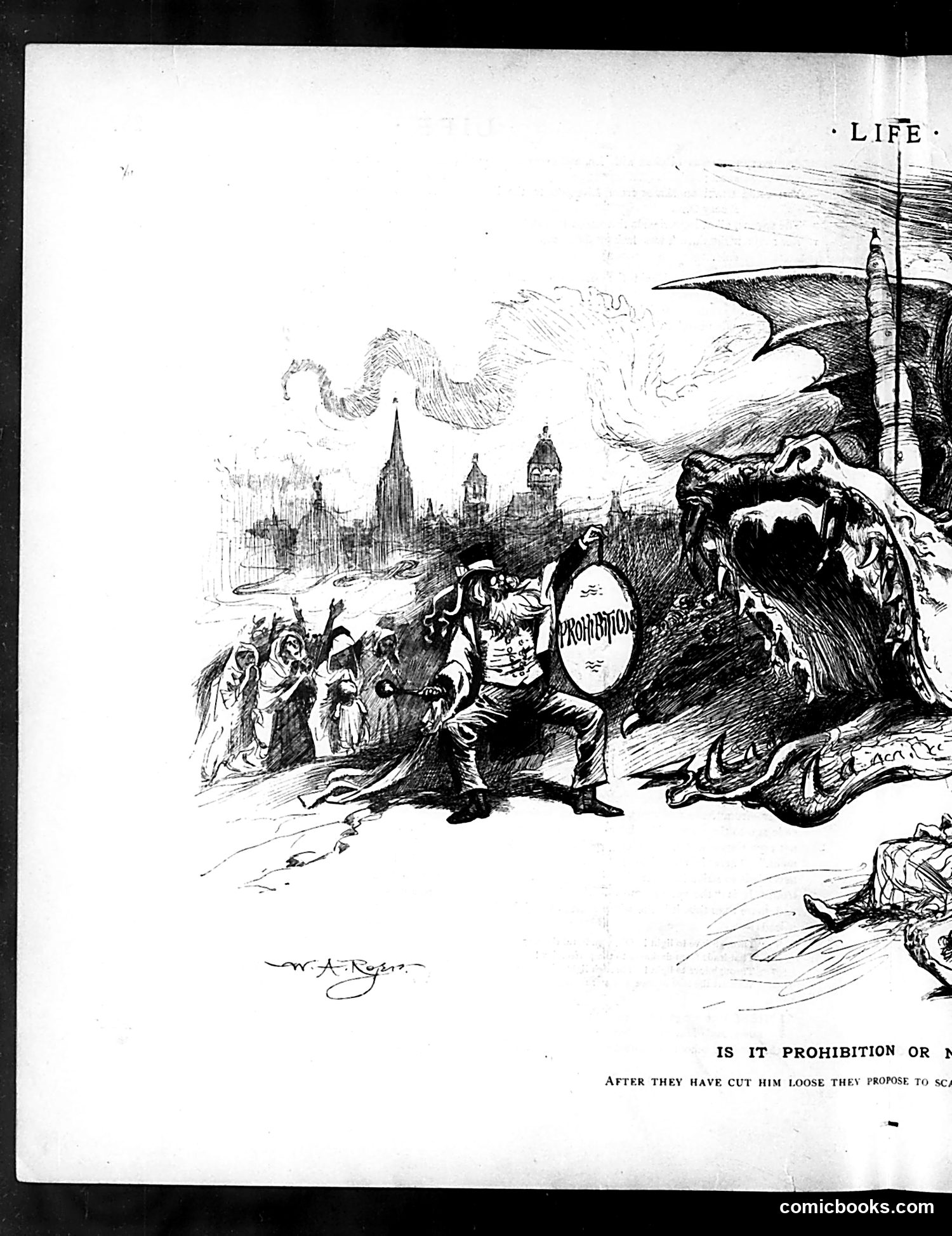
This is a satirical cartoon about Prohibition, likely from the 1920s-early 1930s based on the "PROHIBITION" label visible on a shield/emblem in the center. The cartoon depicts a demonic or monstrous figure wielding Prohibition as a weapon against a group of people approaching a cityscape in the background. The satire criticizes Prohibition as a destructive force—portrayed as something evil or harmful rather than protective. The caption fragment "IS IT PROHIBITION OR..." and reference to cutting someone "loose" suggests the cartoon questions whether Prohibition itself is the real problem, mocking the policy's consequences. The cartoonist (signed "W.A. Rogers") depicts Prohibition's enforcement as tyrannical and socially corrosive, a common anti-Prohibition argument during this period.
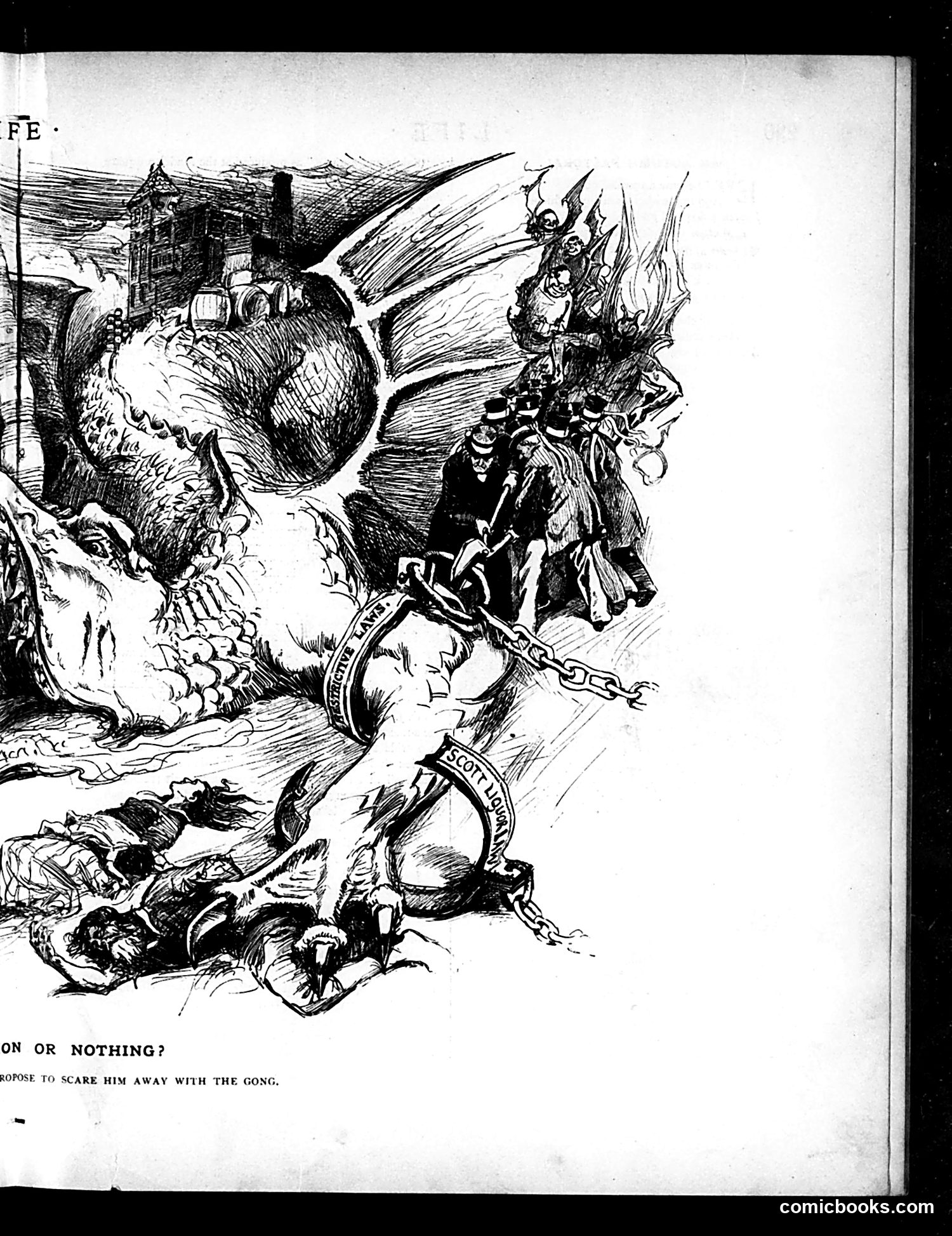
This appears to be a satirical illustration from Life magazine depicting a fantastical scene. The visible text fragments read "ON OR NOTHING?" and "PROPOSE TO SCARE HIM AWAY WITH THE GONG," suggesting a narrative about intimidation or threat. The image shows a large, grotesque creature or demon-like figure with elaborate details, confronting smaller human figures in period dress. One figure appears chained. In the background, a castle or fortified structure is visible. Without the full caption or complete text, the specific political reference is unclear. However, this appears to be late 19th or early 20th-century political satire, possibly commenting on military threats, international relations, or domestic political conflict. The "gong" reference suggests an attempt to frighten away the central threatening figure through noise or pageantry rather than substantive action—likely mocking ineffectual political responses to a serious threat.
This page combines poetry and drama criticism. The poem "An Autumn Pastoral" by Clinton Scollard is a sentimental romantic narrative about a young man's encounter with a rural girl—relatively conventional Victorian verse. The main content is a scathing review of Henry Arthur Jones's play "Saints and Sinners," produced at Madison Square Theatre. The critic systematically demolishes the production: the heroine Letty Fletcher is "a little fool," the villain Captain Fanshawe lacks military authenticity and motivation, and—most notably—the supporting actors deliver execrable provincial English dialects (specifically calling out L. F. Massen's unconvincing "mixture of New York and Old York"). The reviewer acknowledges Jones wrote successful plays like "The Silver King" but argues "Saints and Sinners" offers nothing novel—just predictable Scottish marriage melodrama that emotionally manipulates without artistic justification. The tone is dismissive and cutting throughout.
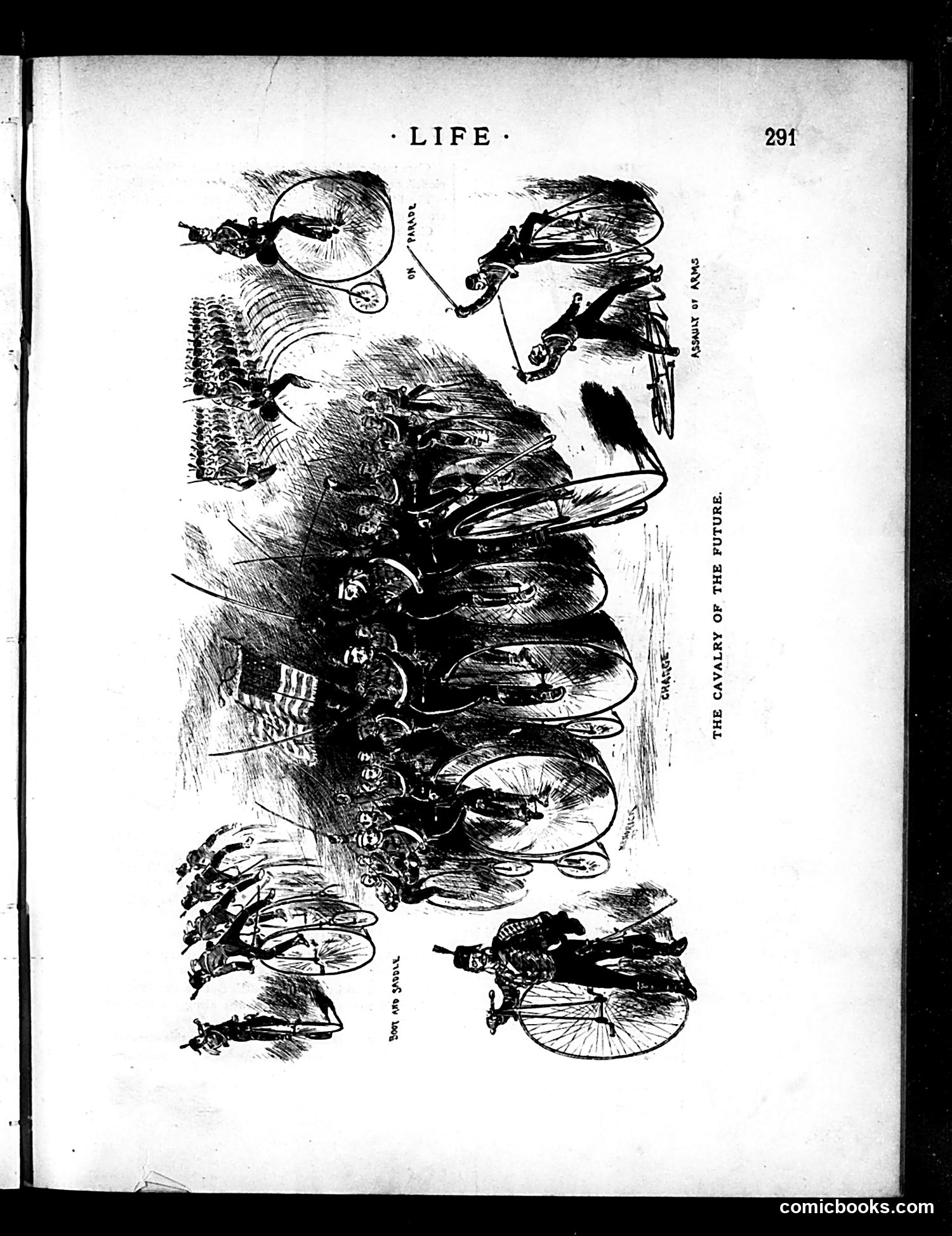
This page appears to be a satirical cartoon titled "The Rivalry of the Future" (visible on the right margin). The image shows a vertical stack of figures riding bicycles, rendered in dark ink with heavy cross-hatching. The cartoon likely satirizes competition or conflict, with "Assault of Arms" suggesting military rivalry. The stacked bicyclists may represent competing nations or political factions engaged in an escalating arms race or competition for dominance. The bicycle as the vehicle of this "assault" adds absurdist humor—contrasting the trivial bicycle with the serious notion of military arms buildup. The OCR text is heavily corrupted, making specific references unclear. Without legible text identifying particular figures or historical context, I cannot definitively explain which specific rivalry or conflict this mocks, though the imagery suggests early-to-mid 20th century political satire typical of Life magazine's editorial cartooning.
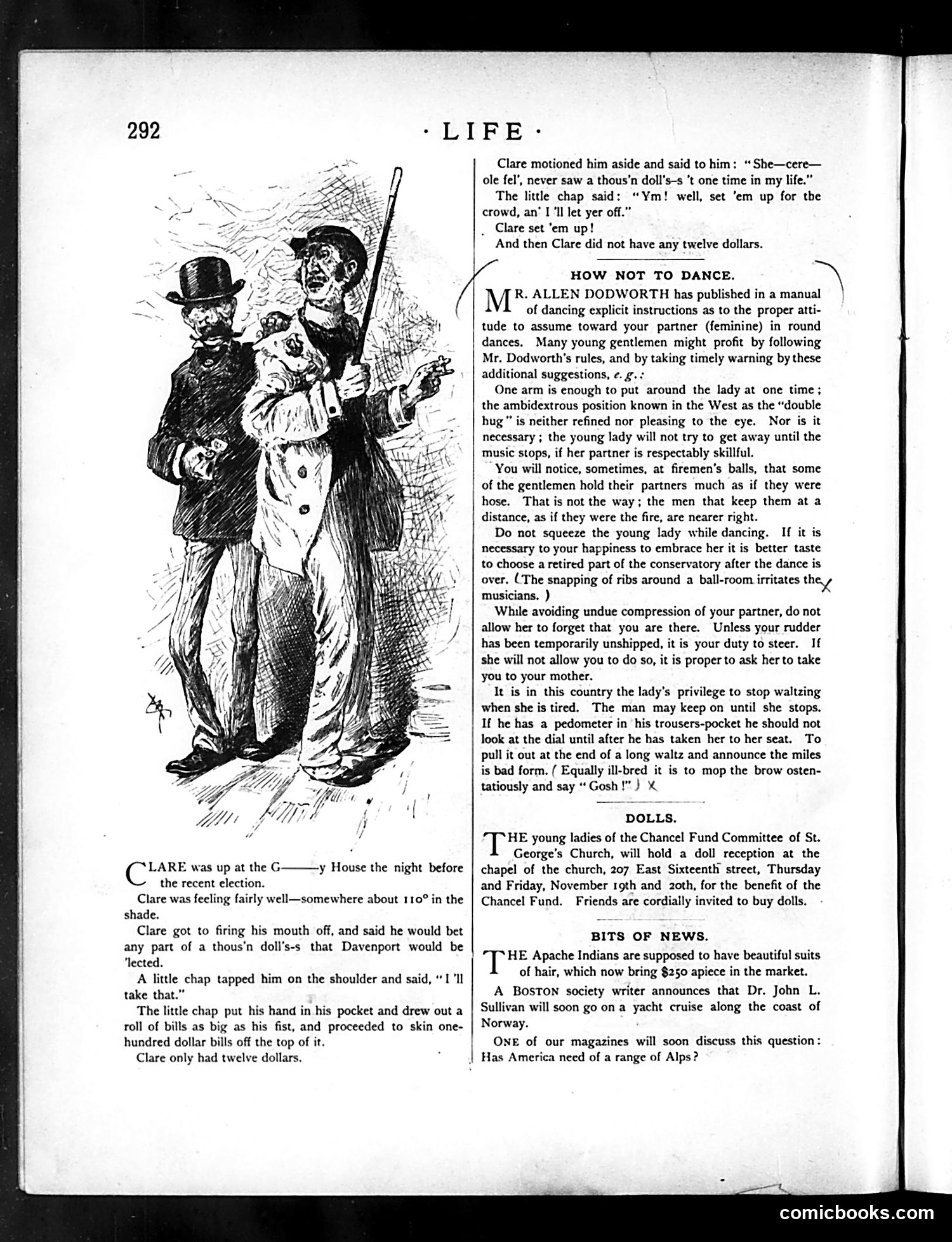
**The Main Cartoon** (left side): Depicts two men in Victorian dress—one appearing well-dressed and confident, the other disheveled. This illustrates the accompanying anecdote about "Clare" at an election-night gathering at what appears to be a political venue (the "G—y House"). Clare boasts he'll bet money that "Davenport" will win the election. A wealthy stranger calls his bluff, producing enormous cash and betting against him. When Clare backs down, the stranger buys drinks for everyone anyway, leaving Clare broke—a humorous tale of political bravado meeting real consequences. **"How Not to Dance"** (right side): Satirizes Mr. Allen Dodworth's dancing manual by offering exaggerated etiquette advice for men dancing with women. The humor targets overly familiar behavior—the "double hug," squeezing partners, checking pedometers during waltzes, and mopping one's brow ostentatiously. It mocks both crude masculine behavior and the pretensions of rigid social dancing rules. The page represents typical *Life* magazine satirical humor: poking fun at social pretension, election-season excess, and Victorian courtship conventions.
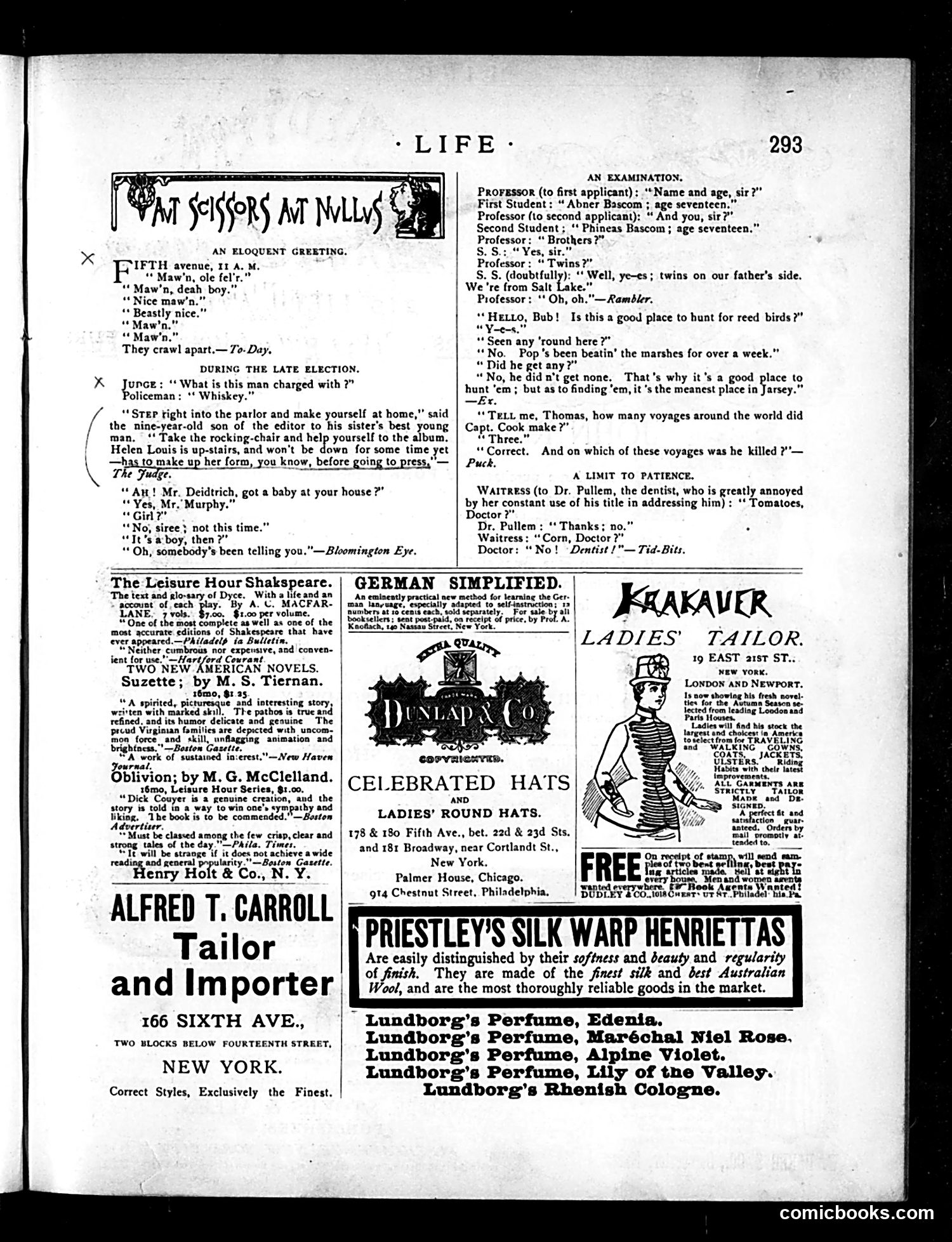
This page contains four brief comic sketches satirizing American social observations: **"An Eloquent Greeting"** (top): Depicts street-level interactions—a man passing a woman on Fifth Avenue; the humor involves unspoken class or social protocols about acknowledging acquaintances in public. **"During the Late Election"**: A judge questions a man arrested for whiskey-related charges, likely referencing debates over alcohol prohibition that were prominent during late-19th-century elections. **"An Examination"**: Jokes about identical twins from "Salt Lake" (referencing polygamy associations with the Mormon territory) being examined as one applicant. **"A Limit to Patience"**: A dentist repeatedly corrected by a waitress who keeps addressing him as "Doctor"—satire on Americans' casual title-dropping and lack of professional respect. The other content is pure **advertising**: tailor services, hat merchants, perfume companies, and books. This is standard for Life, which financed satire through commercial notices.
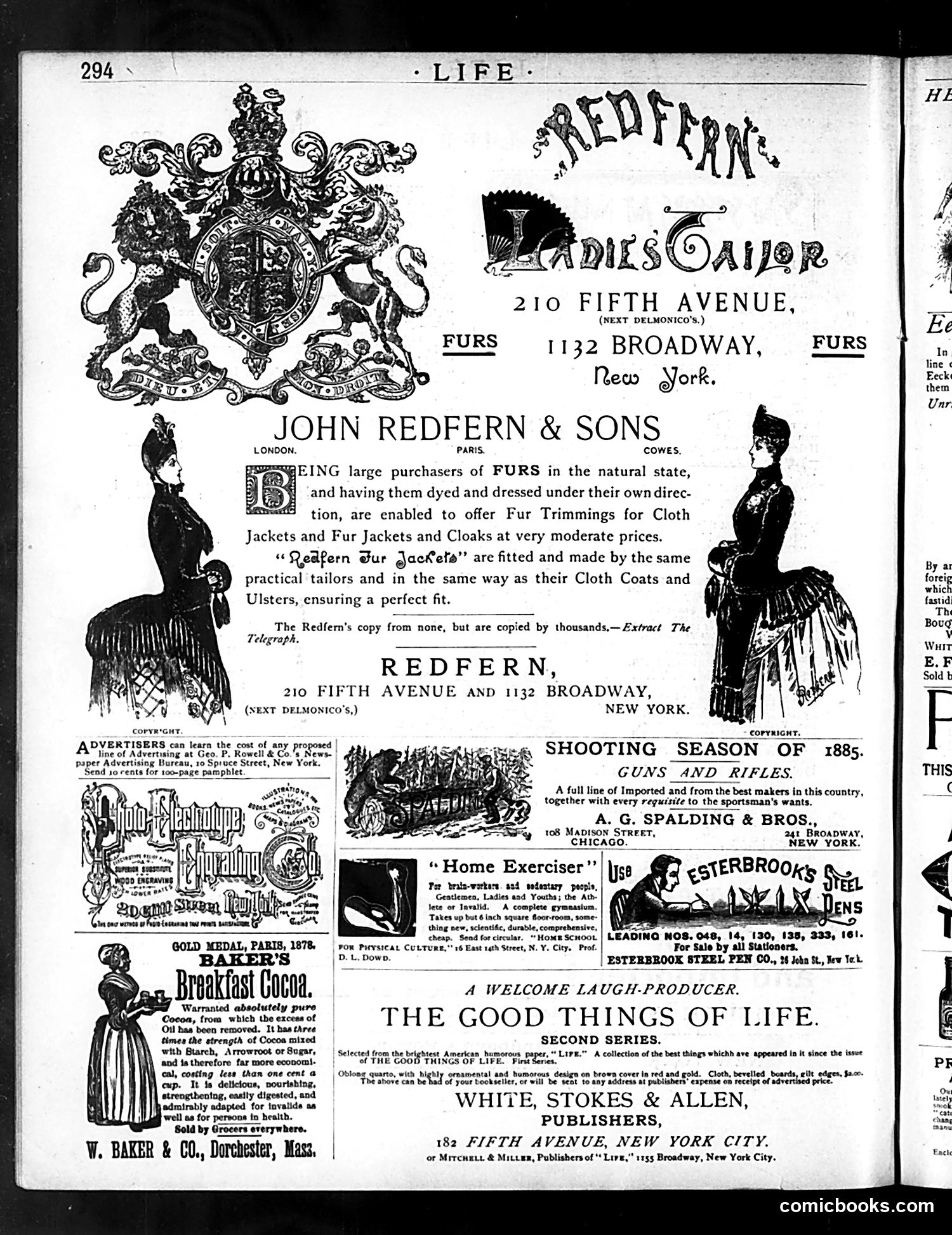
This is primarily an advertising page from *Life* magazine (circa 1885, based on the "Shooting Season of 1885" reference). The page contains no political cartoons or satire—it's a collection of commercial advertisements. Key advertisements include: - **Redfern** (top): A high-end furrier and dressmaker with locations on Fifth Avenue and Broadway, emphasizing that their designs are so popular they're "copied by thousands" - **Baker's Breakfast Cocoa** (bottom left): A nutritional product claiming superior strength compared to competitors - **Spalding & Bros.** (center): Sporting goods for the hunting season - **"Home Exerciser"** and **Esterbrook Steel Pens**: Exercise equipment and writing supplies The illustrations show fashionably dressed women in Victorian clothing typical of 1880s haute couture. This is essentially a luxury goods catalog page targeting wealthy New York consumers.
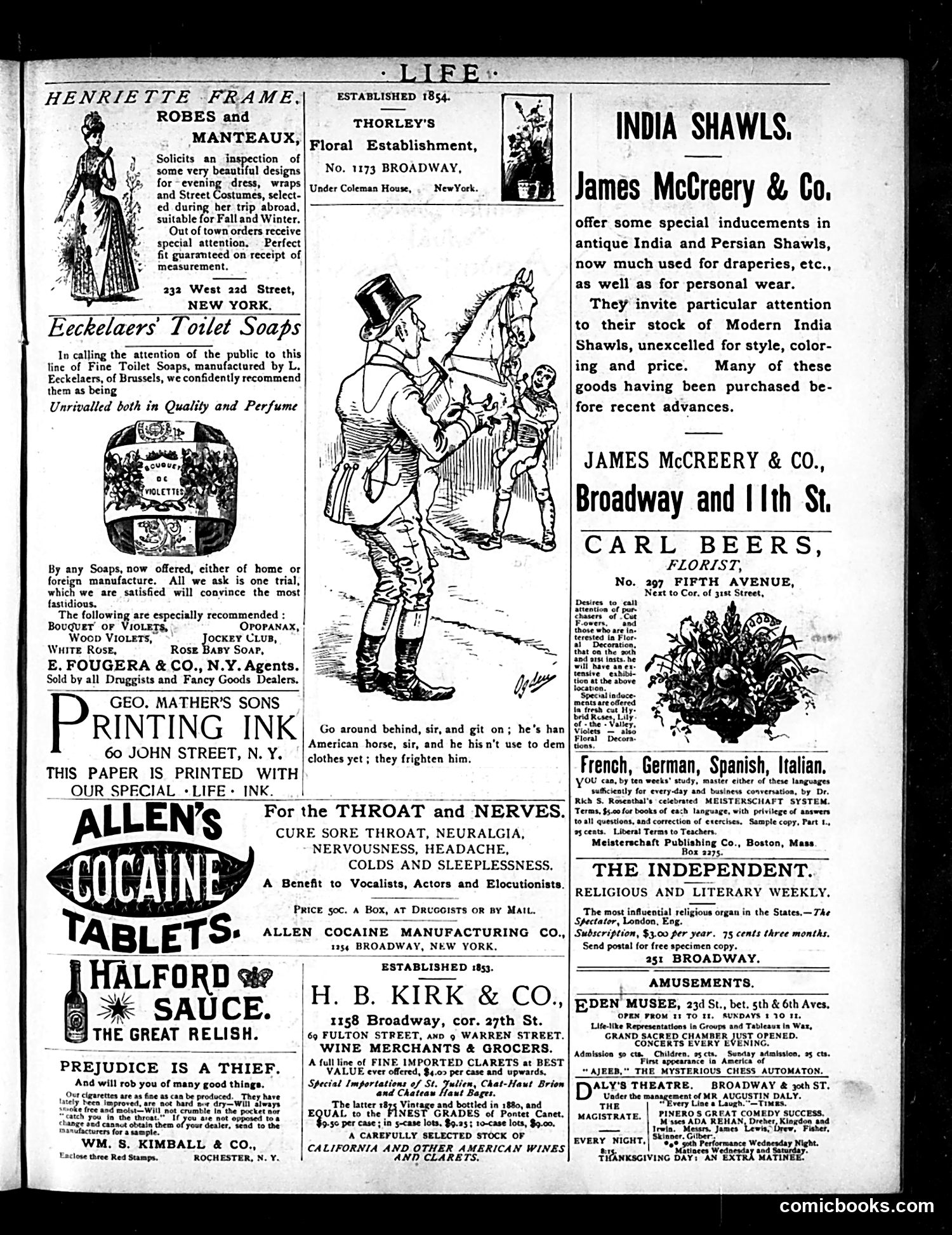
The central cartoon depicts a well-dressed man on horseback, wearing a top hat and formal riding attire, attempting to control an American horse. A smaller figure stands nearby gesturing. The caption reads: "Go around behind, sir, and git on; he's han American horse, sir, and he hisn't use to dem clothes yet; they frighten him." **The satire**: This mocks the pretensions of European (particularly English) fashion and manners being imposed on American society. The "frightened" horse represents Americans—common, practical people unfamiliar with such formal European dress. The joke suggests that fancy European clothing is absurdly out of place in America, and that Americans "aren't used to" such affectations. This reflects 19th-century American anxieties about European cultural superiority and the tension between American practicality and European sophistication—a common theme in *Life* magazine's satirical content of this era.
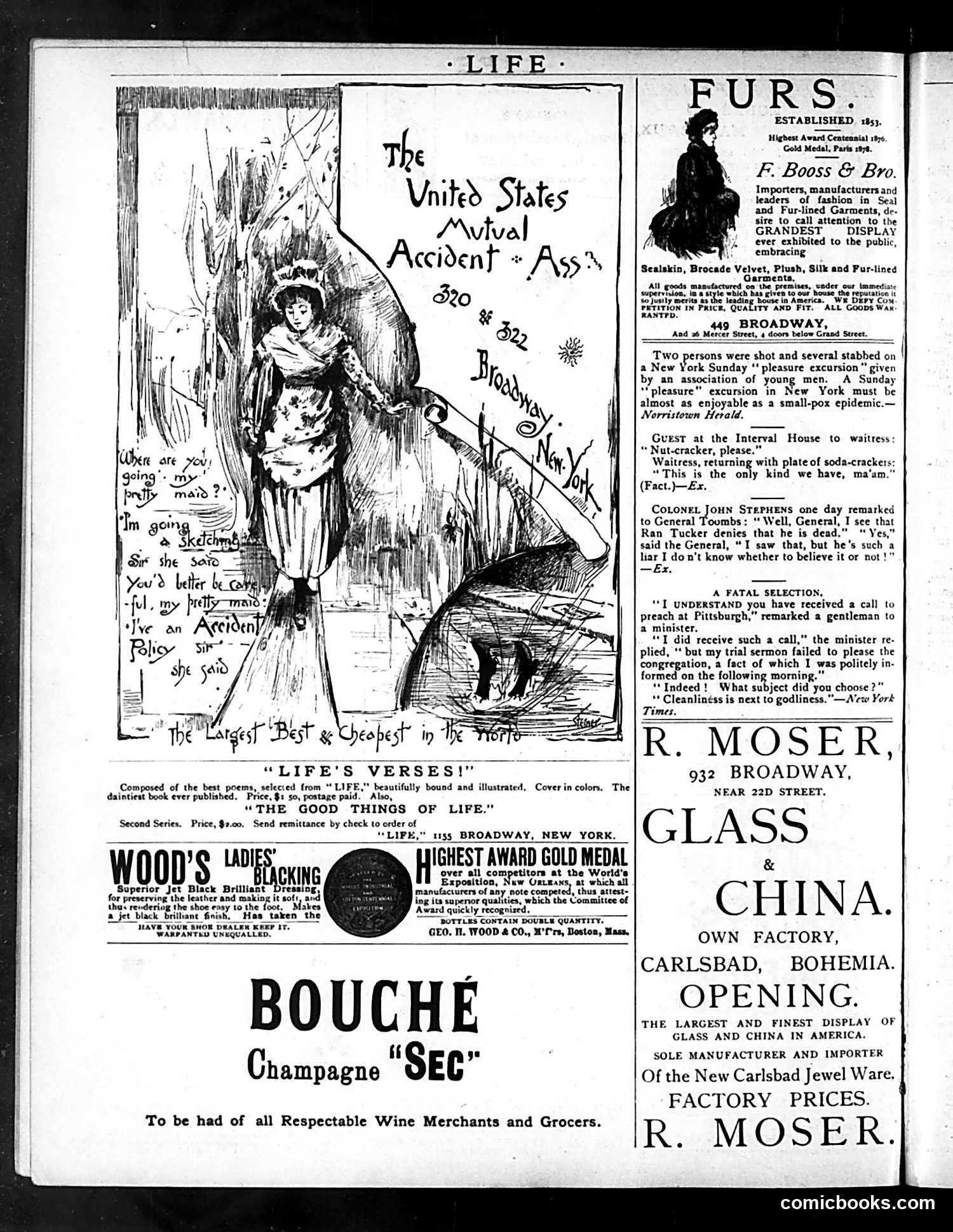
This is primarily an **advertising page** with a small satirical cartoon and humorous anecdotes. The main cartoon, titled "The United States Mutual Accident Ass'n" (Association), depicts a woman in distress, likely injured or in an accident, speaking to what appears to be a representative. The satire mocks accident insurance companies—suggesting they're unreliable or unhelpful when claims are made. The woman's dialogue indicates she's been denied coverage despite paying for protection. The page also includes brief humorous items poking fun at: - A "pleasure excursion" in New York that ended in shootings and stabbings - A waitress offering only soda crackers when asked for "nut-crackers" - A general doubting whether someone is actually dead, given their reputation for lying - A minister rejected for a trial sermon on "Cleanliness is next to godliness" The bulk of the page consists of advertisements for furs, champagne, shoe polish, and glassware—typical late 19th-century commerce.
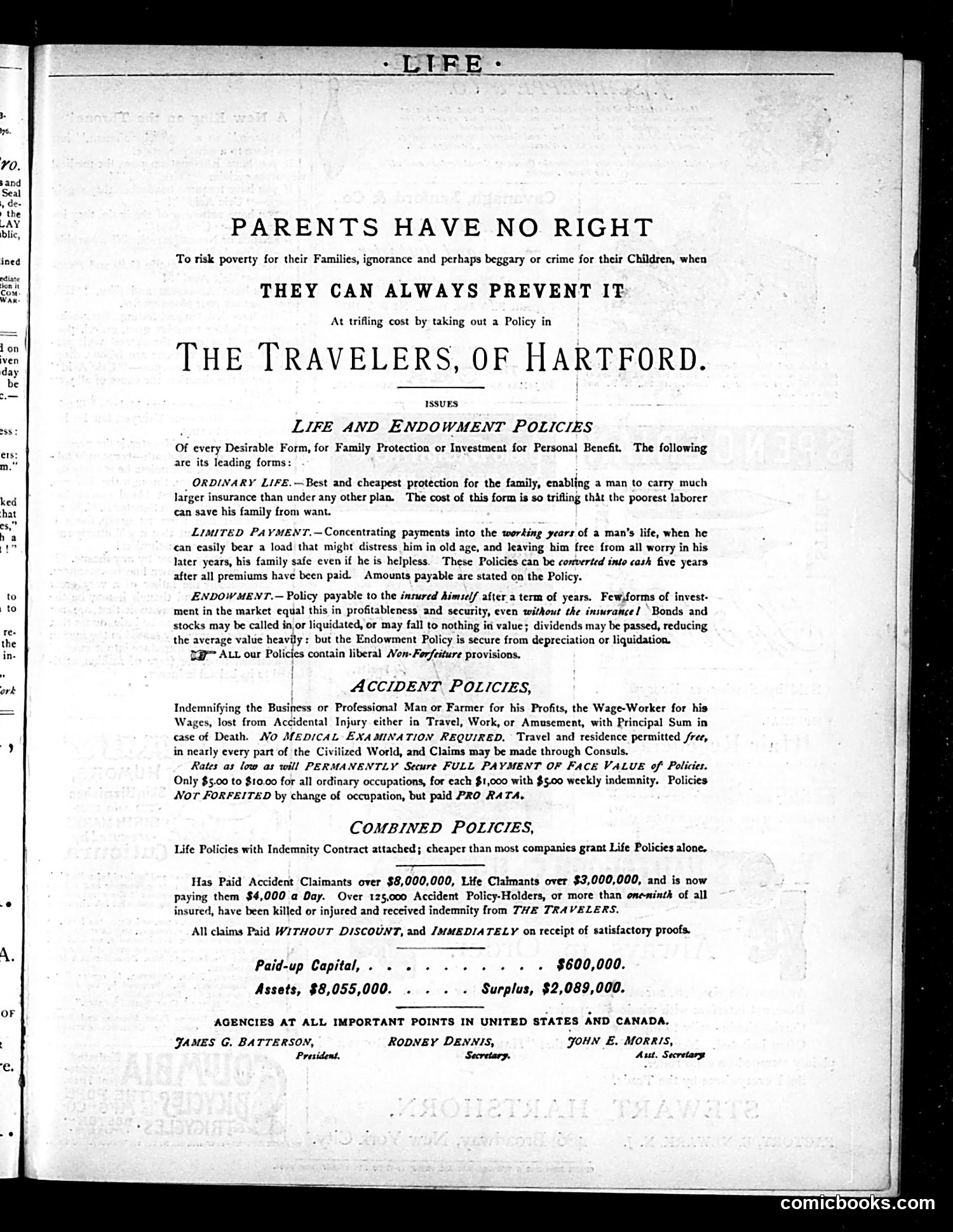
This page is **not a cartoon or satire**—it's a full-page advertisement for The Travelers Insurance Company of Hartford, promoting life and accident insurance policies. The "PARENTS HAVE NO RIGHT" headline uses moral persuasion rather than humor, arguing that fathers have an obligation to protect their families from poverty, ignorance, and crime through affordable insurance. This reflects late 19th/early 20th-century anxiety about economic vulnerability and family security. The ad emphasizes accessibility: policies cost so little that "the poorest laborer can save his family from want." It lists multiple policy types (Ordinary Life, Limited Payment, Endowment, Accident) with technical details, plus financial credentials (capital, assets, surplus figures) to establish trustworthiness. The closing mentions 125,000 policyholders and $4,000 paid daily in claims—marketing through demonstrated success rather than satire or caricature.
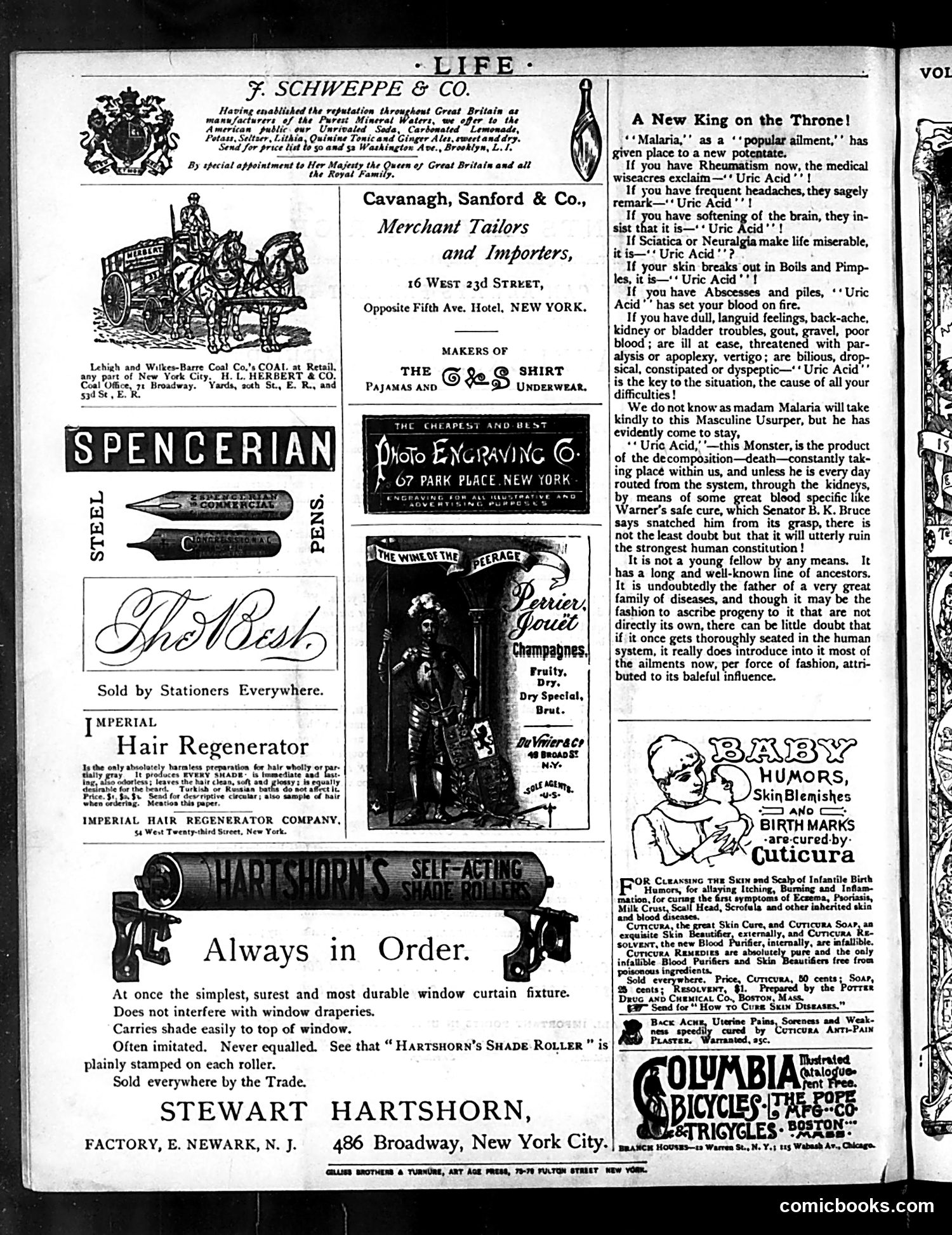
This is satirical medical commentary, not a political cartoon. The piece mocks the contemporary medical tendency to blame "Uric Acid" for virtually every ailment—replacing the previous scapegoat diagnosis, "Malaria." The satire argues that doctors now attribute everything from rheumatism and headaches to constipation and paralysis to excess uric acid, using it as a catch-all explanation much like malaria once was. The text sardonically suggests that unless patients use Warner's Safe Cure (a patent medicine), uric acid will "utterly ruin the strongest human constitution." The humor lies in exposing medical fashion and the over-prescription of patent remedies. Senator B. K. Bruce is mentioned as a supposed endorser of Warner's product, lending false authority to a commercial cure-all. This reflects genuine late-19th-century frustration with both speculative medical theories and aggressive patent medicine marketing.