
Life, 1885-11-19 · page 7 of 18
Life — November 19, 1885 — page 7: what you’re looking at
What you’re looking at
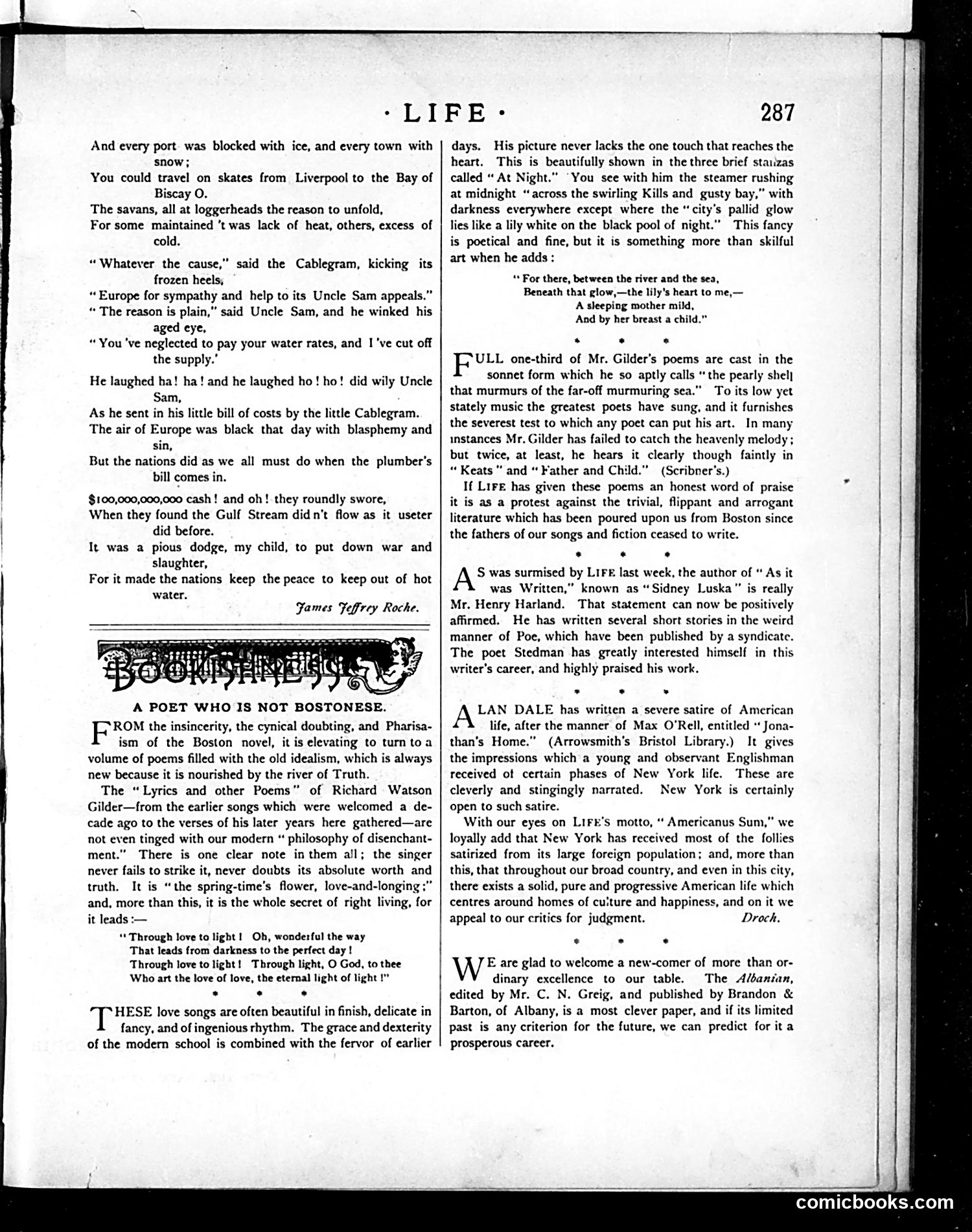
This page contains literary criticism and book reviews rather than political cartoons. The main content discusses: **"A Poet Who Is Not Bostonese"** — a review of Richard Watson Gilder's poetry collection, praising his "absolute worth and truth" and contrasting his work with modern "philosophy of disenchantment." **Brief notices** about: - Sidney Luska (actually Henry Harland) and his Poe-influenced stories - Alan Dale's satire of American life called "Jonathan's Home" - The *Albanian* magazine from Albany, New York The decorative "Book Notices" header features ornamental typography typical of the era. This appears to be a cultural criticism section aimed at educated readers interested in contemporary literature, with no political satire evident on this particular page.
📄 Transcribed text from this page (OCR, searchable)
Machine-transcribed from the original scan — historical spelling and the odd misread are preserved.
-LIFE: 287 And every port was blocked with ice, and every town with snow; You could travel on skates from Liverpool to the Bay of Biscay O. The savans, all at loggerheads the reason to unfold, For some maintained ’t was lack of heat, others, excess of cold. “Whatever the cause,” said the Cablegram, kicking its frozen heels, “Europe for sympathy and help to its Uncle Sam appeals.” “ The reason is plain,” said Uncle Sam, and he winked his aged eye, “You 've neglected to pay your water rates, and I've cut off the supply.” He laughed ha! ha! and he laughed ho! ho! did wily Uncle Sam, As he sent in his little bill of costs by the little Cablegram. The air of Europe was black that day with blasphemy and sin, But the nations did as we all must do when the plumber’s bill comes in. $100,000,000,000 cash ! and oh! they roundly swore, When they found the Gulf Stream didn’t flow as it useter did before. It was a pious dodge, my child, to put down war and slaughter, For it made the nations keep the peace to keep out of hot water. James Jeffrey Rocke. A POET WHO IS NOT BOSTONESE. ROM the insincerity, the cynical doubting, and Pharisa- ism of the Boston novel, it is elevating to turn toa volume of poems filled with the old idealism, which is always new because it is nourished by the river of Truth. The “Lyrics and other Poems” of Richard Watson Gilder—from the earlier songs which were welcomed a de- cade ago to the verses of his later years here gathered—are not even tinged with our modern “ philosophy of disenchant- ment.” There is one clear note in them all; the singer never fails to strike it, never doubts its absolute worth and truth. It is “the spring-time’s flower, love-and-longing ;” and, more than this, it is the whole secret of right living, for it leads :-— “Through love to light !_ Oh, wonderful the way That leads from darkness to the perfect day! Through love to light! Through light, O God, to thee Who art the love of love, the eternal light of light !" . . . HESE love songs are often beautiful in finish, delicate in fancy, and of ingenious rhythm. The grace and dexterity of the modern school is combined with the fervor of earlier days. His picture never lacks the one touch that reaches the heart. This is beautifully shown in the three brief staizas called “ At Night.” “You see with him the steamer rushing at midnight “across the swirling Kills and gusty bay,” with darkness everywhere except where the “city’s pallid glow lies like a lily white on the black pool of night.” This fancy is poetical and fine, but it is something more than skilful art when he adds: “* For there, between the river and the sea, Beneath that glow,—the lily’s heart to me,— A sleeping mother mild, And by her breast a child.” . . * ULL one-third of Mr. Gilder’s poems are cast in the sonnet form which he so aptly calls “the pearly shel] that murmurs of the far-off murmuring sea.” To its low yet stately music the greatest poets have sung, and it furnishes the severest test to which any poet can put his art. In many instances Mr. Gilder has failed to catch the heavenly melody ; but twice, at least, he hears it clearly though faintly in “ Keats " and “ Father and Child.” (Scribner’s.) If LiFe has given these poems an honest word of praise it is as a protest against the trivial, flippant and arrogant literature which has been poured upon us from Boston since the fathers of our songs and fiction ceased to write. . . . S was surmised by LIFE last week, the author of “ As it was Written,” known as “Sidney Luska” is really Mr. Henry Harland. That statement can now be positively affirmed. He has written several short stories in the weird manner of Poe, which have been published by a syndicate. The poet Stedman has greatly interested himself in this writer's career, and highly praised his work. . . . LAN DALE has written a severe satire of American life, after the manner of Max O'Rell, entitled “ Jona- than’s Home.” (Arrowsmith’s Bristol Library.) It gives the impressions which a young and observant Englishman received of certain phases of New York life. These are cleverly and stingingly narrated. New York is certainly open to such satire. With our eyes on LiFe’s motto, “ Americanus Sum,” we loyally add that New York has received most of the follies satirized from its large foreign population; and, more than this, that throughout our broad country, and even in this city, there exists a solid, pure and progressive American life which centres around homes of cuiture and happiness, and on it we appeal to our critics for judgment. Droch. * . . E are glad to welcome a new-comer of more than or- dinary excellence to our table. The Albanian, edited by Mr. C. N. Greig, and published by Brandon & Barton, of Albany, is a most clever paper, and if its limited past is any criterion for the future, we can predict for ita prosperous career.