
Life, 1885-11-19 · page 10 of 18
Life — November 19, 1885 — page 10: what you’re looking at
What you’re looking at
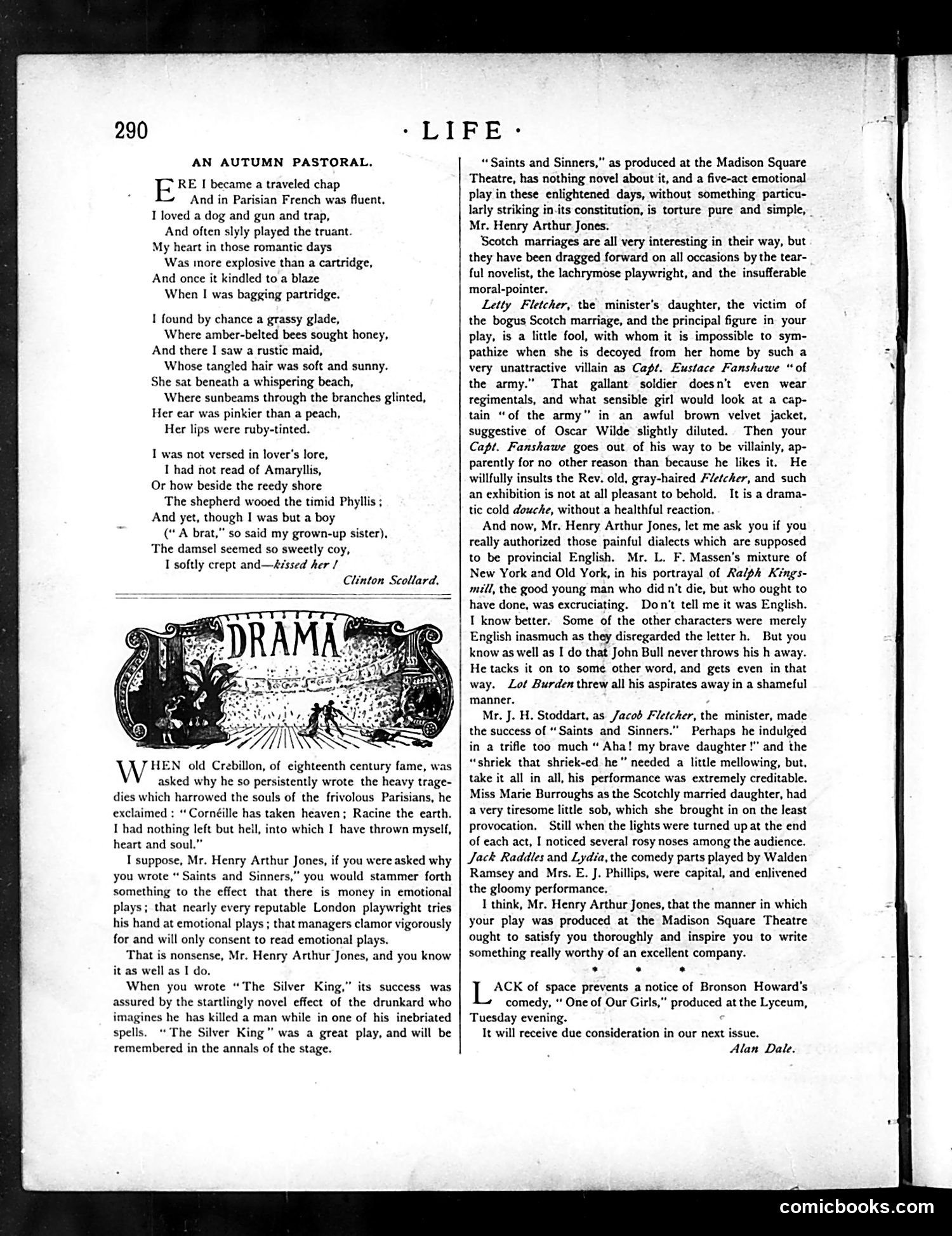
This page combines poetry and drama criticism. The poem "An Autumn Pastoral" by Clinton Scollard is a sentimental romantic narrative about a young man's encounter with a rural girl—relatively conventional Victorian verse. The main content is a scathing review of Henry Arthur Jones's play "Saints and Sinners," produced at Madison Square Theatre. The critic systematically demolishes the production: the heroine Letty Fletcher is "a little fool," the villain Captain Fanshawe lacks military authenticity and motivation, and—most notably—the supporting actors deliver execrable provincial English dialects (specifically calling out L. F. Massen's unconvincing "mixture of New York and Old York"). The reviewer acknowledges Jones wrote successful plays like "The Silver King" but argues "Saints and Sinners" offers nothing novel—just predictable Scottish marriage melodrama that emotionally manipulates without artistic justification. The tone is dismissive and cutting throughout.
📄 Transcribed text from this page (OCR, searchable)
Machine-transcribed from the original scan — historical spelling and the odd misread are preserved.
- LIFE: AN AUTUMN PASTORAL, RE I became a traveled chap And in Parisian French was fluent, I loved a dog and gun and trap, And often slyly played the truant. My heart in those romantic days Was inore explosive than a cartridge, And once it kindled to a blaze When I was bagging partridge. 1 found by chance a grassy glade, Where amber-belted bees sought honey, And there I saw a rustic maid, Whose tangled hair was soft and sunny. She sat beneath a whispering beach, Where sunbeams through the branches glinted, Her ear was pinkier than a peach, Her lips were ruby-tinted. I was not versed in lover's lore, I had not read of Amaryllis, Or how beside the reedy shore The shepherd wooed the timid Phyllis ; And yet, though I was but a boy (“A brat,” so said my grown-up sister), The damsel seemed so sweetly coy, I softly crept and—&/ssed her / Clinton Scollard, V HEN old Crebillon, of eighteenth century fame, was asked why he so persistently wrote the heavy trage- dies which harrowed the souls of the frivolous Parisians, he exclaimed : “Cornéille has taken heaven; Racine the earth. I had nothing left but hell, into which I have thrown myself, heart and soul.” I suppose, Mr. Henry Arthur Jones, if you were asked why you wrote “Saints and Sinners,” you would stammer forth something to the effect that there is money in emotional plays; that nearly every reputable London playwright tries his hand at emotional plays ; that managers clamor vigorously for and will only consent to read emotional plays. That is nonsense, Mr. Henry Arthur Jones, and you know it as well as I do. When you wrote “The Silver King,” its success was assured by the startlingly novel effect of the drunkard who imagines he has killed a man while in one of his inebriated spells. “The Silver King" was a great play, and will be remembered in the annals of the stage. “Saints and Sinners,” as produced at the Madison Square Theatre, has nothing novel about it, and a five-act emotional play in these enlightened days, without something particu- larly striking in-its constitution, is torture pure and simple, Mr. Henry Arthur Jones. ‘Scotch marriages are all very interesting in their way, but they have been dragged forward on all occasions by the tear- ful novelist, the lachrymose playwright, and the insufferable moral-pointer. Letty Fletcher, the minister's daughter, the victim of the bogus Scotch marriage, and the principal figure in your play, is a little fool, with whom it is impossible to sym- pathize when she is decoyed from her home by such a very unattractive villain as Capt. Eustace Fanshawe “of the army.” That gallant soldier doesn’t even wear regimentals, and what sensible girl would look at a cap- tain “of the army” in an awful brown velvet jacket, suggestive of Oscar Wilde slightly diluted. Then your Capt. Fanshawe goes out of his way to be villainly, ap- parently for no other reason than because he likes it. He willfully insults the Rev. old, gray-haired Fletcher, and such an exhibition is not at all pleasant to behold. It is a drama- tic cold douche, without a healthful reaction. And now, Mr. Henry Arthur Jones, let me ask you if you really authorized those painful dialects which are supposed to be provincial English. Mr. L. F. Massen’s mixture of New York and Old York, in his portrayal of Ralph Kings- mill, the good young man who did n't die, but who ought to have done, was excruciating. Don’t tell me it was English. I know better. Some of the other characters were merely English inasmuch as they disregarded the letter h. But you know as well as I do that John Bull never throws his h away. He tacks it on to some other word, and gets even in that way. Lot Burden threw all his aspirates away in a shameful manner. : Mr. J. H. Stoddart, as Jacod Fletcher, the minister, made the success of “Saints and Sinners.” Perhaps he indulged in a trifle too much “ Aha! my brave daughter !" and the “shriek that shriek-ed he” needed a little mellowing, but, take it all in all, his performance was extremely creditable. Miss Marie Burroughs as the Scotchly married daughter, had a very tiresome little sob, which she brought in on the least provocation. Still when the lights were turned up at the end of each act, I noticed several rosy noses among the audience. Jack Raddles and Lydia, the comedy parts played by Walden Ramsey and Mrs. E. J. Phillips, were capital, and enlivened the gloomy performance, I think, Mr. Henry Arthur Jones, that the manner in which your play was produced at the Madison Square Theatre ought to satisfy you thoroughly and inspire you to write something really worthy of an excellent company. . . . LAS of space prevents a notice of Bronson Howard's comedy, “ One of Our Girls,” produced at the Lyceum, Tuesday evening. ¢ It will receive due consideration in our next issue. Alan Dale. comicbooks.com