
Life, 1885-11-19 · page 4 of 18
Life — November 19, 1885 — page 4: what you’re looking at
What you’re looking at
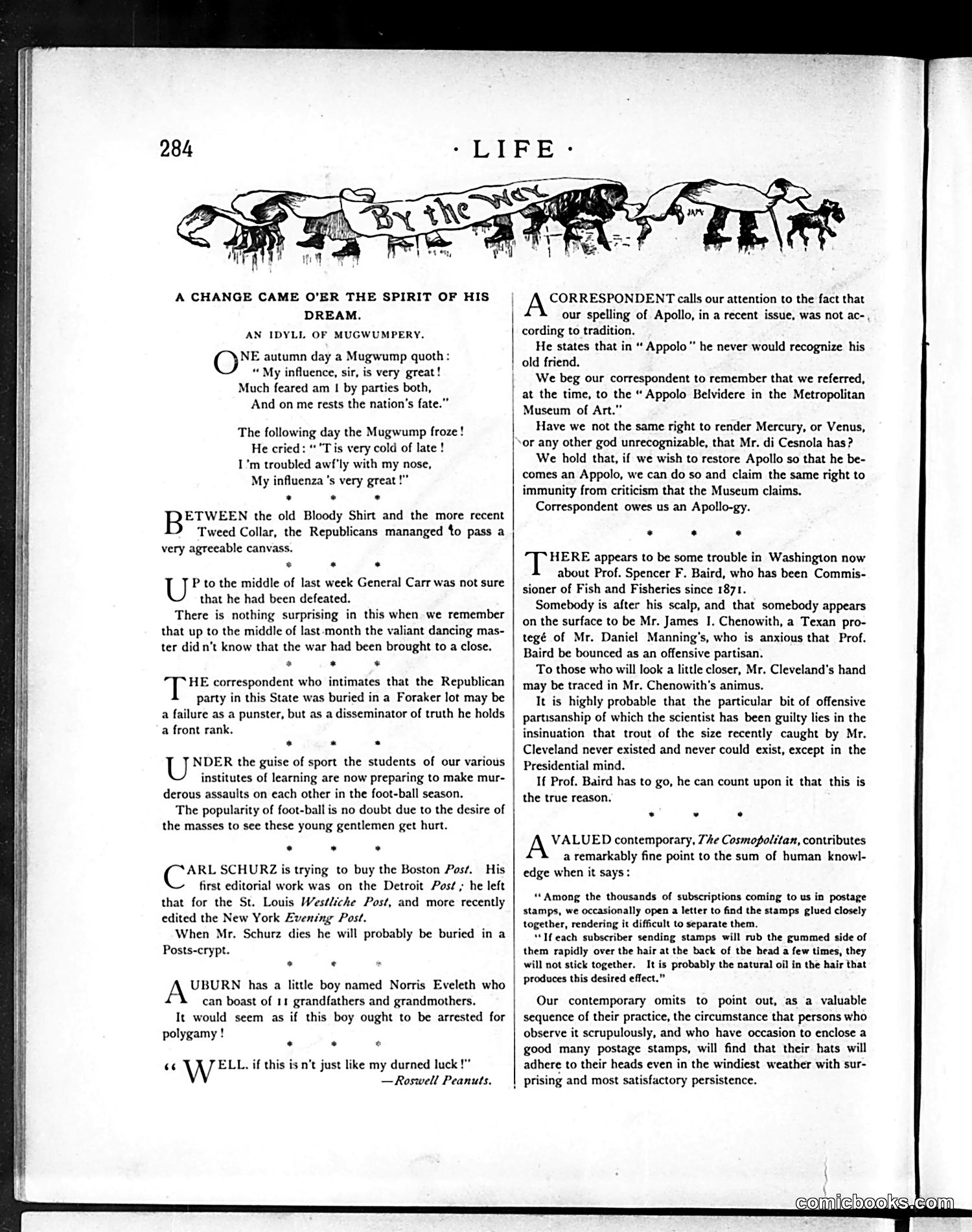
The page contains satirical commentary and short humor pieces rather than a political cartoon. Key content includes: **"An Idyll of Mugwumpery"** — A poem mocking Republican "Mugwumps" (independent Republicans who switched allegiance), depicted as indecisive about political outcomes. **Political commentary** addresses Republican Party failures, General Carr's potential defeat, and Republican strategy regarding the "Bloody Shirt" (Reconstruction-era rhetoric) versus newer "Tweed Collar" politics—referencing Boss Tweed's corruption scandals. **Other items mock**: Football violence at colleges, Carl Schurz's newspaper editing career, and a child with many grandparents (implying illegitimacy). The page reflects 1870s-80s American politics, particularly Reconstruction-era Republican discord and debates over party identity.
📄 Transcribed text from this page (OCR, searchable)
Machine-transcribed from the original scan — historical spelling and the odd misread are preserved.
A CHANGE CAME O'ER THE SPIRIT OF HIS DREAM. AN IDYLL OF MUGWUMPERY. utumn day a Mugwump quoth: “My influence, sir, is very great! Much feared am | by parties both, And on me rests the nation’s fate.” O The following oy the Mugwump froze! He cried: “Tis very cold of late! I'm troubled awf'ly with my nose, My influenza 's very great!" . . . Brees the old Bloody Shirt and the more recent Tweed Collar, the Republicans mananged to pass a very agreeable canvass. . . . U P to the middle of last week General Carr was not sure that he had been defeated. There is nothing surprising in this when we remember that up to the middle of last-month the valiant dancing mas- ter didn’t know that the war had been brought to a close. * . . HE correspondent who intimates that the Republican party in this State was buried in a Foraker lot may be a failure as a punster, but as a disseminator of truth he holds a front rank. . * . NDER the guise of sport the students of our various institutes of learning are now preparing to make mur- derous assaults on each other in the foot-ball season. The popularity of foot-ball is no doubt due to the desire of the masses to see these young gentlemen get hurt. . . ° ARL SCHURZ is trying to buy the Boston Post. His first editorial work was on the Detroit Post; he left that for the St. Louis Westliche Post, and more recently edited the New York Evening Post. When Mr. Schurz dies he will probably be buried in a Posts-crypt. . . UBURN has a little boy named Norris Eveleth who | can boast of 11 grandfathers and grandmothers. It would seem as if this boy ought to be arrested for polygamy ! . . e “cc we if this is n't just like my durned luck!" —Roswell Peanuts, CORRESPONDENT calls our attention to the fact that our spelling of Apollo, in a recent issue, was not ac-, cording to tradition. He states that in “ Appolo” he never would recognize his old friend. We beg our correspondent to remember that we referred, at the time, to the “ Appolo Belvidere in the Metropolitan Museum of Art.” Have we not the same right to render Mercury, or Venus, sor any other god unrecognizable, that Mr. di Cesnola has? We hold that, if we wish to restore Apollo so that he be- comes an Appolo, we can do so and claim the same right to immunity from criticism that the Museum claims. Correspondent owes us an Apollo-gy. HERE appears to be some trouble in Washington now about Prof. Spencer F. Baird, who has been Commis- sioner of Fish and Fisheries since 1871. Somebody is after his scalp, and that somebody appears on the surface to be Mr. James I. Chenowith, a Texan pro- tegé of Mr. Daniel Manning's, who is anxious that Prof. Baird be bounced as an offensive partisan. To those who will look a little closer, Mr. Cleveland's hand may be traced in Mr. Chenowith’s animus. It is highly probable that the particular bit of offensive | partisanship of which the scientist has been guilty lies in the | insinuation that trout of the size recently caught by Mr. Cleveland never existed and never could exist, except in the Presidential mind. If Prof. Baird has to go, he can count upon it that this is the true reason, . . . VALUED contemporary, Zhe Cosmopolitan, contributes a remarkably fine point to the sum of human knowl- edge when it says: “‘Among the thousands of subscriptions coming to us in postage stamps, we occasionally open a letter to find the stamps glued closely together, rendering it difficult to separate them. ““Ifeach subscriber sending stamps will rub the gummed side of | them rapidly over the hair at the back of the head a few times, they will not stick together. It is probably the natural oil in the hair that produces this desired effect.” Our contemporary omits to point out, as a valuable sequence of their practice, the circumstance that persons who observe it scrupulously, and who have occasion to enclose a good many postage stamps, will find that their hats will adhere to their heads even in the windiest weather with sur- | prising and most satisfactory persistence.