
A complete issue · 16 pages · 1885
Life — September 24, 1885
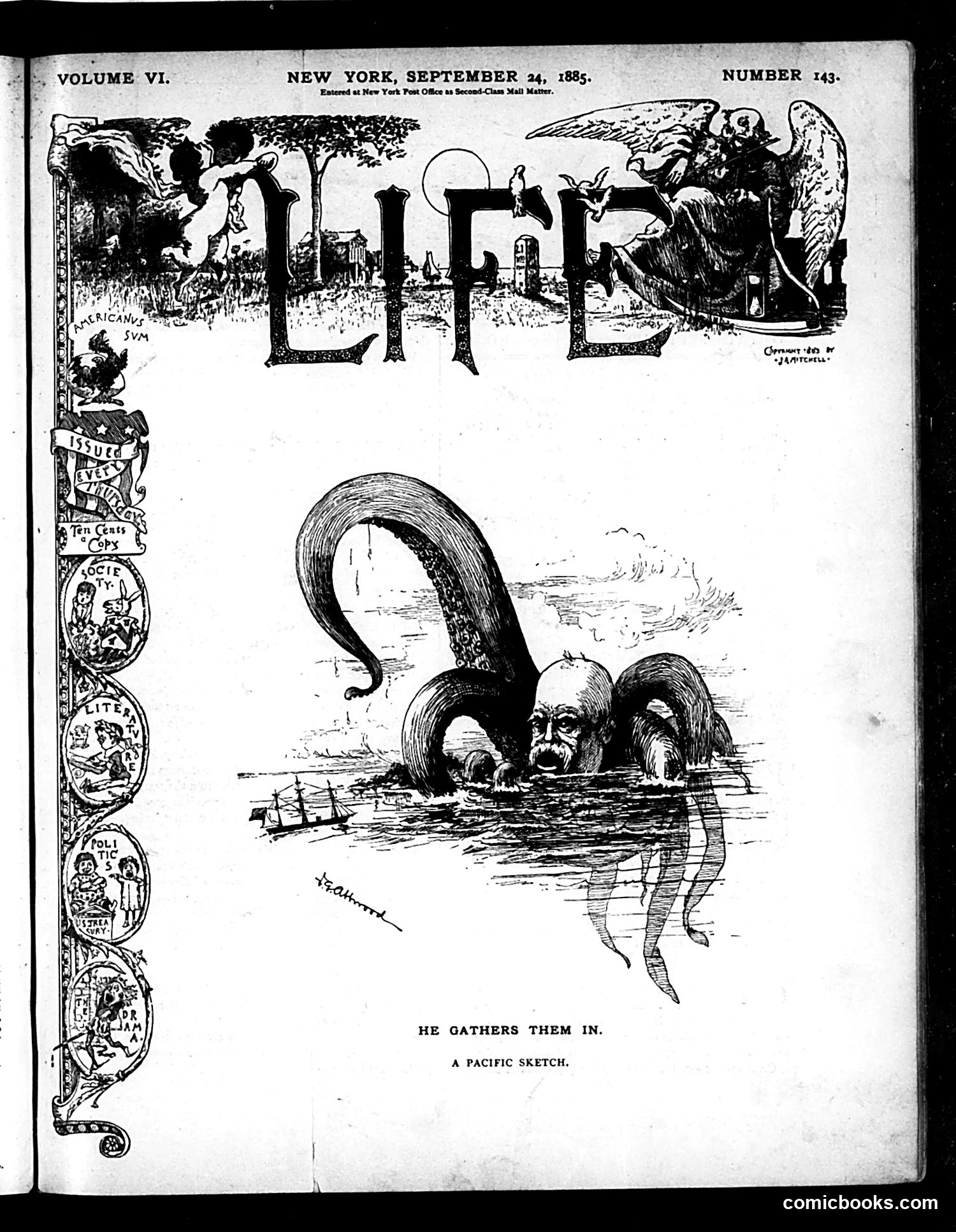
This cartoon depicts an octopus in water pulling struggling human figures toward itself, labeled "A Pacific Sketch." The octopus appears to represent an expansionist power or economic force in the Pacific region during the 1880s. The caption "He Gathers Them In" suggests predatory consolidation or annexation of Pacific territories or peoples. The specific identity of the octopus is unclear from the image alone—it could represent American imperial expansion, a particular corporation, or another colonial power active in the Pacific during this era. The human figures likely represent indigenous populations or smaller nations being absorbed against their will, reflecting contemporary anxieties about imperialism and geopolitical competition in the Pacific.
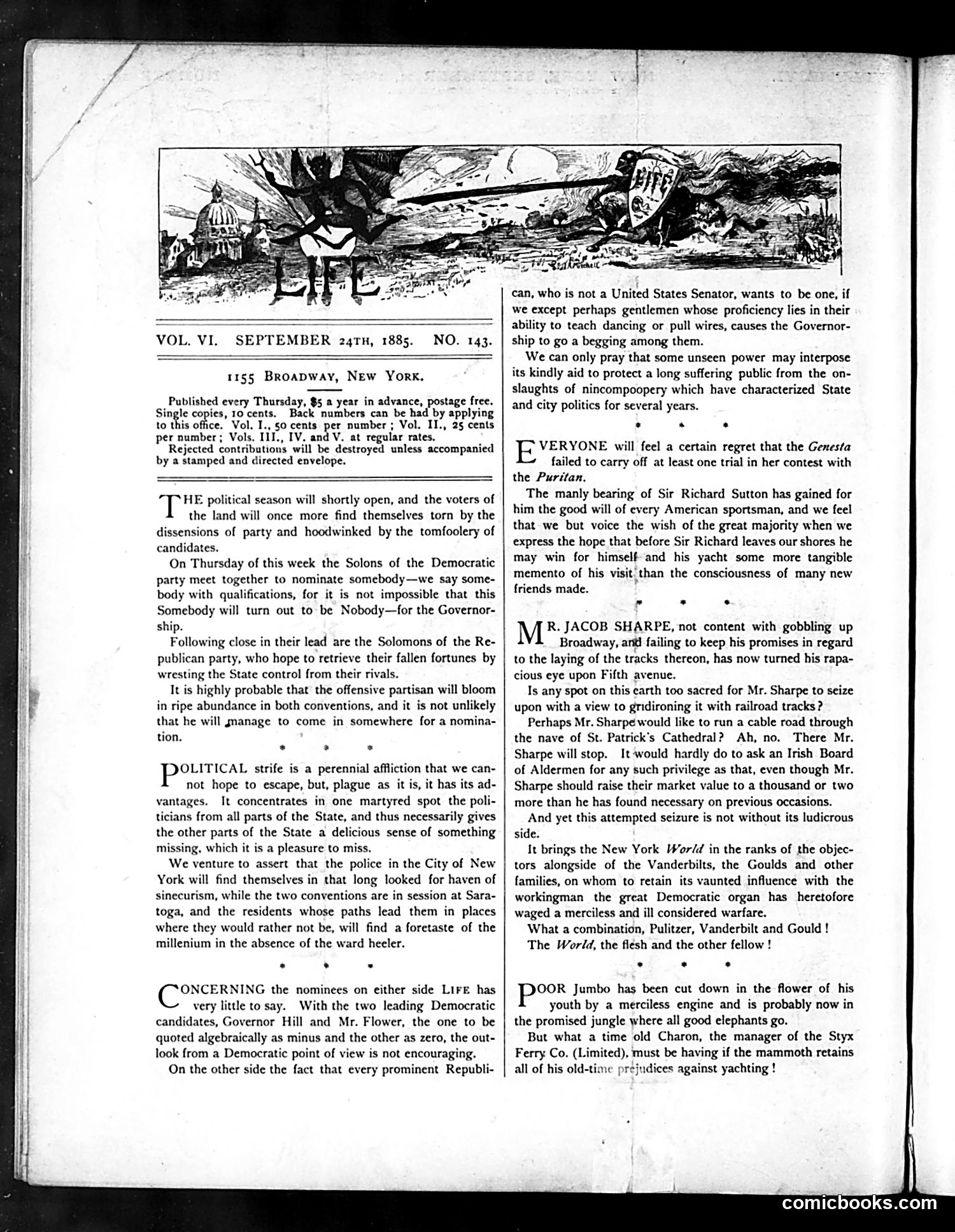
The masthead cartoon depicts a landscape with the word "LIFE" prominently displayed, showing trees, buildings (including what appears to be a Capitol dome), and figures. The accompanying text discusses the upcoming political season and party conventions. The editorial content satirizes Democratic and Republican nominees, specifically mentioning Governor Hill and Mr. Flower as Democratic candidates characterized as "minuses" and "zero," while Republican candidates fare slightly better. The piece mocks political strife as inevitable and criticizes New York City politics as plagued by "nincompoopery." Additional satire targets Jacob Sharpe's railroad schemes on Fifth Avenue and criticizes the *New York World* newspaper's Democratic sympathies. The tone is cynical about partisan politics generally, treating both parties' candidates and motivations as equally ridiculous.
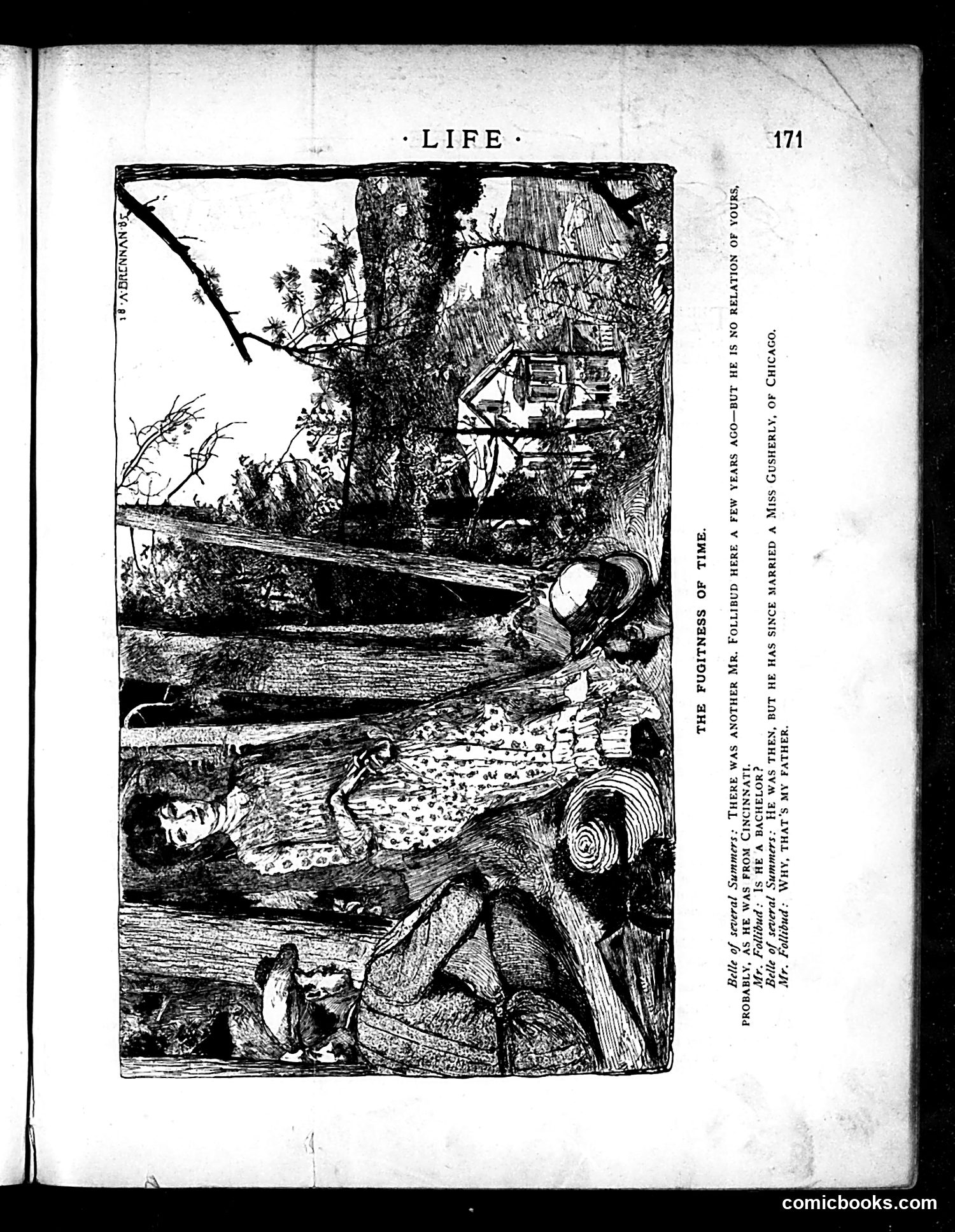
This page from *Life* magazine (page 171) features a woodcut-style illustration titled "The Furthest of Three," depicting a rural scene with felled trees and a solitary figure. The accompanying text references "Several Summers" and mentions trees being "another Mr. Gould" felled years ago, with text about "Since warred Miss Groseley of Chicago" and "With thirty at Putter." The satirical intent appears to concern deforestation or environmental destruction, though the specific political figures and complete context are unclear from the OCR text. The rural woodland setting and emphasis on fallen timber suggest critique of logging practices or land exploitation, but without clearer text attribution, I cannot definitively identify which contemporary political or social figure is being lampooned or what specific event prompted this commentary.
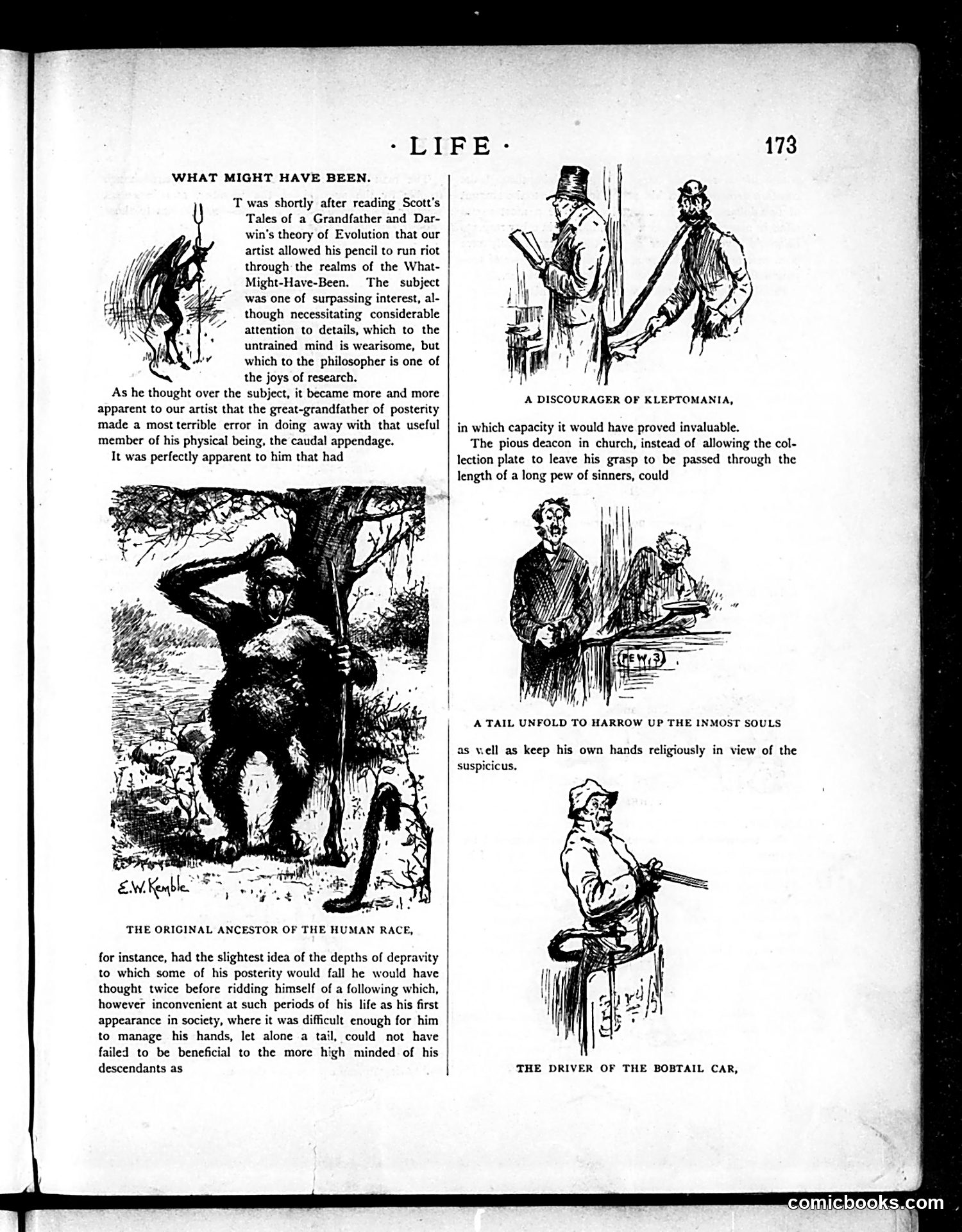
This page satirizes Darwin's theory of evolution, a major scientific and cultural controversy in late 19th-century America. The heading "What Might Have Been" introduces an artist's humorous speculation about evolutionary history. The central cartoon, "The Original Ancestor of the Human Race," depicts an ape-like creature, mocking the idea that humans descended from primates. The accompanying text sarcastically suggests that had this ancestor possessed a tail, it might have caused social embarrassment for his descendants—implying the absurdity of evolutionary claims. The smaller cartoons ("A Discourager of Kleptomania," "A Tail Unfold to Harrow Up the Inmost Souls," and "The Driver of the Bobtail Car") appear to be unrelated satirical sketches, possibly commenting on contemporary social issues or human behavior.
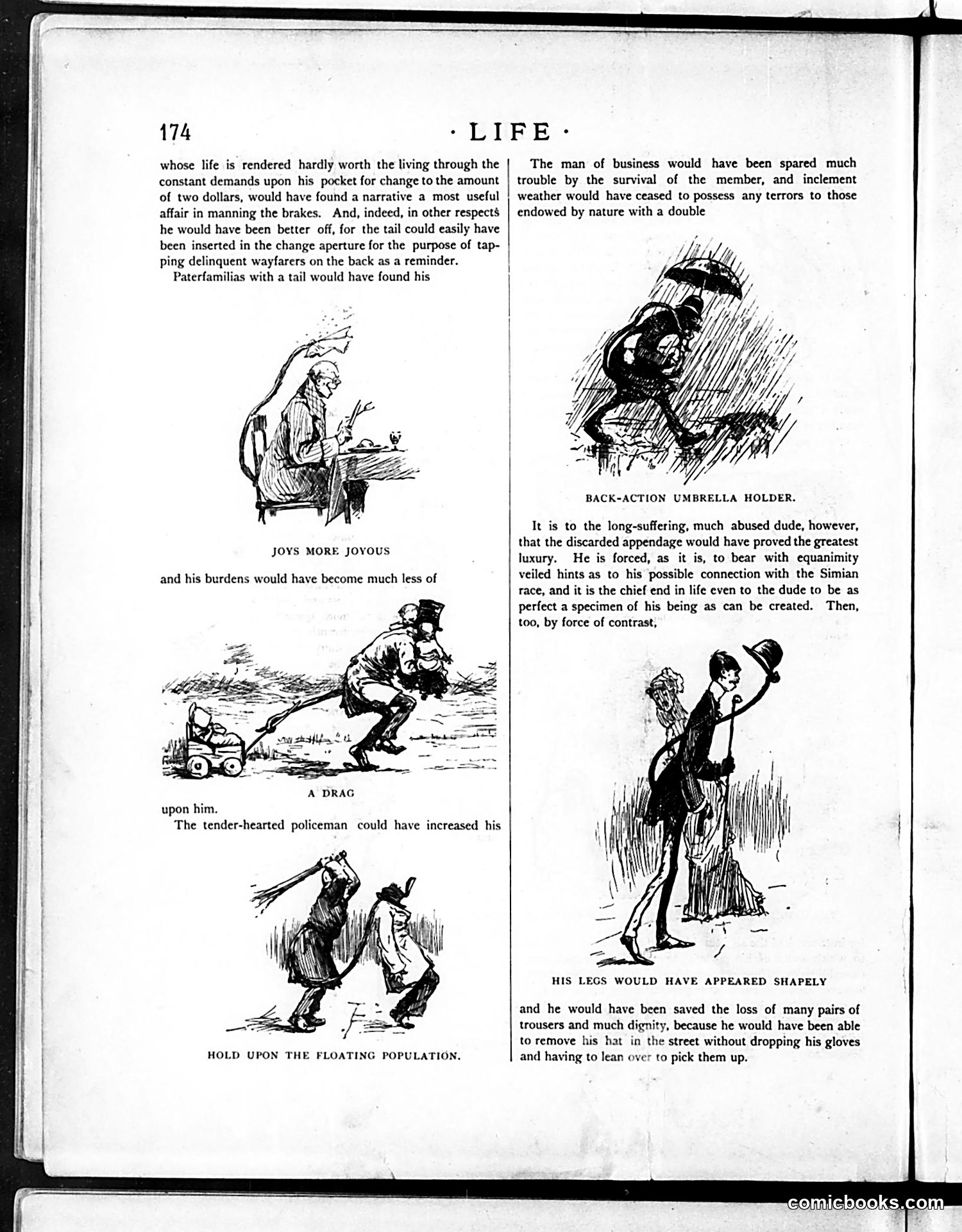
This page satirizes the absurdity of having a tail, using it as a metaphor for social burdens. The text argues that a tail would create endless practical problems: difficulty sitting, needing special pockets for money, becoming a tool for tracking delinquents, and appearing ridiculous in rain. The cartoons illustrate these indignities: a man struggling with a "drag" (tail pulling behind), someone using it to "hold upon the floating population" (controlling crowds), a man awkwardly managing an umbrella with his tail, and another losing dignity removing his hat without dropping his gloves. The underlying satire critiques how inherited or permanent social disadvantages—likely referencing class status or racial identity—force individuals into undignified compromises, despite the dominant culture's expectation that they maintain composure and respectability.
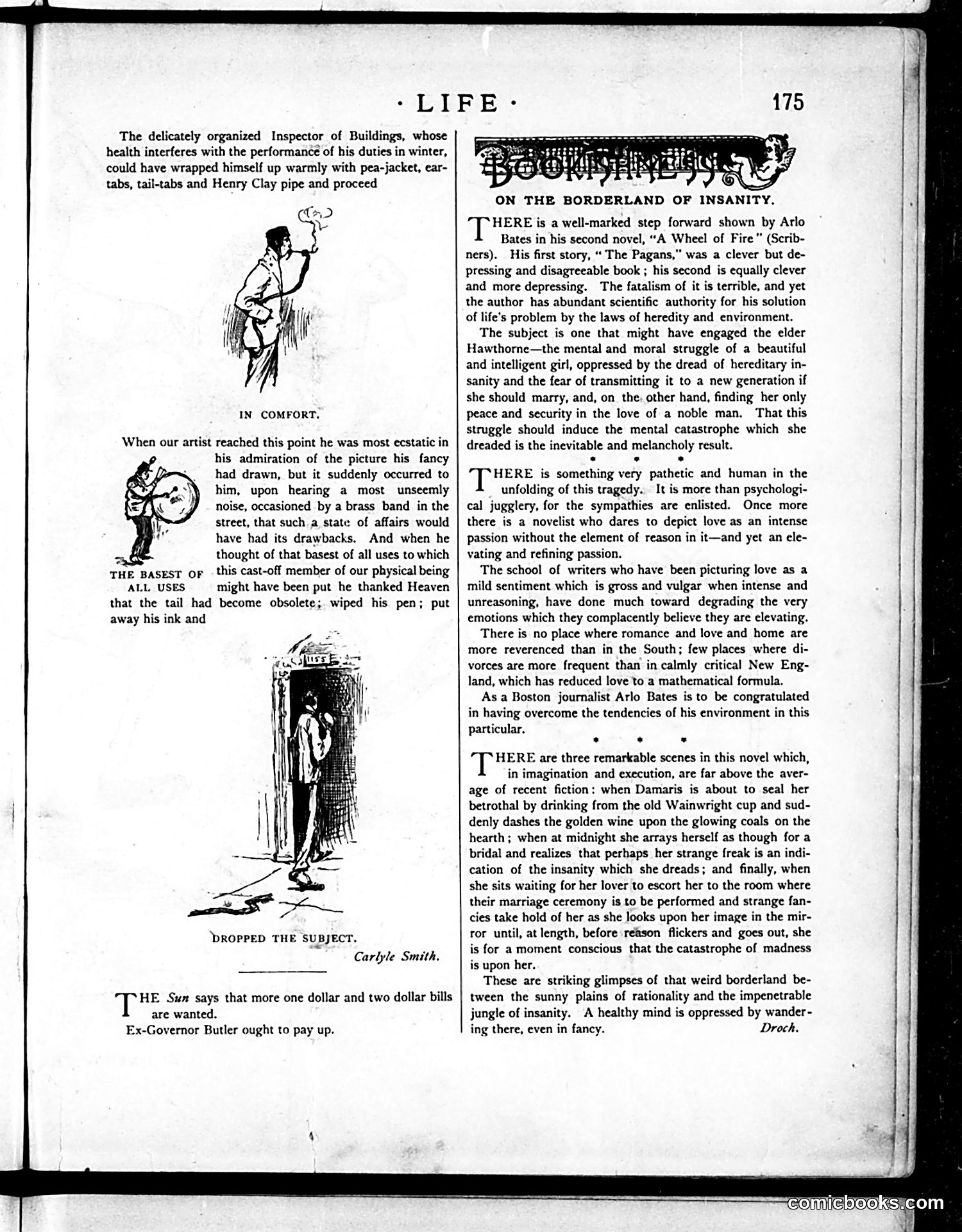
This page contains three separate cartoons satirizing different subjects: 1. **"In Comfort"** and **"The Basest of All Uses"**: These mock an unnamed "Inspector of Buildings" whose delicate health interferes with winter duties. The satire suggests he should dress warmly rather than complain—a jab at bureaucratic inefficiency. 2. **"Dropped the Subject"** (by Carlyle Smith): Shows a figure in a doorway, likely depicting someone abandoning a conversation or obligation. 3. **Main article**: A literary review of Arlo Bates's novel *"A Wheel of Fire,"* discussing themes of hereditary insanity and a woman's moral dilemma. The critic praises Bates for tackling psychological complexity rather than sentimental romance—unusual for his era. The page critiques both governmental incompetence and literary sentimentality.
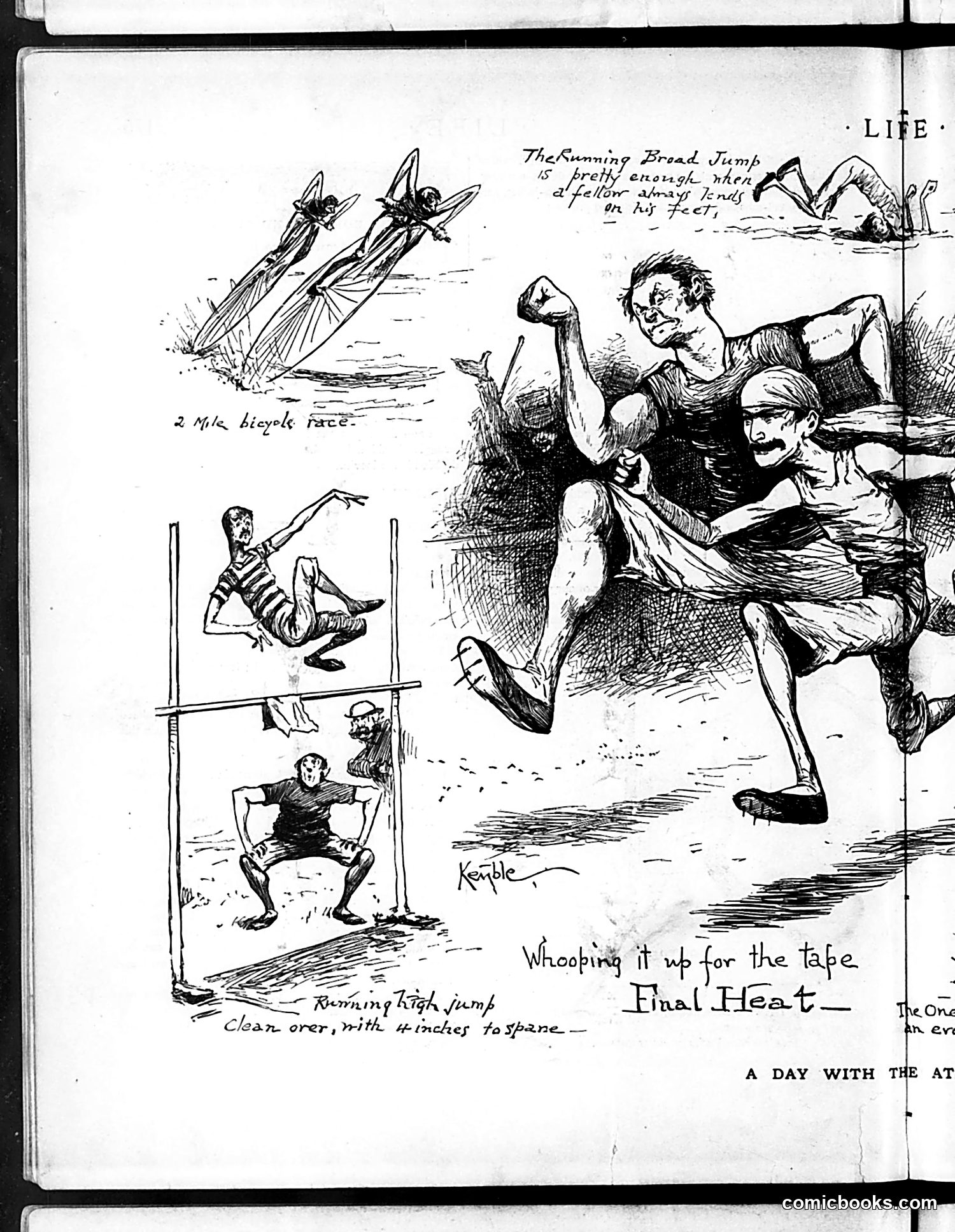
This page from *Life* magazine satirizes athletic training and physical exertion through humorous sketches. The illustrations depict various competitive sports activities: - **"2 Mile bicycle race"**: Two cyclists racing intensely - **"Running high jump"**: An athlete attempting to clear a high bar, labeled "clean over, with 4 inches to spare" - **"The Running Bread Jump"**: A figure tumbling awkwardly, with caption noting it's "pretty enough when a fellow always lands on his feet" - **"Final Heat - Whooping it up for the tape"**: The main illustration showing two athletes in a frantic finish line dash, one appearing to be coaching or encouraging the other The satire mocks the desperation and physical absurdity of competitive athletics, emphasizing exhaustion, awkward technique, and the intensity athletes display chasing victory. The exaggerated poses suggest the ridiculous extremes athletes endure in pursuit of athletic achievement.
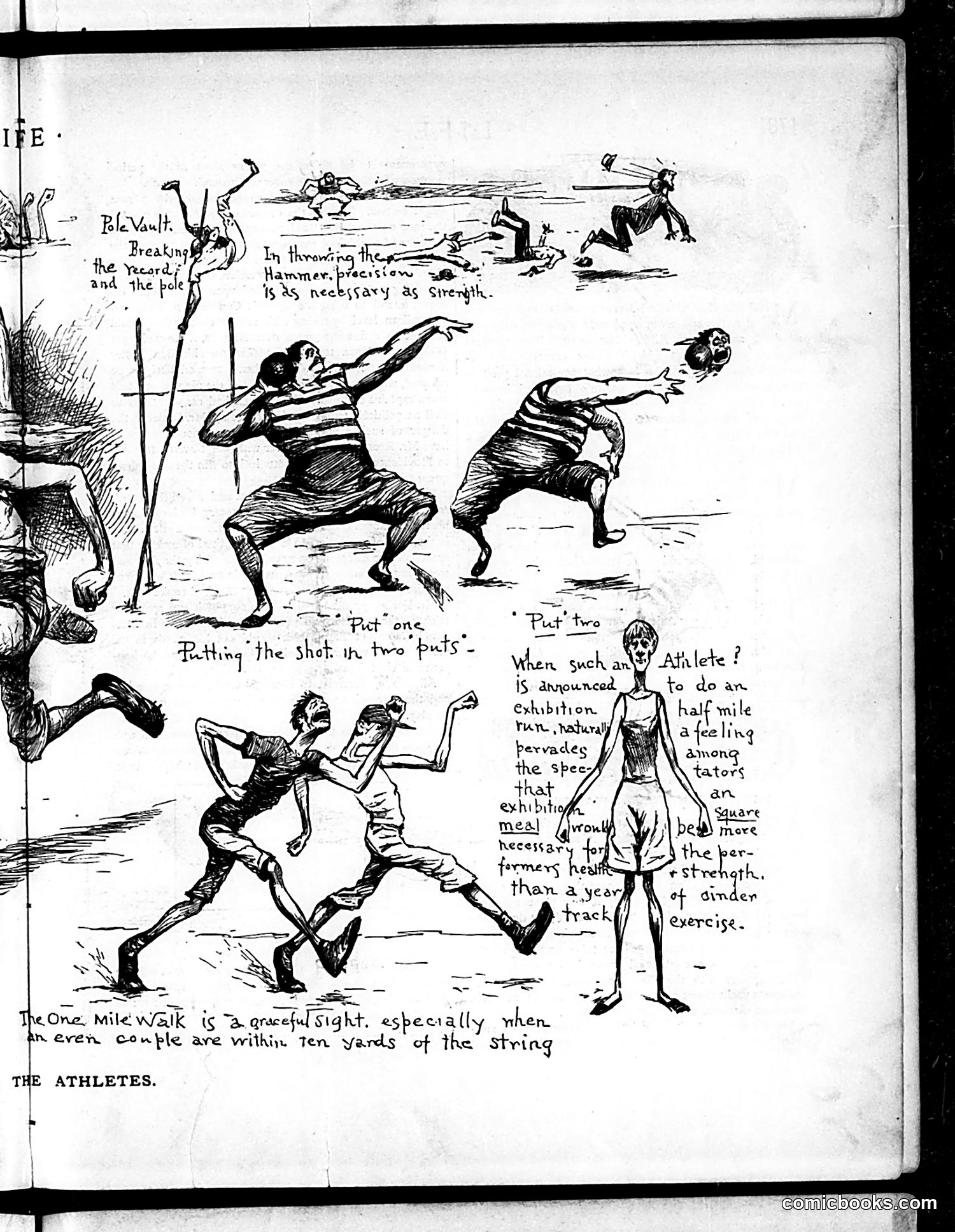
This page satirizes track and field athletics, particularly the shot put and mile walk events. The sketches demonstrate proper technique: "Blevault" breaking the record with pole vault, the two-stage shot put method ("Put one" and "Put two"), and the mile walk form. The satire targets the physical demands and training regimen athletes endure. The accompanying text notes that athletes announced for exhibition runs experience a psychological boost—"a feeling among the spectators"—that requires "square meals" and "a year of arduous exercise" for proper performance. The bottom caption jokes about the mile walk's peculiar aesthetic: it's "a graceful sight, especially when an even couple are within ten yards of the string," mocking the awkward, unnatural posture required by the sport's walking rules.
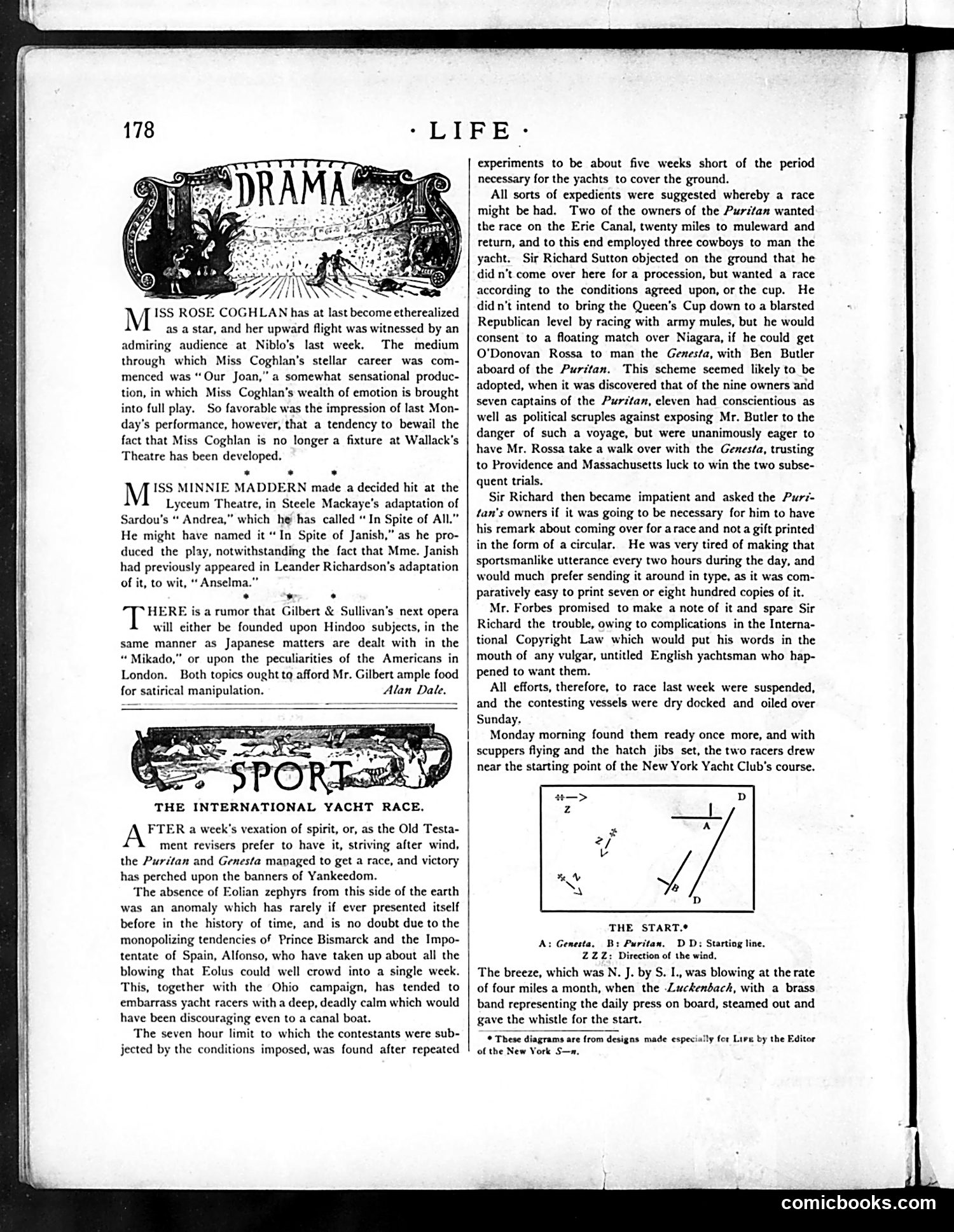
This page satirizes the 1885 International Yacht Race between the American *Puritan* and British *Genesta*. The humor mocks both the absurd delays (caused by lack of wind) and the political tensions surrounding the competition. **The Satire:** Life ridicules proposed alternatives to the stalled race—including moving it to the Erie Canal with "three cowboys" manning the yacht, or holding it over Niagara Falls with controversial political figures like O'Donovan Rossa and Ben Butler as crew members. Sir Richard Sutton (the British challenger's representative) objected to such farce, insisting on a legitimate race "according to the conditions agreed upon, or the cup." **Political References:** The satire jabs at American politics by sarcastically suggesting that nine owners and seven captains of the *Puritan* had "conscientious as well as political scruples" against Butler's involvement—implying partisan divisions over the American Civil War veteran's participation. The page also mocks Prince Bismarck and Spanish King Alfonso for monopolizing "all the blowing that Eolus could well crowd into a single week," humorously blaming global wind patterns on political leaders.
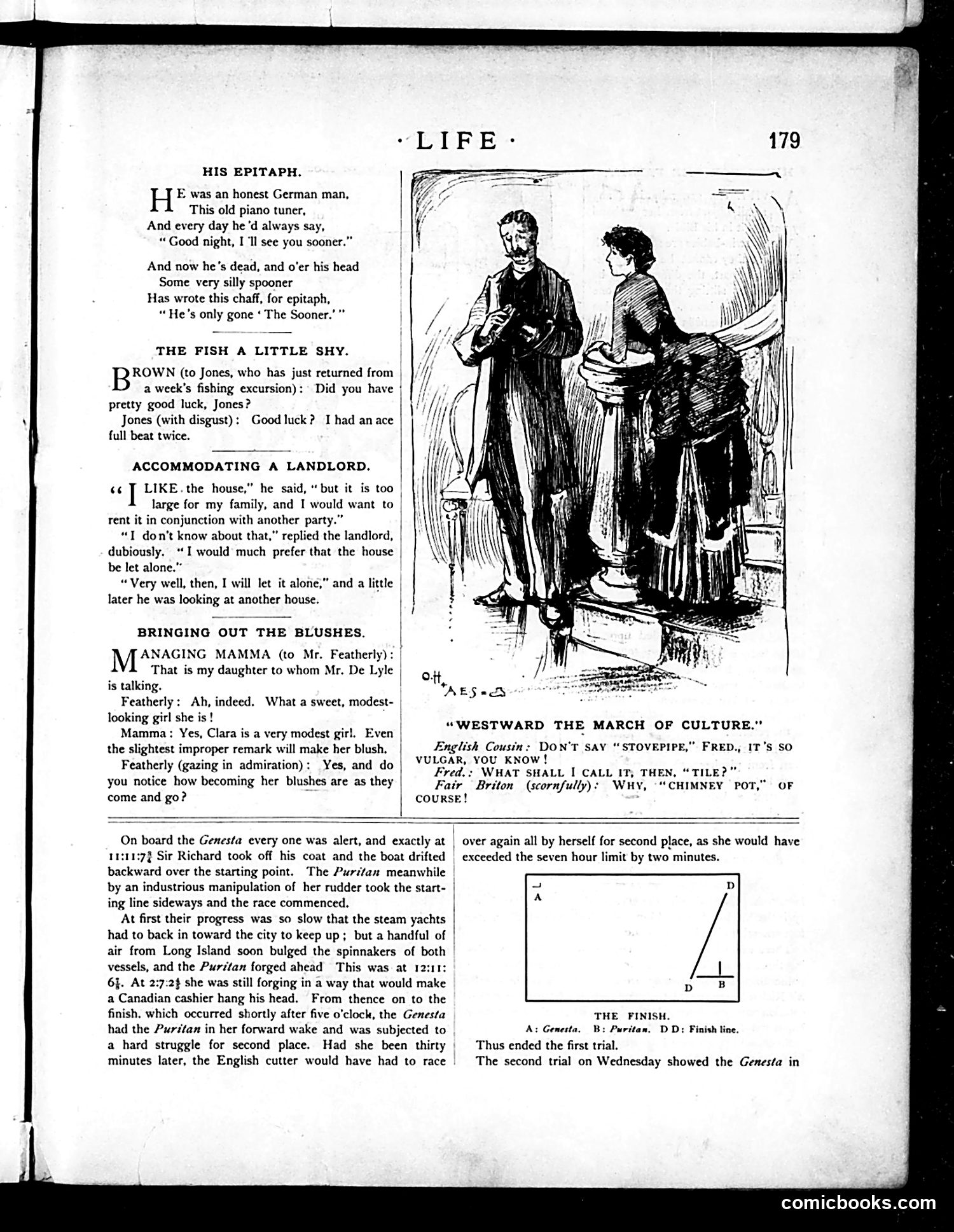
This page from *Life* magazine contains several short satirical pieces typical of the publication's style: **"His Epitaph"** mocks a German piano tuner through wordplay—his catchphrase "I'll see you sooner" becomes the basis for a pun in his epitaph ("He's only gone 'The Sooner'"). **"The Fish a Little Shy"** is a joke about fishing using gambling terminology ("ace full"—a poker hand)—Jones ironically complains his luck was so good it beat him at fishing. **"Accommodating a Landlord"** plays on miscommunication: a tenant offering to rent a large house "in conjunction with another party" is misunderstood as wanting to share it. **"Bringing Out the Blushes"** satirizes maternal propriety—a managing mother boasts her daughter blushes at impropriety, while the admiring suitor notices how "becoming" these blushes are, suggesting vanity. **"Westward the March of Culture"** discusses an America's Cup yacht race between the *Genesta* and *Puritan*, with a dialogue mocking transatlantic pronunciation differences ("stovepipe" vs. "chimney pot").
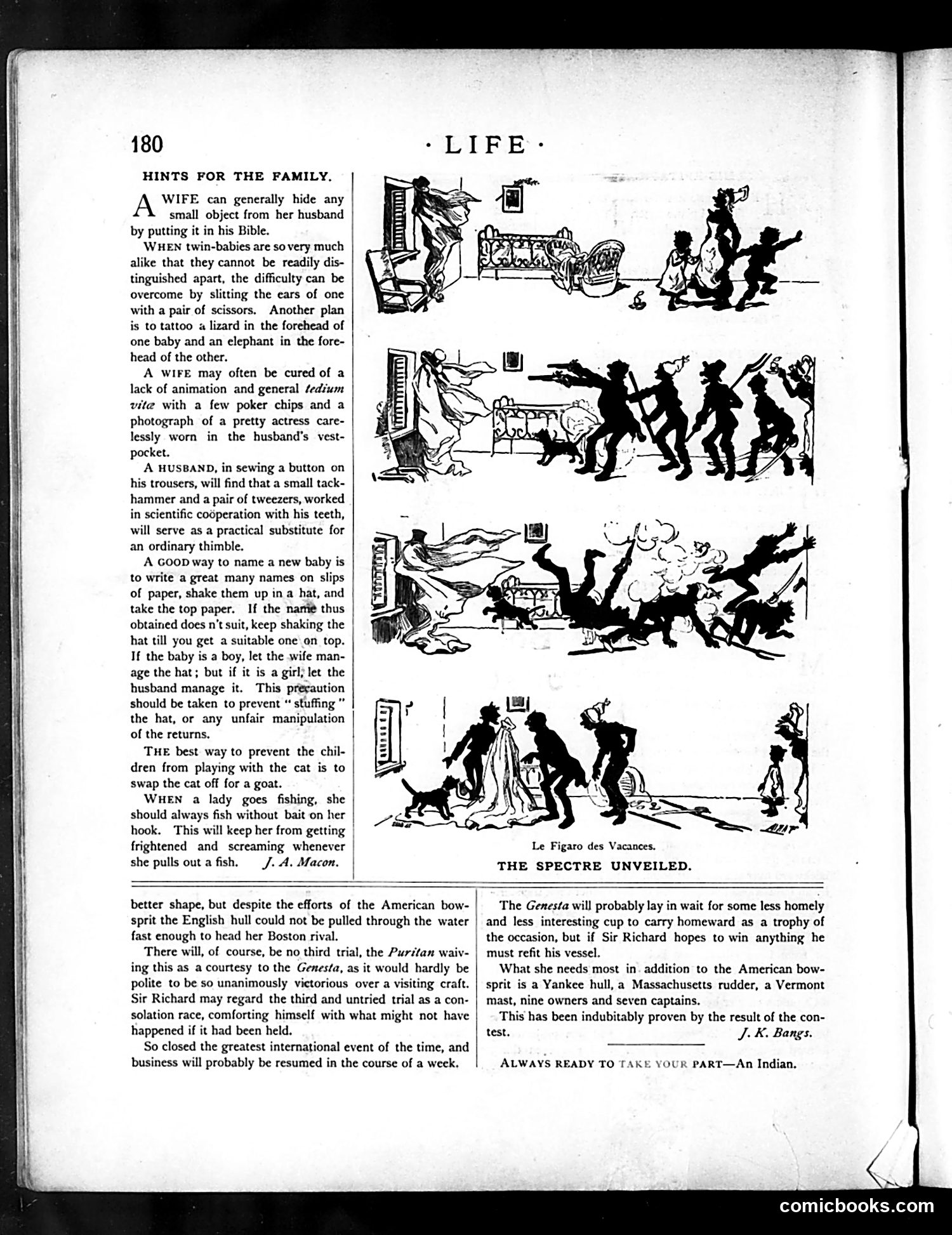
This page contains two distinct sections: **"Hints for the Family"** is satirical domestic advice offering absurd solutions to marital problems—hiding objects in a Bible, distinguishing twin babies by slitting ears or tattooing foreheads, and using poker chips to cure a wife's boredom. The humor targets Victorian gender roles and marital dynamics, mocking both husbands' incompetence (sewing with a tack-hammer) and wives' supposed manipulation. **The lower section** discusses the America's Cup yacht race between the American *Puritan* and British *Genesta*. The commentary, credited to J.K. Bangs, sarcastically suggests the British vessel needs American components—a Yankee hull, Massachusetts rudder, Vermont mast—to compete, implying American naval superiority. The tone is triumphantly nationalist, celebrating America's victory in this "greatest international event." The illustrated cartoons (credited "Le Figaro des Vacances") appear to be French satirical scenes, though their specific references are unclear from the image alone.
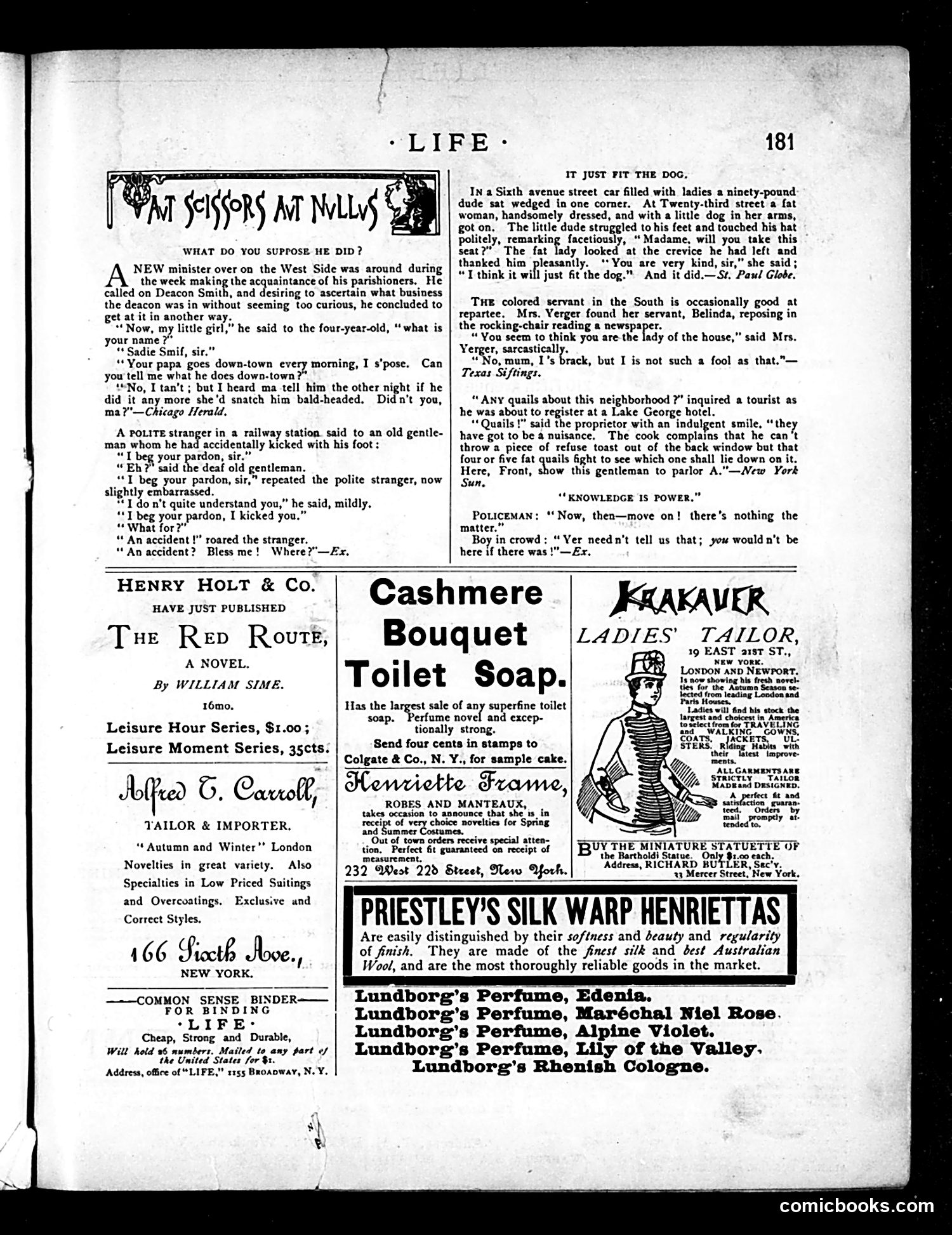
This page contains five brief satirical anecdotes typical of *Life* magazine's humor format. The jokes rely on unexpected twists and social observations: 1. **New Minister/Deacon Smith**: A clergyman tries tactfully asking a parishioner's occupation but gets an embarrassing answer from his four-year-old daughter—she overheard his wife threaten to "snatch him bald-headed" if he continued some misdeed. The satire targets both the minister's clumsy indirection and implied marital discord. 2. **Railway Station**: A deaf gentleman misunderstands repeated apologies for an accidental kick, asking "Where?" The humor comes from literalism and miscommunication. 3. **Streetcar Dude**: A small, fashionably-dressed man offers his cramped seat to a large woman with a dog; she quips it will "just fit the dog." The satire mocks pretentious politeness meeting blunt reality. 4. **Southern Servant**: A maid's sarcastic comeback to her employer criticizing her for sitting in the chair. 5. **Police/Boy**: A bystander's cheeky remark to a policeman. The page is primarily advertisements for books, soap, tailors, and perfume.
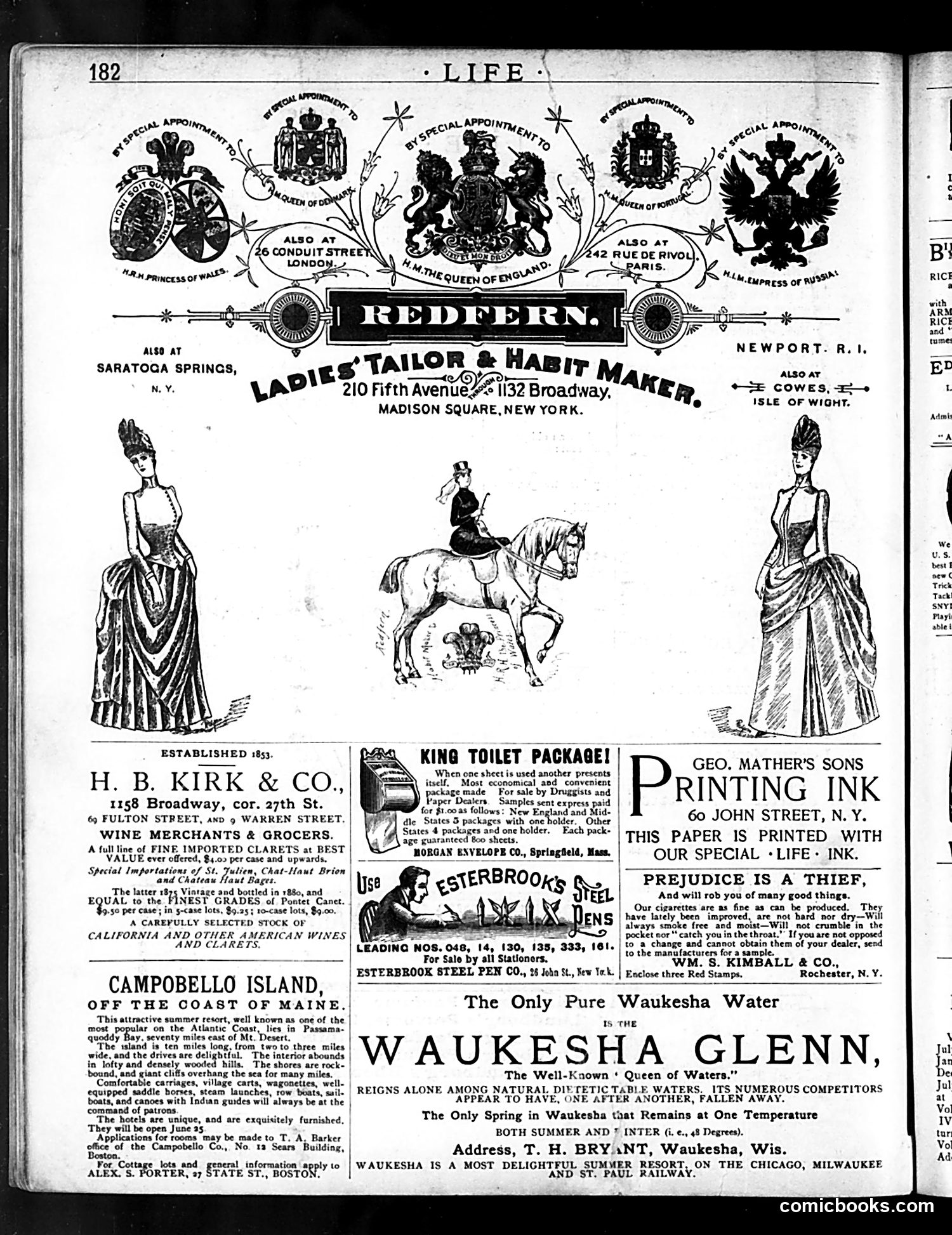
This page is primarily **advertisements** rather than editorial cartoons. The top features a Redfern ladies' tailor shop ad with fashion illustrations of women in 1890s dress, flanked by royal crests (British and Russian), suggesting upscale, aristocratic clientele. Below are various product ads: H.B. Kirk & Co. wine merchants, Campobello Island resort, King Toilet Package, Esterbrook Steel Pens, Geo. Mather's Sons printing ink, and Wm. S. Kimball & Co. cigarettes. The Kimball ad contains the only satirical element—a headline "PREJUDICE IS A THIEF" mocking consumers' potential bias against their newly improved cigarettes. The Waukesha Glenn mineral water ad claims superiority over competitors that "have fallen away." **No political cartoon or substantial satire appears on this page.** It's a typical late-19th-century magazine layout mixing advertisements with commercial boasting rather than editorial commentary.
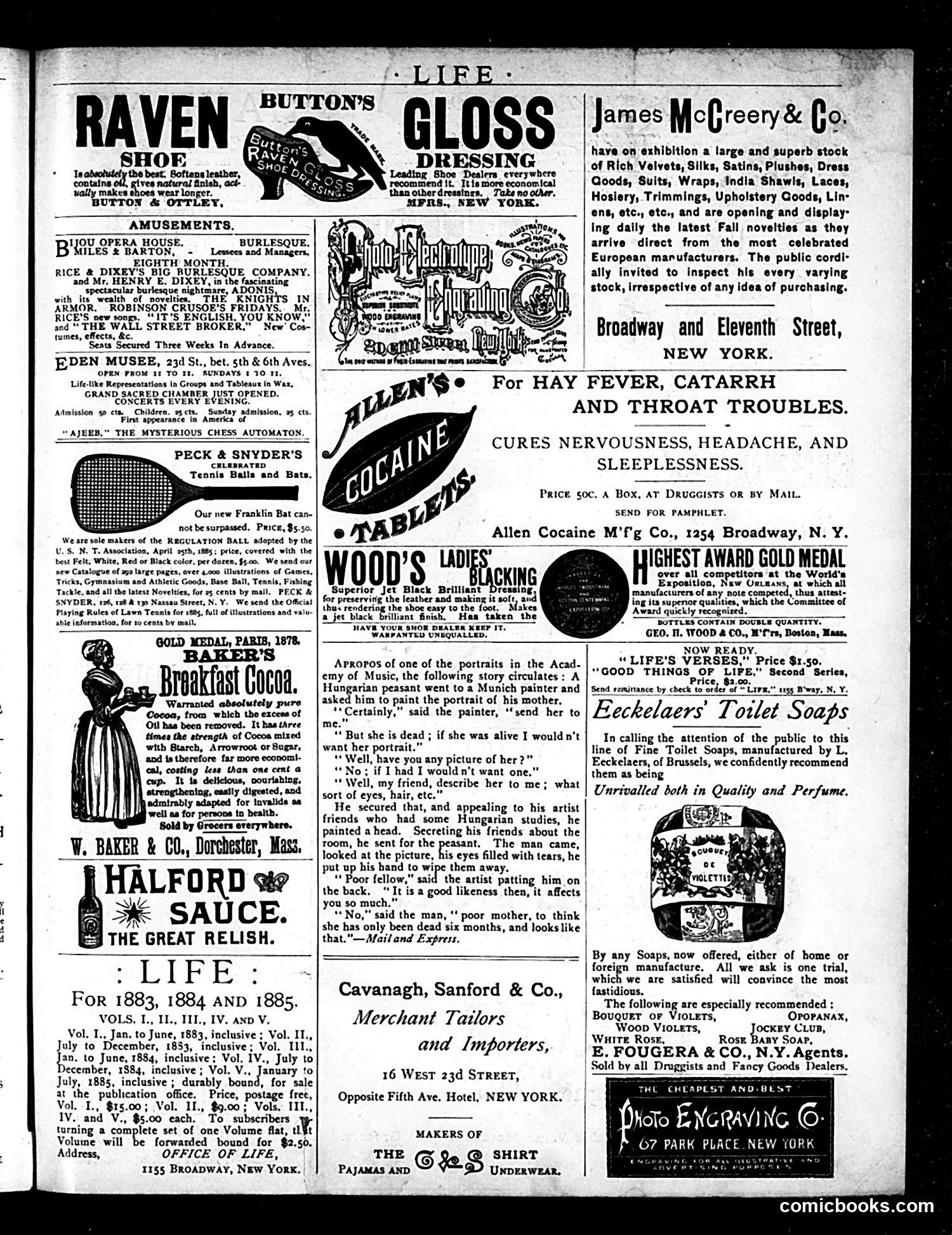
This page is primarily **advertisements and theater listings**, not political satire. It showcases the commercial landscape of 1880s New York, revealing what contemporaries bought and valued. Notable products advertised include **Allen's Cocaine Tablets** (marketed for hay fever, catarrh, and sleeplessness), which appears shocking to modern readers—cocaine was legal and sold over-the-counter as a patent medicine. **Baker's Breakfast Cocoa** claims superiority through its purity and strength. **Wood's Shoe Blacks** advertises winning a World's Exposition gold medal. The theater section promotes burlesque shows and novelty attractions like "Ajeeb," a mechanical chess-playing automaton—apparently a traveling curiosity. A brief anecdote about a Hungarian peasant commissioning a portrait of his dead mother appears to be a humorous aside, not political commentary. The page reflects 1880s American consumer culture, unregulated patent medicine marketing, and popular entertainments rather than satirical commentary.
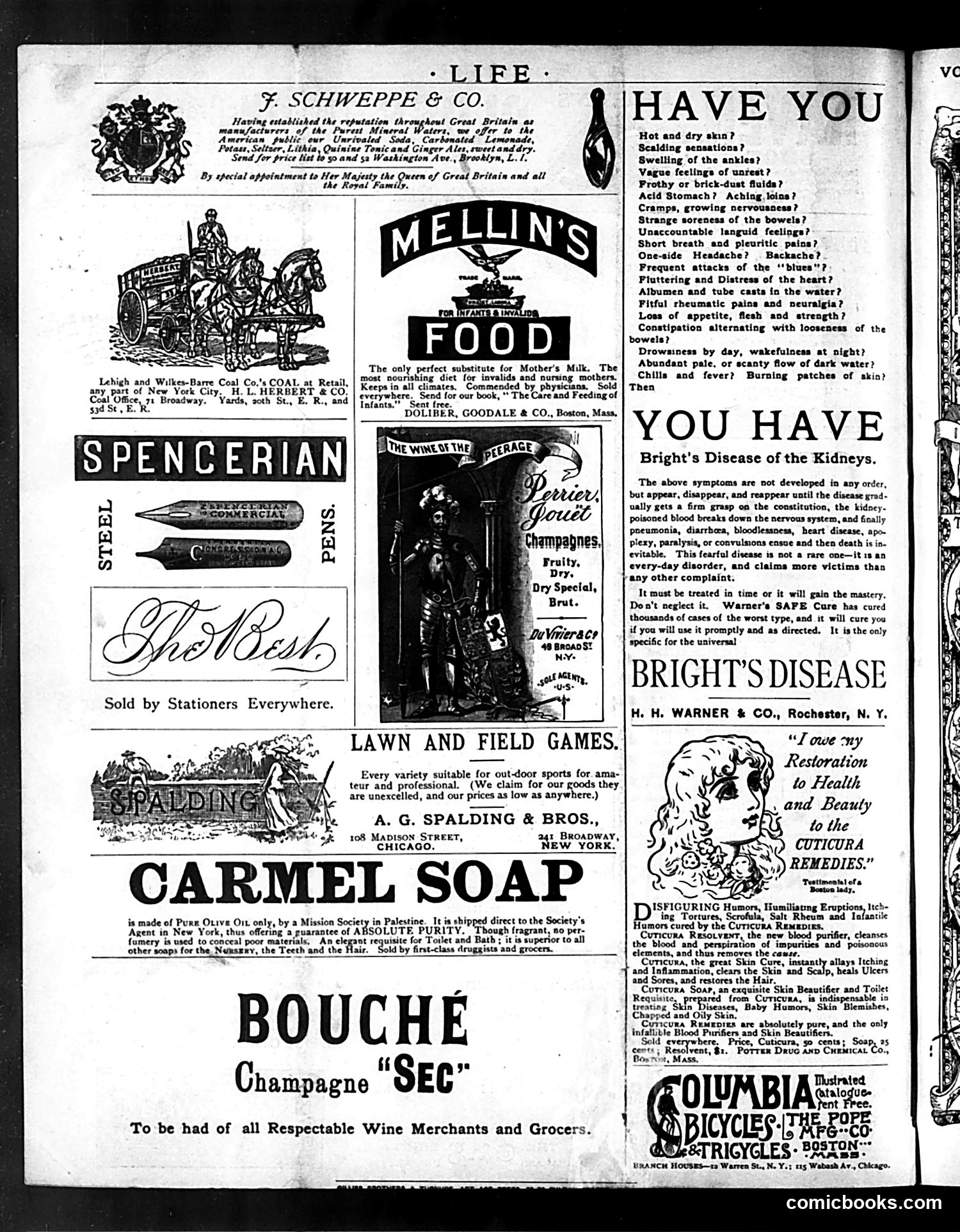
This page is primarily **advertisements**, not political cartoons. It's a typical Victorian-era product advertisement section from *Life* magazine. The ads promote patent medicines and consumer goods common to the period, including: - **Schweppe & Co.** mineral waters (with royal appointment) - **Mellin's Food** (infant formula substitute) - **Bright's Disease cure** by Warner & Co.—a prominent medical fraud claiming to cure kidney disease through a proprietary "safe cure" - **Carmel Soap**, **Cuticura Remedies** (skin treatments), and other toiletries - Sporting goods, champagne, and coal The **Bright's Disease advertisement** is notable as an example of the era's widespread medical quackery: it lists dozens of vague symptoms (fatigue, headaches, nervousness) to convince readers they had this serious kidney ailment, then sells an ineffective "cure." These ads reflect the lack of FDA regulation and truth-in-advertising standards of the period—an era when *Life's* satirical content contrasted sharply with the credulous medical and consumer claims surrounding it.