
Life, 1885-09-24 · page 7 of 16
Life — September 24, 1885 — page 7: what you’re looking at
What you’re looking at
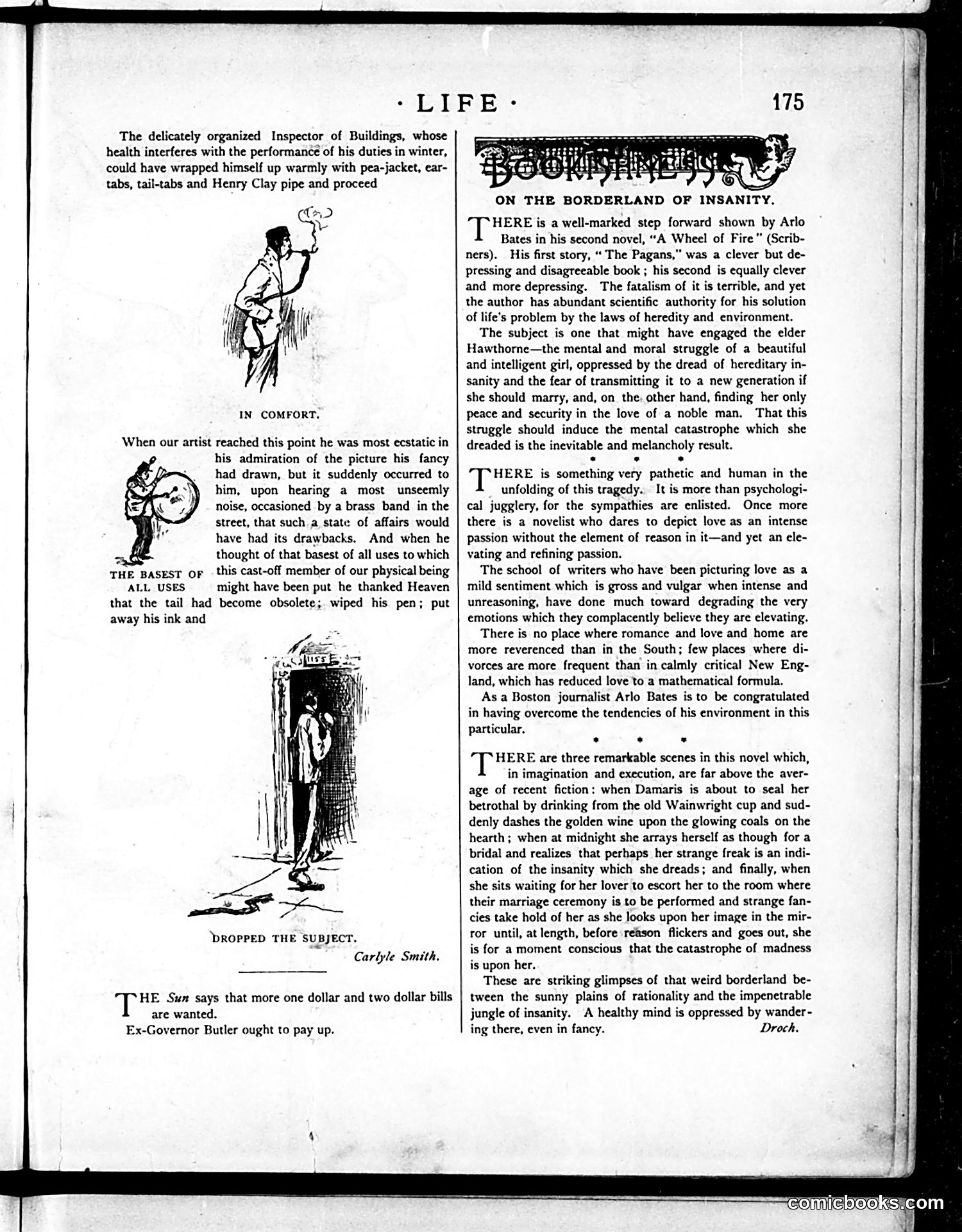
This page contains three separate cartoons satirizing different subjects: 1. **"In Comfort"** and **"The Basest of All Uses"**: These mock an unnamed "Inspector of Buildings" whose delicate health interferes with winter duties. The satire suggests he should dress warmly rather than complain—a jab at bureaucratic inefficiency. 2. **"Dropped the Subject"** (by Carlyle Smith): Shows a figure in a doorway, likely depicting someone abandoning a conversation or obligation. 3. **Main article**: A literary review of Arlo Bates's novel *"A Wheel of Fire,"* discussing themes of hereditary insanity and a woman's moral dilemma. The critic praises Bates for tackling psychological complexity rather than sentimental romance—unusual for his era. The page critiques both governmental incompetence and literary sentimentality.
📄 Transcribed text from this page (OCR, searchable)
Machine-transcribed from the original scan — historical spelling and the odd misread are preserved.
- LIFE: The delicately organized Inspector of Buildings, whose health interferes with the performance of his duties in winter, could have wrapped himself up warmly with pea-jacket, ear- tabs, tail-tabs and Henry Clay pipe and proceed {aD Ne IN COMFORT. When our artist reached this point he was most ecstatic in his admiration of the picture his fancy had drawn, but it suddenly occurred to him, upon hearing a most unseemly noise, occasioned by a brass band in the street, that such. a state of affairs would have had its drawbacks. And when he thought of that basest of all uses to which THE BasEsT oF — this cast-off member of our physical being ALL USES might have been put he thanked Heaven that the tail had become obsolete; wiped his pen; put away his ink and ‘DROPPED THE SUBJECT. Carlyle Smith, HE Sun says that more one dollar and two dollar bills are wanted. Ex-Governor Butler ought to pay up. ON THE BORDERLAND OF INSANITY. HERE is a well-marked step forward shown by Arlo Bates in his second novel, “A Wheel of Fire” (Scrib- ners). His first story, “‘ The Pagans,” was a clever but de- pressing and disagreeable book ; his second is equally clever and more depressing. The fatalism of it is terrible, and yet the author has abundant scientific authority for his solution of life’s problem by the laws of heredity and environment. The subject is one that might have engaged the elder Hawthorne—the mental and moral struggle of a beautiful and intelligent girl, oppressed by the dread of hereditary in- sanity and the fear of transmitting it to a new generation if she should marry, and, on the. other hand, finding her only peace and security in the love of a noble man, That this struggle should induce the mental catastrophe which she dreaded is the inevitable and melancholy result. . . . HERE is something very pathetic and human in the unfolding of this tragedy. It is more than psychologi- cal jugglery, for the sympathies are enlisted. Once more there is a novelist who dares to depict love as an intense passion without the element of reason in it—and yet an cle- vating and refining passion. The school of writers who have been picturing love as a mild sentiment which is gross and vulgar when intense and unreasoning, have done much toward degrading the very emotions which they complacently believe they are elevating. There is no place where romance and love and home are more reverenced than in the South; few places where di- vorces are more frequent than in calmly critical New Eng- land, which has reduced love to a mathematical formula. As a Boston journalist Arlo Bates is to be congratulated in having overcome the tendencies of his environment in this particular. * * . HERE are three remarkable scenes in this novel which, in imagination and execution, are far above the aver- age of recent fiction: when Damaris is about to seal her betrothal by drinking from the old Wainwright cup and sud- denly dashes the golden wine upon the glowing coals on the hearth; when at midnight she arrays herself as though for a bridal and realizes that perhaps her strange freak is an indi- cation of the insanity which she dreads; and finally, when she sits waiting for her lover to escort her to the room where their marriage ceremony is to be performed and strange fan- cies take hold of her as she looks upon her image in the mir- ror until, at length, before reason flickers and goes out, she is for a moment conscious that the catastrophe of madness is upon her. These are striking glimpses of that weird borderland be- tween the sunny plains of rationality and the impenetrable jungle of insanity. A healthy mind is oppressed by wander- ing there, even in fancy. Droch.