
A complete issue · 16 pages · 1885
Life — September 17, 1885
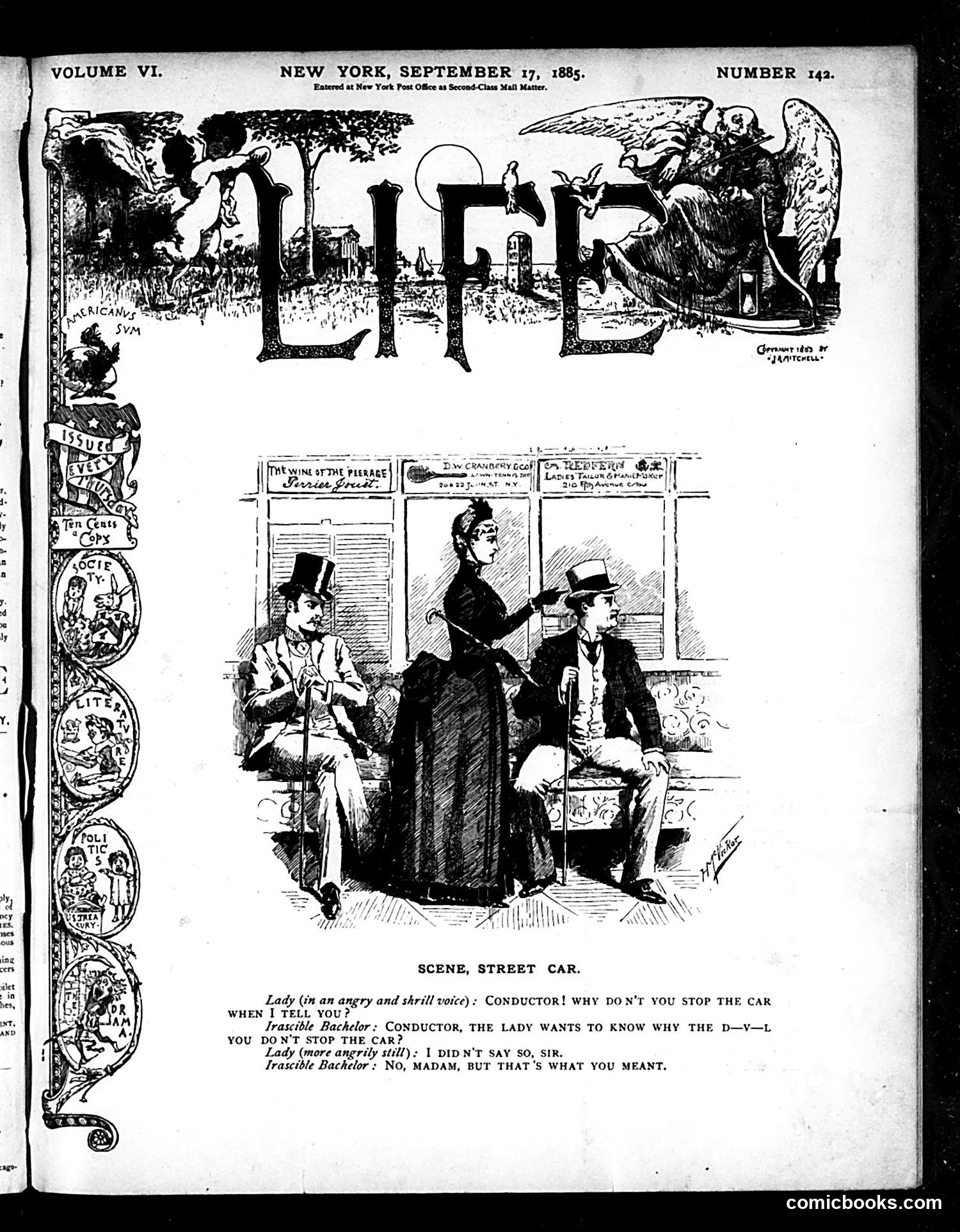
This page features a satirical cartoon titled "Scene, Street Car" depicting a social interaction on public transportation. A woman angrily demands that a conductor stop the car, while two men (labeled "Irascible Bachelor") sit nearby. The humor relies on miscommunication: the woman believes the conductor intentionally won't stop when she requests it. The bachelor sarcastically suggests the conductor *means* something different by his refusal—a commentary on deliberate misunderstanding or willful obtuseness in everyday interactions. The cartoon satirizes Victorian-era courtesy conventions and gender dynamics on public transit, poking fun at how men (particularly the bachelor character) might use semantic games to frustrate women's reasonable requests. It's gentle social satire about interpersonal friction in urban life.
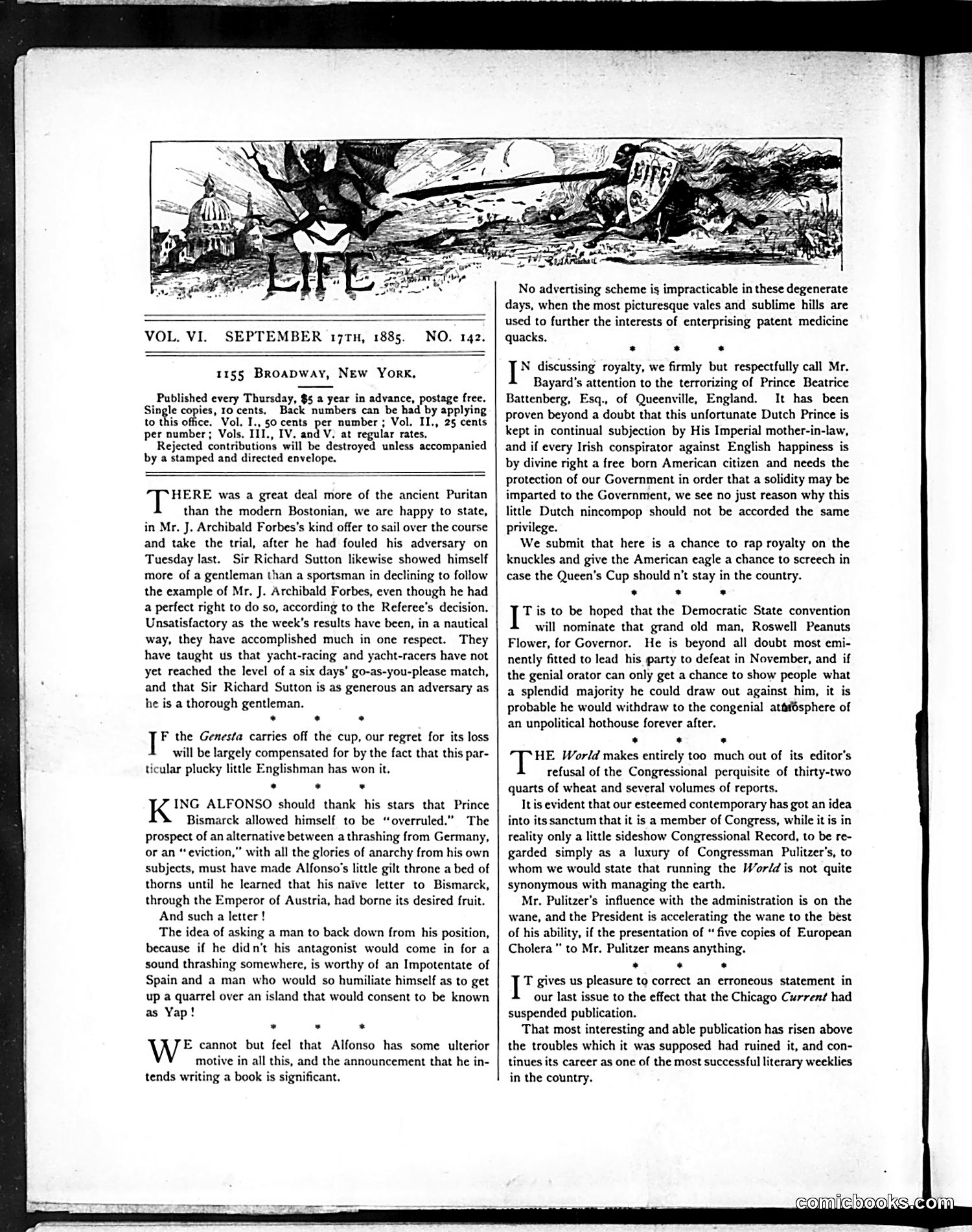
The masthead cartoon depicts "LIFE" emerging from a chaotic landscape with a skeletal tree and stormy sky—apparently representing the magazine's satirical mission amid contemporary turmoil. The editorial content addresses several political figures and issues: - **Prince Bismarck** is criticized for allowing himself to be "overruled," suggesting Germany's political tensions - **King Alfonso** (likely Spain's young monarch) is mocked for backing down from a position, with sarcastic references to his relationship with German and Austrian powers - **Mr. Bayard** is called out regarding Prince Battenberg and English-Dutch diplomatic matters - The **Democratic State convention** is satirized regarding nomination of "Roswell Peanuts Flower for Governor" - The **World newspaper** is criticized for editorial pretensions The tone is sharply satirical, attacking political figures' perceived weakness and press overreach typical of 1880s American political journalism.
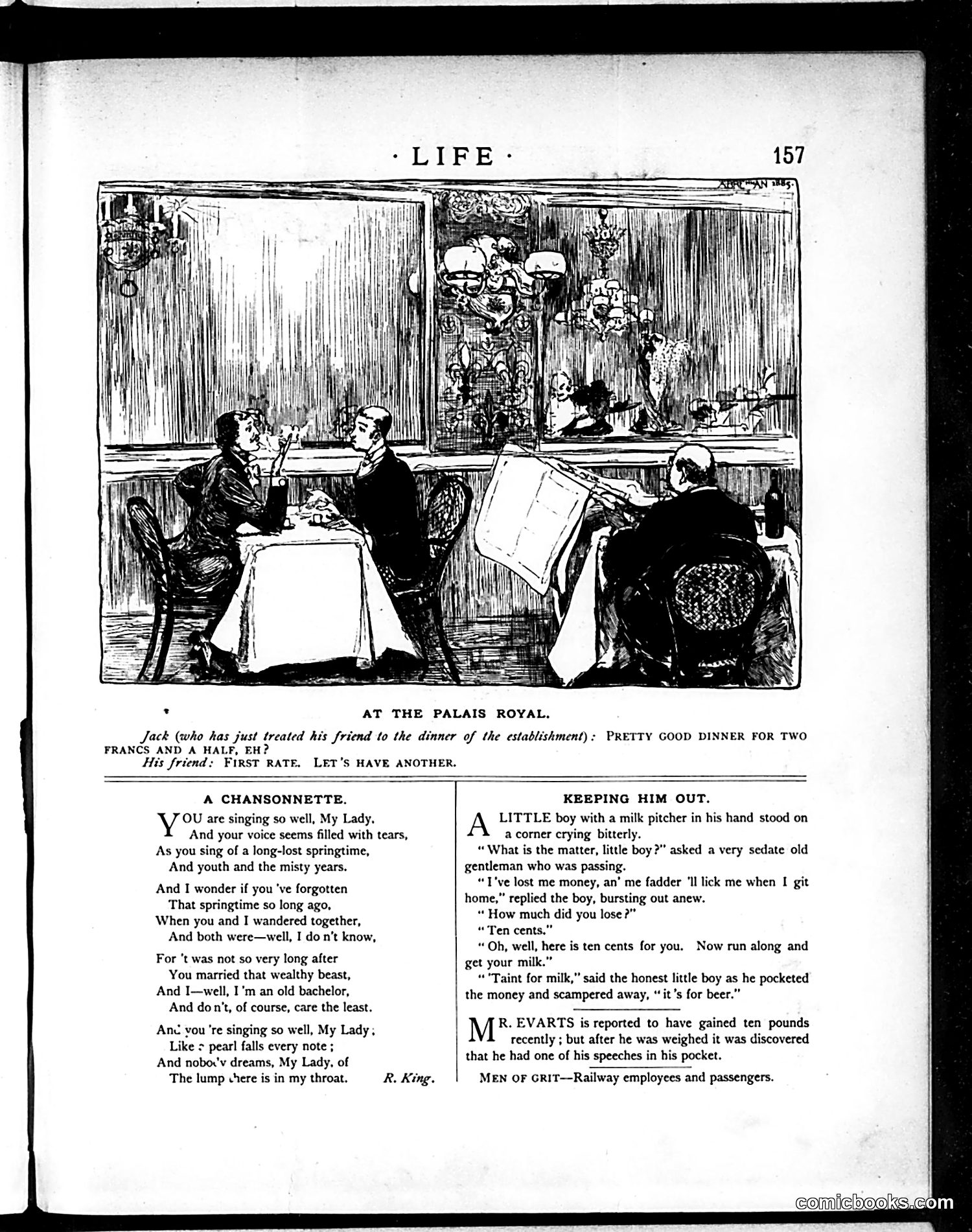
The main cartoon depicts two men dining at the Palais Royal restaurant. The caption humorously credits "Jack" with treating his friend to dinner at this establishment, noting it's a "pretty good dinner for two" at "France and a half, eh?"—a play on the restaurant's expense. Below are three separate pieces: a romantic poem ("A Chansonnette") about lost love, a brief anecdote ("Keeping Him Out") about a poor boy who lost ten cents and was given money by a gentleman, and a short quip about Mr. Evarts gaining weight before being discovered to have hidden a speech in his pocket. The page primarily satirizes wealth disparities and restaurant dining culture rather than specific political figures.
This page contains brief satirical commentary rather than a political cartoon. The items mock various contemporary figures and issues: - A poem mocks locusts and war profiteering, likely referencing WWI-era concerns - Mrs. Spriggins's interest in a "concussion" between the *Genezia* and *Portella* (appears to reference a naval incident) - Criticism of Treasurer Jordan's report on five-dollar bills being scarce - Commentary on Mr. Gladstone's fall from power, mentioning Queen O'Guelph and India policy - References to a Shakespeare's "Tempest" production that failed due to seasickness - Notes on telegraph wire burial and Montreal financial troubles The satire targets political incompetence, naval mishaps, and contemporary absurdities. Without clearer historical context for specific names and incidents, precise dating and identification remain uncertain, though the content suggests early 20th-century American satirical commentary.
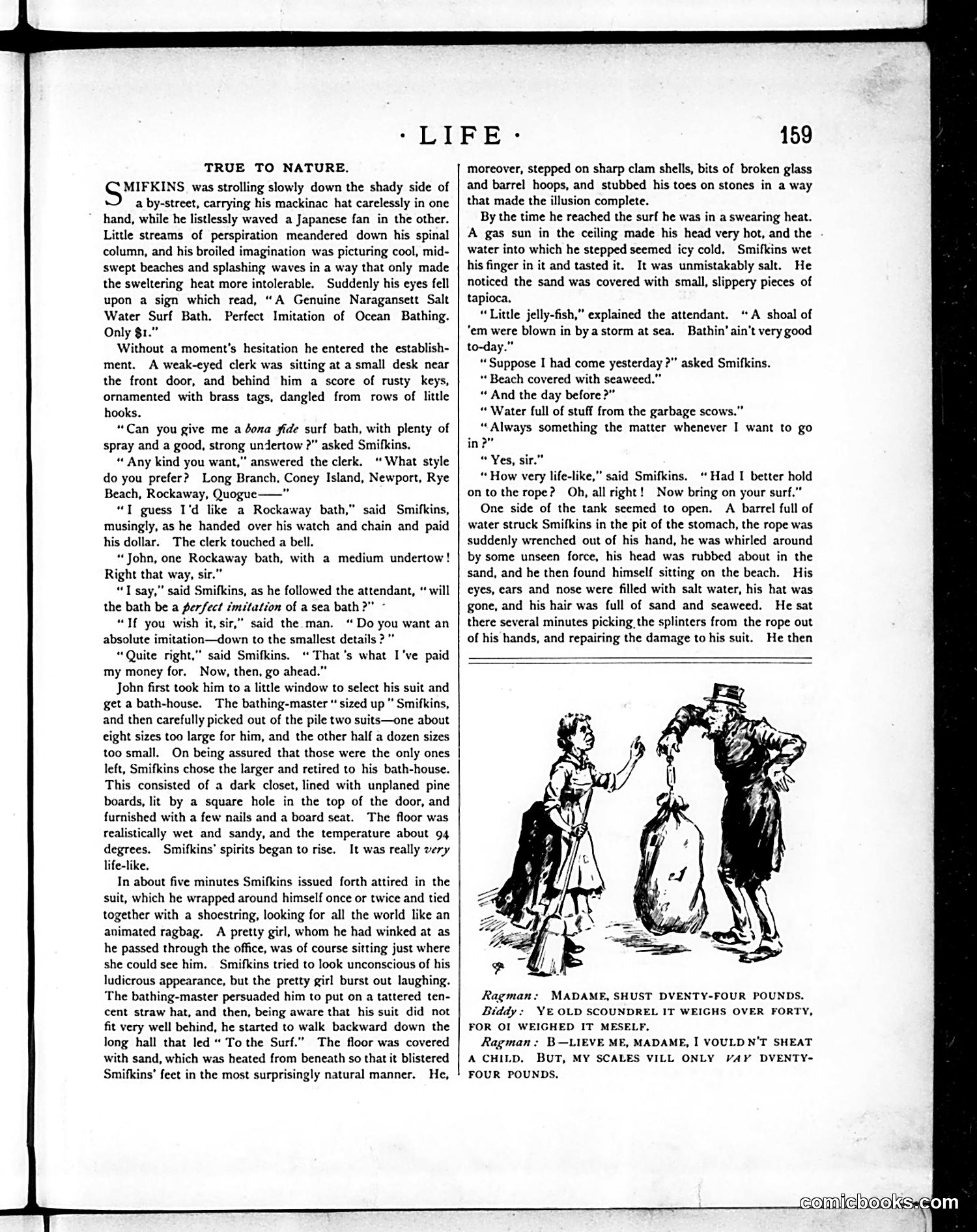
This page contains a humorous short story titled "True to Nature" about a man named Smifkins visiting a salt water bathing establishment. The accompanying cartoon depicts three figures at what appears to be a beach or bathing venue, with a caption about weighing fish ("madame, shust dventy-four pounds"). The humor relies on everyday domestic comedy rather than political satire. Smifkins' absurd experience at the artificial "ocean bathing" facility—complete with fake sand, heated water, and theatrical effects—satirizes the commercialization of leisure and the artificial recreation of nature for urban entertainment. The cartoon's fish-weighing joke appears to mock either exaggeration or the pretentiousness of such establishments. This represents Life magazine's lighter satirical fare: social observation humor targeting consumer culture and middle-class aspirations, rather than political commentary.
This page contains three distinct pieces of humor rather than political cartoons: 1. **"A Dead Cut"** (bottom left): A brief anecdote mocking a clerk's pompous response to a customer complaint, ending with the pun "too damn natural." 2. **"Is It Anybody's Business?"** (center): A poem by Geoffrey Champlin satirizing social etiquette and propriety—specifically, the question of whether it's acceptable to publicly comment on a young couple's courtship. The repeated refrain playfully challenges Victorian-era social conventions about what counts as "anybody's business." 3. **Book review** (right): Critical commentary on "Paul Crew's Story" by Alice Comyns Carr, critiquing overly sentimental, melodramatic writing as "watery" and rhetorically excessive. The page reflects early 20th-century Life magazine's focus on social satire and literary critique rather than political cartooning.
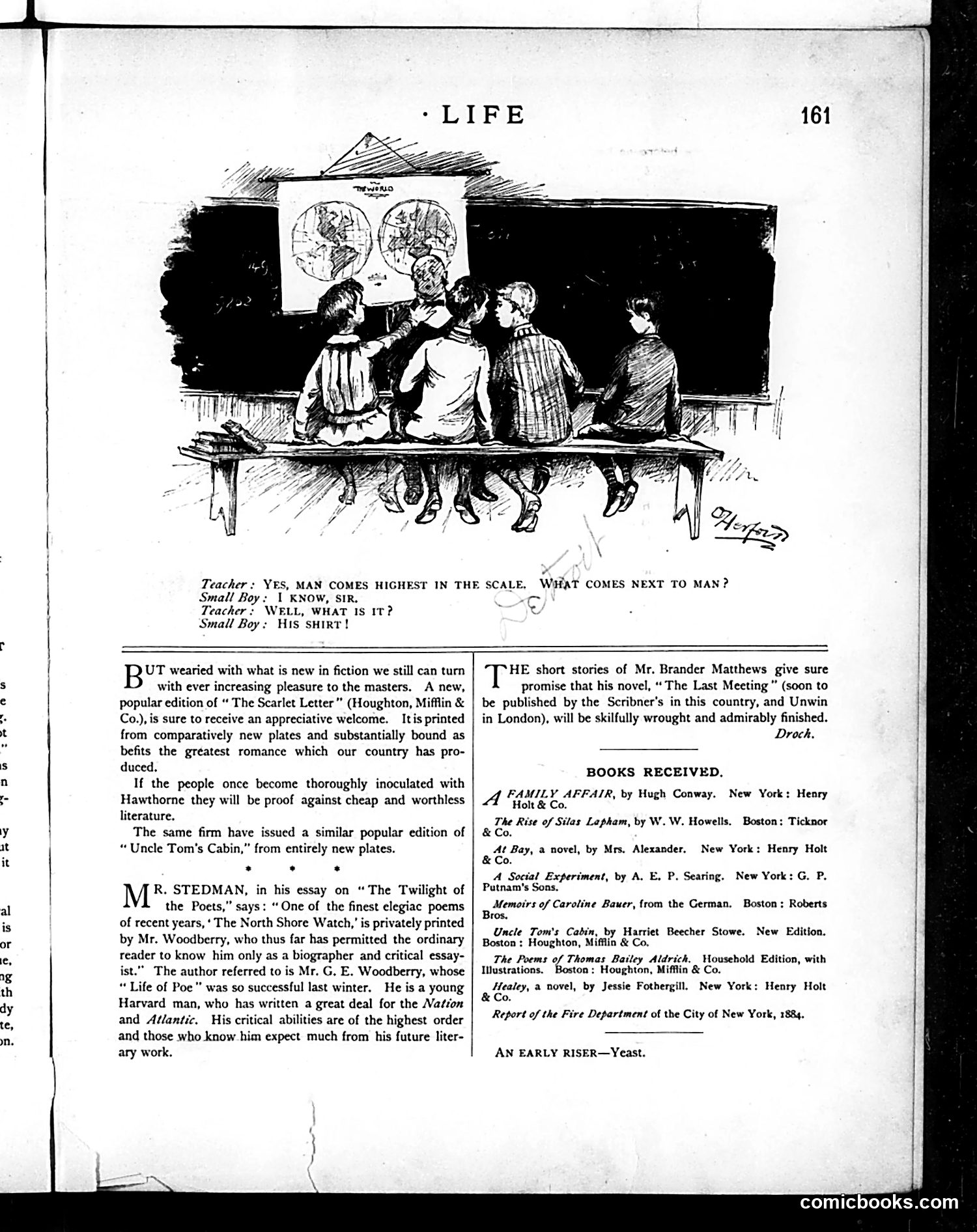
This page from *Life* magazine contains a single cartoon depicting a classroom scene. A teacher points to two circular diagrams on a blackboard while five students sit on a bench. The joke plays on a child's misunderstanding of evolutionary hierarchy. **The Humor:** The teacher asks what comes next to man on a scale of creatures. A small boy answers "his shirt," misinterpreting the question as asking about clothing rather than biological classification. This is a simple pun-based joke rather than political satire. **Context:** This reflects early 20th-century classroom instruction about evolution and biological hierarchies, presented through a child's innocent wordplay. The cartoon requires no specialized knowledge of current events—it's purely comedic, relying on the contrast between the teacher's scientific intent and the child's literal misreading.
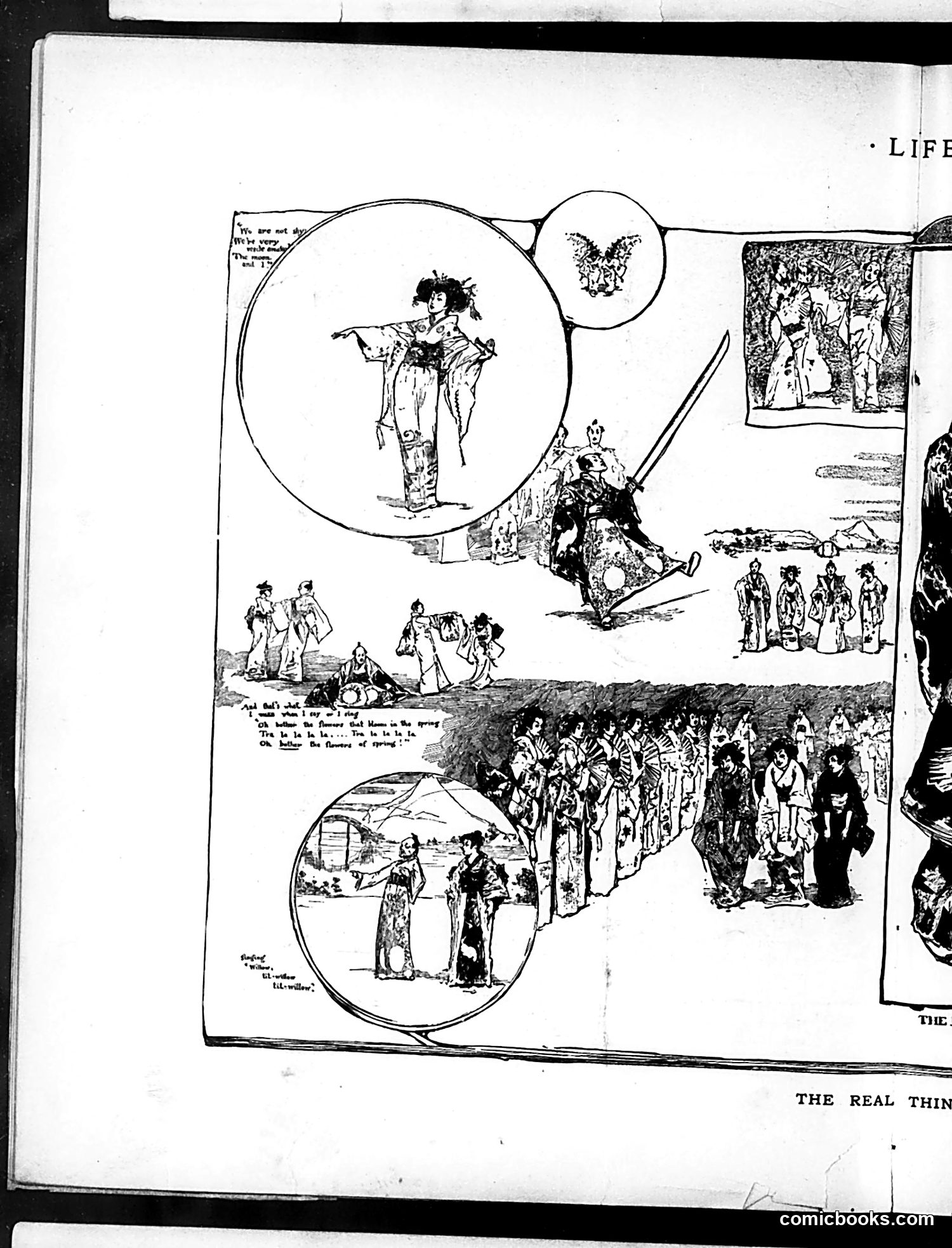
This page appears to be a satirical illustration titled "The Real Thin[g]" (text cut off). The composition uses circular vignettes and sketches to depict what seems to be **Chinese theatrical or operatic performance and cultural scenes**. The large upper circle shows an elaborately costumed figure in traditional Chinese dress. Below are various scenes of performers and audiences, with the bottom circle showing two figures in traditional Chinese clothing. The satire likely comments on **Western fascination with or stereotypical perceptions of Chinese culture** during the early 20th century—possibly mocking exoticized theatrical performances or cultural tourism. The juxtaposition of detailed ceremonial dress with crowd scenes suggests commentary on **authenticity versus spectacle**. Without clearer OCR text or artist attribution, the exact political point remains somewhat unclear, though the overall tone appears mockingly critical of how Western audiences consumed Asian cultural representations.
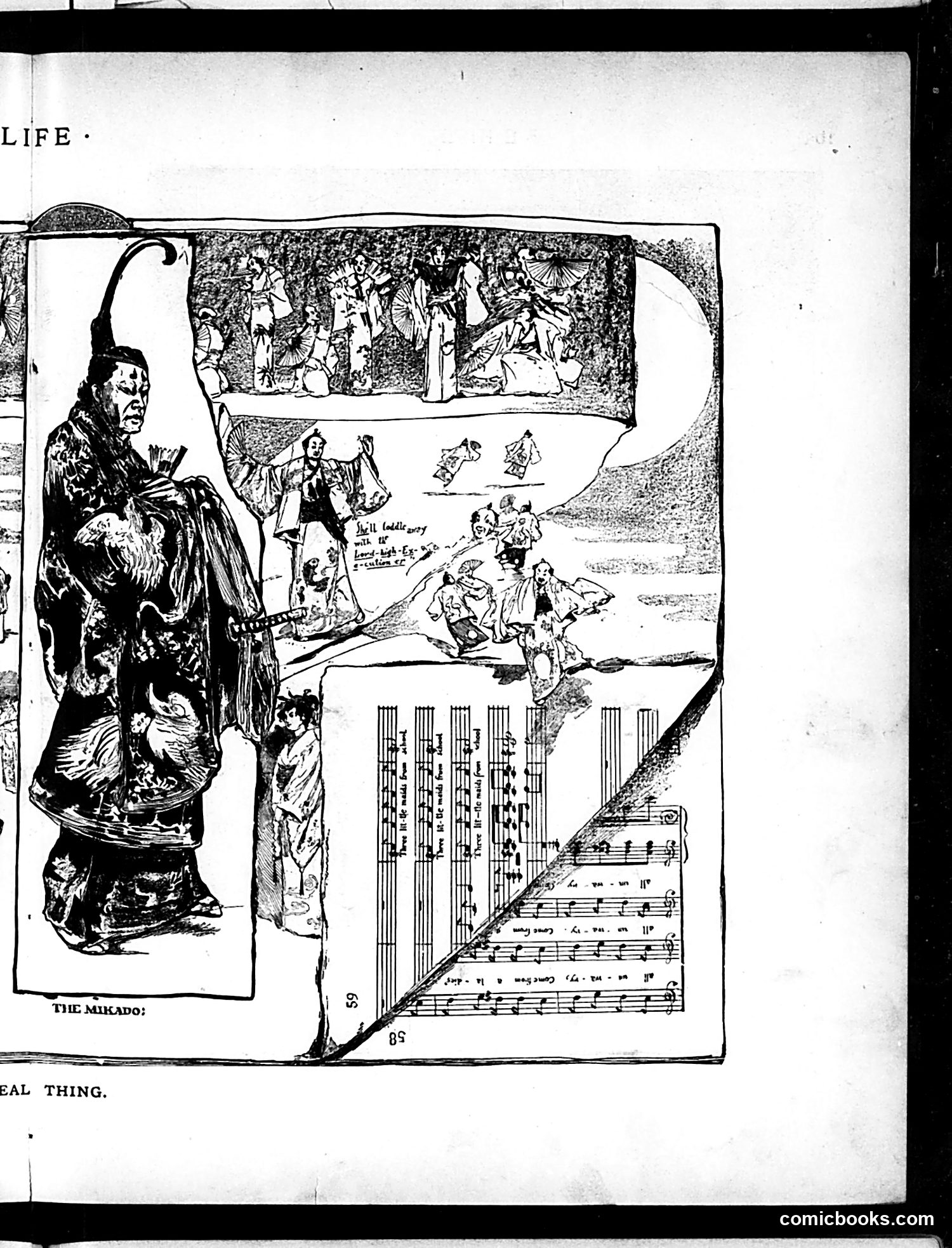
This page features a caricature labeled "THE MIKADO" on the left—a grotesque figure in traditional Japanese dress with exaggerated features, holding a curved sword. The figure appears as a puppet-master controlling performers below. The upper panel shows what appears to be a Japanese theatrical scene or procession with multiple figures. Below are musical score notations, suggesting this relates to Gilbert & Sullivan's operetta "The Mikado." The satire likely comments on perceived Japanese imperialism or military aggression, using the operetta's fictional "Mikado" character as a vehicle for political mockery. The puppet-master imagery suggests the figure controls events or people as mere performers, implying manipulation or authoritarianism. The exact political context—likely relating to early 20th-century U.S.-Japan tensions—would require dating this specific issue.
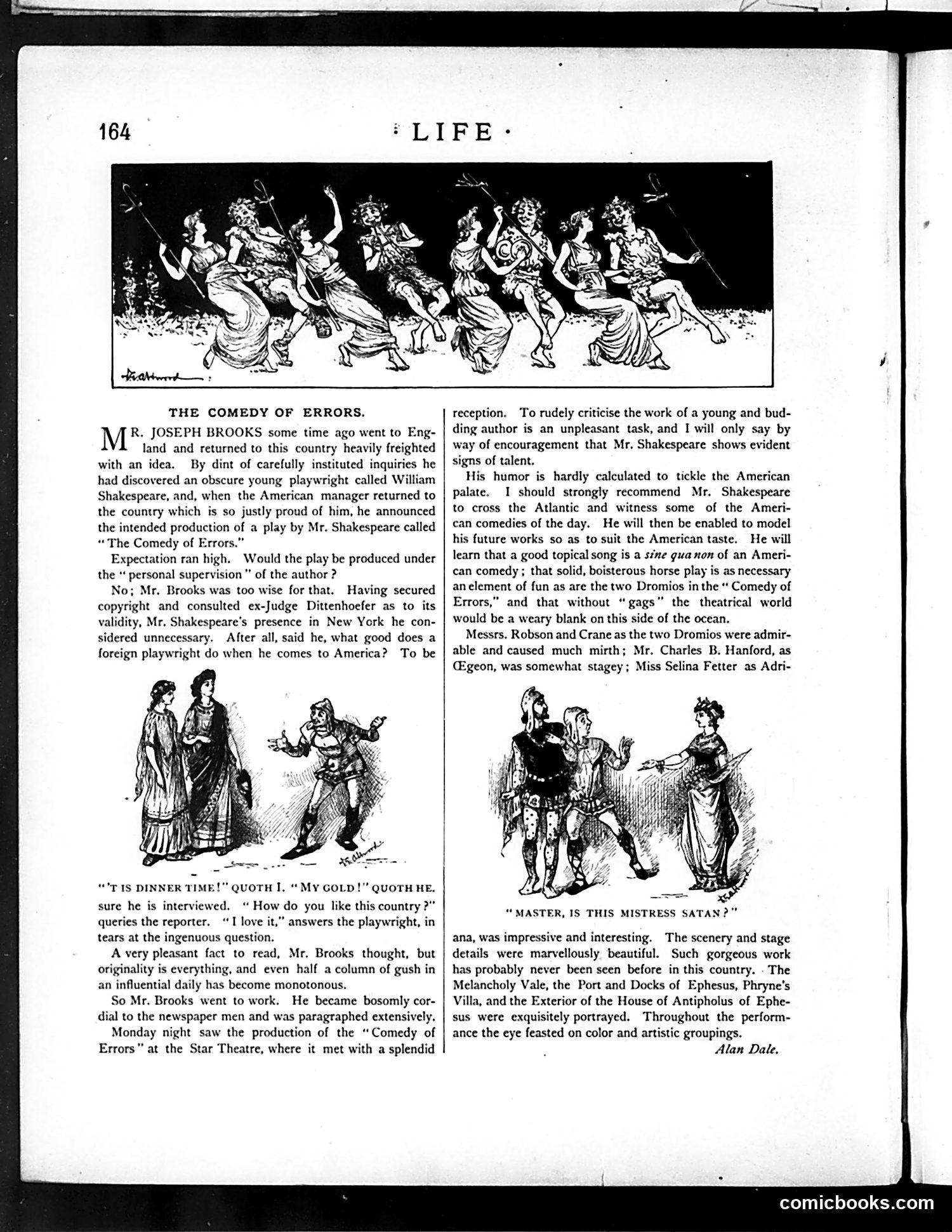
This is a theatrical review-satire, not a political cartoon. Critic Alan Dale mocks American producer Joseph Brooks for bringing Shakespeare's *Comedy of Errors* to New York while excluding Shakespeare himself—then making the production "American" through sensationalism rather than artistic merit. The satire's targets: **Brooks's strategy**: securing copyright, consulting lawyers about validity, then promoting the show through aggressive newspaper courting rather than letting Shakespeare's name speak for itself. **American theatrical taste**: Dale suggests Americans prefer "topical songs" and "boisterous horse play" over Shakespeare's wit—they need "gags" to be entertained. The production's gorgeous scenery and actual talented cast (Robson, Crane, Hanford, Fetter) apparently couldn't overcome the fundamental problem: Shakespeare doesn't suit American audiences. **The irony**: An obscure English playwright is "rediscovered," brought to America under corporate control, and then criticized for not being American *enough*. The accompanying illustrations show theatrical characters, likely from the actual production.
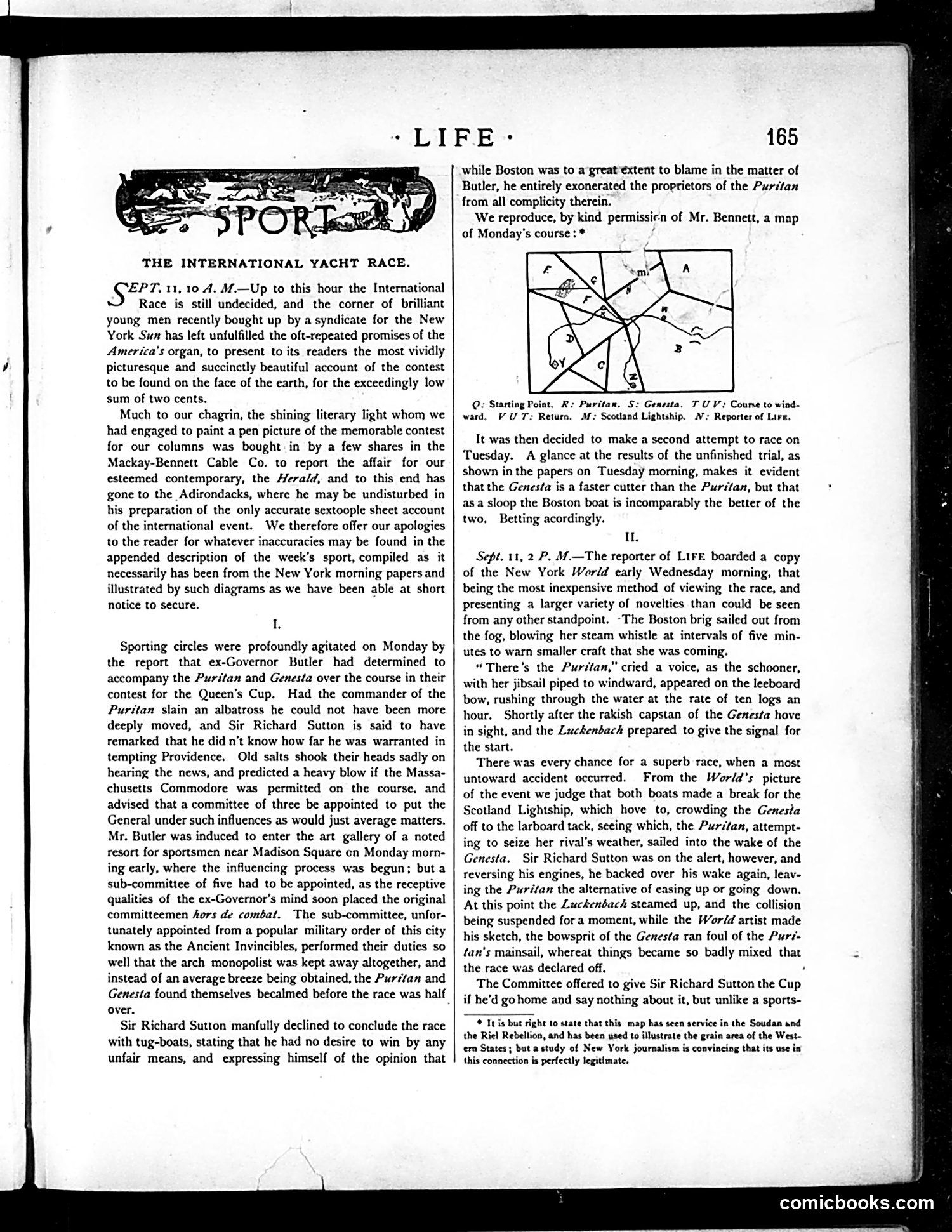
This page satirizes the rivalry between New York newspapers covering the America's Cup yacht race between American boat *Puritan* and British boat *Genesta*. The humor centers on Life magazine's complaint that they hired a talented writer to cover the race, but he was "bought" by the rival *Herald* newspaper (via stock in the Mackay-Bennett Cable Company) to report it exclusively there instead. Life thus must cobble together secondhand coverage from other morning papers—a jab at journalistic ethics and competitive newspaper warfare of the era. The secondary joke involves ex-Governor Butler's presence at the race, which superstitious sailors feared would curse the competition. The text mockingly describes efforts to keep him away through influence at a "resort for sportsmen" (likely a saloon), attributing the race's becalming to his involvement anyway. The accompanying map and detailed race description illustrate Life's determination to provide readers superior coverage despite losing their original reporter to a competitor.
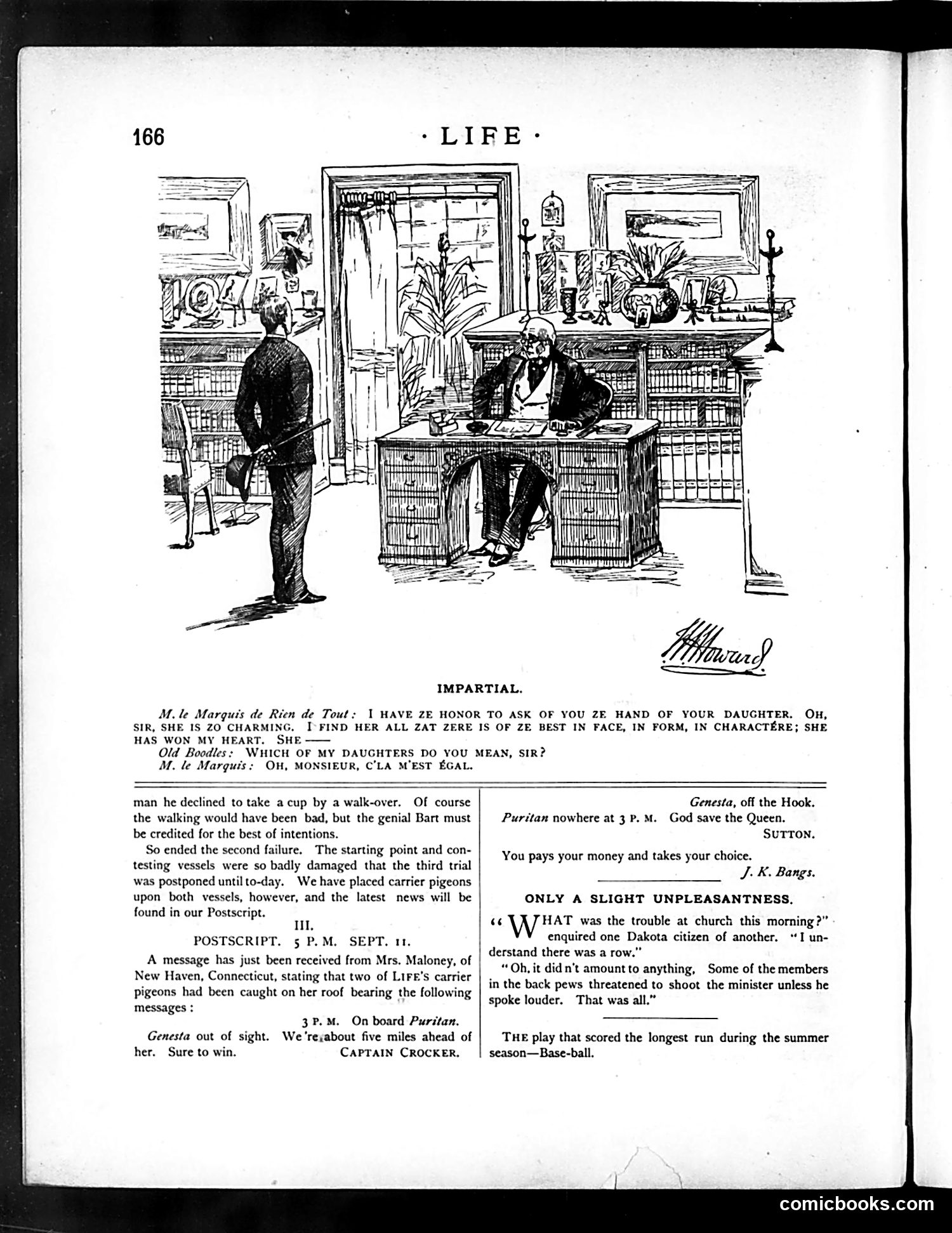
This *Life* magazine page contains three distinct pieces of satire: **"IMPARTIAL" cartoon (top):** A French marquis proposes to an elderly gentleman's daughter, using flowery compliments. When asked which daughter he means, the marquis indifferently replies "it's all the same to me" (in French). The satire mocks fortune-hunting suitors who care nothing for the actual woman—only her wealth or status. **Racing narrative (middle):** References a yacht race between *Genesta* and *Puritan*, with humorous "dispatches" sent via carrier pigeons. This appears to be reporting on an actual 1885 America's Cup competition with comic embellishment. **"Only a Slight Unpleasantness" (bottom):** A brief joke about a Dakota church where parishioners threaten to shoot the minister unless he speaks louder—satire on frontier roughness and the challenge of imposing civilization in remote areas. The page overall reflects *Life*'s style: social commentary through exaggeration and absurdist humor targeting class pretension, sports obsession, and regional American character.
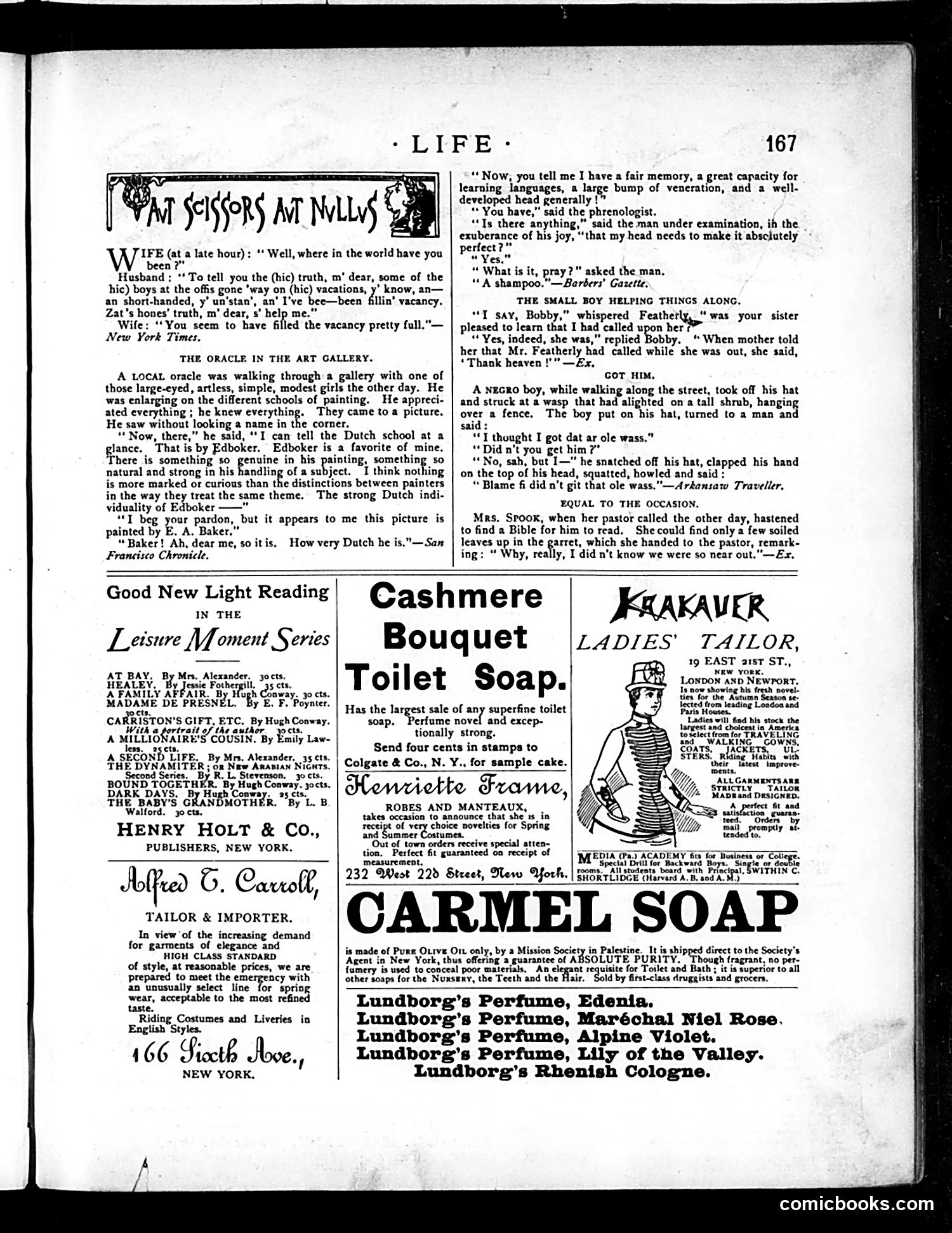
This page contains several **short humorous anecdotes** rather than political cartoons, reflecting Life's satirical humor style. The main jokes satirize: 1. **A drunk husband** (top): A man comes home late, claiming he was "filling in" for absent coworkers at the office. His wife observes he's filled the vacancy "pretty full"—a tipsy double meaning. 2. **The pretentious art critic**: A pompous man confidently identifies a painting as Dutch master "Edboker," praising his style extensively. When corrected that it's by "E.A. Baker," he insists "How very Dutch he is"—mocking those who fake expertise. 3. **The phrenologist's honest assessment**: A man with a large head asks what's needed for perfection. The answer: "A shampoo"—subtle mockery of phrenology pseudoscience. 4. **Other brief anecdotes**: Including a boy catching a wasp and a pastor receiving Bible fragments. The **advertising** dominates the lower half (soap, perfume, tailor services). These represent typical turn-of-century American humor: workplace drunkenness, social pretension, and pseudoscience were popular satirical targets.
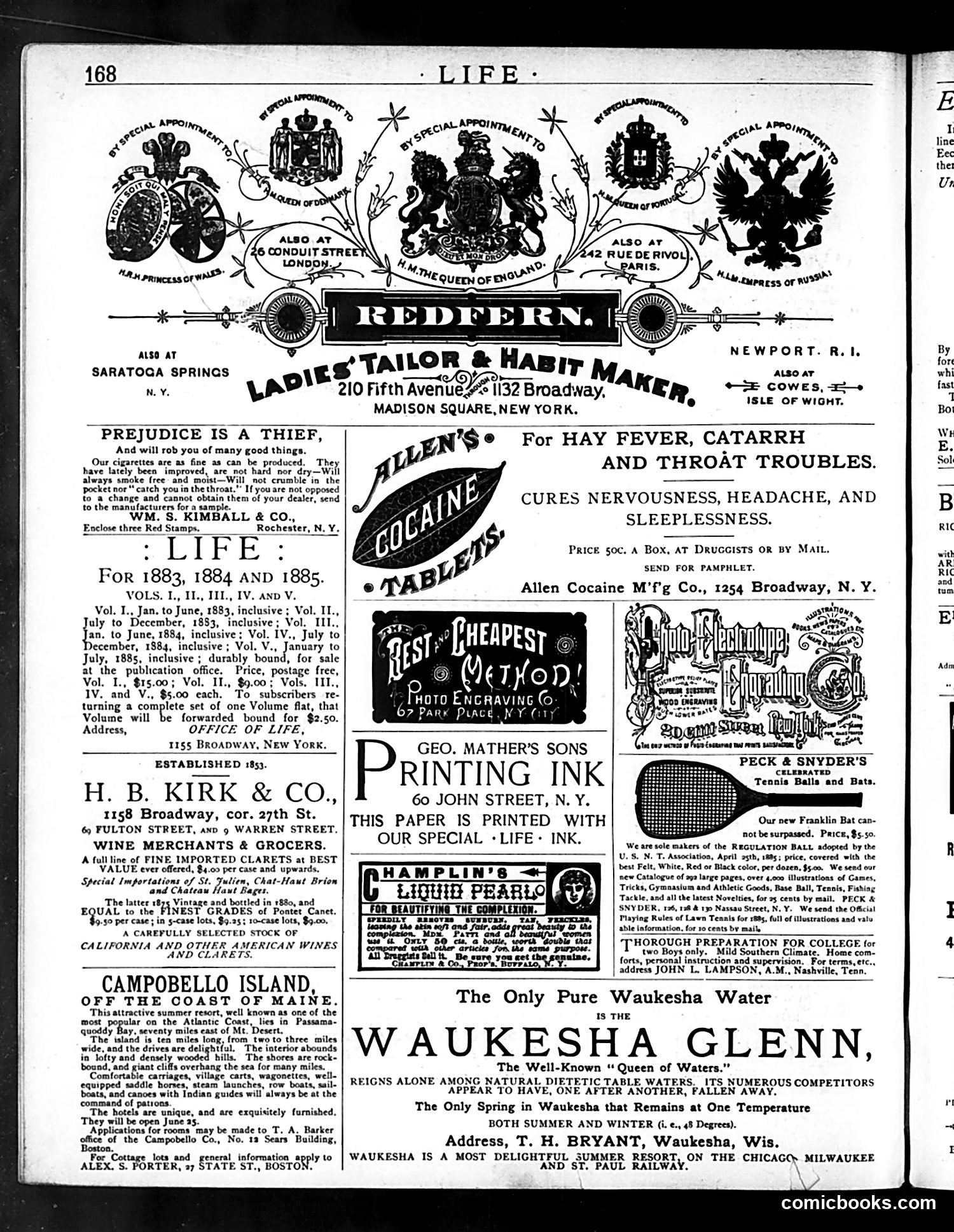
This page is primarily **advertising and subscription information**, not satirical content. The title "PREJUDICE IS A THIEF" appears to be a cigarette advertisement headline rather than political commentary. The page contains: - **Magazine subscription offers** for Life volumes from 1883-1885 - **Product advertisements** including: - Kimball cigarettes - Allen's Cocaine Tablets (for hay fever, catarrh, headaches—legal and marketed as medicine in this era) - Wine merchants and grocers - Printing ink - Tennis equipment - Campobello Island resort The only potentially satirical element is the cigarette ad's opening line ("Prejudice is a Thief"), which uses moral language ironically to sell a product. **Context for modern readers**: This reflects the 1880s when cocaine was legal, openly advertised as medicine, and considered respectable. The page demonstrates how different advertising and consumer culture were in this period.
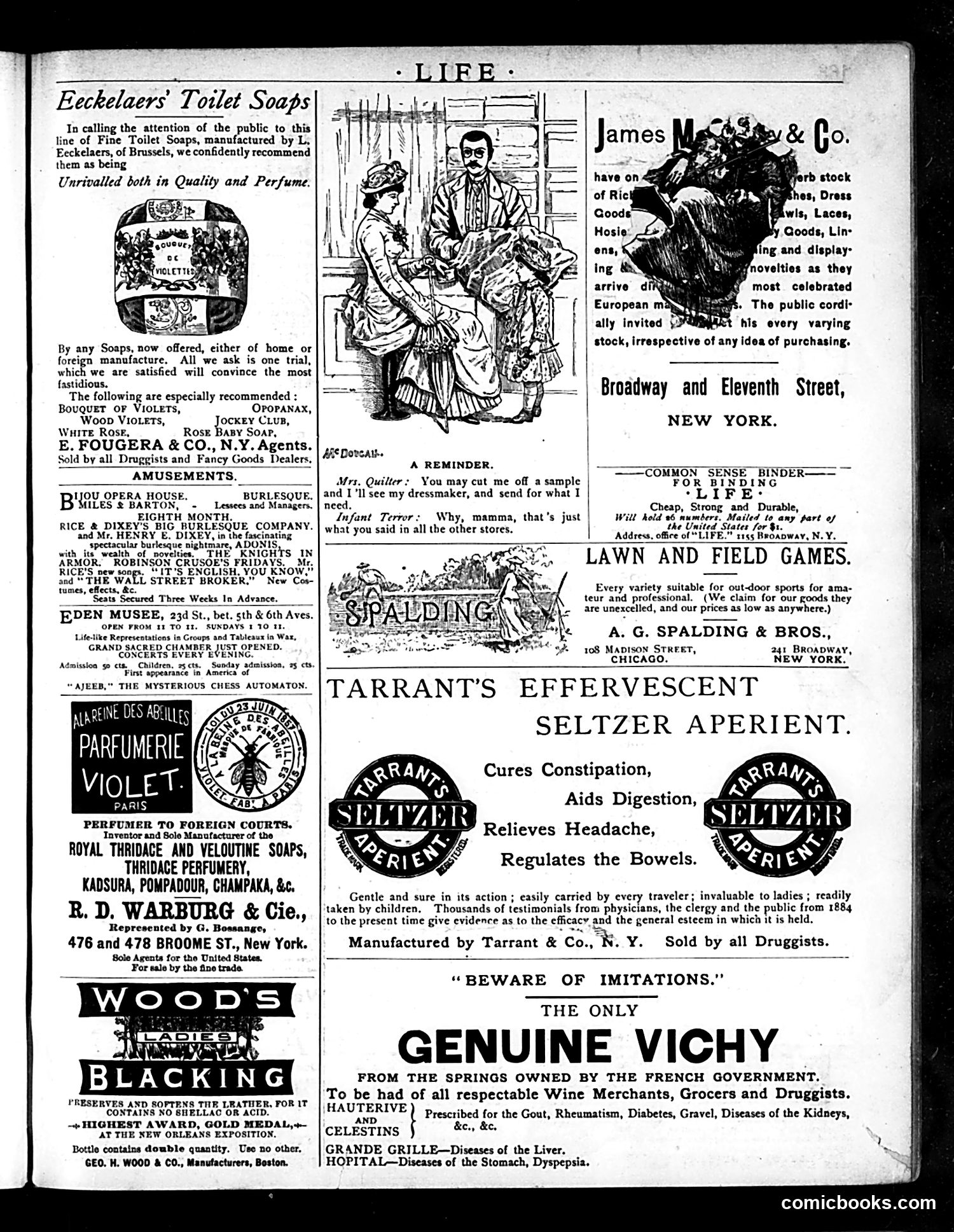
This page is primarily **advertising**, not political satire. It contains approximately 15 product advertisements from the 1880s era, including toilet soaps, theatrical performances, patent medicines, and sporting goods. The only apparent narrative content is a brief two-panel comic labeled "A REMINDER," showing an exchange between "Mrs. Quilter" and an "Infant Terror" (likely a mischievous child). The joke involves the child repeating back something the mother said—she instructed him to get fabric samples from one store, but he's pointing out she gave identical instructions at other stores, exposing her inconsistency. The page reflects the magazine's mixed format of satirical humor and commercial content. The advertisements themselves—for products like "Tarrant's Effervescent Seltzer" and "Genuine Vichy"—represent period patent medicines and luxury imports marketed with health claims common to the era.
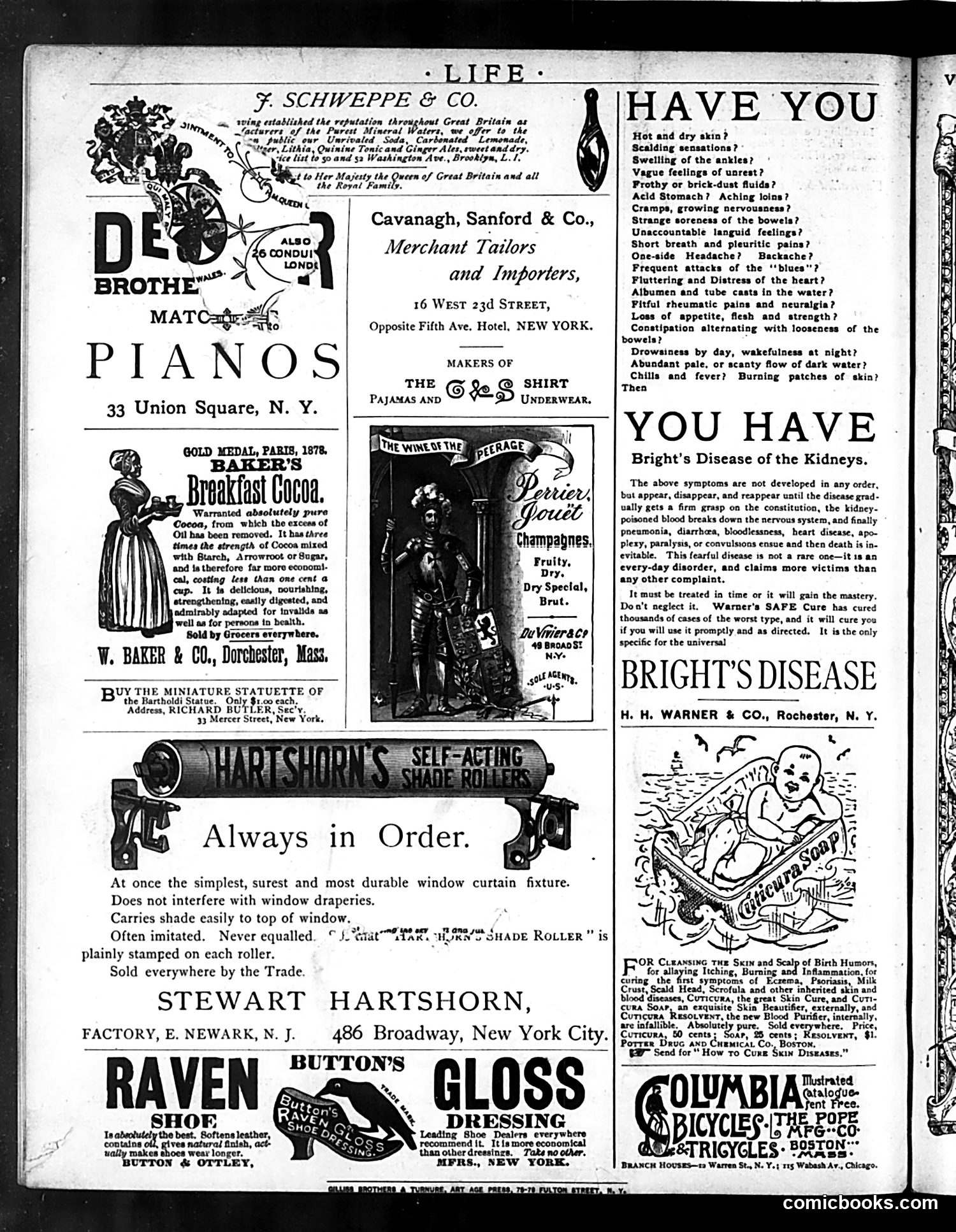
This is **primarily a page of advertisements**, not political satire. The page contains commercial ads for various products: pianos, cocoa, tailoring, window shade rollers, shoe dressing, and others. The most notable content is a **medical advertisement by H.H. Warner & Co.** promoting "Warner's SAFE Cure" for Bright's Disease (a kidney ailment). The ad lists extensive symptoms—fatigue, digestive issues, back pain, etc.—and claims this patent medicine cures even "the worst type" of the disease. **What's significant for modern readers:** This exemplifies late-19th-century **patent medicine marketing**, where companies made sweeping health claims for largely ineffective (sometimes harmful) remedies. No FDA regulation existed yet to prevent such exaggeration. The symptom list was deliberately vague to convince readers they had the disease. The other ads show period consumer culture: imported mineral waters, tailored clothing, and household fixtures—reflecting the magazine's affluent audience. There is **no political cartoon or satire** on this page.